Out of the Blue into the Tree!!

“Out of the blue, into the tree,” is the Hindi equivalent of: “Out of the frying pan, into the fire.” That is exactly what happened to me (the Hindi one) when I parachuted through the clear blue Goa sky on a fine January day in 1986.

It was a skydiving demonstration as a part of the Silver Jubilee Celebrations of the Liberation of Goa. I was in charge and leading a team of skydivers. The forecast winds were way beyond the performance characteristics of the parachute we were using, and the capabilities of the jumpers, to counter. Prudence demanded that I called off the demonstration jump. But then, the thought that organisers and the spectators would be disappointed impelled me to give it a try.

To our good luck, the winds died down absolutely by the time our helicopter came overhead to commence the drop. Flight Lieutenant Thapar from the ground control transmitted the position of the streamer (a piece of cloth that has the descent characteristics of a parachute) that I had dropped to judge the actual winds. The position of the streamer also confirmed gentle winds. It was safe to jump.

It was a clear blue sky and fine weather for a parachute jump but my mind was still clouded by the forecast of very strong winds. So, I decided to err on the positive side. I signalled thumbs up to the jumpers (to jump out) much upwind of the sports ground––where we were to land in front of the spectators––hoping that the winds would help them drift and make it to the target on the ground.

It was a mistake. Jumpers could barely make it to the sports ground––a few landed in the front of the spectators others landed scattered outside the ground. I was the farthest from the landing area. Tall trees welcomed me as I approached mother earth. Despite my best efforts to avoid them, I landed in a big one. My fall through the tree broke several branches before the suspension lines of my parachute got stuck and I was jolted to a stop. It was an uneasy feeling dangling ten feet above the ground.

In the time I took to take stock of the situation, several thoughts flashed past my mind.Burma Radio Operator The worst recall was that of the vivid account of a radio operator who had bailed out of a disabled aircraft over the thick forests of Burma during the Second World War. In a similar situation i.e., hanging from a tree, he was attacked by giant red ants. He tried to cut free of his parachute harness by shooting at its webbing with his service weapon. He shot himself with the last bullet when he failed to come out of the situation and the nuisance of the ants became unbearable. His skeleton was found hanging upside down in the parachute harness when the search and rescue team found him several moths later.

It was a silly recall. I was in a much better situation, less than half a kilometre from the ground. People would soon come looking for me. In any case, I did not wait for them. I followed the standard drill: I whipped open my reserve parachute and lowered it to the ground; carefully unfastened my parachute harness and slithered down to safety. Recovering the parachute was an arduous task.

That parachute jump in Goa is one of my most memorable ones for all the wrong reasons.

Clinking Goblets, Morsels of Love and Life

Like all who get married, Chhaya and I looked forward to a happy life ever after. Respect for each other, love, care… were fine––they were packaged neatly in the blessings, wishes and advice showered upon us. Discreetly though, some scared us with sacrifices (read compromises) people have to make for marriages to work. And of course, the added responsibilities and the little quarrels so typical to the people who dare tie the knot.

It was a tad scary.

We struck an understanding to understand each other and consign our differences, ifGoblets ever they cropped up, to the nearest waste bin at the first opportunity. We devised a pleasant way of weeding out undesirable moments before they could take roots. On rarest-of-the-rare days when we had higher-than-usual-decibel conversation, we clinked our crystal goblets and flushed down evil thoughts with a sip of fresh water. That ensured a clean slate and no baggage to carry on life’s journey.

Perpetually building on mutual respect, love and care is an even better way to avoid sorry situations. We don’t know how and when it commenced––at every meal together, we started offering the first bite to each other. We have now been doing it for over three decades. The unspoken words: “I love you” are embedded in the gesture.

It happened so gradually that we didn’t realise when the habit of offering the first morsel to each other elbowed away the need of clinking goblets for good.

Sifting the History of Pakistan Army’s Surrender (Dacca, 1971)

Strategists and thinkers assign different reasons to the surrender of the Pakistani Army in the eastern sector in the 1971 Indo-Pak War. The views differ and depend on where one stands while looking at the question.

There can’t possibly be one reason for the surrender of 93,000 soldiers. Each service and each arm did its bit to bring the enemy to its knees.

It is rather difficult to say which proverbial straw broke the camel’s back.

But then these, among others, could have been some of the last straws that broke the camel’s back–the leaflets thrown over erstwhile Pakistan.  In essence, the message was:

“Officers and men of the Pakistan Army surrender! You have been surrounded. You have no choice. Your fate is sealed. Don’t you want to return to your family and children? There should be no shame in surrendering to the Indian Army. Indian Army will take care of you. Surrender before it is too late!”

57822CE9-D782-44D4-8A3D-716E565B7ACD


Copy courtesy AVM DK Dhingra (Late) who was a member of the team that planned and executed the Airborne Operation (Tangail, 1971).

Question of a Sabbatical

The date and the year are of less consequence; it was a hot April afternoon. I saw the three of them walking on the footpath in Subroto Park and offered them a lift. They got into the car hesitantly.

“Thank you Sir. I am Ravindra Sharma, he is my brother Navin and he is my son, Ajay (names changed),” one of them broke the ice as they settled in the car.

“I am Group Captain Ashok Chordia,” I introduced myself and asked, “Where do you want to go?”

“We have to board a train from Nizamuddin railway Station. It will be kind of you, if you could leave us at the nearest bus stop on your way,” he urged.

“The Station is on my way. I’ll leave you there.”

“So nice of you, sir.”

Then there was prolonged silence. The three sat quietly, perhaps not knowing what to talk about. I have experienced this type of a mix of reticent and introverted behaviour on the part of simple people in the presence of strangers. In the presence of service officers, the behaviour seems to be more pronounced.

It was going to be a fairly long (15 kms) drive along the Inner Ring Road and was going to take in excess of 30 minutes. Silence with four people sitting in the car would be menacing.

“You don’t seem to belong to Delhi?” I initiated a polite meaningless conversation.

“Sir, we belong to Kota. We were here for a counselling session for Ajay.”

“How was it? What does your son intend doing?”

“Just so. I am disappointed with his board exams result,” said the father with concern.

“What’s the matter?”

Books“Sir, he has scored 94 per cent marks. He just doesn’t read. If he studies properly, he can get more marks. He wants to do engineering. Why don’t you advise him, please?”

My jaw dropped. “Here is a father dissatisfied with his son scoring enviable marks, and he wants me to guide him? What advice do I render to a kid who in my assessment is brilliant,” I wondered.

I did not want to disappoint the father so I continued talking. In a while I realised that the boy was very intelligent and could understand concepts rather fast. Therefore he used to take less time as compared to others to complete his assignments. Repetition used to bore him and that’s where his ideas conflicted with his father.

With much thought I came out with a piece of advice to him, “If you read more books of each subject you will have a deeper understanding of the concepts. Solving question papers and numerical problems from different books will give you a strong base. Lastly, if you still have time, devote it to improving your communication skills––an effort that will stand you in good stead, what ever you do later in life.” All three were listening to me intently.

“Sir, I’ll do as you have suggested,” assured Ajay.

“That’s good. You are capable of better performance and must try to exploit your ability to grasp things fast to broaden your knowledge base and communication skills.”

The father was happy with the interaction. At the railway station, I took him aside and advised him to give a freer hand to the boy to manage his studies. I told him that meddling with his approach to academics might be counter-productive.

The chapter was over, I thought.

Not really!

A month later, I received a call from Ravindra, “Sir, you have cast a magic spell on my son. He is a transformed person now. I want to thank you for making a difference.”

“I am happy to hear that. I hope he continues to work that way. Convey my good wishes to him.” We exchanged some niceties before disconnecting.

It was not over yet.

A few months later, I received another call from Ravindra, which put me in a very difficult situation. “Sir, I am in dire need of your advice. Ajay wants to take a sabbatical and prepare for IIT entrance examination. If he doesn’t get through, a year will be wasted. What shall we do?”

In a few seconds which seemed to last an eternity, I gave a thought to Ravindra’s request for advice. I realised that he had called me with great hope. I found it difficult to turn down his request. But then, what advice could I give him?

I collected my thoughts and organised them in the few seconds in which we exchanged less important information. Then I started, “Ravindra, our lifespan is 75 to 80 years if we lead a decent life. One year in a lifespan of 75-80 years is a small fraction; it is insignificant. If you allow, Ajay to have his way, he will put in his heart and soul in the preparation and, in all probability, he’ll get through. It will be great if that happens. If he doesn’t get through, the hard work that he puts in through the year will not go a waste. The knowledge that he will gain, will stand him in good stead in whichever college he joins subsequently. Besides, if he doesn’t make it to the IIT, he will come to know of his limitations. One last thing… if you let him take a sabbatical wholeheartedly and support him in his endeavour, without bothering about the end result, he will love and respect you more than he does now. I feel he deserves your willing support.” Ravindra thanked me profoundly for sharing my thoughts.

For the next few months, I waited eagerly to hear from him. There was silence.

Much later, when I had forgotten everything, Ravindra called me again. It was a courtesy call. “How do you do, Sir!? All’s well here. Ajay is doing very well. He’ll be an engineer soon. He joins me in conveying regards to you for all the valuable advice you gave us.”

“That’s heartening. What about the sabbatical? Did he take it? Did he get through to IIT?” I was curious to know.

“Sir, I gave him a free hand; told him to go ahead and take a sabbatical and prepare for IIT. But then he decided against it. He got admission in a college of his choice and a course of his liking. I’ll keep you posted of his progress.”

Ravindra has been calling me occasionally to share his little joys.

Damsel in Real Distress

I spotted her from a good distance. She was standing by her parked car; distress lights blinking. Her mobile pressed to her ear, she was gesturing half-heartedly at the drivers of passing vehicles. There were two young men standing by their bike parked a little IMG_0981away on the other side of the road. Several cars passed her before I reached her. There was light traffic on the Barapullah Elevated Road that day.

“Is she really in need of help?” Some old memories flashed past my mind. “What if she is a journalist and the guys on the other side of the road are her colleagues?” With those questions still lingering in my mind, I stopped ahead of her car and walked up to her.

“Are you in need of help?”

“Yes Uncle, my car has run out of petrol.”

I wasn’t surprised. My wife had been stranded on the roadside twice for the same reason.

“No problem,” I said. “I can tow your vehicle down the elevated road. There is a CNG station near the exit of Barapullah. On the other side of the road is the petrol pump.”

I taught her some hand signals while I connected her car to my car with my towrope. Then I asked her to call me on my mobile and listen to my instructions as I towed her car. She was confident and followed my instructions to the letter. Within minutes we were at the CNG charging station. She parked her car and came and sat in my car. We drove across to the other side of the road––to the petrol pump.

She bought a litre of petrol in an empty water bottle. To get back to the car we drove to the Ashram Flyover and took a U-turn. I emptied the bottle in her car’s tank. The engine came to life when she turned the ignition key, but within seconds it ceased. I shook the car, the way mechanics often do. The car started again. But before the girl could drive on, the engine became silent.

With a little effort we found a mechanic who suggested that we put more petrol into the tank. So we bought a 5-litre jerry can of distilled water and emptied it in the nearby gutter and got it filled with petrol.

With more petrol in the tank, the car started again; this time, the engine continued idling. It did not stop. I followed the girl’s car to the petrol pump where she got the tank filled to the brim. Relieved at last she thanked me and handed me a visiting card.

It wasn’t hers.

It was her father’s. The national emblem embossed in gold on the top right corner drew my attention. “Is your father a parliamentarian?” I asked.

“No uncle. But he provides technical support to the Sansad Bhawan complex. He’s been there for many years, about to retire. I have just spoken to him. He has thanked you and will call you sometime.”

Mr Praful (name changed) called me later in the evening. He went overboard, thanking me for being of help to his daughter when she needed it most. He asked me to feel free to call upon me if he could be of any assistance to me.

A few days later…

Mr Praful called me. “My daughter is planning to join the Air Force. Is it OK for girls to join the Air Force?” He continued, “She has to appear at the Air Force Selection Board at Mysore. She can’t be there in Mysore on the given date. Can the date be changed? Or, at least the venue be changed to Dehradun? How do I go about it?”

With a little guidance he was able to find his way. Finally the girl did not join the Air Force. She chose another profession, is in the US now.

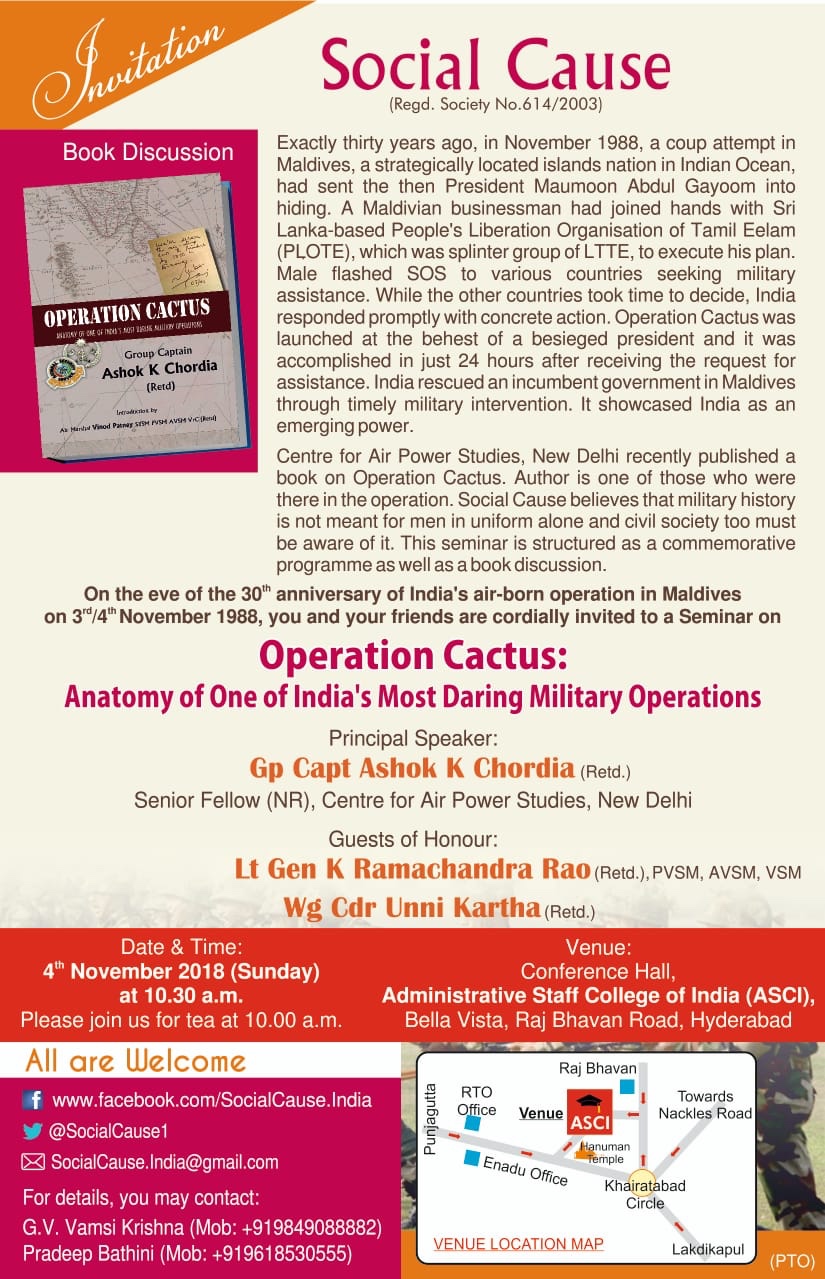
Postscript: Months later, I requested Mr Praful to get me connected to one of the Members of Parliament––who was present at the meeting chaired by Prime Minister Rajiv Gandhi to discuss the rescue of President Maumoon Abdul Gayuum (Operation Cactus, the Maldives, November 1988)––to seek an interview for my seminal study on Operation Cactus. Mr Praful did give me the contact details of the MP but the interview could not materialise. My book, published in February 2018 is devoid of a view from that angle.

The Maldives: Omen of Recovery

Operation Cactus: The Maldives, November 3, 1988.

The Indian Armed Forces had embarked on a seemingly impossible mission; a mission to rescue President Maumoon Abdul Gayoom who had been surrounded by armed men (cadres of People’s Liberation Organisation of Tamil Elam) led by a Maldivian businessmCactusTOI Cuttingan, Abdullah Luthufee. I was a part of the team that landed at Hulule airport to respond to the SOS call of the Maldivian President.

The notice was short; and there was practically no intelligence. The odds were loaded heavily against us. Most strategists would have forecast a failure, nay a debacle, when we took off from Agra. And, although people have compared Operation Cactus with the Charge of the Light Brigade, albeit with a pleasant end, the Indian Armed Forces did not sleepwalk into the Maldives that November night. It was a fairly well planned and methodically executed Operation within the time and resources IMG_4034 2available on that day. The risks were calculated and catered for. The spirits were high. A determined Brigadier FFC Bulsara wrote the following message for me hours before we landed at Hulule: “We’ll secure the airstrip and the President by 1000h tomorrow.”

In a very well coordinated operation involving the three Services and the diplomatic corps, the IAF airlanded the Paratroopers at Hulule who rescued the President. The Indian Navy chased the fleeing rebels and rescued the hostages on board the rogue ship. Among the hostages were a Maldivian minister and his Swiss wife. There was no casualty on our side.

IMG_4033 2A Maldivian National Security Service (NSS) officer, Major Mohammed Zahir wrote a note on my scribble pad. The note speaks about the Maldivian sentiment at that time: “Your Governments kind assistance is very much appreciated by our Force. National Security Service.” He also presented me a cap badge and a formation sign of the NSS as souvenir.IMG_4031 2

That was 30 years ago. Time and tide has eroded the gratefulness.

China has taken over and occupied islands on lease in return for the infrastructure it has created for the Maldivians. Like Sri Lanka, IMG_4030 2the country is heavily in debt. The population seems ignorant; the leadership has fallen into a trap from which it would be difficult to escape. Needless to say, Chinese gains have been at India’s cost. The pro-China sentiment is expressed in a hoarding which was put on the China-Maldives Friendship Bridge when it was under construction: “Waves are gifts from God. Bridge is a gigt from CHINA!”

Cactus Malé Hulule under construction Thanks ChinaIf the recent elections are to go by, democracy is still alive and kicking in the archipelago. Opposition candidate, Ibrahim Mohammed Salih has defeated the present (pro-China) incumbent, Abdullah Yameen. The former President, Mohammed Nasheed has recommended a review of the agreements with China. For India, this might turn out to be an omen of recovery of ties with the Maldives. It is an opportunity to put back the relations with the Maldives on firm footing.

It will be naïve, to say that replacement a pro-China president will lead to slipping of Beijing’s grip on the Maldives (as a newspaper headline suggests). Change of guard does not necessarily mean change of ideology or policies. At best India can start afresh, regaining the confidence of the Maldivians. India has many advantages (over the Chinese), including that of proximity to the Maldives. There is a lot that India can do to restore the strategic balance in the region.

Today is the day, now is the time!


PHOTO-2017-11-30-06-01-45Author’s Note: “Operation Cactus: Anatomy of One of India’s Most Daring Military Operations” (Group Captain Ashok K Chordia, Knowledge World, New Delhi, 2018) is a seminal study of the operation launched by Prime Minister Rajiv Gandhi to rescue President MA Gayoom of the Maldives (November 1988). The book is based on recollections of the protagonists and official unit records and histories.

Rafale Deal: My Anna Bit

The turbulence in the wake of the omni-role fighter aircraft Rafale, which India has decided to buy, has become insignificant in comparison to the turbulence generated by the politics surrounding it. The purchase (mind you, not so much, the flying machine itself) has been making headlines every other day. The politics of it has given the opposition parties the nuclear tipped cruise missile to try and tether the government. Rafale NewsThe Brahmastra has been launched. Now, frantic effort is ON to decide as to who or what should be the target. The effort is to ensure that the missile hits a target (anything that could be labelled as a target) before it runs out of propellant. And it must happen before the Lok Sabha elections scheduled next year.

The media is genuinely trying to keep the all-so-innocent junta informed. Effort to improve the TRP is a parallel enterprise. So, any news that informs (read sensationalises) is good. New issues need to replace the old ones.

In the clamour of people and parties accusing each other of motives and intentions, some good meaning media-persons consider it worthwhile to report on the performance characteristics of the aircraft, leaving aside the politics of it for a while. Who better to hear from than the Chief of the Air Staff (CAS), Air Chief Marshal BS Dhanoa? So they try to get the right answer from him.

Few would envy him for being in a position in which people with shallow theoretical knowledge seek comments on issues that are technical, sensitive and of strategic importance. And among the crowd are the smart people who attach meaning to each word the Chief says; and they comment on his body language and timing of the comment too. Now, because “the country wants to know,” (and because it would be inappropriate to keep the people guessing), the Chief confirms that it is a good aircraft that the country is buying to address the dire current defence need. He says so with the conviction of an air warrior who has flown thousands air chief marshal Dhanoa-ptiof hours in fighter aircraft. He is the one who flew solo in a MiG-21 aircraft soon after taking over as the Chief displaying rare and exemplary military leadership!

When he speaks, he is sure of what he is talking about.

Yet on another occasion, they ask him about the aircraft. His answer is the same. A little later, the question is repeated in different ways. The Chief who means business of national defence only, repeats the answer.

Then comes the time to generate new and renewed interest in the Rafale Deal.

At a National Seminar on the IAF’s Force Structure (2035), a media-person recalls the Chief’s statements on the performance of Rafale aircraft and the timing thereof, and suggests if the comments are politically motivated. It was not the Chief who was asked the question but an officer (a retired one in that). The question was not responded to because it was not relevant to the subject and perhaps because it was the prerogative of the Chief to respond.

Any effort to draw the IAF into the political slugfest on Rafale will benefit people: some will be able to settle scores with the government; others might find a way to pass the blame, if any. But if the deal were to be shelved or the procurement were to be deferred, the worst sufferer will be India whose defence preparedness will get compromised.

AnnaMy Anna Bit: Whichever party comes to power, it will need the Air Force to defend the country’s skies and the frontiers. The Indian Air Force will continue to feel the pressure until the shortfall is made good. We’ll do well to leave the Chief and the Air Force to do their bit.

Grandma or Tom Sawyer!?

One of my all time favourite books is Mark Twain’s Adventures of Tom Sawyer. In particular, I remember the part published as a separate story titled Whitewashing the Fence. Briefly, Tom is assigned the job of whitewashing the fence by aunt Polly––something that he does not really like. He starts whitewashing the fence, but ultimately makes the other kids of his neighbourhood do the job for him. He sells the idea that whitewashing is a work of art and not many can do it well. His friends fall for the challenge and come to do it in turns. They even pay him in kind to be able to get a chance at it. He not only gets the job done (he is able to get three coats of whitewash on the fence) by his friends but also makes some gains in the form of the core of an apple, a kite, a dead rat and a string to swing it with, twelve marbles, part of a Jew’s-harp, a piece of blue bottle-glass to look through… the list is very long. Says Mark Twain, “If he (Tom Sawyer) hadn’t run out of whitewash he would have bankrupted every boy in the village.”

Mark Twain summarises Tom’s exploitation of the kids thus:

“He (Tom) had discovered a great law of human action, without knowing it—namely, that in order to make a man or a boy covet a thing, it is only necessary to make the thing difficult to attain.”

Throwing small challenges, which a kid cannot but accept, is an art. Grandma Rita Jain, a Professor of Botany, seems to have mastered the art well. She has stitched a colourful mat with leftover pieces of cloth that she had. She makes her grandson, Kartik sit on the mat and proposes (that’s her way of challenging the little one), “Kartik, I wonder if you can point at the red squares.”

3aaa0de2-c2b9-436b-ae18-5a72c4d58887Kartik feels victorious when he is able, not only to point, but also count the squares of a particular colour. Sitting in Padmasan, the Lotus Posture on the same mat and performing some other actions form a package deal of challenges, which he enjoys accepting.

One trick cannot keep a kid engaged for long. Kartik seeks variety. The other day, the grandma sat by him and started whipping curds with the traditional Indian whipper (Mathani). It was a stratagem. As the grandma had expected, the little one was attracted to it and wanted to do it all by himself. “Dadiji, I want to do it,” he expressed his desire.

e60e8f23-aed3-4f1d-9828-a4196a484cde“Beta, it is difficult. Do you think you can really do it?” She made the exercise of whipping the curd sound like a highly technical job.

“I’ll do it slowly. I’ll not spill anything. Let me try at least. Please, Dadiji.” Kartik urged.

“Okay! Go ahead! Let me see how well you do it,” the grandma ratcheted up the challenge.

Kartik did it; and did it well. There was nothing great about it. But that little challenge was a step forward in improving eye-hand coordination. The sense of pride that he had at the end of the exercise, gave him confidence for yet another challenge.

In these games that Kartik and the grandma play, both are winners.