Author: Group Captain Ashok K Chordia (Re-attired)
Author - “OPERATION CACTUS: ONE OF INDIA’S MOST DARING MILITARY OPERATIONS”
Episode Consultant: "Operation Cactus" a Discovery Channel Documentary
Short Story & Film Script Writer: Award winning films "The Shoeshine Boy" and "Victor One.”
Hony Professor of Practice and Adjunct Faculty
Sometimes, children are cranky; they cry. At times, they do so for justifiable reasons, on other occasions, there’s no apparent reason for their behaviour. Parents feel obligated to do anything to calm them. They have their own ways of dealing with situations. Succumbing to difficult demands or paying ransom each time is not a good way of dealing with them. Here are three tried, tested and proven ways of handling situations, particularly when there is no just cause for wailing. Needless to say, these approaches must be tried as a last resort; only after one has tried to pinpoint and resolve a genuine problem, if any.
The Kush Approach
This approach entails skilful use of the mobile phone camera to zap an unsuspecting kid. It works with an assured one hundred per cent rate of success when used for the first time. With innovativeness parents can re-use the technique multiple times until the child gets to know the trick.
As a first step, a cranky child is apprised of a serious side effect of crying. He is told that crying ‘without a valid reason’ deforms the face. While the child tries to get the import of what is being said, pictures of some animals––say, an ape, a dog, a cat, a donkey or a cow etc––are downloaded on a mobile phone. This downloading of pictures can be done much in advance. Then, using the same mobile phone, a close-up photograph of the crying child is clicked. He is told that he looks like an ape (or a dog etc.) when he cries. He is urged to stop crying because, the parent could say: “I do not want you to turn into an animal. I’ll be very sad if you turn into an ape and… and what will your cousins, friends and teachers say? Oh my God, … please stop crying.”
Then, with theatrics, he is shown the downloaded picture of an animal. Seeing himself turned into an ape or a dog etc, stuns a child into disbelief.
Named after my grandnephew, Kush, I discovered this approach when one day, during a family get together, he caused a pandemonium for bizarre reasons.
Puneet’s Approach
This is another very effective way of dealing with a child crying for no apparent reason. It has an assured success rate of close to a hundred per cent in the first instance. Its effectiveness erodes considerably with every use.
This technique involves crying and wailing much louder than the child. When a parent, or better still, someone known to the child, cries more loudly than the child, the child invariably pauses in wonderment. That pause is often sufficient to break his chain of thought and to stop his wailing. Children who stop crying under such a spell, normally do not resume crying again.
Named after my jeweller friend Puneet Bagga, I discovered this approach when I saw him calming a child in his showroom.
The Kartik Approach
This technique involves approving a child’s reason for crying, taking him into confidence and then suggesting the idea of postponing his crying to a later point in time.
As a first step the parent agrees with the child that his reason for crying is justified. The child appreciates someone empathising with him. Then he is given a suggestion that he could as well indulge in an activity which he likes e.g., playing carrom, eating an apple or drinking milk chocolate (these are not the activities he is wailing for) and could rather postpone his crying to a later point in time. In this exercise, first, the child gets a bit confused and then, in most cases agrees to pursue an activity deferring his crying to an opportune moment later, which never comes.
This technique works on the elementary principle of: “Deferred agony is lost agony!” The success rate could be as high as 80% depending on the oratory skills of the parent.
Named after my grandnephew, Kartik, I discovered this approach when one day, I saw his father Ravi, using this technique effortlessly to calm him down.
The sudden death on a train journey of a distraught Microbiologist knowledgeable on Chinese Bio-Warfare initiatives, leaves unanswered questions and a bagful of worries for an Air Warrior.
[Now a short film titled, “Victor One” starring Shaktee Singh and Dinpaal Ganguly. The film was screened at the Indian Film Festival of Ireland (IFFI-13). It has won two awards: BEST ACTOR (Shaktee Singh and BEST DIRECTOR (Shivani Singh) at a recently held Film Festival. The film is scheduled to participate in four more film festivals in the short film category (including the one at Cannes).
The Transit Camp at Guwahati was a heavily guarded fortress in the insurgency prone east. I had arrived there from Tezpur a day in advance to board the early morning Sampark Kranti Express to New Delhi. Thanks to the mosquitoes, I hadn’t slept a wink through the night. Besides, my mind was 3000 miles away in NOIDA where Mudit and Chhaya were awaiting me––it had been six long months since we’d been together. Annual leave was a precious commodity for those serving in the exotic east.
I arrived at the station a half hour before the departure time and headed for the train parked on Platform Number 1. My reservation was confirmed in the AC First Class compartment. A faded reservation chart was pasted clumsily at the entrance of the bogie. I strained my eyes to read through and locate my name in the list printed on recycled paper using a dot-matrix printer. There was no rush, and as it appeared, I was the only passenger in ‘C’ Coupe. Quite a few berths in the other coupes were vacant too.
Once inside the coupe, my hands developed their own grey cells––they got down to arranging the bags under the berth and spreading the sheet and the blanket. Once settled, I pulled out from my bag, the crumpled draft of an article: Warfighting Sans Bloodshed. I had been working on it for the past three months. My duties as the Senior Logistics Officer at Air Force Station, Tezpur had kept me sufficiently busy to devote time to that article. With none to talk to in the coupe, I was determined to edit and complete it before reaching Delhi. My thoughts ran errands in many directions as I continued to settle down. In doing so, I lost track of time. It was therefore natural that I did not hear the guard blow the whistle; I did not notice the diesel engine sound its horn either. Like me, my senses too had been furloughed.
I suddenly became conscious when the wheels rolled with a jerk and a tall man stumbled into the coupe. He lost balance, fell and lay spreadeagle on the floor. I was taken aback.
“Easy!” I said instinctively and helped the man lift himself to the seat in front. He was elderly and frail; in his early eighties, I guessed. And he might not have weighed a gram in excess of fifty kilos, even with the clothes on. He was a skeleton, almost. The cap of a Sheafer fountain pen peeping out of his oversized coat pocket suggested that he was possibly engaged in some kind of scholarly pursuit.
“Uh! Thank you… I am jaast een time,” he collected himself and forced a smile on his pale face. If at all, the effort deepened the furrows in his wrinkled cheeks. He adjusted his thick-rimmed glasses with cylindrical lenses to focus his gaze on something beneath my berth. He was reading my name printed on my duffel bag.
“So, you are Squadron Leedor… Indiaan Air Force?” I wasn’t much impressed by what he showed off as his discovery because that was my rank two years ago; I had earned a promotion in the intervening period.
“Pilot?”
Inadvertently though, he had pricked me with that one-word question. “Why do people take everyone who dons blue, to be a pilot?”
“Not really,” I said aloud without making an attempt to hide my punctured ego. “I am a skydiver… the next best thing to being an eagle in the big blue sky.”
The tone, more than the content of my reply, must have amused him, for he chuckled wholeheartedly. Unfortunately, that led to a bout of uncontrollable cough. I patted his back and gave him water to drink. That gave him instant relief.
“Dhonyobaad!” He was grateful for a cup of tea I poured for him from my flask.
He had barely regained his breath when his phone rang. He riffled through his coat pocket to find his phone. He squinted his eyes to read the text on the five-inch screen of his iPhone but couldn’t. Nonetheless, he accepted the call. There was a distinct dash of indifference in the way he responded. It was either an unknown caller, or someone he didn’t wish to speak to. His face turned red as he listened to the individual at the other end. He cupped his mouth as if to prevent being heard, but it seemed he was provoked by the caller to scream into the instrument: “I am not Bheector Bhon (I am not Victor One),” his lips quivered. His large nostrils grew larger, and his unusually long nasal hair flowed out of the cavities like little grey fumes, “Aar, aami Majeek Dadu noi (And, I am not Magic Dadu)! Stop calling me from deepharent nombers (Stop calling me from different numbers).” He disconnected angrily and mumbled a barely-audible sorry when our eyes met.
I gestured an it’s-alright.
He wiped the beads of sweat that had appeared on his forehead. Then there was prolonged silence except for his deep breathing and the rhythmic rumbling of the wagon’s cast iron wheels.
He was professor-like; seemed perpetually lost. He rummaged his pockets for his ticket when the conductor arrived. And, when he did present one, it was an invalid ticket––it was for the Rajdhani Express of the previous day. Without ado, he paid a hefty fine and bought a valid ticket. “I am bheecoming phorgetfool (I am becoming forgetful),” he announced to nobody in particular.
He started a monologue on Warfighting Sans Bloodshed when his eyes fell on the sheaf of papers kept by my side. He amazed me by the depth of his knowledge on the subject.
“Heard about HAARP?” He asked me and, without waiting for an answer, repeated the abbreviation, one letter at a time and expanded it too. “H-A-A-R-P… High Frequency Active Auroral Research Program.”
“It was a secret American Project, a weapon system way ahead of its times. I know a little about it. But I understand that it had turned out to be unwieldy, unviable and a drain on the US Defence Budget. They had decided to scrap it and hand over the site to a university… (I paused groping for the name) … I think, … it was the University of Alaska. I am not too sure of the present status of the Project.” I was unsure and shrugged my shoulders humbly accepting my lack of knowledge.
“You are quite right. It was a rare bheapons programme bheech, if accomplished, bhould habe given the Americans aaneemaghinable pabher to dhominate tha whorld (It was a rare weapons programme which, if accomplished would have given the Americans unimaginable power to dominate the world). Like deesrupting human mentaal processes, jhamming communications, impacting bhethor anywhere in tha whorld,… and maaach more (Like disrupting human mental processes, jamming communications, impacting weather anywhere in the world… and much more). Now Chinese…,” he paused abruptly, looked around and left it at that.
The following hour was spent in what I call polite-meaningless-conversation. My half-hearted effort to know who he was, got stymied each time by his arguments on a variety of subjects: Hypoxia… Foreign Policy… Unmanned aircraft… Electric cars… China… Biological Warfare. There was a core of weirdness in the way he hesitated talking on those last two topics. All through our conversation, his probing eyes scanned our coupe and a part of the adjoining corridor.
Something was troubling him.
At Katihar Junction, I stretched my legs and arms and prepared to fetch hot tea from a tea-stall on the Platform. “Would you like to come along for a cup of tea,” I made an offer.
“Sorry, I habe jhoint pain (I have joint pain). I bhud like to seet hear (I would like to sit here). Bhy don’t you get aa cop phor mee too (Why don’t you get a cup for me too),” An artificial smile bared the gaps in his yellow teeth yet again.
I didn’t mind doing that small favour and walked away with the flask in my hand. I was oblivious of an intriguing request that would follow sooner than later.
The door of the coupe appeared closed when I returned. My repeated gentle knocks and ‘Hello Sir’ through the slits in the small side window were responded by silence. The door, which was not bolted from inside, slid ajar when I tugged it.
The man sat motionless in the corner. He was holding his Sheafer and writing something on his scribble pad. The pen slipped from his fingers as I walked in. He did not pick it up. I thought he had dozed off. The pad too slipped and fell. I couldn’t help read the short note as I picked it up and placed it on his berth.
Written in laboured cursive handwriting was an incomplete and unsigned note which read: “Dear Squadron Leader, I don’t have much time. I have recorded a voice-memo on my mobile phone. Please share it with Victor One. He…”
“Please share it with Victor One.”
The man was dead.
Gears shifted and cogwheels began rotating faster in my cranium––eagerness to reach Delhi and be with the family; this dead stranger in my coupe; the voice memo and, above all… the identity of Victor One. Who on earth was this Victor One? My mind felt cluttered.
First things first. I secured the man’s scribble pad, and pocketed his phone before seeking assistance of the Station Master and the cops. They found nothing on person of that lonesome man, or in his baggage, that could reveal his identity. The body was taken away for post mortem and I was made to sign a declaration.
“Sir, we’ll call you as a witness, only if it is really necessary.” The Head Constable saluted and assured me, before letting me board the train again which had been delayed by fifteen minutes.
Next morning, the headline in The Times of India read: “Dr Shantanu Bhattacharya Dies in Sampark Kranti.” A two-decade old photograph on the front page had striking similarity with the passenger I had met on the train the previous day. The subheading read: “Dr Bhattacharya (83) was convalescing in Baruah Sanatorium in Shillong after undergoing psychiatric treatment at AIIMS, New Delhi.” A boxed item aroused my interest: “On condition of anonymity, a close associate said that lately, Dr Bhattacharya, a less known Microbiologist, had been hallucinating about the quantum jump in Beijing’s Biological Warfare capabilities and that he had been claiming that he had found a counter to some of the Dragon’s bio-weaponry. He even feared abduction by the Chinese; was paranoid. The Scientist had gone missing from his Sanatorium late last Friday. His disappearance was kept under wraps as the intelligence agencies were trying to rule out foreign hand.”
I re-read the news item which said: “Codenamed Victor One, Dr Bhatta was popular among his colleagues as MagicDadu.”
“If the man I met in the train was Dr Bhattacharya, and if Dr Bhattacharya was codenamed Victor One, who do I handover the recorded message on the phone, and the scribble pad to?” I was utterly confused.
My curiosity led me to explore Dr Bhatta’s phone. It wasn’t locked but the sim was missing. Knowing that his end was near, he had erased all the data on his phone except a voice memo. I couldn’t make much sense of the garbled message: “Dear Bheector Bhon, I trast you only. (Dear Victor One, I trust you only) Nobhody ailse (Nobody else)… the Chinese are training a maasquito aarhmy (the Chinese are training a mosquito army)… they habe laarnt tha technique from tha Nazis (they have learnt the technique from the Nazis)… (unintelligible sounds). I habe deeskhovered I have discovered…. They bheel abhduct mee and keel me (They will abduct me and kill me)… Uh! Obhar hown peepal habe bheetrayed me (Our own people have betrayed me)… uh… uh… (long pause) uh…(stuttering)… (silence).”
“Why would Dr Bhattacharya record and send a message to himself?” I was even more puzzled.
My confusion climbed another notch when a newspaper cutting fell from Dr Bhatta’s scribble pad as I flipped its pages to see if it contained anything worthwhile. It read: “Nazis planned malaria-carrying mosquito army.” My train of thoughts was interrupted by Chhaya, my wife, who had laid the table for lunch, “We’ll have to clean up the utensils and dishes for the next few days. Guddi will not be coming to work; she is running high fever. In fact, almost her entire chawl of about 300 dwellers is down with some strange symptoms… I don’t know what’s happening…,” She sighed. “Mrs Manchandani was saying that it is a new breed of malarial parasite, much deadlier, spreading like an epidemic.”
Conspiracy theories abound. Many people thinkbelieve that it was developed by scientists in a laboratory. And, even if one disregards that bizarre pronouncement for want of credible evidence, one thing that can be said with certainty is that the virus originated ‘somewhere‘ in China. That the pandemic could have been controlled well had China shared the relevant information about it with the rest of the world in time is a bone of contention. President Donald Trump blames China squarely for being instrumental in causing devastation of untold dimension. While the experts in the World Health Organisation (WHO) spent more than ten days to christen the pandemic: “Covid-19,” an irate, Donald Trump took no time to declare it a ‘very bad gift’ from China. He went on to call it by more different names: “Kung Flu” on one occasion, and the “Chinese Virus” on another.
Rhetoric apart, today the Sino-US relations are actually at their lowest ebb. The two major world powers (mind the deliberate strikethrough) countries have been trading blows on many fronts––unbecoming behaviour amid extreme crisis. Washington on Wednesday, July 22, 2020 ordered the closure of the Chinese Consulate in Houston; a move it said was aimed “to protect American intellectual property and private information.” It was another way of accusing Beijing of cyber espionage.
Covid-19 Pandemic is but an excuse; lined up behind it are numerous other issues––disputes over trade; Taiwan; violation of human rights in Tibet, Tiananmen Square, Xinjiang and Hong Kong; Chinese assertiveness in the sea they call “South China Sea” and of course, the “not so Peaceful Rise of China….” There isn’t just one issue––there are loads of them. That China is at the root of the problems facing the world today is evident in the actions initiated by Canada, the UK, Japan, Australia, and several other countries.
Actions, counteractions and the blame game will go on till cows come home. At this point when the pandemic is a stark reality and the world is desperately looking for a drug and a vaccine to contain the spread of the virus, some questions beg answers: “Could this pandemic have been avoided? If the answer is “Yes,” then, “How could it have been avoided?”
‘The Butterfly Effect’* might explain how the world has reached this state of being and how it could have been avoided altogether.
Read on….
But before proceeding, please bear the repetition of a fact for the sake of emphasis, and better understanding of the current and the would-be crises of this nature. Openly or in subdued voice, willingly or grudgingly, all the world’s countries, including Chinese stooges like Pakistan and North Korea, are unanimous on two counts: one, that the pandemic originated in China, and two, Beijing could have done much more to avert the catastrophe. China’s predominant role in the spread of the pandemic is undeniable; it is indefensible too. When not under the watchful eyes of Xi, the screams of millions of Chinese––the ilk of Dr Li Wenliang––will also chorus in agreement.
And now, about the distant flutter (Butterfly Effect) that led to the present world crisis. On September 2, 1945, at the time when the formal Japanese surrender ceremony was taking place aboard the battleship Missouri, civil war was brewing in China. With difficulty in communicating an idea from one part of the country to another, let alone transporting a bag of rice, the Chinese were living in extreme poverty and hunger. They were falling easy prey to the Communist ideology. In a showdown between Chiang Kai-shek and the Communists, the Communists had a good chance of winning out. One way to strengthen the generalissimo was to provide him mobility––the ability to spread his influence in the far reaches of China where the Communists were operating freely.
At that time, the Americans were busy winding up; airlifting men and equipment to India/ the US. The Orient Project was under way. They had the capability and the capacity to provide the vital support Chiang Kai-shek needed to thwart the opposing forces. And, although the war-weary American generals strongly supported the idea, there was little political will. The congressmen who visited the region were under pressure from the womenfolk (mothers, wives and sweethearts of the men in uniform) back in the US to bring their menfolk home. It gave every politician a chance to curry favour with the voters by joining in the cry: “Bring the troops home!”
Thus, the Chinese who had supported the Allied war effort in the Indo-Pacific by tethering a two lakh strong Japanese Army in the region, were dealt a raw deal––they got ‘nothing’ for pulling the proverbial chestnuts out of the fire for the Americans. Had the Americans stood by Chiang Kai-shek for some time after the WW II, the geopolitics of the region would have taken a different turn––China would not have gone ‘RED.’ Today’s China would have been ‘different.’
If that was not enough, the US let go of another opportunity to stymie the rise of a belligerent China when, despite the ‘Tiananmen Square Carnage’, it continued to maintain trade relations with Beijing, albeit after a pause.
The monster that the US let take birth and grow is now turning on it. The US is paying for its follies with innocent American lives. As on date (July 20, 2020), Covid-19 infection cases have crossed a 4-million mark in the US. There have been 11,46,516 deaths (and counting)––the number has already exceeded the sum total of American lives lost in all the major wars the country has fought since the War of American Independence.
US inaction today might lead to perpetual mourning
As can be seen, had US prevented the birth of a “Communist” China in 1945––which it was capable of doing then––the world would not be facing the Covid crisis today. Thus, to an extent, the US is responsible (because of its inaction) for the crisis facing the world. That conclusion begs yet another question: How can the US atone innocent deaths all over the world? The simple answer is: By standing up and taking charge. There’s no room for another error of judgement. There will be a huge cost attached to relinquishing leadership under the present circumstances.
*The Butterfly Effect: It is the idea that small things can have non-linear impacts on a complex system. The concept is imagined with a butterfly flapping its wings and causing a typhoon. Of course, a single act like the butterfly flapping its wings cannot cause a typhoon. Small events can, however, serve as catalysts that act on starting conditions.
The 9/11 terror attacks led to killing of over 3000 Americans in New York. The US reacted; formed a coalition and vowed to avenge the strikes. In a response that was largely punitive for the mastermind and the abettors, who were still invisible, Uncle Sam went pounding and pulverising Afghanistan. As if that were not exemplary enough for the rest of the world, an enraged George W Bush went about setting his own standards for the world’s behaviour. He threatened the comity of nations: “Either you are with us or against us.”
Arrogance!
The outcome was much expected: In a moment of America’s extreme sorrow, the world responded with sympathy on the face and a subdued indifference in the heart. The feigned feelings made little difference to the US.
The US was the (mind the strikethrough) a Super Power then. The world looked at that country with awe, and respect, born of fear of its military and economic might rather than reverence for a true leader.
In its effect, the Covid-19 pandemic has been more devastating than the 9/11 attacks––the death toll in the US has exceeded 10,300. It is more than three times the lives lost in 9/11 and the figure continues to rise harrowingly. The catastrophic effect on the economy will be more evident as time passes. In denial, President Trump first called the pandemic a hoax and, in a matter of days changed tack to declare that it was horrific.
With a difference though, this pandemic is indeed America’s 9/11 (Version 2.0).
In 2001, without a second thought, the US began bombing the perpetrators of 9/11 allegedly hiding in Afghanistan. In this instance, although President Trump has blamed China for the spread of the pandemic, and has gone on to call Covid-19 as the Chinese Virus, he has displayed no desire or keenness to punish that country. As it appears, the US contemplates enough before punishing and chastising countries for errant behaviour. China is certainly not Vietnam, Korea, Panama, Guatemala or even Iraq.
There are stark reasons for this reluctance. The years gone by have exposed the rot setting in and have proved the powerlessness of the most powerful nation on the earth. Whether it is Paris Summit on Climate Change, or it is the Nuclear Deal with Iran, or it is trade war with China, or it is the affairs of the NATO, or it is China’s expansionist actions in the Sea in the South of China or it is intervention in a war-torn Syria, the US has gradually relinquished its leadership role. There are allegations that in the last few days, American firms have got a few consignments of medical equipment, meant for Europe, diverted to the US (of course, unscrupulously). Needless to say, these are acts unbecoming of a world leader. In hindsight, Hollywood’s projection of Uncle Sam as the saviour of the world looks comical.
In the same context, the high death toll in Europe (in Italy, Spain, France and the UK in particular) has laid bare the hollowness of the superiority of the West over the rest of the world. Last month, the Italian Prime Minister, Giuseppe Conte was heard saying, “If Europe does not rise to this unprecedented challenge, the whole European structure loses its raison d’être for the people.” The Serbian president Aleksandar Vucic was scathing: “European solidarity does not exist… that was a fairy tale. The only country that can help us in this hard situation is the People’s Republic of China. To the rest of them, thanks for nothing.”
The Covid-19 pandemic curve for China is flattening. Beijing has already begun extending medical support to countries all over the world. Its economy will soon get off the ventilator and show signs of improvement. But, if the news of dissent brewing in the Chinese population is to be believed, the peacefulness of further rise of the People’s Republic of China would be in doubt.
The leadership in India took timely and daring steps to fight the pandemic. Until now Prime Minister Narendra Modi has taken the population of 1.3 billion along by exploiting the ancient art of ‘saam, daam, dand, bhed’ (साम, दाम, दंड, भेद) literally meaning: “by hook or crook, or any rule in the book.” His leadership will be put to an even greater test when the storm has gone past and it is time to pick pieces and revive the economy.
It will be a while before conditions start improving in the US and other parts of the world. As it appears, Post Covid-19, US will not be automatically restored to its Super
Leadership in the Post Covid-19 World
Power position. Perhaps the world will look for a replacement for its desiccated and introverted leadership. Also, in a world that clamours for human rights and democracy, Russia and China will have to work overtime to prove their credentials to be accepted as the Number One. Perhaps it would be a leaderless world until a truly deserving country occupies that first-among-equals status. Perhaps the pace of life will slow down. Perhaps people will be more inclined to family values and spirituality….
Did someone say (…more loudly, this time), “It will be an Asian Century?”
All said (and hinted), it would be naïve to assume that the leadership of the post Covid-19 world would be up for grabs. It’ll have to be truly earned.
A slave went to his master in Cairo with a request to save him from ‘death’.
The wretched man shivered as he narrated his encounter: “I met ‘her’ in the marketplace during my morning errand to buy grocery. ‘She’ was giving me threatening looks. I guess my time has come.”
The master, a benevolent man, gave him the best steed in his stable and advised him to ride to faraway Basra. He owed that kind gesture to a man who had served him devotedly for two decades. “Abdullah, I don’t think death can reach you that far,” he said as he waved the grateful slave good luck.
Abdullah galloped away into the horizon leaving a cloud of dust.
It was a matter of chance that the master too came across ‘death’ when he went for a stroll in the evening. He couldn’t help question the menacing looking ‘creature’ in her black cloak, “Why did you scare Abdullah. He is such a pious Moslem, prays five times a day; follows all rituals; is kind hearted and has served me so selflessly all these years?”
“Why? Why at all would I scare such a good being? I had only one thought when I saw him perambulating here in the streets of Cairo this morning. My appointment with him is in Basra over the next weekend. I was wondering how he would reach Basra in such a short time for our scheduled meeting.”
That was an Arab folklore.
There’s a real story too; wonder if it is true:
Among the victims of the Ukranian jetliner that got shot in the Iranian airspace recently––in the aftermath of the killing of Major General QassemSoleimani––was an individual who had texted his friend before boarding the ill-fated aircraft that he was concerned about the mounting tension between the US and Iran and wanted to leave Tehran before the situation worsened.
That was for the preface.
In dealing with COVID-19, things cannot be left to fate. Everything good, bad or ugly will not happen automatically. Not luck, but actions taken now will determine the outcome.
उद्यमेन हि सिध्यन्ति कार्याणि न मनोरथै ।
न हि सुप्तस्य सिंघस्य प्रविशन्ति मुखे मृगाः ।।
The essence of this Sanskrit Shloka can be summarised thus: Physical action is essential to fulfil wishes. A deer does not walk into a sleepy lion’s mouth––even he (the lion) has to hunt to satiate his hunger.
The global war against Corona Virus is on. Deliberate and conscientious action can spell success. Today, the worst affected countries are China, Italy, Iran and South Korea. Each country is doing its bit to keep the epidemic at bay. Chinese efforts stand out in as much as there’s a decline in the number of new cases. A close scrutiny reveals that unmindful of the ‘world opinion’ they have resorted to dictatorial (draconian, for some) methods of implementation of the medical directives to succeed in their endeavour. Tough times require tough measures. While the end of the crisis is not in sight yet, it is possible to review our own actions thus far and take mid-course corrections to arrive at the desired destination.
Schools have been closed and use of biometrics for identification at entry/exit to offices has been suspended. Teams of doctors, the Armed Forces and the paramilitary forces have been pressed into action. The checks at the airport have been made stringent. There is a suggestion to close the Taj Mahal to tourists. The government has issued an advisory to: “Avoid mass gatherings.”
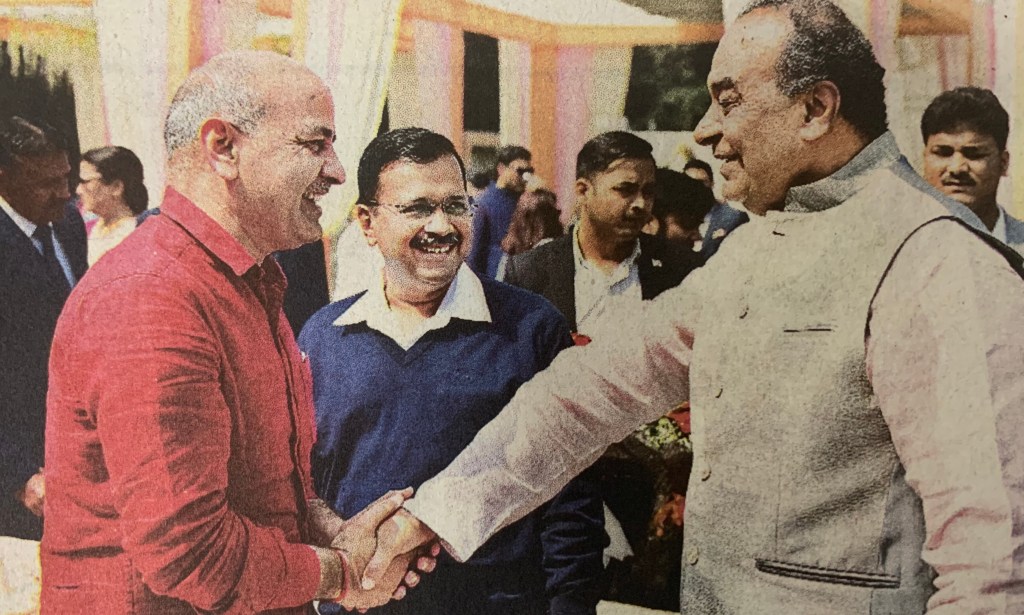
But, as brought out in an earlier post (“Salam, Namaste Kovid-19”) either the magnitude of the problem has not sunk in, or the attitudinal deficiency has still not been made up. Congregations are still taking place. Recently there was a ‘Page Three’ kind of wedding attended by the who’s who of Delhi. The very people who (supposedly) are to lead the lesser mortals to salvation were visible engaging in apparently long firm ‘handshakes’. Still later they were engaged in more serious and essential meetings elsewhere in Delhi to restore normalcy in riot hit parts of city.
All are equal in the eyes of the Corona Virus
Likewise, there was another mega event where the country’s sportspersons were honoured and people mingled. In the larger national interest such gatherings may well be avoided. A lot depends on the willingness of the people at the helm.
Elsewhere, people with colour-smeared faces could be seen throwing caution to the air––the mood to celebrate Holi has already taken the better of people. Hand sanitisers and facemasks have disappeared from the shelves. More and more jokes and cartoons laced with cynicism and weird remedies like names of some herbs, alcohol and cow’s urine etc. (rather than useful tips) are being shared on social media.
Time to issue advisories has long gone
If only people could understand one thing: “Corona Virus is socialist and secular in the true sense of those terms––it is going to spare none. The adage: “Example is better than precept,” was never as relevant as it is today. The chosen and the educated few who can make ‘the difference’ must lead by example. For the government, the time to issue advisories has long gone. These are tough times; tougher times are yet to come. Firm directives rather than suggestive advisories, is the need of the hour. Not prayers but action alone can save this country despite the blessings of the 54,000 and more Gods and deities taking care of its destiny.
Ever wondered who could have been the most harried Indians over the last two months? The answer might not come easy because of the way most people look at things, and act (or react) to situations. The answer is not Modi, not Shah, not Kejriwal and not even Rahul Gandhi.
It is the team of doctors like Dr P Ravindran (Director, Emergency Medical Relief Department), Dr Sujeet Singh Rajput (Director, National Centre for Disease Control) and the medicos of the Directorate General of Health Services (Ministry of Health) that has been having sleepless nights. They, amply supported (as always) by the Indian Army, the ITBP and RML Hospital etc. are in the forefront of the fight against Corona Virus in India. It is a challenge, the enormity of which, it will never be possible to appreciate entirely. Providing medical services is one thing, motivating doctors and nursing staff to work in an environment threatened by the virus is quite another. The diplomats, the bureaucrats and the political leadership are all playing their assigned roles to the best of their abilities but one thing is certain––the credit for the success (if, and when, it is achieved) against the epidemic will go to those at the helm and the brunt of the failure (if any) will be faced by those actually fighting it out.
Bearing the Brunt
To add to the woes of Dr Ravindran and Dr Sujeet is the attitude of some medicos who have said that they would go on strike if masks were not made available. Beyond an iota of doubt, masks and protective gear are an undeniable necessity for the medicos. But at this juncture, going public with this attitude of refusing to work under constraints will prove more contagious and deadly than COVID-19. Those at the helm must do everything in their power to equip the frontline workers appropriately and adequately. They would do well if full control is given to the doctors rather than the bureaucrats or the politicians. It is equally important to allay the fears and anxiety of those in the field.
The fight against COVID-19 is going to be tough. The antecedents of the last few days will establish where we stand in this fight.
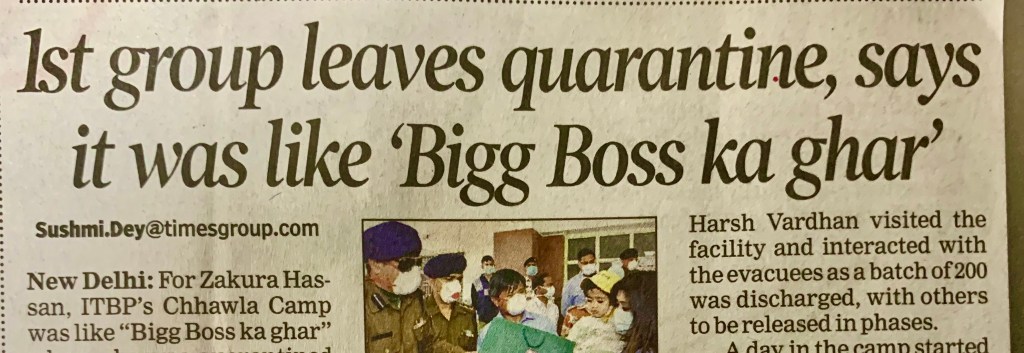
Efforts in right earnest have been on to contain the spread since the threat became evident. It is an acknowledged fact that one of the likely reasons for its spread is proximity and physical contact with the affected individuals. Yet the first lot of people evacuated from China, and quarantined on arrival in India, were seen mingling and frolicking. The video of people dancing together in an isolation ward is horrifying to say the least. On exit from quarantine, one of them compared the life ‘there’ as: “Being a part of the television serial, Bigg Boss.”
Naïve? Stupid? Callous?
Naïve? Stupid? Callous? Or, all three at the same time?
Under the circumstances, let alone people in quarantine, even others (everywhere) must ‘maintain distance.’ Even the media could be denied access to the people in medical isolation––recorded press releases must suffice.
In the recent past a few gatherings took place where people came in close proximity of hundreds others and in physical contact with equally large numbers. Here are some that come to mind:
The youth festival at Gargi College: the ‘reverie’ was disturbed by hordes of goons who entered the campus and assaulted the students. In the ensuing melee, people in large numbers came in physical contact with each other.
Thousands of Delhiites at Ramlila Maidan gathered to witness the oath-taking ceremony of AAP: People were urged to come with families and children.
Nearly 1,00,000 people gathered in Motera Stadium in Gujrat to welcome President Donald Trump on his first ever visit to India.
Giving a rational (and a dispassionate) thought to the antecedents––after the threat of COVID-19 became evident––the above mass gatherings and many others, which are potential hazards, could have been scrupulously avoided. Schools are now being closed and conferences, sports meet and military exercises are being called off. It could be a case of ‘too little, too late.’
For the same reason, prudence demands that celebration of Holi be postponed to coincide with success against COVID-19.
Further, the disruptions caused by the many pro/anti CAA gatherings and rallies have led to rioting, which in turn has flooded the hospitals with casualties. The attention of the medicos and other support agencies that are expected to fight COVID-19 is divided.
There’s an urgent need to regain focus. While some schools in Noida and Delhi have been closed as a ‘precautionary measure,’ avoidance of congregation and travel of any type––besides sticking to the medical advisory in letter and spirit––would help combat spread of COVID-19.
Lastly, ‘Saluting’ or extending a ‘Salaam’ as a Jawan does, or joining hands in a ‘Namaste’ to greet people could be a much better option than shaking hands to avoid physical contact. Besides, the art of saluting will come in handy in the not too distant future when there’ll be a natural urge to SALUTE those on the frontline of the war against COVID-19.
I can barely distinguish an oil painting from watercolour; a sculpted statue from a moulded one; Paper Mache from origami… I remember having embarrassed an artist once, who was using his fingers to give some effects to his painting by asking him if he didn’t have a paintbrush to create the broad strokes he was intending to achieve. For long, I have also pitied artists using charcoal, wondering if it was because of their inability to afford colours.
I am poverty stricken in matters of art.
So, I was a tad worried, a tad concerned, when Shovin Bhattacharjee invited me to ‘Sculpt for Delhi-III’––an exhibition of public art in the Art Gallery of India Habitat Centre.
For me it was less important whether or not I understood the works of art on display. But I didn’t want to embarrass my artist friend by asking him silly questions. So, I decided to stay quiet through the evening, although keeping my curiosity under check has always been a difficult proposition for me.
Out of a different world
‘Being overwhelmed’ would be an understatement to describe my state of being as I went around seeing the masterpieces. To begin with, I remained glued to a bronze sculpture ‘Couple with Apple’ for what appeared to be an eternity. I was humbled by the demeanour of Arun Pandit, its creator. He obliged me by letting me click a picture with him by the side of his work.
Shovin Bhattacharjee’s work stands out because of its signature metallic dazzle and cute statuettes of himself with his trademark hat. They attract people from miles. I was treating my soul with one of his several works on display when I saw him. A warm friendly embrace and a disarming smile was all that I needed to cast aside my vow (to keep my mouth shut). I started off with: “Those regular shaped things appear to be buildings––concrete jungle?” What is the significance of red colour… blah blah blah….” And soon I was in my elements. Shovin kept answering me like a grown up would respond to a child’s queries. Shampa, Shovin’s wife and an artist of repute herself, was amused by my ignorance.
Masterpieces…
Each artwork in the hall had the power to mesmerise mortals and Gods alike. I spent a lot of time opposite each. In fact, I returned several times to some of them. The minute hand had swept the face of my watch twice before I realised it was time to leave. Much against my wish to call it a day, I bade bye to Shovin and set course for Noida. The time that I spent at the exhibition––away from the cacophony of Delhi––was indeed refreshing and rejuvenating.
The purpose of the exhibition is to get creative minds together and churn up ideas to put life into the public spaces of Delhi. Shovin’s ‘Mystery of Life’ series is already enthralling people in Chennai’s IT Park.
…and the masters
My mind sped ahead of my car as I drove homeward. Only a week ago, fascinated by the carving my Prosthodontist friend Dr Aman Kathuria does––he moulds and carves teeth and gums in different materials––I had requested him to get me a carver and some carving wax to try my hand at carving. For some days I had been itching to use the carver. Meeting with Shovin, Pandit and others at the exhibition was the tipping point that had nudged me to get going.
Back at home, I rushed to my workstation, took out a piece of wax crayon and started carving. I decided to make a miniature replica of the Oscar statuette––going by the reputation the award has earned over the last few days, none would mind a distorted version of the popular figurine. Time flew. The exercise that stretched into the wee hours of the morning had a liberating effect on me.
“The Oscar”
With the excitement of a child I showed the outcome of my maiden effort, my still-unfinished labour of love, to Shovin. He responded with: “Great.” That remark coming from my friend, mentor, motivator and guide was a great encouragement, almost like winning an OSCAR. Now I am looking forward to immersing deeper into this new found passion. Thanks to Shovin and Dr Aman, I have discovered a zone of peace––a world away from the humdrum and the din of daily life.
The lecture hall of the Delhi Traffic Police Headquarters (PHQ), Dev Prakash Shatri Marg, Pusa, New Delhi is like any other classroom, anywhere––a table, some chairs, a rostrum, a whiteboard with markers and a stand-alone computer terminal connected to a projection system. Leaders of India’s freedom struggle look down (pun intended) upon the occupants of the room from the posters mounted on the walls. For a facility, which is much in demand for continuation training of cops and for educating errant drivers, and is in use seven days a week, it is fairly well maintained. And, like a Catholic church, it doesn’t discriminate between people on the basis of their caste, creed, colour, sex or status. For the training sessions, sweaty drivers of trucks, taxis and auto rickshaws are huddled in that room and democratically share the limited space with smartly accoutred chauffeurs providing proxies for their rich masters and, of course, with the snobbish who call themselves ‘educated’.
Avoidable!
When the room is packed to more than its capacity and the lights are switched off for audio-visual training, the darkness and the half asphyxiating stench of sweat, Banarasi paan, bidi/ cigarettes, Rajnigandha and the cheap make-up and deodorants attack senses and sensibilities alike. They remind of parts of The City of Joy described so vividly by Dominique Lapierre.
There, in that room, the traffic police instructors ‘try to’ re-educate several hundred wayward drivers daily.
That chaotic situation as described above, is not the doing of the PHQ. The ever-increasing number of unruly drivers causes the mess in that under-sized room as it does on Delhi roads.
Now, how and why I landed up in the ‘that’ lecture hall is unimportant. Suffice it to say that I was an utterly harassed sapiens by the time I reached there after running from pillar to post for three days. And, before you draw any conclusion, let me also tell you that whatever I was getting by way of treatment was my absolute entitlement––I had earned it by dint of my ignorance of the procedure to get back the driving license confiscated by a vigilant cop for a traffic violation.
What followed when I reached the PHQ might be of relevance for those who aspire to learn from the experience of others.
To begin with, the nearly 30 kms drive from my residence in Noida to the PHQ was a nightmare. Well-meaning activists, both pro and ante Citizenship Amendment Act, had ‘unintentionally’ caused clogging of roads. GoogleMaps had gone crazy suggesting different alternatives every few minutes. I still arrived at the destination on the prescribed date and time. In the absence of an authorised parking for visitors, I parked my car on the roadside, half a kilometre away––at ‘owner’s risk’. And, for the next four hours, a part of my brain was occupied; worrying about the well being of my new car.
I had paid a fine of Rs 1000/- online to be eligible to attend the corrective driving training session at the PHQ and stood at the end of a very long queue to register for the same. A mixed feeling of torment and humiliation swept over me like a little tsunami as I stood in that line (mind the stress on the word ‘that’). For once, I wanted desperately to take advantage of my being a senior citizen but couldn’t do so as there wasn’t a separate line for senior citizens. There was a shred of preferential treatment for women, though. A stern cop appeared every once in a while and chastised the men trying to jump the queue.
Deterrence!
All that huffing and puffing and pushing around at 2:00 pm was for a class that was to commence at 4:30 pm. The anxiety of the people in the queue was comparable to the hurry of the drivers trying to get past a crossing when the amber traffic light is blinking––about to give way to red.
I heard bits of interesting conversation as I waited for my turn. Here are some excerpts:
“They caught me for jumping the traffic light whereas they left the guy behind me who was guilty of the same offence.”
“I have been fined for over speeding… I was driving at 80 km/h on DND on an empty road, absolutely no other vehicles. They said, the speed limit is 70 kms/hr.”
“We know what they are going to teach us now… They’ll only sermonise us. Their aim is to torture us for one hour… Close to 150 people, waiting for nearly two hours each… So much time is being wasted… It is criminal. Why don’t they charge us another hundred bucks and let us go.”
And then the masterpiece that drew a laughter even in that not so friendly atmosphere––“These guys are too much, they are not even accepting bribe to let us go without attending the corrective training.”
The PHQ, in its own simple ways, was encouraging entrepreneurship: A typical chotu was minting money, selling tea, samosas and bondas. Young men sitting with inkjet printers/ photocopiers in shacks by the wall were producing facsimiles of documents––RC Book, Aadhaar and Driving License etc––doing good business. Some men who were helping others to fill the various forms and documents, I guess, were doing so for remuneration.
After a wait of about two hours and a half, at 4:30 pm sharp, the door to the lecture hall was opened. There was a clamour yet again to get inside the room and occupy a seat. I was rather lucky to find a seat in the front row.
The cacophony in the room died down to a pin drop silence when a Police Officer––an Assistant Superintending Inspector (ASI) walked into the room. He was tall and well built. He spoke Hindi with a heavy Haryanvi accent. His delivery was laced with humour that only a Haryanvi can generate.
He spoke with authority; was polite and firm at the same time. He snubbed and put in place an odd participant who tried to mock the training process. He reminded me of my drill instructor at the National Defence Academy who appeared tough (and sounded rude at times) but was tender hearted; his only aim being: to train us to be ‘officers and gentlemen’. The ASI was attempting a similar feat with regards to our driving habits. I learnt later that he was a Yoga Instructor too, and had mastered the art of staying calm amid chaos and cacophony.
He spoke with passion about the concern of the Traffic Police and the Honourable Supreme court about the deaths and injuries in road accidents and the traffic jams that are becoming a norm on Delhi roads. A spellbound audience listened to him as he suggested simple tips to avoid mishaps and holdups on roads.
So far as communication of message is concerned, ASI Rajesh Grewal’s performance was as good, if not better than that of Akshay Kumar. Don’t forget, the latter has the advantage of star appeal. What Grewal speaks, flows straight from his heart. He speaks with conviction and there is passion in his appeal.
After making his point the ASI got the ceiling lights turned off and projected videos of real accidents captured from cameras installed at accident-prone crossings. Those clips, which shook and jolted most of us in the audience, were followed by a documentary made by the traffic department of New Zealand (or, was it South Africa?). All the videos were rather old, dark and blurred but conveyed the intended messages aptly––careful driving and adherence to traffic rules is the key to road safety and fuel economy.
Notional income through careful driving
I took the advice to heart (the fuel economy part, in particular). Following the driving tips given by ASI Grewal, I have improved the efficiency of my car from a mere 12-13 km/litre to 20-22 km/litre. Thus, I have more than recovered the thousand bucks I had paid in fine. A process of notional earning has begun. I am certainly more peaceful when I take the wheel now; a tangible gain indeed. I owe my peace of mind while driving to the training session at the PHQ.
After about a fortnight, I attended another class at the PHQ; this time, of my own accord––to consolidate my gains. Also, as a return gesture, I have offered the training staff my assistance and cooperation in improving the training films.
“The hottest corners in hell are reserved for those who maintain their neutrality in times of moral crisis.”
~Dante Alighieri
To be able to have an opinion in times of crises, one must be in the know of things. How does one become well informed when one is not sure of the veracity of what one hears? How does one believe what one sees when there is doubt about the genuineness of the source? The faith in the media (social media, included) has eroded considerably. There’s a limit to the size of a pinch of salt with which one can accept a bit of information these days. That limit is breached so often. Truth is a casualty of our times and circumstances.
The sense that something was drastically ‘amiss’ (I do not consider myself knowledgeable and qualified to use the word, ‘wrong’) dawned on me last week when I spent nearly four torturous hours in traffic travelling from the IGI Airport to my residence in NOIDA. Google was in a state of confusion too, as I guess, three categories of people had stifled the NCR––those, who were against the Citizenship Amendment Act (CAA), those in support of it, and the police force trying to contain the mob’s fury and to maintain law and order.
There were riots in several parts of the country; some people died, many were injured. There were conflicting claims of police brutality and counter claims of policemen being hounded and beaten. There were visuals (some ‘doctored’) to support those claims. It was time to get off the fence, out of the comfort zone, and to have an opinion.
How?
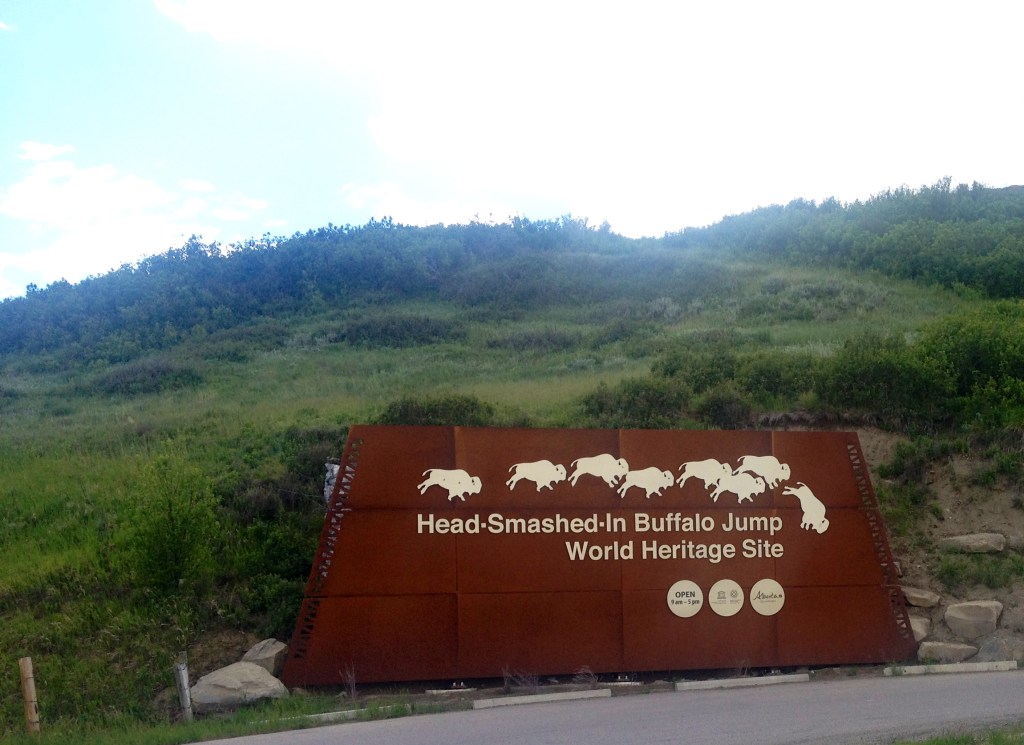
Head-Smashed-In Buffalo Jump
The speeches and the debates on television were high on decibel, low on content. The speakers did not sound convincing in absolute terms. Quite a few of the speeches reminded me of my visit, a few years ago, to a world heritage site in Canada: “Head-Smashed-In Buffalo Jump.” It is a cliff where the first nation (the native) people guised in the skin of the wild buffaloes used to mingle with the herds, cause panic and make the unsuspecting animals run through channels guiding them to their death by falling from the cliff.
Are opinion-makers guised as well-wishers driving a naïve population down different cliffs to mass deaths? Time alone will show. For now, there’s a dire need to defer the urge to follow the Pied Pipers wearing cloaks of any colour.
Head-Smashed-In Buffalo Jump
But how long can one be a sorry spectator and be insensitive to what is going on? A serving general officer of the Indian Army opened his mouth to air some thoughts on the issue. His own breed of men who had donned the military uniform at some point in time in the past, pounced on him, tried to shred him. I shuddered looking at his plight because I had donned military uniform for 35 years before re-attiring. Should I, or I should not, have an opinion, which in any case would instantly regard me as politically inclined (either side)?
I wouldn’t have been so indecisive even in a warlike situation; the dilemma was damning.
A Roman mosaic depicting Medusa, National Archaeological Museum, Athens
Then I saw this activist. Her countenance reminded me of Medusa, the mythical being with snakes in place of hair––one who could turn things to ashes by just staring at them. She was spewing venom; advising the youth to give incorrect information when the officials visited them to collect data. “Give your names as Ranga-Billa…,” she said something to that effect. She must have been joking, I thought, because she was smiling as she said what she said. I am sure, as a responsible citizen, she wouldn’t want the youth to epitomise criminals like Ranga and Billa. Also, if people gave incorrect information, one would be groping for reliable data in the future, to write a treatise on the “Algebra of Infinite (in-)Justice (in India).”
To, or not to, give information sought by the government is one thing; to give incorrect information, is quite the other. The latter, would be a grave mistake––could at best be avoided. On demand, we give (with proof) whatever information a foreign government seeks from us when we apply for a visa. We let open our world to Google, WhatsApp and Facebook. Some of these agencies have been found to be misusing the information. What then, is the harm in sharing the same with our own government?
Some are wary, and are nudging others to be fearful of the intentions of the government.
We are a vibrant democracy. We have proved it repeatedly. If there is a trust deficit, when time comes, people at the helm can be voted out of power as easily as they were voted in; and others, with ‘better’ credentials can be made to replace them. If something has been done unconstitutionally, it can likewise be undone.
The constitution itself is but a document compiled by humans; there are ways to rephrase it, amend it to meet the demands of the changing times.
That said. I am still confused and undecided on the issues causing so much consternation. Until, I form an opinion, I have decided to continue to be neutral. For, in this bitter winter the hottest corners of hell (reserved for neutral people) might still provide some comfort.
I pray to God to grant me the serenity to accept the things I cannot change, courage to change the things I can; and wisdom to know the difference. In my own small way, I have taken it upon myself to urge people––regardless of their stand on the issue––to refrain from burning buses, pelting stones and causing disruptions. I firmly believe that any increase in my ilk is sure to help smother a smouldering India. In the final analysis, whichever side prevails, we all will have to pay for the senseless losses the country is incurring today.