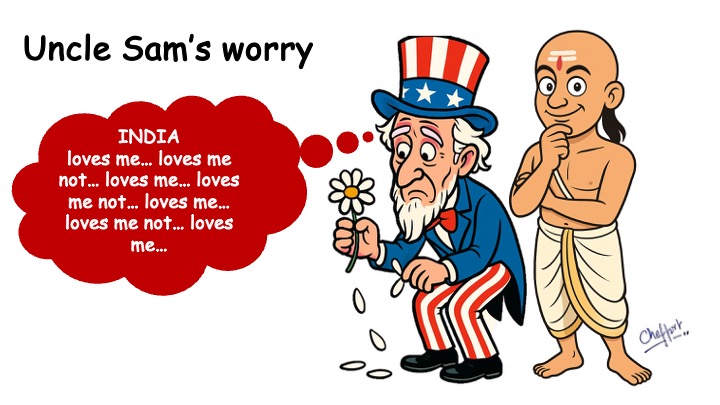
FIFA IS DEAD: LONG LIVE THE BEAUTIFUL GAME

Trump , who hates to lose

Soon got into the act

To reverse a Red Card booking

Without checking facts

With Infantino , his Peace Prize pal

He made a laughing stock of FIFA

Who, for a hundred years

Allayed our fears

Of killing the beautiful game’s allure

And keeping it safe and secure

But the greed of two men

Buried FIFA’s glorious past.

Amen.

Countries Settling Scores Without Bloodshed: Is it a Possibility?

There’s a pause in the fighting…

Troops are sprawled on the sunny side of their camp. These are the boys who had been pulled out of schools; given doses of patriotism and conscripted to fight for the country. Ill-clothed and ill-equipped, sometimes, they wait anxiously for a dying brother-in-arms to breathe his last to stake a claim to his boots and other accoutrements. They are disgusted as they had just had an hour of saluting practice because one of them had greeted an officer sloppily.

“Watch out, lads! We’ll lose the war because we are too good at saluting,” says Kat. The frustration is evident in the senseless talk.

Kropp says philosophically, “All declarations of war ought to be made into a kind of festival, with entrance tickets and music, like they have at bullfights. Then the ministers and generals of the two countries would have to come into the ring, wearing boxing shorts, and armed with rubber truncheons, and have a go at each other. Whoever is left on his feet, his country is declared the winner. That would be simpler and fairer than things are out here, where the wrong people are fighting each other.”

The above is an excerpt (abridged and reworded for flow) from All Quiet on the Western Front by Erich Maria Remarque. The novel is set in the Europe of the First World War. It exposes the brutal realities of war and traces the disillusionment of soldiers. It underscores the lasting impact of war on their minds and emotions. Remarque’s literary masterpiece is a powerful reminder of the human cost of conflict.

Wars are fought for one or more of the following reasons: territory, resources, or ideological differences. They follow an almost set pattern or cycle—differences arise; discussions take place; diplomacy fails; military action follows; the two sides fight to exhaustion, or until one side—or both—recognises the futility of seeking a military solution. Finally, the warring sides return to dialogue. Interestingly, wars end where they begin—at the negotiating table. But, in the process thousands (sometimes millions) of lives are lost; economies are shattered. At times, the living envy the dead.

Kropp sound ‘NUTS’ when he suggests that disputes between countries be settled between leaders wearing boxing shorts using truncheons. But an equally nuttier solution was tried at least once to resolve a territorial dispute between states. And, it really succeeded in arriving at a permanent solution.

The story goes like this. When the colonies declared their independence from Britain, New York State and New Jersey both claimed Staten Island. It was decided to settle the matter with a sailboat race around the Island. The two states sent their best sailor. One Captain Billopp won the race for New York and the island became a part of New York State. Simple!

Can leaders settle scores in the ring?

Fast forward to today, to the wars in Ukraine, Iran, Gaza, Israel and Lebanon.

Imagining peace descending upon today’s world through physical scuffles involving the likes of Donald Trump, Mojtaba Khamenei, Benjamin Netanyahu, Mahmoud Abbas, Vladimir Putin, and Volodymyr Zelenskyy sounds absurd. Yet the idea of these same leaders returning to negotiating tables after millions of lives have been lost is equally absurd.

Does it mean that thousands of lives would have to be lost every time before sense dawns on the leaders?

Sacking of several general officers by the Pentagon and the many desertions in the Russian Army is a clear indication of the fact that the days of the Charge of the Light Brigade are over. Political leaders and diplomats will have to find ways to break the cycle—negotiation, war, negotiation again—with thousands of lives lost in between. The question remains: must we always bleed before we negotiate?

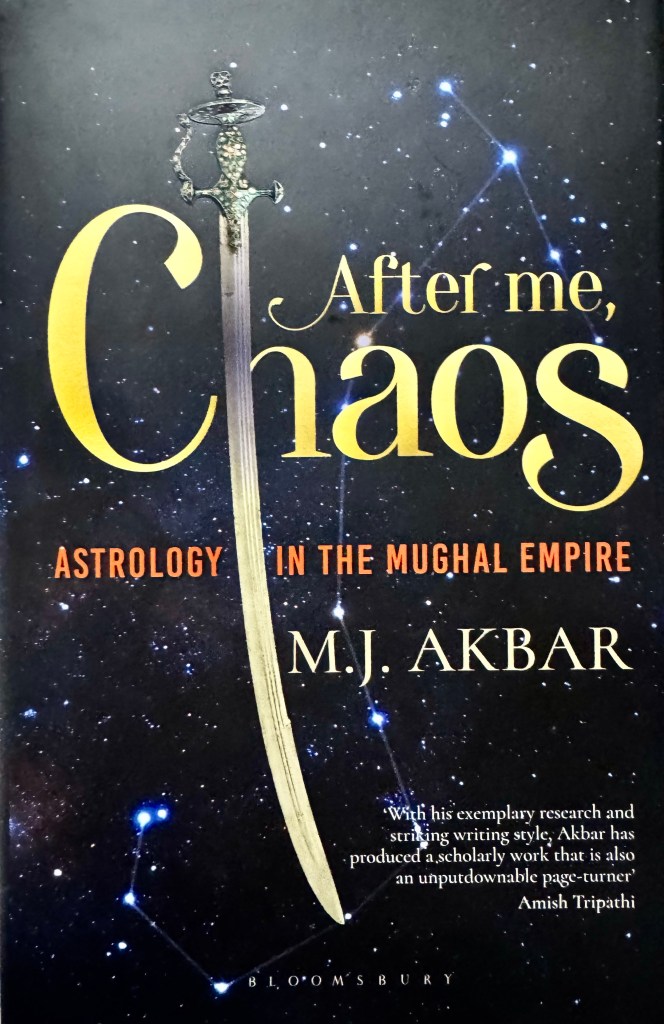
After me, Chaos

The Book

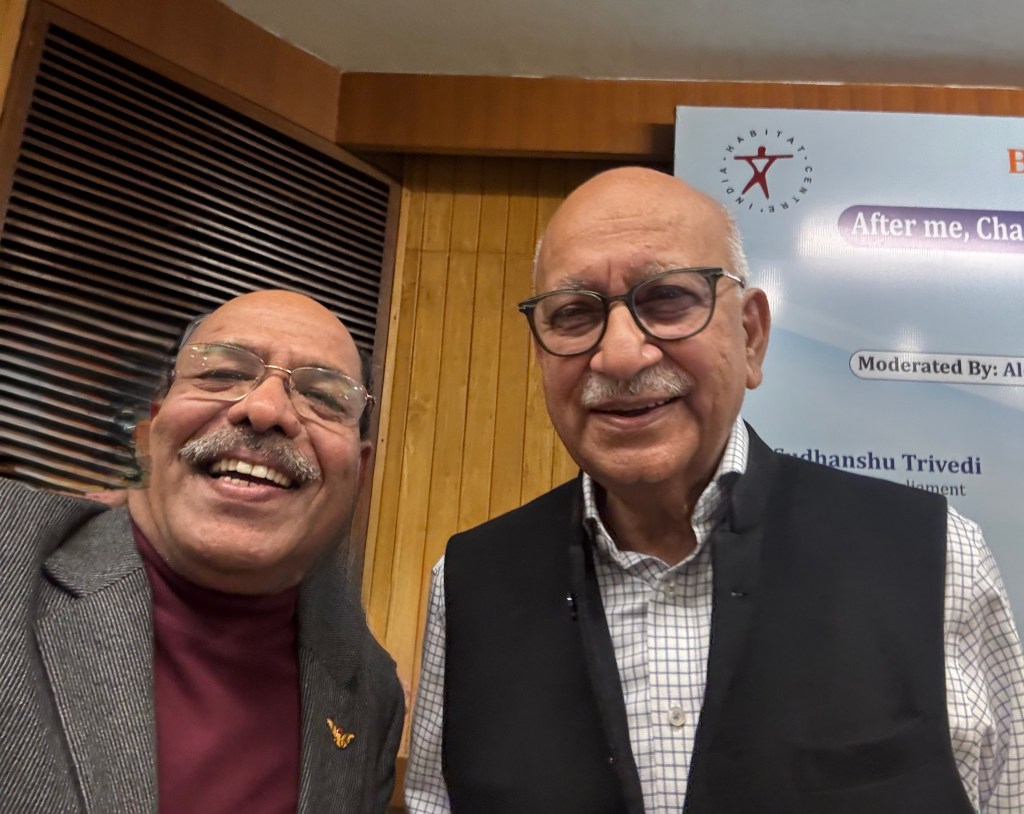
By some quirk of fate, I—a confirmed non-believer in astrology—found myself at the book discussion on “After me, Chaos: Astrology in the Mughal Empire” by MJ Akbar, held at India Habitat Centre. It was January 21, 2026, the Wednesday after Makar Sankranti—an unusually sad festive time when India was reeling under Trump Tariff.

Honestly, my raison d’être at the gathering that day was purely to listen to the author who also happens to be one of my favourite and revered writers. The astrology part of it, I had thought, I’d somehow endure. The erudite panel included Sudhanshu Trivedi, MP; Shazia Ilmi, National spokesperson of BJP; Come Carpentier, Distinguished Fellow, India Foundation; friend Alok Bansal, Executive Vice President, India Foundation and of course, the author himself. I admit that they succeeded in shaking my deep-rooted anti-views on astrology to the extent that I became a fence-sitter; decided to buy a copy of the book and, read it.

In the heart of my heart, I knew that my transformation was temporary. I’d be satisfied with reading the interesting historical facts compiled by the author from primary sources. I believe, one cannot discard an opinion built over 60 plus years of indoctrination by ‘scientific knowledge’ of which one is so proud. At the end of the discussion, among other interesting facts, two bits stuck with me.

with the one I revere

One, about the title of the book, “After Me Chaos.” Mr Akbar had pointed out that it was derived from Aurangzeb’s revelation to his son, Bahadur Shah that every event of his (Aurangzeb’s) life had played out exactly as per the horoscope cast by Fazil Khan. He (Aurangzeb) also forewarned that after his death there would be chaos. And, as we all know—chaos, there was.

Two, the interesting story of Akbar’s (not Akbar, the author; but, Akbar the Great, the Mughal emperor’s) birth. Humayun, engaged in a battle at that time, had deputed his personal astrologer, Maulana Chand to be present at the birthplace to record the exact time of the birth of the baby and to prepare an accurate horoscope of the would-be heir to the throne. The conscientious man was striding up and down, outside queen Hamida Bano’s room when he heard the queen writhe in (labour) pain. At that critical juncture, the enthusiastic astrologer went a step ahead and, from the placement of celestial bodies calculated the ‘right’ time of birth which would ensure that the baby would grow up to be a great emperor. That ‘right’ time, according to him, was still a few hours away. Something had to be done to delay the birth of the baby. The ingenuous man, caught hold of an ugly looking midwife and shoved her face into the queen’s bedchamber. The queen was startled and scared at the apparition. Her pains subsided. Akbar’s birth was thus delayed—he was born under the stars that would ensure name, fame and greatness. Rest is history.

Before, and several times during the discussion, my mind had strayed. I had thought of the stress Trump was causing to India, in particular. Those thoughts influenced my questions in the Q&A session. My first question to Mr Akbar was very personal: “Do you, yourself, believe in astrology?”

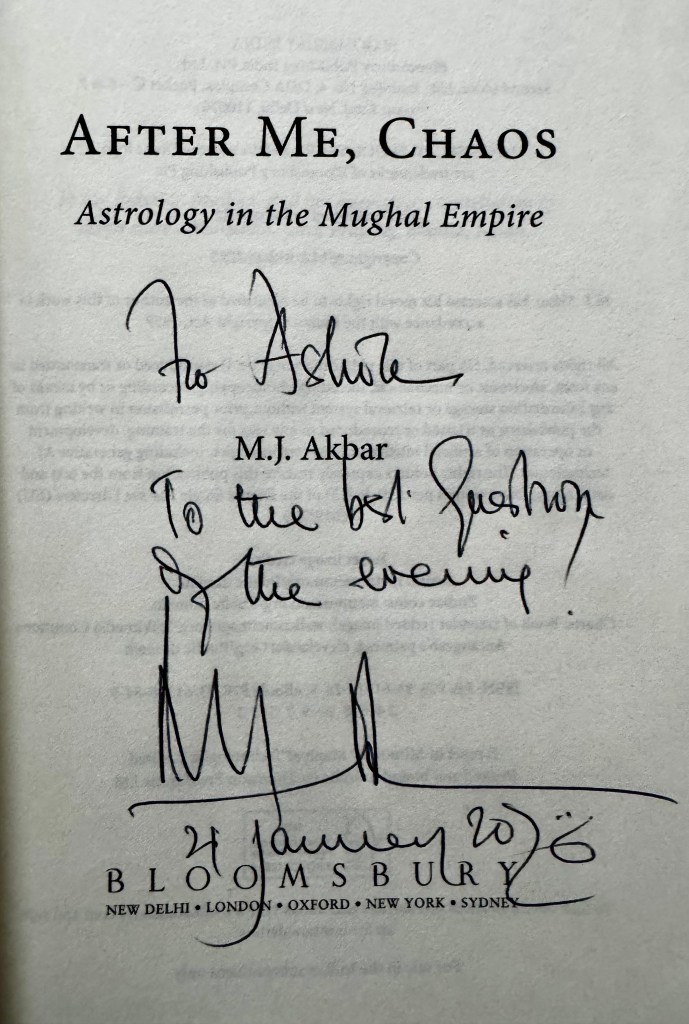
…to the best question of the evening

“Of course, I do believe in astrology,” was his candid answer.

My second question, with a one-line preface, was: “Sir, astrology is as good as the astrologer. Do we have any ‘good’ astrologers around, who can foretell how long would the world have to endure Trump torture?”

In response, Mr Akbar just smiled; the audience burst into laughter. All of us—the author, the discussants, the audience and I—knew that my question that day was a light-hearted one. It didn’t really seek an answer. A gracious Mr Akbar, complimented me for my question when I approached him for a signed copy of his book. “To the best question of the evening,” he wrote for me.

Today, while that question of mine is swirling in millions of minds all over the world, more questions are cropping up. Here are two of them:

One, “Could Trump’s birth have been advanced or delayed to prevent the crisis facing the world today?”

Two, “What can be done so that leaders (as in case of Akbar the Great) are born under appropriate (read “the best”) planetary influences which bolster world peace?”

Even as I conclude this post, my mind, as is its wont, has strayed yet again. I am now wondering if Trump (like Aurangzeb to his son) has told his son-in-law, Jared Kushner, “CHAOS WHILE I AM THERE! UTTER CHAOS AFTER ME!”

Comments

Viney Sharma: Good article Ashok.
As regards Trump, here’s another question…

Q: Could his existence have been prevented?
A: Yes, with the use of a simple device called the condom😀

Group Captain KUK Reddy: Hi Ashok Chordia, It’s so interesting to read your encounter with the great Hyderabadi, Mr M J Akbar, whom we also adore and always keep him in Reverence for being a prolific writer and seasoned journalist.
The question about Trump by you is so tactical as the whole world is asking the same and so no doubt yours is the best question of the evening. I am so proud of you Ashok for your erudice and knowledge and your free expression. Keep it going,my dear.

The Art of Creating a Narrative

In creating a narrative, timing is very important. Most important!

The other day, as a part of the Centenary Celebrations of the RSS, Dr Mohan Bhagwat answered many questions posed to him about the RSS. They were curiosity packed questions, which come to the mind of one taking only a fleeting glance at the activities of the 100-year-old organisation. Incidentally, one thinks of the Swayam Sevaks mostly when they are in the news. Normally, their social work does not draw any attention; it is taken for granted. They become a subject of discussion when they are infrequently dragged into the headlines for unpopular reasons.

Dr Bhagwat tried to clear that perception too.

People have a favourable/ unfavourable opinion about the RSS and as always, some people belong to the ‘unsure’ category. Unsure because of some of its ideologies—its Hindutva ideology and strong stand on conversion, being one of them. The Sangh Parivar has long been accused of influencing politics and, now, of infiltrating other walks of Indian life—bureaucracy, judiciary and lately, even military. In his responses, Dr Bhagwat tried to dispel many such myths. Whether he succeeded, only time will tell.

I assumed that the RSS Boss would be able to influence some fence sitters and might inspire some on the ‘other’ side of the fence, to give an unbiased second thought to the RSS. That was my view until this morning when I listened to a BBC Global News Podcast. It is not so now.

My reason for wavering is a report by BBC South Asia Correspondent, Samira Hussain who spoke of deportation of 40 Rohingiya Refugees by India. The language, tone and tenor have been cleverly used to create a narrative. The transcript of the Podcast is reproduced here:

As per the news caster, the incident took place in May this year. It’s broadcast coinciding with the Centenary Celebrations of RSS, is “BBC-MANAGED.” Now, what has a BBC news report on deportation of Rohingya refugees got to do with the Centenary Celebrations of the RSS?

Well, lately a perception has been created that the ruling BJP and the RSS are two sides of the same coin. So, if a narrative is advanced about India and the Indian Navy—asking refugees to drop their pants for identification and ‘throwing’ poor refugees into the sea—it is likely to project the RSS as instigating or inspiring such actions. This narrative, whether it is to malign the Indian Government, the Indian Navy or, through them, the RSS does not augur well for India as a sovereign nation.    

Some Points to Ponder

As stated earlier, India is not a signatory to the Refugee Convention (1951) and the 1967 Protocol. As such India is not bound by them to accept refugees. Still, India accepted Bangladeshi refugees in 1971. India is paying a price for not sending them back after liberation of Bangladesh. Roughly 2,000 Rohingya refugees are reported to be in India. It is India’s right to deport foreigners who enter India without permission.

Now picture this: The 40 deported refugees were made to disembark at a point beyond which the boat couldn’t have gone. This is being literally projected as “dumping refugees in the sea.” It is a pure action against uninvited visitors to India; BBC is attaching meaning to that action and creating a narrative. Also, projecting Indian navy sailors as villains harassing the refugees (by asking them to drop their pants to determine their religion) is a deliberate effort of the broadcaster to create a narrative.

One must understand, correspondents will go to any length to earn their bread, and some extra butter. With one stone, Ms Samira is striking the Indian government and obliquely trying to stymie, the effort of the RSS to project a different image. Had it not been for the timing, one wouldn’t have seen through the motive.  

No wonder, Israel bans the entry of BBC correspondents into Gaza.

Gaza: The Hostage Issue

O Gaza!

The events of October 7 served as the immediate trigger, but the roots of the Gaza conflict extend far deeper. The underlying causes are complex and subject to debate, with little likelihood of consensus. For this reason, reducing the war to a binary of good versus evil oversimplifies the situation. Meanwhile, the human toll continues to rise, with thousands killed by bombardment and many more affected by hunger and displacement.

Recent decision by France, Australia, and the United Kingdom, to recognise Palestine, though politically significant, is unlikely to resolve the immediate challenges. Rather, it highlights the difficulty the international community has faced in addressing the conflict.

Israel’s Objectives

Israel’s stated aims can be broadly identified as:

•           Destruction of Hamas,

•           Release of the hostages,

•           Ensuring Gaza no longer poses a threat to Israel, and

•           Return of displaced residents of northern Israel.

The feasibility of achieving all four goals simultaneously remains uncertain.

Prospects of Eliminating Hamas

Military operations may succeed in neutralising most Hamas operatives within Gaza. However, complete elimination appears unlikely. Those who escape are likely to regroup elsewhere. Also, displaced Palestinians will carry their wounds and scars to other parts of the world. No border control can prevent the smuggling of hatred and anger. It would be naïve to imagine that some of them would not be behind a “9/11 (Version 2.0),” if and when such an attack happens anywhere in the world. One does not need Nostradamus to foresee this.

The Hostage Question

Israel does not follow a rigid hostage policy and has, in the past, agreed to prisoner swaps. During the Entebbe Raid (July 1976), the hijackers’ demand for the release of Palestinians in Israeli prisons was actively considered, even as preparations for Operation Thunderbolt (later renamed Operation Jonathan) went ahead. The mission was deliberate and well planned. Jonathan Netanyahu (Prime Minister Benjamin Netanyahu’s brother) sacrificed his life to rescue 104 Israeli hostages. One hostage, hospitalised in Uganda, later died under unclear circumstances.

In another instance, Kozo Okamoto of the Japanese Red Army—who, along with two comrades, killed 32 people and injured 72 at Lod Airport (now Ben Gurion Airport) on May 30, 1972—was captured alive. Israel, which has no death penalty, imprisoned him. Yet on May 20, 1985, nearly 13 years later, Okamoto was released as part of a prisoner swap. On that occasion, 4,600 Palestinian and Lebanese prisoners were freed in exchange for three Israeli soldiers.

Why then, despite immense pressure from the families of hostages and international opinion, has Israel been unwilling to proceed with more prisoner swaps? Here one tends to agree with Prime Minister Netanyahu and others: conceding to Hamas’s demands would amount to “rewarding” them for the October 7 attacks.

Other Goals

The other two aims—ensuring Gaza no longer poses a threat and facilitating the return of displaced residents of northern Israel—are relatively less difficult to address once the hostage issue is resolved.

At present, the deadlock lies with Hamas. They know well that releasing the remaining Israeli hostages (and the bodies of the dead) would spell their end. They would be hunted down and eliminated. That fate seems inevitable anyway.

If only one of these sufferings could offset the other…

A Possible Way Out?

What could break the impasse?

One possible—though imperfect—approach could involve offering safe passage for Hamas operatives out of Gaza in exchange for the release of hostages. Such an arrangement might drastically reduce civilian casualties, but it would raise questions about long-term security and the precedent it sets. Whether Israel, and Hamas, would accept such a suggestion remains uncertain.

In the fog of war, it is unclear whether both sides are already working toward a face-saving exit. Meanwhile, frustration and anger are mounting across a world that feels trapped in a seemingly hopeless situation. In the absence of a negotiated settlement, the conflict is likely to continue at great humanitarian cost.

A Warning for India

The dilemma is not unique to Israel. Sooner or later, India too may face a similar horrific choice: how should it deal with terrorists who, after striking a target, hide behind civilian population in India or, still worse, across the border in Pakistan?

The Wolf and the Lamb

A wolf was drinking water on the bank of a river. A little away, downstream, was a lamb taking small sips.

“Why are you dirtying the water I am drinking,” growled the wolf.

“Sir, but I am downstream, how can I dirty the water reaching you?” The lamb tried to reason with the wolf.

“Okay! Okay!” said the wolf, his accent American, his logic Trumpian. “But why did you use abusive language with me last year?”

“But Sir, I wasn’t born last year,” pleaded the lamb wiping his sweat.

“Then, it must have been your mother,” said the angry wolf and pounced on the lamb.

That is the original version of the story.

“Why are you dirtying the water….”

The current version, has some more characters and interesting twists. The wolf is rankled more by two other animals in the jungle—the bear and the little dragon who have enough nuisance value for him. To his annoyance, the lamb is friendly with the bear. And, playing on the mind of the slimy wolf is the fear: “What if, let alone the lamb, the bear and the little dragon, other animals of the jungle stand up against him?

The animals of the jungle have a different concern.

Their worry is that the wolf has an Indian brain, a Chinese heart, a Vietnamese kidney, Latino lungs, Mexican blood, Jewish bones… but, it is controlled by its own xxxhole. How much more stink will it bestow upon the jungle before it suffers from the same?

The Policy Paradox: When American Policies Rewrite Global Fates

The dramatic drop in crime rates across the United States in the 1990s sparked intense debates about its underlying causes. Pundits credited economic growth, stricter gun control, a crackdown on drug trafficking, improved policing, and increased use of capital punishment. However, Steven Levitt and Stephen Dubner, authors of Freakonomics, proposed a controversial yet compelling theory: the legalization of abortion following the U.S. Supreme Court’s landmark Roe v. Wade ruling on January 22, 1973, played a pivotal role.

With abortion legally accessible, many pregnancies that might have resulted in unwanted children—often born into poverty and unstable environments—were terminated. Had these children been born, it was argued, many would have grown up in circumstances that increased their likelihood of engaging in criminal activity.

If this theory holds, a chilling corollary emerges: The United States is poised for an unprecedented surge in crime a decade and a half from now. As expected, experts will scramble for explanations, but this time, the reason will be glaringly obvious—the recent reversal of Roe v. Wade.

While rising crime in America may be a domestic concern, the consequences of its policies extend far beyond its borders. U.S. foreign policy often mirrors the contradictions in its domestic decisions, particularly in the Middle East. Nowhere is this clearer than in its approach to the Israeli-Palestinian conflict.

Successive U.S. administrations have adopted a selective stance on demographic control. During the Intifada of the early 1990s, Palestinian leader Yasser Arafat famously declared, “The womb of the Arab woman is my strongest weapon.” At the time, fertility rates in Gaza soared to an astounding 8.3 births per woman—nearly three times that of Israeli Jews. Alarmed by the demographic shift, the U.S. actively supported birth control programs in Palestine while simultaneously offering unwavering military and moral support to Israel.

Fast forward to today, and the consequences are staggering. Since October 7, 2023, nearly 44,000 Palestinians have died in Gaza, with deaths continuing even after a precarious ceasefire—first from bombings, now from hunger and the collapse of medical care.

Adding to the crisis, the U.S. has halted all foreign aid, including a modest yet symbolically significant $5 million designated for contraceptive supplies in Gaza. But if and when aid is restored, the priority should be clear: food and life-saving medicines, not birth control. As America’s policies continue to shape lives—both within and beyond its borders—the world watches. Whether on the streets of New York or the alleyways of Gaza, the consequences of U.S. decisions are neither isolated nor incidental. Perhaps it is time for the architects of these policies to reckon with the paradox they have created:

A nation that dictates life and death struggles to control its own fate.

© [Group Captain Ashok K Chordia] [2025]
All Rights Reserved
No part of this website/Blog or any of its contents may be reproduced, copied, modified or adapted, without the prior written consent of the author. Extracts may be quoted from the website or link to the website may be forwarded with attribution to “Road Much Travelled.” For any other mode of sharing, contact the author @ (akchordia@gmail.com)

Comments

Air Commodore ROJ Assey (IAF Veteran): Thanks, Ashok.
Very thought provoking, indeed.
I have never come across – or imagined the concept of ‘Roe vs Wade’ being a significant factor in crime control – fascinating. Some of us may be around to see it, too. Superb writing, as usual – and fascinating reading. Warm regards. ~ Rod

Volvo Culture

…reverse gear

An interesting bit of information is displayed on a standee kept next to The Very First Volvo in the World of Volvo, in Gothenburg. It points out that the premier of ÖV4, in the 1920s, fell flat because a rear axle gear had been installed incorrectly and the car could only drive in reverse in its first test drive. Embarrassment caused by the event to the company notwithstanding, Volvo identified the fault and immediately fixed it. Then onwards, the Volvo cars and trucks have had the reverse gears; but Volvo, the automobile giant, has only moved forward. It has gracefully covered the long distance to world leadership in automobile sector.

World of Volvo

Before talking further about Volvo culture, here is a less known fact about the reverse gear—it is the most powerful gear in all automobiles. Once, while on a 3,700-mile road trip from Paris to Ankara, Dominique Lapierre, and his classmate, Dominique Frémy, was faced with a steep climb near Athens, which brought their 6-HP antique Amilcar to its knees. To deal with the challenge, they turned around the car and drove uphill in reverse gear. The effect was miraculous: their valiant car climbed the slope like a Tour de France bicycle.

There is much to learn from Volvo’s culture of acknowledging shortcomings, working on them to improve, and above all, talking candidly about the failure. The power of the reverse gear also has a message.

Managing personal life; running a corporation or a government—each is akin to driving a vehicle. If a not-so-correct decision is taken and implemented, it would only be appropriate to acknowledge it gracefully, in time, like Volvo, and to get into the powerful reverse gear to prevent appreciable damage.

Like the reverse gear, the brakes and the rear-view mirrors also contribute to good driving. The purpose of brakes—more important than the ability to slow down and stop at will—is to allow driving at high speeds. Awareness of functional brakes, or ‘brake consciousness’ as it may be called, sets one free to speed up.

Amusingly, the purpose of the rear-view mirrors installed in the cars of the yesteryears was to enable the drivers to keep an eye on the cops who might be chasing them. Today, they have a more meaningful purpose—to ensure road safety.

Cruising ahead in life; or leading an organisation, it pays to look into the rear view mirror and observe the road travelled. Slowing down to take stock, or getting into reverse gear to make amends are empowering options.

Willingness to adopt the goodness of Volvo Culture is the need of the hour.