Blame it on Steinbeck and Chekhov

Of the many blunders I have committed, two stand out because, together, they almost cost me my sanity.

The first was taking Anton Chekhov’s words seriously. When asked how he got ideas for his short stories, he is believed to have said, “Put your cigarette on this ash-tray and I’ll write a story about it.” I was naïve enough to believe that everything had a story; all one needed was the mind’s eye to find it, read it and reproduce it.

It sounded so simple that, unmindful of the quality of output, I began writing on everything that crossed my imagination. From military life to mosquitoes; from a railway platform in Uttar Pradesh to a cemetery in Sweden; from Champagne to golf and from Trump to China, my pen spared none.

Churning out posts

One writes to be read. So, I kept thrusting my posts on friends who, I thought, didn’t mind being inundated by the ink I spilled. As if that was not enough for a peacefully re-attired life, I made the second big blunder of reading John Steinbeck’s Travels with Charley in Search of America and believing that I could travel and write in India as freely and easily as he did in America.

With raw inspiration from Steinbeck and Chekhov, and nothing else for a backup, this Don Quixote — you might call me one — decided to conquer the literary world. I was oblivious that my chosen mission would demand the daredevilry of an absolute fool. I resolved to travel to the most crowded parts of Delhi — Chandni Chowk and Sadar Bazaar — in search of the authentic pulse of the old city and write about it.

That spelt my doom.

In search of the authentic pulse…

To begin with, the going was good, or at least I thought so. The writer in me was buoyant with the many stories that stewed in my small head, the scalp of which had not seen a crop in years. As I carried on, I clicked hundreds of pictures, for I believe that each picture is worth a thousand words.

Then disaster struck.

It was a Sunday in June. Most of the main shops in Sadar Bazaar were closed, but the pavements and ledges outside had been taken over by street vendors selling everything from imitation jewellery to bridal dresses, toys to suitcases, polythene bags to gift-wrapping paper — it was an endless list. Rickshaws, hand-pulled carts, motorcycles and honking cars, all vied with pedestrians for whatever road space remained. Skeletons of men carrying loads twice their size reminded me of the skeletal robots performing miraculous feats at a Robotics Exhibition in China.

The sheer intensity of human activity in that environment reinforces one’s faith in the 84,000-odd Indian gods.

I shuddered at the sight of electric cables criss-crossing the pathways—a potential fire hazard, I thought. Peepal plants sprouted from cracks in the walls of a dilapidated building. A massive banner displaying the face of a prominent political leader, surrounded by a dozen party workers and proclaiming “Happy Eid-ul-Fitr”, seemed to be the only thing preventing the adjoining wall from crumbling. Older posters still wished people “Happy Holi” and “Happy Diwali”. Several others conveyed birthday greetings to beloved leaders.

There was momentary panic when the vendors suddenly began winding up their wares and closing their shops.

“Committee is coming! Committee is coming!” A boy on the run had energised the street.

The chaos settled as the team of Municipal Committee members—supposedly there to stop the vendors from encroaching on the roads—turned into another by-lane. It was business as usual thereafter.     

The sheer intensity of human activity in that environment reinforced my faith in the 84,000-odd Indian gods.

I ventured further and entered a narrow lane to get a ‘different’ feel. Even at 3 p.m. on that sunny afternoon, it was pretty dark. Hawkers had spread their wares on either side of the narrow passage, making walking past them something like manoeuvring through a minefield. I kept moving, but soon the combination of the asphyxiating smell of an open drain, rotting fruit on the floor, cow dung infested with flies and a lavatory somewhere in the distance began to nauseate me. Further up, the passage was choked with people.

I turned back; I thought I had had enough for the day. In minutes, I would discover how misplaced my assessment was. I hadn’t had enough; there was more to follow.

After clicking the last picture in that lane, I slipped my iPhone into the side pocket of my cargo troussers. I maintain that cargos are ideal for travelling in crowded places, with their box pockets secured by flaps.

Just then, I felt a push on my right flank. I turned around. A boy, in a hurry — he must have been a teenager—was trying to find his way. I gave him a look that said, “Behave yourself.”

Before he could extend the apology, I thought he was trying to convey with his eyes, I was pushed from the left. Another youngster; late teens, perhaps. Then came another push, this time from a third direction. And then, two more.

Those pushes threw me off balance. In the split second that I took to regain my footing; my instinct told me that something was amiss. I felt my pockets — cargo pockets, six of them, secure pockets with flaps — not once, twice, thrice, but many times.

The horse had bolted.

Those five devils! They had taken away my iPhone. In a flash, I realised what else had gone with it. Data apart, my notes and pictures, around which I was weaving stories, were gone—one of my loved worlds had shattered like an Austrian wine glass struck by a Vande Bharat. They had stripped me of my secret pride.

It was an emergency akin to a parachute failure I had experienced years ago. I had seconds to act if I was to get my phone back. Running behind those boys in the dark alley would have been a wild-goose chase. Besides, my ageing knees would have given up the chase sooner rather than later. So, I did the next best thing. I hobbled to the nearest police assistance booth on the main road, introduced myself to the officer on duty and told him that my phone had been snatched.

He sent a police constable with me to ascertain the exact spot where it had happened. To my good fortune, the location was partly covered by a CCTV camera.

Back at the police booth, the cops sifted through the last few minutes of the CCTV footage. Lo and behold, there I was, surrounded by the little devils, signalling to one another and exchanging meaningful glances. Although the actual snatching was not caught on camera, the cops assured me that if those boys had taken my mobile phone, they would get it back.

“We’ll take it out of their belly if they swallow it,” one of them assured me. He identified one of the boys as an old offender.

A constable sent to the boy’s house returned with the information that he had not returned home.

“Please don’t visit our home. Cops visiting us brings disrepute to the family. Arrest the boy if he has committed any crime,” an elderly lady of the house had urged the constable.

“Sir, these people take undue advantage of the laws governing treatment of juvenile delinquency,” the police sergeant apprised me of the difficulty they face dealing with teenaged miscreants.

In the meantime, the smart alecks who had taken my mobile had powered it off. It couldn’t be reached when my number was dialled several times from different mobiles.

“Please rest assured your phone will be recovered.”

Those were the parting words of the police officer when I left Sadar Bazaar that day.

As a first step, on reaching home I blocked my SIM and used my Apple account to declare my phone ‘lost’. This would prevent misuse of my device by anyone. Apple’s Find My option gave the last known location of the device as Sadar Bazaar, where it was snatched.

Thereafter turning on my MacBook and trying to determine the current location of the lost mobile became a mania with me. I tried it several times through the following night, hoping that someone would switch it on and I’d be able to lock its location.    

Thanks to the Telecom Department, along with strict regulations to prevent fraud, there is also the convenience of getting another SIM across the counter. The procedures are simple; and the representatives of the service providers, helpful. I got mine in a jiffy the very next day, when there were still no signs of recovery of my phone.

It was surprisingly difficult to use an old phone that I had discarded years ago. Installation of essential apps, including banking apps, entailed long-drawn processes involving passwords, debit-card details and OTPs. How I went about installing the apps—and the loss of all my messages during the reinstallation of WhatsApp—exposed my technological illiteracy and how poorly organised I was. Many of the lost messages were actionable; they were my commitments which, sadly, I would never even recall, let alone fulfil.

Hassled by the goings-on at my end, I had no time to read, act on, or respond to messages on social media. So, over the following two days, I publicised that I was going on a digital detox and would rejoin in due course. I did this partly because ‘digital detox’ sounded ‘hap’ and partly under the influence of Johann Hari, of Stolen Focus fame. It was my opportunity to stay away from avoidable noise for a while.

It didn’t surprise me a bit when none asked why I was going silent.

It was my conclusion that people are too burdened to bother about another’s life. A genuine soul calling or messaging to enquire about someone’s welfare could be seen as an intrusion or as someone trying to seek a favour.

A break from social media, which ultimately lasted for about a month for different reasons, was a boon. It let me indulge in some of my loved activities and hobbies. A return to calligraphy, sculpturing, caricaturing, serious reading, writing and even walking and cycling was godsent.

Nothing encouraging happened on the second day. The confidence in the police camp dwindled.

“Sir, if your phone is sold while we are trying to trace it, I am afraid it will become impossible to find,” the officer warned.

I discovered that stolen Apple phones are generally not resold for use; they are cannibalised — dismantled, with their parts passed on to repair shops. The outer cases, screens, microphones, speakers and camera lenses fetch decent returns.

I crossed my fingers.

On the third day, Apple’s Find My feature spotted my phone in a residential area near Sangam Vihar. A prominent landmark, Boozer’s Bar, was a block away.

I informed the cops and then, assuming I was smart, drove 30 kilometres to the general area with my dear wife and a team of two tough men — just in case.

When I think of it today, it was a funny sight. The four of us moved stealthily, laptop open, through the locality. It reminded me of an Indian film in which the protagonists, dressed as street singers, with a harmonium dangling from the hero’s neck, go around singing to find a kidnapped child.

Our search that day ended in a fiasco when the batteries of our devices drained and we realised that the location we were chasing was two days old. Once in the vicinity, Google Maps went bonkers. After a three-hour adventure, we, the self-styled sleuths, returned home empty-handed.

The probability of finding the phone receded with each passing day. It dipped to almost zero, and my heart sank when on a following day, Find My spotted the phone at a location in Gaffar Market, notorious for sale of stolen gadgets.

On impulse, I thought, I would pose as a buyer of an old iPhone 15 Pro and look for my phone. In my heart of hearts, I was prepared to buy my own phone. My primary aim was not saving money, but recovering my valuable data.

I gave up that ‘brilliant’ idea when I realised that the Gaffar Market location was also two days old. With the villains switching the phone on and off as they pleased, and scooting all the time, it would be impossible to catch up with them in the normal course.      

Initially, I did not lodge an FIR because if the stolen device were recovered after filing one, I would have to get it through the court—a long bureaucratic hassle. On the third day, I lodged an eFIR reluctantly to stake my claim on the mobile if it were to be found at a later date.

I lumped every torture as a necessary evil and kept going. After four days, I even stopped nagging the cops but continued staring at Find My on my computer screen.

All along, sanity kept eroding. Yoga didn’t help regain peace of mind, but staying away from social media and pursuing hobbies did.

More than a week later, I spotted the device at a location in Sadar. When I called the cops, I was told that they had recovered the phone. I identified it by its ‘night blue’ colour. To avoid the circuitous procedure of getting it back through the court, I withdrew the eFIR. I thanked the cops profoundly and didn’t pester them to tell me how they had recovered it.

When it was handed over to me, I switched it on and tried to ‘open’ it using Wi-Fi. In my excitement, I skipped some steps and lost all the unsaved data on the device.

Recovery of the phone turned out to be a Gift of the Magi for me.

Aware of the futility of pursuing a case against the juvenile delinquents, I didn’t pursue the matter. I was too exhausted to do so. Besides, in some corner of my heart, I had developed a kind of admiration for their skill and teamwork.

I had sympathy for them, for we as a society, had failed to channelise their energies.

It certainly was not a case of Stockholm Syndrome.

In the following three weeks, I lost my remaining sanity trying to re-activate the eSIM in my phone. The police had done their job; the Telecom Department had unblocked the IMEI, but in the records of the service provider it was still BLOCKED.

Out-of-the-way assistance of a buddy, Major General Lav Chand, and an Airtel associate helped remove the glitch and finally ended my ordeal.

It all started with me wanting to look for stories and write them. Instead, I ended up being one.

I blame Steinbeck and Chekhov for it.
O Khajuraho!

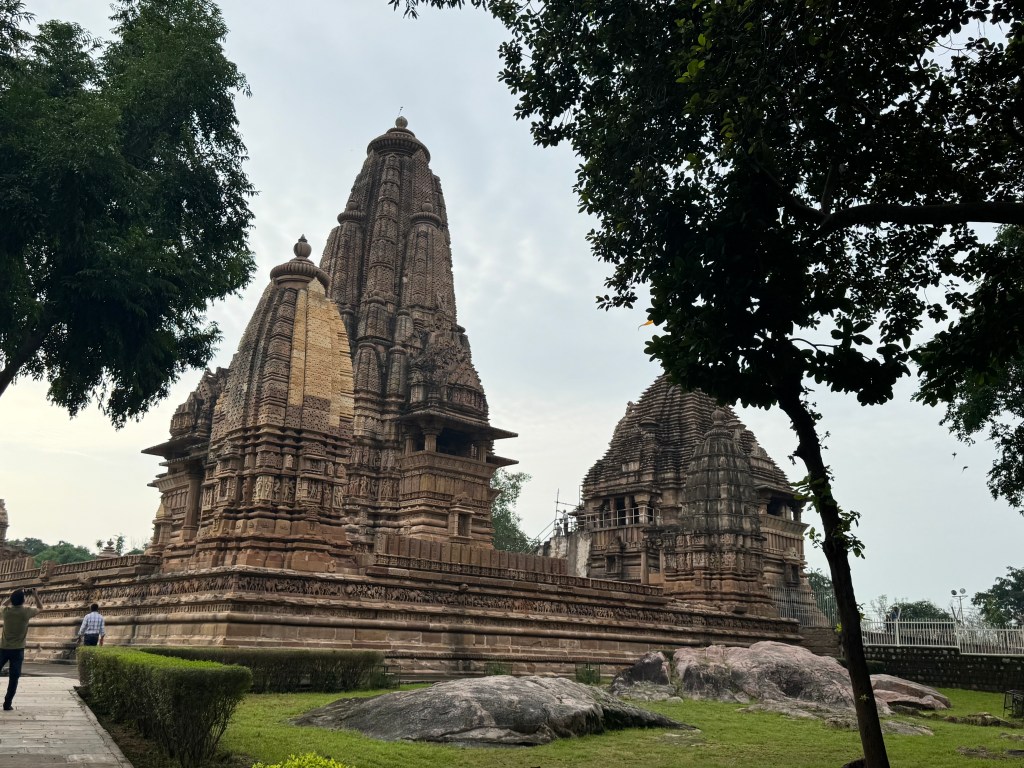
There is something quaintly amusing about my visits to the Khajuraho temples. My first trip, more than forty years ago, was a 75-minute whirlwind tour, including the journey from the airport to the site and back. The circumstances in which I saw the sculptures were far more memorable than the monuments. I have written about that trip in an earlier post: “The Unforgettable Throttle Dutt and his Flying Machine.”

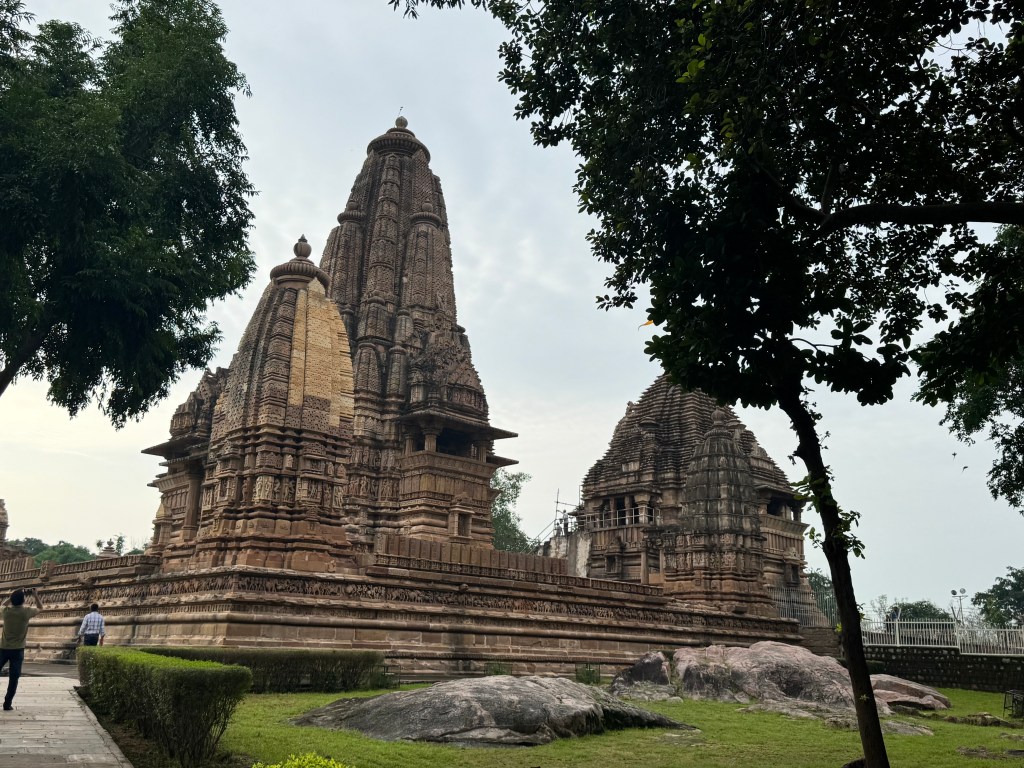
My second trip to the heritage site last weekend likewise became memorable for a reason quite apart from the grandeur and beauty of the place. A chance meeting and interaction with a rare specimen of Gen Z gave my excursion an entirely unexpected significance and meaning.

O Khajuraho!

It happened when the train stopped at Gwalior Railway Station and I got up from my seat to stretch my legs.

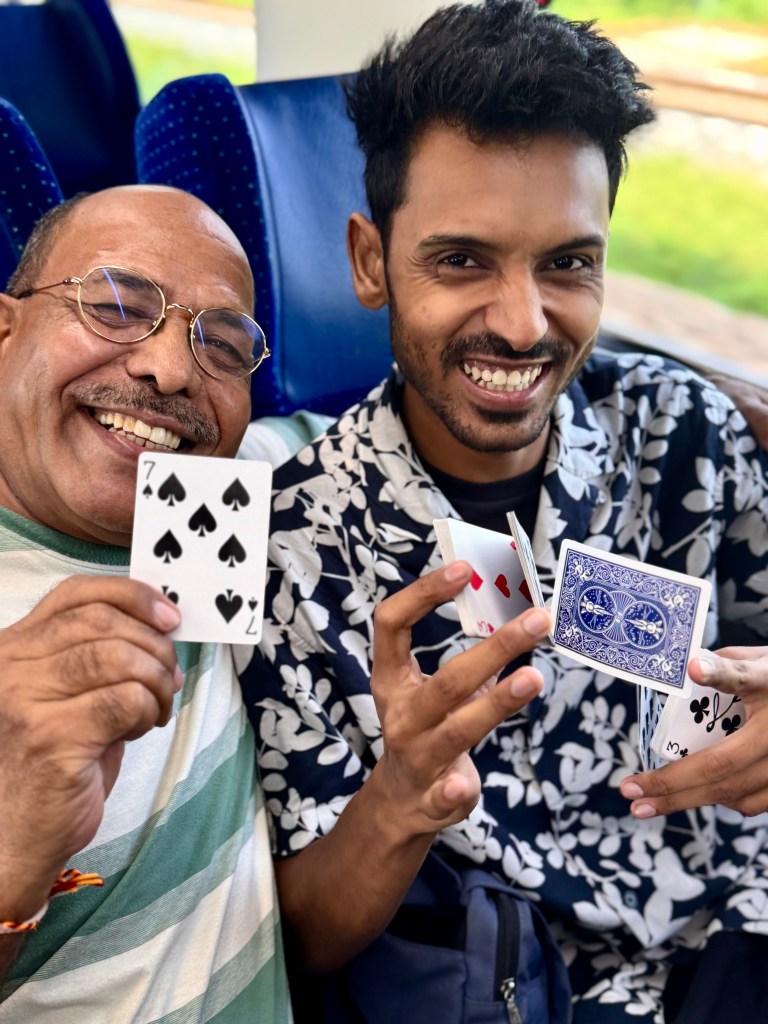
“Sir, please hurry up if you are getting down here. The train will start any minute,” Sonu Diwaker said to me with deep concern. He was seated alone at a window seat—the seat next to him was vacant.

His stubbled chin, uncombed hair, listening pods stuffed into his ears, floral shirt, cargo trousers, sports shoes, the glow in his eyes and, above all, his body language made me take him for one of those Gen Z youngsters who had made news a month ago.

How wrong I was! He wasn’t it. He wasn’t one of them. Rather, in the ensuing interaction, I discovered a focussed gem of Gen Z in him.

I looked him in the eyes and said without the words leaving my lips, “Yes son! Talking to me?”

When he saw that his words didn’t inject any urgency in me, he removed his ear-pods and spoke again, a bit subdued this time, “The train is about to leave, Sirr…” He stopped midway, sensing that I had no intention of disembarking.

“How do you know, I have to get off the train? Do you read minds?” I grinned.

Now it was his turn to chuckle. He said excitedly, “Of course, Sir, I am a mentalist. I read minds, predict choices and influence decisions.”

“O my God! Can you read my mind?” I asked him and sat down next to him.

An audience is as important to performing arts as a believer is to a miracle. Through the following hour, I was Sonu’s cherished believer. For me, he was a coveted book I wanted to read.

He took out a pack of cards and in minutes stole 60 years from me and turned me into an ecstatic child of seven who wondered, “Is he the reincarnation of Mandrake the Magician.”

The Mentalist

I have been enthralling grandchildren in my clan-like large family with similar tricks and have maintained that I cannot be tricked. But here was this twenty-something foxing me beyond my imagination with his words and sleight of hand.

As we went along, he satisfied my natural curiosities.

He enlightened me about what exactly mentalism was. Until I met him, everything was frivolous street-magic to me. He had left studies to pursue his dream of becoming a mentalist. At a time when young people his age are thronging Jantar Mantar over paper leaks and reservation in educational institutions; I found the decision of this son of a man who provides ironing service to people daring. Very daring!

He completed homework and wrote assignments for other children to manage the fees for his guru, Mr Shankar Bakshi to whom he gives 50% credit for his being a successful mentalist. To cut cost, Sonu taught himself and developed tricks on his own too. Today, he mesmerises people from Connaught Place and Select City Walk to Dubai. He is also pursuing a law degree.

“Some paths trodden by Gen Z do not pass through Jantar Mantar.”

We could have gone on and on, but it was time to part when the train reached Jhansi. I had set out for Khajuraho expecting to be fascinated by the 1100-year-old sculptures. Instead, the chance encounter on the train introduced me to an equally fascinating specimen of Gen Z. My biggest takeaway from our meeting was his willing acceptance of me as his pupil—and his invitation to be part of his team someday.

The Unforgettable Throttle Dutt and his Flying Machine

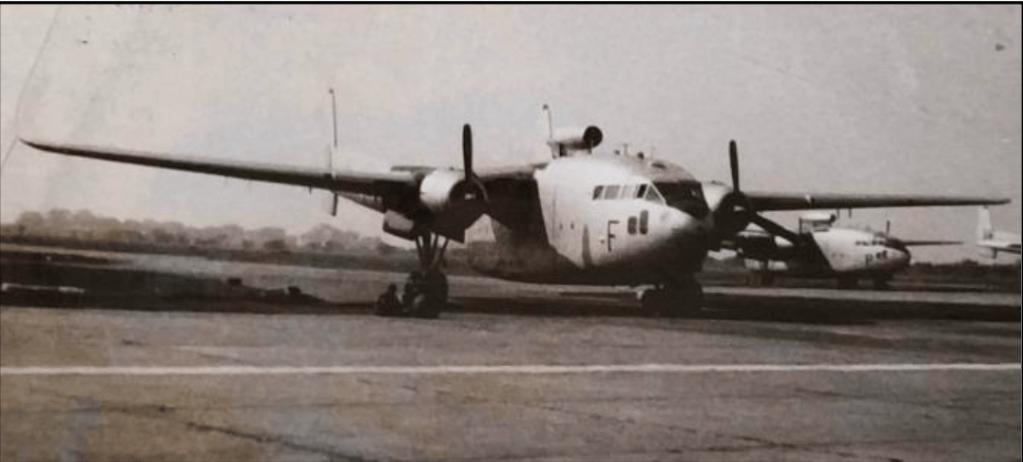
C-119 Fairchild Packet…

Legend has it that after the Korean War the Americans didn’t want to take that aircraft back to the US and offered it to India at a paltry Rs 5,000/- an aircraft; some say, the aircraft were passed on for a mere one USD each. A number of them were certainly donated by the US, to address India’s dire need. Interesting indeed! An aircraft de- commissioned by the US became a workhorse for the IAF.

Packet aircraft remained the mainstay of the IAF’s transport aircraft fleet from the mid- 1950s (around the time when its production stopped) until she was finally given a place of honour in the Air Force Museum at Palam (March 31, 1986). Whether it was to serve the UN in Congo or to airlift relief supplies to Egypt and Hungary; whether it was to land guns and men at Chushul (India-China War, 1962) or to paradrop troops over Tangail (Liberation of Bangladesh, 1971); whether it was to ferry Prime Minister Nehru on a state visit across the Iron Curtain to Moscow or to ship Lieutenant General AAK Niazi from Dacca to Nagpur (1972)––Packet did it all, and did it in style and with élan. The Packet fleet also undertook air maintenance task and paratrooping training as a matter of routine.

…defying gravity and the principles of flight.

A look at that aircraft would make one marvel at its ability to defy the laws of gravity and the Principles of Flight. In appearance it was quite un-aircraft-like — its designers called it a Flying Boxcar. Others, less kind in their treatment of the workhorse, gave it the epithet of Flying Coffin. One wonders, “With not-so- appealing (streamlined) features, how a Packet aircraft used to (at all) get unstuck, let alone get airborne and stay afloat?” Well! Packet aircraft had a wingspan of 110 feet. Its engines were the most powerful engines ever built in piston engine era. They produced 3500 horsepower for a weight of 3350 pounds, that is, more than a horsepower per pound of weight. With that brute power, the aircraft could land at Daulat Beg Oldie, the highest airfield in the world. That was in the years 1962 to 1965––more than half a century before the first C-130J Super Hercules landed there. The great Indian Jugaad of installing a jetpack atop the fuselage gave Packet aircraft the added power needed to achieve marvellous feats. Interestingly, Packet was the only aircraft, which had both, piston engines and a jet engine to provide thrust.

My first acquaintance with the aircraft was in February 1982 when I flew for an air experience. And, before I could get the real feel I had boarded the aircraft a second time, for my first parachute descent. In the following 35 years, as a Parachute Jump Instructor (PJI) I have jumped from nearly a dozen different types of transport aircraft of the IAF––from the vintage Dakota and the Caribou to the state-of-the-art Special Operations aircraft, C-130J Super Hercules. But the memory of the jumps made from Packet aircraft is indelible.

Creating history…

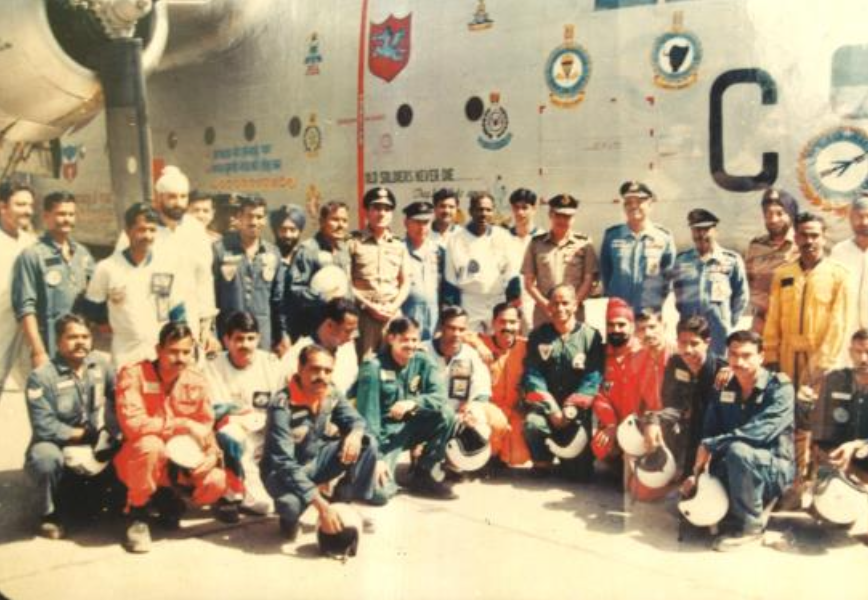
As the mind perambulates between now and those days, I recall that it was the magnificent men who flew that machine that really made jumps and life so memorable. I feel that Packet used to fly not because of its overly powered engines, but because of the willpower of the men in blue. Volumes can be written about those memorable days and those heroes. Today I’ll recall just one.

We called him Throttle Dutt.

As the name suggests, he was indeed throttle-happy––ever eager to hop into the cockpit and fly off. Rex Raymond, his course-mate thought, that nickname suited SK Dutt also because of his resemblance to the thin (read, “slim”) shaft of the throttle of a Piper Cub aircraft, which they flew as youngsters. We, the Parachute Jump Instructors (PJIs) knew that if there was an airworthy aircraft on the tarmac and Throttle was around, we’d get our fill of jumps––he would stop only after the task was completed.

Whenever Wing Commander SK Dutt dropped us, we would land in the Drop Zone, evenly scattered on either side of the centre; his name spelt confidence. He would often come to our crew room and, over a cup of tea discuss almost everything under the sun. He was a voracious reader. No wonder, some of his buddies called him Professor.

That day I was anxious about the jump; I had reasons to be in that state of mind. It was my first outstation jump as an independent spotter. Wing Commander GJ Gomes, our Chief Instructor at the Paratroopers Training School had detailed me to take charge of the Skydiving Demonstration at the ASC Centre at Gaya. It meant that I would be required to work out the release point depending on the prevailing winds and advise the pilot to drop the jumpers. To achieve that, I would be required to lean out of the open door of the aircraft in flight and advise the captain on the intercom to steer the desirable course, with last minute corrections. Skill of the skydivers apart, a good understanding between the pilot and the spotter is the key to pinpoint drops.

O Khajuraho!

I had lined up the skydivers on the tarmac at Gaya Airport and had just completed the pre-jump briefing, when a smiling Throttle Dutt and Squadron Leader Venkiteswaran (the pilots) arrived and signalled us to emplane. They wished me good luck and were about to board the aircraft when Captain Anil Kumar, one of the jumpers walked up to Throttle Dutt and said, “Sir, Khajuraho will be on our way when we fly back to Agra after the demonstration jump…” Then, with wickedness swirling in his eyes, the young officer added, “How about flying a little low over the temples. May be we’ll get a glimpse of the beautiful statues.” He laid extra stress on ‘the beautiful statues’.

Throttle chuckled equally slyly and nudged him towards the aircraft ladder as if to say, “Son, first go and do a good jump.”

The demonstration went off very well. All the skydivers landed in the designated target area in front of the spectators. Wing Commander Gomes was pleased; the crew complimented me when we reached the tarmac after a lavish lunch and fanfare, which are synonymous with such demonstrations. Incidentally, with that jump I completed another century of safe landings. Very soon we were airborne again, heading for Agra. There would be a refuelling halt en route, at Allahabad.

Partly the fatigue, and partly the odd beer or a gin and lime cordial that people had downed at lunch, started taking its toll. Wickets fell one after the other. Within minutes of our departure from Gaya, more than half of us were asleep; the other half were fast asleep. None kept track of time. The chitchit in the ears caused due to the aircraft’s descent and the mild thud associated with the landing, jostled people from their deep slumbers. Rubbing the eyes and trying to get the bearings right, someone asked, “Allahabad? How much time will we take to refuel?” That question went unanswered as more and more people got up and started looking out of the windows. Sleepiness and the fogging caused by their breaths on the cold Perspex conspired to keep them from getting their dead reckoning. It actually didn’t matter because: Throttle Dutt would ensure our return home by dinner.

…the unforgettable Throttle Dutt

As was customary, people waited for the captain of the aircraft to come out of the cockpit and deplane first. Then, they would form a beeline to the nearest rest room. The fastest would get relief first. “Guys!” Throttle Dutt said as he clapped twice and drew the attention of the people still shuffling restlessly in their seats. “I am giving you exactly one hour and fifteen minutes,” he looked at his wristwatch and continued,” It is three now. Be back by four fifteen. We are in Khajuraho; the temples are not far. You can have a look as I get the aircraft refuelled.” He exchanged a meaningful glance with the young officer who had made the suggestion at Gaya Airport.

Throttle Dutt had chosen to refuel at Khajurao instead of Allahabad––it was his way of keeping the morale of the people around him high without, of course, compromising operations. Four thirty was the closing time for that less used civil airport. For the next ninety minutes Throttle would have a tough time handling the airport staff.

It took the greater part of a long minute for the import of Throttle’s communication to sink into the heads of the jumpers. And when it did make sense, they got into action; they couldn’t afford to waste another minute. It was precisely a three-minute, all male striptease inside the aircraft, at the end of which men were in smart casuals. They couldn’t have gone out in the streets in overalls and dungarees.

In the next few minutes two scores of crew-cut men were out in the narrow streets invading the sleepy little town of Khajuraho. They caught hold of any means they could––cycle rickshaw, auto-rickshaw, tonga and some even jogged to reach the tourist attractions.

Meanwhile at the airport…

A worried air traffic controller begged Throttle Dutt to clear the tarmac. He said there wasn’t enough space to accommodate an Air India B 737 aircraft scheduled to land in a while. Throttle assured him that he would move his aircraft further back and create enough space on the tarmac for the incoming B 737. Then, Throttle got into the cockpit, started up the engines and used reverse thrust to create manoeuvring space for the B 737 in full view of a spellbound Airport Staff. It was a sight, they had never seen––they had never seen any aircraft, let alone a massive one of the size of Packet, moving backwards under its own power.

And although that act of reversing the aircraft on that small manoeuvring surface impressed the controller, it did not allay his anxiety. He now urged the crew to get airborne by four thirty; that was when the watch hours at Khajuraho Airport would cease. Throttle assured them that we’d leave in time.

Back at the Temple site––they went; they saw; and they felt conquered! How the jumpers felt after their visit to the Temples could be the subject of another piece. Suffice it to say that they did not talk about it. Perhaps, how Throttle Dutt made it possible for the bunch of those curious men, and the effort it took to reach the heritage site, was more interesting and memorable than the beauty and the artwork people got to witness there. Period. The entire lot was back at the airport in time for the take off. They lined up and got into the aircraft hurriedly. Throttle Dutt gave an impish smile to a beaming Anil Kumar as he climbed the ladder to take off for Agra.