Brother Officer

Wing Commander Ranjit Singh Mann left early. But he knew of his inevitable early departure. Very thoughtfully, he had prepared his family, Mrs Mann in particular, for life after he was gone. He trained her and left her an unwritten SOP to go by. So, when he finally departed, there was only the vacuum to be dealt with, most other aspects of life had been taken care of. Mrs Mann stayed in their flat in Gurugram for a few years before she moved to Bathinda to occupy their house which was being eyed by vultures in the absence of the owner. She did well on that front; had a good grip on evolving situations in which most people would buckle. Life moved on.

When faced with a health concern that could be addressed better in Delhi than in Bathinda, she sought an appointment in Max Saket and travelled to Delhi. What followed was not covered in her SOP. I was a silent witness to it.

Conscious of the heavy traffic and parking woes, we started from my home with sufficient cushion time. That consideration paid off because we found a parking slot far away from the main building. I felt sorry for Mrs Mann who had to walk a long distance on a dusty, uneven pathway between haphazardly parked cars. Nearing noon, the sun was adding to her woes.

Mrs Mann was to travel to the US shortly. Back in Bathinda she had been advised to undergo surgery related to varicose veins. Since she didn’t have much time in hand, she wanted to seek a second opinion and undergo the surgery if mandated by the specialist at Max Hospital.

When we reached the reception just about in time, we were told that it was not Dr Kumud Rai’s OPD day. The Principal Director of Vascular Surgery Department was not seeing patients.

“But I have a confirmed appointment with him,” said Mrs Mann, a bit rankled.

“If that be so, you can see him in the adjoining building,” advised the receptionist.

Unaware of the golf cart facility available at Max, we trudged about half a kilometre, part in the sun and part through winding corridors in the hospital buildings to reach the location. There, at another reception, was a long queue of patients registering their names to meet different specialists. I could see mercury rising in Mrs Mann’s head as we kept crawling forward. We were more than half an hour behind the slotted time with Dr Kumud Rai.

Mrs Mann exploded when our turn came and the receptionist told us that the registration for the ECHS Card holders was at a different location. Going there, registering and then reporting to the specialist would mean that we would be late by more an hour.

“We have been running from pillar to post for more than 40 minutes. Somebody should have guided us through this maddening maze.” Mrs Mann raised her voice.

The receptionist stood silent. Her eyes seemed to say, “I am sorry Ma’am. But that’s the way it is. Registration for ECHS is where it is… for your own convenience.”

Agitated, she dialled Dr Kumud Rai directly to give the specialist a piece of her mind. I smelt trouble and requested her to hand me her mobile. I was expecting a female voice at the other end.

“Hello, Dr Kumud Rai here.” I took a long second to realise that Kumud could be a male name too.

Then without wasting another moment, I delivered the monologue, which I had prepared seconds before and rehearsed too.

“Good afternoon, Dr Rai, I am Group Captain Chordia. I have come with Mrs Mann to Max. She had an appointment with you about half an hour ago. We were in the hospital premises on time but we have been wandering around cluelessly, still trying to register. I’ll be grateful if you could help us out.”

“Okay, I am handing the phone to my assistant. Please tell him where you are. He’ll send someone to assist you.” Dr Rai was busy as we could see.

Very soon, one of the hospital staff came and helped us clear the red tape and, before I could say ‘Jack Robinson,’ we were face to face with Dr Rai.”

Mrs Mann had carried the baggage of our recent experience into the doctor’s chamber. “We have been running from pillar to post for an hour…” she let out a volley when she got an opportunity to speak to the doctor.

Dr Rai poured a bucket of freezing cold water on her, “Ma’am, please calm down. Group Captain Chordia has told me in great detail about the torture you seem to have gone through. Those were procedural requirements. Unfortunately, you were inconvenienced. Now, please tell me what your medical problem is?”

Mrs Mann narrated her condition and showed him her medical history. “Dr, I want to know if surgery is necessary as advised by the doctors in Bathinda. If yes, how soon can it be done? I want to leave for the US within next two months.”

Dr Rai scrutinised Mrs Mann’s reports and said, “Get that person to me who says you need surgery. You don’t need it. You can leave for the US fearlessly. I’ll only advise you to use compression stockings.”

“I am already using compression stockings,” said Mrs Mann.

“Custom-made ones are better. If you wish, you can order them here and they can be delivered to you in Bathinda in two days.” [Note: After we were done with Dr Rai, we met a specialist who took measurements and the compression stockings were delivered to Mrs Mann in Bathinda.]

Dr Rai was interrupted a few times while he dealt with Mrs Mann. He disposed of each matter summarily and with intent. He was multitasking efficiently without ignoring the patient in front of him. 

“Anything else?” enquired Mrs Mann.

“I suggest an ultrasound to help us determine an even clearer course of action.”

“Can I get the ultrasound done today?” asked Mrs Mann.

“I am afraid, ultrasounds are done with appointment and there is a queue there too… wait, let me see.”

He dialled a number on his mobile and spoke to someone in the X-Ray and Ultrasound department. “How busy are you? Can you help me with an ultrasound? It’s a brother officer’s wife…”

I don’t remember what he said after that. But that last bit—‘It’s a brother officer’s wife…’—stayed in my head; kept echoing till he completed his call.

When he was through, I asked him if he had a service background.

“I took premature retirement as a Colonel,” he said.

For Mrs Mann and me, the atmosphere in the room changed instantly. The drudgery of the hour gone by was replaced by fresh fragrant mountain breeze.

I have always felt proud of my uniform—my service. Some occasions instil extra pride. This moment with Dr Kumud Rai was one of them.

Dr Rai not only saw Mrs Mann and examined her papers but also helped us get a priority appointment for the ultrasound. Mrs Mann didn’t have visit Max again to discuss the report with Dr Rai. The gentleman doctor saw the report and advised her on the phone.

A brother officer!

Golfing with Ashok*

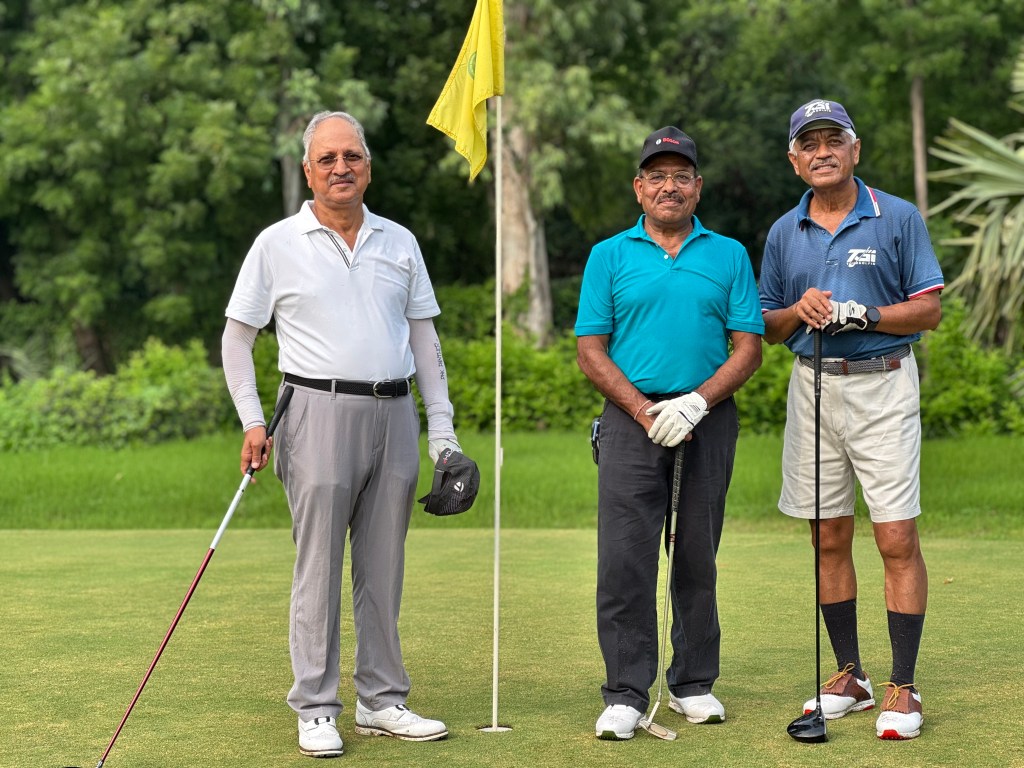
Last Monday, I had a remarkable round of golf. I played just nine holes and that, too, after a break of about six months. I had no pars, no birdies; four bogeys and some double bogeys. Besides, I lost two new balls during the round. Despite these apparent setbacks, what made the game immensely enjoyable was the company. I played with my own young self of 35 years ago. Let me call him ‘Ashok*’, for he was so different from me, the Ashok of today. Air Vice Marshal Sudhanshu Rath and Brigadier Dixit were the others who completed our four-ball.

Beyond the weather…

Teeing off at six on a Monday morning at the Air Force Golf Course has a distinct advantage beyond the beautiful weather and calm of the early morning. There is less rush—the serving officers are back to work and many a golfer takes a break after a weekend of partying. As a spin-off, caddies are more easily available than on other days. There is that feeling of ownership of the golf course.

Ashok* gave me a questioning look when I teed up with a new Callaway golf ball on the first tee. Later, he asked me, “Why did you tee up with a new ball? Wasn’t that your putting ball?”

“I tee off with the best ball in my bag and I use the same for putting,” I told him.

“But that way, there is a greater possibility of losing a new ball.”

He wasn’t convinced when I told him that the aerodynamics of an old, worn-out ball are unpredictable and affect one’s game adversely in ways that one doesn’t even realise. I suggested he read my post on the putting ball. He gave me an I-told-you-so smile when, in the very next shot, I sent my ball into a palm tree, not to be seen again.

In contrast, Ashok* hit an old, chipped ball, hard and straight, down the long fairway. It veered to the right towards the end of its 220-yard flight and landed in the rough. The little extra time his caddie—a rookie who had begun caddying just three months ago—took to locate his ball annoyed him. “It seems I am caddying for this guy rather than he caddying for me,” Ashok* grumbled.

The rains had endowed the course with lush fairways, but they had also rendered the rough and the bunkers difficult to play. So, we had mutually agreed to play preferred lies through the course. Rath, Dixit and I improved our lies whenever we felt the need, but Ashok* was determined to play the ball as it lay—he wanted to stick to the rule book. His stickler-for-rules attitude cost him strokes and frustrated him. To vent his anger, he cursed his caddie for not knowing his job.

On the fifth green, lying about 10 feet from the pin, I asked my caddie, ritualistically, how the green was.

“Sir, it is medium.”

That answer made me laugh because, since I started playing golf in 1991, very few of my caddies have reported the greens to be slow or fast. ‘Medium’ is the safest bet. With that ‘tip’, I landed well short of the hole and took a peaceful three strokes to putt. I overheard Dixit’s caddie also reporting the green to be ‘medium’. Dixit, too, landed short and took two to putt. With another ‘medium’ report, Rath was able to execute a 6-foot putt. Seeing the two of us fall short and miss our putts, while Rath got his, Ashok*’s caddie was confused. He told him that, for the young golfer, the green was ‘slow’. So, our man hit hard, ended up well past the pin, and took four to putt. Obviously, Ashok* was utterly cheesed off, and rightly so—he was using a new putting ball with a line marked with a permanent marker for alignment.

Kabhi khushi, kabhi gham continued until we began walking to the ninth tee. Three of us were enjoying ourselves, but Ashok* was serious about his game and score. Lost in his thoughts, he inadvertently distracted another four-ball by walking across their fairway.

…and don’t miss Ashok* in the pic.

The tee shots of all three of us for the ninth hole were good. For the second shot, there was a water hazard between me and the green—about 150 yards from me. I was going to use a 7-wood, which gives me about 170 yards to land beyond the water hazard. Ashok*, standing next to me, suggested that I play safe: take an 8-iron and drop short of the hazard. I thanked him for the advice but didn’t heed it. My ball landed well beyond the water hazard. I missed out on a par and ended up with a bogey.

Rath and Dixit wanted to continue—play the back nine. Ashok*, rattled by the caddie, looked for another caddie for the back nine. He too decided to leave when he didn’t find a ‘good’ caddie.

In the parking area, when I bade goodbye to Ashok*, he responded with the usual niceties and asked me, “How long have you been playing golf?”

“Nearly 35 years.”

“Hmm…” He paused, gave me an inscrutable look, and continued, “And what’s your handicap?”

“My honesty,” I said, without batting an eye.

I am sure my younger self of 35 years ago, wouldn’t have understood me, for he continued, in a tone which sounded sermonising and cheering at the same time, “Although your scores aren’t anything to write home about, you play calmly, and you dare to experiment and choose difficult shots. How does that come so naturally to you?”

“Maybe because I belong to Generation Jones and learn from Gen Z,” I said as I drove off.

The Second-Best Thing About Playing Golf

The Putting Ball

Golf and Gandak

Guru Nanakji & Golf

Parliament & Champagne

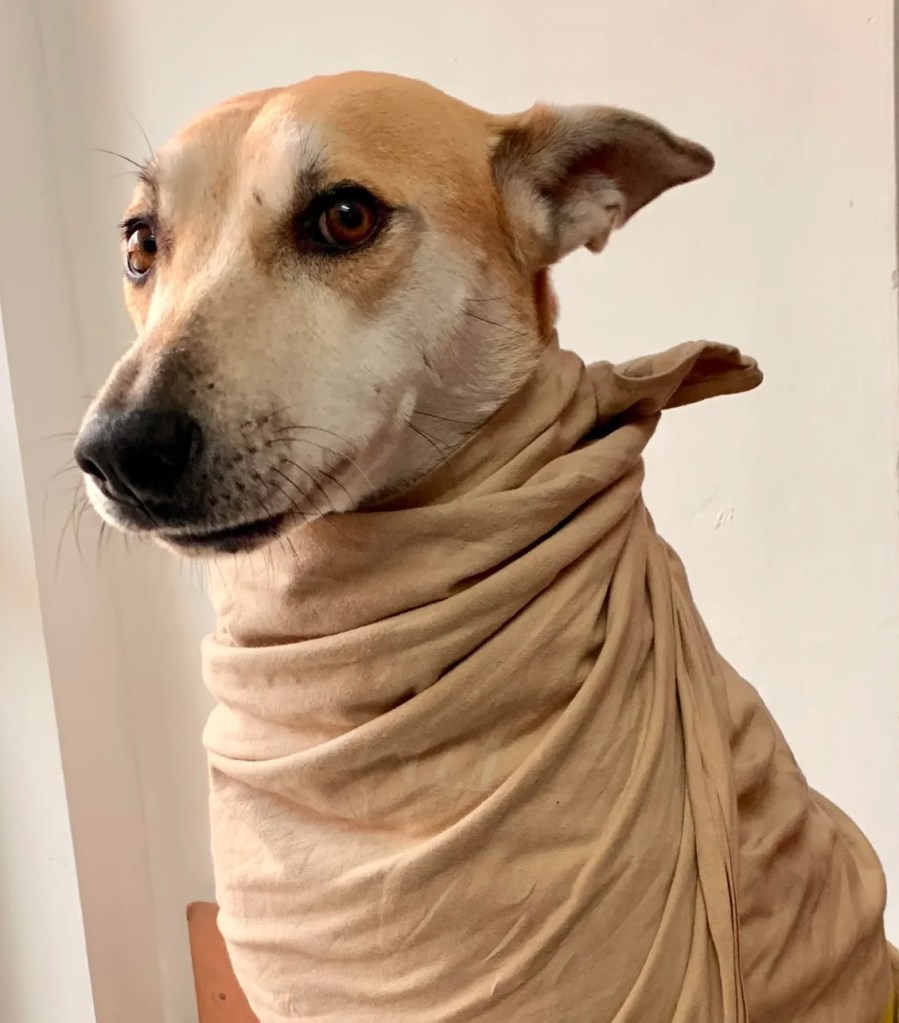
Lest there be misunderstanding—Champagne is not the bubbly drink made in France; he is the stray who has made my doorstep his home— living there for a dozen years, wagging his tail and biting me twice during that period.

…in his heydays

Lest there be a bigger misunderstanding—this parliament being talked about is not the parliament of owls as one would construe it to be from the mention of a stray dog right in the beginning. This is about the Parliament where the elected representatives of the people are expected to sit and conduct the affairs of the country. Just ‘expected.’

A word about Champagne. I love him for he loves me too. And I bet his love is unconditional and purer than mine, despite the two courses of Rabipur vaccine he thrust upon me. He guards my house against ill-intentioned strangers. I believe he keeps away evil spirits too. We read each other’s minds. I confess that I had stolen his thoughts to write his (autobiographical) story five years ago. On numerous other occasions, I have ‘used’ him to simplify and explain everything from international relations to a complex country like China.

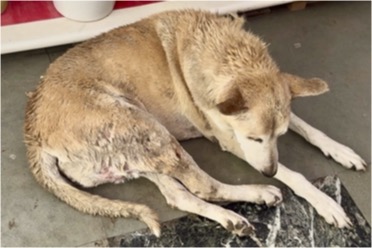
…wounded, hurt and humbled

He is valuable to me—he doesn’t let the ink in my pen dry up.

Recently, around the time Parliament was supposed to be meeting for its monsoon session—but was adjourned, apparently for reasons for which no one can be held accountable—Champagne was badly hurt in a hit-and-run incident. He is now admitted in Noida Animal Shelter and Hospital, struggling for life.

[Author’s Note: Readers with a heart may pause here and offer a prayer for Champagne’s speedy recovery.]

My visits to that complex have been an eye-opener. I have been only to the areas meant for dogs. There are hundreds of them—mostly sick or wounded—barking, fighting. There is dirt; there is stench. The buildings are dilapidated; equipment and the very basic amenities and facilities are either damaged, in beyond-repair condition, or just not there. My impression was that the shelter was understaffed too. But during the time I spent at the shelter looking up Champagne on my several visits, I was amazed by the dedication of those on duty. In my assessment they were more dedicated and conscientious than the representatives mandated to work in the cosy comfort of the temple of democracy. Despite the dismal conditions, those people went about their duties. To me, they were as voiceless as the wretched curs they were serving and treating.

Deserving more? Parliament or…

The monsoon session of the parliament got washed—certainly not by the rain. In the many debates taking place in the media, the cost of doing no-business is estimated at crores of rupees. If the same amount had been allocated to Noida Animal Shelter and Hospital, it’d have been better utilised—Champagne recovered, and we’d have said cheers!

PS: It being an animal matter, there was a suggestion to approach the cockroaches and ask them to rise in support of Champagne and others of his ilk. The brilliant idea had to be given up as soon as it was mooted, because the plates of the arthropods were full and they had become choosy—they had just rejected the idea of picking up the cudgels for the students of Bihar.  

PPS: For readers interested, here are some posts in which I have exploited Champagne’s personal life for my motives…

Champagne

China’s Champagne Moment

Dealing with the Darned Dragon-V: Time to Kowtow?

Delhi’s Dogs of War

Stumbling on a Purpose at 60

About Condoms and Conflicts

For long, very long indeed, I have maintained that in October 1947, it was the prompt action by the fledgling Indian Air Force, of airlifting the troops to Srinagar, that saved the Kashmir Valley from falling into the hands of the Pakistani raiders. Then, I came across the following view of Dominique Lapierre and Larry Collins in “Freedom at Midnight”:

I don’t buy this view entirely. But, having read it, I do acknowledge the role of animal instinct of humans to satisfy their need for physical intimacy even in critical times.

Look at Gaza… that small stretch of land has been under heavy bombardment since October 7, 2023. At a time when survival is at stake, babies are still being born. The Gazans, (un-)like the invaders of Srinagar, have been satisfying their physical need. There is a difference though: the Gazans are not raping Palestinian women.   

A large number of these babies birthing in the war zone are getting orphaned at birth. Also, many children who were born in the few years before October 7, 2023 have likewise, either died in the bombings, or have got maimed, or orphaned. Those who have died will end up as statistics in history books to be written by the victors. It is difficult though, at this point, to say who’ll be the victors: US-Israel or, China-Russia? Or, is it possible that there’ll be only losers in this conflict?

Today, one doesn’t need to consult a crystal-ball gazer to foretell what will happen of the children of Gaza (Iran, likewise). They will grow up with haunting memories. Some of them will lug grudges to their adulthood and smuggle them to other parts of the world. Smartest of customs and security at border posts will not be able to detect the ill-will they’ll carry in their minds and hearts. 9/11 was executed by such people. Who knows, the architects of 9/11 (2.0) might already have been born.

Condom bombs

Could there have been a different future for the Gazans, and the world? May be, yes.

Last year President Donald Trump claimed that he had blocked a USD 50 m aid to Gaza meant for supply of condoms. According to him, Gazans were using them as balloons to float incendiary devices or explosives. This assertion about ‘bomb-making condoms’ was part of a larger, widely debunked claim regarding US foreign aid spending, highlighted by Trump’s press secretary Karoline Leavitt and further circulated by the media.

Had this US aid to Gaza not been stymied, perhaps lesser number of destined-(read ‘doomed’)-to-be-sad people’ would have taken birth. A Gazan might even have used the condoms to carry drinking water and thanked the Americans for giving them a chance to survive. Under the existing circumstances, the very assumption that Gazans are still left with incendiaries and helium gas to give shape to Trump’s fears, seems far-fetched.

Around the same time a media report warned: “West Asia war threatens condom shortage in India.” Priyanka Sharma in the MINT opined that hold up of some shipments would affect production of condoms in India adversely. Someone was fast to comment: “If the US does not pull out in time, Indians will have to learn to pullout in time.”

In the end, it is worth mulling: “Would the world have been a more peaceful place today, had the parents of some of today’s leaders been practicing celibacy or using condoms.

To conclude these random thoughts: “War does not suspend human nature; it exposes it. And perhaps the deeper question is not whether life should continue in times of conflict, but how the world can ensure that those born amid violence inherit something better than its memory.”

Comments

Air Mshl PK Roy PVSM, AVSM, VM, VSM (Veteran): Thanks for a thought provoking reflection on the enduring human cost of conflict. Beyond strategy and geopolitics, wars leave their deepest scars on children, whose memories often outlive the battles. Lasting peace demands not only ending wars but also breaking the cycle of inherited trauma and hatred.

Wing Commander Vijay Ambre (Veteran): Your latest blog about ” Condoms and Coflicts” made for interesting reading. Wars do bring out the worst in human beings ; but there are always a few very noble acts by some others.
The indoctrination and conversion of young boys and girls into extremists/terrorists to avenge the conceived wrongs done to their religion/nation is now quite common.
Yes ! The world would have been a much better place to live in, had the parents of some leaders had gone in for contraception.
Thanks!🙏