
There are times when the living envy the dead.
There’s a pause in the fighting…
Troops are sprawled on the sunny side of their camp. These are the boys who had been pulled out of schools; given doses of patriotism and conscripted to fight for the country. Ill-clothed and ill-equipped, sometimes, they wait anxiously for a dying brother-in-arms to breathe his last to stake a claim to his boots and other accoutrements. They are disgusted as they had just had an hour of saluting practice because one of them had greeted an officer sloppily.
“Watch out, lads! We’ll lose the war because we are too good at saluting,” says Kat. The frustration is evident in the senseless talk.
Kropp says philosophically, “All declarations of war ought to be made into a kind of festival, with entrance tickets and music, like they have at bullfights. Then the ministers and generals of the two countries would have to come into the ring, wearing boxing shorts, and armed with rubber truncheons, and have a go at each other. Whoever is left on his feet, his country is declared the winner. That would be simpler and fairer than things are out here, where the wrong people are fighting each other.”
The above is an excerpt (abridged and reworded for flow) from All Quiet on the Western Front by Erich Maria Remarque. The novel is set in the Europe of the First World War. It exposes the brutal realities of war and traces the disillusionment of soldiers. It underscores the lasting impact of war on their minds and emotions. Remarque’s literary masterpiece is a powerful reminder of the human cost of conflict.
Wars are fought for one or more of the following reasons: territory, resources, or ideological differences. They follow an almost set pattern or cycle—differences arise; discussions take place; diplomacy fails; military action follows; the two sides fight to exhaustion, or until one side—or both—recognises the futility of seeking a military solution. Finally, the warring sides return to dialogue. Interestingly, wars end where they begin—at the negotiating table. But, in the process thousands (sometimes millions) of lives are lost; economies are shattered. At times, the living envy the dead.
Kropp sound ‘NUTS’ when he suggests that disputes between countries be settled between leaders wearing boxing shorts using truncheons. But an equally nuttier solution was tried at least once to resolve a territorial dispute between states. And, it really succeeded in arriving at a permanent solution.
The story goes like this. When the colonies declared their independence from Britain, New York State and New Jersey both claimed Staten Island. It was decided to settle the matter with a sailboat race around the Island. The two states sent their best sailor. One Captain Billopp won the race for New York and the island became a part of New York State. Simple!
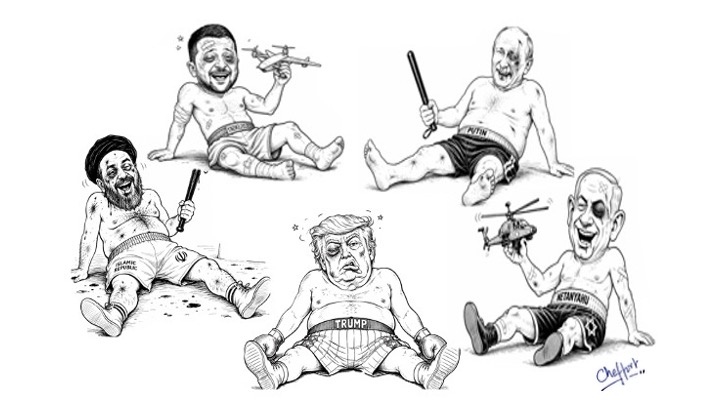
Fast forward to today, to the wars in Ukraine, Iran, Gaza, Israel and Lebanon.
Imagining peace descending upon today’s world through physical scuffles involving the likes of Donald Trump, Mojtaba Khamenei, Benjamin Netanyahu, Mahmoud Abbas, Vladimir Putin, and Volodymyr Zelenskyy sounds absurd. Yet the idea of these same leaders returning to negotiating tables after millions of lives have been lost is equally absurd.
Does it mean that thousands of lives would have to be lost every time before sense dawns on the leaders?
Sacking of several general officers by the Pentagon and the many desertions in the Russian Army is a clear indication of the fact that the days of the Charge of the Light Brigade are over. Political leaders and diplomats will have to find ways to break the cycle—negotiation, war, negotiation again—with thousands of lives lost in between. The question remains: must we always bleed before we negotiate?

