
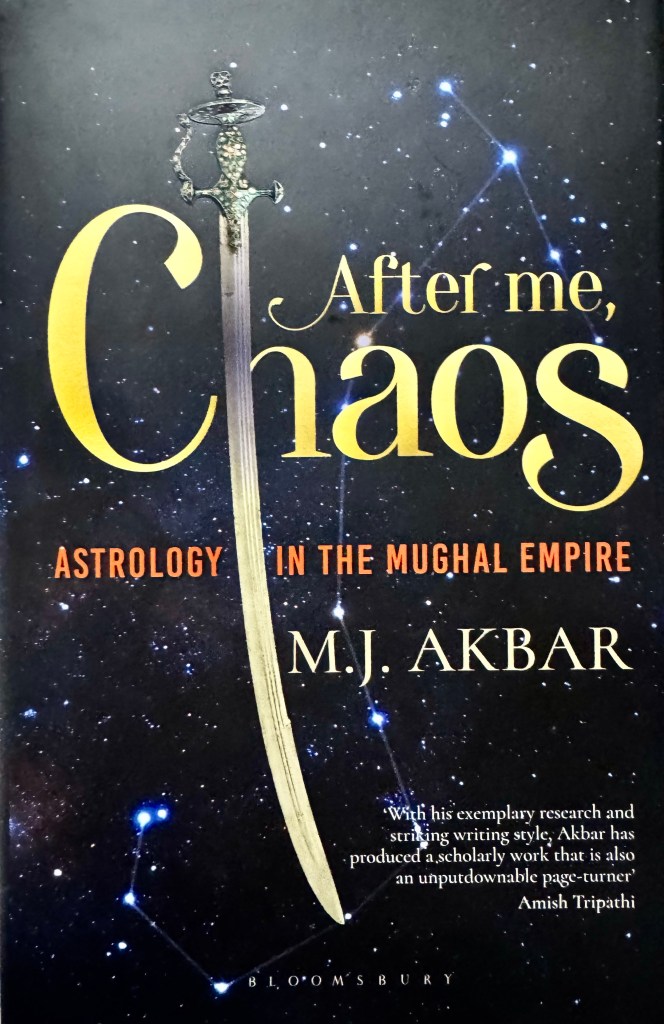
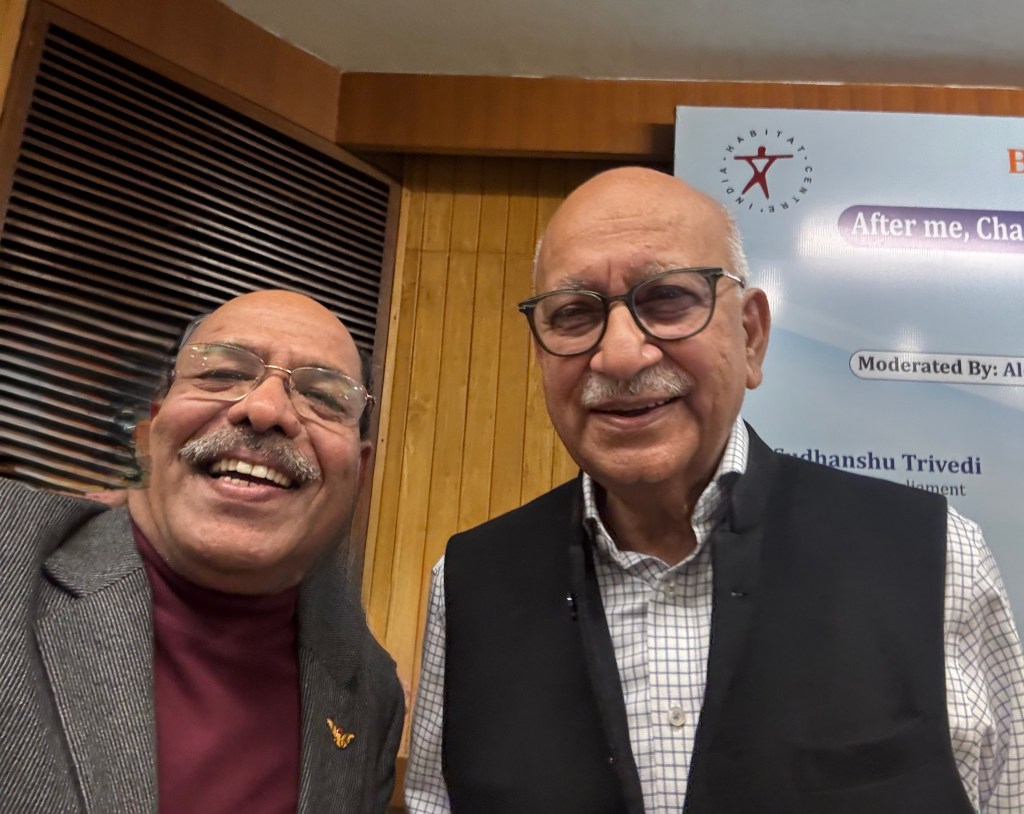
By some quirk of fate, I—a confirmed non-believer in astrology—found myself at the book discussion on “After me, Chaos: Astrology in the Mughal Empire” by MJ Akbar, held at India Habitat Centre. It was January 21, 2026, the Wednesday after Makar Sankranti—an unusually sad festive time when India was reeling under Trump Tariff.
Honestly, my raison d’être at the gathering that day was purely to listen to the author who also happens to be one of my favourite and revered writers. The astrology part of it, I had thought, I’d somehow endure. The erudite panel included Sudhanshu Trivedi, MP; Shazia Ilmi, National spokesperson of BJP; Come Carpentier, Distinguished Fellow, India Foundation; friend Alok Bansal, Executive Vice President, India Foundation and of course, the author himself. I admit that they succeeded in shaking my deep-rooted anti-views on astrology to the extent that I became a fence-sitter; decided to buy a copy of the book and, read it.
In the heart of my heart, I knew that my transformation was temporary. I’d be satisfied with reading the interesting historical facts compiled by the author from primary sources. I believe, one cannot discard an opinion built over 60 plus years of indoctrination by ‘scientific knowledge’ of which one is so proud. At the end of the discussion, among other interesting facts, two bits stuck with me.
One, about the title of the book, “After Me Chaos.” Mr Akbar had pointed out that it was derived from Aurangzeb’s revelation to his son, Bahadur Shah that every event of his (Aurangzeb’s) life had played out exactly as per the horoscope cast by Fazil Khan. He (Aurangzeb) also forewarned that after his death there would be chaos. And, as we all know—chaos, there was.
Two, the interesting story of Akbar’s (not Akbar, the author; but, Akbar the Great, the Mughal emperor’s) birth. Humayun, engaged in a battle at that time, had deputed his personal astrologer, Maulana Chand to be present at the birthplace to record the exact time of the birth of the baby and to prepare an accurate horoscope of the would-be heir to the throne. The conscientious man was striding up and down, outside queen Hamida Bano’s room when he heard the queen writhe in (labour) pain. At that critical juncture, the enthusiastic astrologer went a step ahead and, from the placement of celestial bodies calculated the ‘right’ time of birth which would ensure that the baby would grow up to be a great emperor. That ‘right’ time, according to him, was still a few hours away. Something had to be done to delay the birth of the baby. The ingenuous man, caught hold of an ugly looking midwife and shoved her face into the queen’s bedchamber. The queen was startled and scared at the apparition. Her pains subsided. Akbar’s birth was thus delayed—he was born under the stars that would ensure name, fame and greatness. Rest is history.
Before, and several times during the discussion, my mind had strayed. I had thought of the stress Trump was causing to India, in particular. Those thoughts influenced my questions in the Q&A session. My first question to Mr Akbar was very personal: “Do you, yourself, believe in astrology?”
“Of course, I do believe in astrology,” was his candid answer.
My second question, with a one-line preface, was: “Sir, astrology is as good as the astrologer. Do we have any ‘good’ astrologers around, who can foretell how long would the world have to endure Trump torture?”
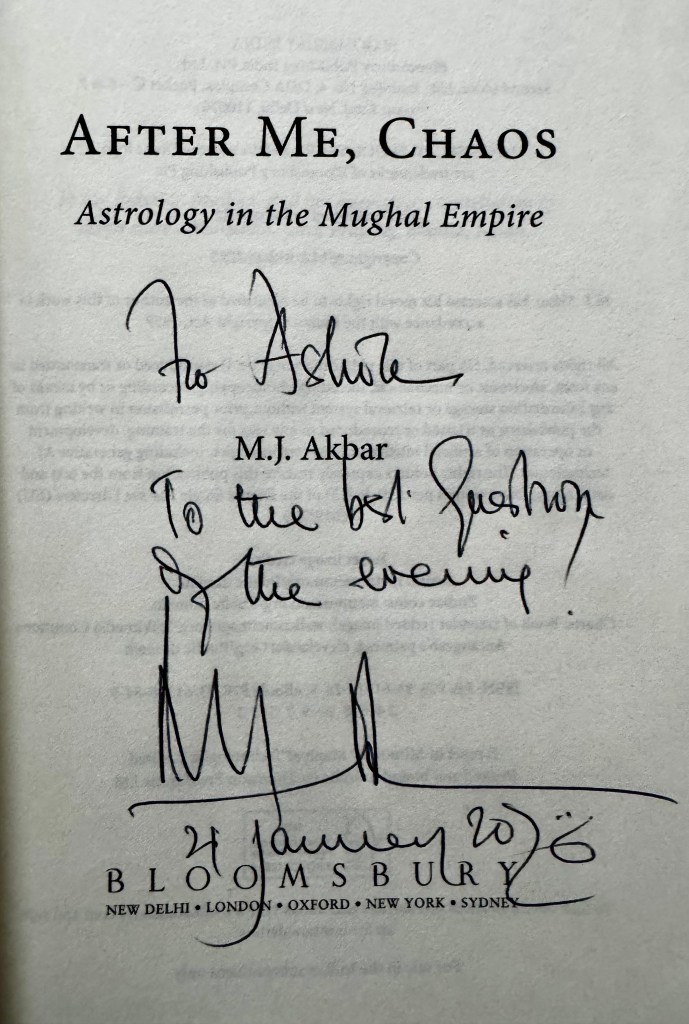
In response, Mr Akbar just smiled; the audience burst into laughter. All of us—the author, the discussants, the audience and I—knew that my question that day was a light-hearted one. It didn’t really seek an answer. A gracious Mr Akbar, complimented me for my question when I approached him for a signed copy of his book. “To the best question of the evening,” he wrote for me.
Today, while that question of mine is swirling in millions of minds all over the world, more questions are cropping up. Here are two of them:
One, “Could Trump’s birth have been advanced or delayed to prevent the crisis facing the world today?”
Two, “What can be done so that leaders (as in case of Akbar the Great) are born under appropriate (read “the best”) planetary influences which bolster world peace?”
Even as I conclude this post, my mind, as is its wont, has strayed yet again. I am now wondering if Trump (like Aurangzeb to his son) has told his son-in-law, Jared Kushner, “CHAOS WHILE I AM THERE! UTTER CHAOS AFTER ME!”
Comments
Viney Sharma: Good article Ashok.
As regards Trump, here’s another question…
Q: Could his existence have been prevented?
A: Yes, with the use of a simple device called the condom😀
Group Captain KUK Reddy: Hi Ashok Chordia, It’s so interesting to read your encounter with the great Hyderabadi, Mr M J Akbar, whom we also adore and always keep him in Reverence for being a prolific writer and seasoned journalist.
The question about Trump by you is so tactical as the whole world is asking the same and so no doubt yours is the best question of the evening. I am so proud of you Ashok for your erudice and knowledge and your free expression. Keep it going,my dear.

