Stoic Valour

“Sir, it is a “hang-up!”

Even in the noisy cargo compartment of the C-119 Fairchild Packet that warning from the master dispatcher on the cold Friday morning of February 17, 1967 rang loud. It jolted Flight Lieutenant Minoo Vania who was all set to make a parachute descent. He was the officer in-charge of the batch of jumpers now on board preparing to take their first plunge after undergoing 12 days of rigorous ground training at the Paratroopers Training School (PTS), Agra. Within seconds, Minoo was in the cockpit with Mukho (Flight Lieutenant Mukherjee), the captain of the aircraft.

A paratrooper was trailing behind another aircraft flying ahead of them over Malpura Drop Zone (DZ). The jumper’s parachute had failed to open. The16-foot nylon staticline which initiates the opening sequence of the parachute had fouled up accidentally, preventing the deployment of his parachute.

The Standard Operating Procedure (SOP) to deal with such a situation entails two crisp actions—to connect a set of two parachutes to the staticline of the jumper in distress and then, to snap the anchor cable. The dispatchers, who are Parachute Jump Instructors (PJIs), are expected to take less than two minutes to execute the ‘Hang-up Release Drill’. 

Six long minutes elapsed as Minoo stood anxiously next to Mukho in the cockpit and watched the man buffeting behind the other aircraft. The young PJI’s worry was that if the reserve parachute of the hanging paratrooper got deployed for some reason, it would endanger the life of everyone on board.

“What is holding them back? Why aren’t they releasing him,” Minoo asked Mukho who was in communication with the other aircraft.

“Some argument is going on with the DZ Safety Officer about what height must the jumper be released,” Mukho explained.

 “Do you mind if I take the RT (Radio Telephone) and talk to the crew of that aircraft?” Minoo said with a sense of urgency.

Mukho acceded.

Minoo took the RT set and aired an appeal: “The aircraft with hang-up, please release the paratrooper in the next run-in over the DZ.”

“Who are you?”

The pilot at the other end happened to be Minoo’s boss—the Commanding Officer of Paratroopers Training School (PTS). He was clearly rankled.  

“I am Flight Lieutenant Minoo Vania.”

“But we have to climb higher before we release him….”

“Sir, further delay in release will endanger the life of the paratrooper and everyone on board. Please go ahead and release at whatever height you are.”

“If anything goes wrong, it’ll be your funeral, young man!”

“I understand that, Sir. Please go ahead and release immediately… I am saying this with responsibility.”

Perhaps the CO didn’t appreciate the young Flight Lieutenant’s assertiveness and professionalism in that moment of crisis. Even as they talked and the PJIs prepared to release the paratrooper, something unusual happened. The jumper got detached from the aircraft and his parachute deployed on its own. This happened a few kilometres away from the DZ.

Minoo judged the gravity of the situation and said to Mukho, “I don’t know how and why this trainee jumper was dangling behind the aircraft. In this while, he might have sustained some injuries and will be in trauma when he lands. There’ll be nobody on the ground to assist him. I want you to drop me close to where he lands. He is my pupil, and I must go to his rescue.”

Without ado, Mukho turned around and let Minoo jump out at a point close to where the trainee had landed. Mukho did a professional job—Minoo touched down yards away from the paratrooper. He quickly discarded his parachute and ran to the jumper who lay unconscious in a field.

To his horror, Minoo found that the man’s right wrist was severed. Apparently, his staticline had wrapped around his wrist preventing the deployment of his canopy. Only when the nylon rope cut through his wrist did the parachute open. The man was lying in a pool of blood. Every time his heart beat, it sent a fountain of blood from the stub that remained of his hand. A childhood lesson on the use of tourniquet returned to the officer’s mind at that anxious moment. He ripped off the cloth belt of his overall and tied it tightly around the profusely bleeding arm. The blood stopped spurting.

Minoo cradled the injured Paratrooper’s head in his lap; looked for signs of life and tried to revive him as he waited for the medical team and the ambulance to arrive. Among the villagers who had gathered to watch what was happening, there were good Samaritans who came with a charpoy, water and milk. Minoo told them to look for, and guide the rescue team to the spot. Flight Lieutenant GJ Gomes, another PJI was the first to reach the spot. The medical officer and the ambulance arrived minutes later.

The first words the paratrooper spoke with a smile as he responded to Minoo’s efforts to revive him were: “Koi galti to nahin ho gayi, sahab (Have I made any mistake, Sir?)?”
The Para Wing

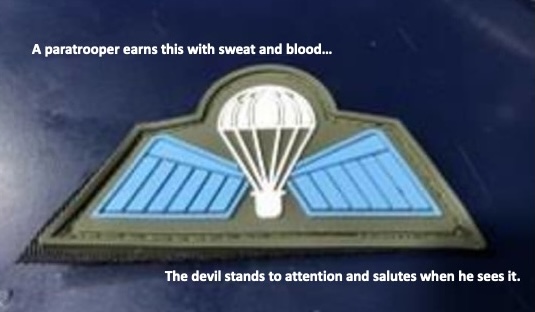
A new right hand was fitted to this brave young man at the Artificial Limb Centre in Pune. Although, he could not complete the para basic course and become a qualified paratrooper, Minoo Vania wished he had the authority to award the young man the coveted para wing for the fateful jump he made. After all it was for that little insignia that he had volunteered to join the Parachute Regiment. He lost a limb in seeking the distinction, but in the eyes of his fellow men he would forever walk tall.

Now in his nineties, Minoo recalls that moment vividly when his injured pupil lay in his arms after his extremely painful and traumatic experience. The boy’s words echo in his mind. The legendary PJI wonders, “If this is not stoic valour, what is?”

Epilogue
Court Martial or Shaurya Chakra?

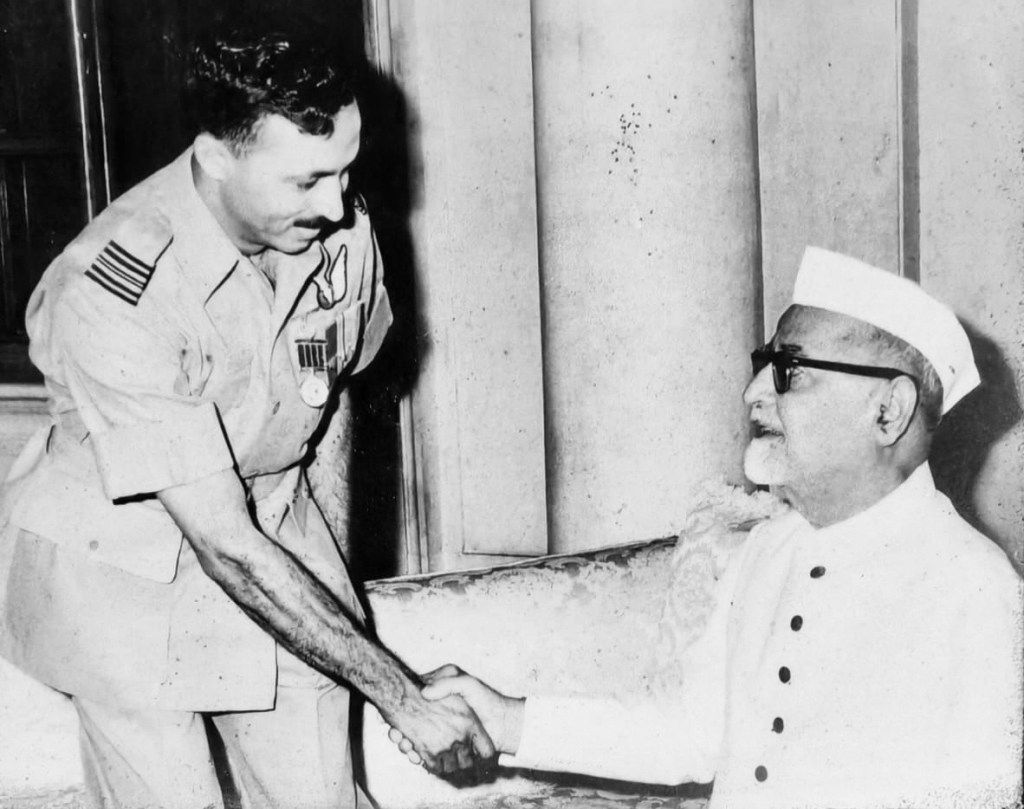
When Minoo Vania parachuted to help his pupil in distress, he was in the flight path of the Agra airfield. Technically speaking it was an operational hazard—NOT A DONE THING. And, there were people who saw it through that lens. “Minoo deserves to be tried by a court martial for flouting the laid down flight safety norms,” they opined. But then, there was a conscientious OC Flying in Wing Commander Pete Wilson who saw Minoo’s action differently—as a selfless act of daring. He viewed it as an officer risking his own life to provide succour to a jawan in dire need of assistance. Pete prevailed. Flight Lieutenant Minoo Vania was awarded the Shaurya Chakra for his selfless act of gallantry in peacetime. In the years ahead, Minoo Vania would train on D-1-8 parachute (jumping from AN-12 aircraft) in erstwhile USSR; carry out jump trials in Ladakh Region and the eastern sector, and undertake numerous equipment trials. His contribution to operations would be recognised by way of award of Vayu Sena Medal.

Postscript (by Air Commodore Minoo Vania SC, VM) Ashok suggested I add a postscript to this story you just read about the hang-up at Agra. To my eternal regret, I never learnt the name of the brave paratrooper. It was not for want of trying that his name eluded me, and I still have a hope. Maybe a fellow paratrooper on reading Ashok’s story may recall; maybe an officer of that era; or even a medical person where he would have been fitted with a prosthesis. It could be anybody who would lift the cloak of anonymity from this hero.

Other Parachuting Stories

Tipping the Fear of the Unknown… the very first jump

Jumping… definitely not to conclusion… what if the parachute fails to open.

Out of the Blue into the Tree!!… and, when one lands in trouble.

Mission First… will do everything for a jump.

Rambo and I

An air warrior uses his wit to steer clear of an almost unavoidable street-fight.

It all happened on a day when my immunity to honking in Delhi traffic dropped momentarily.

I was driving to my office in Subroto Park. As usual at 9 am in the morning, the traffic on the airport road near Dhaula Kuan was moving at a snail’s pace. Everyone on the road seemed to be in a great hurry. Scooters and motorbikes were moving like free electrons in the little spaces between the bumper-to-bumper moving mass of buses and cars. The car behind me seemed to be in greater haste than all others. The driver’s hand seemed to be glued to the horn in perpetuity. Unfortunately, there was no space to allow him to pass.

It just happened that the planets were not aligned favourably for me at that instant on that day. In fact, I am certain that they had conspired to make me feel ragged by the blaring noise. So, otherwise always unmindful of the etiquettes of the drivers sharing the road with me, I responded with a comical gesture. I rolled down my window, and with my hand, signalled the car behind me to go over my car.

Did I infuriate the man behind? May be, I did, because I saw an enraged being in the rear view mirror of my car.

Sometimes weird thoughts come to one’s mind when one gets ragged. It was one of those moments for me. “Why wasn’t he born a few minutes earlier than he did?” I wondered, “He would have reached in time everywhere, all through his life.”

A crooked smile broke on my face.

Did the man behind see my smile? Did it add fuel to fire? From what followed, I have reasons to believe that my spontaneous, silly and uncalled for action and the smile, which in retrospect, I feel I could have avoided, had caused a volcanic eruption. He had seen my face as I looked at him in my mirror. But like a child, I was oblivious of the consequences of stoking a fire.

I saw the first ominous signs of what was to follow when he overtook my car on the first opportunity. He was a hulk of a man with long hair that covered his entire mane. A metallic hairband––like the spiral binding of the notebooks I use––secured them. He wore a thick gold chain around his neck with a heavy looking pendant––Hanuman or some other deity. His left ear lobe had a large diamond stud.

He must have been a member of the Gold Gym for many years. In the slow moving traffic I got a glimpse of his muscled biceps revolting to break free of the tight sleeves of his black round-neck tee shirt. I couldn’t miss the large tattoo depicting a dagger peeping out of his short sleeves.

He removed his large sized Ray Ban goggles as his car crawled past mine and gave a stare that crucified me. Almost! Then his eyes turned into slits as if he were taking a dim view of my actions. He must have been watching many of those western classics, the Clint Eastwood kinds, I thought. We were a few feet apart and separated by two toughened glass panes, yet I heard the crushing sound of beetle nut between his teeth.

Was he planning to chew me? Hallucination!

I avoided his gaze and hoped it was all over.

Far from it, it was just the beginning of, should I say, an ordeal.

Massive fenders and the picture of a not-so-benevolent Hanuman on the rear pane of his car seemed to say, “Boy, better don’t mess with me.” They looked intimidating when he stopped his SUV in front of mine near the main entrance to the Headquarters of the Western Air Command at Subroto Park. Everything on his car’s number plate was obscure except the number 1111––it was a VIP number. I got a glimpse of a tattered tricolour lying limp by a flagstaff on the bonnet of his elephantine car.

VIP

I needed no more introduction of the man who stepped out of the car and stood, arms akimbo, by its side gesturing me to come out. He was wearing cargo pants with camouflage print.  A broad black canvas belt was a formality around his slim waist. The bottoms of his trousers were casually tucked in his more-than-ankle-high boots.

He was a Rambo of sorts.

I quickly evaluated my two options––to fight or, to flee.

Talking of the option to fight…

Attacking first, I had once knocked out an opponent taller than I was. But that was as a schoolboy. Much later, in service, I had trained hundreds of paratroopers and the Garuds of the Indian Air Force. More than a dozen years later, some of the close combat techniques that I had taught my pupils lay embedded in my mind. But I doubted if my fighting abilities at sixty would match this menacing man’s in his late twenties. The red juices of Banarasi Paan oozing from the corner of his mouth and sliding down his lower jaw confirmed that he was not what he appeared to be. He was certainly not a Rambo. He was a youngster, managing his affairs using his appearance and perhaps, his connections. Yet I didn’t want to risk the seven implants that I had just got to regain my ability to bite and chew. At over Rs 2.2 lakhs paid to CLOVE Dental, my mandible had suddenly become precious. It was in my interest to avoid a physical fight.

Needless to say, to be able to conquer the enemy without fighting is the Art of War.

Talking of the option to flee…

I recalled that once Bruce Lee was asked by an interviewer, “What would you do if you were actually cornered by a goon?” The legendary actor and Kung Fu master had said something to the effect that he would find an escape route and run away. The Western Air Command with its gate manned by armed guards was just about fifty metres away. But this man stood like a wall in my way. Besides, having overused my knees during my days as a paratrooper, I felt that I wouldn’t be able to outrun him, even if I could dodge him once.

The time was running out, as I opened the door of my car gingerly; I did not want to be trapped in my car. Was there a third option?

Even at that moment of extreme peril to my being, my mind took an errand to an incident, some forty years ago. We, as first term cadets at the National Defence Academy, had failed to produce a variety entertainment programme, in the given duration of time, for the send off party of the graduating seniors. So a cadet sergeant had taken us to task. An hour of intense physical activity (front rolls, push-ups and crawling in the battalion area) under his supervision had made us all realise that there was an actor lying dormant inside of all of us.

It was a Eureka moment; it was another moment of reckoning; it was time to awaken that actor in me.

Without a second thought, I ran into this guy who was preparing to pounce on me, and held him tightly (as different from hugging warmly). “Long time! When did you return from Siachen?” I asked. And then without looking him into the eyes, I continued, “Are you posted in Delhi now? Army Headquarters? How is Pammi? …And the kids?”

Then I held his limp hand and shook it firmly and let off a second volley of questions: “You ass, you don’t feel like staying in touch. You are in Delhi and you haven’t even called me? If I had not seen you today and waved at you… (a pause for effect)… you would have gone away without meeting me. Very bad!” I admonished him with fatherly affection.

The giant looked absolutely dazed. My stun-grenade had had the desired effect. Before he could regain consciousness, I emptied my last magazine of rubber bullets on him: “Why are you looking so puzzled? Aren’t you Chow? Major Chowdhury? …(another pause for effect)… Son of Brigadier Chowdhury? Don’t you recognise me? I am Group Captain Chordia? Ashok uncle, your dad’s NDA course-mate.”

It must have been a stupendous performance, a great monologue indeed.

The body language of the man suggested that he was still in absolute confusion. “Sir, I am not Major Chodhury,” he said meekly. My father is a primary schoolteacher in Greater Noida….” It was my turn to listen to him. I released him from my embrace and gave him an innocent look.

To cut the long story short, we parted with another hug after about five minutes. It was definitely a genuine and much warmer hug this time. And, in those few minutes that we spent together, he told me that he was one of the the general secretaries of the youth wing of one of the major political parties in Uttar Pradesh. He was a property dealer and ran a construction business too. He offered me his services (including his political affiliations), if I needed in the future.

Epilogue

Six months later…

I received a telephone call. “Sir, I am Manoj… Manoj Sharma. Do you remember me; we met on the airport road when you mistook me to be Major Chowdhury? Can you help me with getting some documents attested by a gazetted officer? I promise, they are genuine.” I willingly obliged my young buddy with that little favour.

(Author’s Note: Although fictionalised, this story is based on a real encounter.)