Countries Settling Scores Without Bloodshed: Is it a Possibility?

There’s a pause in the fighting…

Troops are sprawled on the sunny side of their camp. These are the boys who had been pulled out of schools; given doses of patriotism and conscripted to fight for the country. Ill-clothed and ill-equipped, sometimes, they wait anxiously for a dying brother-in-arms to breathe his last to stake a claim to his boots and other accoutrements. They are disgusted as they had just had an hour of saluting practice because one of them had greeted an officer sloppily.

“Watch out, lads! We’ll lose the war because we are too good at saluting,” says Kat. The frustration is evident in the senseless talk.

Kropp says philosophically, “All declarations of war ought to be made into a kind of festival, with entrance tickets and music, like they have at bullfights. Then the ministers and generals of the two countries would have to come into the ring, wearing boxing shorts, and armed with rubber truncheons, and have a go at each other. Whoever is left on his feet, his country is declared the winner. That would be simpler and fairer than things are out here, where the wrong people are fighting each other.”

The above is an excerpt (abridged and reworded for flow) from All Quiet on the Western Front by Erich Maria Remarque. The novel is set in the Europe of the First World War. It exposes the brutal realities of war and traces the disillusionment of soldiers. It underscores the lasting impact of war on their minds and emotions. Remarque’s literary masterpiece is a powerful reminder of the human cost of conflict.

Wars are fought for one or more of the following reasons: territory, resources, or ideological differences. They follow an almost set pattern or cycle—differences arise; discussions take place; diplomacy fails; military action follows; the two sides fight to exhaustion, or until one side—or both—recognises the futility of seeking a military solution. Finally, the warring sides return to dialogue. Interestingly, wars end where they begin—at the negotiating table. But, in the process thousands (sometimes millions) of lives are lost; economies are shattered. At times, the living envy the dead.

Kropp sound ‘NUTS’ when he suggests that disputes between countries be settled between leaders wearing boxing shorts using truncheons. But an equally nuttier solution was tried at least once to resolve a territorial dispute between states. And, it really succeeded in arriving at a permanent solution.

The story goes like this. When the colonies declared their independence from Britain, New York State and New Jersey both claimed Staten Island. It was decided to settle the matter with a sailboat race around the Island. The two states sent their best sailor. One Captain Billopp won the race for New York and the island became a part of New York State. Simple!
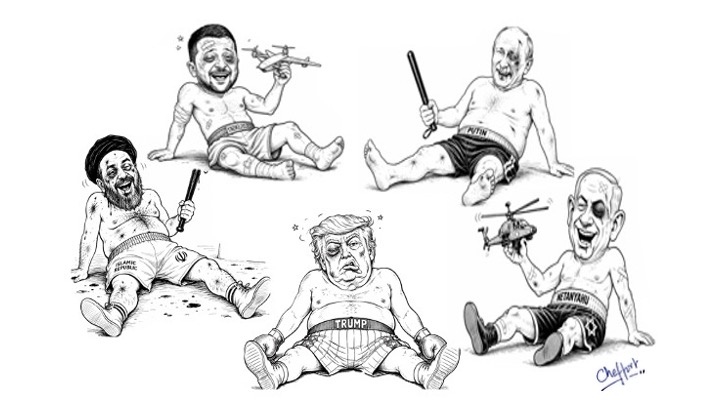
Can leaders settle scores in the ring?

Fast forward to today, to the wars in Ukraine, Iran, Gaza, Israel and Lebanon.

Imagining peace descending upon today’s world through physical scuffles involving the likes of Donald Trump, Mojtaba Khamenei, Benjamin Netanyahu, Mahmoud Abbas, Vladimir Putin, and Volodymyr Zelenskyy sounds absurd. Yet the idea of these same leaders returning to negotiating tables after millions of lives have been lost is equally absurd.

Does it mean that thousands of lives would have to be lost every time before sense dawns on the leaders?

Sacking of several general officers by the Pentagon and the many desertions in the Russian Army is a clear indication of the fact that the days of the Charge of the Light Brigade are over. Political leaders and diplomats will have to find ways to break the cycle—negotiation, war, negotiation again—with thousands of lives lost in between. The question remains: must we always bleed before we negotiate?

World Leadership Beyond Covid-19

The 9/11 terror attacks led to killing of over 3000 Americans in New York. The US reacted; formed a coalition and vowed to avenge the strikes. In a response that was largely punitive for the mastermind and the abettors, who were still invisible, Uncle Sam went pounding and pulverising Afghanistan. As if that were not exemplary enough for the rest of the world, an enraged George W Bush went about setting his own standards for the world’s behaviour. He threatened the comity of nations: “Either you are with us or against us.”

Arrogance!

The outcome was much expected: In a moment of America’s extreme sorrow, the world responded with sympathy on the face and a subdued indifference in the heart. The feigned feelings made little difference to the US.

The US was the (mind the strikethrough) a Super Power then. The world looked at that country with awe, and respect, born of fear of its military and economic might rather than reverence for a true leader.   

In its effect, the Covid-19 pandemic has been more devastating than the 9/11 attacks––the death toll in the US has exceeded 10,300. It is more than three times the lives lost in 9/11 and the figure continues to rise harrowingly. The catastrophic effect on the economy will be more evident as time passes. In denial, President Trump first called the pandemic a hoax and, in a matter of days changed tack to declare that it was horrific.

With a difference though, this pandemic is indeed America’s 9/11 (Version 2.0).

In 2001, without a second thought, the US began bombing the perpetrators of 9/11 allegedly hiding in Afghanistan. In this instance, although President Trump has blamed China for the spread of the pandemic, and has gone on to call Covid-19 as the Chinese Virus, he has displayed no desire or keenness to punish that country. As it appears, the US contemplates enough before punishing and chastising countries for errant behaviour. China is certainly not Vietnam, Korea, Panama, Guatemala or even Iraq.

There are stark reasons for this reluctance. The years gone by have exposed the rot setting in and have proved the powerlessness of the most powerful nation on the earth. Whether it is Paris Summit on Climate Change, or it is the Nuclear Deal with Iran, or it is trade war with China, or it is the affairs of the NATO, or it is China’s expansionist actions in the Sea in the South of China or it is intervention in a war-torn Syria, the US has gradually relinquished its leadership role. There are allegations that in the last few days, American firms have got a few consignments of medical equipment, meant for Europe, diverted to the US (of course, unscrupulously). Needless to say, these are acts unbecoming of a world leader. In hindsight, Hollywood’s projection of Uncle Sam as the saviour of the world looks comical.

In the same context, the high death toll in Europe (in Italy, Spain, France and the UK in particular) has laid bare the hollowness of the superiority of the West over the rest of the world. Last month, the Italian Prime Minister, Giuseppe Conte was heard saying, “If Europe does not rise to this unprecedented challenge, the whole European structure loses its raison d’être for the people.” The Serbian president Aleksandar Vucic was scathing: “European solidarity does not exist… that was a fairy tale. The only country that can help us in this hard situation is the People’s Republic of China. To the rest of them, thanks for nothing.”

The Covid-19 pandemic curve for China is flattening. Beijing has already begun extending medical support to countries all over the world. Its economy will soon get off the ventilator and show signs of improvement. But, if the news of dissent brewing in the Chinese population is to be believed, the peacefulness of further rise of the People’s Republic of China would be in doubt.

The leadership in India took timely and daring steps to fight the pandemic. Until now Prime Minister Narendra Modi has taken the population of 1.3 billion along by exploiting the ancient art of ‘saam, daam, dand, bhed’ (साम, दाम, दंड, भेद) literally meaning: “by hook or crook, or any rule in the book.” His leadership will be put to an even greater test when the storm has gone past and it is time to pick pieces and revive the economy.

It will be a while before conditions start improving in the US and other parts of the world. As it appears, Post Covid-19, US will not be automatically restored to its Super

IMG_3980
Leadership in the Post Covid-19 World

Power position. Perhaps the world will look for a replacement for its desiccated and introverted leadership. Also, in a world that clamours for human rights and democracy, Russia and China will have to work overtime to prove their credentials to be accepted as the Number One. Perhaps it would be a leaderless world until a truly deserving country occupies that first-among-equals status. Perhaps the pace of life will slow down. Perhaps people will be more inclined to family values and spirituality….   

Did someone say (…more loudly, this time), “It will be an Asian Century?”

All said (and hinted), it would be naïve to assume that the leadership of the post Covid-19 world would be up for grabs. It’ll have to be truly earned.