Mission First

The exhilarating feeling is irresistible. A jumper would go as far as one can to satiate the desire to skydive. The Parachute Jump Instructors (PJIs) of the Paratroopers Training School (PTS), Agra are no exception. Drop a pin anywhere on the map of India and in a radius of fifty miles of the pin there will be a place where Akashganga, the Skydiving Team of the Indian Air Force (IAF) would have carried out a skydiving demonstration as a part of a major national event or a military tattoo. If not a demonstration, it would be a paradrop as a part of an airborne military training exercise.

Thanks to my tenures of duty as a PJI, I have been a part of many such displays. From the identification, reconnaissance and exploration of new Drop Zones in the freezing cold Leh-Ladakh region and trial jumps on those Drop Zones, to the exit over the Indian Ocean to land on a target in Thiruvananthapuram, each jump I undertook was different from the other and memorable in a unique way. When I look back, some stand out. An interesting one that often returns to the mind is the one performed as a part of the raising day celebrations of the President’s Bodyguards in November 1998.

High Altitude Jump Trials

I was then the Assistant Director of Operations (Para) at the Air Headquarters.

It was a Herculean task to get the requisite permissions and clearances for the demonstration at the Jaipur Polo Ground. With the who’s who of Indian leadership residing in Lutyens’ Delhi, security was a big concern. Jaipur Polo Ground was not far from the Prime Minister’s Residence. “It would be imprudent to allow such ‘frivolous’ activity in this area,” was an opinion. Then there was the issue of availability of airspace in the proximity of the busy Indira Gandhi International Airport where an aircraft takes off or lands almost every minute and dozens guzzle fuel as they await their turns on the ground or orbit in the nearby sectors. For many well-meaning people, disrupting the air traffic for a skydiving demonstration was an avoidable proposition. An easy way out for those in authority was to say: “NO.”

Notwithstanding what was happening on the files between the Air Headquarters, the Army Headquarters and the South Block in Delhi, the jumpers were agog, drooling. They were excitedly looking forward to the opportunity to jump at the prestigious event to be witnessed by the Supreme Commander of the Indian Armed Forces. Shri KR Narayanan was the then Honourable President of India.

How the permission to undertake the skydiving demonstration came about is the subject matter of another story. Suffice it to say that it did come—somehow. There were caveats, though. We were directed to operate from Air Force Station, Hindan. A team of security experts would sanitise our aircraft and inspect the parachutes for hazardous materials. We were told that they might frisk the jumpers too. Being personally searched was an irksome idea which we brushed aside in service interest.  Although the permission had been granted, we were also to await a last-minute clearance from Palam Air Traffic Control (ATC) before take-off. After getting airborne we were to follow a given corridor; report at check points and proceed only on further clearances.  The helicopter was permitted a maximum of 21 minutes over the Polo Ground to disgorge the jumpers and clear the area. Would the conscientious security apparatus be obliged to consider the aircraft ‘hostile’ if it strayed from the assigned route, or overstayed its allotted time over the Drop Zone (the Jaipur Polo Ground)? May be. May be not. To us, it mattered little as long as we could jump.

On the D-Day, the team led by Squadron Leader Sanjay Thapar, the then Chief Instructor PTS, arrived from Agra. Group Captain TK Rath, (the Director, Air Force Adventure Foundation), Squadron Leaders HN Bhagwat and RC Tripathi (both of the AF Adventure Foundation), and I joined them at Hindan. We inspected and lined up our parachutes and jump equipment and dispersed, since enough cushion time had been catered for, to account for unforeseen changes in programme. We all had our ways of passing the time available before take-off. Most sat quietly with fingers crossed hoping and praying for the drop to go through, because such VVIP programmes are prone to last minute hiccups. Group Captain Rath immersed himself in a book which he always carried in his overall pocket. He took a break in between to do a headstand. It was his way of attaining peace and calm. Thapar was engaged in communicating with Palam and the controller at the Polo Ground for the updates.

It was “OPS NORMAL!”

Minutes into the break the peace of sorts that prevailed on the tarmac was shattered by a commotion. The Security Team—in civilian clothing—after sanitising the aircraft had started overturning our lined-up parachutes to inspect them. They were alarmed to see sharp knives attached to the straps and had started taking them away.

Squadron Leader Tripathi saw them and literally pounced on them, “What are you doing?” he shouted.

“We are doing our duty… securing and sanitising everything. You can’t jump with these knives.” Their leader said with authority.

“But these knives are our lifeline… we need them in case we have to snap some parachute rigging lines in an emergency.”     

“We can’t help it… sharp objects around a VVIP are a taboo,” he drew a line.

Tripathi wasn’t the one to give in easily. He sparred on, “Well, now you have physically handled our parachutes without our knowledge. We don’t know if they have been rendered unfit for use. And, you are not allowing us to carry our survival knives, which is a must for us.” He let that sink in, and then came with the final punch, “Under the circumstances, it will not be possible for the team to jump. Please inform the guys at the other end that the demonstration jump is being called off for these very reasons.”

There was stunned silence before the leader spoke, “We understand your requirements. But you cannot cancel a programme meant for a VVIP and blame it on us. We are all men in uniform. We must find a way out.”

After a little ado, we were permitted to carry our jump knives.

The wait thereafter was long. Panic set in when the clock struck four. It was our scheduled time of take-off. There was no clearance yet. The Honourable President would arrive at 5:00 pm as per programme. In an extreme situation, just in case the Skydiving Demonstration couldn’t be undertaken for any reasons, the Military Band present at the Polo Ground would play martial tunes to entertain the audience. None was interested in that Plan-B; every stake-holder wanted the jump to go through.

In those moments of uncertainty, a deliberate decision was taken to get airborne and hold position over the dumbbell at Hindan airfield so that no time was wasted if and when a go-ahead message was received. So, still on tenterhooks, we strapped our parachutes and boarded the helicopter.

The clearance came 15 minutes too late; we’d now be cutting fine. Our helicopter was asked to hold position over the Yamuna bridge and wait for the final clearance. Time was running out. November smog had begun causing concern. But Thapar, who was born and brought up in Delhi was not deterred by the falling visibility; he knew the ground features by heart. He could manoeuvre blindfolded.

When the final clearance came, there was just enough time to make one pass over the Polo Ground. Under normal circumstances, the aircraft makes three passes over the Drop Zone—one, for the pilot and the Skydiving Team Leader to familiarise with the target on the ground and ascertain the line of run. The other two passes, are to drop jumpers in batches of six to eight each.

A confident Thapar took the decision to do away with the first two passes over the spectators. He briefed the jumpers in the aircraft that all of them—more than a dozen—would exit the aircraft in one go. He re-assigned the parachute opening heights to each jumper and stressed the need to stick to it else there would be many jumpers approaching the landing area together resulting in a melee; maybe collisions.

Good things don’t come easy!

At 5:00 pm, when the helicopter came overhead, the Drop Zone Safety Officer informed that the President had not arrived. “Please hold on!” he advised.

Three minutes later, the Air Traffic Controller from Palam Airport instructed our helicopter to clear the area instantly; international flights were getting inconvenienced. It was when the captain of the aircraft was contemplating abandoning the mission that Thapar leaned out of the aircraft and spotted the President’s motorcade. It would still take a couple of minutes to reach the spectator stands. When he turned back, he had taken the decision.

“Go!” he commanded the line of jumpers awaiting his instructions. Within seconds all the jumpers were out of the helicopter.
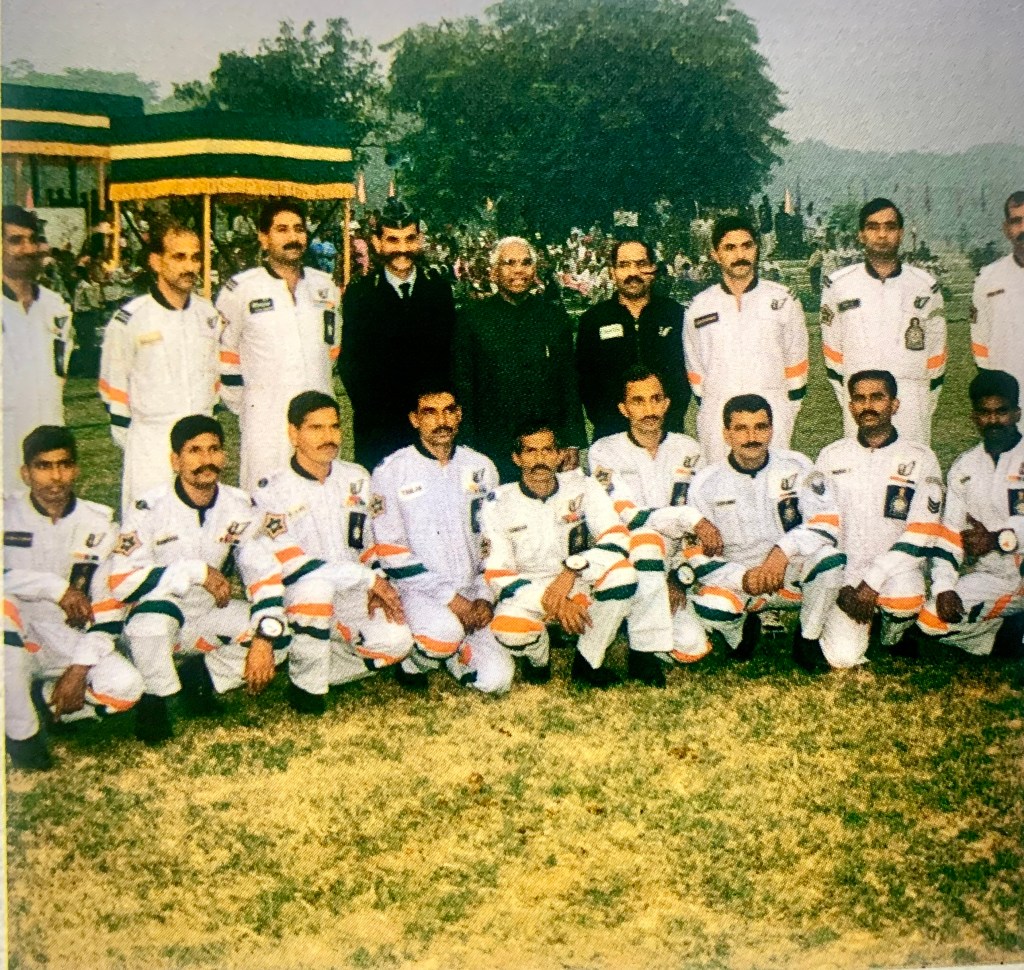
With the Supreme Commander

The pilots racing back to Hindan airfield saw the colourful parachute canopies adorning the sky over Lutyens’ Delhi. The Honourable President’s motorcade just moved into the Ground as the skydivers began landing one by one. It turned out to be a bit comical when the jumpers responded to the tune of the National Anthem and stood to attention on touchdown.

Cancellation of a para drop is one of the worst possibilities faced by a Parachute Jump Instructor.

Dealing with the Darned Dragon-II: Escape Hatch

A day after the meeting between the External Affairs Ministers of India and China, the experts who went deep diving into the official statements of the two, to draw meaning, have not struck upon anything to write home about. Some are now trying to read the body languages of the two ministers during the ten-second photo-op with the Russian Foreign Minister. Until something significant trickles from their efforts, one might take a re-look at the antecedents of the Galwan Valley faceoff and the Pangong Tso standoff. On a dispassionate glance at the incidents in the rear-view mirror, one might just get inclined to draw a conclusion which, might be viewed with mixed emotions… and that inference is:

“Sino-Indian border issue is too serious an affair to be left to a single agency––political leadership, diplomatic corps or the military––to resolve.”

Beyond any doubt, the synergy of the trio has helped India hold the dragon at bay… until now.

The present situation can be summarised thus: India has a tactical military advantage in the Ladakh region––Indian Army will exploit that edge, if a need arises. While China is weighing and considering its options, India is consolidating its position––troops are getting more acclimatised and are stocking up to address the developing situation. China cannot possibly challenge Indian positions in the Ladakh region. If it opens another front elsewhere––say, Sikkim or Arunanchal, where its gains might be iffy––probably Indian troops would en-cash the advantage around Pangong Tso.

A China that now considers itself a world power second only to the US is less likely to eat a humble pie by accepting ‘status quo ante’ (for whatever it means), or by unconditionally withdrawing. A ‘publicised’ setback in Ladakh will affect China’s reputation and stakes elsewhere––Xinjiang, Tibet, Hong Kong, Taiwan and of course, in the sea on its south (some people call it South China Sea‘).

Imponderables are far too many to be summarised here. The time is running out. Suffice it to say that in due course winter will set in and it will become more difficult for Beijing to maintain its forces in the region than Delhi. Dragon is doomed if it accepts India’s terms for peace; it is doomed if it doesn’t. That perhaps is the reason for practically nothing coming out of the meeting between the ministers.

Can India help the dragon wriggle out of a situation it is responsible for creating?

Perhaps Sun Tzu’s Art of War can throw up an answer for India:

“When you surround an enemy [adversary], leave an outlet free…. The object is to make him believe that there is a road to safety, and thus prevent his fighting with the courage of despair. For you should not press a desperate foe too hard.”

~ Sun Tzu, The Art of War, Chapter VII, Manoeuvring

Although not physically surrounded, Beijing’s dilemma in Ladakh is damning––to fight or to find a face saving way out of the imbroglio. While, the Indian Army is holding the fort, can the dragon be nudged into a diplomatic escape hatch from which it can emerge with a smile?

Is Mr Jaishankar listening?

Related posts:

Dealing with the Darned Dragon: Preface

Dealing with the Darned Dragon-I: Border Infrastructure

Dealing with the Darned Dragon-III: A Lesson from Pearl Harbour

Dealing with the Darned Dragon-IV: Exercising (with) the Nuclear Option

Dealing with the Darned Dragon-V: Time to Kowtow!?

Dealing with the Darned Dragon-I: Border Infrastructure

[This follows from an earlier post: “Dealing with the Darned Dragon: Preface”]

News from India-China border isn’t very encouraging. Last month end situation became volatile in eastern Ladakh after India thwarted a Chinese attempt to occupy Indian territory near Pangong Tso. As it stands, India has occupied a number of strategic heights on the southern bank of the lake and strengthened its presence in other areas in the region. India has also rushed in additional troops and military hardware to the region.

The diplomatic and military level talks to ease tensions have failed. Also, nothing worthwhile emerged from the interaction between the Defence Ministers on the sidelines of the SCO Defence Ministers Meeting in Moscow on September 4, 2020. The probability of the success of a similarly planned meeting between the External Affairs Ministers scheduled on September 10, 2020 hovers closer to zero than 1. The reasons are understandable. India, having occupied positions of tactical advantage in Ladakh will be approaching the dialogue with a little more bargaining power than it usually does. China might want this status to change before discussing contentious border issues. Besides, unlike the Indian representatives who are empowered to take decisions, the Chinese representatives at such meetings are not authorised to take decisions.

Meanwhile, following reports of Chinese troops firing warning shots in Ladakh, troops on either side are on the razor’s edge. There are ominous signs that after having made relentless vain attempts at negotiating peace, the political leadership on both sides might pass on the baton to the military to ‘handle’ the issue.

‘War-mongering’? May be. Or, is it ‘wisdom’? Wisdom wrung out of the experience of 1962, which points at the dire need of military preparedness of a high order and readiness to deal with a belligerent neighbour.

Among others, one dimension of military preparedness is existence of support infrastructure along the border. Several projects related to new construction (and development of old ones) of roads, runways, helipads, ammunition dumps, logistics nodes, transit camps and military hospitals etc are under way. These projects are unprecedented and are to Beijing’s chagrin. Once ready, they will bolster India’s war fighting ability considerably. This will force China to invent alternate ways to breach India’s defences. That, in turn, might give rise to the need for India of developing more new infrastructure.

The dire need to create infrastructure in times of crisis is a recurring issue. In 1947, service personnel and the refugees led by Lieutenant Colonel Pritam Singh built a 600-yard runway at Poonch in six days. In another case, tonnes of barbed wire were airdropped to barricade the advancing Chinese (Sino-India War 1962), even as troops were engaged in fighting. Whether it served the intended purpose, is doubtful. During the Berlin Airlift, building from a scratch 17,000 Berliners––men, women and children­­––worked in 8-hourly shifts to construct a runway at Tegel. Those (Poonch and Berlin) were cases of people rising to the occasion.

US Navy’s Construction Battalions (CBs) better known as Seabees have institutionalised speedy creation of infrastructure in times of crisis––a desideratum for fighting forces. Formed following the attack on Pearl Harbour when the task of turning imminent defeat into victory seemed almost insurmountable, the Seabees are very well equipped teams renowned for building bases, bulldozing and paving thousands of miles of roadway and airstrips, and accomplishing numerous other construction projects in different war zones since World War II. They constructed six 8500+ feet runways at the rate of one runway per 53 days; over 18 kms of taxiways; hard-standing to accommodate over 400 bombers, and accommodation for 50,000 personnel and office complexes, on the islands of Tinian and Saipan in a record time of less than a year during World War II. Seabees have been deployed around the globe supporting a variety of humanitarian missions and contingency operations. They were among the first forces in Afghanistan after the 9/11 attacks to upgrade and repair airfields.

To sum up, it is humanly impossible to make the long borders physically secure. While creation of border infrastructure does go a long way in securing the borders, it is also an endless process. There’s a case for creating teams of experts that can undertake rapid construction work of any type, anywhere, anytime: during wartime or during humanitarian assistance and disaster relief operations. Lockdown due to Covid-19 pandemic has rendered a large number of ‘experts’ jobless. It should be possible to enrol volunteers to be employed and paid to serve ‘when the need arises’.

The need could be round the corner.

Other posts in the series:

Dealing with the Darned Dragon-II: Escape Hatch

Dealing with the Darned Dragon-III: A Lesson from Pearl Harbour

Dealing with the Darned Dragon-IV: Exercising (with) the Nuclear Option

Dealing with the Darned Dragon-V: Time to Kowtow!?

China’s Champagne Moment

Champagne!

Champagne in his Good Days
Champagne, in good days

Do not be misled; I am not talking about the sparkling white wine, which comes from a region of that name in France. I am talking of the stray dog, also of the same given name, Champagne who shares the space with a score and more of potted plants placed at the entrance of my house. He quietly occupied that spot more than half a dozen years ago, and before we could realise, started staking a claim on it as ‘HIS DOMAIN’. We didn’t mind his presence there because he barked at every moving thing that crossed our entrance, giving us a vague sense of security. Soon doles of leftover food became a routine and Champagne started demanding them as his right. Passers by started treating him with the regard due to someone’s pet; unknowingly, other dogs started paying obeisance. Our occasional unintentional good treatment and cosseting led to further closeness with the cur. Our affinity notwithstanding, Champagne has bitten nearly a dozen unsuspecting humans including my dear wife and yours truly.

In the last few days––since the lockdown due to Covid-19 pandemic came into effect, to be precise, there has been practically no human footfall in the Amity University campus where we live; stray dogs and birds have been ruling the roost, almost. While strictly observing social distancing norms I have been taking occasional walks. A few days ago, Champagne started accompanying me on these walks.

Champagne expanding territory…

The other day I found something strange in Champagne’s behaviour––he was stopping every now and then, smelling something and peeing on objects. It wasn’t once or twice––he did it more than ten times in the span of an hour. I thought it was unusual. I wondered and pitied, “Was he suffering from some ailment of the urinary system? Do dogs suffer from prostate?” Concern for the poor dog led me to Google the issue and also consult my ‘genuine’ canine lover friends. I discovered that the act of peeing was a dog’s way of marking its territory. Over a few days in the past, he had been trying to expand his geographical area of influence.

You got it right. It’s time China appeared in this discourse…

Champagne was behaving exactly like China––flexing muscles and grabbing territory altering geography. It’ll be easy to recall China messing affairs in Tibet, Taiwan, Hong Kong, the Philippines, Japan, the sea to its south (some people inaccurately call that region, South China Sea), Sri Lanka, the Maldives, Nepal, Doklam and Ladakh––the list is very long. Not to talk of the US, whole of Europe and many other countries all over the world whose economies have been dealt a near death blow by Covid-19 pandemic––allegedly triggered by China.

And by doing so, Champagne, like China, was getting on the wrong side of many who were affected by his belligerence.

Then…

Then, yesterday something happened which made me wonder about China’s immediate future.

Champagne Cornered
Champagne cornered, pays for belligerence…

All the dogs of the area––the strong and docile dogs who had been sitting quiet all the while; the weak dogs who were whimpering but had felt helpless; the couldn’t-care-less dogs; the happy-go-lucky dogs… all the dogs, all the dogs without exception––got together and attacked Champagne. In their offensive action they were fierce like wolves; even the weak and meek ones. They barked in chorus and vied for their turns to bite Champagne. Some, who could, went for his jugular; they wanted to shred him to pieces, smithereens. My effort to save him from the wrath of the angry pack was just about sufficient to save his life.

Champagn'e Jugular
Jugular… almost gone!

Now…

Champagne is licking his wounds (except the ones around his jugular). His body language suggests that he is ruminating, “What went wrong?”

Everything about the recent happenings suggests that China’s Champagne Moment is near, very near.

Will a crystal gazer bury the doubts about ‘when’!?