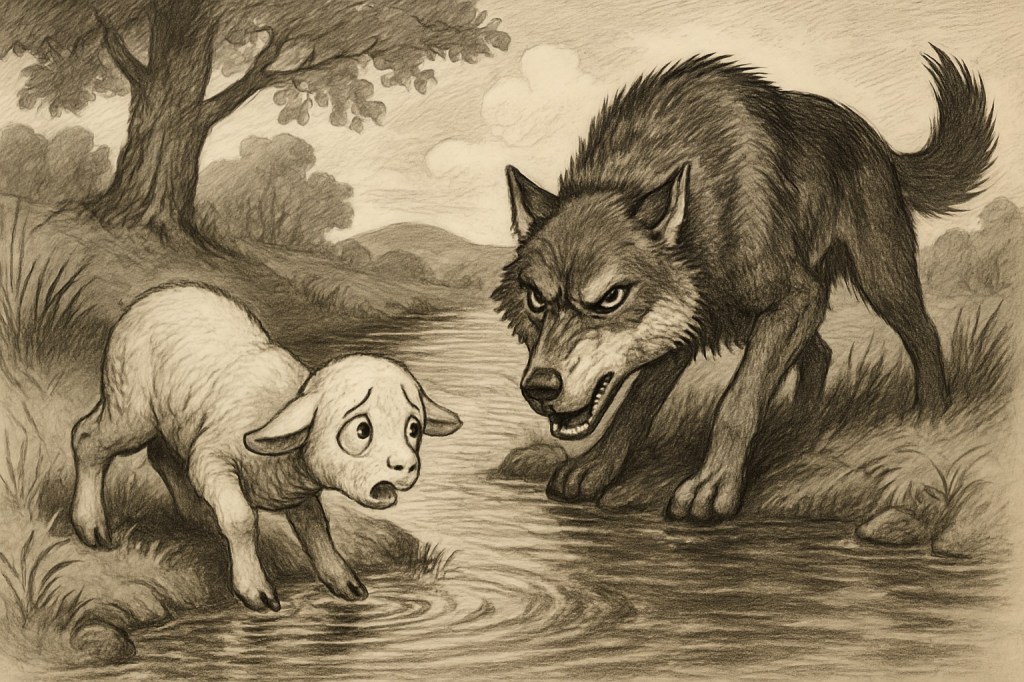
A wolf was drinking water on the bank of a river. A little away, downstream, was a lamb taking small sips.
“Why are you dirtying the water I am drinking,” growled the wolf.
“Sir, but I am downstream, how can I dirty the water reaching you?” The lamb tried to reason with the wolf.
“Okay! Okay!” said the wolf, his accent American, his logic Trumpian. “But why did you use abusive language with me last year?”
“But Sir, I wasn’t born last year,” pleaded the lamb wiping his sweat.
“Then, it must have been your mother,” said the angry wolf and pounced on the lamb.
That is the original version of the story.
“Why are you dirtying the water….”
The current version, has some more characters and interesting twists. The wolf is rankled more by two other animals in the jungle—the bear and the little dragon who have enough nuisance value for him. To his annoyance, the lamb is friendly with the bear. And, playing on the mind of the slimy wolf is the fear: “What if, let alone the lamb, the bear and the little dragon, other animals of the jungle stand up against him?
The animals of the jungle have a different concern.
Their worry is that the wolf has an Indian brain, a Chinese heart, a Vietnamese kidney, Latino lungs, Mexican blood, Jewish bones… but, it is controlled by its own xxxhole. How much more stink will it bestow upon the jungle before it suffers from the same?
Can India let the dragon keep trampling its interests?
At noon on November the 3rd, 1988, it was an anxious moment in the Ops Room of Army Headquarters in Delhi. The who’s who of the Indian political and military leadership, and the sharpest brains of the diplomatic corps had gotten together to plan the rescue of the then Maldivian president surrounded by blood-thirsty armed men. The lingering fear was that of the IAF aircraft, with the troops on board, being blown up by the rebels at the time of touchdown. There were suggestions to respond with maximum force. With a view to outdo the rebels, a general officer suggested inducting more troops than the number that had been proposed by the Army Chief. Humour was not lost on a witty Ronen Sen—a troubleshooter of a diplomat—who said, “Let’s not induct so many troops—the island will sink under their weight.”
Thankfully, Malé didn’t sink under the weight of the Indian military contingent then. Also, in the following decades the islands didn’t submerge despite the weight of the infrastructure developed, mostly gratis, by India. Even the weight of the feeling of indebtedness for the assistance provided by India in their times of various crises couldn’t dunk the islands.
Occasionally, when their leadership was getting ensnared by Beijing, well-meaning islanders—and there is a large number of them—were in touch with Indian leadership and intelligentsia. But India did not heed their clamour for help. Delhi didn’t interfere considering that it was the prerogative of the Maldivian leadership. The result was that the Maldives unfairly cancelled many contracts awarded to the Indian firms (including the $511 million airport project bagged by GMR) and even leased islands to Beijing which are being used as observation posts to snoop on India. This certainly was not what India had bargained for its non-interference in its neighbour’s affairs.
A cross-section of people on either side feel that both India and the Maldives will be the losers as a result of the current spat. They conclude, and rightly so, that China will gain immensely from this tiff. So, should India accept this Malé-Beijing bonhomie as fait accompli? Certainly not, particularly if it is detrimental to India’s strategic interests. Silence is not a rewarding policy in a world of strategic communication. India needs to do more than just conveying its displeasure over Malé’s actions.
People also say that China is economically too powerful to be confronted. The diplomacy we have followed over the years has been trumped at each step by the lure of Chinese investments. It is, therefore, no wonder that Malé is following in the footsteps of Nepal, Bhutan, Bangladesh and Sri Lanka. But, can India let the dragon keep trampling its interests? Time and energy need not be devoted to answering that rhetorical question. China must not continue to get things on a platter.
India must do everything possible to make Beijing pay the cost for encroaching its interests. In the bargain, if Malé suffers, so be it; they have asked for it. All the possible ways in which India can counter China in the Maldives (and elsewhere)—and there are very many of them—may be adopted discreetly, without making a hue and cry. Keeping Beijing guessing will also serve a definite purpose.
Out of step with Chi…
President Mohamed Moizzu who generated the anti-India wave and rode it to success in the presidential election is certainly not in step with Chi. Now in Beijing, he’s trying to get some favours. Among others, China has promised additional flights and tourists to Malé. That will more than make up for the loss of revenue due to Indians not touring the Maldives. Hopefully, for the time being. But for sure, among the tourists will be Chinese agents (and possibly carriers of new variants of Covid) whose presence, the Maldives will regret at some point of time in the not too distant future.
What can India do?
Malé incurred heavy losses during the pandemic
The frenzy will be over soon. When the dust settles, for us Indians, the most difficult thing will be to acknowledge the blind spots so undiplomatically pointed out by the Maldivian ministers. Although, their comments were related to tourism in the Lakshadweep, it will be in our interest to consider tourism as a whole—everywhere in India.
India has umpteen exotic locations to promote tourism—pristine unexplored beaches, mountain treks, jungle safaris, bird sanctuaries and reserve forests. We have historical monuments and places of worship. Tourism for adventure sports, medical care, naturopathy, meditation and Yoga is already flourishing. People also travel for art, culture, theatre, film and photography… the list is long and ever growing. Limits are posed by imagination alone. Each of these has its peculiarities—means of transport, accommodation, food, equipment and above all people who can communicate well. India must go all guns blazing, and create infrastructure and train human resource to give the tourists an experience. Some sincere and meaningful introspection is vital as we take on the adversaries.
Need more be said!?
[Hereafter, how to deal with the Maldivians visiting India for medicare, education or any other purpose—is a subject for another day.]
Comments
Well written, Chordia; as usual! Thought provoking too…really need to up the ante in tourism….we have a long way to go…’coz, I feel genetically we are crooks…especially those who can make a difference..out for the big buck!! ~ Air Vice Marshal TPS Dhillon (IAF Veteran)
Well timed and articulated. India just has 1.6% of global share of tourism. As rightly put by you that we have everything to offer. Beaches, mountains, deserts, monuments, buildings , temples with their unbelievable architecture, yoga, massages, traditional music and dances not to forget medical and religious tourism. We have to exploit all these but for that we have to create infrastructure and also improve our image as a nation. It is difficult to digest that having a destination wedding in India cost three times more than in Bali. ~ Group Captain Sanjiv Aggarwal (IAF Veteran)
Will the man in the street of Malé be able to bear the outcome of the spat between India and the Maldives?
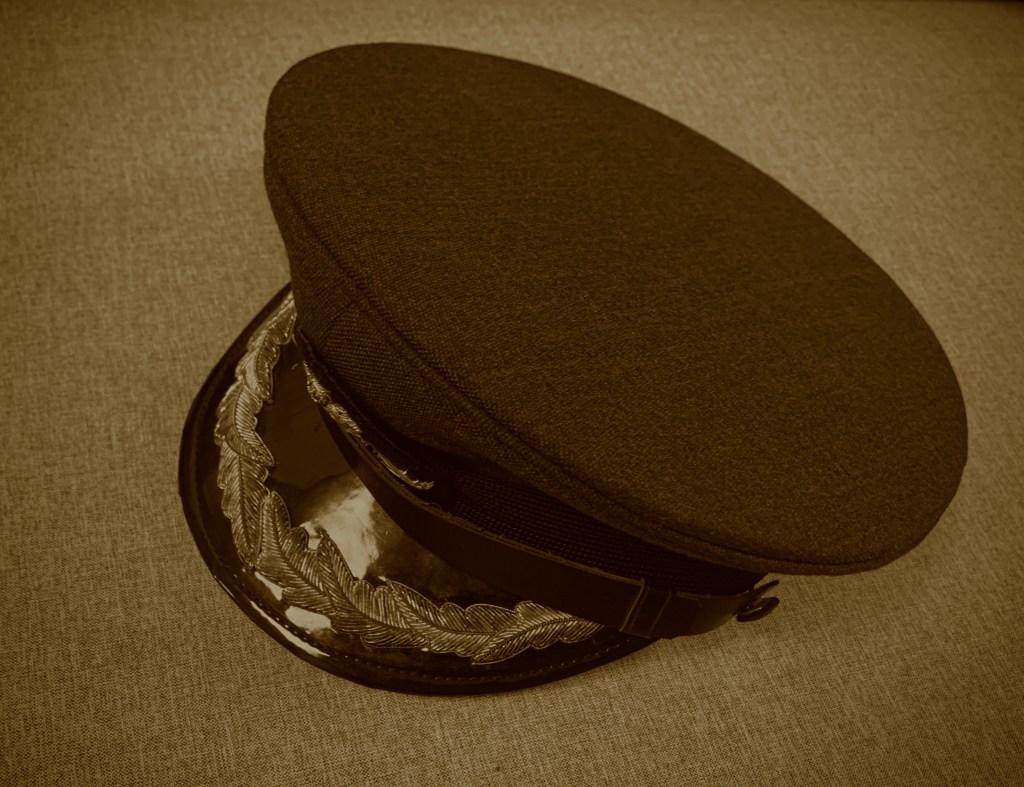
The one, and the only time I have ever been to the Maldives was without a passport, visa or an air ticket. Yet there was a red-carpet welcome. The Maldivians, their Government and their President in particular, were thankful for that visit of ours. In a handwritten note which he gave me, a senior military officer had expressed the sentiment: “Your Governments kind assistance is very much appreciated by our Force. National Security Service.” Signed Major Mohamed Zahir 4/11/88. He also presented me a cap badge and a formation sign of the NSS as souvenirs. “Do come over again in better times,” he had said, extending an invitation to me to the island nation. Perhaps that generous offer from a grateful Maldivian has become time-barred.
That was in November 1988—the Indian Armed Forces had provided succour to the then Government of Mr MA Gayoom in the midst of an attempted coup. The IAF had airlifted the paratroopers from Agra to Malé (2600km away); the paratroopers had rescued the President and restored calm. The Indian Navy had rounded up the fleeing rebels.
Much bloodshed was avoided; the medics of the Indian Army had taken over the Central Hospital to provide care to the wounded. The authorities had fallen short of words to appreciate the gesture (read the letter). The Indian troops remained in the Maldives for six months providing security cover and training the Maldivian forces.
And that was nearly 35 years ago.
Is the Prez being mentored/ chastised?
Time, tide and China have caused the erosion of the relationship that had been built on mutual trust and cooperation over the intervening decades. In the Maldives of President Mohamed Moizzu, the presence of an Indian helicopter and a handful of men—stationed to provide assistance to the Maldivians with the explicit understanding with the previous governments—is no longer acceptable. The manner in which it has been put forth by the man speaks volumes about his standing as the President of a sovereign country. Mind his body language and that of the Al Jazeera anchor during his recent interview to the television channel. The President is sitting up like a schoolboy answering the anchor who is leaning back, cross legged and pointing a pencil at him like a teacher. During their interaction, he appeared fidgety as if he were under instructions from his bosses to tow a particular line.
For sure, minds in Delhi will be working overtime to establish how things have come to such a pass, and more importantly, how to turn the tide. At the same time, the leaderships in Beijing and Malé must be looking forward to extracting the maximum they can from their present bonhomie. The people of Maldives will feel the effect of the Chinese bear hug sooner than later. It’ll be myopic on their part to ignore the outcome of Beijing’s largesse to Pakistan and Sri Lanka, and the result of China’s benevolence in Africa and South America.
Knowing the sentimental Indian, it wouldn’t be long before the ripples caused by #EXPLOREINDIANISLANDS and #boycottmaldives turn into waves. And, it shouldn’t be surprising if those waves turn into a tidal waves and then, into a tsunami that takes a small toll on Maldivian Tourism. As it appears, many have already reworked their plans (changed the destination from the Maldives to the Lakshadweep). A more likely and significant positive spinoff of the spat triggered by the unsavoury comment of a Maldivian politician (on Prime Minister Modi’s call to make Indian islands a tourist destination) would be an improvement in the facilities that our islands provide.
With a few Bollywood celebs echoing the anti-Maldives sentiment, investors might reconsider their plans of shooting their films on locales in the Maldives. A few cancellations will be enough for the Maldivians to feel the heat. Not long ago, I had advised my friends working on two of my stories—one inspired by Operation Cactus, and the other, based on a life changing event in the life of a military veteran—to plan shooting in the Lakshadweep rather than the Maldives. Although those suggestions were purely to keep the costs down, the present euphoria is nudging the decision further in this direction.
In the foreseeable future, Maldivians are less likely to give up visiting India for medical care or enrolling in Indian educational institutions or for other reasons. Visiting India is a need for the Maldivians.
A dispassionate cost benefit analysis of the current spat might show a little gain (or at least, NO LOSS) for India in the near future. The long-term tangible and intangible losses for the Maldives might be unbearable. Needless to say, the islands leased by the Maldives to Beijing have been a thorn in India’s side. Interestingly, the wisdom of an old Hindi proverb boils down to: “Use a thorn to take out a thorn.”
A dragon doesn’t have a soft belly. But it shouldn’t be impossible to find some delicate spots to insert a few needles to relieve the pain in India’s side. I am sure Jay (read Jai, if you will) is at it.
[Note: As I post this article, news of suspension of three Maldivian Ministers for their derogatory remarks against Prime Minister Narendra Modi, is making headlines. Will this action by President Mohamed Moizzu, stop the impending tsunami? Let’s wait and watch.]
UNBELIEVABLE… ‘पोहा’ a delicacy from the Malwa Region of MP is stoking up social discrimination.
For ages, restaurants in the Malwa region of Madhya Pradesh have been serving a delicacy they call Poha. It tastes awesome and a plateful is within the means of the commonest of the common man. It is made using flattened rice and is traditionally savoured at breakfast with jalebi and tea. Some prefer to eat Poha with a glass of milk. The Indian Constitution is silent on the freedom of eating it as a part of any other meal than breakfast. The peace-loving docile people of Malwa have never protested against those deviating from the norm.
Memories!
Etched indelibly in my mind are little flat plates of Poha garnished with fresh coriander and Senv—a local bhujiya which cannot be substituted by the likes of Haldiram and Bikanerwala. Standing by a thela (a typical roofed push-cart used by the Poha vendors) or outside a shack, people used to eat from enamelled plates with flimsy aluminium spoons. Bent at different angles at their necks, those spoons used to be cutlery marvels. Despite the crookedness, they enabled people to shovel measured quantities of Poha into their mouths without spilling. Using those deformed tools to serve their intended purpose of enabling eating was an art akin to using chopsticks. People of all castes, creed, colour, sex or status used the same plates and the same spoons; there was no discrimination. Socialism!
Over a plate of Poha and a cup of kadak chai (strong tea) folks used to discuss everything. Everything meaning, everything under the sun. They talked about the quality of leadership provided by Indira Gandhi as against that of Nehru or Shastri. They shared their concerns emanating from the Cold War and India’s leadership of the Non-Aligned Movement. They had opinions on whether or not Nawab Pataudi could lead India. Those unbiased views were based purely on the Tiger’s performance on the field, although some people doubted his capability because of an eye-defect. Some even felt that his marriage to Sharmila Tagore had affected his game. For better or worse—they were unsure. They even talked about what could be India’s strategy in the next war with China, if it took place ever. All this… over a plate of Poha and a cup of tea. And of course, in a very amiable atmosphere. They did agree to disagree on a few issues but never raised their voices or carried grudges. Poha united them.
Much of that has changed.
Not long ago, people began questioning the cleanliness of the crockery and cutlery used for serving Poha. They objected to eating from plates rinsed repeatedly with water kept in a discarded Asian Paint bucket. They were right in lamenting, “It is unhygienic.” But most of the Poha vendors did not afford the luxury of running water to clean the used plates.
At a time when Poha Culture, an activity that united the Malwi people and could have earned UNESCO’s recognition, was on the verge of extinction, the Poha Vendor’s Association of Malwa (PVAM) came up with an innovative solution which appealed to all and sundry. They recommended use of bits of old newspapers in place of the usual crockery. They also came up with an improvised paper spoon—origami at its best. Those who still preferred the enamelled (now ceramic) plates and the usual spoons (now made of steel and devoid of kinkiness), could be extended the service. All stakeholders were happy; it was a WIN-WIN situation. “Not really,” was the response of one of my acquaintances. “This change is damaging the social fabric of Malwa,” he was emotional. His voice choked; he couldn’t elaborate.
Curiosity led me to indulge in pseudo-investigative journalism. And, this is what I experienced when I visited MahaakalHotel on the outskirts of the holy city of Ujjain in the guise of a highway traveller last week.
Chhotu, the waiter (barely in his teens) didn’t know that I was there to probe a matter of national importance—an issue that could draw the attention of New York Times and sully, India’s image. He came holding five tumblers in a way that his fingers were dipped in the water contained in them, and literally banged them in front of me on the creaky table. He was unmindful of the water he spilled in the process. He bared his yellow teeth when I asked him to clean the table and promptly wiped the tabletop with a smelly rag which left parallel streaks of more water in front of me. Contents of the glasses were tad misty—Poha particles which had been clinging on to Chhotu’s fingers had parted ways and were now descending majestically towards the bottoms of the glasses. It was a beautiful sight; my thirst was quenched without taking a sip.
Exploitation of children concerns me. It pains me to see little ones working in hotels, homes and workshops rather than going to school. On numerous occasions, I have tried my bit to alleviate their misery but to no avail. More often than not, I have found that a child pulled out of the clutches of a restaurant owner ends up sleeping hungry with a school bag for a pillow. Free education—mere ability to read, write and do elementary arithmetic—and mid-day meal, is a good concept but does not find favour with those at the receiving end of it. Working in the hotels enables those children to earn not only meals but also cash to carry home. Occasionally, modest tips add up to a decent amount. Besides, the life’s lessons they learn while serving people are invaluable. That on-the-job training, I think, is one of the purer and more practical forms of education—more useful than crude literacy. I have come across a rare breed of employers, who treat children extremely benevolently. Some provide for all the needs of the urchins including their part time schooling. We also hear of the cruel masters as projected in Bollywood films. Honestly, I am unsure of my stand on the subject. In rare moments of solitude when I have a conversation with myself, my inability to do something gnaws at my heart. I try to overcome my guilt by tipping children who work to earn their livelihood.
Chhotu enquired if I preferred Poha being served to me on a plate, or on a piece of newspaper. “Both will cost the same,” he chimed.
“Get it on a newspaper,” I told him as I placed a rupee fifty note on his little palm. He thought that I was making advance payment for my plate of Poha but was pleasantly surprised when I told him that it was his tip. He looked around and pocketed it.
Mahaakal Hotel was strategically located on a fairly busy road crossing. Next to the hotel was an empty plot of land. More than half a dozen cars were parked haphazardly in that open space. There was a rare green Merc A Class, a passion yellow Audi A4, a black Skoda Ocatvia, an old grey Honda City and a couple of i10 and Maruti Alto class of vehicles. These were the Poha lovers who had travelled long distances from the heart of Indore and Ujjain to relish a plate of the popular Mahaakal Poha. They were honking to draw the attention of the waiters who were fluttering about like butterflies from one car to the other taking orders and effecting deliveries. The occupants of the yellow Audi were clad in white Khadi. When two of them stepped out to stretch their legs, their body language suggested that they were in the business of running the state government. I recalled seeing one of them on the cover page of Nai Duniya that morning. The waiters were certainly not indifferent to the customers sitting at the tables but surely, they were paying greater attention to the needs of patrons sitting in the cars.
Just then, I heard a customer at the adjoining table, whining. He was complaining that his order had been delayed and that the carwallahs were getting preferential treatment. Smelling trouble, the obese owner of the Hotel left his chair at the cash counter and tried to pacify the disgruntled man. “Please calm down, Sir” he said. “Your order will be here in a jiffy.” Then he added with deliberate stress for everyone around to hear, “Sir, for us all customers are equal.”
He then shouted on top of his voice, “Golu, chhallewali gaadi me poha dekar teen number table ko attend kar.” [Golu, attend to the customer at table number 3 after serving the guests in the car with rings (meaning Audi).]
After a little while, I overheard one of the Audi occupants addressing Golu jocularly, “Keep serving us tea like this… we’ll make sure that one day you become the Prime Minister.” This monologue was followed by a chorused chuckle.
Chhotu returned to me after all guests had been served. By then I had finished eating the Poha he had served me. “Can I get you anything else,” he enquired. He continued when I declined. “Sir, you must try a plate of our special Poha and Samosa. Both are really good.”
“What’s so good about them,” I enquired.
“In addition to the usual Senv and coriander, we garnish Special Poha Plate with chopped onion, boondi and fresh pomegranate. The helping is larger and it costs just five rupees more. The Samosa is fried in Saffola oil… very light Sir.”
Since I had already eaten Poha, I ordered a Samosa.
Chhotu got me a Samosa on a piece of paper. Since there weren’t many guests at that time, he stood a little distance from my table and made a deliberate effort to engage me in a conversation. “How’s it, Sir?”
“Hmm, it’s good,” I said rather indifferently.
“Sir, those guests who come in shining cars always order Special Mahaakal Poha and get some Samosas packed for home… I know they are VIPs and serve them on the glossy pages of English magazines or The Times of India newspaper. Others, I serve on the pages of Nai Dunia and Dainik Jagran.”
Chhotu’s salesmanship made me laugh. “But, your boss said, you people do not discriminate. All guests are equal for you?” I took a dig.
He gazed at me in a way which seemed to say, “Come on, Sir you must be joking.” Then he said aloud with all seriousness, “Sir, in theory it is alright to say that all customers are equal. But in real life, some customers are more equal than others… and, they have to be given their due.”
Poha, Samosa and Socialism
Out of curiosity, I looked at the piece of paper on which Chhotu had served me the Samosa. It was that part of the city edition of some local newspaper which had the daily crossword, Sudoku and Hitori. I wasn’t sure on which rung of the social ladder he had placed me.
I am still waiting to conclude my maiden project in journalism.
Sino-Indian border talks have been roiling like a long-brewing ginger-tulsi kadha––becoming bitterer in taste with each passing moment. If only the potion seethes well, might India and China accrue long-term health benefits from it. The outcome of the sixth round of talks doesn’t indicate that; it is another case of the same old wine being served in a new bottle––still focussing on defusing tensions.
The bad broad nibs…
Talks, and more talks, are in the offing––uncertainty and unease on the border have been prolonged. Divining the prospect of peace by reading tea leaves might not be possible since, mutually piqued, Modi and Xi are less likely to meet over a cup of tea in the near future. Yet I have been overzealous about the future.
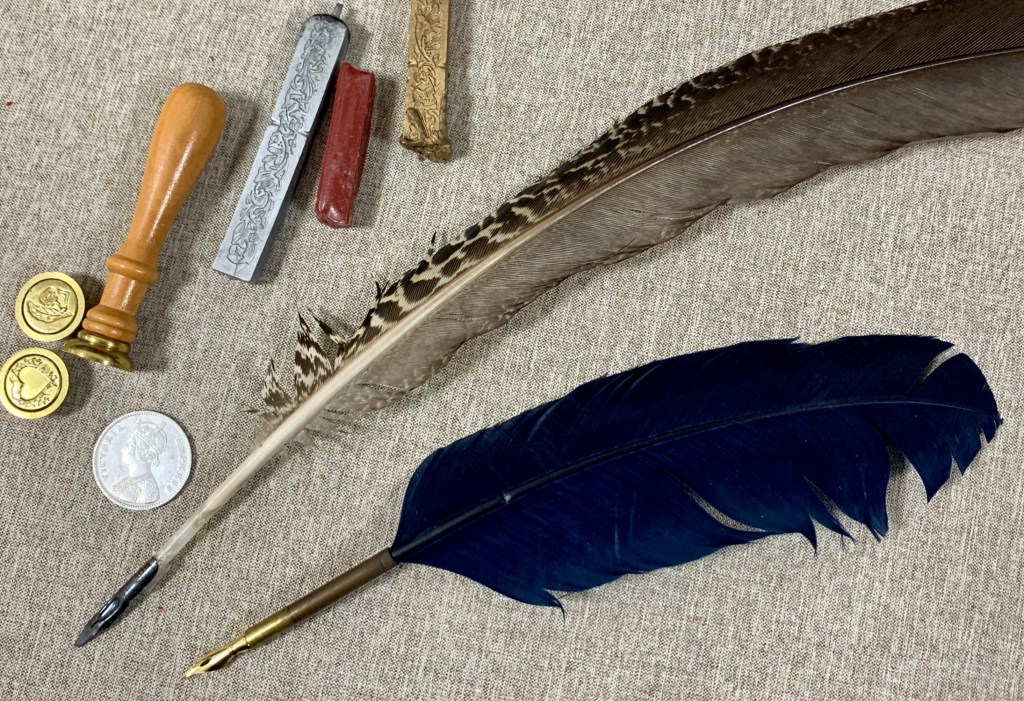
Would the Queen––whose representative caused this Sino-India border problem by using some bad broad nibs to draw the region’s map––help foresee the fate of the subcontinent? Out of curiosity I tossed a Victorian era silver coin hoping to get some answers––war or peace; withdrawal or long drawn standoff….? When judgement becomes difficult, I have started believing in the predictions guided by a coin with the British monarchy on its face for they (the Brits) are at the root of most of the world’s problems of today. And lo and behold, the coin I tossed, bounced off the road, missed a drain narrowly and ended up through a perforated concrete lid into a bottomless well meant for rainwater harvesting. Now sealed some fifty feet below the earth’s surface, is (the much sought knowledge of) the future of this great country.
Wooing and claiming territory in Africa
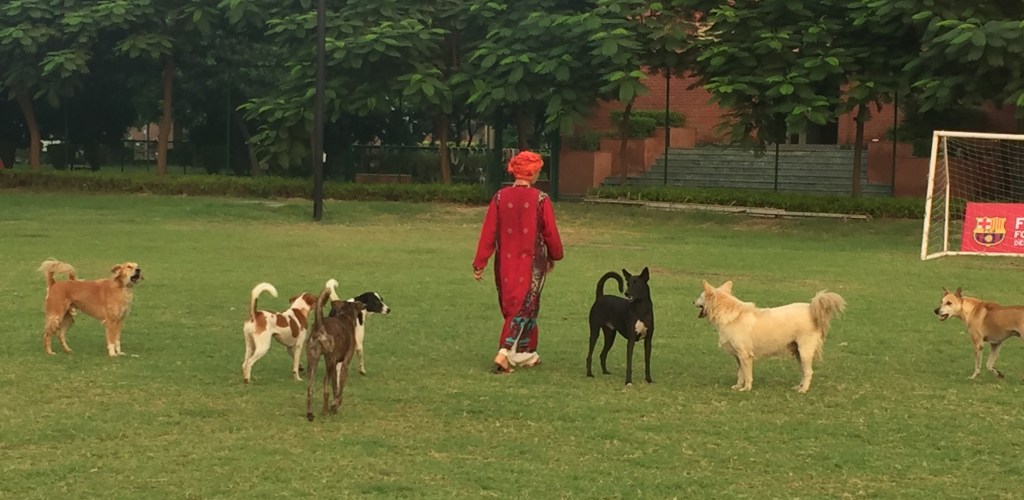
Rankled, I had almost decided to take a break from this Sino-India affair for a while when I saw Champagne––the wretched stray I introduced to my worthy readers in an earlier post titled, “China’s Champagne Moment.” Those familiar with that dog’s demeanour will recall that, like China he had been claiming territory that was not rightfully his until one day, when other dogs got together and taught him a lesson. Through Champagne I had projected Beijing’s doom.
My forecast has not come true yet; it has not been proved entirely false either. Several countries, with the US in the forefront, have been striving to settle their scores with China. The anti-China sentiment is simmering with greater intensity now than ever before. And ever since I wrote that piece, Champagne has been behaving even more like China. Rather than fighting with the dogs in the neighbourhood, he has been trying to travel far and wide and woo the dogs he sees sitting on any kind of resources. The other day I saw him wooing a black dog at a construction site. It felt as if China were wooing Africa.
An anthropomorphised Lisa
Then two strikingly strange and unusual things happened.
One, Lisa, another dog appeared on the scene. She became popular with all the dogs in the area. They aligned with her as much because of her friendly demeanour as for the reason that they wanted someone to stand for them against the aggressiveness of Champagne.
Learning to K-O-W-T-O-W
Two, around the time the last round of Sino-Indian border talks concluded, Champagne was seen practicing ‘kowtowing‘… yes, K-O-W-T-O-W-I-N-G.”
Reverting to China. Behind the façade, Beijing is succumbing to the pressures created by several countries going against it and this is evident in its slowly eroding belligerence. In the last few days, since the standoff at Pangong Tso, China has not reacted with use of force, instead it has spent time at the negotiating table with India. This doesn’t go with China’s past stance and responses to such issues. Reasons for its restraint are better known to Beijing; others can only hazard a guess.
Meanwhile, Indian leadership has not been resting on its oars. It is trying to find the best way to the dragon’s heart out of the so many routes available. One is direct––from Delhi to Beijing. The other is from Delhi to Beijing via one or more of––Washington, Ottawa, Paris, Berlin, Tehran, Tel Aviv, Canberra, Tokyo, Manila, the sea in the South of China (some people erroneously call it South China Sea), Malacca, Strait, Hong Kong, Taipei, Lhasa, Xinjiang, et al. Needless to say, in the present circumstances, Xi Jinping will be pleased to meet Modi’s emissary travelling direct from Delhi to Beijing rather than following a circuitous route.
In the present situation, either China has nothing to say (less likely), or it doesn’t have the words to say, what it wants to say. Therein lie the reasons for no tangible progress in the talks and no further escalation in hostilities. Therein also lies the reason why Xi Jinping, like Champagne, might as well go indoors and refresh his Kowtowing skill––one doesn’t know when he’d need to fall back on the benefits of the ancient Chinese practice.
India would do well to prepare the ESCAPE HATCH for the dragon’s graceful exit.
Four days from now, September the 26th will mark the 37th anniversary of an event that, beyond a sliver of doubt, averted a nuclear war. On that day in 1983, Lieutenant Colonel Stanislav Petrov of the Soviet Air Defence Forces was the duty officer at Serpukhov-15, the secret command centre outside Moscow monitoring its early-warning satellites over the United States when alarms went off––computers warned that five Minuteman intercontinental ballistic missiles had been launched from an American base.
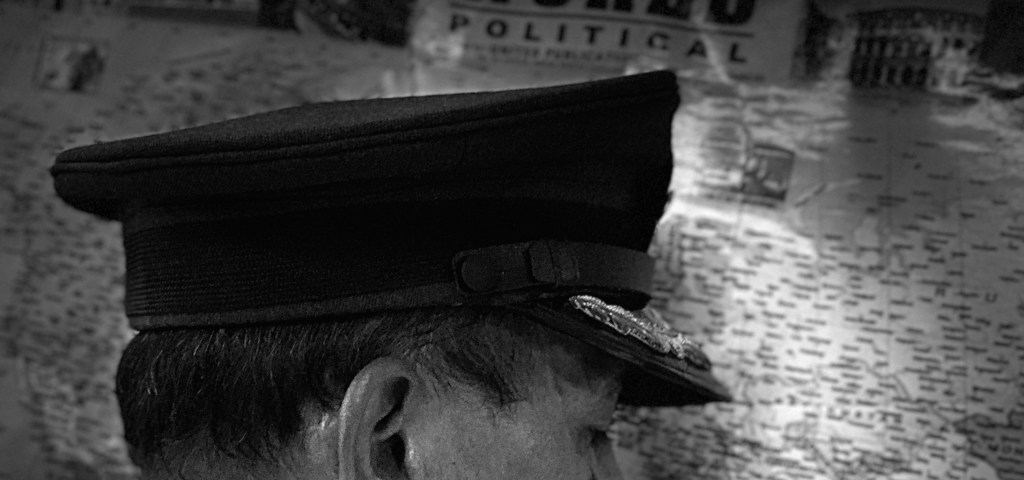
Colonel Petrov was a very important link in the decision-making chain. His superiors reported to the general staff, who would consult the Soviet leader, Mr Yuri V Andropov on launching a retaliatory attack. Since there was no rule about how long the observers were allowed to think before they reported a strike, Petrov took his sweet time absorbing the deluge of incoming information and ‘felt’ that the launch reports were ‘probably’ a false alarm. He, therefore, reported ‘a system malfunction’. “I had a funny feeling in my gut,” he told a newspaper later. “I didn’t want to make a mistake. I made a decision, and that was it.”
Petrov’s nuclear dilemma
Every second of delay on that day took away valuable time that the Soviet military and political leadership would have needed to absorb the inputs and react. Petrov told an interviewer, “… I couldn’t move. I felt like I was sitting on a hot frying pan.” It was at best a 50-50 guess, based on his distrust of the early-warning system and the relative paucity of missiles that were launched. He could afford the luxury of sleeping mulling over the inputs because 25 long minutes would elapse between launch and detonation. Petrov attributed his judgment to his training and his intuition. He had been told that a nuclear first strike by the Americans would come in the form of an overwhelming onslaught.
Training and Intuition… where does India stand?
A typical military exercise––conducted at many of the military training institutes/ colleges/ establishments––has a Blue Force (India) and a Red Force (the adversary––Pakistan or China, implied or explicit). The exercises are realistic with full freedom to the participating officers––with 3 to 30 years of commissioned service; sometimes, including bureaucrats, diplomats and scientists––to let go of their imagination to plan and execute military operations until… someone in the Red Force threatens to use the nukes.
The exercise is paused and the director of the exercise (or the umpire) steps in and enlightens the attendees. Put in different words and with varying intensity, depending on the personality of the guru, the gist of what is repeatedly sermonised and hammered into the craniums of the participants is: “Like India, China has a No-First-Use (NFU) policy––therefore, use of a nuclear weapon by China against India is not a likely proposition. As regards Pakistan, although their leadership talks and acts insanely, they are not mad. Nuclear sabre rattling by Pakistan is, but a hollow threat. Pakistan cannot dare to strike India with a nuclear-tipped missile because even with a ‘second strike’ option, India has the capability to turn the whole of Pakistan into rubble…. We can cause unacceptable damageto any adversary if we are struck with nukes….”
The punch line delivered (invariably) with theatrical emphasis and the air of a political leader seeking to hold a moral high ground at a peace conference at the UN General Assembly reads somewhat:
“Nuclear weapons are not meant for fighting; they are there (only) for deterrence.”
This has now been going on for decades since the legendary Mr K Subrahmanyam drew up the draft of India’s Nuclear Doctrine, which communicated, along with India’s NFU status, the spirit that:
“Nuclear weapons are the weapons of last resort; they’ll be used only in retaliation against a nuclear attack on Indian Territory or on Indian forces anywhere.”
As can be seen, there is a subtle difference between what the genius, Mr Subrahmanyam enunciated and what the later gurus interpreted, communicated and taught to the lesser mortals––the military personnel and the scientists––people who would be expected to ‘handle’ the nukes when ordained by the political leadership. Over the years, the people, who would some day play Colonel Petrov in India’s case; have been getting inoculated with a different vaccine than should have been ideally prescribed.
An ambiguity at a crucial moment––nuclear weapons being weapons of last resort or being meant only for deterrence––borne out of years of training, can cost India dear because it would take just about five to ten minutes from a launch (in Pakistan or China) to detonation (in India). In a situation like Petrov’s, Indians would not afford the luxury of time. It is therefore, imperative that people who would some day be in the decision making chain and those who would be executing a political big decision (particularly the men in uniform and the scientists) be educated and trained to act decisively without dithering like Colonel Petrov.
Need to unlearn and re-learn
The need to unlearn and relearn the nuances of the Indian Nuclear Doctrine is also mandated by the recent behaviour of our neighbours. Let’s look at it this way. Pakistan knows that its nuclear sabre rattling does not perturb India, for India has called Pakistan’s nuclear bluff twice recently––one, by carrying out surgical strikes across the border after Uri terror attack; and two, by executing airstrikes against terror camps at Balakot in response to the Pulwama Terror Attack. In both those cases, Imran Khan first blabbered about the heightening tensions and the possibility of ‘inadvertent’ use of nukes, then ate a humble pie.
Humiliated at home and abroad on those counts, and coupled with a messed up economy and a battered national prestige (because of Pakistan’s terror links), the Khan is vulnerable to arm-twisting by three agencies––Pakistan Military; Pakistan-based terror outfits; and a Shylock-like China, whose debt makes Pakistan cringe. China is capable of using several levers to instigate its stooge, Pakistan to surprise India. Considering these mounting pressures, the cricketer turned puppet of a politician, might be forced to reconsider and carry out his nuclear bluff. The probability, although infinitely low, is not equal to zero. Therefore, it would be prudent on India’s part to cater for a ‘mistaken’ use of a nuke by Imran’s Pakistan.
To sum up, security, and nuclear security in particular, is a dynamic concept; its doctrines and understanding of the same by every link in the chain needs periodic review and refreshing. Exercising realistically with the nuclear option will convey a stronger ‘resolve’ to the adversaries and work as a more meaningful deterrence without changing anything on the ground.
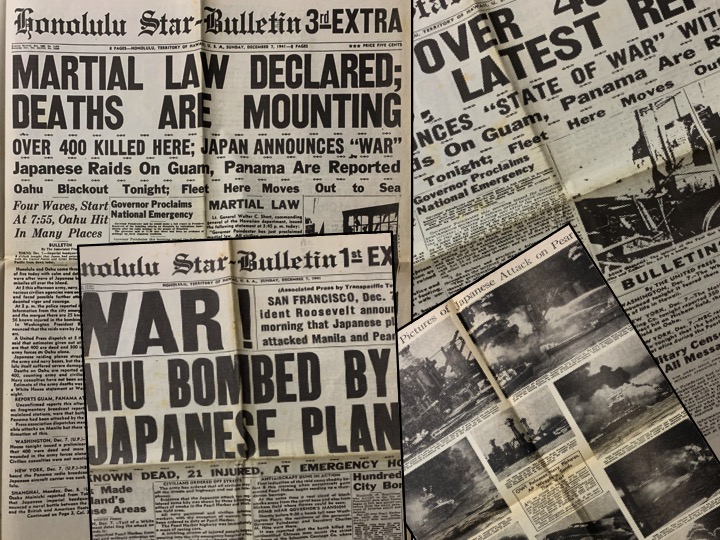
8:00 am. Sunday, December the 7th, 1941. Pearl Harbour happened––a surprise military strike by the Japanese devastated the US naval base in the Pacific. Major US losses included: four battleships sunk and another four damaged and three each cruisers and destroyers damaged. Worse was the destruction of 188 aircraft. Even greater setback was the loss of 2336 men (killed) and 1,143 wounded.
Although the US avenged Pearl Harbour by nuke bombing Nagasaki and Hiroshima, it left indelible scars on the American psyche.
After the end of WW II, the Americans turned almost the whole of Pearl Harbour into a War Museum. The USS Arizona Memorial with the list of the dead warriors; the tattered Stars and Stripes and copies of the next day’s newspapers and much more––keep jolting Americans. “Never again,” is the message writ large upon everything American in Hawaii.
Strafed wall: HQ US PACAF
On my first visit to Hawaii, Brigadier General Meryll drew my attention to bullet marks on the wall of a building of the Headquarters of the US Pacific Air Forces. “We’ve deliberately not repaired those craters left by the Japanese bombers––they remind us that we were caught napping once. Pearl Harbour will never repeat,” he said.
A solemn resolve.
Time erodes memories. America was caught napping again––9/11 happened. The US pounded Afghanistan and killed Osama Bin Laden. Those follow-up actions certainly did not avenge or offset the 3,000 innocent American lives lost in the ghastly attack on the twin towers of the World Trade Centre.
As if that was not enough, America lowered its guard yet again. Covid-19 pandemic is no less than another Pearl Harbour––close to 1,97,000 innocent American lives lost, and still counting. America blames this one on China. Yet, simmering internal strife and the forthcoming Presidential election has blunted weakened Uncle Sam’s ability resolve to punish its perpetrator.
Caught napping…
Countries have their Pearl Harbour moments––October 1962 was India’s, when China attacked and occupied Indian territory by surprise. In the nearly six decades gone by, China has occasionally reminded India of that one time when India had dozed off. Galwan Valley incident was a rude reminder of the dragon’s sliminess. In fact, it was a jolt that let India learn its lesson hard, and fast. The result was evident in the swiftness with which Indian Army grabbed tactical advantage in the Pangong Tso Area. PLA will now use every arrow in its quiver to neutralise the Indian advantage. In all probability, the present lull is a prelude to yet another adventure by the dragon.
For whatever reasons, in 1962, India did not employ its combat air power against the Chinese. Likewise, during Kargil, restriction was imposed on the Indian Air Force on crossing the LAC. In both those cases, India paid an avoidable cost for not exploiting the full potential of its combat air power.
In the present situation, when the Indian Army is sitting pretty on heights overlooking the Chinese positions, it would be advisable to give the Air Force a free hand to plan and execute its operations in support of the Indian Army.
The supreme sacrifice made by the Indian Jawans in Galwan Valley is too recent an occurrence to be forgotten; it is never to be forgotten. 1962, India’s Pearl Harbour, is too unpleasant to be allowed to repeat.
A day after the meeting between the External Affairs Ministers of India and China, the experts who went deep diving into the official statements of the two, to draw meaning, have not struck upon anything to write home about. Some are now trying to read the body languages of the two ministers during the ten-second photo-op with the Russian Foreign Minister. Until something significant trickles from their efforts, one might take a re-look at the antecedents of the Galwan Valley faceoff and the Pangong Tso standoff. On a dispassionate glance at the incidents in the rear-view mirror, one might just get inclined to draw a conclusion which, might be viewed with mixed emotions… and that inference is:
“Sino-Indian border issue is too serious an affair to be left to a single agency––political leadership, diplomatic corps or the military––to resolve.”
Beyond any doubt, the synergy of the trio has helped India hold the dragon at bay… until now.
The present situation can be summarised thus: India has a tactical military advantage in the Ladakh region––Indian Army will exploit that edge, if a need arises. While China is weighing and considering its options, India is consolidating its position––troops are getting more acclimatised and are stocking up to address the developing situation. China cannot possibly challenge Indian positions in the Ladakh region. If it opens another front elsewhere––say, Sikkim or Arunanchal, where its gains might be iffy––probably Indian troops would en-cash the advantage around Pangong Tso.
A China that now considers itself a world power second only to the US is less likely to eat a humble pie by accepting ‘status quo ante’ (for whatever it means), or by unconditionally withdrawing. A ‘publicised’ setback in Ladakh will affect China’s reputation and stakes elsewhere––Xinjiang, Tibet, Hong Kong, Taiwan and of course, in the sea on its south (some people call it South China Sea‘).
Imponderables are far too many to be summarised here. The time is running out. Suffice it to say that in due course winter will set in and it will become more difficult for Beijing to maintain its forces in the region than Delhi. Dragon is doomed if it accepts India’s terms for peace; it is doomed if it doesn’t. That perhaps is the reason for practically nothing coming out of the meeting between the ministers.
Can India help the dragon wriggle out of a situation it is responsible for creating?
Perhaps Sun Tzu’s Art of War can throw up an answer for India:
“When you surround an enemy [adversary], leave an outlet free…. The object is to make him believe that there is a road to safety, and thus prevent his fighting with the courage of despair. For you should not press a desperate foe too hard.”
~ Sun Tzu, The Art of War, Chapter VII, Manoeuvring
Although not physically surrounded, Beijing’s dilemma in Ladakh is damning––to fight or to find a face saving way out of the imbroglio. While, the Indian Army is holding the fort, can the dragon be nudged into a diplomatic escape hatch from which it can emerge with a smile?
News from India-China border isn’t very encouraging. Last month end situation became volatile in eastern Ladakh after India thwarted a Chinese attempt to occupy Indian territory near Pangong Tso. As it stands, India has occupied a number of strategic heights on the southern bank of the lake and strengthened its presence in other areas in the region. India has also rushed in additional troops and military hardware to the region.
The diplomatic and military level talks to ease tensions have failed. Also, nothing worthwhile emerged from the interaction between the Defence Ministers on the sidelines of the SCO Defence Ministers Meeting in Moscow on September 4, 2020. The probability of the success of a similarly planned meeting between the External Affairs Ministers scheduled on September 10, 2020 hovers closer to zero than 1. The reasons are understandable. India, having occupied positions of tactical advantage in Ladakh will be approaching the dialogue with a little more bargaining power than it usually does. China might want this status to change before discussing contentious border issues. Besides, unlike the Indian representatives who are empowered to take decisions, the Chinese representatives at such meetings are not authorised to take decisions.
Meanwhile, following reports of Chinese troops firing warning shots in Ladakh, troops on either side are on the razor’s edge. There are ominous signs that after having made relentless vain attempts at negotiating peace, the political leadership on both sides might pass on the baton to the military to ‘handle’ the issue.
‘War-mongering’? May be. Or, is it ‘wisdom’? Wisdom wrung out of the experience of 1962, which points at the dire need of military preparedness of a high order and readiness to deal with a belligerent neighbour.
Among others, one dimension of military preparedness is existence of support infrastructure along the border. Several projects related to new construction (and development of old ones) of roads, runways, helipads, ammunition dumps, logistics nodes, transit camps and military hospitals etc are under way. These projects are unprecedented and are to Beijing’s chagrin. Once ready, they will bolster India’s war fighting ability considerably. This will force China to invent alternate ways to breach India’s defences. That, in turn, might give rise to the need for India of developing more new infrastructure.
The dire need to create infrastructure in times of crisis is a recurring issue. In 1947, service personnel and the refugees led by Lieutenant Colonel Pritam Singh built a 600-yard runway at Poonch in six days. In another case, tonnes of barbed wire were airdropped to barricade the advancing Chinese (Sino-India War 1962), even as troops were engaged in fighting. Whether it served the intended purpose, is doubtful. During the Berlin Airlift, building from a scratch 17,000 Berliners––men, women and children––worked in 8-hourly shifts to construct a runway at Tegel. Those (Poonch and Berlin) were cases of people rising to the occasion.
US Navy’s Construction Battalions (CBs) better known as Seabees have institutionalised speedy creation of infrastructure in times of crisis––a desideratum for fighting forces. Formed following the attack on Pearl Harbour when the task of turning imminent defeat into victory seemed almost insurmountable, the Seabees are very well equipped teams renowned for building bases, bulldozing and paving thousands of miles of roadway and airstrips, and accomplishing numerous other construction projects in different war zones since World War II. They constructed six 8500+ feet runways at the rate of one runway per 53 days; over 18 kms of taxiways; hard-standing to accommodate over 400 bombers, and accommodation for 50,000 personnel and office complexes, on the islands of Tinian and Saipan in a record time of less than a year during World War II. Seabees have been deployed around the globe supporting a variety of humanitarian missions and contingency operations. They were among the first forces in Afghanistan after the 9/11 attacks to upgrade and repair airfields.
To sum up, it is humanly impossible to make the long borders physically secure. While creation of border infrastructure does go a long way in securing the borders, it is also an endless process. There’s a case for creating teams of experts that can undertake rapid construction work of any type, anywhere, anytime: during wartime or during humanitarian assistance and disaster relief operations. Lockdown due to Covid-19 pandemic has rendered a large number of ‘experts’ jobless. It should be possible to enrol volunteers to be employed and paid to serve ‘when the need arises’.
Chinese incursion into the Galwan Valley earlier this year was but a-matter-of-routine. Nothing new, that’s something China had been doing for decades––entering Indian territory; sometimes withdrawing, but occasionally occupying pockets, and presenting them as ‘disputed areas’ at subsequent talks.
Salami slicing!
India’s response to that provocation surprised the world to no end. Among other options, a tough stance was the least expected, because until then people had judged India on the basis of its meek response to similar incidents in the past. The response dazed even the Indian public who had been in some kind of unspoken or grudgingly spoken awe of the dragon ever since the 1962 debacle.
India’s reaction was a Black Swan Event––unprecedented in its nature, spectacular in its impact. Now, military pundits and strategists are scratching their heads analysing, explaining and justifying the behaviour. The outcomes and the spinoffs of the transaction have been meaningful, and many. Importantly, it has raised the bar on the quality of India’s retaliation to Chinese military adventurism. That India will be even more assertive in such situations in the future is the new ‘expected’ norm. China will do well to take this change into account in its future calculations.
The talks at the diplomatic and the military levels to de-escalate tensions and to restore peace in the region have not made much headway. There is a definite dearth of points of convergence and trust has been conspicuously absent from the scene. A word about the complexity of the Sino-Indian border issue would be in order. Decades of diplomatic foot-dragging have complicated the already complex matter. Now, to resolve the issue appears to be as difficult as untangling a plateful of spaghetti or unscrambling an egg. Both, China and India have taken rigid stances and are unwilling to relent. It is anybody’s guess that the prevailing uneasy calm will end either in peace or will escalate into greater hostility. There’s however, an ominous tilt towards the possibility of the latter. Presently, both sides are trying hard to be in a situation wherein they can negotiate from a position of greater strength.
Meanwhile, General Bipin Rawat, the Chief of Defence Staff of India has declared that India is prepared for a military option, if the talks fail. In making such a provocative statement, the General might have only carried out the orders of the political leadership, because ‘good’ Indian generals do not normally air provocative views against a neighbour unless we are already at war. So, let the General roar and let the countrymen rest assured that Prime Minister Narendra Modi will give a clarion call through his ‘Man ki Baat‘ when the time is ripe. Period.
In a recently recorded video message, Mr Pravin Sawhney, Editor, Force Magazine dissects General Rawat’s words and iterates that unless backed by military power, warnings mean little; he’s so right on that count. He goes on to project India’s extreme vulnerabilities and concludes that it would take at least six months to prove the General’s claim of preparedness. After eulogising China for its varied capabilities––conventional warfare, cyber warfare, anti satellite (ASAT) capabilities, artificial intelligence capability, the capability to disrupt communication networks of India, its nexus with Pakistan et al.––he concludes that a war between China and India, if it were to take place, would be like the First Gulf War between the US and Iraq respectively, implying that India would be routed technologically even before the troops engage in land battle. At the end of a 20 plus-minute video in which he paints a dismal picture of India’s war preparedness and petrifies Indian viewers, he urges that the clip be circulated. For me, a replay of the video led to the distillation of the man’s suggestion, which to my mind conditioned by years of rigorous military life sounded somewhat like this:
“SURRENDER TO CHINA WITHOUT FIRING A BULLET!”
Echo of that implied suggestion so ‘F-O-R-C-E-fully’ made by Mr Pravin Sawhney rings menacingly in the mind until long after one turns off the video. Another look exposes the sense of insecurity of the presenter and the shallowness of his arguments. The naysayer and the pessimist in him, finds India’s faults and deficiencies well nigh infinite. If only he could realise, China is not the US; India, not Iraq. Unwarranted anxieties of the timid will only prove to be countervailing factors in India’s efforts to deal with that country. That said, there is good reason to listen carefully to the meaningful signals, if any, in the cacophony of deafening alarm bells that the paranoid Mr Sawhney rings.
Introspection!
Today, when India and China are at daggers drawn, the chunks of information on military capabilities of the two countries that are available in the open domain, rather ‘fed’ to the public, could be quite inaccurate. Under the circumstances, a SWOT analysis could go awry; it could be an exercise in futility. Therefore, more prudent and fruitful approach to deal with the darned dragon at this moment would be to focus on exploiting all available means and resources to bolster the existing military capacity and capabilities. Therein is the genesis of this five-part blog post––this part being the Preface. The posts that follow will discuss issues related to boosting military manpower, bolstering border infrastructure and military capability, refining military thinking on the use of nuclear weapons and the idea of mustering external influence to bear on the adversary and more.







 Road Much Travelled