Gazans need food, water and medicines; not, contraceptives.
The dramatic drop in crime rates across the United States in the 1990s sparked intense debates about its underlying causes. Pundits credited economic growth, stricter gun control, a crackdown on drug trafficking, improved policing, and increased use of capital punishment. However, Steven Levitt and Stephen Dubner, authors of Freakonomics, proposed a controversial yet compelling theory: the legalization of abortion following the U.S. Supreme Court’s landmark Roe v. Wade ruling on January 22, 1973, played a pivotal role.
With abortion legally accessible, many pregnancies that might have resulted in unwanted children—often born into poverty and unstable environments—were terminated. Had these children been born, it was argued, many would have grown up in circumstances that increased their likelihood of engaging in criminal activity.
If this theory holds, a chilling corollary emerges: The United States is poised for an unprecedented surge in crime a decade and a half from now. As expected, experts will scramble for explanations, but this time, the reason will be glaringly obvious—the recent reversal of Roe v. Wade.
While rising crime in America may be a domestic concern, the consequences of its policies extend far beyond its borders. U.S. foreign policy often mirrors the contradictions in its domestic decisions, particularly in the Middle East. Nowhere is this clearer than in its approach to the Israeli-Palestinian conflict.
Successive U.S. administrations have adopted a selective stance on demographic control. During the Intifada of the early 1990s, Palestinian leader Yasser Arafat famously declared, “The womb of the Arab woman is my strongest weapon.” At the time, fertility rates in Gaza soared to an astounding 8.3 births per woman—nearly three times that of Israeli Jews. Alarmed by the demographic shift, the U.S. actively supported birth control programs in Palestine while simultaneously offering unwavering military and moral support to Israel.
Fast forward to today, and the consequences are staggering. Since October 7, 2023, nearly 44,000 Palestinians have died in Gaza, with deaths continuing even after a precarious ceasefire—first from bombings, now from hunger and the collapse of medical care.
Adding to the crisis, the U.S. has halted all foreign aid, including a modest yet symbolically significant $5 million designated for contraceptive supplies in Gaza. But if and when aid is restored, the priority should be clear: food and life-saving medicines, not birth control. As America’s policies continue to shape lives—both within and beyond its borders—the world watches. Whether on the streets of New York or the alleyways of Gaza, the consequences of U.S. decisions are neither isolated nor incidental. Perhaps it is time for the architects of these policies to reckon with the paradox they have created:
A nation that dictates life and death struggles to control its own fate.
Air Commodore ROJ Assey (IAF Veteran): Thanks, Ashok. Very thought provoking, indeed. I have never come across – or imagined the concept of ‘Roe vs Wade’ being a significant factor in crime control – fascinating. Some of us may be around to see it, too. Superb writing, as usual – and fascinating reading. Warm regards. ~ Rod
The first time I came across that word was when, as a schoolboy, I read RL Stevenson’s Treasure Island—Captain Bill humming: “Fifteen men on the dead man’s chest — Yo-ho-ho, and a bottle of rum!” I was too small then; didn’t heed the RUM part of that utterance. My first, real introduction with RUM, however ‘happened’ in a uniquely comical circumstance.
Mukesh Kumar, my senior and my cross-country team mate at St Stephen’s College, and I was on an endurance run on the ridge road when it started pouring. We pressed on regardless. In a while, a cab came to a halt by our side; the occupant signalled, rather insisted, that we took lift in his cab. So, there we were—a dripping Mukesh sitting beside the stranger in the rear seat, and I, shivering by the side of the driver. The man was swigging from an almost empty bottle of rum. He was happy; happy as one could be after downing more than a pint of the hard stuff. He proffered a fresh bottle for us to take sips in turns.
We declined but then, succumbed to his pestering for just one sip. I hated the unfamiliar taste and the burning sensation in my throat on taking that one sip. I wasn’t sure then, whether I would touch RUM ever again. And, although how I got introduced to the dark drink that rainy day has remained etched in my mind, my most memorable RUM session, a Quixotic one in that, took place about six years later.
At this point, a brief preface would be in order.
I left St Stephen’s to join the NDA; was eventually commissioned in the Air Force, in 1981. In the following year, I trained and became a Parachute Jump Instructor at the Paratroopers Training School (PTS), Agra. It was a turning point in my life—people started treating me as a differently-abled (they actually meant “exceptionally-abled”) individual everywhere, including, the bar. Yet, despite the nudges and needling like, “What sort of a paratrooper are you…, how come you don’t drink blah… blah,” I didn’t take to regular drinking. Two small helpings of anything—rum, gin, whiskey or, even wine (honestly, I couldn’t identify them by taste)—used to satiate me.
A veteran’s advice
“Look at me… five feet, f*** all inches. Don’t expect my capacity to be great,” has been my standard plea to those, and there are many of them, who insist on my having more drinks than I choose to consume. I try to follow a veteran’s advice in this matter: *Always walk out of the bar or a party, the way you walk in… steady, on your own two feet. Spare the shoulders of your friends to help you when you embark on your last long journey. And that, my friend,” he used to say, “is the the secret to enjoyable drinking.”,
I guess that description of my relationship with hard liquor puts my hospitality under a cloud. But I don’t think I’m all that bad a host in that regard. I sincerely try to offer my friends and guests drinks to their satisfaction. Invariably, Master Chef Chhaya covers up my inadequacies with her culinary skills at the dinner table.
Returning to the Quixotic Rum Session—it was a Saturday evening in June. I don’t remember the year. And, the social coward that I am, I’ll not mention the names of the colleagues involved because some might object to inclusion of their names in the mildly boisterous incident fringing on un-officerlike behaviour; others might take offence to their names being left out.
Chhaya, and I, had planned a get together at our residence—a cosy little bungalow in one corner of the Air Force Station. We called it, “Para-dise” (mind the “Para” as in “parachute”). We were busy addressing our shared responsibilities when a Despatch Rider (DR), a messenger on a throbbing Enfield bike, arrived with the message that night para jump sorties had been planned. “Take off, 1900h (7:00 pm); you have been detailed as the Drop Zone Safety Officer (DZSO),” said the DR.
DZSO duty entailed reporting at the Malpura Drop Zone, 11 kms away from home, an hour before the first aircraft (paratroopers on board) took off. Simply put, it entailed coordinating and doing things to ensure that the paratroopers jumping from the aircraft (those days, it was C-119 Fairchild Packet) landed safely in the designated area. Five para drop sorties commencing at 1900h meant that I’d be home late; it could be later than 2300h.
Some other officers from among our invitees would be involved in the conduct of the night para drop—one of them would be there to supervise the emplaning of the jumpers; some others would like to grab the opportunity to log a night jump. Thus, on the threshold of being executed, our plan of the get together lay in ruins. We didn’t have residential telephones; and mobile phones didn’t exist, so I went around on my Vijay Super sharing my predicament with people on my guest list. We decided that, all the ladies, and those officers who were not engaged in the conduct of the para drop would still congregate at Para-dise. The rest of us would join after the completion of the scheduled jumps.
At the Malpura Drop Zone.
It was full moon; the sky was clear; the winds, calm. But the weather was hot and sultry. Having marked the DZ, we, the DZ Safety Team, sat there on a 10 m circular cemented platform in the centre of the 1.5X2.0 km Drop Zone and slapped mosquitoes as we chatted and waited for the aircraft. Cold water from an earthen pitcher provided occasional comfort. We talked of many things under the moon, but none cursed the administration for planning ad hoc para drop sorties and ruining the weekend. In the heart of our heart, we knew that on the timely completion of training jumps depended the parachute jump pay of the troops. Besides, a delay could cost some of them, their planned leave. Therefore, it was imperative that the availability of serviceable aircraft on good weather days be fully exploited. Mission first!
The aircraft came overhead as planned; dropped troops and returned to base. Repeated. By 2200h, 200 troops had jumped and landed safely. There was no injury, incident or accident. The troops would take time to bundle their parachutes and rendezvous at the control tower in one corner of the DZ.
We still had an hour or so before we could close shop.
Meanwhile, as expected, my buddies who had jumped that night, rolled their parachutes and joined me. I was expecting them to convey their condolences over the sad demise of our plan, the plan to party. Far from it—one of them gave me a big surprise by taking out a bottle of Sea Pirate, a popular rum in those days, from his haversack. He had carefully packed the bottle and jumped with it. Another, took out two packets of potato chips—the contents had got crushed during the jump. We were ready to start a celebration of sorts when spirits dipped momentarily. There was only one small dented and battered aluminium mug and we were six people (including two of my DZ Safety Team). Without glasses, how would we enjoy the RUM?
Where there’s a will; there’s a way!
Someone came up with a simple, stupid workable solution. We sat in a wide circle around the pitcher and passed around the bottle of Sea Pirate followed by the mug filled with water. Each one took a sip (large or small, at will) of the dark rum and a sip of water in turns. It was like folks sharing hukah on a village chaupal. It was bliss! It was Nirvana! To me RUM has never tasted as good as it did that moonlit night on the Malpura Drop Zone.
Soon we were at Para-dise—the party continued until past midnight.
A few days back, I came across a social media forward. It was the recipe of a drink using rum. It looked exotic. Sadly, even before I could try it, I lost it in the junk on my mobile phone or maybe, I deleted the link. Now, I cannot recall its name also. Yet, desperate to try it, I concocted my own version of it—from whatever I could recall—and tried it. It tasted good. Then I served it to a friend. He too relished it and asked me the drink’s name. In a spontaneous response, I called it: “Green ON! Go!” “Green ON! Go!” is the command on which a paratrooper jumps out of a perfectly well flying aircraft hundreds of feet above the ground. A top-of-the-world feeling follows the exit from the aircraft.
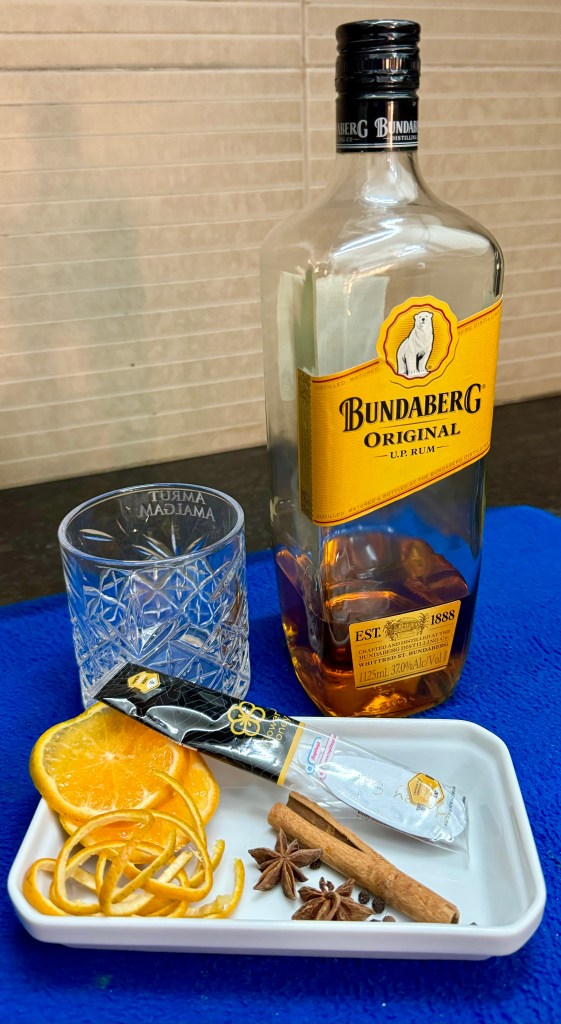
For those interested, here is the recipe.
…the ingredients
Ingredients
Dark Rum (30 ml) – This quantity may be tweaked to taste
Cinnamon (one stick) – Cinnamon has many health benefits. CLICK HERE to read about some of them.
Star anise (two pods) – It is a spice used in traditional Chinese medicine. It has powerful bioactive compounds that may help treat fungal, bacterial, and viral infections.
Black pepper (six pods) – Black pepper too has many health benefits. CLICK HERE to read about some of them.
Orange (one)
Honey (one teaspoon)
Getting Ready
Cut a slice of orange with its peel
Remove the peel of the remaining part of the orange and cut it into long fine shreds
Here we go!
Boil 250 ml water
Add cinnamon stick, star anise and black pepper. Continue boiling for five minutes
Arrange the shredded orange peel at the bottom of a glass tumbler
Pour the contents (boiling water with cinnamon stick, star anise and black pepper) into the tumbler.
Add honey; stir gently.
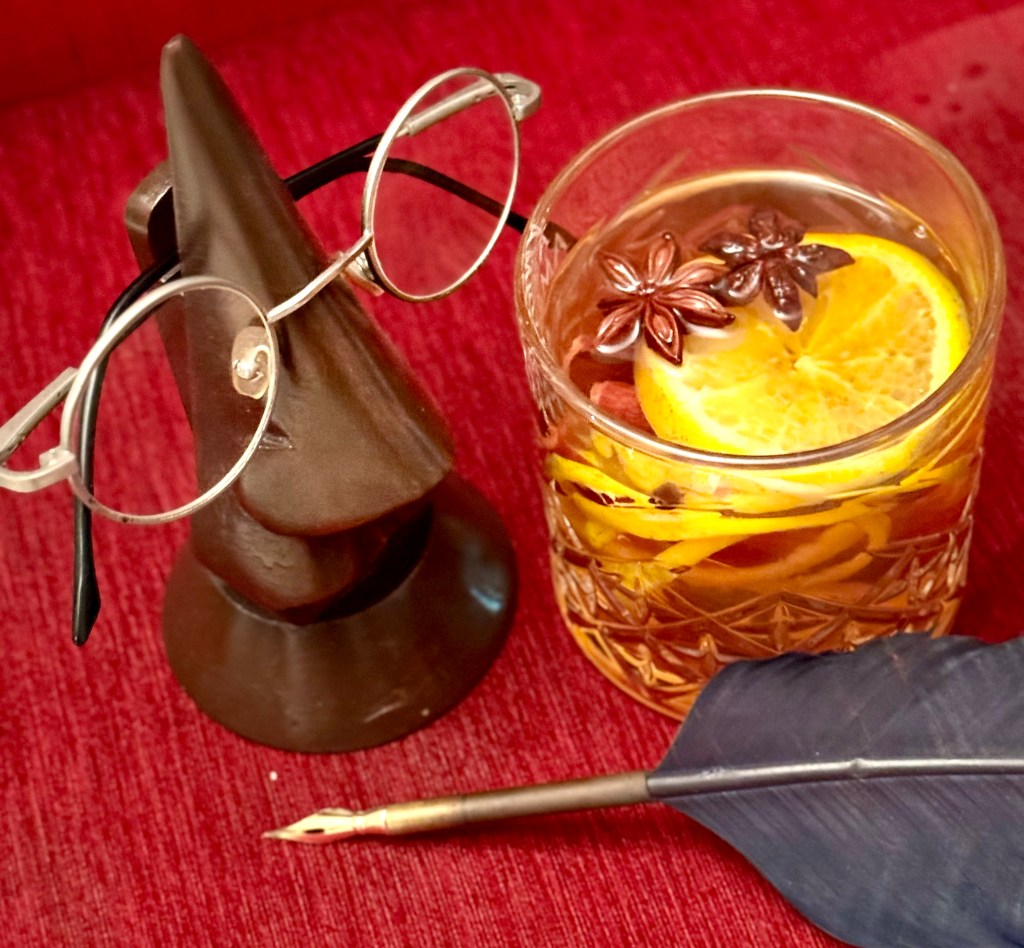
Slowly, add 30 ml dark rum. Don’t stir. Let the RUM linger long and merge with the concoction at its pace.
Gently place the slice of orange on the surface.
Raise a toast to paratroopers and say, “Green ON! Go!”
[Sometimes, I add a spoonful of orange pulp to suit my taste.]
An afterthought Forget the health benefits of the ingredients, I find the process of making “Green ON! Go!” therapeutic. Then, the drink itself… cinnamon and pepper give a distinct flavour. The slice of orange and star anise floating in the tumbler, is soothing to the eyes. The bitter sweet taste of orange and honey… and above all, the lingering RUM merging slowly with the surrounding water is a treat to the soul. On a winter evening, with subdued lights and soft music, a sip of it gives me a top-of-the-world feeling.
Some valued responses
Wg Cdr Vijay Ambre (Veteran): Dear Ashok, I enjoyed reading “Green On! Go!!” as much as I have all your other writings. It evokes memories of our lives in the transport stream of the Air Force; where “our ” times were never ours. Innumerable cancelations/absences that were always treated as a way of life by the family. As for the drink recipe, although, I enjoyed reading it ,I am not going to make GOG ,as I turned teetotal and gave up non-veg food aeons ago. Here’s wishing more power to your pen!👍👌👏
Air Commodore Ashok Kumar (Veteran): Ashok nicely written, as smooth as Patiala Sea Pirate. Chug it!
Air Commodore JV Paul: Sir, your para-normal skills are matched by your anecdotal skills!!!😁👌 Your exploits were already legendary by the time I entered the An 32 fleet in ’88 with the Yaks, and then reinforced and cemented by the time I entered the Skyhawks kingdom in 2007. Much more water had flowed beneath the bridge by the time my daughter entered the portals of Amity Noida to do her Architecture course. And she had the pleasure of Chhaya Ma’am’s benevolence as a hosteler there, especially after I disclosed my Skyhawk connection to Ma’am. The Skyhawk stint remains the high point of my career. Chhatri Mata ki Jai!
Virendra Singh Mann
Thoroughly enjoyed reading the post “Green On! Go!” Felt as though I was reading a novel. But I know this must be for real. Thank you so much for sharing. 🥃Cheers to a bottle of rum.
Viney Sharma
Hello Ashok, Very interesting read and I can fully relate to it.
In 1967 I got introduced to RUM (Hercules XXX @ Rs 10/ bottle from the CSD). 4 of us from college had gone on a trekking trip in Kashmir. We had taken a shikara to Char Chinar in the middle of Dal Lake (probably a full moon night). One of us with fauji connections produced the bottle from his backpack. It was quickly consumed with much back slapping and leg pulling. Don’t remember how we got back to our lodge but still remember the massive hangover next morning.
Squadron Leader RP Mittal (Veteran)
Nostalgic and smooth capture of the spirit of the moment in narration. 😊
Wing Commander Pradeep Dahiya (Veteran)
As always great read. Your writing has a wonderful capacity to stimulate imagining the scenes and characters . Thoroughly enjoyed.
Raghu Ramakrishnan Aiyar
Lively and highly, ” Spirited’, anecdote. Smooth, it flowed; Sublime, it lingered; Sensational, it spoke of the Para Jumps, even as the GreenON! Go… went on and on, wild and wanton👍👍👍👍
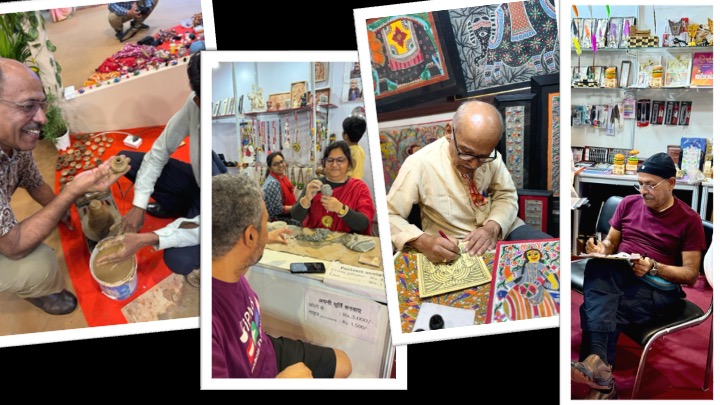
All have their own definition of it; and, it changes from time to time. For now, for me, it is a feeling of contentment and satisfaction one gets when one does something one has never done before. The other day, I experienced just that, when I spent quality time at the Trade Fair in Pragati Maidan. An artisan allowed me, and encouraged me to work on his potter’s wheel. With a little guidance and help, I could fulfil a desire I had nurtured since childhood. I could make a miniature vase; I felt, I was on top of the world.
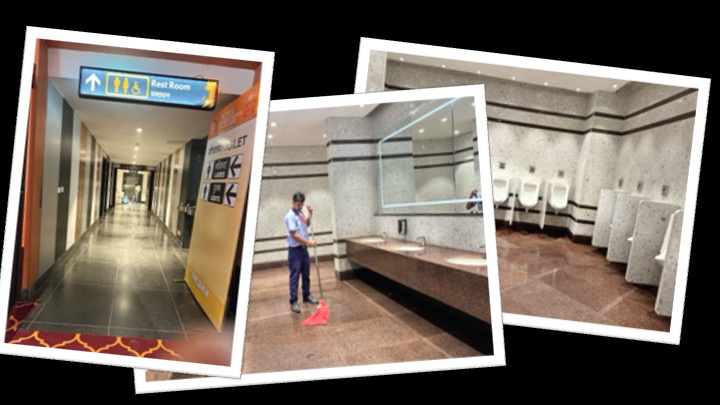
Spick and span…a different Pragati Maidan
In another stall, it was therapeutic to watch a lady work on the clay bust of a person sitting opposite her. I have seen umpteen artists making caricatures likewise, but never a person making a clay bust within minutes. Watching Mr Indrakant Jha engrossed in Madhubani art was a treat to the soul.
I had never experienced virtual reality before. So, flying a parachute canopy (in virtual reality) at the NTPC stall, seven years after I made my last parachute descent, was a top of the world experience.
Conscientious staff…
The child in me went berserk when I found a stall displaying writing instruments. I spent the good part of an hour trying my hand at calligraphy. If I had had my way, I’d have spent the entire day visiting the remaining stalls and exploring the other options.
In itself, the experience was exhilarating; it became more so because of the improvements I saw and experienced at the fair. To cite a few — the new underground parking is very well organised; comparable to any good mall in the NCR. Everything in and around the halls is spick-and-span. The public utilities are sparkling clean. The absence of litter, even around the eateries, is a pleasing sight. There are conscientious staff to maintain the surroundings. The security staff and those at the help-desks are courteous. The thoughtfully designed and placed signage makes things convenient.
Let’s be “good”
On the whole, our experience was in sharp contrast to what we have seen in the years gone by. People who are striving silently to make this possible deserve Kudos.
On our part, let us help them in their endeavour by just being ‘good’.
Post Script
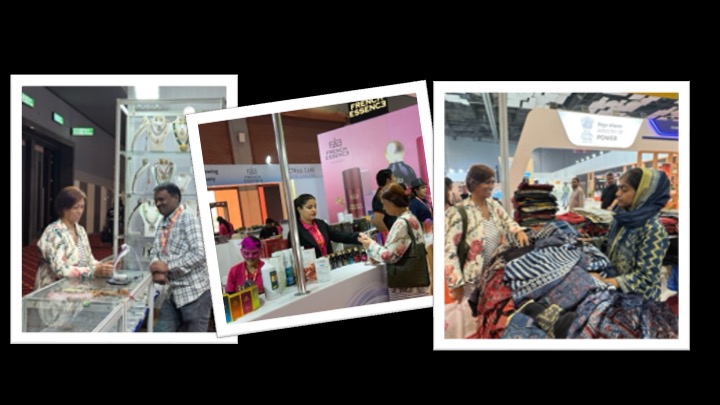
This description of our visit to the Trade Fair would be incomplete without the narration of our interaction at a stall displaying Gujrati garments. Chhayaji liked two dresses and decided to buy them. When she tried to bargain with one of the salespersons, the lady said with a lot of pride, “Like Modiji, we are Gujratis! We are upright people. We do not tell lies about price; we do not leave a scope for haggling.”
…fir bhi dil hai Hindustani
Amused, I asked her, “Why are you dragging Modiji, in this conversation?”
“Because, he is an upright leader; and he is a Gujrati,” she chirped with even greater pride.
“Why do you say you and Modiji are Gujratis? Aren’t we all Indians—you, I and Modiji? Think of it, it is only a matter of time, even Trump and Nigerians will stake a claim on Modiji. What will you do then?”
She laughed heartily at my quick-fire repartee; gave us a handsome rebate. We thanked both, the lady, and Modiji, profoundly before leaving the premises.
It will be interesting to know Modiji’s “MAN KI BAAT” someday on belongingness to a state, the nation, and the world.
The bug of indecisiveness stings the officers of the Armed Forces early in life.
The successes in the wars and operations, which the Indian Armed Forces have executed since we earned our freedom in 1947, has proved the prowess of our men in uniform. Their ability to take quick and near perfect tactical and strategic military decisions under extreme pressure and in the thick fog of war, is matchless. But, in some situations, even in peacetime, they are straightjacketed and indecisive.
‘Eeny Meeny Miny Moe…’
For example, the top brass takes good time to decide whether to use a chipper, a seven-iron or a putter to send their golf ball five yards from the edge of the putting green to the pin. Some freeze in that situation; many go by what their caddie advises them to do. I know of a few good ‘golf mentors’ being rewarded with permanent jobs for their services to their bosses. A senior golfer used to quietly resort to ‘Eeny Meeny Miny Moe…’ to avoid decision making on the course.
A study has revealed that the bug of indecisiveness stings the officers of the Armed Forces early in life. As young bachelors when they enter the dining hall every morning their minds are already browsing the ‘TO DO LIST’ of the day. In the few minutes that they set aside for breakfast; they are not in a position to give clear instructions to the waiter about what egg preparation they would like to be served. The choice is fairly wide and confusing—boiled eggs (hard/ soft boiled), fried eggs (single/ double fried), sunny side up eggs; scrambled eggs, poached eggs, simple omelette, savoury omelette, cheese omelette, Lucknowi Omelette… the list is long. Decades ago, an officer who had the time and inclination to devote to the issue, directed the mess staff to prepare his entitlement of eggs in a particular way. The preparation became popular as Datikara Bhujiya in the Indian Air Force.
I was a veggie for most part of my service life. That saved me the pain of taking a difficult decision every morning. Once in a blue moon, when I did order eggs, my instructions used to be clear: “Get anything; anything that you can get fast, lest the eggs hatch and I have more difficult time deciding what to make of the chicken.”
It has been forty long years since I stopped dining in the mess; and seven years since I hung my uniform and re-attired. I had almost forgotten about the daily egg dilemma when I was faced with the same old question, recently. I had given a very short notice to Keshav and Saurabha when I told them that I was calling on them just to say, “Hello!” It being lunch time, they insisted that I break bread with them.
“Nothing special, Uncle. We’ll have whatever is there. Saurabha has prepared rice and daal, and has baked a banana cake.” Keshav suggested when I hesitated. “Do you take egg? How would you like to have it? Will egg curry be fine? I can make it in a jiffy.”
“I am fine with egg curry. You guys keep it simple; don’t upset your schedules because of me.”
To cut the long story short, the egg curry was delicious. Seldom have I found an egg preparation so appealing. I still drool when I think of it. I sought their permission to use my hands instead of the well laid cutlery and ate to my heart’s content.
Since, in my re-attired life I do not have a long ‘TO DO LIST,’ I thought I might as well learn how to prepare the mouth-watering egg curry. I requested Keshav for the recipe which he did promptly. For those who wish to experiment, here is the recipe.
Thank you, Keshav! Thank you Saurabha!
Main Ingredients (serving for two)
5 eggs (boiled and peeled)
2 large red onions
1 garlic clove
1 tbsp grated ginger
1 tbsp crushed garlic
1½ tbsp chili powder
1 tsp turmeric powder
3 tbsp curry powder (use for egg curry)
1 tsp cumin powder
½ stick cinnamon
2 pcs star anise
4 pcs cardamom pods (whole)
3 pcs cloves
400 ml cream (adjust as needed)
A pinch of salt
1 tbsp ghee or clarified butter
3 tbsp cooking oil
Fresh coriander leaves (for garnishing)
Ingredients for Seasoning
4 tbsp ghee or clarified butter
5-6 pcs dried chillies
4-5 pcs curry leaves
1 tsp diced onion
Procedure
Preparation of Ingredients:
Boil the eggs, peel them, and set aside.
Dice the red onions, use half the garlic clove.
Initial Cooking:
Heat oil in a deep non-stick pot.
Add cinnamon, star anise, cardamom pods, and cloves. When fragrant, throw in the diced onions, garlic, and green paprika. Cook on medium heat until soft.
Add the grated ginger, and garlic paste. Sauté for a minute until everything is well combined and aromatic. The masala is ready.
Add the boiled eggs to the masala and gently coat them with it.
Add all the powders (chili, turmeric, cumin, curry powder). Mix well, ensuring the eggs are well coated.
Add salt to taste.
Preparation of the Curry:
Pour in the cream, stir well, and reduce the heat by two levels.
Cover the pot with a lid and let the curry simmer for about 10 minutes. Stir occasionally to prevent it from burning.
Remove the lid and cook until the curry thickens, allowing it to reduce until almost dry.
Final Touches:
In a separate small sauté pan, heat the ghee or clarified butter. Add the dried chilies, curry leaves, and diced onions. Cook until the onions turn golden brown.
Pour this tempered mixture over the egg curry and stir.
Serve
Garnish with fresh coriander leaves. Serve with basmati rice, cucumber with mayonnaise, some pickles, or simply chapati and daal.
The man I was trying to evade so resolutely, caught up with me at last. He overtook me with a last long stride; turned about with the agility of a gymnast and stood in my way. His hands sheathed in tattered gloves stopped me from moving further. Although I was rankled and trying desperately to steer clear of a brawl in a foreign land, I was sure of my entitlement to self-defence anywhere, anytime. A calmer me was armed with confidence, and coiled, and ready to stun the stranger and execute my escape and evasion, if need arose.
I was panting; so was he. At an ambient temperature of three degrees Celsius our breaths were sending out little grey clouds of vapour towards each other. Did he smell of cannabis? Or, I was imagining things? My naïve olfactory system cannot distinguish smells but I had good reason to believe what I was thinking—he was into drugs; wanted to peddle his stuff.
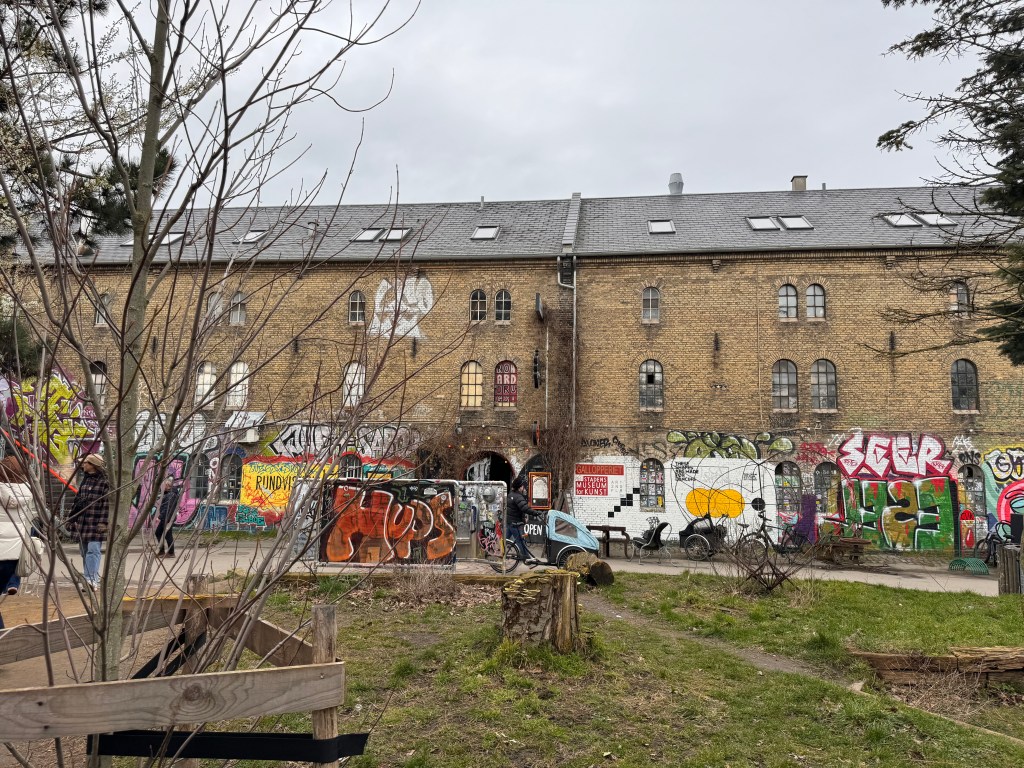
It was a noisy exchange in a public place. Yet the people around us were unbothered. “Why would they care,” I thought. We were in the heart of Copenhagen, on Pusher Street in Freetown Christiania, the Green Light Area, a haven for hippies and drug peddlers… far from the civilized world. Concern for strangers was an alien sentiment on that shady patch of the planet.
“Will you please listen to me, Sir?” he urged. Very clumsily, he wiggled his hand out of his greasy gauntlet and held mine with forced friendliness, and shook it. “Calm down my friend from India. I mean no harm.”
Friend, or a foe? I was still in doubt. He wore a mud-caked black beret—Che Guevara style, less the star. A deep scar ran across his right cheek. During the just concluded handshake, I had noticed with a sense of creepiness, that the index finger of his right hand was missing. He astonished me with an unexpected act—he joined his hands in reverence and bowed, “Namaste! me Obert Ngoma… they call me Obe…, Black Obe.”
***
The seed of this encounter, which later turned out to be perplexing and grisly, was sown in an Airbnb apartment we had rented earlier that week for a holiday in Copenhagen. I had arrived in the Danish capital from Gothenburg with my son, Mudit; daughter in law, Anjali and granddaughter Maya. My nephew, Nihit along with his wife, Swetha, had travelled from Delft (the Netherlands) to be with us.
Nyhavn—A tourist delight
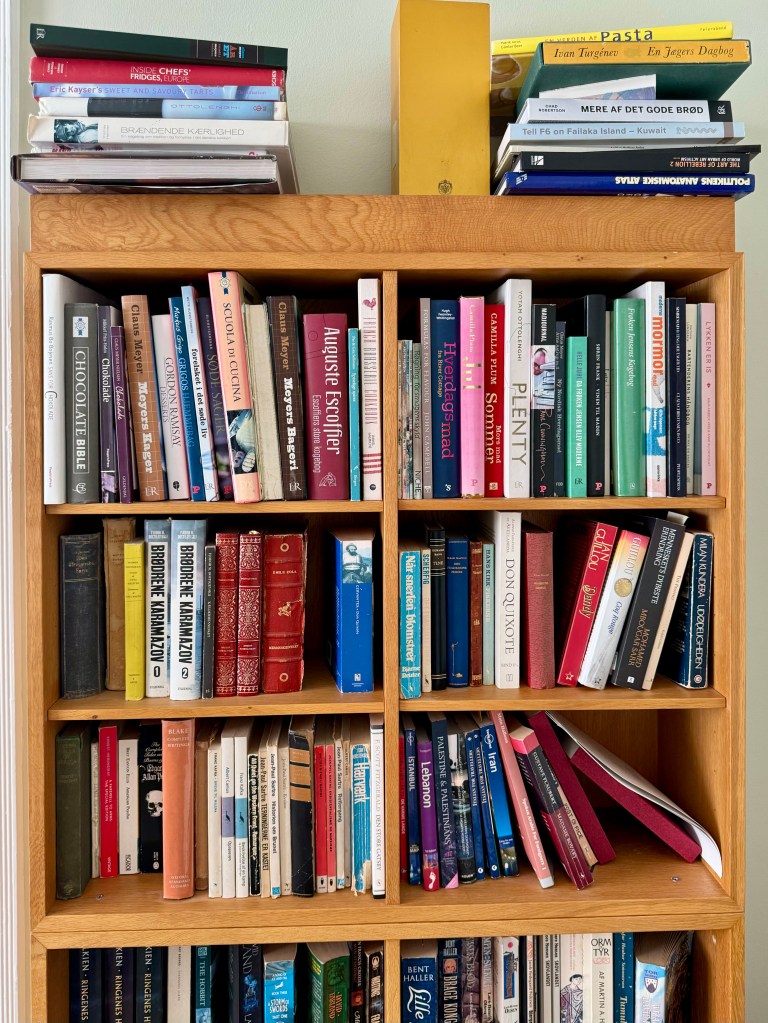
The hired accommodation had cherished amenities; a well-provisioned kitchen and a cellar stocked with exclusive wines. There were three tall racks of books. The subjects ranged from travel to literary classics; from sports to baking cakes to origami; from humour to science fiction. There were books on Palestine, Iran and the middle east. Two copies of Cervantes’ Don Quixote, one in English and the other in Danish spoke of the owner’s unfeigned interest in literature.
We spent three days seeing places, clicking pictures, trying local cuisines and buying souvenirs. The fourth day was devoted to Nyhavn. A walk down the cobblestone street—the canal with anchored yachts and historical wooden ships on one side, and colourful 17th century townhouses and restaurants lining the other—was a tourist delight. In the evening, a thoughtfully ordered dinner awaited us in the apartment. The young couples, and the baby crashed early.
Books! Books! Books!
The library of rare books and my habit of reading before retiring, colluded to dodge my sleep. I pulled out The Complete Tales and Poems of Edgar Allan Poe from its shelf and began reading it. It took less than half of an hour for me to appreciate why Poe is considered a master of macabre literature. Suspense and intrigue presented with hallucination in his stories made me sweat.
Past midnight, I returned Poe to its reserved berth on the shelf. His gruesome characters and ghosts were strolling in my mind when I pulled the quilt over me. For reasons unbeknown to me, the night felt ominous. A restless sleep followed an hour of tossing and turning in the bed.
Like a funny bone in people, there is a curious bone too and, I think, I have it in me. On the last day, I wanted to spend the few remaining hours in Copenhagen exploring whatever else we could. “Our train to Gothenburg is at 1:00 pm. Nihit and Swetha’s flight to Amsterdam is at 3:00 pm. We still have about five hours in hand. Is there another place we can visit in Copenhagen?” I posed the question to nobody in particular.
“I wonder if Christiania might interest you,” queried Nihit.
“What’s it known for?” I asked.
Once upon an army barrack…
“It is an insulated anarchist territory within Copenhagen. It was founded by squatters seeking freedom. They occupied abandoned Danish military barracks of the WW II era, and declared Christiania an independent country. It is notorious for open sale of narcotics. There are occasional gang wars, and fights between the drug-peddlers and the people who strive to put a stop to drug peddling. It’ll be a good experience visiting that place; I suggest you take this trip while we wind up here. You might find something interesting to write about.”
A little later, my ordeal began in Christiania
***
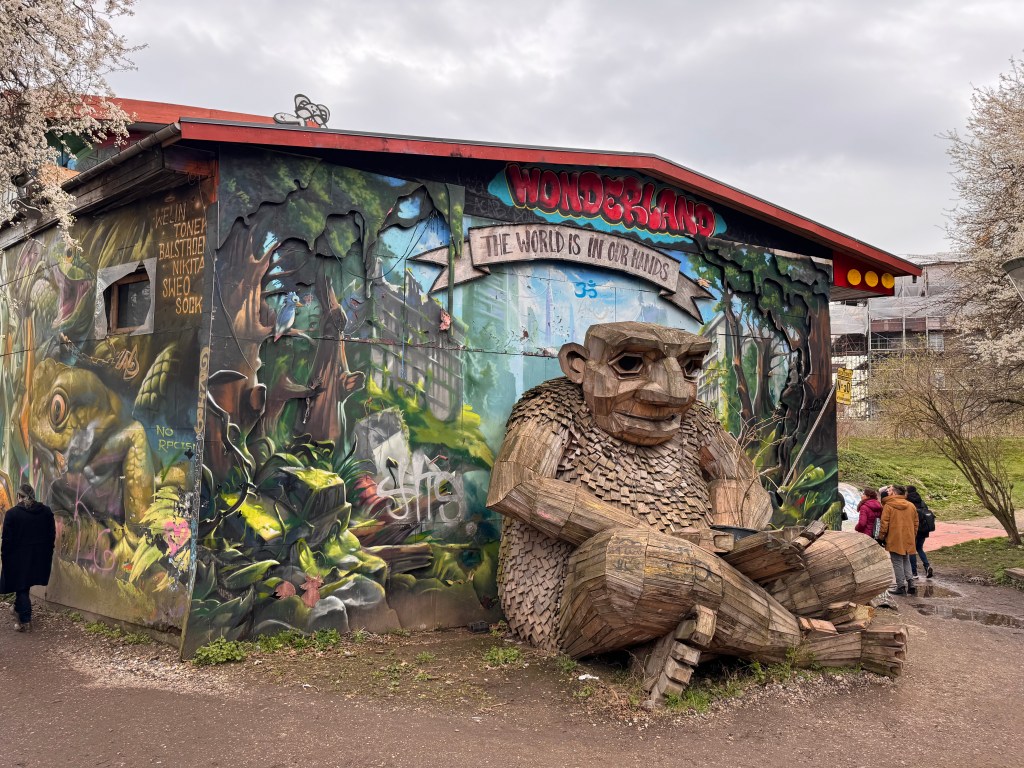
Obe calmed me down with meaningful arguments and won me over. He succeeded in proving his harmlessness, and prevailed upon me to visit his shack nearby. His little dwelling was neat and tidy. The walls were painted with slogans, and religious symbols like the swastika, the om, the holy cross, the crescent and many others, which I didn’t recognise. Earlier, on my arrival in Christiania, I had noticed with surprise, the Hindu symbol of om painted on the wall behind a giant wooden statue of a weird crouched man—the so-called free man—sitting in what appeared to be the padmasana (the lotus pose in Yoga) at the entrance to the hamlet. The caption read: “The World is in our Hands!” I had also seen the obsession of the dwellers of this weird world with the lotus flower resembling the party symbol of the BJP of India. Stickers, depicting the flower were on sale everywhere. I felt more at ease when I saw Obe flaunting a string of rudraksh beads.
“Om Shanti! Om!”The World is in our Hands!”
“Howsoever queer this man might appear; he doesn’t seem to have bad intentions.” I was very consciously lowering my guard.
“A coffee for you, Sir?” Obe asked me, and taking my yes for granted, flipped the switch of his electric kettle. Meanwhile, my roving eyes spotted a tattered pocket book version of the Geeta and a bible on a shelf. In a corner, the amber flame of a candle nested in a shining pewter stand, vied with the blue grey smoke of the incense sticks, to reach for the roof. I had a hunch that the things around me were conveying messages, which I was not comprehending.
Without preamble, Obe began talking about his vision of a drug-free peaceful world. He elaborated what his colleagues, and he was doing to realise their common dream. “A place like Christiania has a shelf life before the vested interests destroy it. The pioneers wanted this place to be a Utopia and strived for it, but those who came later, have plundered it. The glamourous appeal of our kind of world remains long after the reality decays. Anarchy is enticing, but finally, we need a stable society. Me think, Yoga and spirituality can get us back on track.” He said as he offered me a chipped porcelain cup filled to the brim with steaming coffee. He paused for breath but didn’t allow me to speak.
“It’s a noble idea. I support it whole-heartedly like I support all other causes. The LGBTQ and women’s rights, child labour, global warming, nuclear non-proliferation, Rohinghiyas, Eskimos, elephant poaching and what have you… but I am not the kind of activist who’d join candle marches, and further aggravate global warming. In fact, I am not an activist at all. I am fine with silent support to all causes. But, by the way, Mr Obert Ngoma, what do you expect me to do for your specific-to-Christiania cause?” I said to myself and then, to appear interested in his life’s mission, I spoke aloud, “I wish governments took this issue more seriously.”
What my host said next, surprised me.
“LGBTQ and women’s rights, child labour, global warming, nuclear non-proliferation, Rohinghiyas, Eskimos, elephant poaching and what have we…. one doesn’t have to join candle marches; they only aggravate global warming. There’s no need for one to be an activist at all….” He repeated my thoughts verbatim, almost. Was he a thought diviner? Black Obe gave me a premonitory shiver.
“Me been watching you, since you stepped into Christiania about an hour ago. Me trail all visitors of interest. Me study them, and seek help for our cause from those who, me think, can make a difference,” he continued.
“I am leaving this afternoon. I wonder, how I can be of any help to you?” I asked.
“Me colleague, Nevin Abrahams resides in Gothenburg. He used to be on cannabis until we met; he struggled, and gave it up… for good,” Obe’s eyes lit up like little lanterns, “Never took a milligramme of it until bad people pushed him into the hell again.”
I listened to him intently.
“We could bail him out again but, by then, his health had deteriorated. He’s mostly bed-ridden now. Me been visiting him every week, and have been taking him out, sometimes. It makes him feel good.”
“What was Black Obe expecting of me?” I was getting curious.
“Lately, me been too occupied to visit Nevin… been requestin’ visitors like you to do me small favours. Since you goin to Gothenburg, Me wanna request you to….”
He was quick to put off a sliver of simmering suspicion and hesitation my hurriedly acquired knowledge of Christinia had bred in me. “Don’t you worry, Sir. me not askin’ you to deliver nothin’ to him, lest you think me tryin’ to use you to peddle bad stuff. Me, Black Obe, ain’t doin’ that. Me just wanna’ me friend feel cared. He’ll be delighted if you meet him. It’ll be great seeing someone from India—someone from the land that gave us Yoga; the land that epitomises peace and harmony; the land of Mahavira and Buddha.”
He upgraded his request when he saw me yielding, “Nevin has been missin’ outings with me. He’ll be on top of the world, if you could take him out tonight. He doesn’t stay very far from where you are puttin’ up on Barytongatan; just a little more than a mile away; close to St Matthew’s Chapel.”
“How did he know, I was putting up on Barytongatan?” Obert’s knowledge of me astonished me to no end. He didn’t allow me to interrupt him, and ask him about how he had come to know what he knew about me.
“The easiest way to reach Nevin is to ask anyone at the Chapel or around there, and they’ll be pleased to guide you to where Nevin Abrahams—the man who fought drug mafia like none other—resides. You don’t need no address to find me buddy.”
Obe didn’t have a mobile phone. “I can do without one,” he said when I asked him for his contact details. Very reluctantly, he clicked a selfie of the two of us on my mobile phone when I suggested that I carry his pic for Nevin’s sake.
The story of my meeting with Obe elicited a positive and chorused response from Mudit, Anjali, Nihit and Swetha: “You can bring untold joy to Nevin. Time permitting, you must say, ‘Hello’ to him… nothing like it, if you can take him out.”
***
Gothenburg. 5:00 pm.
It was still broad daylight; sunset would be at 8:00 pm. The outside temperature was hovering around 4°C. Snowfall had been forecast after 7:00 pm. A week hence, I would be setting course for Delhi, so Mudit and Anjali had called over their Indian friends— Keshto and Bipasha, a couple who hail from Kolkata—to meet me. When we reached home, Mudit and Anjali got down to preparing dinner for the guests. Since I had little to contribute in the kitchen, I proposed to take a walk to meet Nevin. The aim was to tick an item on my To Do list.
“That’s a good idea,” said Mudit, “More than two hours to go before Keshto and Bipasha arrive. You can put this time to good use by meeting that guy and conveying Obe’s wishes to him. He’ll be pleased.”
“St Matthew’s Chapel is not far. I should be back in a little more than an hour—well in time to welcome your friends,” I said as I stepped out of the apartment.
***
My mind wandered as I walked to my destination. For reasons which I couldn’t place my finger on, my interaction with Black Obe kept intriguing me. My consciousness began drifting like a feather in gentle breeze. In a while on the road, I was overcome with a feeling that I wasn’t taking that short trip to meet Nevin; the trip was taking me. Meeting him was an unenthusiastic commitment which I had accepted gingerly. But, the urge to comply with it, now felt like a celestial command.
***
St Mathew’s Chapel
St Matthew’s Chapel was deserted. The doors were closed. I pressed my face on to a window pane to see if there was anyone inside. The inner sanctum gave me the impression of an abandoned masonic lodge. My breath fogged the cold glass and blurred my vision. I wiped the smooth surface with my sleeve to get a clearer view when I felt some movement behind the main door. I stepped back and waited. The door handle moved down and the old wooden door creaked open just enough for me to get a whiff of the inside air laden with the mixed odours of damp linen, aged paper, mold and old leather. Beams of light entering the Chapel through the panelled windows illuminated cobwebs and floating dust particles. Everything inside was draped in sepia. Disuse hallmarked St Matthew’s Chapel.
A tall man slipped out when the door opened wider. He wore a dark robe with a hood that covered most of his face. Pale white Franciscan Cincture with its three knots—signifying poverty, chastity and obedience—secured his waist. His skin was white; white as white could be; and hair, blonde. Strange as it may sound, his very light brown eyes without eyebrows appeared to be wrinkled; they kept popping out and retiring into their sockets at will. His sparse, equally white eyelashes were merging with his skin. He reminded me of Silas, the Opus Dei character of The Da Vinci Code. It was very difficult to judge his age except by the crow’s feet at the outer ends of his eyes—they became more prominent when he squinted to see me.
The white man scanned me from top to bottom and then let his eyes linger on my face. I felt intimidated. When he opened his mouth to speak, I discovered that he had prominent canines. The large gaps between his teeth were dark scarlet.
“Yes?” he hissed.
“I am Ashok Chordia. Mr Obert Ngoma has guided me to this place. I wish to meet one Mr Nevin Abrahams. I wonder if you could guide me to where he stays.”
“Who… Obert Ngoma?”
“He’s the dark guy… from Freetown Christiania…,” I scrolled the picture library of my iPhone to show him my picture with Obe. I was shocked to find that in the selfie which Obe had clicked, Obe was missing: only I was there in the frame. How did he go missing from that picture? I had seen the picture when he had clicked it; he was very much there.
“Do you mean Black Obe, by any chance… missing index finger; scarred face?”
I nodded approvingly.
“Oh, Obe… Black Obe… my boy! ‘He’ has sent you?” There was a strange emphasis on ‘he’. I get it now… Nevin Abrahams… yes, yes, of course. I was, indeed, expecting you.” His demeanour changed for the better, but not good enough to make me feel easy. “…good guys, both of them, Black Obe and Nevin. They belong to a different league; live in a world of their own. Obe keeps sending requests for odd little favours. Have you joined these guys?” I felt he wasn’t actually seeking an answer to his question; I remained non-committal.
A lesson in respect-for-the-dead
“Come, let’s go! We’ll take this short path. I am Aldersen… Hens Aldersen. You can call me Hens. I am the custodian here.” He led the way; I walked half a pace behind him. The short path he chose was through the Western Cemetery. The gently undulating ground on either side was lush and tidy. Neatly aligned grave-stones filled me with sobriety and awe. I felt the world could take a lesson in respect-for-the-dead from the Europeans.
***
“Have you met Nevin lately? How’s he doing?” I asked to dissipate the growing discomfort I was experiencing.
“Met Nevin lately!” the cloaked man exclaimed. “What do you mean… have I met Nevin lately? He is dead… died long ago. Didn’t Black Obe tell you?”
“Dead? Died long ago! Then, where are you taking me?” I was going nuts.
“I am taking you to the grave where he lies interred.”
Nevin Abrahams’s abode
Before I could recover from the shock I had just experienced, we were at Nevin’s grave. The epitaph read: “TAKE ME OUT TO NIGHT.”
“In his last days, he used to wait very impatiently for Obe. Black Obe used to visit him every weekend without fail; used to take him out. Nevin died when he got the news that Obe was killed in the crossfire between two gangs. Poor Nevin… he couldn’t take the shock,” Hens stunned me yet again.
“You mean… Black Obe is also dead? Did I meet a dead man in Christiania?” Hoping, that was not the case, I waited in trepidation for what Hens might say next.
“Both, Nevin and Black Obe are dead.” The custodian’s voice reverberated even in the open. “They died unnatural and untimely deaths. Since they were passionate about their mission, and the mission remained incomplete, their spirits keep returning. Sometimes, Obe finds people to visit Nevin, here, in the Western Cemetery. I facilitate the visits.” Hens stood solemnly facing Nevin’s tombstone. He touched his forehead, heart and the shoulders—signifying the Father, the Son and the Holy Spirit—to invoke God’s blessing and protection.
Even in that intriguing moment, I knew that people would never believe what I had experienced, so I quickly clicked a picture of Nevin’s tombstone. Then, with no further word, I pirouetted and took my first step away from Hens. I heard him say, “Hejdå,” to my back. I didn’t respond to the Swede’s goodbye; I was in a hurry to be somewhere else. I wanted to be back home; back with my people. To make things difficult for me, several snowflakes fell on my face and signalled the snowfall that had been forecast by the weather man. So that I was not stuck on the way, I took a tram back home.
Another Chapel… not again!
It was snowing at Nymilsgatan, where I disembarked the tram. Everything around was covered in a white sheet. Another chapel on the way looked haunted. Cautiously, I trudged the slippery path in front of me.
***
Keshto and Bipasha had just arrived when I reached home. I took several deep breaths to calm my unwieldy emotions before I narrated my evening’s experience to everyone at the dinner table. None believed me until there was another twist. Keshto looked at the picture of Nevin’s tombstone on my mobile’s screen and declared, “Black Obe and Nevin are dead men; so is Hens Aldersen. He died nearly 200 years ago.” He pointed at a tombstone in the background of Nevin’s. It belonged to Hens Aldersen. Keshto’s curiosity, and the following investigation, led to another startling revelation—St Matthew’s Chapel has remained closed ever since its custodian, one Mr Hens Aldersen died under mysterious circumstances in 1829.
An interesting bit of information is displayed on a standee kept next to The Very First Volvo in the World of Volvo, in Gothenburg. It points out that the premier of ÖV4, in the 1920s, fell flat because a rear axle gear had been installed incorrectly and the car could only drive in reverse in its first test drive. Embarrassment caused by the event to the company notwithstanding, Volvo identified the fault and immediately fixed it. Then onwards, the Volvo cars and trucks have had the reverse gears; but Volvo, the automobile giant, has only moved forward. It has gracefully covered the long distance to world leadership in automobile sector.
World of Volvo
Before talking further about Volvo culture, here is a less known fact about the reverse gear—it is the most powerful gear in all automobiles. Once, while on a 3,700-mile road trip from Paris to Ankara, Dominique Lapierre, and his classmate, Dominique Frémy, was faced with a steep climb near Athens, which brought their 6-HP antique Amilcar to its knees. To deal with the challenge, they turned around the car and drove uphill in reverse gear. The effect was miraculous: their valiant car climbed the slope like a Tour de France bicycle.
There is much to learn from Volvo’s culture of acknowledging shortcomings, working on them to improve, and above all, talking candidly about the failure. The power of the reverse gear also has a message.
Managing personal life; running a corporation or a government—each is akin to driving a vehicle. If a not-so-correct decision is taken and implemented, it would only be appropriate to acknowledge it gracefully, in time, like Volvo, and to get into the powerful reverse gear to prevent appreciable damage.
Like the reverse gear, the brakes and the rear-view mirrors also contribute to good driving. The purpose of brakes—more important than the ability to slow down and stop at will—is to allow driving at high speeds. Awareness of functional brakes, or ‘brake consciousness’ as it may be called, sets one free to speed up.
Amusingly, the purpose of the rear-view mirrors installed in the cars of the yesteryears was to enable the drivers to keep an eye on the cops who might be chasing them. Today, they have a more meaningful purpose—to ensure road safety.
Cruising ahead in life; or leading an organisation, it pays to look into the rear view mirror and observe the road travelled. Slowing down to take stock, or getting into reverse gear to make amends are empowering options.
Willingness to adopt the goodness of Volvo Culture is the need of the hour.
Butternut squash, a close cousin of pumpkin, can also taste delicious!
At school, we used to be faced with two choices in the dining hall—eat what was served or, go hungry. Prudence guided me to stick to the first option. Those days, we used to dislike pumpkin which was served often. One day, a student posted a cartoon depicting a caricature of a helpless looking boy, hands joined, murmuring reverently to a pumpkin:
“ऊपर से हो ताम्र वर्ण, भीतर से हो सोना… जिस दिन न देखूँ तुम को, आता मुझ को रोना… ओ कदुआ, ओ कदुआ, ओ कदुआ!”
Meaningfully translated…
“Thou art coppery on the outside; golden inside… O Revered Pumpkin, tears flow from my eyes, when I don’t see thou.”
We got a short-lived relief from pumpkin, when the sarcasm flowing from the cartoon melted our principal’s heart. If only, the fairy godmother who turned a pumpkin into a golden chariot for Cinderella, could also make it disappear from our daily menu, we used to pray.
Many grown-ups also detest pumpkin. There’s a popular joke about a commanding officer visiting his men who are being routinely served, among other preparations, pumpkin in the langar (jawans’ dining area). Although aware of his men’s dislike for the vegetable, he nudges his Langar Havaldar, (caretaker of the jawans’ dining hall), “बंता सिंह, कद्दू बहुत अच्छी सब्ज़ी है… (Banta Singh, pumpkin is a very good vegetable) …”
A seasoned Banta senses the mood of the Commanding Officer and paints a beautiful picture, “जी सर, कद्दू सेहत के लिए बहुत अच्छा होता है इसमें विटामिन A, B, C, D, E, F, G… (Yes Sir, pumpkin is very good for health… it contains vitamins A, B, C, D, E, F, G…).”
The Commanding Officer smiles; he understands Banta’s predicament. A few days later, he needles Banta, “कद्दू बिलकुल बेकार सब्ज़ी है… ये मुझे नापसंद है(Pumpkin is an absolutely useless vegetable… I dislike it).”
Banta Singh starts off instantly, “जी सर कद्दू तो होता ही बेकार है… ये लंगर में इसलिए सप्लाई किया जाता है क्योंकि ये सस्ता होता है। इसमें कोई विटामिन नहीं होता है… (For sure Sir, pumpkin is a useless vegetable… it is supplied to the langar because it is cheap. It doesn’t contain any vitamins…).”
The Commanding Officer takes an endearing dig at Banta, “ओए बंते… कुछ दिन पहले तो तू कह रहा था कि कद्दू बहुत अच्छी सब्ज़ी होती है… आज ये बेकार कैसे हो गई… (My dear Banta… the other day you were saying that pumpkin is a very good vegetable… how come it has become a useless vegetable today…)?”
“साहब जी, मैंने आपके अंडर नौकरी करनी है, कद्दू के अंडर नहीं (My dear Sir, I have to serve under your command… not under pumpkin’s),” Banta banters unflinchingly.
***
A habit to accept all food with reverence, or may be, indifference, was a spinoff off of the survival instinct we developed in school. For that reason, my dislike for pumpkin is now water under the bridge. At age 65, I can eat (read, “tolerate”) most preparations without squirming or making faces. So, when one day, Anjali, my daughter-in-law proposed to prepare butternut squash soup for dinner, my response was, “Why, of course! I would love to try something I have not eaten before.” ‘Butternut Squash’ had sounded very appealing to me. But my enthusiasm nosedived when I was told that butternut squash was a close cousin of our own pumpkin (कद्दू) — Pumpkin, which I had begun accepting after half a century’s detestation.
I waited with apprehension until the soup was ready. And, lo and behold, when I started eating it, there was no stopping. I ate it to my heart’s content and relished it greatly. It amazed me that butternut squash, a close cousin of pumpkin, could taste so good.
The little one slurping a bowl of the soup was a treat to the soul
Anjali shared the recipe with me and guided me when I prepared it on my own for the first time. I felt elated when she certified my preparation fit-for-human-consumption. I was happier still when Maya, my granddaughter (2) slurped down a bowl of it with joy.
The experience of preparing the soup was therapeutic and truly blissful.
For those of my readers whose curiosity to try butternut squash soup, has been whetted by my recollection, the recipe is here.
Ingredients (for a sumptuous helping for two)
• A medium sized butternut squash – about 1.5 kgs. Use of pumpkin instead, will give the soup a sweeter taste. A Marwari by birth, and still a Marwari at heart, I love that sweet taste in everything.
• Two onions
Butternut Squash — a close cousin of our own pumpkin
• Two peeled and diced potatoes
• Ginger – 50 gms
• Garlic – two to three cloves
• Olive oil
• Broth – make it by boiling two cubes (sachets are available in the market) in two litres of water. This can also be made by boiling fresh vegetables of choice, like carrot, celery, potato etc. Use of non-vegetarian broth is a personal preference.
…simple ingradients
• Coconut Milk or Fresh Cream – 200 ml
• Rosemary
• Salt and pepper to taste
• Parsley, pumpkin seeds, sunflower seeds, flex seeds for garnishing (fresh parsley leaves may also be used for garnishing
Procedure
• Chop onion, ginger and garlic and sauté in olive oil until onion is golden brown
• Add peeled and diced butternut and diced potatoes (potatoes serve to thicken the soup), and continue to sauté for 3-4 minutes.
• Add the broth in a quantity such that it covers the solids.
• Add rosemary, salt and pepper to it while it boils.
• When butternut squash becomes soft and can be meshed easily with a spoon, blend.
• Fresh parsley leaf, or even coriander leaf can be used for garnishing. Butternut Squash Soup (orange colour), looks awesome (like Indian tricolour) when garnished with a little cream and fresh parsley or coriander leaves.
• This could also be accompanied with a salad (chick peas salad or cous cous, a Latin American salad)
• Red wine goes well with this soup.
Note: Served with garlic bread, butternut squash soup is a full meal. Butternut Squash can be replaced with broccoli or potato or carrot or cauliflower to make respective soups.
The Mesopotamian had changed my outlook towards people and life. In the month following my exchange with him, I met people with a mind emptied of all old stories.
Just another cabbie
The first person I met thereafter was (also) a cab driver of Arab descent; he was as pleased with life as the Mesopotamian. Then, I came across an educated Somali taxi driver who played soothing Somali songs on the car stereo and hummed along. He even explained the song themes to me. Next was a Swede of Nordic ancestry, who remained silent, mostly; smiled, only when he responded to my queries about Sweden. Then there was a Palestinian, a part of whose name was synonymous with holy war. Hanging from the rear-view mirror of his cab were Palestinian colours. On a green cloth cover draping the head-rest of the driver’s seat was printed matter in Arabic which Google translated for me as: “The Green Giant.” Maybe it had something to do with consciousness about the environment. In passing, he expressed sorrow for what was happening in Gaza and sympathised with his brethren he had left behind to fend for themselves.
For good reason, I had started believing in the metamorphosis I had undergone. I even goaded myself to a greatness which is the result of looking at, and treating all people as equal beings. But, poof! It took just another interaction to lay bare how superficial and reversible the change was.
That day, we—my son, Mudit; daughter-in-law, Anjali; granddaughter, Maya and I—were returning late from an outing. Sleep deprivation was making the little one restless. So, we chose to take a cab home instead of a tram. We booked one and waited for it.
On arrival, the cabbie conveyed curtly that it was mandatory to use a baby seat for the toddler. He added that he had one, and he’d would charge us SEK 100 in addition to the fare which was SEK 160. Although I felt he was charging an unfairly high amount for the baby’s seat, we agreed to pay and quickly settled into the cab. I, as usual occupied the front seat, and the rest, filled the rear seats.
“Hum kitni der mein ghar pahunchenge (In how much time will we reach home)?” I asked Mudit with a concern for the baby. My use of Hindi was a matter of natural habit.
“Kareeb aadha ghanta lagega (It’ll take about a half of an hour),” the prompt response came not from Mudit, or Anjali but, surprisingly, from the driver.
I was overwhelmed and surprised to hear the cabbie speak in chaste Hindi. “Aap Hindi bolte hain (You speak Hindi)!” I exclaimed joyously. His accent suggested that he hailed from Jallandhar, Ludhiana or Amritsar, or somewhere there. “He could well be a Satinder, or a Kulwinder or Maninder…,” I imagined.
“I am from Pakistan, and I know Hindi.” said the man boastfully.
Silence!
More silence!
Even more silence!
For me, his matter-of-fact statement broke a barrage of discomforting memories. The menacing waves pushed me many years back, to the year 1965 when India and Pakistan were at war. I was too small then—memory of my childhood days in Ujjain had faded. Yet sitting by the side of the Pak driver, I recalled hazily that one of the sons of an elderly couple staying nearby, was a commissioned officer in the Indian Army. We were all proud of the fact that someone we knew personally was fighting the enemy at the border. Then, one day, came a bit of news which cast a pall of gloom over the entire neighbourhood — he had been taken a prisoner of war (PoW). I never saw him again, but we were told that he was a skeleton of himself when he returned home after the cessation of hostilities.
The 1965 Indo-Pak War gave a different meaning to Pakistan and Pakistani for me—now they were my Enemy Number One.
My train of thoughts chugging along its track was interrupted by the cabbie (let me assign him a name, “Saleem”). “I was born and brought up in Sialkot….”
I remembered Sialkot as the graveyard of Pakistani armour (Indo-Pak War 1965) and one of the targets of our air raids in the war games I had participated in at the College of Air Warfare and the Army War College.
“I love to travel,” Saleem continued with his story. He was blissfully unaware of what was stewing in my head, “I have been to many countries in Europe and to Australia. I have spent many years in Athens and Gothenburg. I used to be a chef but I gave up cooking because, in Gothenburg a cook has to do everything himself, he is even required to clean utensils. There is no help at hand. I don’t like to do those chores. So, I have started driving a cab.” He said, although he was able to make ends meet, life was difficult in Europe.
“What about your family?”
“My wife, siblings and children are in Sialkot. I send them enough money once in a while. They don’t need me. I don’t need them. I am happy glob-trotting. I have spent about five years in Sweden. I might be able to settle here for good. What about you?”
I was expecting that question, but I had not thought of an answer.
“I am a veteran air warrior… Indian Air Force.” I said, and looked at his face to observe his reaction. Given the strained relations between our two countries, I expected diminished warmth from his side.
Both, his answer, and his demeanour surprised me. “Sir, so nice to know that you are from the Indian armed forces. I have a lot of respect for the military. My father was also a fauji.”
That sent me on another trip.
Saleem didn’t look very old. He must have been in his early forties. If his father too was a soldier, we—his father and I—must have donned the military uniforms of our countries around the same time. And, in some situations, we’d have been happy to see each other damned. Or, was his father older? Was he one of the 93,000 who surrendered to the Indian Army in December ’71?”
For a little while I kept wondering about his father’s participation in wars against India. Infiltration in Kashmir…, Mumbai blasts…, Kargil…. Ayub Khan, Yahya Khan, Bhutto, Zia-ul-Haq, Musharraf, Kasab…. Stories! Stories! When my meandering mind took a short break, I realised that the man in the driver’s seat taking me home was not an enemy soldier or a terrorist wielding a weapon. Yet, I was finding it difficult to treat him like anything, but a foe. I started looking for a reason for my thought process.
A fidgety voice inside me said, “But, they had been trying to bleed us through a thousand cuts since 1947.”
A different, calmer, voice argued, “But Saleem, the cabbie is not the same as they. He has caused India no harm. And, having stayed out of Pakistan for so many years, he has had no opportunity to fuel and fan the fires of hatred burning on either side of the fence. Why should he be seen through the same lens as they?”
Notwithstanding the wave after wave of unsettling thoughts inundating me, I was listening to whatever Saleem was saying.
“I have been to Jammu many years ago… when peace prevailed. People there, were so cordial and caring….”
“Peacenik! What is he trying to tell me? Having left Pakistan years ago, he was a Mr Nobody to speak on these issues.” I chugged along—still bellowing clouds of dark black smoke in my head.
“The people on both sides want peace, but….”
At that point, I became more interested and waited for him to complete.
“The people on both sides are fed up; want peace. But the politicians don’t want the relations to improve.” Saleem made a sweeping statement. My experience suggests that a discussion on these lines leads nowhere. So, I didn’t nudge him any further; kept listening to his other stories.
At our destination, Saleem waived off the SEK 100 which he had quoted for the baby seat. It was a big concession considering that he was working hard to make ends meet. More importantly, when we insisted to pay for the baby seat, he declined with a guileless smile. “It’s fine. We are one people. I needn’t charge you for this small facility.”
After some ado, Saleem prevailed and drove off leaving me with a debt of a hundred SEK which, I wonder, I’ll ever be able to repay. More importantly, he left me ruminating with his: “We are one people.”
Comments
Air Commodore Anil Kumar Benipuri (IAF Veteran):This is called Hunny Tirap🥴🥴👌
Gp Capt Siba Sankar Mishra (IAF Veteran): 👌👌👌 Sir nicely written. I somehow love ur style of writing. The spontaneity, the flow of words, the subplots, the story itself. Ur writings have the intensity to grab a reader away from his other train of thoughts instantly. Thanx for sharing and keep sending ….
Aseem Jindal:This true story is not only thrilling but also serves as a profound lesson for our minds. The way you have recounted the entire event is both captivating and thought-provoking. Yet, after all, we too are but human…🙏
The man arranged my bags in the boot of his taxi and opened the door with a smile for me to occupy the rear seat. That was his routine, and he followed it mechanically, I guess, with everyone. He was visibly surprised when I politely declined his suggestion and sought his okay to sit by his side. Sitting in the front seat satiates the desire of the child in me to look out and see places through the windscreen. Besides, chatting with a local gives me a peep into the life and culture of a people I know less about. This was my fourth landing in Gothenburg. On all the earlier occasions I had been received and escorted from the airport by one of my family. This time, I was alone.
I found it strange that the cab driver wasn’t familiar with the address I wanted him to take me to. As a matter of habit, which my children consider silly, I compared the state of affairs with India where taxi drivers know the locations by heart. They download the local maps into their heads and are capable of driving a guest through the narrow lanes literally blindfolded. At peak hours, they know better than Google does, the best route for fast mobility. With a little struggle, he energised the Google Map on his tablet. “You want to go here?” He placed his rugged finger on the screen to confirm the location.
Even as I nodded an affirmation, my knowledge of body language and accent indicated that in all probability he was an immigrant; not a Swede by birth. It didn’t really matter to me. Or, did it?
“From the front seat I will be able to truly appreciate the beauty of your city,” I initiated a meaningless conversation as I strapped up by his side.
“You tourist? First visiting to Gothenburg?” His pronunciation, economy and choice of words, and flawed English led me to doubt if he was of European descent either. Just for academic interest I wanted to establish his roots. And, I wished to do it without asking him. Back home, in India I take pride in identifying the domicile (state or the region) of a person with 60 to 70 precent accuracy, after conversing with the individual for a few minutes. Now I was anxious to test my ability in Sweden.
“An Arab?” I thought as I began narrowing down my search. “This is my fourth trip to Gothenburg… I am visiting my children,” I opened up.
“They is working here,” he asked.
“They are researchers,” I replied as I fished for more clues about him.
“You from India…? Hindoostan?” He stumped me with that question. He turned out to be a master of the art I was trying to learn. And then, when I smiled, he took off, “I am Afran Ahmed (name changed). I am from Iraq.” With that declaration, he took away my chance to complete my discovery and feel elated. “I like Indian films… Amitabh Bachchan… Shahrukh Khan….” A glow swept his face.
For me, Iraq refreshed the memory of the Iran-Iraq War; Saddam Hussein, the Shah of Iran, Ayatollah Khomeini; the Israeli raid on the Osirak nuclear facility; the Gulf War; George W Bush and the Weapons of Mass Destruction; the hanging of Saddam Hussein and other recent happenings in and around Iraq. In the decades gone by, I had either watched the news of those events on the television, or read about them extensively to sharpen my knowledge to pass promotion examinations while in the Air Force. The last names that came to mind were Tikrit and Mosul—the regions made infamous by the ISIS. I admit that the recent history of Iraq churning in my mind was somehow eroding my interest in him.
“So, how long have you been driving in Sweden?”
“Few years… before that I do work for VOLVO… about 20 years,” he said proudly.
I have a high opinion of the automobile giant, VOLVO. Visiting ‘The World of VOLVO,’ the recently commissioned VOLVO Museum, in Gothenburg was in my itinerary. A man who had worked for VOLVO for two decades must have had something in him. It was his mettle I was not privy to. I held him in high esteem for a brief while until Iran-Iraq War, Gulf War, Saddam Hussain… returned to my mind.
“What were you doing before coming to Sweden?”
“Many years I play for Iraq football team. Once I play friendly match in Bombay,” his eyes lit up like little LEDs and searched the horizon excitedly for the Indian city. I love the game; and I adore football players. My interest in him, which was sliding down, braked momentarily. My reverence for him rose until the thoughts of Mosul, Tikrit and ISIS crawled in again.
He continued enthusiastically. My occasional “Unh” and “Oh, I see” kept recharging him. He was grateful to the Swedish government for having accepted him. By the time I was ready to disembark, I had come to know a lot more about him and his family. His daughter was studying medicine and with the grace of Allah, his son would be an engineer someday. In the time I spent with him, he had presented me with a waft of his life. He was a contended man — a rare species in today’s world.
He did not tell me why he had left Iraq. Was he persecuted? May be. May be not. I thought it impolite to probe. He was sad about his once prosperous country being ravaged by wars and internal disturbances.
Anjali, my daughter-in-law, and Maya, my granddaughter was approaching the parking area when our cab rolled in. Suddenly, I was in a hurry to be with them. A problem with the payment using my International Debit Card caused a last-minute hiccup. Afran handed me the swipe machine to swipe the card myself. I tried, and succeeded. Afran enquired if I wanted a receipt. I always decline a printed receipt, but in this instance, I wanted to retain it as a souvenir, so I requested him to print one. Afran obliged me with a copy and drove off cheerfully. In a minute after his cab turned the first corner, I deposited the Iraqi into a far corner of my memory—to be retrieved if, and when required.
I relished the delicious food prepared by Anjali and tried to decipher Maya’s gibberish at the dinner table. It was still broad daylight at about 10 pm when we closed our plates. Days are long in Sweden at this time of the year (July). It was time to reset my biological clock and get used to the long daylight hours.
My flight from Delhi to Gothenburg, with a two-hour layover in Helsinki, had been very tiring. I had been up for nearly fifteen hours; had not slept except for a few winks here and there. I was expecting to experience a jet lag and was preparing to crash when panic struck. While unpacking my bags I realised that my wallet was missing. I remembered taking out my debit card from it to pay the cab fare. Then, in a hurry, I had kept back the card in the front pocket of my shirt. What about the wallet? Where could I have kept it, if not back in my waist pouch or my hip pocket? Maybe I had dropped it in the cab or on the way from the parking area to my son’s flat. It contained some cash, my debit cards and identity cards. If not recovered, I’d have to block them. My worry was that, having never done it before, I wasn’t familiar with the procedure to de-activate cards. The need to recall the consumer numbers, user ids, and passwords was making me feel sick — reproducing those details accurately would entail a lot of scratching of my bald head.
I was sad that the loss of my wallet was going to dent, in some ways, my endeavour to feel the pulse of the people and places I was going to visit during my excursion, which had hardly begun.
…feeling the pulse of a people and place
As a first step, Anjali and I walked back to the spot where I had left the cab. We scanned the path for the wallet. But there was no trace of it. Possibly I had left it on the seat in the cab or dropped it on the floor of the vehicle. God alone, or that driver must have known where my wallet was. I was harbouring no illusions about finding it because I did not have the cabbie’s contact details. I couldn’t picture him going out of his way to trace me to return the wallet. At best, he might deposit it in some lost and found depository, I thought.
“Why would someone go out of his way to connect with a stranger?”
“Afran… Iraq, Gulf War, Saddam Hussein, Tikrit, ISIS….,” I was sinking slowly into the quicksand of negativity when Anjali came up with a suggestion, “Dad, give me the receipt. It’ll surely have the details of the driver and the cab company.”
To our good luck, it bore the name of the cab company.
Anjali called the company’s helpline. Given the transaction id and the name of the driver, the mobile number of the individual and the trip details could be traced. For some reasons, Afran did not, or could not, respond to the cab agency’s phone calls raising my anxiety by a few notches. Within me, I was cursing the habit of people turning off their phones after work hours.
“Gulf War, weapons of mass destruction, Saddam Hussein, ISIS, Tikrit, ….”
The car rental company’s representative shared Afran’s number with us. After a while, when he could be contacted, Afran confirmed that my wallet was left in his cab; it was safe with him. I had dropped it on the floor of the car. He said that it could be collected from him from a central place in Gothenburg the next day.
Anjali collected my wallet from Afran the next afternoon and conveyed grateful thanks to him. The contents were intact. The time since I arrived in Gothenburg had flown so fast that I had not had an opportunity to go through the messages on my mobile phone and my emails. Relieved of the immediate tension, I sifted through my unread messages. There was one from an unfamiliar Sweden number. It read, “Hi, this is Afran Ahmed.” It was delivered to me at 10:37 pm (local time) the previous evening, around the time we were trying to connect with Afran. He had perhaps got my number from my visiting card kept in my wallet and was trying to contact me to let me know that I had left behind my wallet. If I had read that message and had spoken with Afran instantly, I wouldn’t have cluttered my mind so much.
A different Iraq
At peace. I revisited Iraq. This time, I could effortlessly wade past the ISIS, the Gulf War and a country in ruins — to a once-prosperous civilisation between the Tigris and the Euphrates. I recalled the fascinating history of Mesopotamia and its rich and varied heritage. One of the oldest civilisations in the world; the birth place of cuneiform writing and recorded history… and much more.
The Mesopotamian I met that day left me a lesson — to savour the true vibrant colours of this beautiful world, one must see it without tinted glasses.
In a month into the excursion, I would meet a Pakistani — the one and only person of that nationality, I have ever interacted with. He’d leave another indelible memory, and a small debt, which, I doubt, I’d ever have an opportunity to repay. That story… another day, another time.
Comments
Air Commodore Anil Kumar Benipuri (Veteran) : This is also called the Stockholm Syndrome. 🤣🤣