
Uncle Sam uncertain as seldom never before…
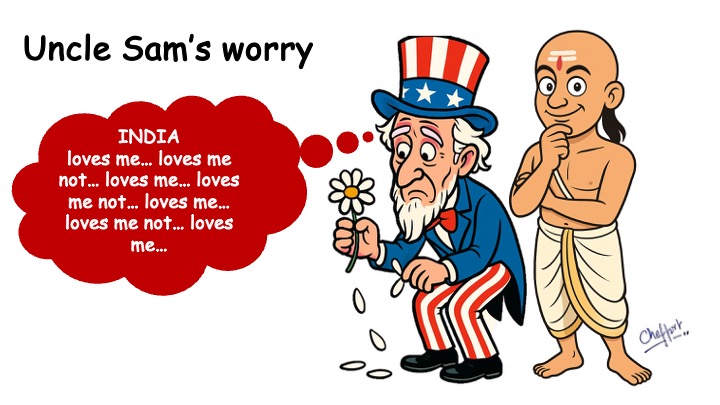
Uncle Sam uncertain as seldom never before…
…and the world will never be the same again.



No wonder Israel bans the entry of BBC correspondents in Gaza.
In creating a narrative, timing is very important. Most important!
The other day, as a part of the Centenary Celebrations of the RSS, Dr Mohan Bhagwat answered many questions posed to him about the RSS. They were curiosity packed questions, which come to the mind of one taking only a fleeting glance at the activities of the 100-year-old organisation. Incidentally, one thinks of the Swayam Sevaks mostly when they are in the news. Normally, their social work does not draw any attention; it is taken for granted. They become a subject of discussion when they are infrequently dragged into the headlines for unpopular reasons.
Dr Bhagwat tried to clear that perception too.
People have a favourable/ unfavourable opinion about the RSS and as always, some people belong to the ‘unsure’ category. Unsure because of some of its ideologies—its Hindutva ideology and strong stand on conversion, being one of them. The Sangh Parivar has long been accused of influencing politics and, now, of infiltrating other walks of Indian life—bureaucracy, judiciary and lately, even military. In his responses, Dr Bhagwat tried to dispel many such myths. Whether he succeeded, only time will tell.
I assumed that the RSS Boss would be able to influence some fence sitters and might inspire some on the ‘other’ side of the fence, to give an unbiased second thought to the RSS. That was my view until this morning when I listened to a BBC Global News Podcast. It is not so now.
My reason for wavering is a report by BBC South Asia Correspondent, Samira Hussain who spoke of deportation of 40 Rohingiya Refugees by India. The language, tone and tenor have been cleverly used to create a narrative. The transcript of the Podcast is reproduced here:
Rohingiya Refugees tell us, how they were dumped in the sea by the Indian authorities.
Back in May, alarming reports emerged of deported Rohingya refugees being forced off an Indian Navy vessel and off the coast of Myanmar. [Interesting! Very interesting, indeed. Something which happened in May, is being reported in August. Motive?]
Sameera Hussain sent this report from Delhi.
Hello. A group of seven men appear on my screen. They’re all sharing a mobile phone.
We were so helpless. We were waiting for someone to come to help us.
They are desperate to tell their story, how they were thrown in the sea [mind the use of words] and ended up stranded in Myanmar, a country they fled in fear of violent persecution.
We don’t feel secure in Myanmar. This place is completely a war zone.
That’s Sayed Noor, and he is one of 40 card-carrying, UN-recognised refugees living in Delhi, who were put on planes to the Andaman and Nicobar Islands, then put on a naval vessel in the Bay of Bengal, headed towards Myanmar.
Fourteen hours later, they were told to board smaller boats.
We were boarded to two lightboats. Our hands were bound for more than seven hours.
They asked us to jump off the lightboats one by one and we swam around hundred plus metres to get to the seashore.
When you got on the bus to go to the boats, who took you on the bus?
[This question by the BBC correspondent seems to be a leading question out of context because the interviewee has not mentioned bus ride before this. Also, the confidence with which the refugee answers is praiseworthy. His command over English language suggests that he is fairly literate, if not educated, and knows what sells. Or, I wonder if he has been briefed (by?) to say what he says hereafter.]
The same Navy. [This guy has not mentioned “Navy” earlier in the interview. Now he is saying “The same Navy.”]
How did you know they were Navy?
Because of the Bus inscription like, Bhatia Nawasena.
[Remarkable! This English-speaking refugee didn’t read “INDIAN NAVY” written in English on the bus, but could read “भारतीय नौसेना” and Ms Samira goes on to explain that it is the Hindi word for “Indian Navy.”]
The Hindi word for Indian Navy. Then he says, one by one, they were pulled aside on the boat and questioned by Indian authorities.
They would call someone and talk in Hindi, and they will even say something like, why didn’t you become Hindu? [It seems this smart refugee understands Hindi also.]
[Even the least literate of the Indian Navy sailors can speak good English. If the idea was to ask this refugee (a foreigner) some questions, it is less probable that the sailor would have spoken in Hindi.]
They questioned to Christian, Rohingya Christians, why did you convert a Muslim to Christianity? Why didn’t you become a Hindu?
And even they treat us to uncover are pains (penis) or to confirm whether we are circumcised or not. And they said, why did you come to India?
Why didn’t you choose another country?
Despite being registered as UN refugees, the Indian government says the more than 20,000 Rohingya refugees living in India are illegal immigrants.
[This correspondent, Ms Samira Hussain is ignorant of the fact that India is not a signatory to the Refugee Convention (1951) and its Protocol (1967) and hence, not obliged to accept refugees.]
This is a matter of life and death for these people.
Tom Andrews is the UN special rapporteur on the situation of human rights in Myanmar.
I’ve been receiving reports of refugees being detained, interrogated, mistreated. These are people who are not in India because they want to be. They are there because of the horrific violence that is occurring in Myanmar.
They literally have been running for their lives.
We put these allegations to the Indian government, who did not respond to our request for comment.
[Indian government is not obliged to respond to cooked up and scripted allegations.]
I’m walking up the stairs of a four-storey building in Vikaspuri neighbourhood of Delhi. I am going to meet Noorul Amin. He’s 24 years old.
Noorul Amin’s parents, two brothers and sister-in-law, are among the 40 deported refugees now in Myanmar.
We are humans, not animals. How can you just throw people into the sea?
[Mind the use of words to create a vivid narrative.]
In my heart, there is only this fear that the Indian government will also take us and throw us in the sea at any point.
[“PEOPLE BEING THROWN INTO THE SEA.” Thanks to BBC and Ms Samira, this vivid description will remain etched in minds.]
India’s Rohingya community, already existing on the margins are now living in fear, not welcome in their home country and not wanted in the country where they sought refuge.
A report by Samira Hussain.
As per the news caster, the incident took place in May this year. It’s broadcast coinciding with the Centenary Celebrations of RSS, is “BBC-MANAGED.” Now, what has a BBC news report on deportation of Rohingya refugees got to do with the Centenary Celebrations of the RSS?
Well, lately a perception has been created that the ruling BJP and the RSS are two sides of the same coin. So, if a narrative is advanced about India and the Indian Navy—asking refugees to drop their pants for identification and ‘throwing’ poor refugees into the sea—it is likely to project the RSS as instigating or inspiring such actions. This narrative, whether it is to malign the Indian Government, the Indian Navy or, through them, the RSS does not augur well for India as a sovereign nation.
Some Points to Ponder
As stated earlier, India is not a signatory to the Refugee Convention (1951) and the 1967 Protocol. As such India is not bound by them to accept refugees. Still, India accepted Bangladeshi refugees in 1971. India is paying a price for not sending them back after liberation of Bangladesh. Roughly 2,000 Rohingya refugees are reported to be in India. It is India’s right to deport foreigners who enter India without permission.
Now picture this: The 40 deported refugees were made to disembark at a point beyond which the boat couldn’t have gone. This is being literally projected as “dumping refugees in the sea.” It is a pure action against uninvited visitors to India; BBC is attaching meaning to that action and creating a narrative. Also, projecting Indian navy sailors as villains harassing the refugees (by asking them to drop their pants to determine their religion) is a deliberate effort of the broadcaster to create a narrative.
One must understand, correspondents will go to any length to earn their bread, and some extra butter. With one stone, Ms Samira is striking the Indian government and obliquely trying to stymie, the effort of the RSS to project a different image. Had it not been for the timing, one wouldn’t have seen through the motive.
No wonder, Israel bans the entry of BBC correspondents into Gaza.
Is there a way to put immediate stop to suffering in Gaza?
O Gaza!
The events of October 7 served as the immediate trigger, but the roots of the Gaza conflict extend far deeper. The underlying causes are complex and subject to debate, with little likelihood of consensus. For this reason, reducing the war to a binary of good versus evil oversimplifies the situation. Meanwhile, the human toll continues to rise, with thousands killed by bombardment and many more affected by hunger and displacement.
Recent decision by France, Australia, and the United Kingdom, to recognise Palestine, though politically significant, is unlikely to resolve the immediate challenges. Rather, it highlights the difficulty the international community has faced in addressing the conflict.
Israel’s Objectives
Israel’s stated aims can be broadly identified as:
• Destruction of Hamas,
• Release of the hostages,
• Ensuring Gaza no longer poses a threat to Israel, and
• Return of displaced residents of northern Israel.
The feasibility of achieving all four goals simultaneously remains uncertain.
Prospects of Eliminating Hamas
Military operations may succeed in neutralising most Hamas operatives within Gaza. However, complete elimination appears unlikely. Those who escape are likely to regroup elsewhere. Also, displaced Palestinians will carry their wounds and scars to other parts of the world. No border control can prevent the smuggling of hatred and anger. It would be naïve to imagine that some of them would not be behind a “9/11 (Version 2.0),” if and when such an attack happens anywhere in the world. One does not need Nostradamus to foresee this.
The Hostage Question
Israel does not follow a rigid hostage policy and has, in the past, agreed to prisoner swaps. During the Entebbe Raid (July 1976), the hijackers’ demand for the release of Palestinians in Israeli prisons was actively considered, even as preparations for Operation Thunderbolt (later renamed Operation Jonathan) went ahead. The mission was deliberate and well planned. Jonathan Netanyahu (Prime Minister Benjamin Netanyahu’s brother) sacrificed his life to rescue 104 Israeli hostages. One hostage, hospitalised in Uganda, later died under unclear circumstances.
In another instance, Kozo Okamoto of the Japanese Red Army—who, along with two comrades, killed 32 people and injured 72 at Lod Airport (now Ben Gurion Airport) on May 30, 1972—was captured alive. Israel, which has no death penalty, imprisoned him. Yet on May 20, 1985, nearly 13 years later, Okamoto was released as part of a prisoner swap. On that occasion, 4,600 Palestinian and Lebanese prisoners were freed in exchange for three Israeli soldiers.
Why then, despite immense pressure from the families of hostages and international opinion, has Israel been unwilling to proceed with more prisoner swaps? Here one tends to agree with Prime Minister Netanyahu and others: conceding to Hamas’s demands would amount to “rewarding” them for the October 7 attacks.
Other Goals
The other two aims—ensuring Gaza no longer poses a threat and facilitating the return of displaced residents of northern Israel—are relatively less difficult to address once the hostage issue is resolved.
At present, the deadlock lies with Hamas. They know well that releasing the remaining Israeli hostages (and the bodies of the dead) would spell their end. They would be hunted down and eliminated. That fate seems inevitable anyway.

A Possible Way Out?
What could break the impasse?
One possible—though imperfect—approach could involve offering safe passage for Hamas operatives out of Gaza in exchange for the release of hostages. Such an arrangement might drastically reduce civilian casualties, but it would raise questions about long-term security and the precedent it sets. Whether Israel, and Hamas, would accept such a suggestion remains uncertain.
In the fog of war, it is unclear whether both sides are already working toward a face-saving exit. Meanwhile, frustration and anger are mounting across a world that feels trapped in a seemingly hopeless situation. In the absence of a negotiated settlement, the conflict is likely to continue at great humanitarian cost.
A Warning for India
The dilemma is not unique to Israel. Sooner or later, India too may face a similar horrific choice: how should it deal with terrorists who, after striking a target, hide behind civilian population in India or, still worse, across the border in Pakistan?
Will the wolf pay this time…?
A wolf was drinking water on the bank of a river. A little away, downstream, was a lamb taking small sips.
“Why are you dirtying the water I am drinking,” growled the wolf.
“Sir, but I am downstream, how can I dirty the water reaching you?” The lamb tried to reason with the wolf.
“Okay! Okay!” said the wolf, his accent American, his logic Trumpian. “But why did you use abusive language with me last year?”
“But Sir, I wasn’t born last year,” pleaded the lamb wiping his sweat.
“Then, it must have been your mother,” said the angry wolf and pounced on the lamb.
That is the original version of the story.
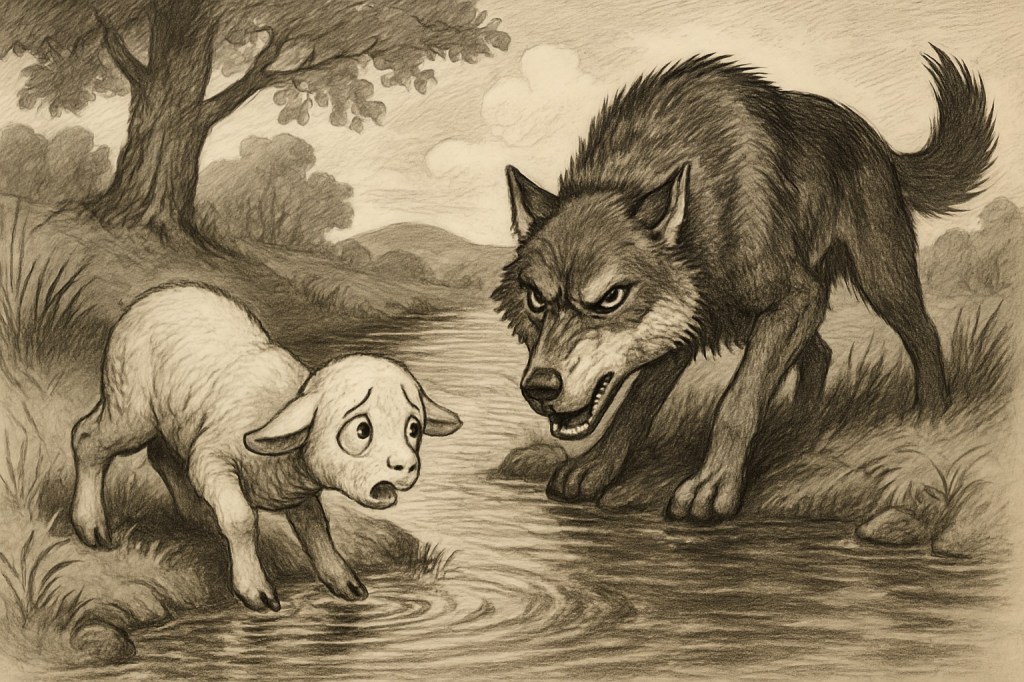
The current version, has some more characters and interesting twists. The wolf is rankled more by two other animals in the jungle—the bear and the little dragon who have enough nuisance value for him. To his annoyance, the lamb is friendly with the bear. And, playing on the mind of the slimy wolf is the fear: “What if, let alone the lamb, the bear and the little dragon, other animals of the jungle stand up against him?
The animals of the jungle have a different concern.
Their worry is that the wolf has an Indian brain, a Chinese heart, a Vietnamese kidney, Latino lungs, Mexican blood, Jewish bones… but, it is controlled by its own xxxhole. How much more stink will it bestow upon the jungle before it suffers from the same?
Gazans need food, water and medicines; not, contraceptives.
The dramatic drop in crime rates across the United States in the 1990s sparked intense debates about its underlying causes. Pundits credited economic growth, stricter gun control, a crackdown on drug trafficking, improved policing, and increased use of capital punishment. However, Steven Levitt and Stephen Dubner, authors of Freakonomics, proposed a controversial yet compelling theory: the legalization of abortion following the U.S. Supreme Court’s landmark Roe v. Wade ruling on January 22, 1973, played a pivotal role.
With abortion legally accessible, many pregnancies that might have resulted in unwanted children—often born into poverty and unstable environments—were terminated. Had these children been born, it was argued, many would have grown up in circumstances that increased their likelihood of engaging in criminal activity.
If this theory holds, a chilling corollary emerges: The United States is poised for an unprecedented surge in crime a decade and a half from now. As expected, experts will scramble for explanations, but this time, the reason will be glaringly obvious—the recent reversal of Roe v. Wade.
While rising crime in America may be a domestic concern, the consequences of its policies extend far beyond its borders. U.S. foreign policy often mirrors the contradictions in its domestic decisions, particularly in the Middle East. Nowhere is this clearer than in its approach to the Israeli-Palestinian conflict.
Successive U.S. administrations have adopted a selective stance on demographic control. During the Intifada of the early 1990s, Palestinian leader Yasser Arafat famously declared, “The womb of the Arab woman is my strongest weapon.” At the time, fertility rates in Gaza soared to an astounding 8.3 births per woman—nearly three times that of Israeli Jews. Alarmed by the demographic shift, the U.S. actively supported birth control programs in Palestine while simultaneously offering unwavering military and moral support to Israel.
Fast forward to today, and the consequences are staggering. Since October 7, 2023, nearly 44,000 Palestinians have died in Gaza, with deaths continuing even after a precarious ceasefire—first from bombings, now from hunger and the collapse of medical care.
Adding to the crisis, the U.S. has halted all foreign aid, including a modest yet symbolically significant $5 million designated for contraceptive supplies in Gaza. But if and when aid is restored, the priority should be clear: food and life-saving medicines, not birth control. As America’s policies continue to shape lives—both within and beyond its borders—the world watches. Whether on the streets of New York or the alleyways of Gaza, the consequences of U.S. decisions are neither isolated nor incidental. Perhaps it is time for the architects of these policies to reckon with the paradox they have created:
A nation that dictates life and death struggles to control its own fate.
© [Group Captain Ashok K Chordia] [2025]
All Rights Reserved
No part of this website/Blog or any of its contents may be reproduced, copied, modified or adapted, without the prior written consent of the author. Extracts may be quoted from the website or link to the website may be forwarded with attribution to “Road Much Travelled.” For any other mode of sharing, contact the author @ (akchordia@gmail.com)
Comments
Air Commodore ROJ Assey (IAF Veteran): Thanks, Ashok.
Very thought provoking, indeed.
I have never come across – or imagined the concept of ‘Roe vs Wade’ being a significant factor in crime control – fascinating. Some of us may be around to see it, too. Superb writing, as usual – and fascinating reading. Warm regards. ~ Rod

An interesting bit of information is displayed on a standee kept next to The Very First Volvo in the World of Volvo, in Gothenburg. It points out that the premier of ÖV4, in the 1920s, fell flat because a rear axle gear had been installed incorrectly and the car could only drive in reverse in its first test drive. Embarrassment caused by the event to the company notwithstanding, Volvo identified the fault and immediately fixed it. Then onwards, the Volvo cars and trucks have had the reverse gears; but Volvo, the automobile giant, has only moved forward. It has gracefully covered the long distance to world leadership in automobile sector.

Before talking further about Volvo culture, here is a less known fact about the reverse gear—it is the most powerful gear in all automobiles. Once, while on a 3,700-mile road trip from Paris to Ankara, Dominique Lapierre, and his classmate, Dominique Frémy, was faced with a steep climb near Athens, which brought their 6-HP antique Amilcar to its knees. To deal with the challenge, they turned around the car and drove uphill in reverse gear. The effect was miraculous: their valiant car climbed the slope like a Tour de France bicycle.
There is much to learn from Volvo’s culture of acknowledging shortcomings, working on them to improve, and above all, talking candidly about the failure. The power of the reverse gear also has a message.
Managing personal life; running a corporation or a government—each is akin to driving a vehicle. If a not-so-correct decision is taken and implemented, it would only be appropriate to acknowledge it gracefully, in time, like Volvo, and to get into the powerful reverse gear to prevent appreciable damage.
Like the reverse gear, the brakes and the rear-view mirrors also contribute to good driving. The purpose of brakes—more important than the ability to slow down and stop at will—is to allow driving at high speeds. Awareness of functional brakes, or ‘brake consciousness’ as it may be called, sets one free to speed up.
Amusingly, the purpose of the rear-view mirrors installed in the cars of the yesteryears was to enable the drivers to keep an eye on the cops who might be chasing them. Today, they have a more meaningful purpose—to ensure road safety.
Cruising ahead in life; or leading an organisation, it pays to look into the rear view mirror and observe the road travelled. Slowing down to take stock, or getting into reverse gear to make amends are empowering options.
Willingness to adopt the goodness of Volvo Culture is the need of the hour.
If only vibes too could be translated!
Drawing inferences or lessons is an art.
A researcher placed a frog on a table and snapped, “Froggie jump!”
The frog jumped and landed two feet away.
The man, in quest of knowledge, scribbled an observation on his notepad and put the frog back at the starting point and chopped one of its hind legs. “Froggie jump!” he yelled again retaining the pitch and the loudness of the previous occasion.
The frog jumped. This time, it landed just about a foot away.
With great anticipation, the academic chopped the other hind leg of the helpless being and repeated the exercise. The profusely bleeding frog didn’t move an inch. The scholar repeated, “Froggie jump,” several times, varying the pitch and loudness of his command.
Then, with the air of an Archimedes discovering the principle of buoyancy, he noted: “A frog becomes deaf when its hind legs are severed.”
In a study on the impact of major historical events on the environment, published over a dozen years ago, it was theorised that some occurances could have impacted the climate due to the return of forests after depopulation; one of the events studied was the Mongol invasion of the 13th and 14th Century. It was revealed that 40 million deaths during the Mongol conquests caused large areas of cultivated land to grow thick once again with trees, which absorbed carbon dioxide from the atmosphere. Ecologists believe it may be one of the first ever cases of successful man-made global cooling. Thus, Genghis Khan was the greenest invader in history.
The ecologists who arrived at the green conclusion didn’t have the tools or, more probably, they didn’t have the inclination to comment on the kind of 40 million people killed by the Green Genghis. Among those put to sword, there could have been artists, painters, thinkers and social scientists who might have put the earth back on a greener track? May be. May not be.
It is only a matter of time, some social scientist, somewhere, will draw similar conclusions about the (good) environmental impact of the recent wars. More than 90 million (including civilians) have died in the wars since WW I (including only the major wars with casualties in excess of 25,000). Blame it on the fog of war—this estimate of ~90 million+ could be grossly incorrect. This figure does not include the Covid deaths.
Most wars have their genesis in the failure of dialogue and diplomacy. And when two sides do go to war, they fight to win it, and impose their will on the vanquished. Incidentally, the numbers that die on one side are not compensated by the number killed on the other side—they add up. In military academies and war colleges all over the world, they teach the art and the Principles of War. The knowledge gleaned from the writings of Kautilya, Sun Tzu, Clausewitz and their ilk, is passed on from a generation to another. The future leaders study campaigns, and try to figure out whether or not the military wisdom of the yore was put to use. The effort is to establish, to what extent the victor and the vanquished adhered to the proven warfighting tactics/ strategy.
The Ukraine War and, now the War in Gaza (some call it the War on Gaza, and with good reason, which depends where they stand and how their glasses are tinted), has necessitated the need to refine and redefine warfighting for the ones executing the will of the political leadership. A few might agree (most others will agree absolutely) to cram the sum and substance of all military knowledge in just four words: “LIVE AND LET DIE!”
“Live and let die!” that is what exactly the Ukrainians, the Russians, the Israelis and the members of Hamas are trying to achieve even as the cheerleaders, the US, the UK, the NATO and Iran etc are eagerly awaiting the opportunity to enter the fray.

Meanwhile, in the International Court of Justice (ICJ), the ‘genocide’ issue led to an animated debate. South African advocates painted a vivid picture of Israeli atrocities in Gaza. The Israeli rebuttal was passionate and strong. Rhetoric at the Hague boiled down to the definition of ‘genocide’ and ‘the intention to kill.’ At one point, the chair had to advise the Israeli representative to go slow to enable the translators and interpreters to keep pace. Speed notwithstanding, it is axiomatic that some meaning is always lost in translation. How then, can one expect people to understand each other, let alone be sympathetic? There is no way yet, to translate the ‘vibes.’ It is no wonder then, that the interim order of a toothless ICJ sounds so hesitant. The UN body has directed Israel to prevent genocide (mind the subtle difference between ‘preventing’ and ‘stopping’) in Gaza. As it stands, the ICJ is certainly not blaming Israel for the said crime. It has not ordered an immediate ceasefire.
The Gaza War has the potential to engulf many more actors and stakeholders in its raging flames. It is an unparalleled crisis. It is said that the worst corners of hell are reserved for those who maintain neutrality in times of crisis.
Time is NOW to speak up and work towards preventing further bloodshed.
Many wrongs have been committed since the birth of Israel in 1948. All those wrongs do not add up to make a right. They also do not justify either the Hamas raid on Israel on October 7, 2023 or the Israeli action following that attack. One of the possible ways out of the present crisis is the release of the Israeli hostages followed immediately by a ceasefire. If Israel decides to continue to pursue its aim of eliminating Hamas even after release of its hostages, it might succeed in its mission (although that is an extremely doubtful proposition) but in the process, it will sow the seeds for still worse to happen.
The writing on the wall is legible and clear. May sense prevail.
Tathastu!
Comments
Colonel Jamshed Hussain (Veteran) — Reasons are invented to justify most violent actions, including wars. Winners prevail, hence history is recorded as viewed by a victor. Seeds sown by imperial powers of yesteryears, will continue to fester conflicts…So Gazas and Ukraines will continue.. Ashok👍
Air Commodore Roj Assey (Veteran) — Very well written, Ashok.
I have a video clip of the Israeli ambassador speaking at the UN, a couple of weeks ago. He made two major points ….
If Hamas returns all the hostages, Israel will stop its offensive the next day.
Nothing is more important to Israel than its own survival – irrespective of what the world does, or thinks.
On the first point, this statement was made by an official rep of Israel and is a guarantee made in front of a world audience.
On the second point, ever since Israel declared its independence on 14 May 1948, after the dramatic Resolution taken in the UN on 29 Nov 1947, Israel has had to fight for its survival. A Russian Mig or an Israeli Mirage takes only a few minutes to cross the entire country of Israel.
There has been an enormous amount of heated, prejudiced, passionate and emotional talk and writing about the crisis. How much of it is true, depends, as you very aptly quoted, on how the glasses are tinted. I would suggest that 99 per cent – at least – of what is written, is a mix of fact and outright fiction.
But I cannot fault Israel’s desire to survive.
Can India let the dragon keep trampling its interests?
At noon on November the 3rd, 1988, it was an anxious moment in the Ops Room of Army Headquarters in Delhi. The who’s who of the Indian political and military leadership, and the sharpest brains of the diplomatic corps had gotten together to plan the rescue of the then Maldivian president surrounded by blood-thirsty armed men. The lingering fear was that of the IAF aircraft, with the troops on board, being blown up by the rebels at the time of touchdown. There were suggestions to respond with maximum force. With a view to outdo the rebels, a general officer suggested inducting more troops than the number that had been proposed by the Army Chief. Humour was not lost on a witty Ronen Sen—a troubleshooter of a diplomat—who said, “Let’s not induct so many troops—the island will sink under their weight.”
Thankfully, Malé didn’t sink under the weight of the Indian military contingent then. Also, in the following decades the islands didn’t submerge despite the weight of the infrastructure developed, mostly gratis, by India. Even the weight of the feeling of indebtedness for the assistance provided by India in their times of various crises couldn’t dunk the islands.

Occasionally, when their leadership was getting ensnared by Beijing, well-meaning islanders—and there is a large number of them—were in touch with Indian leadership and intelligentsia. But India did not heed their clamour for help. Delhi didn’t interfere considering that it was the prerogative of the Maldivian leadership. The result was that the Maldives unfairly cancelled many contracts awarded to the Indian firms (including the $511 million airport project bagged by GMR) and even leased islands to Beijing which are being used as observation posts to snoop on India. This certainly was not what India had bargained for its non-interference in its neighbour’s affairs.
A cross-section of people on either side feel that both India and the Maldives will be the losers as a result of the current spat. They conclude, and rightly so, that China will gain immensely from this tiff. So, should India accept this Malé-Beijing bonhomie as fait accompli? Certainly not, particularly if it is detrimental to India’s strategic interests. Silence is not a rewarding policy in a world of strategic communication. India needs to do more than just conveying its displeasure over Malé’s actions.
People also say that China is economically too powerful to be confronted. The diplomacy we have followed over the years has been trumped at each step by the lure of Chinese investments. It is, therefore, no wonder that Malé is following in the footsteps of Nepal, Bhutan, Bangladesh and Sri Lanka. But, can India let the dragon keep trampling its interests? Time and energy need not be devoted to answering that rhetorical question. China must not continue to get things on a platter.
India must do everything possible to make Beijing pay the cost for encroaching its interests. In the bargain, if Malé suffers, so be it; they have asked for it. All the possible ways in which India can counter China in the Maldives (and elsewhere)—and there are very many of them—may be adopted discreetly, without making a hue and cry. Keeping Beijing guessing will also serve a definite purpose.

President Mohamed Moizzu who generated the anti-India wave and rode it to success in the presidential election is certainly not in step with Chi. Now in Beijing, he’s trying to get some favours. Among others, China has promised additional flights and tourists to Malé. That will more than make up for the loss of revenue due to Indians not touring the Maldives. Hopefully, for the time being. But for sure, among the tourists will be Chinese agents (and possibly carriers of new variants of Covid) whose presence, the Maldives will regret at some point of time in the not too distant future.
What can India do?

The frenzy will be over soon. When the dust settles, for us Indians, the most difficult thing will be to acknowledge the blind spots so undiplomatically pointed out by the Maldivian ministers. Although, their comments were related to tourism in the Lakshadweep, it will be in our interest to consider tourism as a whole—everywhere in India.
India has umpteen exotic locations to promote tourism—pristine unexplored beaches, mountain treks, jungle safaris, bird sanctuaries and reserve forests. We have historical monuments and places of worship. Tourism for adventure sports, medical care, naturopathy, meditation and Yoga is already flourishing. People also travel for art, culture, theatre, film and photography… the list is long and ever growing. Limits are posed by imagination alone. Each of these has its peculiarities—means of transport, accommodation, food, equipment and above all people who can communicate well. India must go all guns blazing, and create infrastructure and train human resource to give the tourists an experience. Some sincere and meaningful introspection is vital as we take on the adversaries.
Need more be said!?
[Hereafter, how to deal with the Maldivians visiting India for medicare, education or any other purpose—is a subject for another day.]
Comments
Well written, Chordia; as usual! Thought provoking too…really need to up the ante in tourism….we have a long way to go…’coz, I feel genetically we are crooks…especially those who can make a difference..out for the big buck!! ~ Air Vice Marshal TPS Dhillon (IAF Veteran)
Well timed and articulated. India just has 1.6% of global share of tourism. As rightly put by you that we have everything to offer. Beaches, mountains, deserts, monuments, buildings , temples with their unbelievable architecture, yoga, massages, traditional music and dances not to forget medical and religious tourism. We have to exploit all these but for that we have to create infrastructure and also improve our image as a nation. It is difficult to digest that having a destination wedding in India cost three times more than in Bali. ~ Group Captain Sanjiv Aggarwal (IAF Veteran)
Also read
Sino-Indian border talks have been roiling like a long-brewing ginger-tulsi kadha––becoming bitterer in taste with each passing moment. If only the potion seethes well, might India and China accrue long-term health benefits from it. The outcome of the sixth round of talks doesn’t indicate that; it is another case of the same old wine being served in a new bottle––still focussing on defusing tensions.
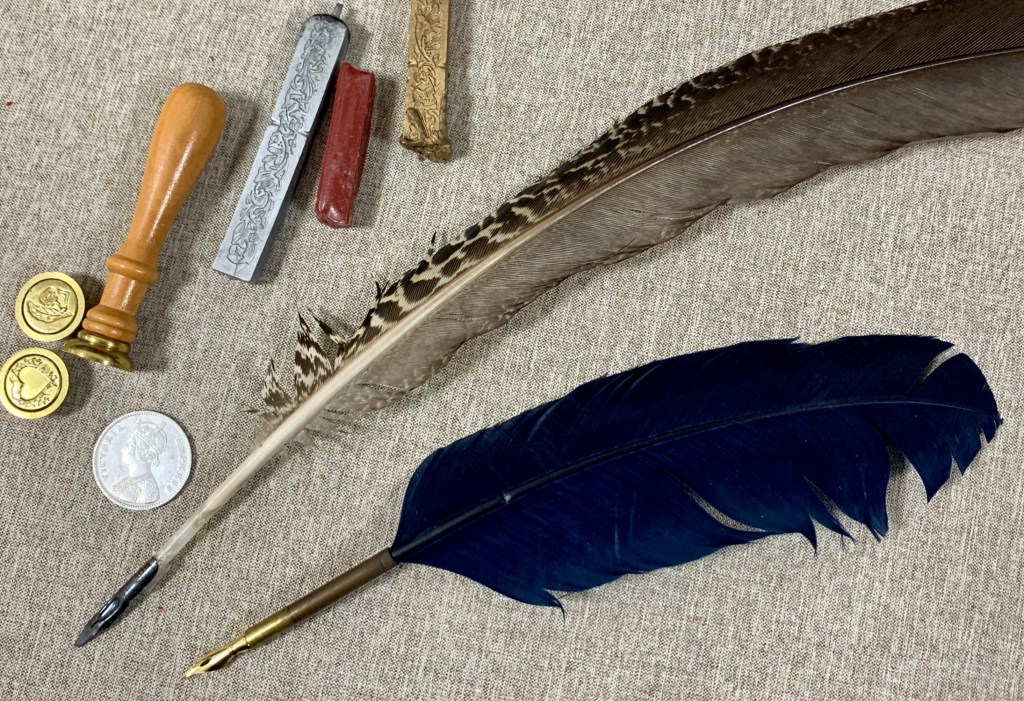
Talks, and more talks, are in the offing––uncertainty and unease on the border have been prolonged. Divining the prospect of peace by reading tea leaves might not be possible since, mutually piqued, Modi and Xi are less likely to meet over a cup of tea in the near future. Yet I have been overzealous about the future.
Would the Queen––whose representative caused this Sino-India border problem by using some bad broad nibs to draw the region’s map––help foresee the fate of the subcontinent? Out of curiosity I tossed a Victorian era silver coin hoping to get some answers––war or peace; withdrawal or long drawn standoff….? When judgement becomes difficult, I have started believing in the predictions guided by a coin with the British monarchy on its face for they (the Brits) are at the root of most of the world’s problems of today. And lo and behold, the coin I tossed, bounced off the road, missed a drain narrowly and ended up through a perforated concrete lid into a bottomless well meant for rainwater harvesting. Now sealed some fifty feet below the earth’s surface, is (the much sought knowledge of) the future of this great country.

Rankled, I had almost decided to take a break from this Sino-India affair for a while when I saw Champagne––the wretched stray I introduced to my worthy readers in an earlier post titled, “China’s Champagne Moment.” Those familiar with that dog’s demeanour will recall that, like China he had been claiming territory that was not rightfully his until one day, when other dogs got together and taught him a lesson. Through Champagne I had projected Beijing’s doom.
My forecast has not come true yet; it has not been proved entirely false either. Several countries, with the US in the forefront, have been striving to settle their scores with China. The anti-China sentiment is simmering with greater intensity now than ever before. And ever since I wrote that piece, Champagne has been behaving even more like China. Rather than fighting with the dogs in the neighbourhood, he has been trying to travel far and wide and woo the dogs he sees sitting on any kind of resources. The other day I saw him wooing a black dog at a construction site. It felt as if China were wooing Africa.

Then two strikingly strange and unusual things happened.
One, Lisa, another dog appeared on the scene. She became popular with all the dogs in the area. They aligned with her as much because of her friendly demeanour as for the reason that they wanted someone to stand for them against the aggressiveness of Champagne.

Two, around the time the last round of Sino-Indian border talks concluded, Champagne was seen practicing ‘kowtowing‘… yes, K-O-W-T-O-W-I-N-G.”
Reverting to China. Behind the façade, Beijing is succumbing to the pressures created by several countries going against it and this is evident in its slowly eroding belligerence. In the last few days, since the standoff at Pangong Tso, China has not reacted with use of force, instead it has spent time at the negotiating table with India. This doesn’t go with China’s past stance and responses to such issues. Reasons for its restraint are better known to Beijing; others can only hazard a guess.
Meanwhile, Indian leadership has not been resting on its oars. It is trying to find the best way to the dragon’s heart out of the so many routes available. One is direct––from Delhi to Beijing. The other is from Delhi to Beijing via one or more of––Washington, Ottawa, Paris, Berlin, Tehran, Tel Aviv, Canberra, Tokyo, Manila, the sea in the South of China (some people erroneously call it South China Sea), Malacca, Strait, Hong Kong, Taipei, Lhasa, Xinjiang, et al. Needless to say, in the present circumstances, Xi Jinping will be pleased to meet Modi’s emissary travelling direct from Delhi to Beijing rather than following a circuitous route.
In the present situation, either China has nothing to say (less likely), or it doesn’t have the words to say, what it wants to say. Therein lie the reasons for no tangible progress in the talks and no further escalation in hostilities. Therein also lies the reason why Xi Jinping, like Champagne, might as well go indoors and refresh his Kowtowing skill––one doesn’t know when he’d need to fall back on the benefits of the ancient Chinese practice.
India would do well to prepare the ESCAPE HATCH for the dragon’s graceful exit.
Related posts:
Dealing with the Darned Dragon: Preface
Dealing with the Darned Dragon-I: Border Infrastructure
Dealing with the Darned Dragon-II: Escape Hatch
Dealing with the Darned Dragon-III: A Lesson from Pearl Harbour
Dealing with the Darned Dragon-IV: Exercising (with) the Nuclear Option
 Road Much Travelled