This morning my little grandnephew asked me, “Dadu, why do we say, ‘the US, the UK, the UAE?’ Why don’t we say, ‘the India’?”
“It is rather simple, my child,” I said, “When the name of a country suggests that it is a group of states or a confederation or a federation, we use ‘the‘ before their names like, the United States, the United Kingdom, the United Arab Emirates….”
“I see,” Kartik nodded.
“Not only that…,” I added to enlighten him further, “…the names of some countries which are archipelagos or groups of islands, are also preceded by ‘the‘ for example the Maldives and the Seychelles.”
“I will not use ‘the’ with Maldives. I don’t like that country. The Indian troops risked their lives for their President and we have been rushing to help them in their times of need, yet they speak with disrespect for our Prime Minister. They are bad people!”
“Language has nothing to do with relations between countries,” I chuckled. “Grammar is not governed by feelings, Maldives will continue to be called, the Maldives. Your dislike for that country doesn’t change anything. Relations between countries are temporary; only interests are permanent. Yesterday the Maldives were with us; today they are with China. Who knows, tomorrow they might end up being without any one on their side when China discards them like a spent tissue.”
A pout on the little lips, lateral movement of the eyeballs, and a shrug of his little shoulders was Kartik’s way of conveying his displeasure about this particular rule of the English grammar. He continued paying attention regardless.
“Not only that, we use ‘the’ before names of groups/ organisations that suggest coming together of several entities. For example, the United Nations, the World Health Organisation and…,” I paused to think of names of more organisations.
“In that case it would be grammatically correct to use ‘the’ with India too,” the little one spoke with sparkling eyes. “I.N.D.I.A. stands for ‘Indian National Developmental Inclusive Alliance’ and meets the criteria of being a coalition of several entities?”
That question put me in a tailspin. I remained silent for a long minute until Kartik tugged me, “Isn’t it Dadu?
I scraped the inside of my cranium for the special wisdom required to answer such questions. Then I spoke hesitantly. “Well, theoretically you’d be right if you use ‘the’ before I.N.D.I.A. But as it stands, there is nothing like I.N.D.I.A. It is just a group of ambitious people trying to remain relevant in Indian politics by any means. Rather than setting an agenda for the country, their only aim is to remove the ruling dispensation, and their primary concern is ‘seat sharing.’ Men apart, every man there is a candidate for the post of prime minister. As of now I.N.D.I.A. exists only as a concept.”
The quizzical look on Kartik’s face suggested that he didn’t understand a word of what I had said. But does either India or I.N.D.I.A. visualise the consequences of having a weak, rudderless and meaningless opposition?
Comments
Wing Commander Sanjay Sharma (IAF Veteran) — If my Grandson were to grill me like you were fried, I shall take apolitical asylum in Djibouti.😱😱🤯🤯
Wing Commander Vijay Ambre (IAF Veteran)—You need a strong and united opposition for a vibrant parliamentary democracy. The present conglomeration in the opposition is not likely to provide that after the general elections, especially if the present government returns to power. The Modi government is doing a very good job on all fronts and deserves another term for internal and external policy continuity.
Colonel Jamshed Hussain (Indian Army Veteran)—Very interesting…use of grammer to drive home a point..for a meaningful democracy, a strong opposition is as important…. The small one for weekend, is razor sharp in its thought..Ashok, my compliments.👍 Stay blessed🙏
Air Marshal PV Athawale (IAF Veteran—Beautifully put across Ashok, through Kartik, something which “the politicians” scream aloud every evening on the TV, and no one understands!
Will the man in the street of Malé be able to bear the outcome of the spat between India and the Maldives?
The one, and the only time I have ever been to the Maldives was without a passport, visa or an air ticket. Yet there was a red-carpet welcome. The Maldivians, their Government and their President in particular, were thankful for that visit of ours. In a handwritten note which he gave me, a senior military officer had expressed the sentiment: “Your Governments kind assistance is very much appreciated by our Force. National Security Service.” Signed Major Mohamed Zahir 4/11/88. He also presented me a cap badge and a formation sign of the NSS as souvenirs. “Do come over again in better times,” he had said, extending an invitation to me to the island nation. Perhaps that generous offer from a grateful Maldivian has become time-barred.
That was in November 1988—the Indian Armed Forces had provided succour to the then Government of Mr MA Gayoom in the midst of an attempted coup. The IAF had airlifted the paratroopers from Agra to Malé (2600km away); the paratroopers had rescued the President and restored calm. The Indian Navy had rounded up the fleeing rebels.
Much bloodshed was avoided; the medics of the Indian Army had taken over the Central Hospital to provide care to the wounded. The authorities had fallen short of words to appreciate the gesture (read the letter). The Indian troops remained in the Maldives for six months providing security cover and training the Maldivian forces.
And that was nearly 35 years ago.
Is the Prez being mentored/ chastised?
Time, tide and China have caused the erosion of the relationship that had been built on mutual trust and cooperation over the intervening decades. In the Maldives of President Mohamed Moizzu, the presence of an Indian helicopter and a handful of men—stationed to provide assistance to the Maldivians with the explicit understanding with the previous governments—is no longer acceptable. The manner in which it has been put forth by the man speaks volumes about his standing as the President of a sovereign country. Mind his body language and that of the Al Jazeera anchor during his recent interview to the television channel. The President is sitting up like a schoolboy answering the anchor who is leaning back, cross legged and pointing a pencil at him like a teacher. During their interaction, he appeared fidgety as if he were under instructions from his bosses to tow a particular line.
For sure, minds in Delhi will be working overtime to establish how things have come to such a pass, and more importantly, how to turn the tide. At the same time, the leaderships in Beijing and Malé must be looking forward to extracting the maximum they can from their present bonhomie. The people of Maldives will feel the effect of the Chinese bear hug sooner than later. It’ll be myopic on their part to ignore the outcome of Beijing’s largesse to Pakistan and Sri Lanka, and the result of China’s benevolence in Africa and South America.
Knowing the sentimental Indian, it wouldn’t be long before the ripples caused by #EXPLOREINDIANISLANDS and #boycottmaldives turn into waves. And, it shouldn’t be surprising if those waves turn into a tidal waves and then, into a tsunami that takes a small toll on Maldivian Tourism. As it appears, many have already reworked their plans (changed the destination from the Maldives to the Lakshadweep). A more likely and significant positive spinoff of the spat triggered by the unsavoury comment of a Maldivian politician (on Prime Minister Modi’s call to make Indian islands a tourist destination) would be an improvement in the facilities that our islands provide.
With a few Bollywood celebs echoing the anti-Maldives sentiment, investors might reconsider their plans of shooting their films on locales in the Maldives. A few cancellations will be enough for the Maldivians to feel the heat. Not long ago, I had advised my friends working on two of my stories—one inspired by Operation Cactus, and the other, based on a life changing event in the life of a military veteran—to plan shooting in the Lakshadweep rather than the Maldives. Although those suggestions were purely to keep the costs down, the present euphoria is nudging the decision further in this direction.
In the foreseeable future, Maldivians are less likely to give up visiting India for medical care or enrolling in Indian educational institutions or for other reasons. Visiting India is a need for the Maldivians.
A dispassionate cost benefit analysis of the current spat might show a little gain (or at least, NO LOSS) for India in the near future. The long-term tangible and intangible losses for the Maldives might be unbearable. Needless to say, the islands leased by the Maldives to Beijing have been a thorn in India’s side. Interestingly, the wisdom of an old Hindi proverb boils down to: “Use a thorn to take out a thorn.”
A dragon doesn’t have a soft belly. But it shouldn’t be impossible to find some delicate spots to insert a few needles to relieve the pain in India’s side. I am sure Jay (read Jai, if you will) is at it.
[Note: As I post this article, news of suspension of three Maldivian Ministers for their derogatory remarks against Prime Minister Narendra Modi, is making headlines. Will this action by President Mohamed Moizzu, stop the impending tsunami? Let’s wait and watch.]
Until the beginning of 1980s, the thing that drew an Indian traveller’s attention when the train approached a station was bare-bottomed men with a container of water squatting blissfully by the track, deliberately oblivious of the passing trains. Then, there came something that vied for attention and grabbed it nice and proper. It was a hoarding in big white letters in Hindi repeated on the dilapidated brown brick walls separating the tracks from the suburbs on the approach to all cities. It read:
प्रोफेसर अरोड़ा। रिश्ते ही रिश्ते। मिल तो लें। 28, रैगर पुरा, करोल बाग। ब्रांचेज इन अमरीका एण्ड कनाडा।
Literally: “Professor Arora. Loads of matrimonial contacts. Just meet (us). (Address) 28, Raigarpura, Karol Bagh. (We have our) Branches in America (the US) and Canada.”
Innumerable married Indians, and quite a few Americans and Canadians, owe their happily, or very happily married lives to that ad campaign which might be a case study for budding entrepreneurs. That 28, Raigarpura ad was more striking and easier to avail of the offered match-making services than the matrimonial columns of the leading national dailies. The system run by Prof Arora couldn’t have been computerised. Computers didn’t exist even in the imagination in the India of the 1980s. Yet Prof Arora gave a run for the money to all others offering match-making options. Had Modi been the Prime Minister at that time, Arora would have been a subject of discussion on “Man ki Baat.”
Whoever said, “Marriages are made in heaven,” must have lived on a different planet; may not have belonged here. Or, that may have been true in a different era. We rarely see it happen nowadays. The last well known swayamvar was that of Sita (or was it Draupadi?).
The breaking up of the marriage of the daughter of a leading astrologer of India days after she took seven pheras of the holy fire has cast doubt on that system. The role of astrologers, if not the art and science of match-making using astrology, has also lost its appeal.
A joke has been doing the rounds:
A five-floor super store provides choice of men for husbands; desirable qualities keep adding as one moves to the next higher floor. One can climb floors but cannot return to a lower floor to make a choice. A lady wanting to choose a husband found caring men with jobs on the first floor. Curiosity took her to the second floor where she found wealthy caring men with good looks. With a desire to find a better man, she went to the third floor where there were good looking rich romantic men. The woman was happy with the offer but was tempted to have a look on the fourth floor. On offer on the fourth floor were good looking romantic millionaire men who’d help in the kitchen and take care of kids too. Anticipating an even better choice, she took the lift to the top floor to find a prominently displayed message: “Sorry, the kind of man you are looking for does not exist.” [Disclaimer: This joke has been recalled and reproduced to the best of the author’s ability. The readers may change the gender of the main protagonist and re-read if it pleases them.]
Seeing the growing demand, websites facilitating match-making have proliferated. They collect what they call ‘BIO-DATA’ of the customers and their expectations. Then, for a fee they offer contacts of matches who generally meet the requirements. One doesn’t need to write complex algorithms to get the desired output of this nature. A school student adept at using Microsoft Excel can help choose a ‘suitable’ candidate. For that reason, such websites are available a dime a dozen. Satisfaction from their services doesn’t count. Whether matches made through them result in successful marriages or they end up in divorce is immaterial—none visits them a second time. To remove the element of uncertainty people have begun visiting ‘dating’ sites which, again, are a gamble.
All these efforts to find a near-perfect, if not an ideal match, suffer from an inherent drawback—an individual might provide incorrect data or conceal vital personal information during the meetings that follow initial interaction on email or during telephonic conversations. Little has been done to carry out a reliable background check on individuals by the match-making websites. If attempted, this could be construed as invasion of privacy. People with resources are known to employ private detectives for background checks. Artificial Intelligence (AI) has still not stepped into this arena in any big way. So, beyond just comparing ‘requirements,’ how does one ascertain compatibility?
In December last year, Hold My Hand Matrimony, was adjudged as the Best Matrimonial Company by the Global Business Award (GBA). I was curious: How can one compare different websites providing almost exactly the same services? May be a website has a larger database with more fields to compare, match and report? My query led to a revelation; the company was doing something different. They were utilising services of skilled and experienced psychologists to ascertain the compatibility between individuals.
Best Matrimonial Company
The process starts with sharing the biodata and pictures for marriage. A compatibility form for marriage is provided to the candidates. On the basis of the criteria mentioned by the candidates, the matchmaking team shortlists the matches.
A personal relationship manager is always present on the first call on conference between the two individuals/ families. It is to make the individuals comfortable before they communicate with each other and familiarise themselves. Hold My Hand Matrimony boasts of having the data on some of the most eligible marriageable youth of the country and a large number of PIOs and NRIs.
Marriages are made here… on the earth
This aspect of involvement of psychologists to ascertain compatibility got me interested; amused, to be honest. So, with a view to find a suitable match for my nephew, I called Mr Navneet Sharma, the CEO of the company to know more about their modus operandi. I discovered that the company is run by the husband-wife team. Ms Puja Sharma (Navneet’s wife) is an equal partner in the Company and handles some of the gender specific issues. I was amazed by their vision. They are experimenting with two more never-before-thought-of dimensions to their match-making service. In their business interest, I cannot write about the fascinating aspects, which are still under trial. Suffice it to say that one of them is social and the other, quite scientific—both will take match-making several notches up to the next higher level.
It is beyond doubt that with so much effort going into match-making, more and more people will live happily for ever.
PS: A few readers have called me seeking the contact details of Hold My HandMatrimony. Here they are: WhatsApp: +919319706587 Email: info@holdmyhandmatrimony.com
The Air Raid on Government House, Dacca (Indo-Pak War 1971) triggered a chain of events that eventually led to the historical surrender of a 93,000 strong Pakistan Army on December 16, 1971.
Many events led to the historic surrender of a 93,000 strong Pakistan Army on December 16, 1971; some stand out. One of them is the bombing of the Government House in Dacca which, according to many historians, was the proverbial last straw which broke the camel’s back. It is interesting how it came about.
In about a week since its breakout on December 3, the Indo-Pak War in the eastern sector had reached a turning point. The Indian Air Force was in command of the skies and was striking Pakistani military targets with impunity. The Indian Navy had achieved a blockade in the Bay of Bengal so that no assistance could reach the battered and bruised Pakistani forces from the sea. The biggest and the most successful paradrop since the Second World War (Tangail, December 11, 1971) had shattered the morale of the Pakistani forces. The Indian Paratroopers who had landed at Tangail had linked up with the troops from the north and had closed in on Dacca. Dacca with 26,400 Pakistani troops was surrounded by 3,000 Indian troops. The numerical asymmetry favoured Pakistan. Hereafter, it would be a bloody street fight between desperate Pakistani troops fighting for survival and the Indian troops and the cadres of Mukti Bahini flushing them out in an effort to wrest control of the city.
The rudderless and helpless Pakistani leadership holed up in Dacca knew that a fortified Dacca would be costly and time-consuming for the Indian troops to capture; holding on to it would give them the possible time needed to clamour for international support, and maybe, get it. Several ceasefire resolutions had already been tabled in the UN. The US, siding with Pakistan had tried to pressurise India in to a ceasefire by moving its aircraft carrier USS Enterprise and other warships into the Bay of Bengal. The Soviet Union had vetoed all the resolutions that did not link a ceasefire with the recognition of the will of the people of East Pakistan. But under diplomatic compulsions, Moscow had conveyed to Delhi that there would be no more vetoes. Under those circumstances, any prolonging of the War would be detrimental to the interest of the freedom fighters seeking independence from Pakistan and for the Indian armed forces who had brought the War so close to a favourable conclusion. Victory and the achievement of the goal was so close, yet so far. Something had to be done before a third party could intervene and ‘thrust’ a ceasefire.
To work out a concrete plan to delay the fall of Dacca until international support could be mustered, Governor Dr AM Malik had called a very high-level meeting in the Government House around mid-day on December 14. The who’s who of the administrative machinery, the military leadership, a few foreign diplomats, the representative of the International Committee of the Red Cross and the UN representative, John Kelly would be present. The main aim was to find a way to bring about a face-saving ceasefire rather than a shameful surrender by the Pakistani Army.
There were several transmissions by the Pakistanis on the radio air waves sharing the details of the meeting called by the Governor. It is a matter of chance that those communications were picked up by a vigilant Wireless Experimental Unit of the Indian Air Force. A flight lieutenant officiating as the Commanding Officer, heard and re-heard those messages because they indicated a congregation of the top Pakistani leadership at a place at a given time. He wasted no time in bringing it to the notice of his ‘higher ups.’
Thereafter things happened really fast. The Signal Intelligence Directorate, Army Command and the Eastern Air Command shared the leak with Delhi. Those in Delhi, realised the strategic importance of the leaked message. To thwart the Pakistani design to manoeuvre a ceasefire or to tether the Indian troops on the periphery of Dacca until ‘help’ arrived, it was imperative to somehow prevent decision making by the Governor. It was of strategic importance to disrupt that planned meeting. The stymieing of the meeting would also send the administration and defence of Dacca into total disarray. With the time of the meeting fast approaching, the window of opportunity to throw a spanner in the works was rather small.
Acting fast, Air Headquarters ordered the Eastern Air Command in the morning of December 14, to strike the Circuit House where the meeting was to take place. The First Supersonics, the MiG-21 fighters of 28 Squadron, Air Force based at Guwahati, were tasked with the responsibility. Wing Commander BK Bishnoi, the Commanding Officer, who had just returned from a close-support mission from Mainamati Cantonment in the morning received the instructions through Group Captain MSD Wollen (Station Commander, Air Force Station, Guwahati).
The time was 10:55 am when Bishnoi was directed to strike the Circuit House in Dacca at 11:20 am. It was a tall order in as much as, the flying time from Guwahati to Dacca was 21 minutes. And, to add to the woes of the pilots, none in the Squadron knew where in Dacca was the Circuit House located. The building was not clearly indicated in the quarter-inch and the one-inch maps available in the Squadron. Under those circumstances, striking the target without causing collateral damage would be difficult.
To help out Bishnoi with the location of the intended target, Wollen produced a tourist map which gave the location of the Circuit House. Even on that map of the city of Dacca, pinpointing a particular crossing and the Circuit House on that crossing in a crowded locality was difficult. How to strike the target in that crammed locality and yet avoid harming the civilian population in the vicinity, must have been uppermost in the mind of a conscientious Bishnoi when he took the tourist map from Wollen and accepted the daunting task. Since time was running out, he decided to fly over Dacca with the tourist map and look for the Circuit House. He could afford that luxury because there was practically no resistance from the Pakistani Air Force.
Four MiG-21 aircraft loaded with 32 High Explosive Rockets each were readied for the mission. It was when Bishnoi was strapping up in the cockpit that one of his officers came running to him and gave him a slip of paper which said that the target was Government House and not Circuit House. A major faux pas was averted.
Once the formation was airborne and was on its way to execute the mission, Bishnoi scanned the tourist map and identified the Government House on it. The other three members of the strike team––Flight Lieutenants Vinod Bhatia, Raghavachari and Malhi––were still oblivious of the last-minute change of the target from Circuit House to Government House. Bishnoi had not announced the change on the R/T, to maintain secrecy to the extent possible.
Barely a minute before the formation was over Dacca, Bishnoi shared the ‘revised’ target information with his team. He described it for them and gave them the approximate location and asked them to look out for it. Bhatia who spotted the Government House first, identified it as a magnificent old styled palatial building with a high dome, in the middle of a lush green compound, eleven o’clock to them, about 500 yards away. A few vehicles were parked on its premises.
Bishnoi orbited once to confirm the identity of the target and then ordered the attack, himself taking the building from the wider side. He aimed at the room below the dome. The others targeted other parts of the building. In two passes, the team fired 128 rockets at the Government House. Two MiG aircraft of No. 5 Squadron Air Force followed Bishnoi’s formation. They made four passes each, firing rockets at their target. The IAF aircraft remained unscathed by the half-hearted firing by the Pakistani anti-aircraft guns
Smoke and dust rose from the seat of Pakistani power in East Pakistan.
Like Wing Commander Bishnoi, Wing Commander SK Kaul, the Commanding Officer of 37 Squadron, Air Force located at Hashimara, too didn’t get much time to prepare. At about 10:30 am on the same day he also received instructions to target the Government House in Dacca. When he raised questions about the location of the building, a young officer of his Squadron came up with a Burmah Shell tourist map of the city of Dacca. It amazed the Commanding Officer to no end. But, according to Kaul, the map was more detailed than the quarter-inch and the one-inch maps used by the pilots. At least, it served the intended purpose at that crucial moment.
Before, the Governor and the people in the Government House could absorb the shock of the rocket attack by the MiG fighters, they were attacked by two Hunter aircraft flown by Wing Commander SK Kaul and Flying Officer Harish Masand, respectively. They made several passes over the target and emptied their guns. On their way back they saw the spectator gallery that was on the rooftop of the Dacca Intercontinental Hotel. Standing atop the hotel building, the foreigners and the media-persons were watching the spectacle at the Government House.
Those in the Government House didn’t have a respite; they didn’t have time to raise their heads. The raid by the duo of Kaul and Masand was followed by a raid by Squadron Leader Bose and Flight Lieutenant Menon. Again, there was a feeble response from the Air Defence elements on the ground. The Indian MiG and Hunter formations had inflicted severe damage on the seat of power in East Pakistan; the air attacks had shattered the pride and morale of the leadership.
Down below, the massive roof of the main hall of the Government House was ripped. There was pandemonium in the building as people ran for cover. The Governor rushed to the air-raid shelter. Between the raids, he quickly scribbled his resignation to General Yahya Khan, the President of Pakistan. He was seen taking off his shoes, washing his hands and feet and kneeling down for prayers in an air raid shelter. Allah alone could save him and the Pakistanis from the wrath of the Indian Armed Forces.
After tendering his resignation, Dr Malik, his Cabinet and the West Pakistani Civil Servants based in the city, made a beeline to the Dacca Intercontinental Hotel, which had been converted into a Neutral Zone by the International Red Cross. As per diplomatic norms Serving Pakistani officials couldn’t have taken refuge in the Hotel. So, the top brass dissociated themselves in writing from the Government of Pakistan to become eligible to get admission in the Neutral Zone.
The same evening, in a desperate bid, Lieutenant General Niazi rushed to Mr Herbert Daniel Spivack, the US Consul-General in Dacca with a request to negotiate a ceasefire with India on Pakistan’s behalf. The American diplomat declined the request outright, instead he offered to ‘send a message’. The air attacks on the Government House in Dacca broke the back of Pakistani command and control in the eastern sector. In the following two days, it took a little more of arm-twisting of Lieutenant General AAK Niazi by Lieutenant General JFR Jacob to make him agree to an unconditional surrender by the Pakistani Army.
Strange happenings await an Indian family on a holiday in the Canadian Rockies.
Dozens of times in the last seven years I have woken up in a pool of sweat. I owe that miserable state of my being to the repeated recall, in my dreams, of some incidents that took place during my maiden visit to Canada. A family excursion in Alberta in the Summer of 2014, which was expected to be fun and adventure, had turned out to be anything but. One can pop pills to take care of disturbed sleep or the occasional loss of it, but there is no remedy for people relating your behaviour to the lunar cycle and the oceanic tides.
The ordeal began soon after our touchdown in Calgary. We had joined our son, Mudit who was then working with Jacobs. We, meaning: Chhaya, my wife; Renu, her sister and her husband, Squadron Leader Devendra Goyal; another sister, Seema and her chirpy daughter, Shivani and, of course, I––the six of us. As was the plan, Mudit was driving us through the exotic countryside. We had traversed more than a thousand and five hundred miles of the wilderness––driven across Jasper and Waterton National Parks savouring some of the most awesome landscapes on the earth. The beautiful Waterton Lakes almost waylaid us into putting aside our itinerary and camping for longer than we had planned. It had been a fun packed tour until we entered the Banff National Park, and things took a gentle turn in a different direction without anyone realising.
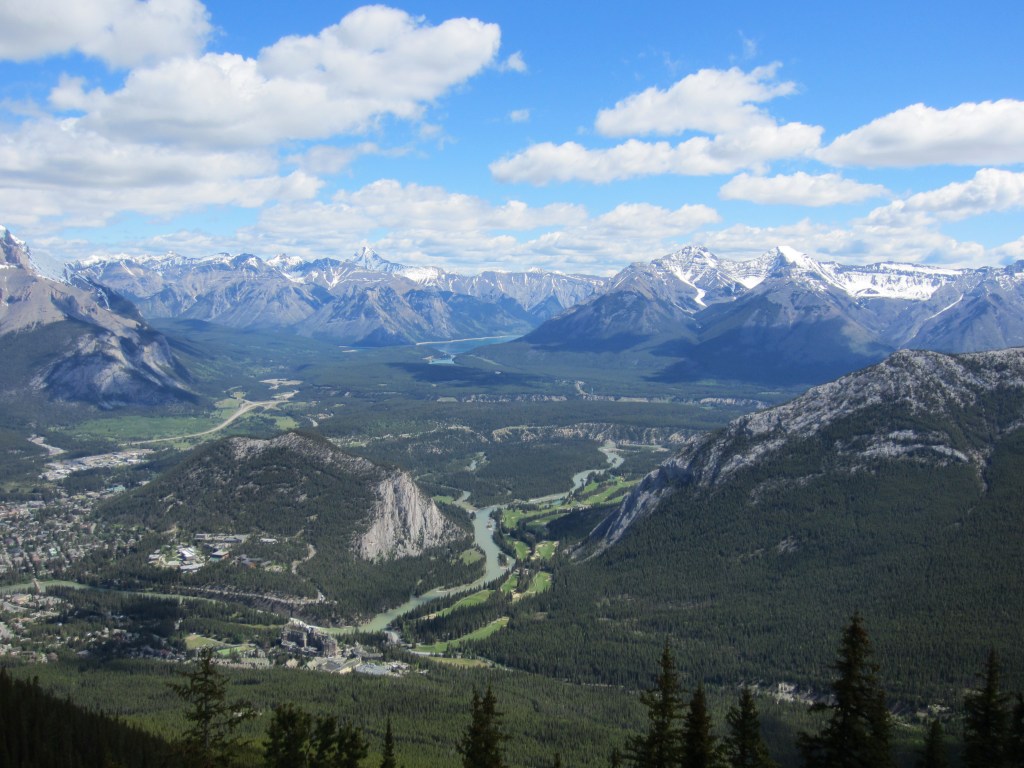
A cable car ride had landed us at the Sulphur Mountain Observatory. The view from the gondola was awesome––the Bow River meandering by the Fairmont Banff Springs Golf Course was picturesque and a treat not only to the eyes but to this golfer’s soul as well. Far in the north, the Ghost River Wilderness dominated the landscape. It was scenic, albeit with a dash of unattributable eeriness.
Bow River and the Fairmont Banff Springs Golf Course
The Observatory––a room merely ten feet square––was perched atop Sanson Peak. Its walls made of stones of irregular shapes and sizes seemed incapable of withstanding a gust, let alone a mild tremor. Cold mountain breeze caressing the walls made shrill whistling sounds of varying pitch as it encountered gaps in the structure. There were large glass windows for tourists to get a good look at things on display.
The Observatory
Inside, on a water-stained wooden floor, was a crudely assembled cot. A casually popped pillow on a ruffled blanket and crumpled linen, gave the impression that someone had been sleeping in the bed until a few minutes ago. An unvarnished wooden table and a cane chair were the other items of furniture vying for the crammed space. An old newspaper dated September 10, 1926; a roll of measuring tape; a kerosene lamp hanging from the ceiling; a bucketful of charcoal; an empty pail; a pair of worn-out ankle boots without laces; a large axe and some gardening implements and tools; casually hung garments, and a slouch hat and a lantern pegged on wooden pillars––everything in the cabin, and the manner in which they were laid out, bore a stamp of frugality and rusticity. There was a characteristic musty smell quite similar to the type one experiences in the masonic lodges and museums. Shivani was quick to name it: “Sanson Odour.”
Separated by a few miles from the nearest human habitation, that dwelling with its odds and sods was clearly a century behind the present times. It could well have been the location for the shooting of a Rudyard Kipling film; just waiting for, “Camera!” and “Action!”
Until we had gotten a glimpse of the objects inside the room, I was invested in the idea of seeing the usual paraphernalia that one finds in any observatory––barometer, maximum-minimum thermometer, weather cock, plotting charts, pencils, erasers, pens, inkpots, rulers and the like. What we saw was a tad less expected. Besides, the dated objects, and items of clothing and furniture, the Observatory had an engaging history which we were to discover next.
“Hello, I am William Sanson. You can call me Bill.” A bespectacled man in his mid-seventies introduced himself as the caretaker of the Observatory. His appearance and demeanour suggested that he had followed a toilsome routine in life. His enthusiasm contrasted his wrinkled face and his tired eyes peering from behind thick cylindrical lenses held in place by a broken frame balanced on his bony nose.
“This Observatory is dedicated to Norman Bethune Sanson.” Bill announced with verve. “Sanson was the curator of the Banff Park Museum from 1896 to 1932. During his tenure, he travelled extensively through the several National Parks in this area collecting specimens for the museum. His love for animals made him take additional charge of the Banff Zoo. The weather station on the peak was erected at his behest and later, in 1948, named in his honour. He made more than a thousand trips to the peak in his capacity as the park meteorologist until 1945, when he was 84 years old.”
Sanson’s World
“Are you related to Norman Sanson?” Mudit asked Bill when he paused for a breather.
“Oh yeah! I am his grandson. I was nine when I first climbed this peak with him.” Bill’s chest swelled and his voice brimmed with pride. “Like him, I too have served the Queen’s Own Rifles, and ever since I retired, I’ve been looking after this place.”
Bill spoke with great reverence for his grandfather. He almost sang, “Norman Sanson was fully devoted to this Observatory. His work, and the flora and fauna of this area, meant a world to him. Everything here, living and inanimate, reciprocates his love to this day. And, lemme tell you, some of them animals and birds still call on my grandpa and spend time with him.” There was a core of weirdness in the way he referred to Norman Sanson as if he were still alive.
“In the twilight years of his life, Sanson went visiting people he cared for, and presenting them his cherished belongings as souvenirs.” Bill pulled out a gold chain from the pocket of his waistcoat. “This was his parting gift to me.” At the other end of the chain was a gold watch. Engraved on the cover, in cursive was the name: “Norman B Sanson.” It was a covetable antique.
“Working alone all the time, didn’t he get bored? No telephone, no radio, no television––how did he spend the parts of his days when he was not recording any observations?” Shivani was curious.
“Sanson had a lot of other things to do. He used to read technical journals, and write reports and articles for a local newspaper. Besides, he did take occasional breaks from his work. One of his favourite pastimes was to run down the slope to a location called Point Bravo. He used to boast of completing a round trip to Point Bravo in exactly 87 seconds. It is interesting how he timed those shuttles … oops (there was an interruption). …just watch out!” A squirrel appeared from nowhere and distracted Bill. It started frolicking on the window sill.
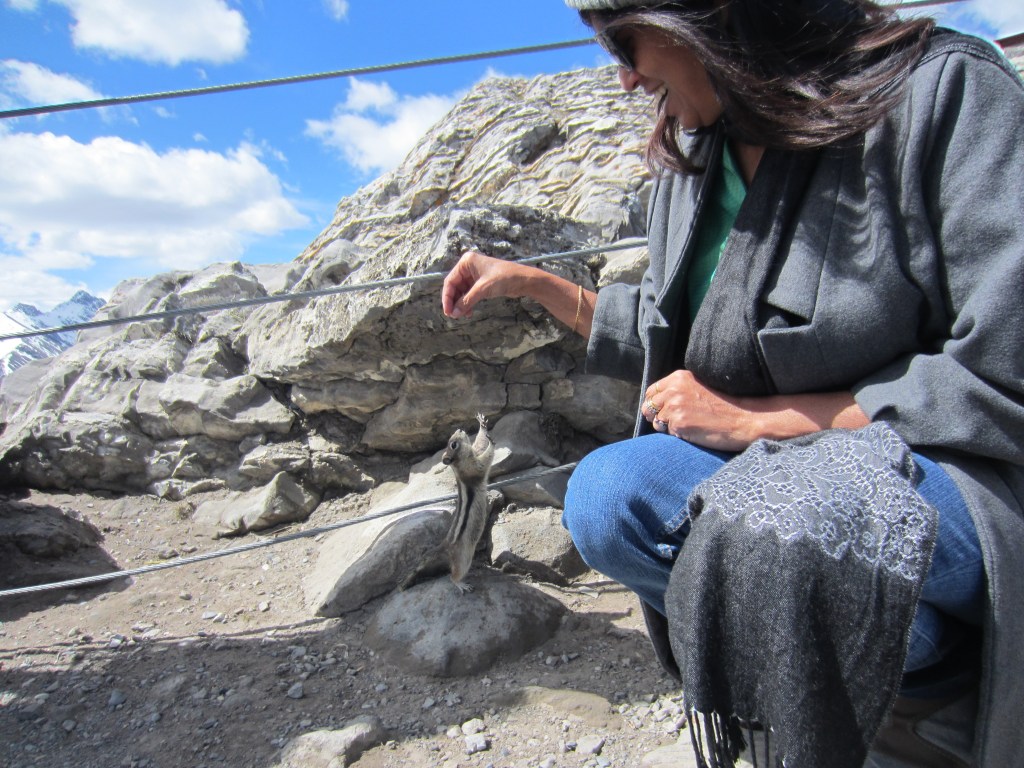
“Lisa! You are up to your tricks again!” Bill admonished the squirrel as a father would, an errant child. The little thing was unmindful of Bill’s scolding; and, as if to tease him, she stood on its hind legs and began dancing.
Lisa and Chhaya
We clapped for Lisa, for providing us unadulterated entertainment. Left with little choice, Bill condoned her behaviour with mock annoyance. She came running when Chhaya waved a bread crumb at her. We were enjoying her antics when she suddenly leapt and cowered into a crevice to evade a large bird that had swooped down to prey on her.
“David! Stop it! Will you!” yelled Bill. It sounded like a military word of command. Then he snapped his fingers and twisted his tongue and twittered in an unusual way. His utterance can at best be reproduced on paper as: “Tschulk! Tschulk! Tschulk!” And, lo and behold, the bird glided down and landed on his outstretched arm. It was massive with scary eyes that glistened in the sun.
“He’s David, the raven. He’s a big bully, keeps scaring Lisa and plays pranks on people. He lives here; guards the Observatory and gives company to my grandpa. He even does errands for him.” Bill introduced the raven to us as though he were a member of the Sanson family and turned his head to address him, “Come on baby, now stop being naughty. Last week when you did something funny, you lost a talon and broke your neck, almost.” With great care, Bill inspected David’s bandaged foot. He brought his mouth closer to the bird’s head and pretended to speak in his ear, “Now, say hello to our Indian friends. If you are well behaved, they might show you the Great Indian Rope Trick.” He winked at us and tittered, baring the gaps in his decaying teeth.
“Caw! Caw! Caw!” David obeyed and nodded several times. He seemed to be trying to get acquainted with each one of us, individually. It was fun. We thanked Bill and prepared to leave. I continued to engage him with questions while we waited for the cable-car. I stopped only when Mudit drew my attention and said in our mutually understood sign language, “Hey Bro, how about sparing poor Bill. He has other guests to attend to.”
Our next halt was at the Bear Mountain Motel where we had planned to spend the night. It was going to be a long three-hour drive to the Motel. When the wheels rolled, Squadron Leader Goyal recalled the visit to the Sanson Peak, “What a man! Sanson performed his duties with utter disregard to his personal comfort. I am mighty impressed. We hardly come across such dedicated people now a days. The Observatory had Sanson’s aura; I could almost feel his presence inside it.”
“It used to take several hours to cover the treacherous trek; and he used to make it to the top two to three times a week. Hats off to him,” added Seema.
“It must have been so difficult during the winter season with snow all around,” wondered Renu.
“Lisa amused me… she was so cute,” came in Chhaya. “Poor thing had to run away…. And that crow… hey Bhagwan (Oh my God), it scared me too; his eyes were as big as golf balls.”
“Mom, it was a raven… same family as a crow, but much bigger,” Mudit corrected Chhaya.
“Masaji (uncle), as always, you were in your element. With the interest you displayed, I thought you were working on a scholarly paper on the Observatory,” Shivani nudged me naughtily.
Chhaya poured hot coffee for all of us when Mudit pulled up by the roadside to take a break. Shivani found time to copy Bill’s bird call: “Tschlack, Tchhuluck.” Instinctively rest of us followed suit. It spread like a contagion with everyone trying to reproduce the sound. Although hardly anyone succeeded, we had fun taking turns.
What happened next was not something very unusual. A raven landed on the bonnet of our Volkswagen. We were half amused and half amazed because David was still on our minds.
“Oh my God! Oh my God! It’s David! Look there! A talon is missing on his left foot, and… and there’s the bandage too” Shivani shrieked.
It indeed, was him. It was David! Now, this was extremely unusual and intriguing––how and why would David fly a hundred odd miles behind us? Flabbergasted and not knowing what to do, we tried wooing David with our versions of Tschulk. Some of us even raised our arms for him to come and sit on, but our collective efforts did not impress the raven. He appeared rather, rankled. Then, with clear disdain for our overtures, he walked a few steps on the bonnet and, very lazily spread his large wings, which must have measured close to five feet from tip to tip, and beat the air with them. Despite his massive body, he took to the air effortlessly. Through the sun-roof, we saw him orbiting overhead for some time before he was gone.
David remained the subject of our discussion until we reached the Bear Mountain Motel.
Once there, at the Motel, everyone rushed to their suites to freshen up. I stayed back in the lobby to complete the arrival formalities. A few tourists were waiting for their turns at the reception, so I picked up an information brochure with a road map of Alberta from a kiosk to put my time to good use. I had barely opened the glossy pamphlet when I saw someone walking towards me. He was a mountain of a man, reminded me of Richard Kiel, who has played Jaws in many a Bond film. His face was partly covered by the visor of his baseball cap. His eyes were masked by large sunglasses. Salt and pepper stubble covering the rest of his face and the speed at which he was closing in on me, eliminated the remote possibility of recalling a past acquaintance or encounter with him. I thought, in fact I was almost certain, I didn’t know the man from Adam. He stopped inches from me. I could smell butter chicken in his breath.
“Jai Hind Sir-jeee!” He stood erect and saluted. “What a pleasant surprise seeing you here in Kneda (Canada),” he beamed. “Sergeant Dhillon… Logistics Squadron, Jalahalli, Sir. Do you Rumember (remember) me?” With the answer beautifully embedded in the question, he saved me the trouble of sifting my memory to place him.
“Of course, I remember you, Dhillon,” I spoke a half truth and held his extended hand and shook it. His appearance had changed so much since we were together in Jalahalli a dozen years ago that there was no way I could have recognised him. The warm hug that followed was long enough for me to travel back in time and return with some vivid memories.
“I am delighted to see you, Dhillon! We are visiting our son in Calgary. Just been to the Sulphur Mountain Observatory. And, what are you doing here? Visiting your brother?”
“Sir, after hanging my uniform, I moved to Edmonton with my family when my brother-in-law found me a job as a manager at a gas station. With the blessing of Vahe Guru and your good wishes, now I own two gas stations and have stakes in a couple of motels in Alberta. I am here with Flies with Falcon.” Dhillon introduced me to his business partner who belonged to the first nations community. His forefathers had lived in Canada for centuries before the Europeans arrived. Flies with Falcon, Falcon for short, had a good build; his body was oozing out of his tight-fitting tee. He wore a Buddha-like smile and appeared to have attained Nirvana.
“How has been your trip, Sir? You must be enjoying the long drive?”
“Of course, of course! Being on the road with Mudit has been a dream come true. We have been stopping off and on, savouring the landscape and clicking pictures––it is awesome countryside. The drive from the Sulphur Mountain Observatory to this place was particularly interesting––a raven that we had come across at the Observatory followed us, and re-joined us, when we took a break en route.”
“A raven followed you? Is it? Sir, do you know, such animal behaviour portends something?” Dhillon was at his mischievous best, “It could be auspicious or ominous.” He failed to hide his impish smile.
“Puttar, are you trying to scare me?” I joined Dhillon as he burst out laughing.
“You know Sir, I don’t believe in such things,” Dhillon took a step back. Then he tried to involve Falcon who was sitting quietly, “But Falcon’s grandfather reads animal behaviour and foretells events. Maybe Falcon too can analyse this raven’s actions.”
I knew Dhillon was joking but Falcon’s countenance changed. His smile vanished and he went into some deep thought. Before he could say something, Dhillon hailed a waiter he seemed to know personally, “John!”
John greeted us with a smile, “Hello Mr. Dhillon and Mr. Falcon! Long time! I see, you have an Indian friend today.” Then looking at me, he said, “Welcome Sir! What can I get you?”
Dhillon ordered coffee for the three of us, and before John left, introduced him to me, “Sir, John is the oldest staff on the rolls of this Motel. He serves people heartily, and he knows this place like the back of his hand.” Dhillon continued after John was gone, “This guy is in his late seventies, and like most men his age, a bit talkative. He is notorious for hallucinating. And, he claims that he is visited occasionally by his dead wife and some other people.”
It was the same old Sergeant Dhillon I had known back in the Air Force––working like a horse, but not missing an opportunity to tell tales and to gossip.
“Raven… yes, yes raven! So, Falcon, why don’t you tell us something interesting about this raven’s behaviour?” Dhillon returned to where he had left.
Falcon began without a preface, “As Dhillon has told you, it is true that this type of interaction with a raven portends a meeting. It is a meeting with an absolute stranger. It’ll leave a lasting impression on you. Stay calm if, and when, it happens.” He saw the puzzled look on my face and allayed my anxiety, “But, don’t you worry, I don’t see no harm coming your way.”
Hardly a word was spoken over coffee. Dhillon and Falcon left me with a cluttered mind.
I remained quiet at the dinner table. I didn’t feel like talking to my people about Dhillon and Falcon. I didn’t want them, the ladies in particular, to have a sleepless night in anticipation of a possibly ominous meeting with a stranger.
“Masaji is so quiet. He’s missing Bill, David and Lisa,” Shivani noticed the change in my behaviour in the span of an hour. I responded with a feeble smile.
After dinner, we congregated in Mudit’s suite to spend some time together before retiring for the day. The idea was to talk about the day gone by, and discuss the itinerary of the following day. We were enjoying Italian Fish, a card game introduced by Mudit. That’s when I excused myself for a routine after-dinner walk, “I’ll be gone for about a half hour. Would anyone like to join me?”
Just as I had intuited, none accepted my offer. Shivani came up with a counter, “Come on Masaji, it has been long since you hung your uniform. Why don’t you take life easy now? Just chill! You are on a holiday. You can resume your military routine when you are back in Delhi. Isn’t spending quality time with the family more important than sticking to mundane routine?”
“No rain, no hail, nothing can stop him from following his routine, and that’s what keeps him going,” Chhaya came to my rescue. Then, addressing me, she said, “Shona, we are all tired and want to crash now. Please return soon.”
“Bro, did you realise, lately the SUV has been pulling to the left? Have you checked the air pressure in the tyres? And what time do we plan to leave tomorrow?” I asked Mudit as I prepared to leave.
“Aye Captain! I have got the tyres charged and have cleaned the SUV. We plan to leave by eight if Shivani is up by then,” Mudit took the opportunity to pull Shivani’s leg. “All okay, Dad. Don’t worry, enjoy your walk.”
I stepped out of the suite, not knowing that adherence to my routine that evening was going to buy me anxiety of a lifetime.
The Bear Mountain Motel is a classic 1960’s style motel. The wood and masonry architecture and drive-up parking is a favourite with the travellers. The drive-way is lined with street lights which stand ten feet tall. They are there mostly for decoration; they also provide a little illumination.
I had taken barely a dozen paces into the walkway when Bill, David, Dhillon and Falcon forced a re-entry into my cranium. My mind strayed in an altogether new direction. And, if that was not enough, I saw John, the waiter, returning from room service with a tray balanced on his gloved palm.
“So, John, what’s up?” I said when he drew near. It was meant to be a polite stand-alone question. I had no intention to go further than that.
“Yep! Doin fine! Thanks Sir,” he replied. but didn’t stop at that. “Going out for a stroll at this late hour?” He continued softly but with falling inflection which made me think that his question was loaded with more meaning than conveyed by the words he had spoken. And sure enough, he cleared my doubt, “Beware Sir, we are close to the Bear Mountain. It’s home to the grizzly bears. Occasionally an inquisitive cub strays this side, followed by caring papa and mama bears. Normally they don’t do no harm, but they scare the living daylights out of people. And, sometimes…(pause).” John remembered something and stopped in his track. “Sorry Sir, I left the oven on in the kitchen. I can smell over-baked bread. I must rush before it burns.” He pirouetted, the tray still balanced precariously on his palm, and sauntered towards the cookhouse. I could hear the clinking of cutlery in his deep pockets until he turned the corner at the end of the building.
John wanted to say something more before he ran back to the kitchen. Perhaps he wanted to say something more about the wildlife. Or, did he have something else to share? Or, was Dhillon’s opinion of John, about his habit of hallucinating, playing on my mind? Did this guy want to tell me about his dead wife? I wasn’t sure.
It was a creepy feeling. I continued walking regardless.
Two days to the full moon, the moon was shining brightly. Constellations of stars were moving innocently on their assigned paths and yet, were contributing to the coffers of the godmen all over the world. I had not seen so many stars in the Delhi sky in the twenty-five years since I dropped anchor in India’s capital city. The LED screen near the gate flickered; it indicated, “40º F.” There had been a drop of about four degrees since I had stepped out. I could feel the cold air touch the inside of my lungs. A thin layer of mist had started forming and it hung lazily a few feet above the head. I pulled the collar of my leather jacket and adjusted my balaclava to mitigate the chill that I was experiencing. My hands dug deeper in the pockets of my grey flannels, seeking warmth in their cosy corners.
With the fall in temperature, the layer of mist thickened and obscured the moon and the stars. The sky was now the colour of wet aluminium. There was no indication where the moon was. And although it was still quite bright, the shadows had disappeared. Street lights too, appeared dimmed.
Mind, as is its wont, began revisiting the day’s events. In the process, it awakened the child in me. I couldn’t resist, and blurted out fairly loudly, “Schulk.” It was an inadvertent utterance. I looked around shyly and then made an attempt, a deliberate one this time, to improve upon my previous performance, “Tskuck! Tschulk! Tschulk!”
I thought, I had got it correct and was celebrating the little success with ecstasy when rustling of leaves in a nearby tree drew my attention. It was not just any bird; it was a raven gliding towards me. I froze when it landed a few feet from me and, even in that poor light, I could see its bandaged left foot.
It was David yet again!
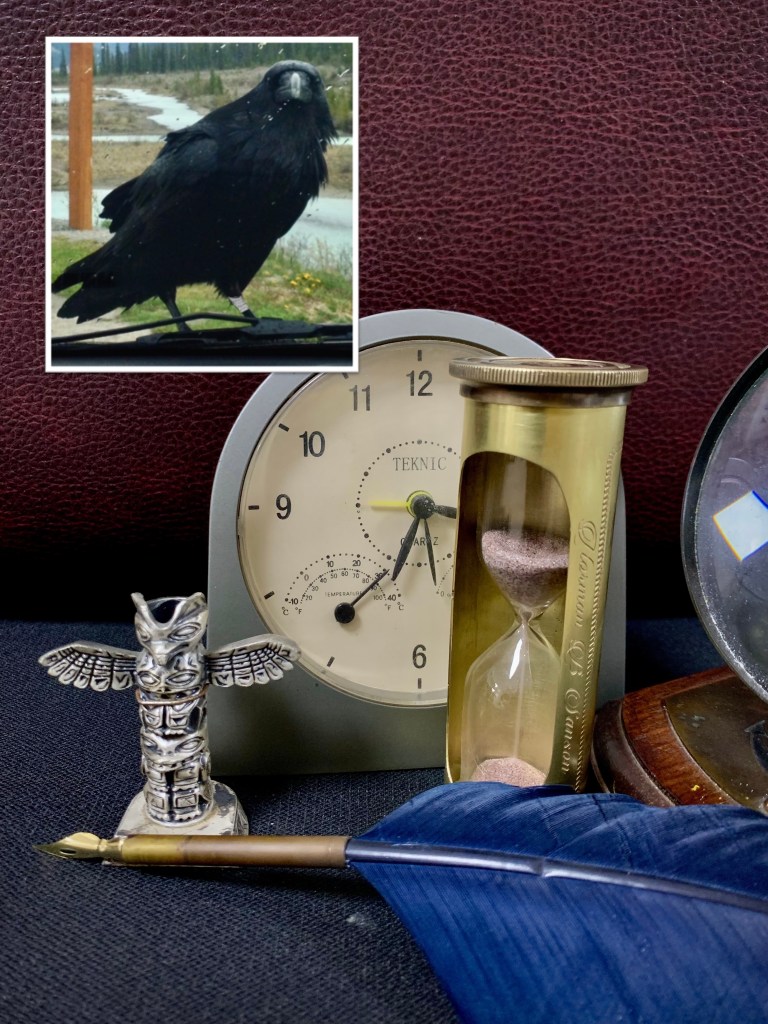
He released something that he was holding in his claws. It made a soft metallic sound as it hit the concrete surface. I stepped back and started observing his next move. He nudged and rolled the metallic thing towards me. Not knowing his intentions, I took another step back. At this, he nudged the thing towards me several times more; and with greater force each time. When it was very close to me, he hopped back some distance, and cawed softly. Out of sheer curiosity, I picked up the object. It was kind of an hourglass, much smaller, though. Delicate glass bubbles filled with sand were encapsuled in a slim brass cylinder with a window. More appropriately, it was a Sand Timer rather than an Hourglass.
Mystified and unsure, I put back the thing on the road and rolled it towards David who, very promptly, nudged it back towards me. I saw him nodding his head when I picked it up again; his eyes glowed in the ambient light. I was uneasy holding the Sand Timer. I took a deep breath to get a sense of control over my body and mind. I thought it would be the end of the matter.
I couldn’t have been more off the mark on that count.
In the deep breath that I had just taken, I got the whiff of a very familiar odour––it was the masonic-lodge-and-museum kind of smell. “Sanson Odour!” Shivani’s words reverberated menacingly in my head. I realised, that the palm of my hand holding the Sand Timer was wet. I consigned the little thing to my pocket and removed my glasses that had become foggy due the sweat that had evaporated from around my eyes.
I was rummaging my pockets to find a tissue to clean my glasses when the eeriness and the uneasy calm of the night was broken by approaching footsteps. My glasses still in my hand, I could only see the silhouette of a man in the distance. The decibel of his patter rose as he neared me. One hand in pocket; he didn’t move the other as he walked; his feet hardly left the ground as he kept closing in. Having cleaned the glasses, I could see more clearly. He was tall; must have been a few inches over six feet. He wore a slouch hat and a military kind of tunic with brass buttons and patch pockets with flaps and a broad leather belt; his trousers were tucked into his long boots. He toted a natural leather bag slung across his shoulder. In that sorry state of mind, I forced myself to believe that he was a Motel guard on the beat. That thought gave me a false sense of relief which didn’t last long.
I said, “Hello,” and found myself groping for words to continue.
“Hello, how’s been your trip to Canada going?” That question from that stranger didn’t surprise me because, I guess that-I-was-a-foreign-tourist–in-Canada was writ large upon my face.
“It has been going great; we have been to the Sulphur Mountain Observatory this morning. It was a memorable experience.”
“I go there often. In fact, I was there this afternoon too. I reached there after you had left. Bill told me that some very inquisitive Indians had been to the Observatory. He was floored by your keenness. Are you from the forces?” He spoke in a low toneless voice as he sat down on the culvert by the side of the gate.
“Yes, I’m an Indian Air force Veteran. Now I write for a living.” I said proudly. “Do you also have a military background?” I enquired.
“Yeah, kinda quasi-military. I retired long ago. And, I too used to write. They know me as Seer Altitudinuos.” He spoke slowly and was unintelligible in parts.
He fumbled in his tote bag and dug out a crumpled packet of cigarettes. He tapped it so that a filter-less cigarette popped out. He offered it to me.
“Thanks, I don’t smoke.” I declined politely.
“Hope you don’t mind if I do,” he said and started looking for a light in his bag.
I was momentarily blinded when he struck the match to light the cigarette held in one corner of his mouth, Gregory Peck style. Then, in the illumination caused by the match held in his cupped hand, I got a glimpse of his face for the first time. In the darkness surrounding it, his bearded face looked like a dangling Guy Fawkes mask. And, in it there was an uncanny resemblance to a face I had seen in many pictures through the day.
He looked exactly like Norman Bethune Sanson and that resemblance stunned me into disbelief which lasted a coupla seconds.
Was I hallucinating?
Not knowing how to proceed, I became quiet. I could feel beads of sweat appear on my forehead. Inside my balaclava, my scalp felt wet. Then on, each minute became something heavy and tangible trying to push the one before it. The man’s eyes, and those of David, glimmered every time he took a drag on his cigarette. Both looked sinister. In between, he took a deep swig from his hip flask and swirled it in his mouth. In that foggy night, the only thing that could be heard was his laboured breathing and my heart thumping against my rib-cage, struggling to break free.
It may have been five minutes or, maybe fifteen; I don’t know how long. I had lost the sense of time. I guess, the man was able to divine my thoughts, because he did make a conscious effort to involve me in conversation. But my mind was elsewhere and my entire body felt deprived of sensation.
Just then, I heard a soft “Tschulk” and at the same time saw David trot and take a small flight to perch on the man’s shoulder. I stood like a statue watching everything. I felt hypnotised.
David, the Raven and the Sand Timer
A gentle tap on my shoulder jolted me out of my trance.
It was Mudit, and by his side was Shivani. “Dad, are you alright? We’ve been watching you sitting alone, quiet and motionless, on this culvert for the last ten minutes. You came out for a half-hour walk but you’ve already been here for more than an hour.”
“I’m fine. I was just enjoying the quietude of this place,” I lied as I wiped my forehead with my sleeve. I found that everything around had been swallowed by the fog. There was no trace of the man, or of the raven with the bandaged leg.
I collected myself as the three of us walked back to our suites. The Sand Timer felt heavy in my pocket. I secured it in my shaving pouch before slipping into the bed by a blissfully sleeping Chhaya.
For obvious reasons, I have a very poor recollection of the rest of our trip.
On the first opportunity thereafter, I googled for Seer Altitudinuos, and discovered that that was Sanson’s pen name. My curiosity led me to take a closer look at the Sand Timer. Inscribed on it, in neat cursive, was the name “Norman B Sanson.” My surprise knew no bounds when I timed it with the stopwatch of my iPhone, and discovered that it clocked exactly 87 seconds––the time Norman Bethune Sanson used to take to make a round trip to Point Bravo.
Four days from now, September the 26th will mark the 37th anniversary of an event that, beyond a sliver of doubt, averted a nuclear war. On that day in 1983, Lieutenant Colonel Stanislav Petrov of the Soviet Air Defence Forces was the duty officer at Serpukhov-15, the secret command centre outside Moscow monitoring its early-warning satellites over the United States when alarms went off––computers warned that five Minuteman intercontinental ballistic missiles had been launched from an American base.
Colonel Petrov was a very important link in the decision-making chain. His superiors reported to the general staff, who would consult the Soviet leader, Mr Yuri V Andropov on launching a retaliatory attack. Since there was no rule about how long the observers were allowed to think before they reported a strike, Petrov took his sweet time absorbing the deluge of incoming information and ‘felt’ that the launch reports were ‘probably’ a false alarm. He, therefore, reported ‘a system malfunction’. “I had a funny feeling in my gut,” he told a newspaper later. “I didn’t want to make a mistake. I made a decision, and that was it.”
Petrov’s nuclear dilemma
Every second of delay on that day took away valuable time that the Soviet military and political leadership would have needed to absorb the inputs and react. Petrov told an interviewer, “… I couldn’t move. I felt like I was sitting on a hot frying pan.” It was at best a 50-50 guess, based on his distrust of the early-warning system and the relative paucity of missiles that were launched. He could afford the luxury of sleeping mulling over the inputs because 25 long minutes would elapse between launch and detonation. Petrov attributed his judgment to his training and his intuition. He had been told that a nuclear first strike by the Americans would come in the form of an overwhelming onslaught.
Training and Intuition… where does India stand?
A typical military exercise––conducted at many of the military training institutes/ colleges/ establishments––has a Blue Force (India) and a Red Force (the adversary––Pakistan or China, implied or explicit). The exercises are realistic with full freedom to the participating officers––with 3 to 30 years of commissioned service; sometimes, including bureaucrats, diplomats and scientists––to let go of their imagination to plan and execute military operations until… someone in the Red Force threatens to use the nukes.
The exercise is paused and the director of the exercise (or the umpire) steps in and enlightens the attendees. Put in different words and with varying intensity, depending on the personality of the guru, the gist of what is repeatedly sermonised and hammered into the craniums of the participants is: “Like India, China has a No-First-Use (NFU) policy––therefore, use of a nuclear weapon by China against India is not a likely proposition. As regards Pakistan, although their leadership talks and acts insanely, they are not mad. Nuclear sabre rattling by Pakistan is, but a hollow threat. Pakistan cannot dare to strike India with a nuclear-tipped missile because even with a ‘second strike’ option, India has the capability to turn the whole of Pakistan into rubble…. We can cause unacceptable damageto any adversary if we are struck with nukes….”
The punch line delivered (invariably) with theatrical emphasis and the air of a political leader seeking to hold a moral high ground at a peace conference at the UN General Assembly reads somewhat:
“Nuclear weapons are not meant for fighting; they are there (only) for deterrence.”
This has now been going on for decades since the legendary Mr K Subrahmanyam drew up the draft of India’s Nuclear Doctrine, which communicated, along with India’s NFU status, the spirit that:
“Nuclear weapons are the weapons of last resort; they’ll be used only in retaliation against a nuclear attack on Indian Territory or on Indian forces anywhere.”
As can be seen, there is a subtle difference between what the genius, Mr Subrahmanyam enunciated and what the later gurus interpreted, communicated and taught to the lesser mortals––the military personnel and the scientists––people who would be expected to ‘handle’ the nukes when ordained by the political leadership. Over the years, the people, who would some day play Colonel Petrov in India’s case; have been getting inoculated with a different vaccine than should have been ideally prescribed.
An ambiguity at a crucial moment––nuclear weapons being weapons of last resort or being meant only for deterrence––borne out of years of training, can cost India dear because it would take just about five to ten minutes from a launch (in Pakistan or China) to detonation (in India). In a situation like Petrov’s, Indians would not afford the luxury of time. It is therefore, imperative that people who would some day be in the decision making chain and those who would be executing a political big decision (particularly the men in uniform and the scientists) be educated and trained to act decisively without dithering like Colonel Petrov.
Need to unlearn and re-learn
The need to unlearn and relearn the nuances of the Indian Nuclear Doctrine is also mandated by the recent behaviour of our neighbours. Let’s look at it this way. Pakistan knows that its nuclear sabre rattling does not perturb India, for India has called Pakistan’s nuclear bluff twice recently––one, by carrying out surgical strikes across the border after Uri terror attack; and two, by executing airstrikes against terror camps at Balakot in response to the Pulwama Terror Attack. In both those cases, Imran Khan first blabbered about the heightening tensions and the possibility of ‘inadvertent’ use of nukes, then ate a humble pie.
Humiliated at home and abroad on those counts, and coupled with a messed up economy and a battered national prestige (because of Pakistan’s terror links), the Khan is vulnerable to arm-twisting by three agencies––Pakistan Military; Pakistan-based terror outfits; and a Shylock-like China, whose debt makes Pakistan cringe. China is capable of using several levers to instigate its stooge, Pakistan to surprise India. Considering these mounting pressures, the cricketer turned puppet of a politician, might be forced to reconsider and carry out his nuclear bluff. The probability, although infinitely low, is not equal to zero. Therefore, it would be prudent on India’s part to cater for a ‘mistaken’ use of a nuke by Imran’s Pakistan.
To sum up, security, and nuclear security in particular, is a dynamic concept; its doctrines and understanding of the same by every link in the chain needs periodic review and refreshing. Exercising realistically with the nuclear option will convey a stronger ‘resolve’ to the adversaries and work as a more meaningful deterrence without changing anything on the ground.
Conspiracy theories abound. Many people thinkbelieve that it was developed by scientists in a laboratory. And, even if one disregards that bizarre pronouncement for want of credible evidence, one thing that can be said with certainty is that the virus originated ‘somewhere‘ in China. That the pandemic could have been controlled well had China shared the relevant information about it with the rest of the world in time is a bone of contention. President Donald Trump blames China squarely for being instrumental in causing devastation of untold dimension. While the experts in the World Health Organisation (WHO) spent more than ten days to christen the pandemic: “Covid-19,” an irate, Donald Trump took no time to declare it a ‘very bad gift’ from China. He went on to call it by more different names: “Kung Flu” on one occasion, and the “Chinese Virus” on another.
Rhetoric apart, today the Sino-US relations are actually at their lowest ebb. The two major world powers (mind the deliberate strikethrough) countries have been trading blows on many fronts––unbecoming behaviour amid extreme crisis. Washington on Wednesday, July 22, 2020 ordered the closure of the Chinese Consulate in Houston; a move it said was aimed “to protect American intellectual property and private information.” It was another way of accusing Beijing of cyber espionage.
Covid-19 Pandemic is but an excuse; lined up behind it are numerous other issues––disputes over trade; Taiwan; violation of human rights in Tibet, Tiananmen Square, Xinjiang and Hong Kong; Chinese assertiveness in the sea they call “South China Sea” and of course, the “not so Peaceful Rise of China….” There isn’t just one issue––there are loads of them. That China is at the root of the problems facing the world today is evident in the actions initiated by Canada, the UK, Japan, Australia, and several other countries.
Actions, counteractions and the blame game will go on till cows come home. At this point when the pandemic is a stark reality and the world is desperately looking for a drug and a vaccine to contain the spread of the virus, some questions beg answers: “Could this pandemic have been avoided? If the answer is “Yes,” then, “How could it have been avoided?”
‘The Butterfly Effect’* might explain how the world has reached this state of being and how it could have been avoided altogether.
Read on….
But before proceeding, please bear the repetition of a fact for the sake of emphasis, and better understanding of the current and the would-be crises of this nature. Openly or in subdued voice, willingly or grudgingly, all the world’s countries, including Chinese stooges like Pakistan and North Korea, are unanimous on two counts: one, that the pandemic originated in China, and two, Beijing could have done much more to avert the catastrophe. China’s predominant role in the spread of the pandemic is undeniable; it is indefensible too. When not under the watchful eyes of Xi, the screams of millions of Chinese––the ilk of Dr Li Wenliang––will also chorus in agreement.
And now, about the distant flutter (Butterfly Effect) that led to the present world crisis. On September 2, 1945, at the time when the formal Japanese surrender ceremony was taking place aboard the battleship Missouri, civil war was brewing in China. With difficulty in communicating an idea from one part of the country to another, let alone transporting a bag of rice, the Chinese were living in extreme poverty and hunger. They were falling easy prey to the Communist ideology. In a showdown between Chiang Kai-shek and the Communists, the Communists had a good chance of winning out. One way to strengthen the generalissimo was to provide him mobility––the ability to spread his influence in the far reaches of China where the Communists were operating freely.
At that time, the Americans were busy winding up; airlifting men and equipment to India/ the US. The Orient Project was under way. They had the capability and the capacity to provide the vital support Chiang Kai-shek needed to thwart the opposing forces. And, although the war-weary American generals strongly supported the idea, there was little political will. The congressmen who visited the region were under pressure from the womenfolk (mothers, wives and sweethearts of the men in uniform) back in the US to bring their menfolk home. It gave every politician a chance to curry favour with the voters by joining in the cry: “Bring the troops home!”
Thus, the Chinese who had supported the Allied war effort in the Indo-Pacific by tethering a two lakh strong Japanese Army in the region, were dealt a raw deal––they got ‘nothing’ for pulling the proverbial chestnuts out of the fire for the Americans. Had the Americans stood by Chiang Kai-shek for some time after the WW II, the geopolitics of the region would have taken a different turn––China would not have gone ‘RED.’ Today’s China would have been ‘different.’
If that was not enough, the US let go of another opportunity to stymie the rise of a belligerent China when, despite the ‘Tiananmen Square Carnage’, it continued to maintain trade relations with Beijing, albeit after a pause.
The monster that the US let take birth and grow is now turning on it. The US is paying for its follies with innocent American lives. As on date (July 20, 2020), Covid-19 infection cases have crossed a 4-million mark in the US. There have been 11,46,516 deaths (and counting)––the number has already exceeded the sum total of American lives lost in all the major wars the country has fought since the War of American Independence.
US inaction today might lead to perpetual mourning
As can be seen, had US prevented the birth of a “Communist” China in 1945––which it was capable of doing then––the world would not be facing the Covid crisis today. Thus, to an extent, the US is responsible (because of its inaction) for the crisis facing the world. That conclusion begs yet another question: How can the US atone innocent deaths all over the world? The simple answer is: By standing up and taking charge. There’s no room for another error of judgement. There will be a huge cost attached to relinquishing leadership under the present circumstances.
*The Butterfly Effect: It is the idea that small things can have non-linear impacts on a complex system. The concept is imagined with a butterfly flapping its wings and causing a typhoon. Of course, a single act like the butterfly flapping its wings cannot cause a typhoon. Small events can, however, serve as catalysts that act on starting conditions.
Do not be misled; I am not talking about the sparkling white wine, which comes from a region of that name in France. I am talking of the stray dog, also of the same given name, Champagne who shares the space with a score and more of potted plants placed at the entrance of my house. He quietly occupied that spot more than half a dozen years ago, and before we could realise, started staking a claim on it as ‘HIS DOMAIN’. We didn’t mind his presence there because he barked at every moving thing that crossed our entrance, giving us a vague sense of security. Soon doles of leftover food became a routine and Champagne started demanding them as his right. Passers by started treating him with the regard due to someone’s pet; unknowingly, other dogs started paying obeisance. Our occasional unintentional good treatment and cosseting led to further closeness with the cur. Our affinity notwithstanding, Champagne has bitten nearly a dozen unsuspecting humans including my dear wife and yours truly.
In the last few days––since the lockdown due to Covid-19 pandemic came into effect, to be precise, there has been practically no human footfall in the Amity University campus where we live; stray dogs and birds have been ruling the roost, almost. While strictly observing social distancing norms I have been taking occasional walks. A few days ago, Champagne started accompanying me on these walks.
Champagne expanding territory…
The other day I found something strange in Champagne’s behaviour––he was stopping every now and then, smelling something and peeing on objects. It wasn’t once or twice––he did it more than ten times in the span of an hour. I thought it was unusual. I wondered and pitied, “Was he suffering from some ailment of the urinary system? Do dogs suffer from prostate?” Concern for the poor dog led me to Google the issue and also consult my ‘genuine’ canine lover friends. I discovered that the act of peeing was a dog’s way of marking its territory. Over a few days in the past, he had been trying to expand his geographical area of influence.
You got it right. It’s time China appeared in this discourse…
Champagne was behaving exactly like China––flexing muscles and grabbing territory altering geography. It’ll be easy to recall China messing affairs in Tibet, Taiwan, Hong Kong, the Philippines, Japan, the sea to its south (some people inaccurately call that region, South China Sea), Sri Lanka, the Maldives, Nepal, Doklam and Ladakh––the list is very long. Not to talk of the US, whole of Europe and many other countries all over the world whose economies have been dealt a near death blow by Covid-19 pandemic––allegedly triggered by China.
And by doing so, Champagne, like China, was getting on the wrong side of many who were affected by his belligerence.
Then…
Then, yesterday something happened which made me wonder about China’s immediate future.
Champagne cornered, pays for belligerence…
All the dogs of the area––the strong and docile dogs who had been sitting quiet all the while; the weak dogs who were whimpering but had felt helpless; the couldn’t-care-less dogs; the happy-go-lucky dogs… all the dogs, all the dogs without exception––got together and attacked Champagne. In their offensive action they were fierce like wolves; even the weak and meek ones. They barked in chorus and vied for their turns to bite Champagne. Some, who could, went for his jugular; they wanted to shred him to pieces, smithereens. My effort to save him from the wrath of the angry pack was just about sufficient to save his life.
Jugular… almost gone!
Now…
Champagne is licking his wounds (except the ones around his jugular). His body language suggests that he is ruminating, “What went wrong?”
Everything about the recent happenings suggests that China’s Champagne Moment is near, very near.
Will a crystal gazer bury the doubts about ‘when’!?









 Road Much Travelled