

Will avail every opportunity to spend time in the Temple.
Will avail every opportunity to spend time in the Temple.



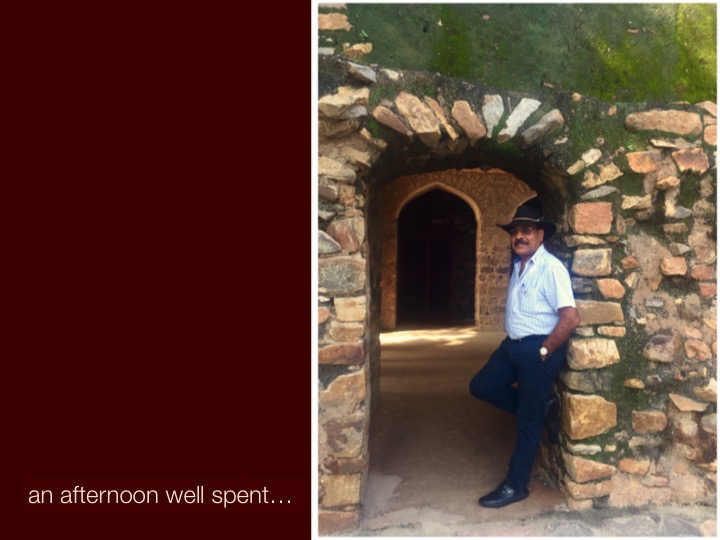
I spotted her from a good distance. She was standing by her parked car; distress lights blinking. Her mobile pressed to her ear, she was gesturing half-heartedly at the drivers of passing vehicles. There were two young men standing by their bike parked a little 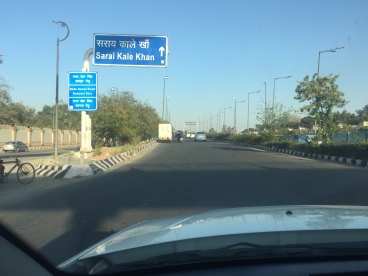 away on the other side of the road. Several cars passed her before I reached her. There was light traffic on the Barapullah Elevated Road that day.
“Is she really in need of help?” Some old memories flashed past my mind. “What if she is a journalist and the guys on the other side of the road are her colleagues?” With those questions still lingering in my mind, I stopped ahead of her car and walked up to her.
“Are you in need of help?”
“Yes Uncle, my car has run out of petrol.”
I wasn’t surprised. My wife had been stranded on the roadside twice for the same reason.
“No problem,” I said. “I can tow your vehicle down the elevated road. There is a CNG station near the exit of Barapullah. On the other side of the road is the petrol pump.”
I taught her some hand signals while I connected her car to my car with my towrope. Then I asked her to call me on my mobile and listen to my instructions as I towed her car. She was confident and followed my instructions to the letter. Within minutes we were at the CNG charging station. She parked her car and came and sat in my car. We drove across to the other side of the road––to the petrol pump.
She bought a litre of petrol in an empty water bottle. To get back to the car we drove to the Ashram Flyover and took a U-turn. I emptied the bottle in her car’s tank. The engine came to life when she turned the ignition key, but within seconds it ceased. I shook the car, the way mechanics often do. The car started again. But before the girl could drive on, the engine became silent.
With a little effort we found a mechanic who suggested that we put more petrol into the tank. So we bought a 5-litre jerry can of distilled water and emptied it in the nearby gutter and got it filled with petrol.
With more petrol in the tank, the car started again; this time, the engine continued idling. It did not stop. I followed the girl’s car to the petrol pump where she got the tank filled to the brim. Relieved at last she thanked me and handed me a visiting card.
It wasn’t hers.
It was her father’s. The national emblem embossed in gold on the top right corner drew my attention. “Is your father a parliamentarian?” I asked.
“No uncle. But he provides technical support to the Sansad Bhawan complex. He’s been there for many years, about to retire. I have just spoken to him. He has thanked you and will call you sometime.”
Mr Praful (name changed) called me later in the evening. He went overboard, thanking me for being of help to his daughter when she needed it most. He asked me to feel free to call upon me if he could be of any assistance to me.
A few days later…
Mr Praful called me. “My daughter is planning to join the Air Force. Is it OK for girls to join the Air Force?” He continued, “She has to appear at the Air Force Selection Board at Mysore. She can’t be there in Mysore on the given date. Can the date be changed? Or, at least the venue be changed to Dehradun? How do I go about it?”
With a little guidance he was able to find his way. Finally the girl did not join the Air Force. She chose another profession, is in the US now.
Postscript: Months later, I requested Mr Praful to get me connected to one of the Members of Parliament––who was present at the meeting chaired by Prime Minister Rajiv Gandhi to discuss the rescue of President Maumoon Abdul Gayuum (Operation Cactus, the Maldives, November 1988)––to seek an interview for my seminal study on Operation Cactus. Mr Praful did give me the contact details of the MP but the interview could not materialise. My book, published in February 2018 is devoid of a view from that angle.
Operation Cactus: The Maldives, November 3, 1988.
The Indian Armed Forces had embarked on a seemingly impossible mission; a mission to rescue President Maumoon Abdul Gayoom who had been surrounded by armed men (cadres of People’s Liberation Organisation of Tamil Elam) led by a Maldivian businessm an, Abdullah Luthufee. I was a part of the team that landed at Hulule airport to respond to the SOS call of the Maldivian President.
The notice was short; and there was practically no intelligence. The odds were loaded heavily against us. Most strategists would have forecast a failure, nay a debacle, when we took off from Agra. And, although people have compared Operation Cactus with the Charge of the Light Brigade, albeit with a pleasant end, the Indian Armed Forces did not sleepwalk into the Maldives that November night. It was a fairly well planned and methodically executed Operation within the time and resources  available on that day. The risks were calculated and catered for. The spirits were high. A determined Brigadier FFC Bulsara wrote the following message for me hours before we landed at Hulule: “We’ll secure the airstrip and the President by 1000h tomorrow.”
In a very well coordinated operation involving the three Services and the diplomatic corps, the IAF airlanded the Paratroopers at Hulule who rescued the President. The Indian Navy chased the fleeing rebels and rescued the hostages on board the rogue ship. Among the hostages were a Maldivian minister and his Swiss wife. There was no casualty on our side.
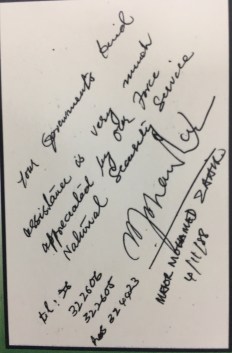 A Maldivian National Security Service (NSS) officer, Major Mohammed Zahir wrote a note on my scribble pad. The note speaks about the Maldivian sentiment at that time: “Your Governments kind assistance is very much appreciated by our Force. National Security Service.” He also presented me a cap badge and a formation sign of the NSS as souvenir.
That was 30 years ago. Time and tide has eroded the gratefulness.
China has taken over and occupied islands on lease in return for the infrastructure it has created for the Maldivians. Like Sri Lanka,  the country is heavily in debt. The population seems ignorant; the leadership has fallen into a trap from which it would be difficult to escape. Needless to say, Chinese gains have been at India’s cost. The pro-China sentiment is expressed in a hoarding which was put on the China-Maldives Friendship Bridge when it was under construction: “Waves are gifts from God. Bridge is a gigt from CHINA!”
 If the recent elections are to go by, democracy is still alive and kicking in the archipelago. Opposition candidate, Ibrahim Mohammed Salih has defeated the present (pro-China) incumbent, Abdullah Yameen. The former President, Mohammed Nasheed has recommended a review of the agreements with China. For India, this might turn out to be an omen of recovery of ties with the Maldives. It is an opportunity to put back the relations with the Maldives on firm footing.
It will be naïve, to say that replacement a pro-China president will lead to slipping of Beijing’s grip on the Maldives (as a newspaper headline suggests). Change of guard does not necessarily mean change of ideology or policies. At best India can start afresh, regaining the confidence of the Maldivians. India has many advantages (over the Chinese), including that of proximity to the Maldives. There is a lot that India can do to restore the strategic balance in the region.
Today is the day, now is the time!
 Author’s Note: “Operation Cactus: Anatomy of One of India’s Most Daring Military Operations” (Group Captain Ashok K Chordia, Knowledge World, New Delhi, 2018) is a seminal study of the operation launched by Prime Minister Rajiv Gandhi to rescue President MA Gayoom of the Maldives (November 1988). The book is based on recollections of the protagonists and official unit records and histories.
The turbulence in the wake of the omni-role fighter aircraft Rafale, which India has decided to buy, has become insignificant in comparison to the turbulence generated by the politics surrounding it. The purchase (mind you, not so much, the flying machine itself) has been making headlines every other day. The politics of it has given the opposition parties the nuclear tipped cruise missile to try and tether the government. 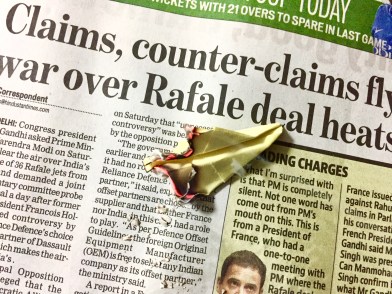 The Brahmastra has been launched. Now, frantic effort is ON to decide as to who or what should be the target. The effort is to ensure that the missile hits a target (anything that could be labelled as a target) before it runs out of propellant. And it must happen before the Lok Sabha elections scheduled next year.
The media is genuinely trying to keep the all-so-innocent junta informed. Effort to improve the TRP is a parallel enterprise. So, any news that informs (read sensationalises) is good. New issues need to replace the old ones.
In the clamour of people and parties accusing each other of motives and intentions, some good meaning media-persons consider it worthwhile to report on the performance characteristics of the aircraft, leaving aside the politics of it for a while. Who better to hear from than the Chief of the Air Staff (CAS), Air Chief Marshal BS Dhanoa? So they try to get the right answer from him.
Few would envy him for being in a position in which people with shallow theoretical knowledge seek comments on issues that are technical, sensitive and of strategic importance. And among the crowd are the smart people who attach meaning to each word the Chief says; and they comment on his body language and timing of the comment too. Now, because “the country wants to know,” (and because it would be inappropriate to keep the people guessing), the Chief confirms that it is a good aircraft that the country is buying to address the dire current defence need. He says so with the conviction of an air warrior who has flown thousands  of hours in fighter aircraft. He is the one who flew solo in a MiG-21 aircraft soon after taking over as the Chief displaying rare and exemplary military leadership!
When he speaks, he is sure of what he is talking about.
Yet on another occasion, they ask him about the aircraft. His answer is the same. A little later, the question is repeated in different ways. The Chief who means business of national defence only, repeats the answer.
Then comes the time to generate new and renewed interest in the Rafale Deal.
At a National Seminar on the IAF’s Force Structure (2035), a media-person recalls the Chief’s statements on the performance of Rafale aircraft and the timing thereof, and suggests if the comments are politically motivated. It was not the Chief who was asked the question but an officer (a retired one in that). The question was not responded to because it was not relevant to the subject and perhaps because it was the prerogative of the Chief to respond.
Any effort to draw the IAF into the political slugfest on Rafale will benefit people: some will be able to settle scores with the government; others might find a way to pass the blame, if any. But if the deal were to be shelved or the procurement were to be deferred, the worst sufferer will be India whose defence preparedness will get compromised.
 My Anna Bit: Whichever party comes to power, it will need the Air Force to defend the country’s skies and the frontiers. The Indian Air Force will continue to feel the pressure until the shortfall is made good. We’ll do well to leave the Chief and the Air Force to do their bit.
The par four seventh hole of the Air Force Training Command Golf Course was a difficult one. Let alone a par, getting a bogie on that hole was a herculean effort. But in those days––I am talking about 2004 when owing to family commitments, I was leading the life of a forced bachelor––I had all the time in the world and I used to play regularly. My game had improved greatly. I was hitting good distance, fairly accurately. I was confident about my short game and could manage puts equally well. Getting a few pars and an occasional birdie had become an expectation.
 “Small bets make you fight; they get the best out of you.” That suggestion from a fellow golfer had appealed to me and I had got into what I thought was competitive golf. The bet used to be modest: breakfast on the loser, or meagre amounts that would be barely enough to pay the caddie. Howsoever small those amounts were, there used to be a great charm in winning. If nothing, honour used to be at stake. No wonder, the hundred-rupee note that I won for hitting an Eagle on the seventh hole, signed by the fellow golfers (those days scribbling on currency notes was not considered an offence) became a trophy of sorts for me.
The habit continued when I left Bangalore. I have been playing with very modest stakes for more than a dozen years now. When I look back, I find that in all these years, my game has deteriorated gradually. I have analysed the decline in my performance and have been satisfied with my conclusions: I have not been playing regularly; age is catching up, my strength and stamina has gone down…
“Could playing with stakes have taken toll of my game?” The idea never cropped up.
This afternoon I was with someone I consider my golf guru, Minky Barbora. It was not for a lesson in golf, but we were at the Noida Golf Course just for lunch. Discussion on my own performance was not even the last thing on my mind. There were two other gentlemen and as it always happens, the discussion moved on to performance on the course.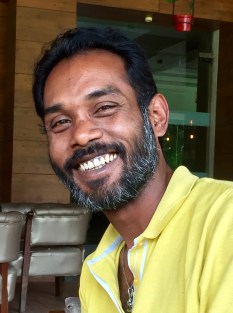
Minky had an opinion on betting, much different from mine. He said that when one bets, one is content with performing to a level, which ensures a win––just a win. One is satisfied with a par when the opponent has a bogie. He is fine with a bogie, if the competitor has a double bogie and so on… The determination to go for pars and birdies, regardless of the competitor’s performance, erodes. Under the circumstances, progress is a far cry.
The guru had a point, a valid one in that. I have so often seen people conceding holes when playing with stakes––to save time and to move on to the next tee.
In my case, quiet introspection has led to a decision: On the next visit to the course, I’ll play G-O-L-F. The modest betting amount that I have been setting aside—If I improve upon my previous performance, I’ll tip the caddie. If my game is bad, I’ll give it to him assuming that I have lost a bet.
 Last Monday, playing nine holes after six months, I had three pars; two of them were missed birdies. Rest of the game was decent, mostly bogies, and an odd double bogie. For me, that’s a great performance. It can give me wings to soar for the next six months. But that is not what made my day. My day was made at the Noida Golf Course when I went there later in the afternoon to witness a Golf Tournament organised for the caddies.
I was late and saw only the concluding ceremony. That was enough to overwhelm me.
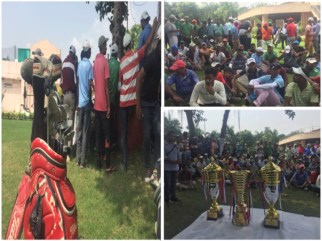 The golf bit––the gross scores, the net scores, the longest drive, the closest to the pin… and the prizes––was like any I had seen in so many places. What touched me was a team of people talking passionately to them about L-I-F-E. Trying to talk them into looking at their lives and think about improving it. I did not know the people who spoke, but I remember the passion with which they were trying to influence their minds. They spoke to their families too––their wives and children who had come well dressed for the occasion. They had cast a spell on the lot. At the end of it, they seemed determined to rise and shine in life.
Chicken biryani, dahi raita and gulab jamun laid in an area which is normally an out of bound area for the caddies was another high in their lives.
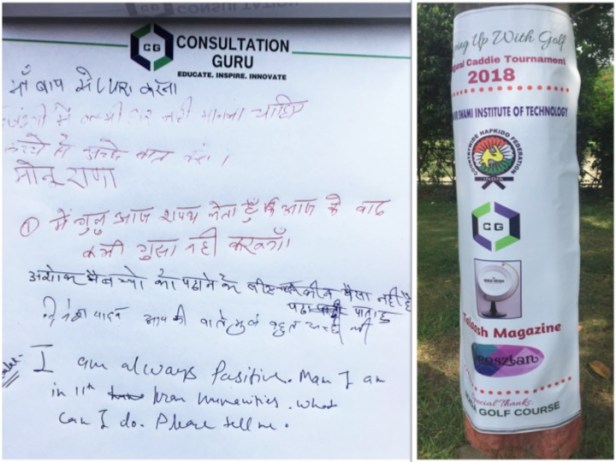
In the end of it all, when they were asked to write on a display board, one good thing each one had learnt that morning, they vied to express themselves. It was a sight I’ll cherish for days to come.
The joy and the positive vibes that I experienced there were unparalleled.
Well done Minky! Well done Mahima! You are making a big difference! Keep it up!
“Water,” they say, “is a medicine for sick people; a tonic, for the healthy.”
I drink sufficient water every day to stay hydrated and healthy. Never thought of carrying some in the car except while embarking on long journeys. Until one day, a few years ago when we were driving from Noida to Lajpat Nagar. It was just a 15-minute drive and we were halfway home. Swati, our niece enquired if I had drinking water in the car. I regretted and told her that we would be home soon. I continued to drive. In a little while, she became restless and desperate for water. She was in agony till we reached home. In a couple of hours, she was in Moolchand Hospital under the surgeon’s scalpel undergoing surgery for appendicitis.
Swati did not get water when she needed it so much. That day marked the beginning of a new habit with me; I started carrying a bottle of drinking water in the car. Sometimes I take a sip from the bottle to wet my throat when I am stuck in traffic. On numerous occasions the small water reserve has come in handy.
 Once, at a traffic light I saw a kid hanging out of a school bus. He was unwell and was trying to throw up. He was relieved when he drank some water from my bottle. The bottle of water has also provided succour to people in similar state, standing by their cars parked by the roadside. Interestingly, the number of times this bottle of water has quenched the thirst of dried up car radiators is large.
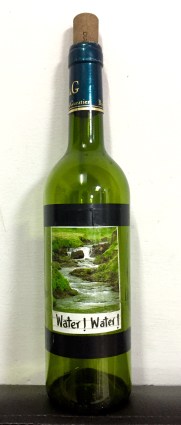 When I started, I used to be carrying water in a plastic bottle. Then came the warning that drinking water from a pet bottle kept in a car parked in the sun could cause cancer. So I started using a beautiful wine bottle. Green glass and a cork––it looked good! Very good, indeed! It became the envy of friends who saw it.
Then one day, when I was taking a sip at a road crossing, waiting for the traffic light to turn green, I was asked by a cop to pull up to the side of the road. Everything looks yellow to a jaundiced eye! He thought, I was consuming alcohol in public. It was not his fault; he comes across many daring drunken drivers during the tour of his duty. It took some polite talking on my part and a puff into the breath analyser to be let off.
That incident nudged me into some creativity. I removed the wine label (Cuvée Spéciale) and pasted another label, which reads: “Water! Water!
One day when Mudit was still a child, he felt very magnanimous and promised to buy me a Ferrari one day. I was delighted with the visions of me driving the dream car. With a degree in Mechanical Engineering, a Masters in Petroleum and another one in Sustainable Technology, the idiot has got on a track to develop technology that supports development of environment friendly cars. His promise of buying me a Ferrari stands.
But now I have a change of mind.
If I were to believe this morning’s BBC World News, the EU Commission is likely to open an investigation into the allegation of collusion between the Circle of Five (BMW, Daimler, Volkswagen and its subsidiaries (Porsche and Audi) not to compete in the area of emission control technology––to develop such technologies slowly. If the allegations were to be proved it would mean deliberate denial of cleaner cars to the customers. It would also amount to breach of competition law, which can attract heavy penalties, and the side effect of reducing access to cleaner technologies.
In another case, three years ago––the notorious Volkswagen diesel scandal––Volkswagen was found guilty of developing software that could enable the company to get past the stringent emission control norms while still polluting the air. The company suffered nearly 2 billion dollars in penalty and had to buy back its cars. Did it lose face and a share of the market? Maybe. Or, who cares!
The investigation is yet to take place; the allegations against the Circle of Five may or may not be proved. I also don’t know whether this smoke is with or without fire.
But I have made up my mind.
“Bro, are you listening (reading this post)? I no longer want a top-of-the-rung foreign car. Firstly, because those reports have cast a doubt in my mind. Will I get what these companies say they sell? Secondly, I cannot possibly enjoy those cars on congested Delhi roads. Some of those companies boast of a good performance like good acceleration and high speeds in excess of 150 kmph or so. Why would I pay for a performance, which I would not get to experience while driving in Delhi? In fact, driving woes had needled me to resign from the Centre for Air Power Studies where I was so happy working.”
What about the status those cars accord to the owners. Well, my Mamaji has a fleet of Mercs, BMWs and the like and I go for a drive with him for the thrill of it. That’s enough for this sapien.
“Bro, are you still listening (reading). I want you to tweak your promise. I’ll be delighted now to have a Tata, Maruti or a Mahindra vehicle rather than one of those cars. With the money you thus save, buy me another Mac (the present one seems to have outlived its utility for me). I will derive greater pleasure tapping the keys of my Mac and publishing my next book rather than getting stuck in a Ferrari or a VW or a Porsche or a… and pitying my state of being.”
A parting thought: A few years after the purchase has been made, what is left of a car (any car)? Are the grapes sour? Whatever may be the case, I am decided.
Why would I pay for a performance that I would seldom get to experience?

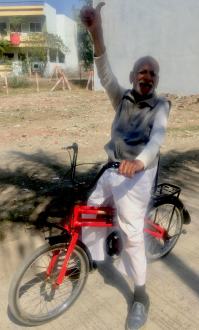 My father was fitter in his nineties than many in their late seventies. He took adequate care of himself. Just for the fun of it, he even rode a bicycle well past his ninetieth birthday. Unto his last days he was an enthusiastic learner. He tried using a tablet and a smartphone to be able to net-surf and Google for the knowledge he sought to acquire.
He was in decent health until he passed away at 93. For a sound body and a sound mind he believed in three things: Eating less, setting aside ego and, being flexible in thoughts. Among other things, he recommended consumption of Triphala for good health and longevity. Triphala is an Ayurvedic mix in powdered form.
Here is an extract of his advice on consumption of Triphala.
 Dosage (in gms): One eighth (1/8) of one’s weight in kgs. It is to be taken every morning (empty stomach) with fresh water. No food must be consumed until one hour after taking the dose. Note: Initial use can cause loose motions.
The effects are pronounced if Triphala is consumed with seasonal additives as follows:
Health Benefits: Regular consumption of Triphala as described above improves strength, stamina, immunity and vitality. It is said to improve eyesight, attentiveness and texture of the skin.
 Road Much Travelled