“Chanakya” as the real Chanakya could possibly have been!
Sterling…
My revered theatre friend, Shri Ashok Banthia, rekindled my love for the stage when he invited me to work with him on the play Maha Param Veer two years ago. The production was staged in Udaipur, Jaipur, and Bhopal, and is expected to travel to other state capitals as well.
Recently, thanks to Ashokji, I had my first glimpse into the beautiful world of the National School of Drama (NSD). I was awestruck, to say the least. As is often my habit of wishing I could go back in time to pursue unfulfilled dreams, I found myself longing to study drama at NSD. That renewed desire arose from the stellar performances I witnessed yesterday.
Gripping…
The play was Chanakya.
All of us Indians have grown up hearing stories of Chanakya and Chandragupta Maurya. Honestly, those stories seldom inspire awe anymore. However, this Chanakya—researched and scripted over four years—felt fresh and intellectually invigorating. Having been staged more than 1,700 times, it’s no surprise that the actors have come to live and breathe their roles. Watching them, I couldn’t help but wonder if the real Chanakya, Amatya Rakshas, and Chandragupta Maurya could have expressed themselves half as powerfully. No exaggeration intended!
Been there.
The team led by Manoj Joshi (as Chanakya) and Ashok Banthia (as Amatya Rakshas) delivered a sterling performance. The dialogues were powerful and passionate, complemented by excellent costumes, lighting, sound, and music—every element of the production was par excellence. Time seemed to fly, and before I knew it, the play was over.
Beyond its artistic brilliance, the play reintroduces Indian history in a way that leaves a lasting impact. Those who watch it—especially those involved in running the country—will carry pearls of wisdom passed on by the real Chanakya through Manoj and Ashok’s portrayals.
…with my theatre mentor
We often judge a film or play by whether it’s worth our time. My conclusion? Watching Chanakya was worth more than a dozen of the best films or OTT series combined.
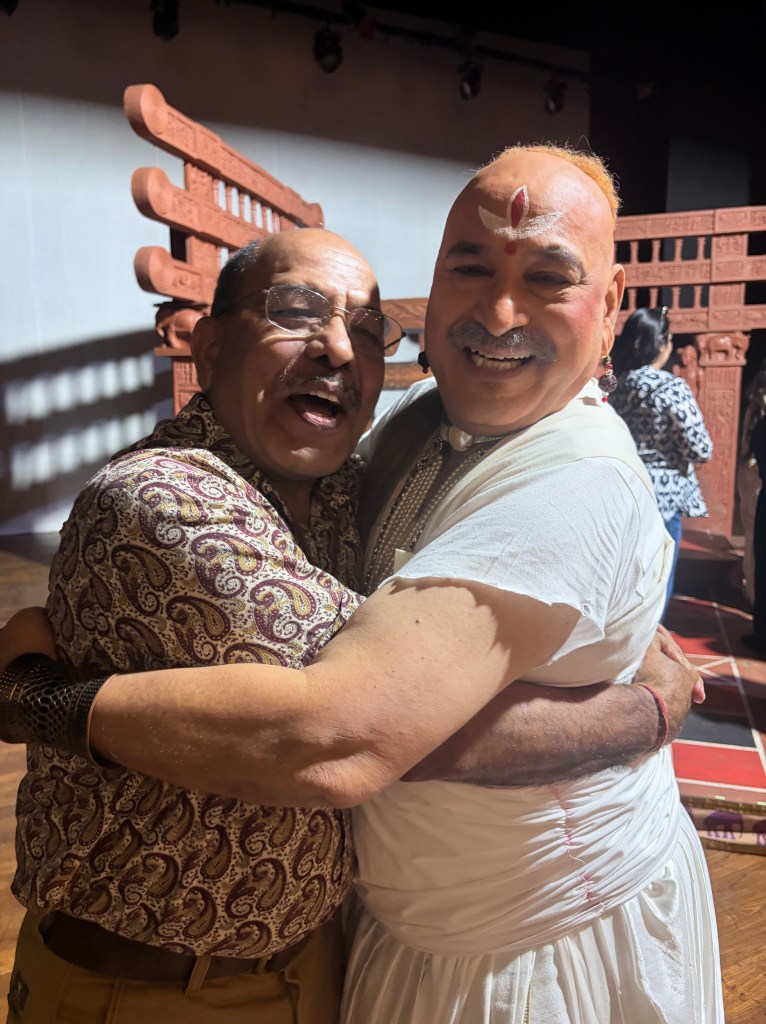
When I received a warm, friendly hug from Shri Ashok Banthia after the performance, I couldn’t hold back my hidden desire. I requested him, “Sir, please accept me as your pupil. If nothing else, I’ll cherish the role of a tree or a lamp-post beside which you stand and mesmerize audiences.”
Kudos to Manoj, Ashok, and the entire Chanakya team!
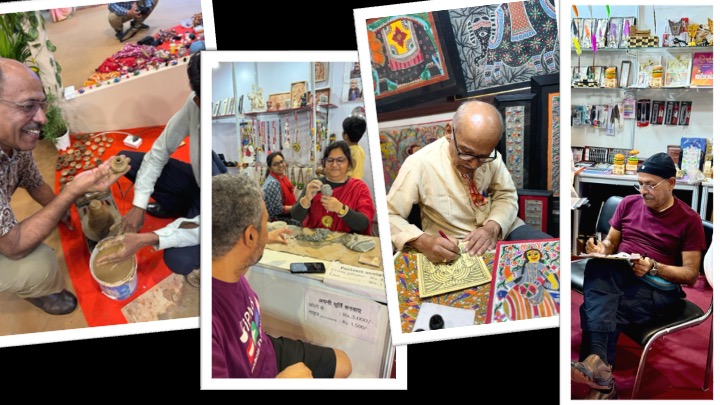
All have their own definition of it; and, it changes from time to time. For now, for me, it is a feeling of contentment and satisfaction one gets when one does something one has never done before. The other day, I experienced just that, when I spent quality time at the Trade Fair in Pragati Maidan. An artisan allowed me, and encouraged me to work on his potter’s wheel. With a little guidance and help, I could fulfil a desire I had nurtured since childhood. I could make a miniature vase; I felt, I was on top of the world.
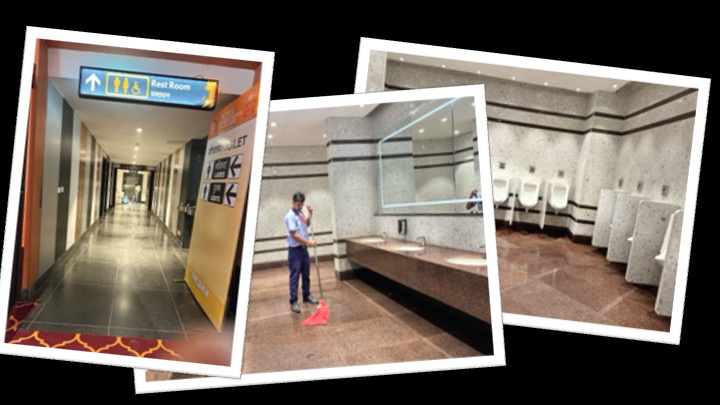
Spick and span…a different Pragati Maidan
In another stall, it was therapeutic to watch a lady work on the clay bust of a person sitting opposite her. I have seen umpteen artists making caricatures likewise, but never a person making a clay bust within minutes. Watching Mr Indrakant Jha engrossed in Madhubani art was a treat to the soul.
I had never experienced virtual reality before. So, flying a parachute canopy (in virtual reality) at the NTPC stall, seven years after I made my last parachute descent, was a top of the world experience.
Conscientious staff…
The child in me went berserk when I found a stall displaying writing instruments. I spent the good part of an hour trying my hand at calligraphy. If I had had my way, I’d have spent the entire day visiting the remaining stalls and exploring the other options.
In itself, the experience was exhilarating; it became more so because of the improvements I saw and experienced at the fair. To cite a few — the new underground parking is very well organised; comparable to any good mall in the NCR. Everything in and around the halls is spick-and-span. The public utilities are sparkling clean. The absence of litter, even around the eateries, is a pleasing sight. There are conscientious staff to maintain the surroundings. The security staff and those at the help-desks are courteous. The thoughtfully designed and placed signage makes things convenient.
Let’s be “good”
On the whole, our experience was in sharp contrast to what we have seen in the years gone by. People who are striving silently to make this possible deserve Kudos.
On our part, let us help them in their endeavour by just being ‘good’.
Post Script
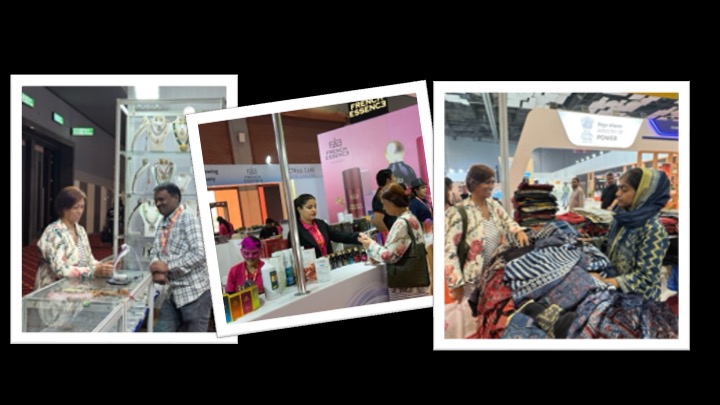
This description of our visit to the Trade Fair would be incomplete without the narration of our interaction at a stall displaying Gujrati garments. Chhayaji liked two dresses and decided to buy them. When she tried to bargain with one of the salespersons, the lady said with a lot of pride, “Like Modiji, we are Gujratis! We are upright people. We do not tell lies about price; we do not leave a scope for haggling.”
…fir bhi dil hai Hindustani
Amused, I asked her, “Why are you dragging Modiji, in this conversation?”
“Because, he is an upright leader; and he is a Gujrati,” she chirped with even greater pride.
“Why do you say you and Modiji are Gujratis? Aren’t we all Indians—you, I and Modiji? Think of it, it is only a matter of time, even Trump and Nigerians will stake a claim on Modiji. What will you do then?”
She laughed heartily at my quick-fire repartee; gave us a handsome rebate. We thanked both, the lady, and Modiji, profoundly before leaving the premises.
It will be interesting to know Modiji’s “MAN KI BAAT” someday on belongingness to a state, the nation, and the world.
This morning my little grandnephew asked me, “Dadu, why do we say, ‘the US, the UK, the UAE?’ Why don’t we say, ‘the India’?”
“It is rather simple, my child,” I said, “When the name of a country suggests that it is a group of states or a confederation or a federation, we use ‘the‘ before their names like, the United States, the United Kingdom, the United Arab Emirates….”
“I see,” Kartik nodded.
“Not only that…,” I added to enlighten him further, “…the names of some countries which are archipelagos or groups of islands, are also preceded by ‘the‘ for example the Maldives and the Seychelles.”
“I will not use ‘the’ with Maldives. I don’t like that country. The Indian troops risked their lives for their President and we have been rushing to help them in their times of need, yet they speak with disrespect for our Prime Minister. They are bad people!”
“Language has nothing to do with relations between countries,” I chuckled. “Grammar is not governed by feelings, Maldives will continue to be called, the Maldives. Your dislike for that country doesn’t change anything. Relations between countries are temporary; only interests are permanent. Yesterday the Maldives were with us; today they are with China. Who knows, tomorrow they might end up being without any one on their side when China discards them like a spent tissue.”
A pout on the little lips, lateral movement of the eyeballs, and a shrug of his little shoulders was Kartik’s way of conveying his displeasure about this particular rule of the English grammar. He continued paying attention regardless.
“Not only that, we use ‘the’ before names of groups/ organisations that suggest coming together of several entities. For example, the United Nations, the World Health Organisation and…,” I paused to think of names of more organisations.
“In that case it would be grammatically correct to use ‘the’ with India too,” the little one spoke with sparkling eyes. “I.N.D.I.A. stands for ‘Indian National Developmental Inclusive Alliance’ and meets the criteria of being a coalition of several entities?”
That question put me in a tailspin. I remained silent for a long minute until Kartik tugged me, “Isn’t it Dadu?
I scraped the inside of my cranium for the special wisdom required to answer such questions. Then I spoke hesitantly. “Well, theoretically you’d be right if you use ‘the’ before I.N.D.I.A. But as it stands, there is nothing like I.N.D.I.A. It is just a group of ambitious people trying to remain relevant in Indian politics by any means. Rather than setting an agenda for the country, their only aim is to remove the ruling dispensation, and their primary concern is ‘seat sharing.’ Men apart, every man there is a candidate for the post of prime minister. As of now I.N.D.I.A. exists only as a concept.”
The quizzical look on Kartik’s face suggested that he didn’t understand a word of what I had said. But does either India or I.N.D.I.A. visualise the consequences of having a weak, rudderless and meaningless opposition?
Comments
Wing Commander Sanjay Sharma (IAF Veteran) — If my Grandson were to grill me like you were fried, I shall take apolitical asylum in Djibouti.😱😱🤯🤯
Wing Commander Vijay Ambre (IAF Veteran)—You need a strong and united opposition for a vibrant parliamentary democracy. The present conglomeration in the opposition is not likely to provide that after the general elections, especially if the present government returns to power. The Modi government is doing a very good job on all fronts and deserves another term for internal and external policy continuity.
Colonel Jamshed Hussain (Indian Army Veteran)—Very interesting…use of grammer to drive home a point..for a meaningful democracy, a strong opposition is as important…. The small one for weekend, is razor sharp in its thought..Ashok, my compliments.👍 Stay blessed🙏
Air Marshal PV Athawale (IAF Veteran—Beautifully put across Ashok, through Kartik, something which “the politicians” scream aloud every evening on the TV, and no one understands!
Can India let the dragon keep trampling its interests?
At noon on November the 3rd, 1988, it was an anxious moment in the Ops Room of Army Headquarters in Delhi. The who’s who of the Indian political and military leadership, and the sharpest brains of the diplomatic corps had gotten together to plan the rescue of the then Maldivian president surrounded by blood-thirsty armed men. The lingering fear was that of the IAF aircraft, with the troops on board, being blown up by the rebels at the time of touchdown. There were suggestions to respond with maximum force. With a view to outdo the rebels, a general officer suggested inducting more troops than the number that had been proposed by the Army Chief. Humour was not lost on a witty Ronen Sen—a troubleshooter of a diplomat—who said, “Let’s not induct so many troops—the island will sink under their weight.”
Thankfully, Malé didn’t sink under the weight of the Indian military contingent then. Also, in the following decades the islands didn’t submerge despite the weight of the infrastructure developed, mostly gratis, by India. Even the weight of the feeling of indebtedness for the assistance provided by India in their times of various crises couldn’t dunk the islands.
Occasionally, when their leadership was getting ensnared by Beijing, well-meaning islanders—and there is a large number of them—were in touch with Indian leadership and intelligentsia. But India did not heed their clamour for help. Delhi didn’t interfere considering that it was the prerogative of the Maldivian leadership. The result was that the Maldives unfairly cancelled many contracts awarded to the Indian firms (including the $511 million airport project bagged by GMR) and even leased islands to Beijing which are being used as observation posts to snoop on India. This certainly was not what India had bargained for its non-interference in its neighbour’s affairs.
A cross-section of people on either side feel that both India and the Maldives will be the losers as a result of the current spat. They conclude, and rightly so, that China will gain immensely from this tiff. So, should India accept this Malé-Beijing bonhomie as fait accompli? Certainly not, particularly if it is detrimental to India’s strategic interests. Silence is not a rewarding policy in a world of strategic communication. India needs to do more than just conveying its displeasure over Malé’s actions.
People also say that China is economically too powerful to be confronted. The diplomacy we have followed over the years has been trumped at each step by the lure of Chinese investments. It is, therefore, no wonder that Malé is following in the footsteps of Nepal, Bhutan, Bangladesh and Sri Lanka. But, can India let the dragon keep trampling its interests? Time and energy need not be devoted to answering that rhetorical question. China must not continue to get things on a platter.
India must do everything possible to make Beijing pay the cost for encroaching its interests. In the bargain, if Malé suffers, so be it; they have asked for it. All the possible ways in which India can counter China in the Maldives (and elsewhere)—and there are very many of them—may be adopted discreetly, without making a hue and cry. Keeping Beijing guessing will also serve a definite purpose.
Out of step with Chi…
President Mohamed Moizzu who generated the anti-India wave and rode it to success in the presidential election is certainly not in step with Chi. Now in Beijing, he’s trying to get some favours. Among others, China has promised additional flights and tourists to Malé. That will more than make up for the loss of revenue due to Indians not touring the Maldives. Hopefully, for the time being. But for sure, among the tourists will be Chinese agents (and possibly carriers of new variants of Covid) whose presence, the Maldives will regret at some point of time in the not too distant future.
What can India do?
Malé incurred heavy losses during the pandemic
The frenzy will be over soon. When the dust settles, for us Indians, the most difficult thing will be to acknowledge the blind spots so undiplomatically pointed out by the Maldivian ministers. Although, their comments were related to tourism in the Lakshadweep, it will be in our interest to consider tourism as a whole—everywhere in India.
India has umpteen exotic locations to promote tourism—pristine unexplored beaches, mountain treks, jungle safaris, bird sanctuaries and reserve forests. We have historical monuments and places of worship. Tourism for adventure sports, medical care, naturopathy, meditation and Yoga is already flourishing. People also travel for art, culture, theatre, film and photography… the list is long and ever growing. Limits are posed by imagination alone. Each of these has its peculiarities—means of transport, accommodation, food, equipment and above all people who can communicate well. India must go all guns blazing, and create infrastructure and train human resource to give the tourists an experience. Some sincere and meaningful introspection is vital as we take on the adversaries.
Need more be said!?
[Hereafter, how to deal with the Maldivians visiting India for medicare, education or any other purpose—is a subject for another day.]
Comments
Well written, Chordia; as usual! Thought provoking too…really need to up the ante in tourism….we have a long way to go…’coz, I feel genetically we are crooks…especially those who can make a difference..out for the big buck!! ~ Air Vice Marshal TPS Dhillon (IAF Veteran)
Well timed and articulated. India just has 1.6% of global share of tourism. As rightly put by you that we have everything to offer. Beaches, mountains, deserts, monuments, buildings , temples with their unbelievable architecture, yoga, massages, traditional music and dances not to forget medical and religious tourism. We have to exploit all these but for that we have to create infrastructure and also improve our image as a nation. It is difficult to digest that having a destination wedding in India cost three times more than in Bali. ~ Group Captain Sanjiv Aggarwal (IAF Veteran)
The sudden death on a train journey of a distraught Microbiologist knowledgeable on Chinese Bio-Warfare initiatives, leaves unanswered questions and a bagful of worries for an Air Warrior.
[Now a short film titled, “Victor One” starring Shaktee Singh and Dinpaal Ganguly. The film was screened at the Indian Film Festival of Ireland (IFFI-13). It has won two awards: BEST ACTOR (Shaktee Singh and BEST DIRECTOR (Shivani Singh) at a recently held Film Festival. The film is scheduled to participate in four more film festivals in the short film category (including the one at Cannes).
The Transit Camp at Guwahati was a heavily guarded fortress in the insurgency prone east. I had arrived there from Tezpur a day in advance to board the early morning Sampark Kranti Express to New Delhi. Thanks to the mosquitoes, I hadn’t slept a wink through the night. Besides, my mind was 3000 miles away in NOIDA where Mudit and Chhaya were awaiting me––it had been six long months since we’d been together. Annual leave was a precious commodity for those serving in the exotic east.
I arrived at the station a half hour before the departure time and headed for the train parked on Platform Number 1. My reservation was confirmed in the AC First Class compartment. A faded reservation chart was pasted clumsily at the entrance of the bogie. I strained my eyes to read through and locate my name in the list printed on recycled paper using a dot-matrix printer. There was no rush, and as it appeared, I was the only passenger in ‘C’ Coupe. Quite a few berths in the other coupes were vacant too.
Once inside the coupe, my hands developed their own grey cells––they got down to arranging the bags under the berth and spreading the sheet and the blanket. Once settled, I pulled out from my bag, the crumpled draft of an article: Warfighting Sans Bloodshed. I had been working on it for the past three months. My duties as the Senior Logistics Officer at Air Force Station, Tezpur had kept me sufficiently busy to devote time to that article. With none to talk to in the coupe, I was determined to edit and complete it before reaching Delhi. My thoughts ran errands in many directions as I continued to settle down. In doing so, I lost track of time. It was therefore natural that I did not hear the guard blow the whistle; I did not notice the diesel engine sound its horn either. Like me, my senses too had been furloughed.
I suddenly became conscious when the wheels rolled with a jerk and a tall man stumbled into the coupe. He lost balance, fell and lay spreadeagle on the floor. I was taken aback.
“Easy!” I said instinctively and helped the man lift himself to the seat in front. He was elderly and frail; in his early eighties, I guessed. And he might not have weighed a gram in excess of fifty kilos, even with the clothes on. He was a skeleton, almost. The cap of a Sheafer fountain pen peeping out of his oversized coat pocket suggested that he was possibly engaged in some kind of scholarly pursuit.
“Uh! Thank you… I am jaast een time,” he collected himself and forced a smile on his pale face. If at all, the effort deepened the furrows in his wrinkled cheeks. He adjusted his thick-rimmed glasses with cylindrical lenses to focus his gaze on something beneath my berth. He was reading my name printed on my duffel bag.
“So, you are Squadron Leedor… Indiaan Air Force?” I wasn’t much impressed by what he showed off as his discovery because that was my rank two years ago; I had earned a promotion in the intervening period.
“Pilot?”
Inadvertently though, he had pricked me with that one-word question. “Why do people take everyone who dons blue, to be a pilot?”
“Not really,” I said aloud without making an attempt to hide my punctured ego. “I am a skydiver… the next best thing to being an eagle in the big blue sky.”
The tone, more than the content of my reply, must have amused him, for he chuckled wholeheartedly. Unfortunately, that led to a bout of uncontrollable cough. I patted his back and gave him water to drink. That gave him instant relief.
“Dhonyobaad!” He was grateful for a cup of tea I poured for him from my flask.
He had barely regained his breath when his phone rang. He riffled through his coat pocket to find his phone. He squinted his eyes to read the text on the five-inch screen of his iPhone but couldn’t. Nonetheless, he accepted the call. There was a distinct dash of indifference in the way he responded. It was either an unknown caller, or someone he didn’t wish to speak to. His face turned red as he listened to the individual at the other end. He cupped his mouth as if to prevent being heard, but it seemed he was provoked by the caller to scream into the instrument: “I am not Bheector Bhon (I am not Victor One),” his lips quivered. His large nostrils grew larger, and his unusually long nasal hair flowed out of the cavities like little grey fumes, “Aar, aami Majeek Dadu noi (And, I am not Magic Dadu)! Stop calling me from deepharent nombers (Stop calling me from different numbers).” He disconnected angrily and mumbled a barely-audible sorry when our eyes met.
I gestured an it’s-alright.
He wiped the beads of sweat that had appeared on his forehead. Then there was prolonged silence except for his deep breathing and the rhythmic rumbling of the wagon’s cast iron wheels.
He was professor-like; seemed perpetually lost. He rummaged his pockets for his ticket when the conductor arrived. And, when he did present one, it was an invalid ticket––it was for the Rajdhani Express of the previous day. Without ado, he paid a hefty fine and bought a valid ticket. “I am bheecoming phorgetfool (I am becoming forgetful),” he announced to nobody in particular.
He started a monologue on Warfighting Sans Bloodshed when his eyes fell on the sheaf of papers kept by my side. He amazed me by the depth of his knowledge on the subject.
“Heard about HAARP?” He asked me and, without waiting for an answer, repeated the abbreviation, one letter at a time and expanded it too. “H-A-A-R-P… High Frequency Active Auroral Research Program.”
“It was a secret American Project, a weapon system way ahead of its times. I know a little about it. But I understand that it had turned out to be unwieldy, unviable and a drain on the US Defence Budget. They had decided to scrap it and hand over the site to a university… (I paused groping for the name) … I think, … it was the University of Alaska. I am not too sure of the present status of the Project.” I was unsure and shrugged my shoulders humbly accepting my lack of knowledge.
“You are quite right. It was a rare bheapons programme bheech, if accomplished, bhould habe given the Americans aaneemaghinable pabher to dhominate tha whorld (It was a rare weapons programme which, if accomplished would have given the Americans unimaginable power to dominate the world). Like deesrupting human mentaal processes, jhamming communications, impacting bhethor anywhere in tha whorld,… and maaach more (Like disrupting human mental processes, jamming communications, impacting weather anywhere in the world… and much more). Now Chinese…,” he paused abruptly, looked around and left it at that.
The following hour was spent in what I call polite-meaningless-conversation. My half-hearted effort to know who he was, got stymied each time by his arguments on a variety of subjects: Hypoxia… Foreign Policy… Unmanned aircraft… Electric cars… China… Biological Warfare. There was a core of weirdness in the way he hesitated talking on those last two topics. All through our conversation, his probing eyes scanned our coupe and a part of the adjoining corridor.
Something was troubling him.
At Katihar Junction, I stretched my legs and arms and prepared to fetch hot tea from a tea-stall on the Platform. “Would you like to come along for a cup of tea,” I made an offer.
“Sorry, I habe jhoint pain (I have joint pain). I bhud like to seet hear (I would like to sit here). Bhy don’t you get aa cop phor mee too (Why don’t you get a cup for me too),” An artificial smile bared the gaps in his yellow teeth yet again.
I didn’t mind doing that small favour and walked away with the flask in my hand. I was oblivious of an intriguing request that would follow sooner than later.
The door of the coupe appeared closed when I returned. My repeated gentle knocks and ‘Hello Sir’ through the slits in the small side window were responded by silence. The door, which was not bolted from inside, slid ajar when I tugged it.
The man sat motionless in the corner. He was holding his Sheafer and writing something on his scribble pad. The pen slipped from his fingers as I walked in. He did not pick it up. I thought he had dozed off. The pad too slipped and fell. I couldn’t help read the short note as I picked it up and placed it on his berth.
Written in laboured cursive handwriting was an incomplete and unsigned note which read: “Dear Squadron Leader, I don’t have much time. I have recorded a voice-memo on my mobile phone. Please share it with Victor One. He…”
“Please share it with Victor One.”
The man was dead.
Gears shifted and cogwheels began rotating faster in my cranium––eagerness to reach Delhi and be with the family; this dead stranger in my coupe; the voice memo and, above all… the identity of Victor One. Who on earth was this Victor One? My mind felt cluttered.
First things first. I secured the man’s scribble pad, and pocketed his phone before seeking assistance of the Station Master and the cops. They found nothing on person of that lonesome man, or in his baggage, that could reveal his identity. The body was taken away for post mortem and I was made to sign a declaration.
“Sir, we’ll call you as a witness, only if it is really necessary.” The Head Constable saluted and assured me, before letting me board the train again which had been delayed by fifteen minutes.
Next morning, the headline in The Times of India read: “Dr Shantanu Bhattacharya Dies in Sampark Kranti.” A two-decade old photograph on the front page had striking similarity with the passenger I had met on the train the previous day. The subheading read: “Dr Bhattacharya (83) was convalescing in Baruah Sanatorium in Shillong after undergoing psychiatric treatment at AIIMS, New Delhi.” A boxed item aroused my interest: “On condition of anonymity, a close associate said that lately, Dr Bhattacharya, a less known Microbiologist, had been hallucinating about the quantum jump in Beijing’s Biological Warfare capabilities and that he had been claiming that he had found a counter to some of the Dragon’s bio-weaponry. He even feared abduction by the Chinese; was paranoid. The Scientist had gone missing from his Sanatorium late last Friday. His disappearance was kept under wraps as the intelligence agencies were trying to rule out foreign hand.”
I re-read the news item which said: “Codenamed Victor One, Dr Bhatta was popular among his colleagues as MagicDadu.”
“If the man I met in the train was Dr Bhattacharya, and if Dr Bhattacharya was codenamed Victor One, who do I handover the recorded message on the phone, and the scribble pad to?” I was utterly confused.
My curiosity led me to explore Dr Bhatta’s phone. It wasn’t locked but the sim was missing. Knowing that his end was near, he had erased all the data on his phone except a voice memo. I couldn’t make much sense of the garbled message: “Dear Bheector Bhon, I trast you only. (Dear Victor One, I trust you only) Nobhody ailse (Nobody else)… the Chinese are training a maasquito aarhmy (the Chinese are training a mosquito army)… they habe laarnt tha technique from tha Nazis (they have learnt the technique from the Nazis)… (unintelligible sounds). I habe deeskhovered I have discovered…. They bheel abhduct mee and keel me (They will abduct me and kill me)… Uh! Obhar hown peepal habe bheetrayed me (Our own people have betrayed me)… uh… uh… (long pause) uh…(stuttering)… (silence).”
“Why would Dr Bhattacharya record and send a message to himself?” I was even more puzzled.
My confusion climbed another notch when a newspaper cutting fell from Dr Bhatta’s scribble pad as I flipped its pages to see if it contained anything worthwhile. It read: “Nazis planned malaria-carrying mosquito army.” My train of thoughts was interrupted by Chhaya, my wife, who had laid the table for lunch, “We’ll have to clean up the utensils and dishes for the next few days. Guddi will not be coming to work; she is running high fever. In fact, almost her entire chawl of about 300 dwellers is down with some strange symptoms… I don’t know what’s happening…,” She sighed. “Mrs Manchandani was saying that it is a new breed of malarial parasite, much deadlier, spreading like an epidemic.”
A slave went to his master in Cairo with a request to save him from ‘death’.
The wretched man shivered as he narrated his encounter: “I met ‘her’ in the marketplace during my morning errand to buy grocery. ‘She’ was giving me threatening looks. I guess my time has come.”
The master, a benevolent man, gave him the best steed in his stable and advised him to ride to faraway Basra. He owed that kind gesture to a man who had served him devotedly for two decades. “Abdullah, I don’t think death can reach you that far,” he said as he waved the grateful slave good luck.
Abdullah galloped away into the horizon leaving a cloud of dust.
It was a matter of chance that the master too came across ‘death’ when he went for a stroll in the evening. He couldn’t help question the menacing looking ‘creature’ in her black cloak, “Why did you scare Abdullah. He is such a pious Moslem, prays five times a day; follows all rituals; is kind hearted and has served me so selflessly all these years?”
“Why? Why at all would I scare such a good being? I had only one thought when I saw him perambulating here in the streets of Cairo this morning. My appointment with him is in Basra over the next weekend. I was wondering how he would reach Basra in such a short time for our scheduled meeting.”
That was an Arab folklore.
There’s a real story too; wonder if it is true:
Among the victims of the Ukranian jetliner that got shot in the Iranian airspace recently––in the aftermath of the killing of Major General QassemSoleimani––was an individual who had texted his friend before boarding the ill-fated aircraft that he was concerned about the mounting tension between the US and Iran and wanted to leave Tehran before the situation worsened.
That was for the preface.
In dealing with COVID-19, things cannot be left to fate. Everything good, bad or ugly will not happen automatically. Not luck, but actions taken now will determine the outcome.
उद्यमेन हि सिध्यन्ति कार्याणि न मनोरथै ।
न हि सुप्तस्य सिंघस्य प्रविशन्ति मुखे मृगाः ।।
The essence of this Sanskrit Shloka can be summarised thus: Physical action is essential to fulfil wishes. A deer does not walk into a sleepy lion’s mouth––even he (the lion) has to hunt to satiate his hunger.
The global war against Corona Virus is on. Deliberate and conscientious action can spell success. Today, the worst affected countries are China, Italy, Iran and South Korea. Each country is doing its bit to keep the epidemic at bay. Chinese efforts stand out in as much as there’s a decline in the number of new cases. A close scrutiny reveals that unmindful of the ‘world opinion’ they have resorted to dictatorial (draconian, for some) methods of implementation of the medical directives to succeed in their endeavour. Tough times require tough measures. While the end of the crisis is not in sight yet, it is possible to review our own actions thus far and take mid-course corrections to arrive at the desired destination.
Schools have been closed and use of biometrics for identification at entry/exit to offices has been suspended. Teams of doctors, the Armed Forces and the paramilitary forces have been pressed into action. The checks at the airport have been made stringent. There is a suggestion to close the Taj Mahal to tourists. The government has issued an advisory to: “Avoid mass gatherings.”
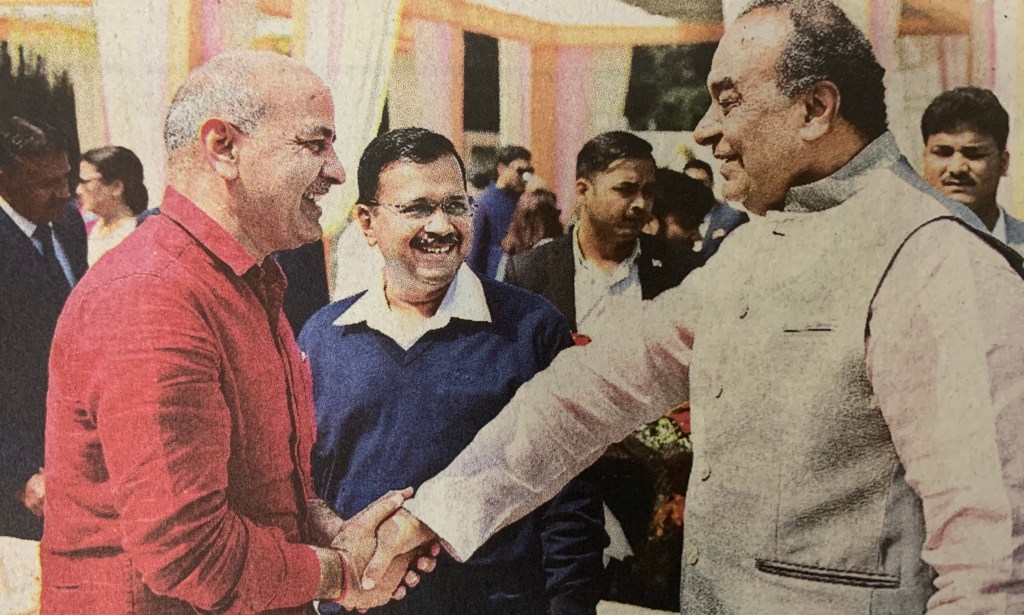
But, as brought out in an earlier post (“Salam, Namaste Kovid-19”) either the magnitude of the problem has not sunk in, or the attitudinal deficiency has still not been made up. Congregations are still taking place. Recently there was a ‘Page Three’ kind of wedding attended by the who’s who of Delhi. The very people who (supposedly) are to lead the lesser mortals to salvation were visible engaging in apparently long firm ‘handshakes’. Still later they were engaged in more serious and essential meetings elsewhere in Delhi to restore normalcy in riot hit parts of city.
All are equal in the eyes of the Corona Virus
Likewise, there was another mega event where the country’s sportspersons were honoured and people mingled. In the larger national interest such gatherings may well be avoided. A lot depends on the willingness of the people at the helm.
Elsewhere, people with colour-smeared faces could be seen throwing caution to the air––the mood to celebrate Holi has already taken the better of people. Hand sanitisers and facemasks have disappeared from the shelves. More and more jokes and cartoons laced with cynicism and weird remedies like names of some herbs, alcohol and cow’s urine etc. (rather than useful tips) are being shared on social media.
Time to issue advisories has long gone
If only people could understand one thing: “Corona Virus is socialist and secular in the true sense of those terms––it is going to spare none. The adage: “Example is better than precept,” was never as relevant as it is today. The chosen and the educated few who can make ‘the difference’ must lead by example. For the government, the time to issue advisories has long gone. These are tough times; tougher times are yet to come. Firm directives rather than suggestive advisories, is the need of the hour. Not prayers but action alone can save this country despite the blessings of the 54,000 and more Gods and deities taking care of its destiny.
Ever wondered who could have been the most harried Indians over the last two months? The answer might not come easy because of the way most people look at things, and act (or react) to situations. The answer is not Modi, not Shah, not Kejriwal and not even Rahul Gandhi.
It is the team of doctors like Dr P Ravindran (Director, Emergency Medical Relief Department), Dr Sujeet Singh Rajput (Director, National Centre for Disease Control) and the medicos of the Directorate General of Health Services (Ministry of Health) that has been having sleepless nights. They, amply supported (as always) by the Indian Army, the ITBP and RML Hospital etc. are in the forefront of the fight against Corona Virus in India. It is a challenge, the enormity of which, it will never be possible to appreciate entirely. Providing medical services is one thing, motivating doctors and nursing staff to work in an environment threatened by the virus is quite another. The diplomats, the bureaucrats and the political leadership are all playing their assigned roles to the best of their abilities but one thing is certain––the credit for the success (if, and when, it is achieved) against the epidemic will go to those at the helm and the brunt of the failure (if any) will be faced by those actually fighting it out.
Bearing the Brunt
To add to the woes of Dr Ravindran and Dr Sujeet is the attitude of some medicos who have said that they would go on strike if masks were not made available. Beyond an iota of doubt, masks and protective gear are an undeniable necessity for the medicos. But at this juncture, going public with this attitude of refusing to work under constraints will prove more contagious and deadly than COVID-19. Those at the helm must do everything in their power to equip the frontline workers appropriately and adequately. They would do well if full control is given to the doctors rather than the bureaucrats or the politicians. It is equally important to allay the fears and anxiety of those in the field.
The fight against COVID-19 is going to be tough. The antecedents of the last few days will establish where we stand in this fight.
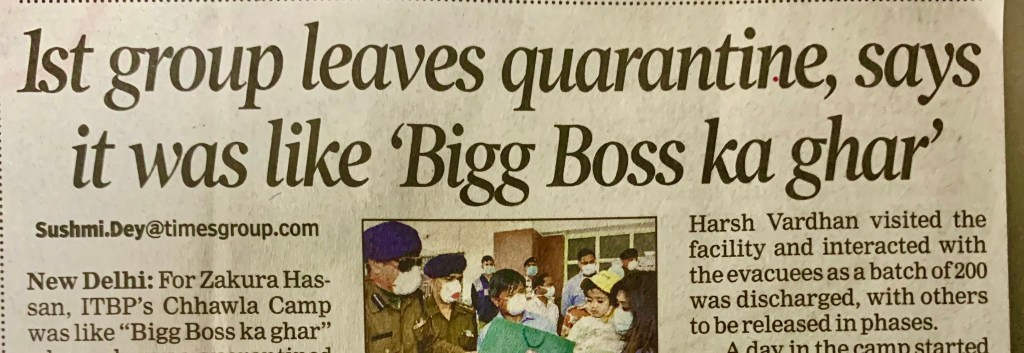
Efforts in right earnest have been on to contain the spread since the threat became evident. It is an acknowledged fact that one of the likely reasons for its spread is proximity and physical contact with the affected individuals. Yet the first lot of people evacuated from China, and quarantined on arrival in India, were seen mingling and frolicking. The video of people dancing together in an isolation ward is horrifying to say the least. On exit from quarantine, one of them compared the life ‘there’ as: “Being a part of the television serial, Bigg Boss.”
Naïve? Stupid? Callous?
Naïve? Stupid? Callous? Or, all three at the same time?
Under the circumstances, let alone people in quarantine, even others (everywhere) must ‘maintain distance.’ Even the media could be denied access to the people in medical isolation––recorded press releases must suffice.
In the recent past a few gatherings took place where people came in close proximity of hundreds others and in physical contact with equally large numbers. Here are some that come to mind:
The youth festival at Gargi College: the ‘reverie’ was disturbed by hordes of goons who entered the campus and assaulted the students. In the ensuing melee, people in large numbers came in physical contact with each other.
Thousands of Delhiites at Ramlila Maidan gathered to witness the oath-taking ceremony of AAP: People were urged to come with families and children.
Nearly 1,00,000 people gathered in Motera Stadium in Gujrat to welcome President Donald Trump on his first ever visit to India.
Giving a rational (and a dispassionate) thought to the antecedents––after the threat of COVID-19 became evident––the above mass gatherings and many others, which are potential hazards, could have been scrupulously avoided. Schools are now being closed and conferences, sports meet and military exercises are being called off. It could be a case of ‘too little, too late.’
For the same reason, prudence demands that celebration of Holi be postponed to coincide with success against COVID-19.
Further, the disruptions caused by the many pro/anti CAA gatherings and rallies have led to rioting, which in turn has flooded the hospitals with casualties. The attention of the medicos and other support agencies that are expected to fight COVID-19 is divided.
There’s an urgent need to regain focus. While some schools in Noida and Delhi have been closed as a ‘precautionary measure,’ avoidance of congregation and travel of any type––besides sticking to the medical advisory in letter and spirit––would help combat spread of COVID-19.
Lastly, ‘Saluting’ or extending a ‘Salaam’ as a Jawan does, or joining hands in a ‘Namaste’ to greet people could be a much better option than shaking hands to avoid physical contact. Besides, the art of saluting will come in handy in the not too distant future when there’ll be a natural urge to SALUTE those on the frontline of the war against COVID-19.
A moment of weakness on the course torments a conscientious golfer…
They were beginners.
They had purchased old; second hand golf sets with assorted clubs with worn-out grips and dilapidated bags. They played with old balls, reserving the new, and the better ones only for the putting greens. They used the oldest ball in their bag, on the fifth tee for the fear of losing a good one in the water hazard. They had not been exposed to the wisdom of playing with a new ball.
They could strike a ball clean from the tee––not
muffing it––just about fifty per cent of the times. But only on half of those
contacts, the ball would take a decent flight and land in the fairway. A mini
celebration would ensue every time their approach shots from within a hundred yards
range landed on the green––that happened as rarely as the solar eclipses. They
took, on an average, not less than two and a half strokes on the putting green
to hole out. They played for honour; betting only once in a blue moon with breakfast
of eggs and toasted bread with jam and butter at stake. Ignorant of the rules,
they played with consensus until one of them picked up an old out-dated booklet
of golf rules from a street vendor, which they referred only when a dispute
remained unresolved for a few days.
Amit Ahluwalia (Alu), Anil Jain, Gopal Phanse
and Biswajeet Ghose had been bitten by the golf bug. If they had their way,
they would spend their entire lives on the greens. But wishes don’t have wings.
Gupta Law Associates (GLA) kept the four young lawyers tethered to their
workstations through the week. Nonetheless, their weekends were devoted to golf––it
was a ritual they never skipped. Winning or losing the game was less material;
they would do ‘anything’ to snatch an opportunity to play.
Anything!
It was far easier to plead and convince a
judge presiding over a criminal case than to persuade Harsh Gupta the seventy-nine
year old Chairman of Gupta Law Associates (GLA) to spare the young men for a few
hours on a workday even for their personal errands. Being spared to play golf––there
was no chance whatsoever. How Alu sold the idea to the old man is a guarded
secret. But suffice it to say that at the end of their seven-minute
interaction, Harsh Gupta had not only agreed to field a team to represent GLA
in the HH Maharaja Jayachamaraja Wadiyar Golf Championship at the JWGC, Mysore
but had also sanctioned all their expenses including a sleeve of golf balls and
a tee shirt each. The old man had possibly calculated the net gains that would accrue
to his law firm by way of publicity due to the presence of his emissaries in
Mysore amidst what he considered an elite crowd.
With a registered handicap of 18 and actual
performance no better than 24, none of them stood the remotest chance of making
the cut at the end of the first round. Winning a prize in the Stableford format
on the final day was out of the question. They knew their limitations well. Yet
their urge ‘just to play’ another round was rather strong.
In the first day’s fixtures their names appeared together in a four-ball. In that, Alu saw an opportunity and a ray of hope. He came up with a scheme. He suggested that they played exactly as they played on their parent golf course in Bangalore––changing the balls on the putting greens and conceding short (one grip length) putts. That would give them the advantage of a few strokes and a possible chance of making the cut. He also suggested a ‘rolling’ mulligan that could be availed discreetly on any hole. “I’ll ‘manage’ the caddies,” he added slyly.
“But that would be unfair to the other
golfers participating in the tournament,” protested Jain.
“You are right,” reflected Alu. “But that’s
our only hope to qualify and play another round. In any case, with our known
performances, none of us will win a prize tomorrow even if we were to qualify
today. A little manipulation will not harm other people’s chances of winning a
trophy.” Then, after a pause for effect, Alu continued, “Jain, if you avoid
being Satyawadi Harishchandra for a
change, all of us could enjoy another day of golf.” He looked at Ghose and
Phanse who extended tacit support. Unsure and reluctant, Jain also gave in.
To cut the long story short, at the end of
the first day’s play, all four of them stood somewhere on the leader board entitling
them to play the final round the next morning. That evening they enjoyed the
gala party hosted by the organisers. How they had made the cut was forgotten
soon enough.
Gimme!
For the final round they were put in different
four-balls. Everything changed––no mulligan, no ‘gimme’. It made no difference to them because they had achieved
their aim of playing another day. Scores didn’t matter anymore. In fact there
was nothing to write home about when they submitted their scorecards. They
wanted to set course back for Bangalore as soon as possible but then, as a mark
of respect for the organisers they decided to stay back for the prize
distribution.
They sat in the last row cracking occasional
jokes, eating plum cakes and sipping fresh fruit juices. The announcements
being made as a part of the prize distribution ceremony were falling on their
deaf ears so that when the name of the runner-up for the prize for the
Stableford Net Score (handicap 18 and under) was announced they didn’t monitor
it. Anil Jain’s name had to be called thrice before he could register and
respond to the call. He had to literally run to the podium to receive his trophy.
The sense of winning a prize dawned on him only a half hour later when, on their
drive back to Bangalore Alu demanded a treat for Anil’s ‘achievement’.
Next morning in the office: Harsh Gupta felicitated
Jain in the presence of the office staff. There was a high tea to commemorate
his win at the golf tournament. “It is GLA’s achievement,” said an elated
Gupta. There was a photo session with the trophy. And then…
And then came an exuberant Alu.
“Congratulations, Bro!” he said with a broad smile as they shook hands and
hugged. “Great game! You have been hitting well over the last few days. I knew
you would win a prize….” Despite Alu’s effort to be innocuous, Anil felt that
every word he uttered was loaded with meaning. “Am I imagining things,” he
wondered. A smirk on Alu’s face laid that doubt to rest––Alu was mocking him. Anil
also sensed indifference in the way Ghose and Phanse greeted him on his maiden
golfing success.
In the evening, when Anil returned home his
wife, Sheela wiped the already glittering trophy clean with one end of her dupatta and placed it proudly in the
glass showcase in the drawing room. Ideally, that should have been the end of a
not so pleasant chapter for Anil.
Not really….
That day onwards, whenever Anil looked at the
trophy, rather than getting a sense of fulfilment, it only depressed him. Golfing
with his buddies was not the same either––he began seeing meaning in whatever
the other three guys said. Carrying the burden of ‘that’ maiden golf trophy was
becoming increasingly difficult for Anil until one day it became absolutely
unbearable.
Sheela looked at the trophy and said, “Anil
this golf trophy is tarnished.” Then turning it over, she exclaimed, “Oh my
God, this is real silver. It must be 200 grams. This will require repeated
polishing…. I don’t mind you playing more often if you win trophies like this
one….” While she continued with her monologue, Anil was stuck with one word: “T-A-R-N-I-S-H-E-D.”
Anil couldn’t bear the guilt of unfair play
any longer. The next day he called the Secretary of the JWGC, Mysore and expressed
his desire to return the trophy. His lips quivered as he cited his reason for
returning the trophy. Mr Madhavan was, first, shell-shocked, and then, touched
by what he heard. Collecting himself he said it was fine so long as Anil regretted
his action; he didn’t have to return the trophy. After a little ado, he agreed
to take back the trophy and present it for fair play to a deserving player in
the next tournament.
At the prize distribution ceremony of the HH
Maharaja Jayachamaraja Wadiyar Golf Championship next year, Madhavan made a
surprise announcement; that of award of ‘Fair Play Trophy’. Without citing any
name he spoke about Anil’s confession and called some Dr Sanjay Dixit to
receive the trophy––Dixit had been selected by a panel of judges for the
honour.
Amid loud clapping, euphoria and standing
ovation, Dixit came to the podium and received the trophy. Then with all
humility, he returned it to the Chief Guest saying, “I thank the organisers for
finding me suitable for the ‘Fair Play Trophy’. But I would not like to take
home a ‘Tarnished Trophy’.
For a long minute, there was pin drop silence. And when people spoke again, the ‘Tarnished Trophy’ had become a talk of the town. After much thought the General Body of the JWGC decided to place the “Tarnished Trophy” in the foyer of the Club––with its brief history cited below it.
Now, the trophy inspires players with a conscience, to be loyal to the royal in them.
(Author’s Note: The resemblance of names of persons and places mentioned in this story to real persons and places is incidental).
Rear Admiral MP Avati (later, Vice Admiral), the Commandant, wasn’t amused when cadets mocked him on the stage. It was an Inter Battalion Dramatics Competition and cadets acting as roadside magicians (madaris) had gone overboard with their act. With the wave of a wand one had turned an on-stage Admiral Awati into a goat; and the goat went bleating until the play lasted. The antics of the cadets were in bad taste.
Few appreciated that stage performance. Yet,
to everyone’s surprise, the Admiral walked up to the stage after the play and
started bleating somewhat like the
cadets had done a while ago. He waited for the officers and the families to
vacate the auditorium and when only the cadets were left behind in that closed
space, he made another small speech, the sum and substance of which was:
“Future officers of the Indian armed forces do not behave like this. I don’t
approve of this sense of humour.”
In the following days, did some heads roll?
Were the producer, director and actors of the skit taken to task? Might have
been; might not. Most of us never came to know. In fact, nearly half a century
later, all that is of no relevance. What is really relevant is the message that
went down to a thousand five hundred future officers, and through them, to
thousands more. And the message was not about ‘mocking/ not mocking superiors’, but a more serious one––it was
about the art of speaking one’s mind and leaving a lasting impression.
Fast-forward forty years; a different geographical location; different characters but quite a similar situation in some ways. When Ambassador Sir Kim Darroch wrote a memo to his government expressing his ‘free and frank’ opinion about President Trump and his Administration, he was performing his solemn duty as UK’s representative in the US. It is just that the confidential communication got leaked and embarrassed the governments and a whole lot of individuals on either side of the Atlantic.
The spat that followed is unprecedented. President Trump stopped short of declaring Ambassador Darroch persona non grata. Saying, “We will no longer deal with the ambassador,” and calling Sir Darroch, “Whacky,” was no less damaging. It would perhaps have been a different spectacle, had President Trump dealt with the situation in a more amicable way––like Admiral Awati––behind closed doors.
All-weather Friends?
Needless to say, at this moment the US-UK relations are at their lowest ebb since the Boston Tea Party. Yet, Ambassador Darroch’s resignation is not likely to be the proverbial last nail in the coffin of their partnership––they cannot afford to let it be. Even in times of extreme crisis these two all-weather friends have lived with certain amount of lack of trust. At the peak of World War II (1944), the Americans had put the pilots of the RAF in a (friendly) lock up in Purulia to maintain the secrecy of their B-29 Super Fortress bomber operations against the Japanese.
Country’s interest comes first!
Today, both UK and US are facing the worst crisis since World War II. The US is grappling with Iran, China, Syria, North Korea and Mexico (not to talk of the irritant that has cropped up because of President Trump’s recent racist tweets against congresswomen). The UK, on the other hand, has its hands full with Brexit and the urgency to form a new and stable government. The sacrifice of a diplomat on the altar of their mutual relations would be put on the back-burner for the time being; to be put under the carpet later.
At this juncture, any further dip in relations will be a monumental mutual loss. In a zero-sum game, who’ll gain from their strain? A third party?
आजकल देश में बारहों महीने देश-भक्ति की लहर होती है। कोई न कोई राजनीतिक दल या समुदाय किसी न किसी महान व्यक्ति को याद कर रहा होता है––कभी लोग गाँधी को, तो कभी भगत सिंह को; कभी नेहरू को तो कभी महाराणा प्रताप को याद करते हैं। कोई न मिले, तो लोग अपने श्रद्धा सुमन देश पर मर-मिटने वाले शहीद जवानों पर ही अर्पण कर देते हैं। देश-भक्ति के छोटे-बड़े हिलकोरों से भारत सदा मनमस्त रहता है। गणतन्त्र दिवस और स्वतन्त्रता दिवस के अवसर पर तो मानो देश-भक्ति की सुनामी ही आ जाती है।
राष्ट्रपर्वों
पर राष्ट्रध्वज की शान निराली होती है। न जाने कहाँ-कहाँ से निकल कर तिरंगा हर हिलती-डुलती
और चलती-फिरती वस्तु और वाहन पर शान से लहराता दिखाई देने लगता है। फिर झण्डा प्लास्टिक
का हो, सिल्क का हो, या असली खादी का, कोई मायने नहीं रखता। देशवासियों की भावनाओं
का ध्यान रखते हुए कुछ लोग कागज़-कपडे वाले मुद्दे को तूल नहीं देते, तो कुछ उस ‘तुच्छ’
मुद्दे को (फिलहाल) दरकिनार कर देते हैं। ऐसे समय तिरंगे की बिक्री शीर्ष पर होती है।
और क्यों न हो, उसका एक-एक ताना-बाना देश प्रेम की भावना से जो रंगा होता है। लोग जो
भी कहें, तिरंगा तिरंगा होता है, उसका भी अपना दिन होता है।
और
फिर, ऐसे समय शब्द, सुर, ताल और लय कैसे भी हों––गली, नुक्कड़ और चौराहों पर लाउड-स्पीकरों
पर देश-भक्ति से सराबोर गीत निर्जीव से निर्जीव व्यक्ति में प्राण फूँक देते हैं। इसी
प्रकार, टीवी चैनलों पर देश-भक्ति से ओत-प्रोत सीरियलों और फिल्मों का अम्बार सा लग
जाता है। एक प्रकार से देश-भक्तों में देश-भक्ति दर्शाने की होड़ सी लग जाती है।
देश
भक्त फिल्म निर्माता और अभिनेता न केवल अपनी देश के युद्ध गौरव को दर्शाती बहुसितारा
(मल्टीस्टारर) फिल्मों को इसी दौरान पर्दों उतरने की उधेड़बुन में रहते हैं, बल्कि
सिद्धिविनायक मंदिर में माथा टेक कर उन फिल्मों की सफलता के लिए मन्नत भी मांगते हैं।
भगवान फिल्म उद्योग की सुनता भी खूब है। देखिये न, लोग मेजर कुलदीप सिंह चांदपुरी को
कम, सनी देओल को 1971 भारत-पाक युद्ध का नायक ज्यादा मानते हैं; मेरी कॉम से ज्यादा
प्रियंका चोपड़ा को पहचानते हैं।
मेरा
भारत (वास्तव में) महान है!
इन राष्ट्रीय पर्वों के बारे में मेरे बचपन की यादें सीदी-सादी हैं और आज, पचास साल बाद, भी बिलकुल स्पष्ट और ताजा हैं। क्यों न हों? बस्ते की झंझट नहीं, आधे दिन बाद स्कूल की छुट्टी हो जाती थी। ध्वजारोहण के बाद सब “वन्दे मातरं” गाते थे; प्रिंसिपल के भाषण के बाद देश भक्ति के कुछ गीत और नाटक होते थे। थोड़ी देर देश के वीर शहीदों के बारे में सोचते थे, उनसे प्रेरित होते थे। “भारत माता की जय” के नारे और वीर पुरुषों की गाथाएं बालमन को देश के प्रति उदात्त भावना से भर देती थीं। चाहे मोतीचूर के लड्डूओं के बँटते ही घर की तरफ गिल्ली-डंडा खेलने भागते थे, लेकिन भावना कुछ ऐसी होती थी कि कहीं भी, कभी भी, “जन गण मन….” की धुन कानों में पड़ती थी, तो सबकुछ छोड़ कर सीधे खड़े हो जाते थे। और फिर, पूरे वर्ष महारानी लक्ष्मीबाई, महाराणा प्रताप, शहीद भगत सिंह, चंद्र शेखर आजाद आदि की चर्चा होती थी। भावना कुछ ऐसी होती थी, जिसकी परिकल्पना सरलता से शब्दों में नहीं की जा सकती है।
मेरा
भारत तब भी महान था!
फिर
से वर्तमान में…
हाल
ही में, मैं अपनी तीसरी पीढ़ी के एक बालक के साथ कार में सैर रहा था। बालक निश्चय ही
मेधावी है। रास्ते में करीब साठ फुट ऊँचे खम्बे पर लहराता तिरंगा दिखाई दिया। झण्डा
देख कर मेरा सीना गर्व से फूल गया। मैंने सम्मान से उसे निहारा और बालक से पूछा,
“बेटा, जब आप अपना राष्ट्रीय ध्वज देखते हैं, तो आपके मन में कैसे विचार आते हैं?”
मेरा भारत महान!
उस
अपेक्षापूर्ण प्रश्न के उत्तर की प्रतीक्षा करने में मुझे कोई ऐतराज नहीं था।
परन्तु…
परन्तु,
बालक ने एक बार झंडे को और एक बार मुझे अर्थहीन दृष्टि से ताका। सच मानिये, उस छोटे
से बालक ने मुझे, और (मेरे प्यारे) झंडे को “देखा नहीं”, उसने असल में हमें
“ताका”। फिर वह तपाक से और भावहीनता से बोला, “नानाजी, वास्तव में,
कुछ नहीं; तिरंगे को देख कर मेरे मन में कोई विचार नहीं आते हैं।”
मुझ
पर मानो गाज गिर गयी। परन्तु मैं भी हार मानने वाला कहाँ था? भूतपूर्व वायु-योद्धा
जो हूँ।
“क्या
तिरंगा आपको देश के वीरों की और शहीदों की याद नहीं दिलाता है? इसे देख कर आप के मन
में देश प्रेम की भावना जागृत नहीं होती है?” मैंने बच्चे से हर शब्द पर अत्यधिक
जोर देकर पूछा। मेरी उम्मीदों का बांध और ऊँचा हो चुका था।
उस
बालक के उत्तर ने मेरी उम्मीदों के बांध को तहस-नहस कर दिया और उसकी तबाही से आने वाले
सैलाब में मैं बह गया, डूब गया। अवाक, निस्तब्ध… मैं उसे देखता ही रह गया। वह बड़ी
सहजता से बोला, “नानाजी, मुझे इतना अधिक होमवर्क करना होता है कि मेरे पास देश
और तिरंगे के विषय में सोचने का समय ही नहीं बच पता है।”
हतप्रभ,
मैं उस नादान को पथराई आँखों से देखता ही रह गया।
भारी
मन से मैंने कार आगे बढ़ा दी।
अभी
थोड़ा ही चले थे कि एक विशाल विज्ञापन-पट (होर्डिंग) पर गाँधी जी की भव्य तस्वीर देखी।
मेरे मन में देश-भक्ति का उबार एक बार फिर आया। आया और चला गया। मेरी हिम्मत नहीं हुई कि नन्हे बालक से पूछ लूँ,
“ये कौन हैं?” मन में आशंका थी कि कहीं बच्चा जवाब में यह न कह दे,
“नानाजी, यह तो बेन किंग्सले है।”
निश्चित ही, मेरा भारत महान है। सदैव रहेगा।
देश प्रेम और देश भक्ति पर अभी और कहना बाकी है…
(यह पोस्ट मेरे अंग्रेजी पोस्ट “I Love My India” का हिंदी रूपान्तर है, जिसके लिए मैं अपनी प्रिय बहन प्रोफेसर रीता जैन का आभारी हूँ।)











 Road Much Travelled