Candlelight Dinner

A young couple inadvertently weaves a story to swap their special moment of happiness with unfounded unpleasantness.

It was their big day.

In the forenoon, Gurinder and Pammi had finalised the deal for the two-bedroom flat overlooking the Yamuna in the Supernova Towers right next to the Okhla Bird Sanctuary Metro Station. Their ears had made a ‘chitchat’ sound when they had come out of the lift on the breezy 67th floor. Oops! It was like taking a small hop flight in an aircraft. The balcony provided an awesome view of Delhi. The meandering Yamuna with its green banks; metro, resembling a toy train; the Delhi-Noida-Delhi Expressway, the miniature cars; the Lotus Temple and what have you––an enlarged Google map.  Only two flats per floor meant sufficient privacy. Their offices in Sector-127 would literally be at a handshake distance––no more pulling hairs in the unruly traffic. They had reasons to be euphoric about the deal. It was a-dream-come-true.

It called for a celebration.

So very relaxed, they spent the evening whiling away their time in the DLF Mall of India. At 8 pm, they were at L’affaire. From the open-air restaurant on the seventh floor of the newly commissioned hotel in Sector 18, they would be able to see their soon-to-be Sweet Home.

With a gloved hand placed neatly and deliberately on his red cummerbund, the magnificently accoutred burly durbaan, bent at his waist to welcome the two. He opened the door gracefully to usher them in with a smile that looked absolutely out of place on his rugged face with thick black eyebrows and sideburns, and a handlebar moustache.

A smartly dressed floor manager smiled at them from behind the counter near the entrance; he was busy talking on his mobile phone. Despite his smile, he was visibly hassled. Only five tables were occupied by customers; there wasn’t much rush. Subdued light and Kenny G’s Songbird playing softly in the background were providing the perfect ambience for a candlelight dinner they had fantasised through the afternoon.

They had barely settled in their chairs in the far end of the restaurant when a young man in whites, in his early twenties, came running to their table. Although dishevelled, he wore a smile, and a genuine one in that. He had a small crystal-glass flower vase in one hand and an ornate candle stand in the other. His greeting––“Good evening Ma’am, good evening Sir”––turned out to be an exercise in apology as he almost stumbled and placed nay, slammed his wares on the table. Mumbling an apology, he made a couple of clumsy attempts to light the candle. And before one could say, Jack Robinson, he was gone.

Gurinder and Pammi looked at each other. “Did we bargain for this sort of service when we chose to dine her?” They seemed to say. And before they could exchange any words, the man returned. With two glasses filled with water on a tray. He was still in some kind of hurry––he managed to spill some water on the table.

Another genuine “S-O-R-R-Y.” But Pammi was furious. Her lips quivered as if to spew some harsh advisory. But he had vanished again before she could vent her anger. Gurinder took charge and signalled her to calm down. “Let’s not spoil our evening. We’ll not tip this guy and will never return to this joint,” he said.

Their minds were on a different trip when the waiter returned with the menu. They ordered food half-heartedly. They observed that there were only two waiters serving all the guests in the restaurant. They were like butterflies fluttering from table to table, taking orders and serving. This made Gurinder and Pammi feel deprived of their rightful services.

It happened so gradually….

The flickering flame of the candle consumed the dreams the two had woven through the day. Like the black smoke of the candle burning silently between them, their aspirations got lost in the thin air. The silhouette of Supernova Towers, which was looking so charming when they had arrived on the terrace, lost appeal. The switch over from their discussion on their dream house to the subject of deteriorating quality of food and services in restaurants happened quite naturally. Kenny G too, lost its charm.

At the end of the dinner when the waiter suggested a layout of desserts, Gurinder declined rudely and gestured for the bill to be produced. In a huff he pulled out his wallet and took out his credit card and waited impatiently to make the payment.

The waiter didn’t return; instead came the Floor Manager.

With hands joined in a namaste and a disarming smile he approached the table. “Sir, today four of our staff have been injured in a road accident. They have been taken to the hospital; nothing serious but they will take some time to be fit and join duty. Since we could not provide you with proper service, as we would have wanted to, the food is on us. You needn’t pay the bill.” Then with a pause he added, “In fact Sir, the wife of the waiter who was serving you is also indisposed; he was on leave. But he surrendered his leave to help us tide over the crisis. He is a very sincere guy; full of initiative. I hope he looked after you well? Thank you for visiting us. We hope to see you again! Good night Ma’am, good night Sir!”

(Author’s Note: This story is inspired by the Forum conducted by Landmark Education where they teach: “Actions are actions (they are meaningless); ‘we’ attach meaning to them.”)

A Generation That Cares

Lately, Chhaya, my better half and I have started travelling by Delhi Metro wherever and whenever possible. And honestly, the reason for choosing to travel by Metro Rail rather than by our own car has less to do with our concern for the environment (although it is always uppermost in our minds). The main reason for that choice is to avoid the pain of driving in heavy traffic because of which the time one takes to travel from a place A to a place B is uncertain. I recall an occasion when I even failed to convey a friend from Amity University, Noida to Hazrat Nizamuddin Railway Station in time. A journey, which takes about twenty minutes, took more than an hour and a half that day, and he missed his train. In addition to that ‘harassed’ feeling on the road, there is the problem of finding a parking slot in most places.

Travelling by Metro hasn’t been an experience to write home about either. The stations are crowded. In the peak hours, the trains are so packed with commuters that people have to take turns to breathe. That said, we still find it a good option, at least in the lean hours. There’s relatively less rush and we are sure of reaching our destination in time. To think of it, it is a conscious effort to avoid road rage too. I often recall an instance when a youth, half my age wanted to enter into a physical fight with me. It is a different matter that when we finally parted, he wanted to stitch a lounge suit for me; he was a fashion designer.   

So when we boarded the Metro at Okhla Bird Sanctuary last Saturday, it was just another day. We had to travel to Nehru Place––a 17-minute journey with seven stops en route. At 7:30 pm, although there wasn’t a big rush, there were no vacant seats either. We were prepared to go standing.

Good Samaritan

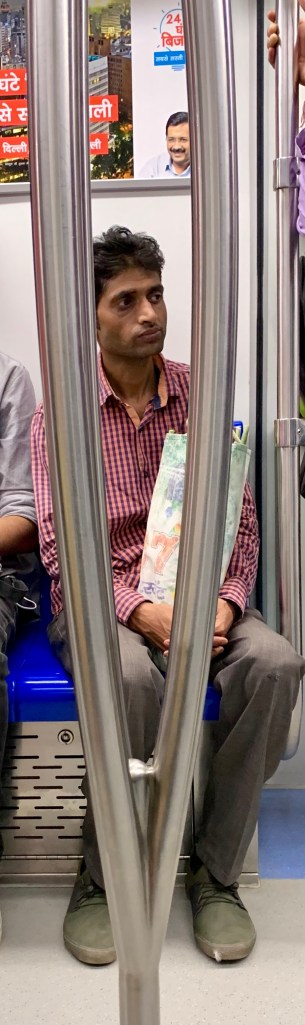
Just then, a lean and rather fragile looking man, with a bag in hand stood up and offered his seat to Chhaya. Chhaya politely declined because looking at his health, she felt that he needed the seat more than her. Besides, he was travelling to Vasant Vihar; sixteen stops and double the time away. But he insisted and prevailed. So without further ado, Chhaya accepted the offer and thanked him.

Even before the import of that kind gesture could sink in, another young man stood up and offered his seat to me. I was a bit embarrassed because standing ramrod straight, I maintain that in appearance I still do not look like a senior citizen. This gentleman who was to travel to Palam Vihar (20 stops and 42 minutes away) was even more insistent. Left with little choice, I succumbed to his request.

While all this was happening, there was a rapt audience watching us with smiles on their faces––a bit amused by the transaction. Why?

A Generation that C-A-R-E-S

Perhaps because such a behaviour in public, is still not-a-norm in India. In fact, momentarily even I was taken aback because somewhere in the deep recesses of my mind there was a somewhat colonial thought, which declared chivalry as the fiefdom of the armed forces. In the end, I wasn’t so surprised. The emotion that we carried when we got out of the train was one of deep satisfaction; the generation next is one that C-A-R-E-S.

Two reasons have prompted me to share my thoughts on this apparently trivial issue. Firstly, not really expecting them to behave the way they did, the gesture of those young people has touched our hearts. Secondly, there was an urge to share that feeling of appreciation.

Women of Substance

सैर कर दुनिया की ग़ाफ़िल, ज़िन्दगानी फिर कहाँ? ज़िन्दगानी ग़र रही, तो नौजवानी फिर कहाँ?

This couplet in Urdu––please do not mind the spellings––nudges one to travel around the world while one is (still) alive, for life would mean less (nothing) in old age.

Although I do not go out of my way visiting places, I try to live up to the spirit expressed by the poet and try to make the best of the opportunities that come my way. And, I love to travel by rail rather than by air. Time spent travelling in the train is fun. Sometimes it is more memorable (and enjoyable) than arrival at the destination. The same is true about life too––the struggle and toil that one goes through in life, is as enjoyable, if not more than the achievement of the goal. A journey is a period of time, it is dynamic. The achievement of goal is, but a stationary point. Talking of train journeys––two of my best friends are the people I met during one such memorable journey more than a quarter of a century ago. Arun! Prashant! Are you listening?

I always carry a book when I travel. But lately, the opportunities to flip pages have become rare. There are enough books to read in the faces of people around you. Thanks to the media (social media, included) people are so opinionated and so articulate these days that it is difficult to concentrate and read a line because of the cacophony that surrounds you. When an issue is debated, it becomes difficult to stay neutral. People nudge and tip you to one side of the fence even if you don’t have the knowledge, let alone an opinion, on a subject.

In those regards, my last train journey from Nizamuddin to Ujjain to visit my nonagenarian mother was no less memorable; I carried back a life’s lesson from it. My co-passengers were three men and four women––a balanced crowd, devoid of gender bias. The ages of the men are not all that important; the women were ‘going to be’ senior citizens in a year or two. This revelation came when the conductor made a round and it was revealed that they had availed the concession, which is due to senior citizens (women aged 58 years or more).

The men sat silently; the women were chirpy––talking and cracking jokes. They were less mindful of the people around. Nonetheless in polite meaningless conversation, it emerged that they were a part of a larger ‘women only’ group (nearly a dozen or more travelling by the same train) visiting Ujjain and the nearby places of tourist interest. Their visit to the holy city had nothing to do with their religious beliefs. They were just going sightseeing.

More about them…

That rare species of genuinely happy humans had got together and embarked on this excursion; they had been visiting places similarly for several years now. They had been abroad in the yesteryears. They said that they were through with their commitments in the sense most Indians look at life. Their children were married and well settled in life with respectable jobs. The husbands? Well, they too were happy doing what they were doing.

They appeared to be working ladies in Government jobs travelling on Leave Travel Concession (LTC). A little more familiarity led to a revelation. They were all working for MTNL/ BSNL. They were travelling at their own expense, not on LTC. They had not received their pay cheques for some months and to add to their woes, there was a move to lower their retirement age. There were some glitches with the Voluntary Retirement Scheme (VRS) too.

Surprisingly, there was no trace of grief that one would normally associate with people in such a state––no pay for months and uncertain future. Their only ray of hope was––the union leaders being true to themselves and finding an amicable solution. If the union leaders fell for any personal allurement by the management/ government, all of them would face doom.

“Why were they, the MTNL/ BSNL, a one time Nav Ratna Company, in such dire straits?” queried a curious listener.

“Sir, for years we (MTNL/BSNL) have been getting a raw deal, a stepmotherly treatment. Successive governments have tried to clip our wings. We were not allowed  to partcipate (actually ‘forbidden’) when 4G spectrum was auctioned. Now even though we give unlimited data, other private companies are preferred because although they offer very little data, they provide much higher speeds (4G). We have enviable assets, which are rotting. If the government has decided to favour the private players over us, so be it. They can go ahead and sell our assets and give us our pay.” With passion they continued to talk in turns. “Now that we do not have 4G we’ll not be eligible to go in for 5G although our R&D people are already working with some world leaders on 7G technology.”

One of the ladies showed a video clip on her mobile in which someone was trying passionately to elucidate how MTNL/BSNL were unscrupulously marginalised.

Their arguments were Greek and Latin to us. And honestly, we didn’t care. We were satisfied with our Jio and Airtel connectivity. Without going into the depth of what those ladies were saying, we tended to believe that MTNL/BSNL were paying for their poor performance. Period!

Did they care what we thought about MTNL/ BSNL or about them? Or, what was in store for them? Not the least.

Women of Substance

Those exuberant women were joined by many others of their ilk when they disembarked at Ujjain Junction. None would have believed that they were going through a crisis of their lifetime with no end in sight. “We want to live life today and now,” said one of them. “Tomorrow when we retire, we’ll go and settle down in different parts of the country and might not get an opportunity to be together ever again.”

Never seen women of such substance, such grit. God was perhaps reading my lips when I picked up my bags to proceed homeward: “Oh God! Give them their due, and more.” I had prayed.

A week later, lost in the din of the UN Climate Summit and Howdy Modi, there are two news items.

One, a threat from a foreign vendor: “Won’t invest more if denied 5G permission, says Huawei.” Is it going to be another nail in the coffin of BSNL/MTNL?

Two, a relief to the deserving: “BSNL pays August salaries to staff: CMD.”

A Tarnished Golf Trophy

A moment of weakness on the course torments a conscientious golfer…

They were beginners.

They had purchased old; second hand golf sets with assorted clubs with worn-out grips and dilapidated bags. They played with old balls, reserving the new, and the better ones only for the putting greens. They used the oldest ball in their bag, on the fifth tee for the fear of losing a good one in the water hazard. They had not been exposed to the wisdom of playing with a new ball.

They could strike a ball clean from the tee––not muffing it––just about fifty per cent of the times. But only on half of those contacts, the ball would take a decent flight and land in the fairway. A mini celebration would ensue every time their approach shots from within a hundred yards range landed on the green––that happened as rarely as the solar eclipses. They took, on an average, not less than two and a half strokes on the putting green to hole out. They played for honour; betting only once in a blue moon with breakfast of eggs and toasted bread with jam and butter at stake. Ignorant of the rules, they played with consensus until one of them picked up an old out-dated booklet of golf rules from a street vendor, which they referred only when a dispute remained unresolved for a few days.

Amit Ahluwalia (Alu), Anil Jain, Gopal Phanse and Biswajeet Ghose had been bitten by the golf bug. If they had their way, they would spend their entire lives on the greens. But wishes don’t have wings. Gupta Law Associates (GLA) kept the four young lawyers tethered to their workstations through the week. Nonetheless, their weekends were devoted to golf––it was a ritual they never skipped. Winning or losing the game was less material; they would do ‘anything’ to snatch an opportunity to play.

Anything!

It was far easier to plead and convince a judge presiding over a criminal case than to persuade Harsh Gupta the seventy-nine year old Chairman of Gupta Law Associates (GLA) to spare the young men for a few hours on a workday even for their personal errands. Being spared to play golf––there was no chance whatsoever. How Alu sold the idea to the old man is a guarded secret. But suffice it to say that at the end of their seven-minute interaction, Harsh Gupta had not only agreed to field a team to represent GLA in the HH Maharaja Jayachamaraja Wadiyar Golf Championship at the JWGC, Mysore but had also sanctioned all their expenses including a sleeve of golf balls and a tee shirt each. The old man had possibly calculated the net gains that would accrue to his law firm by way of publicity due to the presence of his emissaries in Mysore amidst what he considered an elite crowd.

With a registered handicap of 18 and actual performance no better than 24, none of them stood the remotest chance of making the cut at the end of the first round. Winning a prize in the Stableford format on the final day was out of the question. They knew their limitations well. Yet their urge ‘just to play’ another round was rather strong.

In the first day’s fixtures their names appeared together in a four-ball. In that, Alu saw an opportunity and a ray of hope. He came up with a scheme. He suggested that they played exactly as they played on their parent golf course in Bangalore––changing the balls on the putting greens and conceding short (one grip length) putts. That would give them the advantage of a few strokes and a possible chance of making the cut. He also suggested a ‘rolling’ mulligan that could be availed discreetly on any hole. “I’ll ‘manage’ the caddies,” he added slyly.

“But that would be unfair to the other golfers participating in the tournament,” protested Jain.

“You are right,” reflected Alu. “But that’s our only hope to qualify and play another round. In any case, with our known performances, none of us will win a prize tomorrow even if we were to qualify today. A little manipulation will not harm other people’s chances of winning a trophy.” Then, after a pause for effect, Alu continued, “Jain, if you avoid being Satyawadi Harishchandra for a change, all of us could enjoy another day of golf.” He looked at Ghose and Phanse who extended tacit support. Unsure and reluctant, Jain also gave in.

To cut the long story short, at the end of the first day’s play, all four of them stood somewhere on the leader board entitling them to play the final round the next morning. That evening they enjoyed the gala party hosted by the organisers. How they had made the cut was forgotten soon enough.

Gimme!

For the final round they were put in different four-balls. Everything changed––no mulligan, no ‘gimme’. It made no difference to them because they had achieved their aim of playing another day. Scores didn’t matter anymore. In fact there was nothing to write home about when they submitted their scorecards. They wanted to set course back for Bangalore as soon as possible but then, as a mark of respect for the organisers they decided to stay back for the prize distribution.

They sat in the last row cracking occasional jokes, eating plum cakes and sipping fresh fruit juices. The announcements being made as a part of the prize distribution ceremony were falling on their deaf ears so that when the name of the runner-up for the prize for the Stableford Net Score (handicap 18 and under) was announced they didn’t monitor it. Anil Jain’s name had to be called thrice before he could register and respond to the call. He had to literally run to the podium to receive his trophy. The sense of winning a prize dawned on him only a half hour later when, on their drive back to Bangalore Alu demanded a treat for Anil’s ‘achievement’.

Next morning in the office: Harsh Gupta felicitated Jain in the presence of the office staff. There was a high tea to commemorate his win at the golf tournament. “It is GLA’s achievement,” said an elated Gupta. There was a photo session with the trophy. And then…

And then came an exuberant Alu. “Congratulations, Bro!” he said with a broad smile as they shook hands and hugged. “Great game! You have been hitting well over the last few days. I knew you would win a prize….” Despite Alu’s effort to be innocuous, Anil felt that every word he uttered was loaded with meaning. “Am I imagining things,” he wondered. A smirk on Alu’s face laid that doubt to rest––Alu was mocking him. Anil also sensed indifference in the way Ghose and Phanse greeted him on his maiden golfing success.

In the evening, when Anil returned home his wife, Sheela wiped the already glittering trophy clean with one end of her dupatta and placed it proudly in the glass showcase in the drawing room. Ideally, that should have been the end of a not so pleasant chapter for Anil.

Not really….

That day onwards, whenever Anil looked at the trophy, rather than getting a sense of fulfilment, it only depressed him. Golfing with his buddies was not the same either––he began seeing meaning in whatever the other three guys said. Carrying the burden of ‘that’ maiden golf trophy was becoming increasingly difficult for Anil until one day it became absolutely unbearable.

Sheela looked at the trophy and said, “Anil this golf trophy is tarnished.” Then turning it over, she exclaimed, “Oh my God, this is real silver. It must be 200 grams. This will require repeated polishing…. I don’t mind you playing more often if you win trophies like this one….” While she continued with her monologue, Anil was stuck with one word: “T-A-R-N-I-S-H-E-D.”

Anil couldn’t bear the guilt of unfair play any longer. The next day he called the Secretary of the JWGC, Mysore and expressed his desire to return the trophy. His lips quivered as he cited his reason for returning the trophy. Mr Madhavan was, first, shell-shocked, and then, touched by what he heard. Collecting himself he said it was fine so long as Anil regretted his action; he didn’t have to return the trophy. After a little ado, he agreed to take back the trophy and present it for fair play to a deserving player in the next tournament.

At the prize distribution ceremony of the HH Maharaja Jayachamaraja Wadiyar Golf Championship next year, Madhavan made a surprise announcement; that of award of ‘Fair Play Trophy’. Without citing any name he spoke about Anil’s confession and called some Dr Sanjay Dixit to receive the trophy––Dixit had been selected by a panel of judges for the honour.

Amid loud clapping, euphoria and standing ovation, Dixit came to the podium and received the trophy. Then with all humility, he returned it to the Chief Guest saying, “I thank the organisers for finding me suitable for the ‘Fair Play Trophy’. But I would not like to take home a ‘Tarnished Trophy’.

For a long minute, there was pin drop silence. And when people spoke again, the ‘Tarnished Trophy’ had become a talk of the town. After much thought the General Body of the JWGC decided to place the “Tarnished Trophy” in the foyer of the Club––with its brief history cited below it.

Now, the trophy inspires players with a conscience, to be loyal to the royal in them.

(Author’s Note: The resemblance of names of persons and places mentioned in this story to real persons and places is incidental).

“दान” बनाम “अर्पण”

अभिस्वीकृति

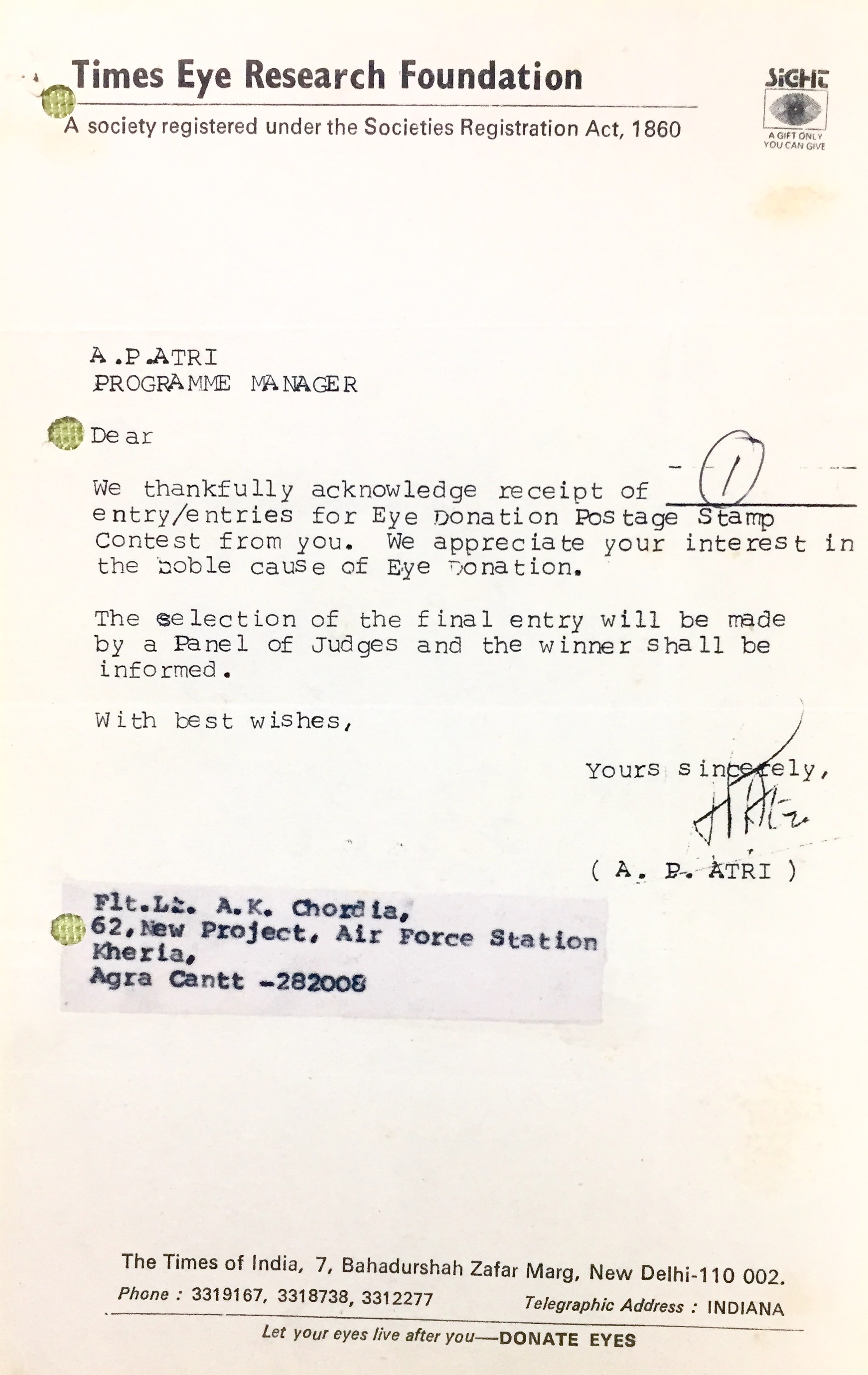
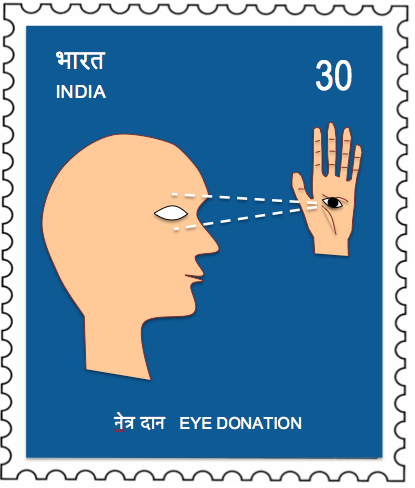
बात अस्सी के दशक की है। टाइम्स आई रिसर्च फाउंडेशन के माध्यम से भारतीय डाक तार विभाग ने नेत्र दान विषय पर डाक टिकिट जारी करने के लिए एक प्रतियोगिता आयोजित की थी। इस तरह के सामाजिक अभियानों में मेरी आस्था ने मुझे इस पहल में शामिल होने के लिए प्रेरित किया। मेरी कल्पना ने एक उड़ान भरी और मैं डाक टिकिट के लिए एक नमूना बनाने जुट गया। जल्दी ही मैंने अपनी प्रविष्टि टाइम्स आई फाउंडेशन को भेज दी।

दो शब्द मेरी प्रविष्टि के बारे में…

नेत्र दान

एक तरफ मैंने एक मानवीय चेहरे का रेखाचित्र बनाया था जिसमें आँख की जगह रिक्त (सफ़ेद) स्थान छोड़ा था जो कि अंधापन दर्शा रहा था। दूसरी तरफ मैंने एक हथेली बनाई थी जिसकी मुद्रा भगवानों की तस्वीरों में आशीर्वाद देते हाथ की होती है। हथेली के मध्य में मैंने एक आँख बनाई थी जिससे निकलती प्रकाश की किरणे अंधे व्यक्ति पर पड़ रही थीं। मेरी कल्पना में हथेली में बनी आँख से निकल कर अंधे चेहरे पर पड़ती प्रकाश की किरणे दृष्टि (नेत्र) दान की द्योतक थीं। मेरे मित्रों ने मेरी कलाकृति की खूब प्रशंसा की थी। निश्चय ही मैं अपने प्रयास से संतुष्ट था। टाइम्स आई रिसर्च फाउंडेशन ने भी मेरी प्रविष्टि को स्वीकार कर लिया था। कुछ ही समय में मैं उस प्रतियोगिता को भूल सा गया था।

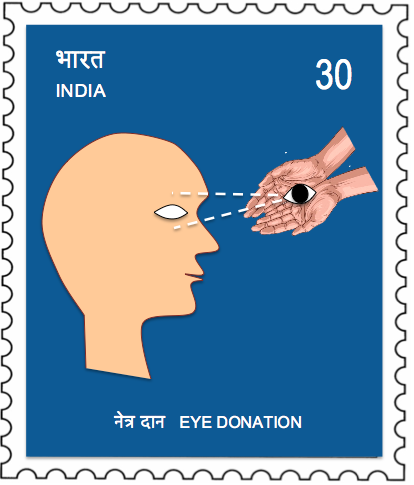
एक दिन, अचानक ही मेरी दृष्टि टाइम्स ऑफ़ इंडिया में भारतीय डाक-तार विभाग द्वारा नेत्र दान पर जारी किये गए डाक टिकिट की तस्वीर पर पड़ी। वह तस्वीर मेरी भेजी हुई प्रविष्टि से बहुत मिलती थी। पहली नज़र में तो मुझे वह मेरी ही भेजी हुई कलाकृति लगी। गौर से देखने पर एक छोटी-सी, परन्तु अत्यंत ही अर्थपूर्ण भिन्नता दिखाई दी जिसने जीवन के बारे में मेरे दृष्टिकोण को सदा के लिए बदल दिया।

नेत्रार्पण

डाक टिकिट के लिए चयनित एवं पुरस्कृत चित्र में एक की जगह दो हथेलियां प्रदर्शित की गयीं थीं। दोनों का रुख आसमान की तरफ था। हाथों की मुद्रा ऐसी थी मानो मंदिर में चढ़ावा दिया जा रहा हो। हथेलियों में एक आँख चित्रित थी जिसमें से निकल कर प्रकाश की किरणे अंधे चेहरे पर पड़ रही थीं––मेरे बनाए चित्र की तरह। अंतर केवल इतना था कि तस्वीर से एक भाव छलक रहा था जो मेरे बनाए चित्र से स्पष्ट रूप से नदारद था –– ‘अर्पण’ करने का भाव। उस चित्र में दाता-याचक का समीकरण नहीं था अपितु दृष्टि देने वाले की विनम्रता और दृष्टि पाने वाले की गरिमा छलक रही थी।

यद्यपि वह डाक टिकिट ‘नेत्र दान’ के लिये प्रेरणा देने के लिए था, उस दिन मैंने ‘दान’ और ‘अर्पण’ शब्दों के अर्थ के अंतर को भली-भांति जाना था; ‘दान’ शब्द में निहित अहंकार को समझा था और ‘अर्पण’ की भावना का अनुभव कर पाया था।

सोचता हूँ, क्या नाम बदलने से लोगों की सोच में बदलाव आ सकता है? क्या लोग दान की भावना को छोड़ अर्पण की भावना को अपना सकते हैं? नेत्रार्पण; रक्तार्पण; देहार्पण?

इस विषय पर इतना लिख कर मैं अपनी कलम को अवकाश दे चुका था। परन्तु मेरी प्रिय बहन की एक टिप्पणी ने मुझे कुछ और शब्द लिखने के लिए उत्साहित किया है। मेरा लेख पढ़कर मेरी बहन ने हास्य-पूर्ण तरीके से मेरा ध्यान “कन्यादान” और “कन्यार्पण” की ओर आकर्षित किया है और मेरी प्रतिक्रिया जाननी चाही है। मैं समझता हूँ कि आज के भारत में इन दोनों के लिए कोई स्थान नहीं है। इनके बारे में सोचना भी पाप है। 

नोट: मेरे इस लेख का उद्देश्य केवल और केवल “दान” और “अर्पण” की भावनाओं में जो अंतर मैंने समझा है उसको अपने पाठकों से साझा करना है। इस में प्रदर्शित डाक टिकिट की जो छवियाँ हैं, वे प्रतीकात्मक हैं। वास्तविक डाक टिकिट और मेरे द्वारा भेजी प्रविष्टि इस लेख में दिखाए गए चित्रों से भिन्न थीं। आशा करता हूँ कि भारतीय डाक विभाग और टाइम्स आई रिसर्च फाउंडेशन, दोनों ही इस मामले को कोई तूल न देंगे।

बड़ी सोच!?

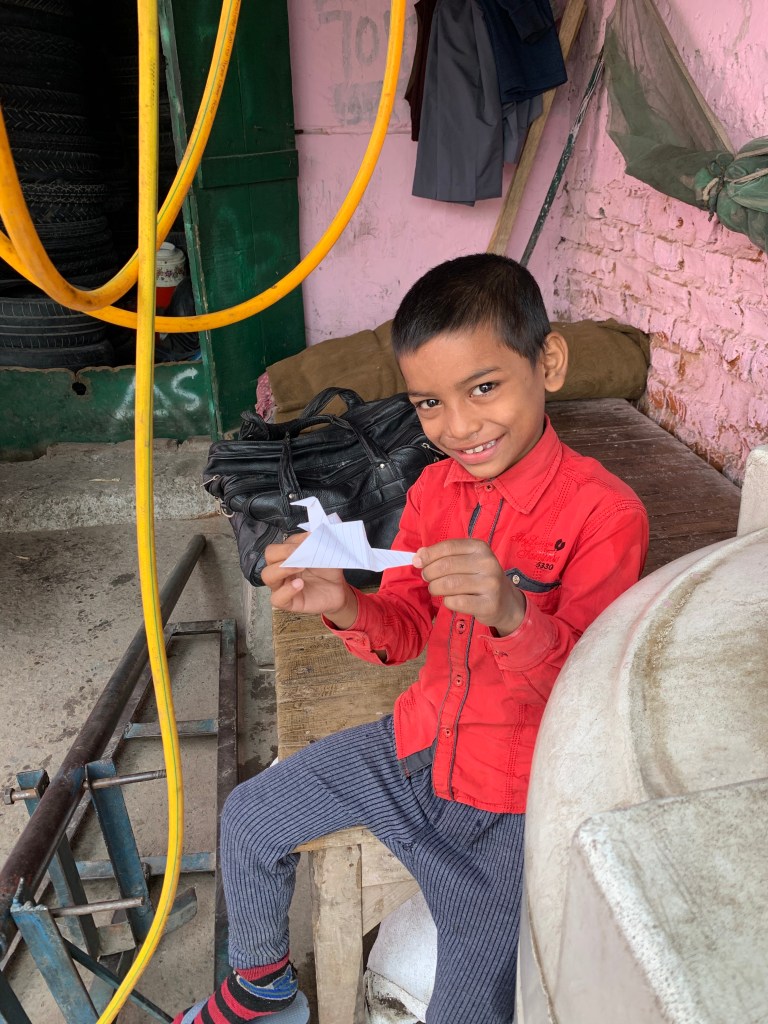
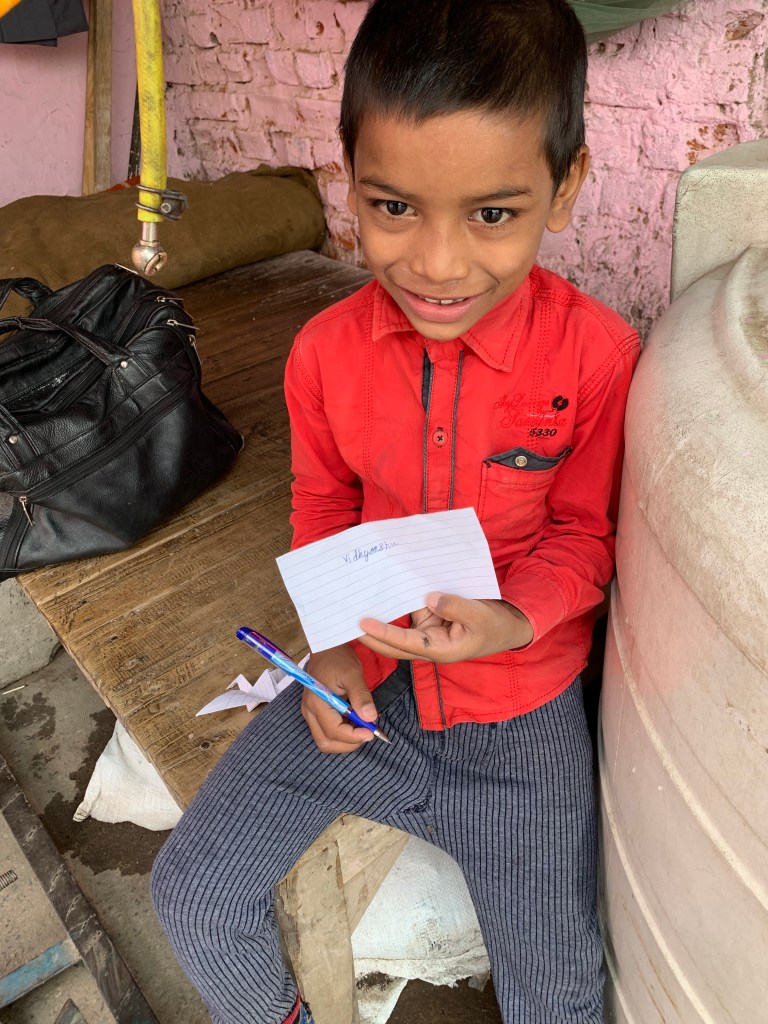
सुबह से करीम बारह कारें साफ कर चुका था। यह तेहरवीं गाड़ी थी। हाथ में कपडा लिए, वह डर-डर कर उस चमचमाती लाल फेरारी कार की तरफ बढ़ा और फिर ठिठका और रुक ही गया। वह नोएडा सेक्टर-18 के रेडिसन ब्लू होटल के सामने पार्क की गयी गाड़ियों पर कपड़ा मार कर दो पैसे कमा लेता था। प्रायः महंगी कारों की सफाई करने से ज्यादा पैसे मिल जाया करते थे। उसके मन में पनपते डर का एक कारण था। पिछले हफ्ते ही एक कार मालिक ने उसकी पिटाई कर दी थी। उसका का गुनाह था––कार के मालिक से बिना पूछे गाड़ी को हाथ लगाना। ग्यारह साल के करीम को दो चांटों के लगने से होने वाली शारीरिक पीड़ा का आभास तक नहीं हुआ था परन्तु अपने साथ हुई बदसलूकी से लगी चोट का दर्द वह भुला नहीं पाया था।

उसने उस फेरारी जितनी आलिशान कार पहले कभी नहीं देखी थी। चुम्बकीय आकर्षण था उस कार में; वह उस के नज़दीक जाकर उसे निहारने लगा। उसका लाल रंग, उसके बम्पर, उसके सामने की जाली, उसकी लाइटें, उसका डैशबोर्ड, उसकी साफ-सुथरी सीटें… एक दम नई थी वह कार। अभी तो उसकी सारी सीटों के पॉलिथीन के कवर भी नहीं उतरे थे और बोनट पर सिन्दूर से बना स्वस्तिक का निशान बिलकुल ताज़ा लग रहा था। स्टीयरिंग पर बंधी माता रानी की चमकवाली लाल चुन्नी, और साइलेंसर पर बंधा काले रंग के धागे का लच्छा कार के मालिक की देवी माता में आस्था को दर्शा रहा था। 

करीम अपने आप को रोक नहीं पाया था; ताका-झांकी कर रहा था। अपने चार दिन पुराने अनुभव को भूल सा गया था। तभी उसने लम्बे कदम भरते एक छः फुटे नौजवान को अपनी तरफ आते देखा। वह मोबाइल पर किसी से बात कर रहा था। करीम सहम सा गया। पल भर में उसे फिर से चार दिन पहले मर्सिडीज़ के मालिक से पड़े झापड़ याद आ गए।

“ओके अनु… तो फिर आज शाम हम गोल्डन ड्रैगन जा रहे हैं। मैं तुम्हें छः बजे घर से पिक अप करूंगा। वी विल गो फॉर अ लॉन्ग ड्राइव बिफोर डिनर,…  बाय बाय! लव यू।” कहते हुए युवक ने मोबाइल बंद किया और करीम पर प्रश्न भरी निगाहें डालीं। करीम ने कार को हाथ नहीं लगाया था फिर भी वह डर-सहम सा गया।

अगर नज़रें क़त्ल कर सकतीं तो युवक की नज़रों से करीम की मौत संभावित थी।

“स स स ररर, कार साफ कर दूँ?” करीम हाथ जोड़ कर मिमियाने लगा। “अच्छे से चमका दूंगा। यह देखिये, यहाँ पर धूल बैठ गयी है।”

युवक को सोचता हुआ देख कर करीम ने थोड़ा साहस जुटाया और आगे बोला, “सर, सिर्फ पाँच मिनट लूँगा।” छोटी सी उम्र में करीम ने यह जान लिया था की बड़े लोगों को अच्छा लगता है जब कोई उनके समय की कद्र करे। युवक को ऐसा लगा जैसे कि करीम ने उसे कुछ और फोन कॉल्स करने का मौका दे दिया हो। उसने सिर हिला कर करीम को कार साफ करने की अनुमति दे दी और फिर से मोबाइल पर एक नंबर डायल करने लगा।

“हैलो, मैं अमित कालरा बोल रहा हूँ… यस, यस, मैंने ही कॉल किया था।  जी हाँ, टेबल फॉर टू… कैंडल लाइट… ओके, कनफर्म्ड।”

अमित कालरा कॉल किये जा रहा था। उन कॉल्स के दौरान उसकी नज़र करीम पर टिकी थी।

करीम बड़ी तन्मयता से कार साफ कर रहा था। कपड़े से पोंछ कर वह अलग-अलग कोण से कार को देख कर तस्सली कर रहा था कि चमक में कहीं कमी न रह जाय। करीम की मेहनत से युवक प्रभावित था। करीम के फटे कपडे देख कर उसे बच्चे पर दया भी आने लगी थी। मन ही मन उसे अच्छी टिप देने का निश्चय कर लिया था अमित ने।

“हेलो भैया, व्हाट अ फैबुलस कार? इट रिएली फ्लाईज़… सुपर्ब… आई एम एंजोयिंग ड्राइविंग इट। तुसि ग्रेट हो। आई लव यू, बिग ब्रदर।” अमित ने एक और कॉल किया।

अमित कालरा आज खुश था। और क्यों न होता? उस के मन में अपनी नई फेरारी में पहली बार अनु को सैर कराने की उमंग जो थी। पर वह असमंजस में भी था, “यमुना एक्सप्रेसवे पर जाना ठीक होगा या डीएनडी पर सैर का आनंद आएगा? आज डिनर के वक्त हिम्मत कर के अनु को प्रोपोज़ कर ही दूंगा। उसे फूल कम पसंद हैं, डार्क चॉकलेट्स ठीक रहेगीं…।”

मई की गर्मी में भी अमित कालरा वसंत ऋतु में खिले फूलों की ताज़गी को महसूस कर रहा था।

न जाने कैसे पंद्रह मिनट बीत गए। मन में चल रहे अनेक संवादों में अमित कुछ इस तरह खो गया था कि समय का पता ही नहीं चला। जब विचारों के भंवर से अमित उबरा तो अपने सामने करीम को पाया। अमित उस गरीब की मुस्कुराहट के पीछे छुपी गम्भीरता को महसूस कर रहा था। अमित ने पर्स खोल कर करीम के हाथ में एक पांच सौ रुपये का नया नोट रख दिया।

निस्संदेह आज कुछ खास बात थी; अमित के मन में उदारता उमड़ रही थी। उम्मीद से बहुत अधिक पैसे पाकर करीम की ख़ुशी का कोई ठिकाना न रहा। उसका चेहरा अब एक खुली किताब था जिसे अमित आसानी से पढ़ सकता था। “सर, ये तो मेरे तीन दिन से ज्यादा की कमाई हो गयी,” करीम ख़ुशी से पगला सा गया ।

“क्या करोगे इन पैसों का,” अमित ने वैसे ही गाड़ी में बैठते हुए मुस्कुराते हुए पूछ लिया। करीम के उत्तर में उसकी कोई दिलचस्पी नहीं थी।

“सर, सीधा घर जाऊँगा। अगले कुछ दिन गाड़ियाँ साफ नहीं करूंगा। पढाई करुँगा। अगले हफ्ते परीक्षा है। इन पैसों से घर का काम चल जाएगा।” करीम की बातें सुन कर अमित के मन में अचानक उत्सुकता और दया के भावों की छोटी सी सुनामी आ गयी।

“कहाँ रहते हो?”

“सर, पास ही में; सेक्टर-52 में जो फ्लाईओवर बन रहा है उसके पास की झुग्गिओं में मेरा घर है। अम्मी वहीँ साइट पर काम करती हैं।”

“कालरा कंस्ट्रक्शंस की साइट पर?”

“सर नाम तो नहीं मालूम पर हमारे मालिक ऐसी ही लाल गाड़ी में कभी-कभी आते हैं। ताड़ जैसे ऊँचे हैं, बिलकुल आप जैसे दिखते हैं।”

अमित कालरा के चेहरे पर मुस्कराहट का आना स्वाभाविक था––कालरा कंस्ट्रक्शंस उसके पिता की कंपनी थी जिसे उसका भाई सुमित चलाता था। अमित ने अभी-अभी एमिटी यूनिवर्सिटी से एम बी ए पास किया था। सी.जी.पी.ए.  बहुत कम था––डिग्री तो नाम के लिए चाहिए थी, आगे चल कर तो घर का बिज़नेस ही संभालना था। घर पर सभी बहुत खुश थे।

“आओ में तुम्हें वहाँ छोड़ दूँगा। मैं उधर ही जा रहा हूँ,” अमित के मन में उदारता और दया भाव ने एक और हिलकोरा लिया। उसने मुस्कुराते हुए करीम को कार में बैठने का इशारा किया। अमित सोच रहा था कि उस गरीब की जिंदगी का वह एक बड़ी यादगार वाला दिन होगा। अमित को ख़ुशी थी कि वह उस बच्चे को एक खास ख़ुशी देने जा रहा था। उसे, खुद को होने वाली अनुभूति में कहीं––थोड़ा सा सही––घमंड घुला हुआ था।

करीम सकपकाया। वह सपने में भी ऐसी कार में बैठने की बात नहीं सोच सकता था। वह कार के खुले दरवाजे की ओर बढ़ा और रुक गया। फिर जल्दी से उसने अपनी टूटी चप्पलें––जिनकी सेफ्टी पिन से मरम्मत की गयी थी––उतारी और उनको थपथपा कर उनकी धूल को निकलाकर उन्हें साफ किया। फिर जल्दी से जेब से एक गन्दा सा कपड़ा निकाला और उसे कार की पॉलिथीन से कवर की गयी सीट पर बिछा दिया––”सर, रुमाल फैला देता हूँ, सीट गन्दी नहीं होगी।”

करीम की ख़ुशी का ठिकाना न था।

करीम की ख़ुशी में अमित आनंदित हो रहा था। सेक्टर-18 के गुरूद्वारे के सामने से निकलते हुए अमित के मन में न जाने क्या बात आयी कि सीधे सेक्टर-52 की तरफ जाने के बजाय उसने जी.आई.पी. के सामने यू-टर्न ले लिया और फिल्म सिटी की ओर चल पड़ा। वह चाहता था कि करीम को थोड़ी लम्बी सैर कराए।

खुश लेकिन सहमा सा, करीम कभी कार में तो कभी बाहर देख रहा था। कार के स्टीरियो पर बजते गाने की आवाज़ कम करते हुए अमित ने बोलना शुरू किया, “कैसा लग रहा है?”

“बहुत अच्छा,” पुलकित करीम चहचहाया।  

“जानते हो, मुझे यह कार मेरे भाई ने मेरे बर्थडे पर गिफ्ट में दी है?”

“अच्छा!?” करीम की आँखों में प्रश्न और विस्मय से भरी प्रशंसा थी।

“वे तो मुझे रेंजरोवर देना चाहते थे पर मैं फेरारी के लिए अड़ गया,” अमित खिलखिलाया और फिर जोर देकर बोला, “… … सोच बड़ी होनी चाहिए।”

ये बातें करीम की समझ से बाहर थीं। फिर भी वह जवाब में आँखें बड़ी कर के सिर हिला रहा था।

“और घूमना है?”

“नहीं सर, बस अब मुझे उतार दें।”

“कोई बात नहीं, मैं तुम्हें साइट पर छोड़ दूँगा।”

महामाया फ्लाईओवर की ओर से एक लम्बा चक्कर लगाते हुए अमित ने कार को सेक्टर-52 की झुग्गिओं के सामने ला कर रोक दिया और करीम की और देख कर एक बार फिर मुस्कुराया, “परीक्षा के लिए बेस्ट ऑफ़ लक।”

“थैंक यू, सर,” करीम ने कार का दरवाज़ा खोलने की कोशिश करते हुए कहा। उससे दरवाजा न खुलते देख अमित ने मदद की। कार से उतरते-उतरते करीम रुक गया और अमित की ओर देख कर विनती की, “सर, प्लीज एक मिनट रुक जायें, मैं अभी लौट कर आता हूँ।”

करीम की मेहनत और लगन पर फिदा अमित ने हामीं भर दी और अपना मोबाइल उठा लिया और व्हाट्सएप मैसेजेस देखने लगा।

दो ही मिनट में करीम वापस आ गया। उसकी गोद में एक छोटा सा बच्चा था जिसे वह बड़ी मुश्किल से उठा पा रहा था। कार के पास आकर वह अमित से बोला, “सर, ये मेरा भाई आरिफ है।” फिर आरिफ को ऊँगली से दिखा कर बोला, “आरिफ, पता है, आज इन साब ने मुझे इस मोटर में बिठा कर घुमाया है। ये इनके बड़े भाई ने इनको तोहफे में दी है। एक दिन मैं भी तुझे ऐसी ही गाड़ी तोहफे में दूँगा।”

अमित ने एक मिनट बाद कार आगे बढ़ा दी। फिर देर तक कार के रियर व्यू मिरर में दोनों बच्चों को खिलखिला कर टा-टा करते देखता रहा।

“सोच बड़ी होनी चाहिए।” अमित की अपनी ही आवाज़ उसके कानो में गूँज रही थी।

Dear Mr Kejriwal, are you listening?

Dear Mr Kejriwal,

You began your journey of sweeping the muck in Indian Politics with baby steps alongside Anna Hazare. Soon you outpaced him; the old soldier could not march by your side. You left him behind. Nothing is wrong about that decision of yours because when a mission is still unaccomplished; it is not incorrect, unfair or unethical to leave behind the weak and the wounded. They can be attended to; their wounds nursed, and their contribution to the war effort can always be lauded after the flag has been hoisted on the objective. In some cases, a nicely worded epitaph can make up for everything.

The problem is of shifting goal posts and ever-changing objectives. Selection and Maintenance of Aim is a principle of war. It is difficult; nay impossible to recall a victory wherein this proven principle has been flouted. Needless to say, the journey is long and arduous; you have miles to go. Be sure what you want to aim at: purifying Indian politics or uplifting aam admi or uprooting BJP with the help of others with whom you otherwise don’t see eye to eye. 

I hear you have done remarkable job in some walks of Delhi’s life; your team’s effort to provide quality education and healthcare is, beyond any doubts, unparalleled; it deserves a very special mention and appreciation. May you have the resources, power and support to keep going great guns.

Now, how does one keep going when people are jumping off the bandwagon at regular intervals? Some members of your core team who have left you have compared you with Napoleon. Napoleon––not the French Emperor, but the Napoleon of George Orwell’s Animal Farm. And, Ms Shazia Ilmi thinks she was the Boxer (of the same epic). Others who left you also perhaps thought so, but didn’t say it openly. But, you don’t have to worry on that count. Animal Farm, written nearly three quarters of a century ago as a satire on communism fits Indian politics of today. It fits very well! Rejoice in the fact that you don’t stand alone––every party has Napoleons. When I look at you (people) dark humour amuses me to no end.

That’s just the preface to draw your attention; what follows is more serious. I only hope you have the time, and the inclination too, to read on.

What has struck my imagination recently is your decision to consider granting free travel to women in DTC buses and Delhi Metro. The reason you have extended this proposal is––women’s safety. It baffles me to no end. How can making the ride free for women in public transport enhance their safety? A large number of women can afford public transport and are already availing DTC and Delhi Metro services. The additional number of women who will get attracted to (government) public transport because of the freebie will be miniscule. And, if I am not grossly wrong, in these times of #MeToo, by this very gesture of yours, you might end up offending many a self-respecting woman who seek absolute equality in thoughts and actions.

If you still implement your plan, I fear that you will start a practice, which will nurture yet another breed of people getting used to free lunches with added burden on the state. Mind you Mr Kejriwal, the public are smart. Blame yourself for it; you made them smart. I remember you telling them long ago, to accept whatever freebies (and bribes) other parties were giving, and still vote for AAP. I will not be surprised if, in the next assembly elections women do just that––accept your freebie and still go by their choice.

Freebies

Think of it, there are umpteen ways of making women safer than by just giving them free rides. Directing the resources and energies towards, and focussing them on the source of crime can make people, let alone women in our cities safe.

I have a suggestion, if you care.

We have a large population living in slums all over the city, on footpaths, and under the flyovers. People living in those places work as labourers on construction sites and as servants in bungalows, offices and factories. The stark reality is that Delhi “needs” them. Delhi cannot do without them––Delhi will come to a standstill if they are not there. Their children sell pirated bestsellers, used flowers, hand towels and ballpoint pens on traffic lights. To earn a livelihood, some of them take to crime. And, if one was to go by what our films depict, they are picked up by bigger fish to get their works accomplished.

Such places where survival is a daily chore, people are vulnerable. Those places can easily turn into nurseries for crime.

Convert those slums into double-storey accommodation with the very basic amenities (drinking water, sanitation and electricity). Give them medical facilities and schools. That will demolish some of the nurseries where little ones get to learn their basics of crime. How so ever difficult it might appear, it is achievable. All that is required is a strong will to do it.

A single court decision in the US––to legalise abortion––brought down the crime rate drastically. But that took nearly twenty years. If you give a decent livelihood to the poorest of the poor today, it is just likely that the positive effect might be felt twenty years hence.

Are you ready to wait that long, Mr Kejriwal?

Remember, a lot can be achieved in this world, if one is not bothered about who gets the credit for the achievement or, who reaps the harvest. Are you ready to switchover from the alleged Napoleon’s role to that of Boxer’s in the yet-to-be-conceptualised Animal Farm Revisited? Keep the answer to yourself.

At this juncture, may God bless you with the wisdom to choose the right path.

Yours truly,

Group Captain Ashok K Chordia (Re-attired)

An Indian Air Force Veteran

Cooking the Goose of the Gender

It is important to make sure that one doesn’t offend people by inadvertently using language that might be considered sexist. In these times of #MeToo, it is even more important to mind one’s P’s and Q’s. For several decades now, many words and well-accepted expressions have come to be seen as discriminatory––discriminatory against women, in particular. It could be because of the nature of job being done mainly by men in the bygone days e.g. businessman, postman and fireman etc. Some other words give a distinctly different identity to women than their male equivalent (e.g. actor/actress; mayor/ mayoress, steward/stewardess, heir/ heiress, hero/ heroine, manager/ manageress). Some of these words, while giving the women a different identity have, over a period of time, come to convey a somewhat different status for them.

Feminists and well-meaning people on either side of the gender divide have been trying hard to remove the bias in the language. So now we have words like chairperson or chair (instead of chairman), head teacher (instead of headmaster/ headmistress). Mrs, for a married woman is passé; Ms is the right form to use. It is also customary now to use a term, which was previously used exclusively for men to refer to both men and women. For example, authoress, poetess and actress, have been replaced by author, poet and actor. The more conscious of the English language users have begun using human race or humankind instead of mankind. And until acceptable words/ terms are coined, words like princess, tigress, lioness, abbess, duchess, usherette, seamstress and seductress etc. will remain in use. One is less likely to take offence.

We do not mind using he/ she, him/ her and his/ her any number of times in our correspondence to remain gender neutral. Here are some examples:

  • He/ She (the candidate) must report at the reception by 10 am.
  • The HR department will inform him/ her about the likely dates.
  • A scholar is expected to submit his/ her report in a month.
  • The student can seek advice from his/ her

While the linguists and the feminists have been striving to achieve gender neutrality, people are exercising their right to cook the goose of the gender. I know of a lady from the Hindi heartland of India who prefers to use the male verbs (in Hindi) for herself e.g. करता हूँ, खाता हूँ, जाता हूँ,… etc.

Mrs Indira Gandhi didn’t like to be called ‘Madam’. Legend has it that once when she was on a state visit to the US, the American President wanted to know (through the then Indian Ambassador, Mr BK Nehru) how to call her, “Madam Prime Minister or Prime Minister?” She said, “Tell the President I don’t care what he calls me; he can call me Mr Prime Minister or just Prime Minister. But tell him also that my colleagues call me Sir.”

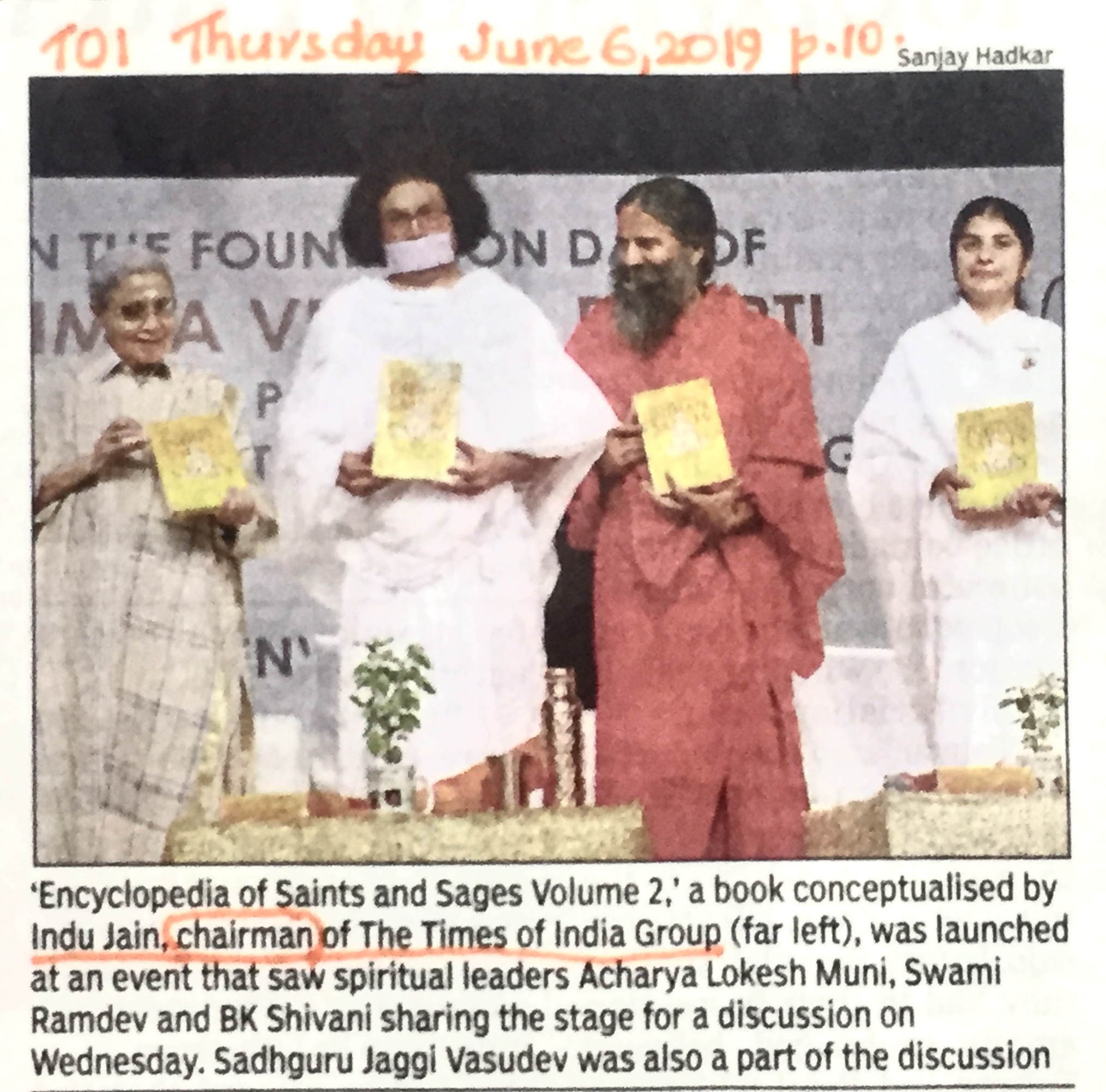
TOI Gender IMG_9170
Cooking the Goose of the Gender

Are the editorial staff of the Times of India following in the footsteps of Mrs Gandhi’s colleagues?


The Red Marble & Thieves

I guess you remember Kanti, the little entrepreneur who wanted to make a fortune by growing lemons on his head.

So, without ado, I bring you here another episode from his eventful childhood. It might evoke different emotions in you––from humour to sympathy to indifference––depending on what strikes your imagination.

But, for Kanti it was a traumatic experience. Read on…

One evening, Kanti came charging into the house and began rummaging the only drawer he was assigned in a chest of drawers to keep his belongings. It was a little beyond his reach even when he stood on the tips of his toes; he had to climb a stool to reach it. That inability to access his drawer was one of the main reasons he wanted to grow tall, really soon. And, that was the reason he accepted everything his mother gave him. “Eat it; it’ll help you grow tall,” she would say.

Kanti grew desperate as he looked for something, which seemed to evade his eyes. In a last ditch effort, he pulled out the full drawer, the weight of which, his tiny frame couldn’t bear. And, lo and behold, he lost balance and fell to the ground with a massive thud. All his toys came tumbling out––three cars, two tennis balls, crayons, pencils, a kaleidoscope, a piece of coloured glass, a top, Ludo and Snakes & Ladders board and a dozen other things.

“Maaa… heelppp!” Kanti yelled as he fell.

“What happened?” Maya, a concerned mother ran out of the kitchen in response to the distress call of her little one. She was aghast at the sight of Kanti lying spread-eagled on the floor facing the roof, a bit dazed; the drawer see-sawing on his little chest and a dozen and more marbles still traversing different paths on the floor in the hope of finding a state of equilibrium.

“Oh my God!” She staggered, “What happened? I hope you aren’t hurt, my child!?” She enquired with great concern even as she stepped on a marble and tripped and tumbled. Only a heavenly intervention enabled her to grasp the arm of a dining chair and avoid a fall. In one quick action she removed the drawer from Kanti’s chest and helped him on his feet.

“I’m fine,” said Kanti. But a face contorted by a spasm of pain, and a clearly visible limp in his gait gave away his actual condition.

“What happened,” was the repeated question, the doting mother asked as she hugged him and looked for signs of injuries.”

“Nothing really!” said Kanti. “I was looking for a red marble.”

“Now Kanti, you could have waited for me, as you always do. I would have helped you with it.”

“But you were in the kitchen and I was in too great a hurry. I couldn’t have waited.”

“Couldn’t have waited…. What do you mean?” Maya distorted her eyebrows to lay stress on the questions.

Unmindful of Maya’s concern, Kanti started picking up the marbles strewn on the floor. He was still looking for the ‘red’ marble.

Maya gave a glass of water to Kanti who still appeared hassled. “Tell me, what is the matter? And, look there. Yes there, under the chair. There’s your ‘red’ marble.” Maya said as she pointed at it.

The Red Marble

Greatly relieved, Kanti picked up the ‘red’ marble and pocketed it. He then hugged her mother tightly (Shashi Tharoor would rather have called the hug, a “kwtch”. A “kwtch” is more than a hug).

“Maa, you have saved me from ending up in prison.” His eyes welled and a tear rolled down his little pink cheek.

Maya’s face wore a big question mark.

“It’s like this… This morning I was playing marbles with Dinesh when he was called by his mother. He quit the game but left his red marble in a hope to re-join soon. But he did not return. So I picked up all the marbles and returned home. I carried his “red” marble too, to hand it over to him later.”

Curiosity was killing Maya: “Ending up in Jail? Red marble? What was going on in Kanti’s mind?”

Kanti continued with the seriousness of a grown up.

“Just a while ago, when I was playing outside with Veena (remember Veena? Kanti’s cousin of his age, and his living encyclopaedia of worldly knowledge) we saw a policeman passing by. In his tow was a handcuffed man. Veena told me that he was a thief being taken to the jail where he would be kept away from his family and friends for many days. She told me that a thief is a person who takes away someone else’s belongings without the owner’s consent. She also told me that…”

“Of course, thieves get punished. So how does that bother you?” Maya was impatient and wouldn’t let Kanti complete his story.

“I have taken Dinesh’s red marble without his consent. I am afraid the police will jail me for being a thief. I don’t want to be away from you and Dad,” sobbed Kanti.

“Oh my dear. You are not a thief. You have taken the marble only to help your friend. Thieves take away things with bad intention; not to return them,” Maya allayed Kanti’s anxiety. “Now go and handover the marble to Dinesh.”

Kanti was panting when he returned from Dinesh’s house. Maya smiled at him. “So that’s the end of it.” She thought.

She couldn’t have been more wrong.

Later, in the evening at the dinner table the three––Kanti, Anil (his father) and Maya––exchanged notes on how each spent the day. That was the family’s way of unwinding every day. Maya was the first one to speak. She had nothing to talk about her day. So she told Anil about the red marble and Kanti’s woe that afternoon. She chuckled as she shared the incident. Anil struggled to hold back the impulse to smile at the story when he saw a quiet Kanti lost in some thoughts.

“So Kanti, did you return the red marble to Dinesh,” Anil asked Kanti to get him involved in the conversation.

“Yes Dad, I did… and Dinesh was happy to get it back.” Kanti still wore a blank look. His discomfiture couldn’t escape Anil’s eyes.

“Is there something still troubling you, Kanti?” Anil poured all the tenderness that a caring father could in that question.

“Dad, Veena told me a lot of things about the thieves and the jail. She told me how they make the inmates clean, sweep and work hard in the jail. The police even shave off their heads.” Anil was all ears, nodding occasionally as he absorbed Kanti’s bits.

Then Kanti paused and looked around as if to make sure that no one else was listening. Once assured of the privacy, he brought his mouth close to his father’s ear and started talking in a hushed tone. “And Dad, do you know…?” He glanced around the room again and spoke in a whisper, “We are surrounded by thieves! Brij Mohan Bhaiya (the milkman), Ramu Bhaiya (the dhobi), and… even Ramesh Uncle (Major Ramesh, a friend of Anil)––all of them have shaven heads. As Veena said, they must have served sentences in the jail.”

Rest of Anil’s evening, and the following weekend was spent in convincing Kanti that all men with shaven heads were not thieves. Anil realised how easy it was to teach a child a new thing rather than erase things from its tender mind.

Of Two ‘Swastika’

For centuries, cultures across the world have used the Swastika as a sacred icon. Literally, the word Swastika is formed of two Sanskrit words ‘सु’ (meaning ‘well’ or ‘good’) and ‘अस्ति’ (meaning ‘to be’). Most Indian scriptures depict it as a symbol of well-being. For a religious-minded in India, it symbolises two Gods. One is the Goddess of wealth and prosperity––Maa Laxmi. And the other is the God of all wisdom––Lord Ganesha. Hindus, Jains, Buddhists and a large number of Eurasians regard and revere the symbol––auspicious ceremonies commence with the worship of the symbol.

For some, Swastika comprises four elements––earth, air, water and fire. It adorns the walls of places of worship. People treat it as a symbol of positive energy and good luck. From divinity and spirituality to auspiciousness and good fortune and from religiousness to mysticism, Swastika evokes many feelings (to say nothing of Hitler’s Swastika which sets afire an entirely different emotion).

A Swastika can be drawn in two ways. One: with the outer elements drawn in a clockwise direction. And two: with them being drawn in the counter clockwise direction. Drawn any which way, a Swastika is a lot more than the simple geometric figure it appears to be. Visit the famous Chintaman Ganesh Temple in Ujjain to feel the power and the magic of the two Swastika.

Chintaman Ganesh Temple, Ujjain

The Chintaman Ganesh Temple is located on the outskirts of the holy city of Ujjain known for its glorious past. King Vikramaditya ruled here and Kalidasa wrote the epic Shakuntalam and Meghdutam in the serene atmosphere on the bank of the Shipra River.

According to the scriptures, Lord Rama stopped here for a while during his fourteen years in exile. Finding things amiss, he established the temple to get the blessings of Lord Ganesha. Laxman, on his part shot an arrow into the ground to create a well to provide water for a thirsty Sita to drink. The well called Laxman Baori is located next to the temple.

Laxman Baori

And now about the magic of the two Swastika

People from far and wide visit the temple with the hope of getting their wishes fulfilled. The faithful believe that if one draws a Swastika (anticlockwise) and makes a wish after praying to Lord Ganesha in the temple, the wish comes true. And then––when the wish is fulfilled––one is expected to re-visit the temple and draw another Swastika (clockwise, this time on). Looking at the hundreds of Swastika drawn on the temple’s walls––both anticlockwise and clockwise––one can gauge the popularity of the Temple.

Swastika and the Sacred Thread

Lately, people have started complementing the Swastika with a sacred thread for the same effect. One ties a thread while making a wish and removes it (or any other thread) when the wish is fulfilled. Thousands of sacred threads tell a tale of belief.

Wishes, unfulfilled and the fulfilled

Some of those whose wishes are fulfilled have a curious way of conveying their gratitude to the God. They weigh themselves in clothes, blankets, sweets or milk or food grain and donate the same to the poor. The poor and the transgender thrive on the generosity and the largesse of the blessed ones. At all times, the temple is thronged by two categories of people––those with wishes to be fulfilled and those, whose wishes have been fulfilled. The first category includes the newly married couples.

Gratitude by weight
To be happily married forever

The next time when there’s an exam to be cracked; a heart to be won; a family feud to be resolved; a lottery to be won; or, peace to be restored in a tumultuous life––think of the two Swastika and the Chintaman Ganesha Temple of Ujjain (sixty kilometres from Indore Airport in Madhya Pradesh).

That, of course, after you’ve done your bit.

Wishes! Wishes! Wishes!