
The date and the year are of less consequence; it was a hot April afternoon. I saw the three of them walking on the footpath in Subroto Park and offered them a lift. They got into the car hesitantly.
“Thank you Sir. I am Ravindra Sharma, he is my brother Navin and he is my son, Ajay (names changed),” one of them broke the ice as they settled in the car.
“I am Group Captain Ashok Chordia,” I introduced myself and asked, “Where do you want to go?”
“We have to board a train from Nizamuddin railway Station. It will be kind of you, if you could leave us at the nearest bus stop on your way,” he urged.
“The Station is on my way. I’ll leave you there.”
“So nice of you, sir.”
Then there was prolonged silence. The three sat quietly, perhaps not knowing what to talk about. I have experienced this type of a mix of reticent and introverted behaviour on the part of simple people in the presence of strangers. In the presence of service officers, the behaviour seems to be more pronounced.
It was going to be a fairly long (15 kms) drive along the Inner Ring Road and was going to take in excess of 30 minutes. Silence with four people sitting in the car would be menacing.
“You don’t seem to belong to Delhi?” I initiated a polite meaningless conversation.
“Sir, we belong to Kota. We were here for a counselling session for Ajay.”
“How was it? What does your son intend doing?”
“Just so. I am disappointed with his board exams result,” said the father with concern.
“What’s the matter?”
 “Sir, he has scored 94 per cent marks. He just doesn’t read. If he studies properly, he can get more marks. He wants to do engineering. Why don’t you advise him, please?”
My jaw dropped. “Here is a father dissatisfied with his son scoring enviable marks, and he wants me to guide him? What advice do I render to a kid who in my assessment is brilliant,” I wondered.
I did not want to disappoint the father so I continued talking. In a while I realised that the boy was very intelligent and could understand concepts rather fast. Therefore he used to take less time as compared to others to complete his assignments. Repetition used to bore him and that’s where his ideas conflicted with his father.
With much thought I came out with a piece of advice to him, “If you read more books of each subject you will have a deeper understanding of the concepts. Solving question papers and numerical problems from different books will give you a strong base. Lastly, if you still have time, devote it to improving your communication skills––an effort that will stand you in good stead, what ever you do later in life.” All three were listening to me intently.
“Sir, I’ll do as you have suggested,” assured Ajay.
“That’s good. You are capable of better performance and must try to exploit your ability to grasp things fast to broaden your knowledge base and communication skills.”
The father was happy with the interaction. At the railway station, I took him aside and advised him to give a freer hand to the boy to manage his studies. I told him that meddling with his approach to academics might be counter-productive.
The chapter was over, I thought.
Not really!
A month later, I received a call from Ravindra, “Sir, you have cast a magic spell on my son. He is a transformed person now. I want to thank you for making a difference.”
“I am happy to hear that. I hope he continues to work that way. Convey my good wishes to him.” We exchanged some niceties before disconnecting.
It was not over yet.
A few months later, I received another call from Ravindra, which put me in a very difficult situation. “Sir, I am in dire need of your advice. Ajay wants to take a sabbatical and prepare for IIT entrance examination. If he doesn’t get through, a year will be wasted. What shall we do?”
In a few seconds which seemed to last an eternity, I gave a thought to Ravindra’s request for advice. I realised that he had called me with great hope. I found it difficult to turn down his request. But then, what advice could I give him?
I collected my thoughts and organised them in the few seconds in which we exchanged less important information. Then I started, “Ravindra, our lifespan is 75 to 80 years if we lead a decent life. One year in a lifespan of 75-80 years is a small fraction; it is insignificant. If you allow, Ajay to have his way, he will put in his heart and soul in the preparation and, in all probability, he’ll get through. It will be great if that happens. If he doesn’t get through, the hard work that he puts in through the year will not go a waste. The knowledge that he will gain, will stand him in good stead in whichever college he joins subsequently. Besides, if he doesn’t make it to the IIT, he will come to know of his limitations. One last thing… if you let him take a sabbatical wholeheartedly and support him in his endeavour, without bothering about the end result, he will love and respect you more than he does now. I feel he deserves your willing support.” Ravindra thanked me profoundly for sharing my thoughts.
For the next few months, I waited eagerly to hear from him. There was silence.
Much later, when I had forgotten everything, Ravindra called me again. It was a courtesy call. “How do you do, Sir!? All’s well here. Ajay is doing very well. He’ll be an engineer soon. He joins me in conveying regards to you for all the valuable advice you gave us.”
“That’s heartening. What about the sabbatical? Did he take it? Did he get through to IIT?” I was curious to know.
“Sir, I gave him a free hand; told him to go ahead and take a sabbatical and prepare for IIT. But then he decided against it. He got admission in a college of his choice and a course of his liking. I’ll keep you posted of his progress.”
Ravindra has been calling me occasionally to share his little joys.




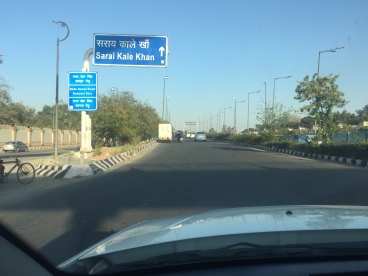 away on the other side of the road. Several cars passed her before I reached her. There was light traffic on the Barapullah Elevated Road that day.
 an, Abdullah Luthufee. I was a part of the team that landed at Hulule airport to respond to the SOS call of the Maldivian President.
 available on that day. The risks were calculated and catered for. The spirits were high. A determined Brigadier FFC Bulsara wrote the following message for me hours before we landed at Hulule: “We’ll secure the airstrip and the President by 1000h tomorrow.”
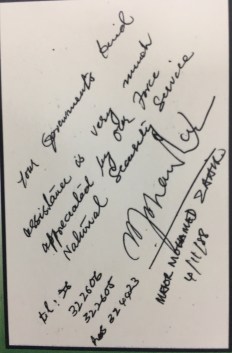 A Maldivian National Security Service (NSS) officer, Major Mohammed Zahir wrote a note on my scribble pad. The note speaks about the Maldivian sentiment at that time: “Your Governments kind assistance is very much appreciated by our Force. National Security Service.” He also presented me a cap badge and a formation sign of the NSS as souvenir.
 the country is heavily in debt. The population seems ignorant; the leadership has fallen into a trap from which it would be difficult to escape. Needless to say, Chinese gains have been at India’s cost. The pro-China sentiment is expressed in a hoarding which was put on the China-Maldives Friendship Bridge when it was under construction: “Waves are gifts from God. Bridge is a gigt from CHINA!”
 If the recent elections are to go by, democracy is still alive and kicking in the archipelago. Opposition candidate, Ibrahim Mohammed Salih has defeated the present (pro-China) incumbent, Abdullah Yameen. The former President, Mohammed Nasheed has recommended a review of the agreements with China. For India, this might turn out to be an omen of recovery of ties with the Maldives. It is an opportunity to put back the relations with the Maldives on firm footing.
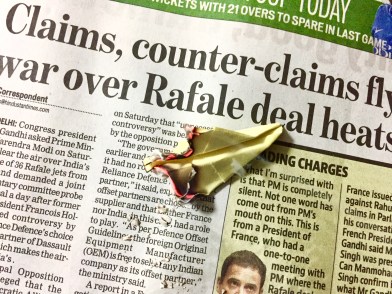 The Brahmastra has been launched. Now, frantic effort is ON to decide as to who or what should be the target. The effort is to ensure that the missile hits a target (anything that could be labelled as a target) before it runs out of propellant. And it must happen before the Lok Sabha elections scheduled next year.
 of hours in fighter aircraft. He is the one who flew solo in a MiG-21 aircraft soon after taking over as the Chief displaying rare and exemplary military leadership!
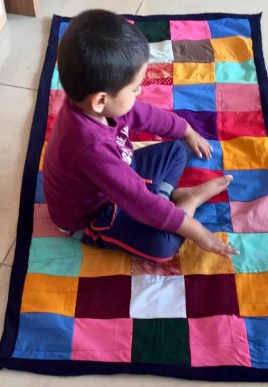 Kartik feels victorious when he is able, not only to point, but also count the squares of a particular colour. Sitting in Padmasan, the Lotus Posture on the same mat and performing some other actions form a package deal of challenges, which he enjoys accepting.
 “Beta, it is difficult. Do you think you can really do it?” She made the exercise of whipping the curd sound like a highly technical job.
 “Small bets make you fight; they get the best out of you.” That suggestion from a fellow golfer had appealed to me and I had got into what I thought was competitive golf. The bet used to be modest: breakfast on the loser, or meagre amounts that would be barely enough to pay the caddie. Howsoever small those amounts were, there used to be a great charm in winning. If nothing, honour used to be at stake. No wonder, the hundred-rupee note that I won for hitting an Eagle on the seventh hole, signed by the fellow golfers (those days scribbling on currency notes was not considered an offence) became a trophy of sorts for me.
 Last Monday, playing nine holes after six months, I had three pars; two of them were missed birdies. Rest of the game was decent, mostly bogies, and an odd double bogie. For me, that’s a great performance. It can give me wings to soar for the next six months. But that is not what made my day. My day was made at the Noida Golf Course when I went there later in the afternoon to witness a Golf Tournament organised for the caddies.
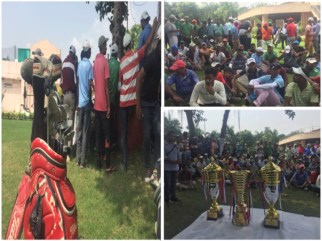 The golf bit––the gross scores, the net scores, the longest drive, the closest to the pin… and the prizes––was like any I had seen in so many places. What touched me was a team of people talking passionately to them about L-I-F-E. Trying to talk them into looking at their lives and think about improving it. I did not know the people who spoke, but I remember the passion with which they were trying to influence their minds. They spoke to their families too––their wives and children who had come well dressed for the occasion. They had cast a spell on the lot. At the end of it, they seemed determined to rise and shine in life.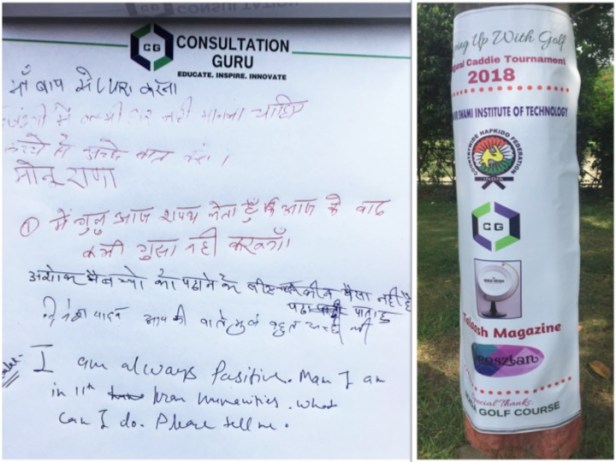
 Once, at a traffic light I saw a kid hanging out of a school bus. He was unwell and was trying to throw up. He was relieved when he drank some water from my bottle. The bottle of water has also provided succour to people in similar state, standing by their cars parked by the roadside. Interestingly, the number of times this bottle of water has quenched the thirst of dried up car radiators is large.
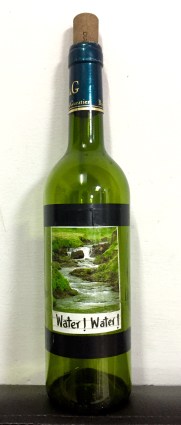 When I started, I used to be carrying water in a plastic bottle. Then came the warning that drinking water from a pet bottle kept in a car parked in the sun could cause cancer. So I started using a beautiful wine bottle. Green glass and a cork––it looked good! Very good, indeed! It became the envy of friends who saw it.
 Road Much Travelled