“Some paths trodden by Gen Z do not pass through Jantar Mantar.”
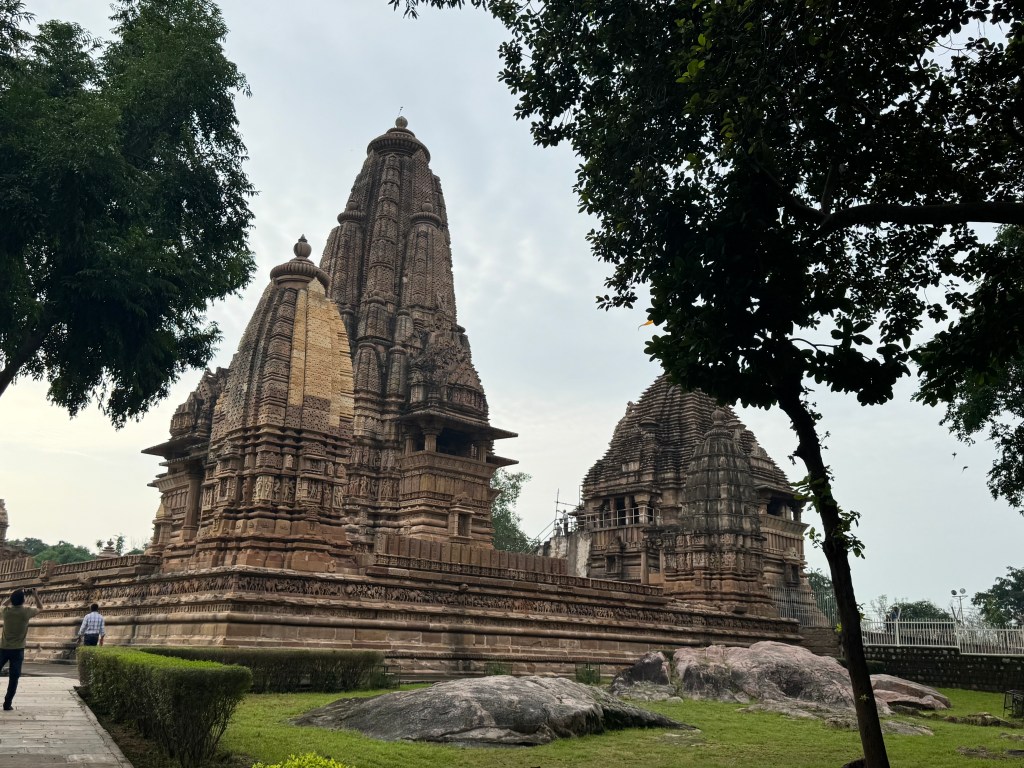
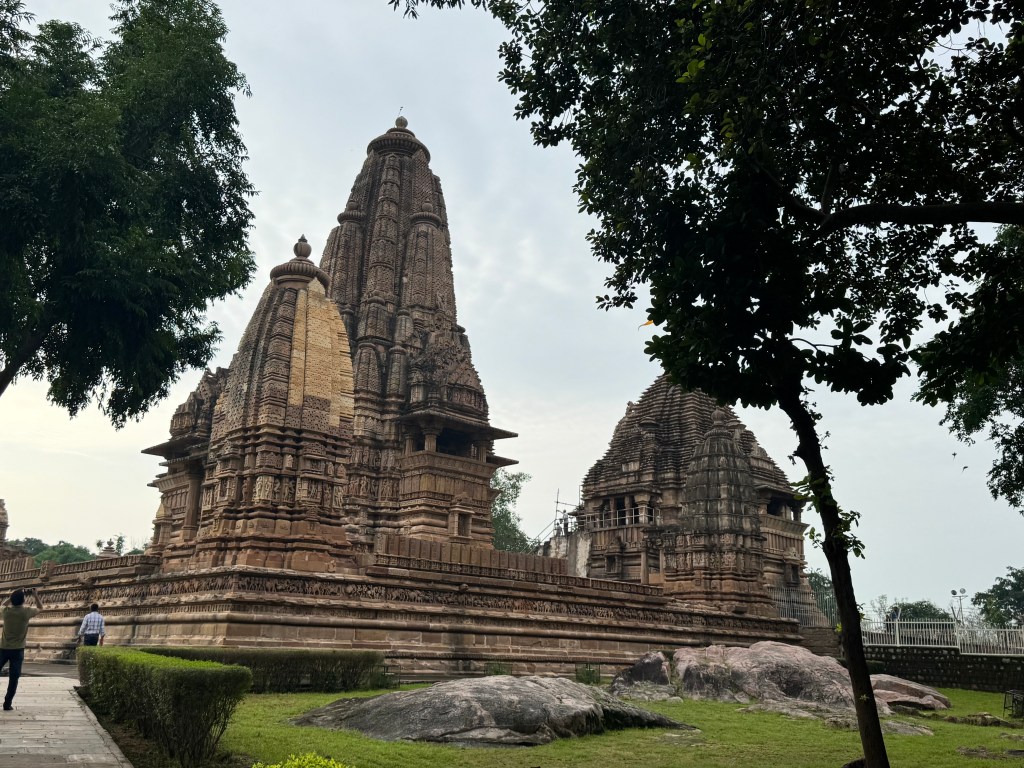
There is something quaintly amusing about my visits to the Khajuraho temples. My first trip, more than forty years ago, was a 75-minute whirlwind tour, including the journey from the airport to the site and back. The circumstances in which I saw the sculptures were far more memorable than the monuments. I have written about that trip in an earlier post: “The Unforgettable Throttle Dutt and his Flying Machine.”
My second trip to the heritage site last weekend likewise became memorable for a reason quite apart from the grandeur and beauty of the place. A chance meeting and interaction with a rare specimen of Gen Z gave my excursion an entirely unexpected significance and meaning.
O Khajuraho!
It happened when the train stopped at Gwalior Railway Station and I got up from my seat to stretch my legs.
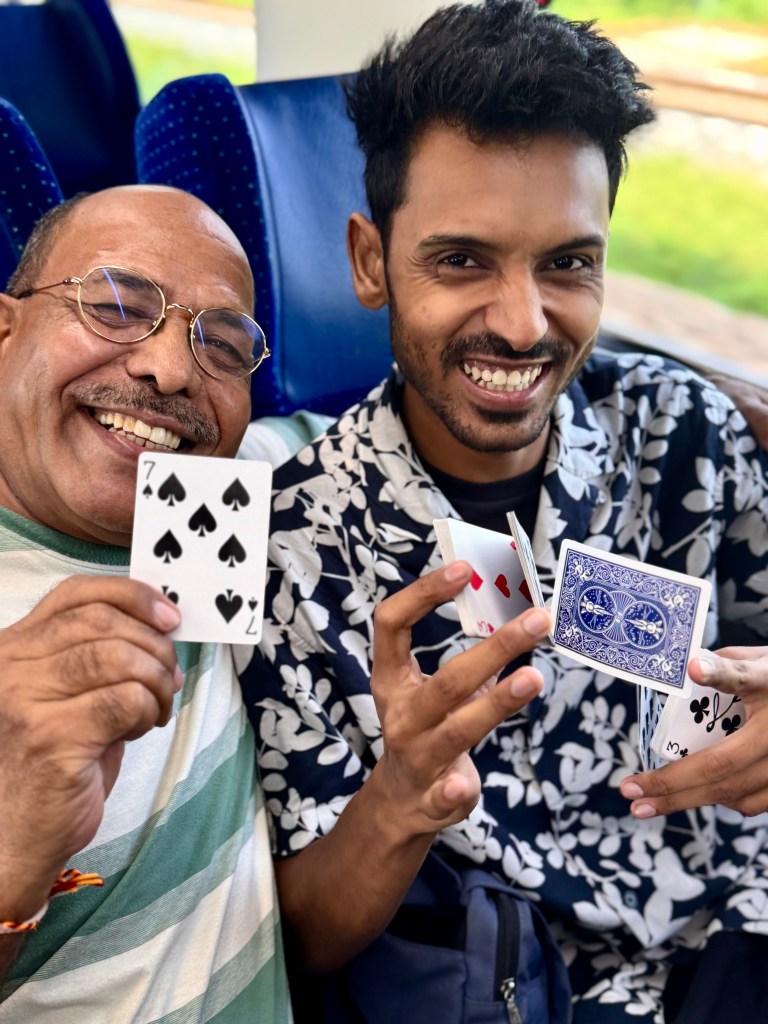
“Sir, please hurry up if you are getting down here. The train will start any minute,” Sonu Diwaker said to me with deep concern. He was seated alone at a window seat—the seat next to him was vacant.
His stubbled chin, uncombed hair, listening pods stuffed into his ears, floral shirt, cargo trousers, sports shoes, the glow in his eyes and, above all, his body language made me take him for one of those Gen Z youngsters who had made news a month ago.
How wrong I was! He wasn’t it. He wasn’t one of them. Rather, in the ensuing interaction, I discovered a focussed gem of Gen Z in him.
I looked him in the eyes and said without the words leaving my lips, “Yes son! Talking to me?”
When he saw that his words didn’t inject any urgency in me, he removed his ear-pods and spoke again, a bit subdued this time, “The train is about to leave, Sirr…” He stopped midway, sensing that I had no intention of disembarking.
“How do you know, I have to get off the train? Do you read minds?” I grinned.
Now it was his turn to chuckle. He said excitedly, “Of course, Sir, I am a mentalist. I read minds, predict choices and influence decisions.”
“O my God! Can you read my mind?” I asked him and sat down next to him.
An audience is as important to performing arts as a believer is to a miracle. Through the following hour, I was Sonu’s cherished believer. For me, he was a coveted book I wanted to read.
He took out a pack of cards and in minutes stole 60 years from me and turned me into an ecstatic child of seven who wondered, “Is he the reincarnation of Mandrake the Magician.”
The Mentalist
I have been enthralling grandchildren in my clan-like large family with similar tricks and have maintained that I cannot be tricked. But here was this twenty-something foxing me beyond my imagination with his words and sleight of hand.
As we went along, he satisfied my natural curiosities.
He enlightened me about what exactly mentalism was. Until I met him, everything was frivolous street-magic to me. He had left studies to pursue his dream of becoming a mentalist. At a time when young people his age are thronging Jantar Mantar over paper leaks and reservation in educational institutions; I found the decision of this son of a man who provides ironing service to people daring. Very daring!
He completed homework and wrote assignments for other children to manage the fees for his guru, Mr Shankar Bakshi to whom he gives 50% credit for his being a successful mentalist. To cut cost, Sonu taught himself and developed tricks on his own too. Today, he mesmerises people from Connaught Place and Select City Walk to Dubai. He is also pursuing a law degree.
“Some paths trodden by Gen Z do not pass through Jantar Mantar.”
We could have gone on and on, but it was time to part when the train reached Jhansi. I had set out for Khajuraho expecting to be fascinated by the 1100-year-old sculptures. Instead, the chance encounter on the train introduced me to an equally fascinating specimen of Gen Z. My biggest takeaway from our meeting was his willing acceptance of me as his pupil—and his invitation to be part of his team someday.
Thanks to Throttle Dutt, how we got to see the heritage site became more memorable than the temples.
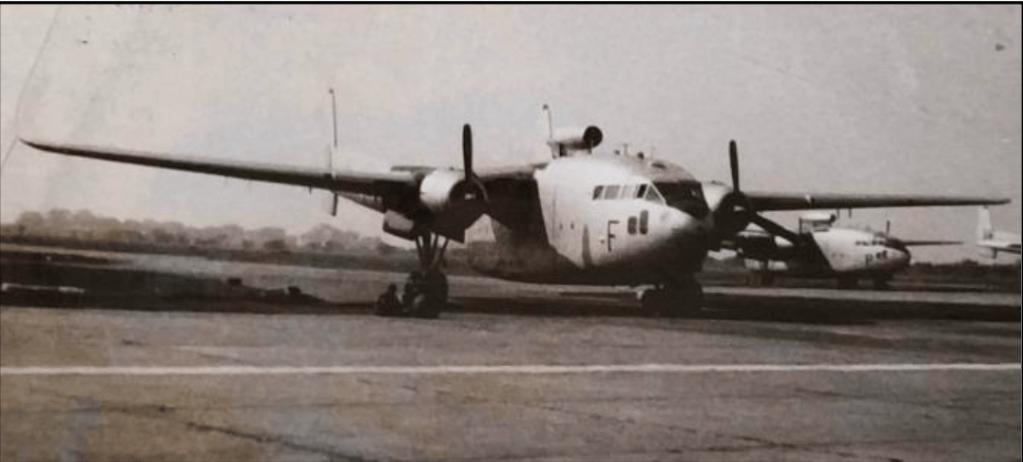
C-119 Fairchild Packet…
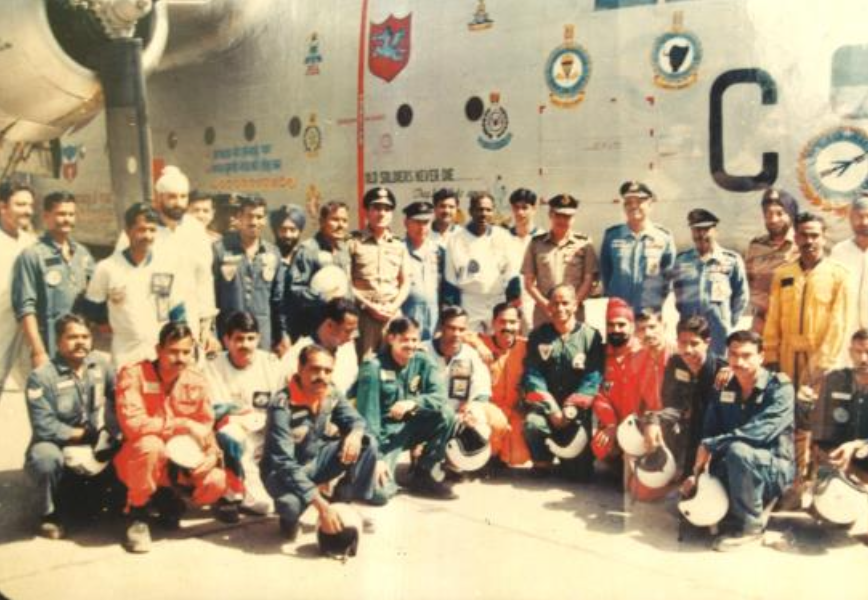
Legend has it that after the Korean War the Americans didn’t want to take that aircraft back to the US and offered it to India at a paltry Rs 5,000/- an aircraft; some say, the aircraft were passed on for a mere one USD each. A number of them were certainly donated by the US, to address India’s dire need. Interesting indeed! An aircraft de- commissioned by the US became a workhorse for the IAF.
Packet aircraft remained the mainstay of the IAF’s transport aircraft fleet from the mid- 1950s (around the time when its production stopped) until she was finally given a place of honour in the Air Force Museum at Palam (March 31, 1986). Whether it was to serve the UN in Congo or to airlift relief supplies to Egypt and Hungary; whether it was to land guns and men at Chushul (India-China War, 1962) or to paradrop troops over Tangail (Liberation of Bangladesh, 1971); whether it was to ferry Prime Minister Nehru on a state visit across the Iron Curtain to Moscow or to ship Lieutenant General AAK Niazi from Dacca to Nagpur (1972)––Packet did it all, and did it in style and with élan. The Packet fleet also undertook air maintenance task and paratrooping training as a matter of routine.
…defying gravity and the principles of flight.
A look at that aircraft would make one marvel at its ability to defy the laws of gravity and the Principles of Flight. In appearance it was quite un-aircraft-like — its designers called it a Flying Boxcar. Others, less kind in their treatment of the workhorse, gave it the epithet of Flying Coffin. One wonders, “With not-so- appealing (streamlined) features, how a Packet aircraft used to (at all) get unstuck, let alone get airborne and stay afloat?” Well! Packet aircraft had a wingspan of 110 feet. Its engines were the most powerful engines ever built in piston engine era. They produced 3500 horsepower for a weight of 3350 pounds, that is, more than a horsepower per pound of weight. With that brute power, the aircraft could land at Daulat Beg Oldie, the highest airfield in the world. That was in the years 1962 to 1965––more than half a century before the first C-130J Super Hercules landed there. The great Indian Jugaad of installing a jetpack atop the fuselage gave Packet aircraft the added power needed to achieve marvellous feats. Interestingly, Packet was the only aircraft, which had both, piston engines and a jet engine to provide thrust.
My first acquaintance with the aircraft was in February 1982 when I flew for an air experience. And, before I could get the real feel I had boarded the aircraft a second time, for my first parachute descent. In the following 35 years, as a Parachute Jump Instructor (PJI) I have jumped from nearly a dozen different types of transport aircraft of the IAF––from the vintage Dakota and the Caribou to the state-of-the-art Special Operations aircraft, C-130J Super Hercules. But the memory of the jumps made from Packet aircraft is indelible.
Creating history…
As the mind perambulates between now and those days, I recall that it was the magnificent men who flew that machine that really made jumps and life so memorable. I feel that Packet used to fly not because of its overly powered engines, but because of the willpower of the men in blue. Volumes can be written about those memorable days and those heroes. Today I’ll recall just one.
We called him Throttle Dutt.
As the name suggests, he was indeed throttle-happy––ever eager to hop into the cockpit and fly off. Rex Raymond, his course-mate thought, that nickname suited SK Dutt also because of his resemblance to the thin (read, “slim”) shaft of the throttle of a Piper Cub aircraft, which they flew as youngsters. We, the Parachute Jump Instructors (PJIs) knew that if there was an airworthy aircraft on the tarmac and Throttle was around, we’d get our fill of jumps––he would stop only after the task was completed.
Whenever Wing Commander SK Dutt dropped us, we would land in the Drop Zone, evenly scattered on either side of the centre; his name spelt confidence. He would often come to our crew room and, over a cup of tea discuss almost everything under the sun. He was a voracious reader. No wonder, some of his buddies called him Professor.
That day I was anxious about the jump; I had reasons to be in that state of mind. It was my first outstation jump as an independent spotter. Wing Commander GJ Gomes, our Chief Instructor at the Paratroopers Training School had detailed me to take charge of the Skydiving Demonstration at the ASC Centre at Gaya. It meant that I would be required to work out the release point depending on the prevailing winds and advise the pilot to drop the jumpers. To achieve that, I would be required to lean out of the open door of the aircraft in flight and advise the captain on the intercom to steer the desirable course, with last minute corrections. Skill of the skydivers apart, a good understanding between the pilot and the spotter is the key to pinpoint drops.
O Khajuraho!
I had lined up the skydivers on the tarmac at Gaya Airport and had just completed the pre-jump briefing, when a smiling Throttle Dutt and Squadron Leader Venkiteswaran (the pilots) arrived and signalled us to emplane. They wished me good luck and were about to board the aircraft when Captain Anil Kumar, one of the jumpers walked up to ThrottleDutt and said, “Sir, Khajuraho will be on our way when we fly back to Agra after the demonstration jump…” Then, with wickedness swirling in his eyes, the young officer added, “How about flying a little low over the temples. May be we’ll get a glimpse of the beautiful statues.” He laid extra stress on ‘the beautiful statues’.
Throttle chuckled equally slyly and nudged him towards the aircraft ladder as if to say, “Son, first go and do a good jump.”
The demonstration went off very well. All the skydivers landed in the designated target area in front of the spectators. Wing Commander Gomes was pleased; the crew complimented me when we reached the tarmac after a lavish lunch and fanfare, which are synonymous with such demonstrations. Incidentally, with that jump I completed another century of safe landings. Very soon we were airborne again, heading for Agra. There would be a refuelling halt en route, at Allahabad.
Partly the fatigue, and partly the odd beer or a gin and lime cordial that people had downed at lunch, started taking its toll. Wickets fell one after the other. Within minutes of our departure from Gaya, more than half of us were asleep; the other half were fast asleep. None kept track of time. The chit–chit in the ears caused due to the aircraft’s descent and the mild thud associated with the landing, jostled people from their deep slumbers. Rubbing the eyes and trying to get the bearings right, someone asked, “Allahabad? How much time will we take to refuel?” That question went unanswered as more and more people got up and started looking out of the windows. Sleepiness and the fogging caused by their breaths on the cold Perspex conspired to keep them from getting their dead reckoning. It actually didn’t matter because: ThrottleDutt would ensure our return home by dinner.
…the unforgettable Throttle Dutt
As was customary, people waited for the captain of the aircraft to come out of the cockpit and deplane first. Then, they would form a beeline to the nearest rest room. The fastest would get relief first. “Guys!” ThrottleDutt said as he clapped twice and drew the attention of the people still shuffling restlessly in their seats. “I am giving you exactly one hour and fifteen minutes,” he looked at his wristwatch and continued,” It is three now. Be back by four fifteen. We are in Khajuraho; the temples are not far. You can have a look as I get the aircraft refuelled.” He exchanged a meaningful glance with the young officer who had made the suggestion at Gaya Airport.
ThrottleDutt had chosen to refuel at Khajurao instead of Allahabad––it was his way of keeping the morale of the people around him high without, of course, compromising operations. Four thirty was the closing time for that less used civil airport. For the next ninety minutes Throttle would have a tough time handling the airport staff.
It took the greater part of a long minute for the import of Throttle’s communication to sink into the heads of the jumpers. And when it did make sense, they got into action; they couldn’t afford to waste another minute. It was precisely a three-minute, all male striptease inside the aircraft, at the end of which men were in smart casuals. They couldn’t have gone out in the streets in overalls and dungarees.
In the next few minutes two scores of crew-cut men were out in the narrow streets invading the sleepy little town of Khajuraho. They caught hold of any means they could––cycle rickshaw, auto-rickshaw, tonga and some even jogged to reach the tourist attractions.
Meanwhile at the airport…
A worried air traffic controller begged ThrottleDutt to clear the tarmac. He said there wasn’t enough space to accommodate an Air India B 737 aircraft scheduled to land in a while. Throttle assured him that he would move his aircraft further back and create enough space on the tarmac for the incoming B 737. Then, Throttle got into the cockpit, started up the engines and used reverse thrust to create manoeuvring space for the B 737 in full view of a spellbound Airport Staff. It was a sight, they had never seen––they had never seen any aircraft, let alone a massive one of the size of Packet, moving backwards under its own power.
And although that act of reversing the aircraft on that small manoeuvring surface impressed the controller, it did not allay his anxiety. He now urged the crew to get airborne by four thirty; that was when the watch hours at Khajuraho Airport would cease. Throttle assured them that we’d leave in time.
Back at the Temple site––they went; they saw; and they felt conquered! How the jumpers felt after their visit to the Temples could be the subject of another piece. Suffice it to say that they did not talk about it. Perhaps, how ThrottleDutt made it possible for the bunch of those curious men, and the effort it took to reach the heritage site, was more interesting and memorable than the beauty and the artwork people got to witness there. Period. The entire lot was back at the airport in time for the take off. They lined up and got into the aircraft hurriedly. Throttle Dutt gave an impish smile to a beaming Anil Kumar as he climbed the ladder to take off for Agra.
“Many a trip continues long after movement in time and space has ceased,” says John Steinbeck in Travels with Charley. I read the book years ago, but got the sense of what the Nobel laureate implied when our family excursion to Jodhpur in late December 2025 began to feel like one. Now I don’t get tired of talking about it. Curiously, it was not our visits to monuments of historical significance and architectural grandeur which made the Jodhpur trip memorable. In fact, the enthusiasm with which we had visited those landmarks and taken photos in their foreground has dulled with time. As it stands those impressions are but tick marks on our completed itinerary.
Café 651 beckons
My most cherished recollection of that trip is of our visit to Café 651.
Savouring authentic Rajasthani cuisine—dal, bati, churma, ker, sangri, kadhi and gatta—was, of course, on our wish list. But seeing the long wait at the restaurant of our choice, we decided to explore other options. Mudit and Anjali, our son and daughter-in-law (whom I fondly call “Muditanjali”), suggested that we try Café 651.
“Café 651?” I wondered aloud. “The name sounds a bit…”
“What’s in a name, Dad?” Anjali interrupted me with a chuckle. “The place is highly rated online. Besides, Maya isn’t a dal-bati enthusiast. She might find the food in other eateries a bit spicy. At 651, we’re sure to find something she’ll enjoy.”
So, there we were.
An unassuming signboard clinging to a roadside pole directed us to the Café, which was tucked away on the first floor. There was no lift, so we trudged up an open flight of stairs along the side of the building. Unimpressed, in my mind’s journal I began critiquing the place even before we reached the door.
Inside, things were different. Quite different. A busboy ushered us with a warm smile, and the air felt inviting. On display at the entrance were a large number of trophies and certificates of merit earned by the Café since it opened on Republic Day in 2018. Neatly framed paintings and posters of rock stars, landscapes and abstract art adorned the walls. As we learnt later, they belonged to local artists and were ‘FOR SALE.’ Muditanjali liked one of them and now own it.
Awards galore
Large glass windows gave a commanding view of the road below. The furniture was aesthetically laid out; one of the tables was occupied by young people engaged in animated discussion. In all probability, they were students. Nice people—they lowered their voices when they saw us.
A waiter served us bottled water, presented the menu and left us to take our time and make our choices. Then came a tall, smartly turned-out gentleman to take our orders.
Without ado, we decided to order pizzas and a plate each of noodles and pasta.
In our family party of five—which included my wife Chhaya, Muditanjali, our two-year-old granddaughter Maya, and myself—Maya and I were the curious kind, ever so keen to know about everything. No one minded Maya’s questions, but mine were often seen differently. Undeterred by that blatant discrimination, I kept seeking answers to my questions at Café 651.
The soft-spoken gentleman sought inputs for the “Make Your Pizza” option we chose—it was interesting choosing from two sauces and nine different toppings.
“I don’t eat mushrooms, and my husband doesn’t like bell pepper. Please put very little of them,” urged Chhaya.
Muditanjali, on the other hand, didn’t mind those toppings; in fact, they wanted mushrooms.
“Please don’t bother about that, I’ll restrict mushrooms and bell peppers to a part of the pizza; the remaining portion will be devoid of them. You’ll be able to pick and choose your slices,” assured our man.
Rare hospitality
In my assessment, the man scored high on attitude to elevate customer satisfaction. Impressed by his polished demeanour and fluency both in Hindi and English, I asked him, “How long have you been working here? And… what’s the significance of this name, Café 651?” Within me, I was rehearsing the good feedback I’d give about this guy to his boss.
Perhaps he was able to divine my thoughts, for he gave a Buddha-like smile and said, “Sir, I own this café. It’s our ancestral house, number 651. I gave the Café this name to bring recognition to the property.”
It is remarkable how a simple revelation changes our perception of a person. Already, we were looking at him through a different lens. Being served personally by the owner made us feel genuinely honoured.
Annant was his name. Annant Baheti.
“This little one likes the pasta in red sauce …also, it’ll be nice if you could make it a bit gooey for her,” requested Anjali.
“That will be possible. And, while your order gets ready, would you care for some drinks, snacks?” he enquired.
We ordered virgin mojito and coke for drinks, and some French Fries for snacks. Annant disappeared behind a door which seemed to be the kitchen.
He resurfaced after a few minutes. “I have placed the pizza bases in the oven. They’ll be ready in a short while,” he informed us.
“So, you bake your own pizza bases,” I mused.
“Yes, Sir, we bake our own pizza bases and breads. Not only that, we use our own herbs grown in the nursery run by my family on the ground floor of this building. To the extent possible, everything we serve is organic.”
“And you cook too, do you?” I asked curiously.
“Sir, I am a graduate of IHM Mumbai (2014); I have been a part of the specialty coffee industry for over eight years,” he said modestly. “I learnt cooking from my mother. My curiosity in food science eventually led me to pursue a career in hospitality. I have this small setup and a team of three employees.”
“How can you be cheffing around, and also manage all this with a team of just three?” I asked.
“My wife, Meenal, is a big support and an equal partner in all our endeavours. Our team remains committed to serving exceptional coffee and delicious food with warmth. We believe in “Atithi Devo Bhava” (the guest is God). Managing becomes possible because I enjoy spending time at the café, meeting and interacting with guests. We strive to create a memorable experience for every person who visits the Café’.”
Annant found time to show me around the Café; he even gave me a peek into the kitchen. It was one of the tidiest (restaurant) kitchens I had ever seen. When we were out of hearing distance of Muditanjali, I stumped him with a freak demand difficult to meet with his manpower limitation.
“Annant, I want to request you a big favour,” I began without a preface. “Please feel free to decline, if it is not possible. It is our son and daughter-in-law’s wedding anniversary today. Can you arrange a cake for them from a nearby bakery?”
I knew, I had put Annant in a difficult situation. With a team of just three on his staff, and so many guests to be looked after, mine was indeed a tall order. Yet, after a small pause, he nodded, “It’s not a bother, Sir. I’ll get it.”
Needless to say, the pizzas and the plate of pasta more than met our expectations. Each one of us got exactly what we wanted. We couldn’t have asked for more. We devoured the servings to our hearts’ content. The cake that followed was a bit of a surprise for everyone.
That day at Café 651, I experienced the acme of hospitality; all my senses and my heart felt it. A revisit to those memorable moments is always so refreshing.
Postscript
There is this heartwarming story of exceptional hospitality, sometimes attributed to The Ritz-Carlton (Bali). When a guest demanded a specific type of hamburger and standard French fries, which were not on the Hotel’s menu, the executive chef himself procured them from elsewhere and served them. That gesture set a benchmark in hospitality. With a small team, and no man to spare, what Annant did for us, has raised the bar.
Viva Café 651!
A Note to Readers: Visited regularly by students, armed forces officers, professionals, including doctors from AIIMS, and foreign as well as local tourists, Café 651 is the first specialty café of Jodhpur serving only SCA score 80+ coffees brewed in eight different ways. They serve variety of food, burgers, and garlic bread sticks. Pancakes are the bestselling.
Café 651 has earned following awards and recognition:
Article reproduced with permission from Wing Commander JK Kaushik (IAF Veteran).
The lead story in the newspapers and the TV channels over the last few days has been the US-Iran Summit at Lucerne in Switzerland. This took me back a couple of years when we had an encounter of a different kind in the very city that hosted the Summit recently.
Our son Aditya has lived in Zurich, Switzerland since 2020. The Covid pandemic restrictions disrupted travel and the plans for a family reunion. When travel restrictions were gradually removed, we decided to visit him. There’s a lovely view of Lake Zurich and the snow-covered peaks of the Alps from Aditya’s apartment. After soaking in the unadulterated beauty for a few days, we began exploring the rest of Switzerland. Aditya or Angelika (our daughter-in-law) accompanied us on these trips depending on their work schedules. When both were busy, Kalpana and I ventured out on our own.
…the Lucerne Summit Meet
One of the first excursions we undertook was to Lucerne—a short train ride from Zurich. On reaching Lucerne station we took a short bus ride to go Mount Pilatus. We absorbed the natural beauty of the Swiss alps on the gondola ride to the top of Mount Pilatus. The strong cold wind that greeted us at the top froze us to the bones. But, the view from the top was a treat to the soul. We enjoyed it for some time and, after a hot cup of coffee at the summit restaurant, prepared to return to Lucerne. This time we chose to take the special cogwheel railway down. Incidentally, the cogwheel railway from Mount Pilatus is the steepest such train in the world. The cogwheel railway ride down the slopes of Pilatus was a rare experience. Once we reached the base, we took a boat across Lake Lucerne to return to Lucerne.
The excursion to Mt Pilatus had taken much less time than we had anticipated. We had a few more hours at our disposal. The guidebooks suggested that we visit the Kapellbrücke (Chapel Bridge). This is an old wooden bridge, 170 m long, constructed in 1300 AD. There is a stone water tower at one end which, as the glossy handouts noted, had served as a lookout tower, a water storage tower and also as a prison. The bridge was partially burnt in 1993, but has since been painstakingly restored.
the LIONS
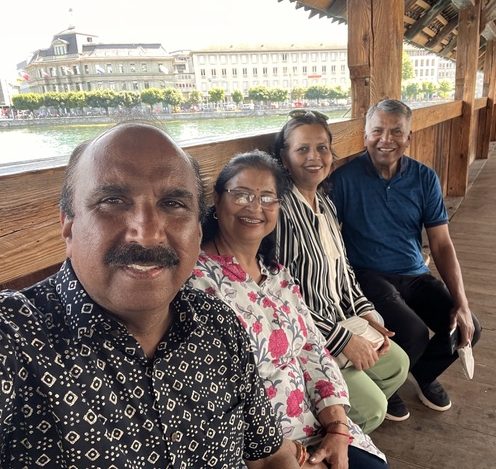
Google Maps guided us through the short walk from Lake Lucerne ferry terminal to the Chapel Bridge. We found that the area around was practically deserted as the Bridge is meant only for the pedestrians. After the ‘mandatory’ photo at the entrance, Kalpana and I started strolling slowly to the other end. We noticed a couple of benches on the bridge and decided to sit down for a few minutes. As we were approaching the benches I noticed another couple of almost our age walking ahead of us slowly and occupying the first bench. I remarked to Kalpana that they appeared to be Indian tourists like us. We went past them and settled on the next bench.
Kalpana started taking out the water bottle and some refreshments from her handbag. “They look very familiar,” she mused gesturing at the couple. I dismissed her remark as pure imagination. But, when she insisted that I take a look, I lifted my eyes from the screen of my mobile phone, which I had been scrolling as a matter of habit.
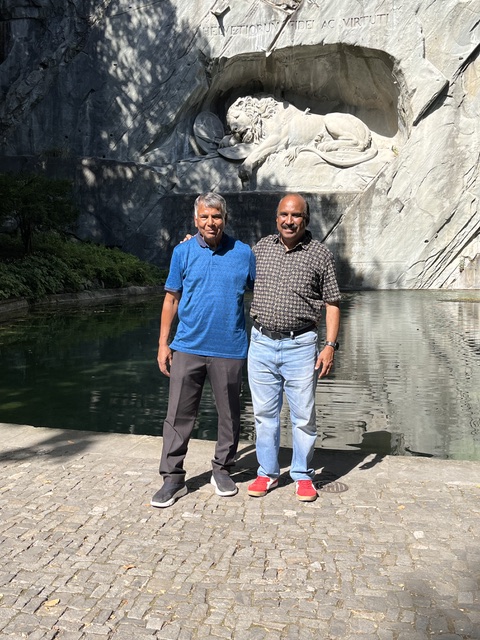
And, lo and behold, it was Diwakant, my NDA Course-mate and Squadron-mate and his wife. We had last met about 6 years ago at the course get-together at the IMA.
… and the’LIONS’ meet at Lucerne
“Hi Diwa!” I got up and called out to him.
He looked up a bit surprised as to who could be calling him by his name so far away from India. In seconds we were in a bear hug—laughing at the rare coincidence of two course mates from same squadron being at a tourist spot in Switzerland at the same time. After much backslapping Diwa told us that they were on a short trip to France and Switzerland from Ireland where his son was working. Once the initial euphoria subsided we completed our walk along the Chapel Bridge and the Old town across the river.
Lucerne has a Lion Monument. Since two Lions from Lima squadron had met by chance it was almost obligatory for us to visit the Lion Monument. After the visit to the Lion Monument and some souvenir shopping it was time for good byes. We had to head back to Zurich; Diwa was staying the night at Lucerne before taking the flight back to Ireland the next day. The world is wondering if the US-Iran Lucerne Summit will lead to some tangible outcomes. Let them keep meeting and fencing till cows come home. But the chance meeting of NDA Course-mates—and two LIONS in that—is a feeling to be cherished for a lifetime. This chance rendezvous was much more rewarding than any Lucerne Summit.
Article reproduced with permission from Wing Commander JK Kaushik (IAF Veteran).
Anyone who drives a car or two wheelers knows the sorry state of our traffic. A study of the CCTV footage of the peak-hour traffic by the department of road transportation concluded that there were over 1300 traffic violations in a half hour period in a small stretch of less than 500m. And guess, who were the biggest violators—not the bus drivers, not the autos, but the educated car owners. Hard to digest and believe? One evening when I was seeing off some relatives at the Noida Bus terminus, I overheard two drivers discussing the traffic on Dehradun Highway. It happened to be a Sunday evening. “Today there will be chaos on the roads because all the educated lot will be coming back after the weekend. They have absolutely no sense and try to squeeze in from anywhere.”
The traffic in the NCR is not regulated by any rules. “Might is right,” seems to be the only norm. The next principle of driving is, “I go ahead and everything else be dammed.” Lane driving, overtaking from the right, right of way and maintaining distance are rules and principles that are extinct like the dinosaurs. Most of the car drivers are oblivious of these principles. About the bus drivers, autos and trucks… well, the less said the better. Of course, there is one other class—the tractor drivers. Traffic rules? What are those? Are they applicable to farmers/tractors? And then we have the gentlemen and ladies from the traffic police whose job it is to enforce the rules. Except for a few exceptional policemen from Delhi police the rest of the traffic police in the NCR is as ignorant about traffic rules as the tractor drivers.
Let’s understand the basic traffic rules as understood by the NCR drivers. First, to turn right at a traffic signal, you can be in any lane. It is your birth right to turn from any lane and if in the process the other drivers get held up, it is not your problem. The policemen are equally ignorant about the rules governing this. Next, while negotiating roundabouts, there is no such thing as right of way. One can go to the extreme end and then cut across traffic coming in from the inside. Don’t believe me? Check out any of the roundabouts in New Delhi area or the one near the Golf Course Metro station during the morning and evening rush hours. Overtaking from the left is something that everyone does. There is of course one basic rule, driving on the left of the road. This is violated so often that traffic police have put up a board as soon as you enter Noida from the N24 side near Sector 62. People of all classes happily drive on the wrong side of the road for a few hundred meters putting themselves and others to grave risk. I fail to understand why these people can’t follow the rules and execute a U-turn from the authorised spot and come and turn towards their destination. A few hundred meters will not increase their fuel costs too much! While the car drivers are bad, the two-wheeler riders are horrible.
Another important characteristic of this region is the scant respect and regard for other drivers/ traffic. All one has to do is try driving past any of the schools in the morning or when the school is closing or whenever there is a PTA meeting. Every parent assumes that it is their birthright to park their vehicles as close to the school gate as possible in any haphazard manner whatsoever. So what, if in the bargain other motorists are put to inconvenience. Who cares? Not the traffic police for sure. I am yet to see traffic police disciplining these errant parents around any of the schools be it DPS, Bal Bharti, Khaitan, or any of the countless others. We can also see the same behaviour when people decide to have an ice cream or a snack, and park their vehicles on the road blocking the traffic in the process.
The two wheelers are a different breed all together. They dodge in and out of traffic with scant regard to the traffic, speed limits or rules. There seems to be some unwritten rule stating that a two-wheeler can weave in front of a fast-moving car at any speed and it is up to the car driver to slow or stop his vehicle. A biker also need not signal or indicate in any manner when he decides to turn.
A class apart is the drivers who drive around with their music systems at full blast and their windows open. I often wonder about the impact of such loud music on the hearing of the driver and the occupants of the car. Another irritating habit that is fast developing into a pain is the use of the ambulance siren by all and sundry. Call centre taxis and SUVs have the siren installed and switch it on when they wish to overtake. The use of sirens by unauthorised vehicles is illegal, but our policemen simply don’t seem to care.
One day, in Chennai a few years ago, I saw a car coming from the opposite direction weaving in and out of traffic and breaking all possible rules. In Chennai, such rash driving is really rare. In a lighter vein, I told my wife that that driver of that car was driving like a Delhiwala. And sure enough, as the car passed us, I saw the Delhi number plates. So, friends, Delhi drivers stand out wherever they may be. In stark contrast to this are drivers abroad. In Malaysia or Singapore or Thailand—people follow rules and respect the others sharing the road. Of course, strict enforcement by the law enforcing agencies helps.
It may be a good idea to make the implementation of the rules stricter at all times and not just when the police carry out some special drives. Policemen should instil a sense of fear and respect in the mind of the driver. As a final word it is very easy to say that someone else should do something about the traffic while the majority of us continue to violate rules. Let each one of us resolve to first educate ourselves and our families about traffic rules and to follow them. If each one of us follows traffic rules as a matter of habit, I am sure the NCR will improve making life safer and happier for all.
Do I need to correct everyone I perceive to be ‘wrong’?
On rare days, the area around Nizamuddin Railway Station, on the Sarai Kale Khan side, is in chaos. On normal days, it is in utter chaos. To my luck it was a normal day on that June morning when I had alighted from the Bhopal Rajdhani at 6:00 am. I skilfully wove my way through fly-infested little heaps of litter, and patches of dirty water caused by leaky pipes, and manoeuvred around people sleeping on the platform to exit the station. Getting atop the foot-over bridge and walking through a tidal wave of humanity had been an exercise in itself. Outside the station I was greeted by the mixed smell of overcooked spicy food emanating from the dingy hotels on the roadside. Competing with the signature odours of omelette and aloo parantha was the stench from the overflowing drains. A wretched dog, and two crows were feasting on the leftover food offered by a kind-hearted passenger.
Having lost my iPhone a few days ago, I was undergoing a forced digital detox. The apps on the phone I was using for the time being, were functioning at less-than-optimal efficiency. For that reason, my four attempts to engage a cab had failed. In the meantime, I had declined several auto rickshaw drivers to take me to NOIDA. Not that I was averse to travelling by a three-wheeler. It is just that I had three suitcases and an air-bag, which I presumed wouldn’t fit into an auto.
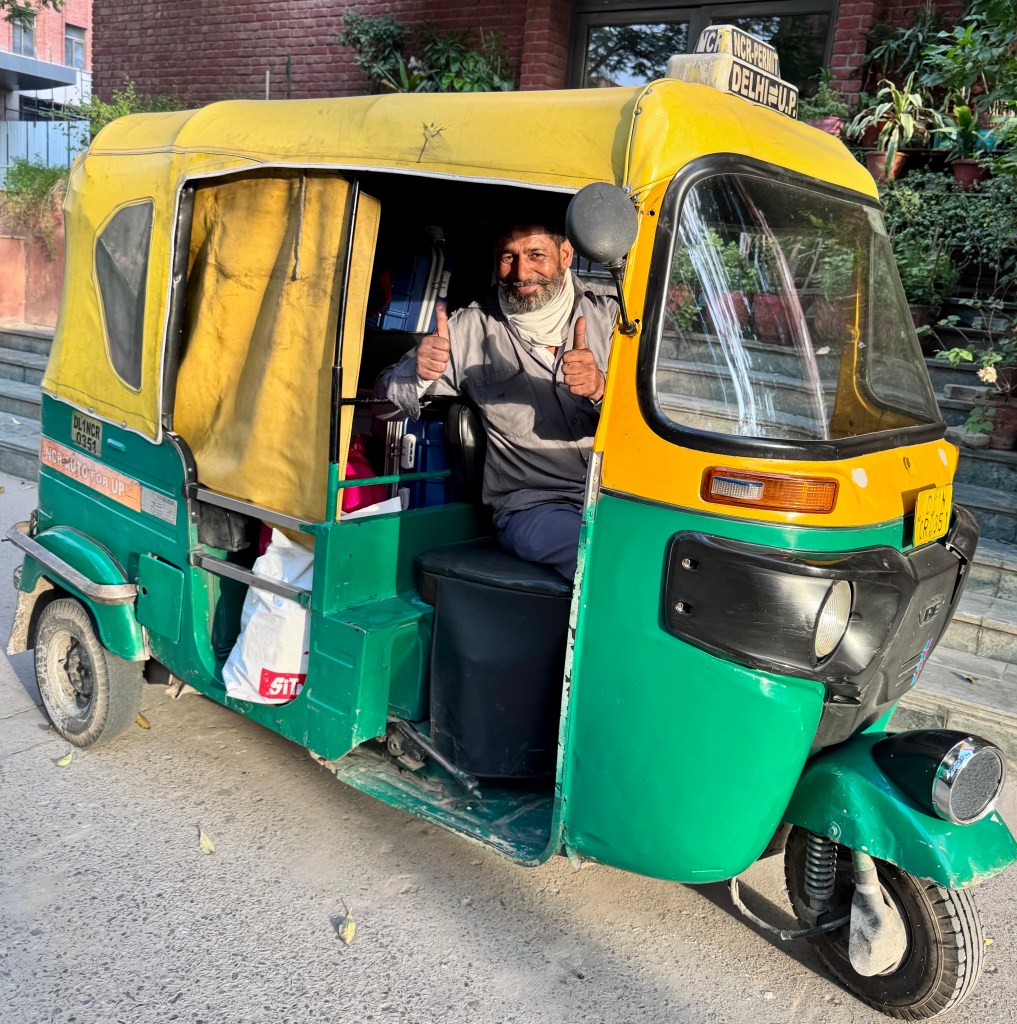
Mahender Singh, an auto driver—the events of the following half hour or so, had obliged me to ask him his name when we parted in NOIDA—read my mind and nudged me to re-evaluate my options. “Sir, don’t worry, I’ll be able to adjust everything into my auto,” he offered.
“Should I continue to stand in the crowded place and keep trying to get a cab; or, I must hop into his auto and get some semblance of relief?” Embedded in that dilemma was my strong urge to be anywhere else, soon. Then, the stench and the noise nudged me to accept his offer. The man could well have been a smart warehouse in-charge, or a logistician, I thought when he stowed my bags meticulously in the little space behind the passenger’s seat.
…king of the road
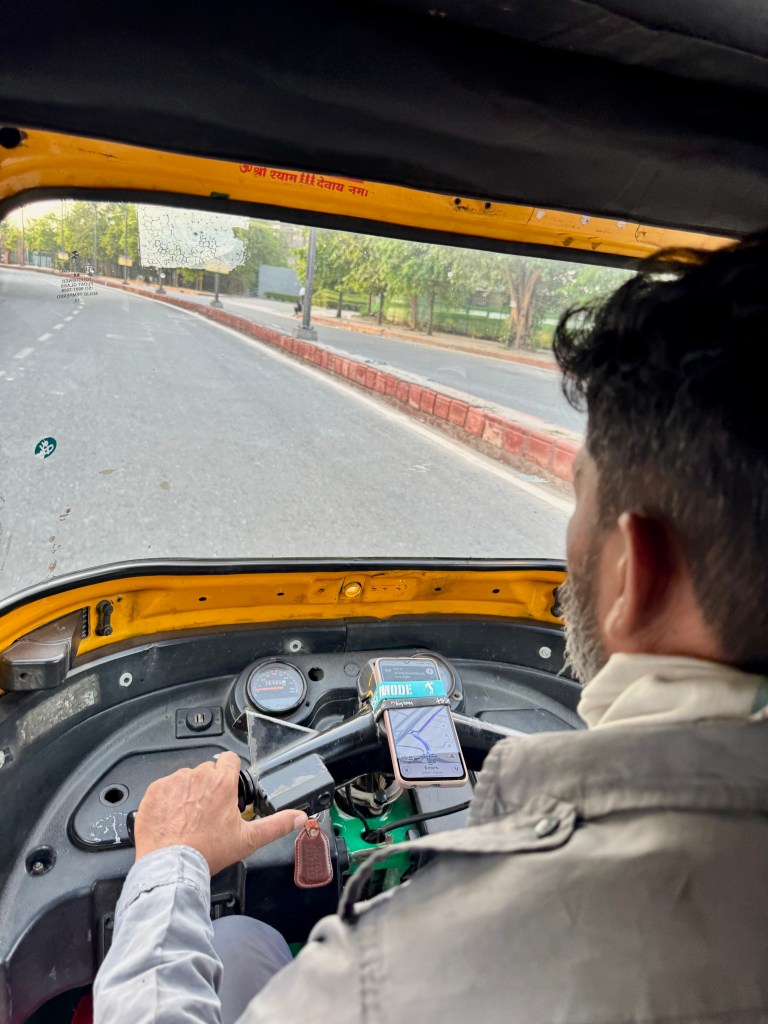
“Sir, sit tight and keep pushing the back of the seat so that your bags stay in place,” he directed me as he cranked the engine to life. Soon, we were zipping down the crowded road. In a small stretch of about half a kilometre, where pedestrians and vehicles of all kinds were fighting for every inch of space, Mahender’s driving speed was causing me anxiety. The horn of his vehicle was perpetually ‘ON’. He was shoving the nose of his auto into the small gaps wherever he could find them, and was pushing forward. He was behaving like a man possessed. At one point, he entered the wrong lane. My heart missed a beat every time he dodged the traffic coming from the opposite direction. He was occasionally lifting his eyes off the road and staring at the Google Maps on the damaged screen of his mobile phone, which he had tied (literally crucified) on the handle of his auto where the speedometer ought to have been. To him, speed did not matter. In any case, he was driving at max possible throttle setting all the time.
By the time we reached the Outer Ring Road, I had refined the long draft of my sermon to him on adherence to traffic norms. The density of the traffic had reduced, and the average speed of vehicles on the road had gone up considerably. So, I decided to defer the delivery of a piece of my mind to him until we reached NOIDA.
Yet, there was no respite for me. All along the way, he kept changing lanes without giving any indication and overtook vehicles from any ‘convenient’ side. I held firmly on to the metal pipe in front of me and avoided getting thrown out of the auto. On a few occasions, I dared to assist him by stretching my hand out to convey his intention (turning left or right) to the drivers he was sharing the road with. He was looking at me from the corners of his eyes and didn’t mind what I was doing.
“If we, the educated lot, do not correct these erring drivers, who will? On reaching my destination, I’ll pull him up…. But, who am I to correct him? Who all will I correct? There are so many reckless people on the road… the drunken, the rich and the mighty who mow down unsuspecting pedestrians… the under-age privileged ones who kill and are let off by the court after writing an essay on traffic rules….”
Sinner, or Saint
My thoughts were travelling ahead of the noisy auto when, all of a sudden, came a moment of reckoning. An ambulance approached a roundabout which Mahender was negotiating at a high speed. I was certain that he would carry on driving, not giving a pass to the ambulance approaching us from the left. So, I stretched my left hand, indicating to the ambulance driver that Mahender was in no mood to slow down.
To my utter surprise, Mahender slowed down, almost to a halt, and asked me to pull back my hand. “Sir, let the ambulance go,” he said with an air of urgency. Then, he felt the surprise in my reaction and said, “Sir, an ambulance must always be given the right of way. Don’t know how serious the patient inside it might be.” This thought coming from Mahender who had been flouting almost every possible traffic rule since we left Nizamuddin Railway Station, surprised me no end.
I ejected the draft of the moral lecture meant for Mahender, out of my cluttered mind when the auto stopped at my residence. He didn’t deserve a sermon from me. He didn’t let me carry my bags—lifting them himself up a flight of ten steps to the landing in front of my flat. And, before I could realise, he was gone, leaving a breath of fresh air on that summer morning.
Comments
Air Commodore Sanjay Sharma (IAF Veteran)
I was 17 and a half. BSc Prev. Onboard Utkal Express from my small town Kosi Kalan to Raja ki Mandi. ( From home to Sapru Hostel, Agra College). Month of December. A group of four ruffians in their twenties boarded the train without a ticket (an accepted norm on that route) from Mathura. Asked the other passengers to ” Khisko, thoda sa” to make room for them to sit. Started playing cards. I was cursing them silently in my slight frame for being so unruly. There was a beggar in a tattered shirt and an excuse for a pajama. He came dragging himself and started begging. Hardly anybody gave him a paisa until he came close to this gang and suddenly, the most ” Goonda looking” one amongst them took his pullover off and made this beggar wear it. People broke into applause. I felt small in my own eyes for judging the book by its cover.
On June 12, 2025, tragedy struck. Air India Flight AI 171, en route to London Gatwick, crashed seconds after take-off from Sardar Vallabhbhai Patel International Airport, Ahmedabad. The accident claimed the lives of 241 people on board—passengers and crew—and 19 individuals on the ground.
In the hours and days that followed, television screens lit up with expert analyses and heated debates. While some insights were valuable, much of it merely served to feed anxiety, both among seasoned travellers and the general public.
The Ripple Effect of a Crash
When such mishaps occur, they set off a domino effect across the aviation ecosystem. Authorities tighten checks and airlines enforce stricter adherence to procedures. In the days following the AI 171 crash, many flights were delayed, diverted, or even cancelled. Recent helicopter incidents only compounded the public’s growing unease.
These reactions are not just procedural—they are deeply psychological. Fear travels faster than airplanes.
Passenger Profiles
Following aviation accidents, travellers often fall into three categories:
The Stoics – the que sera sera kind. They acknowledge the incident, mourn the loss, and continue flying without visible hesitation.
The Escapists – those who vow never to board a flight again, unless absolutely necessary.
The Unsure – the ones caught in limbo, unsure whether to continue flying or retreat into fear.
A Peep into Passenger Psyches
Take for example July 4, 2025 Indigo Flight 6E 2258 from Delhi to Lucknow. It was delayed by over two hours due to a navigation system snag. As technicians worked to fix the issue, several passengers chose to disembark. Some left because their schedules were disrupted. Others simply couldn’t shake off their anxiety. Among them was a professor—perhaps someone who lectures on resilience. In contrast, an 85-year-old woman, bound for Ayodhya, stayed calm for a while—until she began chanting the Hanuman Chalisa, seeking comfort through faith.
Stories That Defy Logic
Aviation history is filled with eerie tales of missed flights and miraculous survivals.
In the early 1980s, a military Packet aircraft crashed during take-off in Agra, claiming the lives of 45 paratroopers, instructors, and crew. Squadron Leader (later AVM) D.K. Dhingra survived because he was held up in his office by a telephone call. Some others, too, missed the flight due to last-minute changes. Fate intervened.
Even in the case of AI 171, one man survived—Ramesh Viswash Kumar. He managed to walk away from the wreckage. Was it luck, chance, or destiny? It’s hard to say—but such stories shape the way we think about survival.
Air Warriors show the Way Aircraft incidents and accidents are a part of life in the Air Force; a professional hazard. Sitting in my office in Tezpur, I had once seen two pilots punch out (eject) of a flamed out MiG aircraft seconds after take-off. It is customary for all the pilots of a unit to take to air immediately (as soon as possible) after a serious accident (unless there are strong reasons to ground the entire fleet) to keep up the spirit. Likewise, a mass jump follows a parachute accident. There is no scope for fear to set in.
A Lesson in Acceptance
A classic parable might help those grappling with post-crash anxiety:
A slave once ran to his master in Cairo, trembling with fear. “Master,” he cried, “I saw Death today in the market. She stared at me and asked, ‘What are you doing here?’ I fear she has come for me. Please, I beg you, help me escape!”
The master gave him his finest horse and advised him to flee to Basra.
Later that evening, the master encountered Death and asked, “Why did you frighten my servant?”
Death replied calmly, “I was only surprised to see him in Cairo. You see, I have an appointment with him next week—in Basra.”
Sometimes, what we fear and try to avoid might be the very path we are destined to take. This isn’t to say we should be fatalistic—but it helps to recognize that some things lie beyond our control.
Trust, Caution, and Collective Responsibility
Aviation remains one of the safest modes of travel. Pilots are rigorously trained, technicians are meticulous, and air traffic controllers are highly competent professionals. Accidents, though tragic, are rare. They lead to introspection, investigation, and improvements in safety protocols.
As passengers, we can also contribute:
Avoid carrying unaccounted or suspicious baggage.
Follow crew instructions diligently.
Switch off mobile devices when requested.
Stay calm and respectful, even during delays or checks.
Let’s remember: behind every flight are thousands of hours of effort, layers of safety checks, and dedicated human beings who care about getting us safely to our destination.
Let’s fly safe. Fly wise. And above all—fly without fear.
The man I was trying to evade so resolutely, caught up with me at last. He overtook me with a last long stride; turned about with the agility of a gymnast and stood in my way. His hands sheathed in tattered gloves stopped me from moving further. Although I was rankled and trying desperately to steer clear of a brawl in a foreign land, I was sure of my entitlement to self-defence anywhere, anytime. A calmer me was armed with confidence, and coiled, and ready to stun the stranger and execute my escape and evasion, if need arose.
I was panting; so was he. At an ambient temperature of three degrees Celsius our breaths were sending out little grey clouds of vapour towards each other. Did he smell of cannabis? Or, I was imagining things? My naïve olfactory system cannot distinguish smells but I had good reason to believe what I was thinking—he was into drugs; wanted to peddle his stuff.
It was a noisy exchange in a public place. Yet the people around us were unbothered. “Why would they care,” I thought. We were in the heart of Copenhagen, on Pusher Street in Freetown Christiania, the Green Light Area, a haven for hippies and drug peddlers… far from the civilized world. Concern for strangers was an alien sentiment on that shady patch of the planet.
“Will you please listen to me, Sir?” he urged. Very clumsily, he wiggled his hand out of his greasy gauntlet and held mine with forced friendliness, and shook it. “Calm down my friend from India. I mean no harm.”
Friend, or a foe? I was still in doubt. He wore a mud-caked black beret—Che Guevara style, less the star. A deep scar ran across his right cheek. During the just concluded handshake, I had noticed with a sense of creepiness, that the index finger of his right hand was missing. He astonished me with an unexpected act—he joined his hands in reverence and bowed, “Namaste! me Obert Ngoma… they call me Obe…, Black Obe.”
***
The seed of this encounter, which later turned out to be perplexing and grisly, was sown in an Airbnb apartment we had rented earlier that week for a holiday in Copenhagen. I had arrived in the Danish capital from Gothenburg with my son, Mudit; daughter in law, Anjali and granddaughter Maya. My nephew, Nihit along with his wife, Swetha, had travelled from Delft (the Netherlands) to be with us.
Nyhavn—A tourist delight
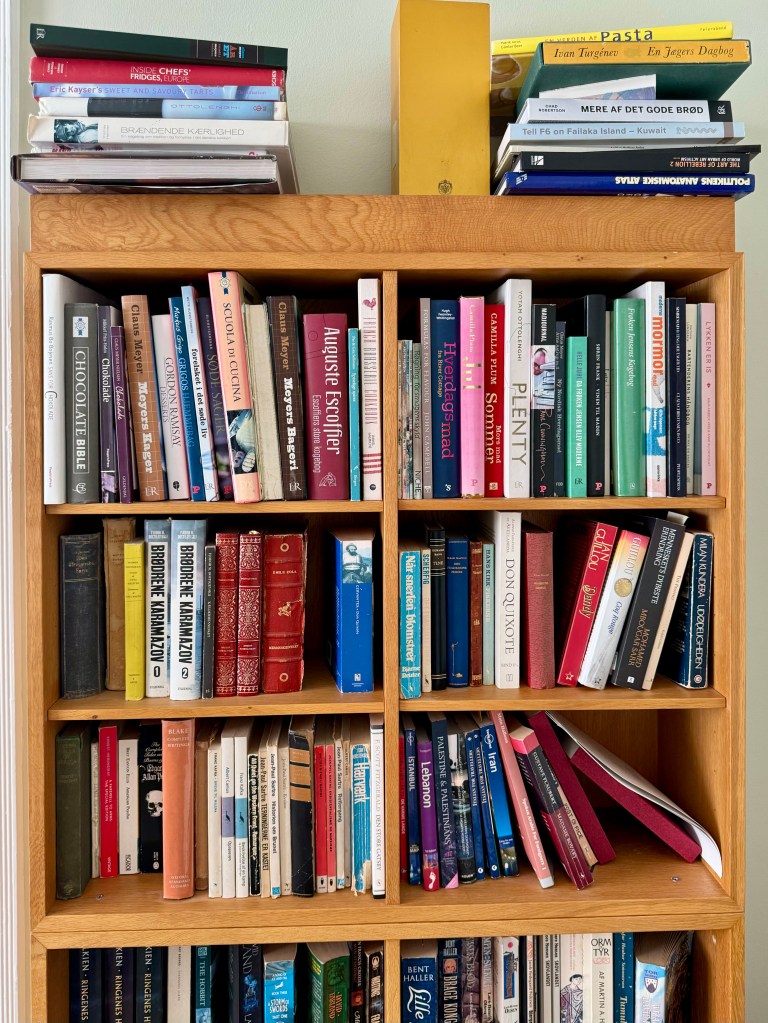
The hired accommodation had cherished amenities; a well-provisioned kitchen and a cellar stocked with exclusive wines. There were three tall racks of books. The subjects ranged from travel to literary classics; from sports to baking cakes to origami; from humour to science fiction. There were books on Palestine, Iran and the middle east. Two copies of Cervantes’ Don Quixote, one in English and the other in Danish spoke of the owner’s unfeigned interest in literature.
We spent three days seeing places, clicking pictures, trying local cuisines and buying souvenirs. The fourth day was devoted to Nyhavn. A walk down the cobblestone street—the canal with anchored yachts and historical wooden ships on one side, and colourful 17th century townhouses and restaurants lining the other—was a tourist delight. In the evening, a thoughtfully ordered dinner awaited us in the apartment. The young couples, and the baby crashed early.
Books! Books! Books!
The library of rare books and my habit of reading before retiring, colluded to dodge my sleep. I pulled out The Complete Tales and Poems of Edgar Allan Poe from its shelf and began reading it. It took less than half of an hour for me to appreciate why Poe is considered a master of macabre literature. Suspense and intrigue presented with hallucination in his stories made me sweat.
Past midnight, I returned Poe to its reserved berth on the shelf. His gruesome characters and ghosts were strolling in my mind when I pulled the quilt over me. For reasons unbeknown to me, the night felt ominous. A restless sleep followed an hour of tossing and turning in the bed.
Like a funny bone in people, there is a curious bone too and, I think, I have it in me. On the last day, I wanted to spend the few remaining hours in Copenhagen exploring whatever else we could. “Our train to Gothenburg is at 1:00 pm. Nihit and Swetha’s flight to Amsterdam is at 3:00 pm. We still have about five hours in hand. Is there another place we can visit in Copenhagen?” I posed the question to nobody in particular.
“I wonder if Christiania might interest you,” queried Nihit.
“What’s it known for?” I asked.
Once upon an army barrack…
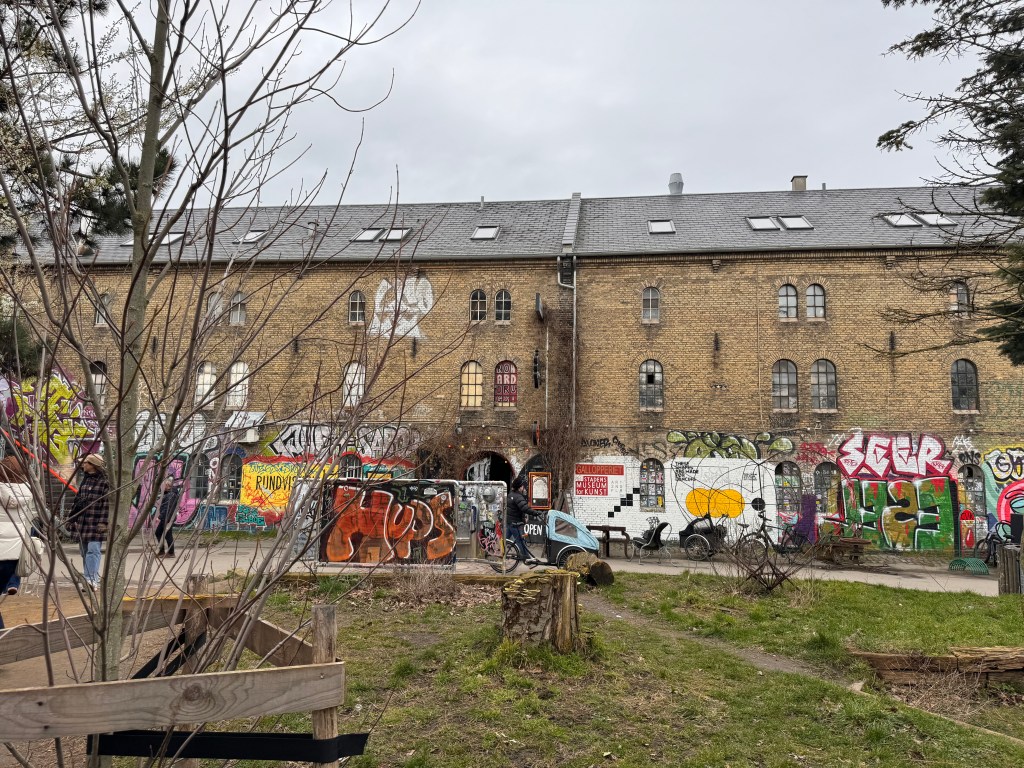
“It is an insulated anarchist territory within Copenhagen. It was founded by squatters seeking freedom. They occupied abandoned Danish military barracks of the WW II era, and declared Christiania an independent country. It is notorious for open sale of narcotics. There are occasional gang wars, and fights between the drug-peddlers and the people who strive to put a stop to drug peddling. It’ll be a good experience visiting that place; I suggest you take this trip while we wind up here. You might find something interesting to write about.”
A little later, my ordeal began in Christiania
***
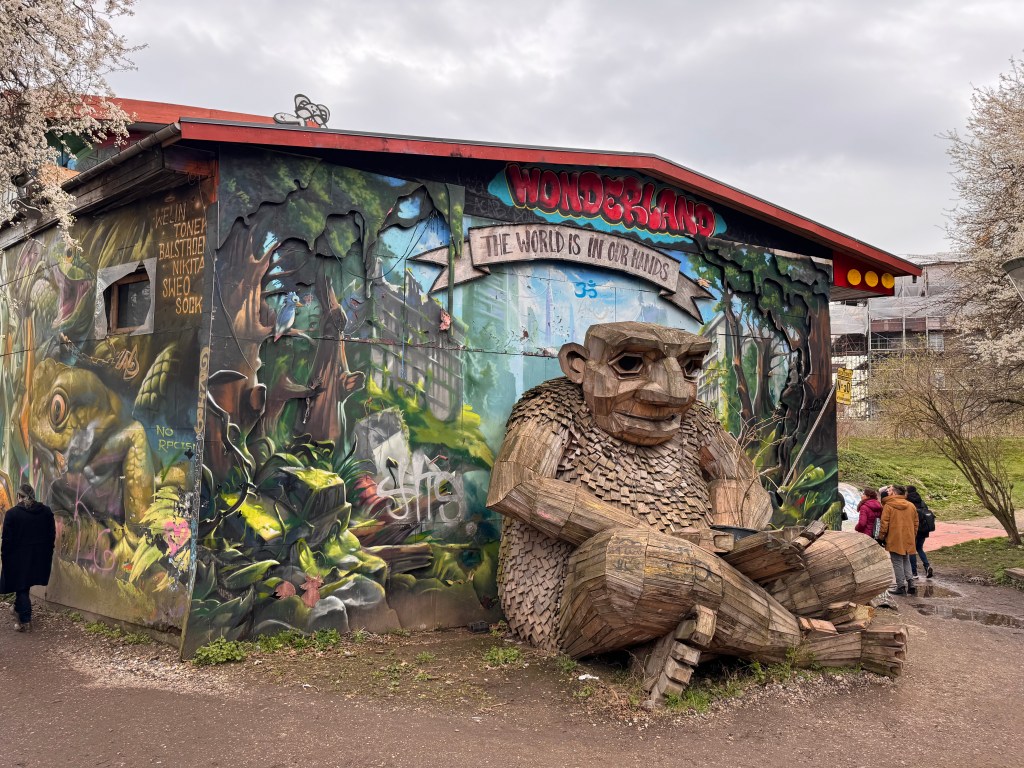
Obe calmed me down with meaningful arguments and won me over. He succeeded in proving his harmlessness, and prevailed upon me to visit his shack nearby. His little dwelling was neat and tidy. The walls were painted with slogans, and religious symbols like the swastika, the om, the holy cross, the crescent and many others, which I didn’t recognise. Earlier, on my arrival in Christiania, I had noticed with surprise, the Hindu symbol of om painted on the wall behind a giant wooden statue of a weird crouched man—the so-called free man—sitting in what appeared to be the padmasana (the lotus pose in Yoga) at the entrance to the hamlet. The caption read: “The World is in our Hands!” I had also seen the obsession of the dwellers of this weird world with the lotus flower resembling the party symbol of the BJP of India. Stickers, depicting the flower were on sale everywhere. I felt more at ease when I saw Obe flaunting a string of rudraksh beads.
“Om Shanti! Om!”The World is in our Hands!”
“Howsoever queer this man might appear; he doesn’t seem to have bad intentions.” I was very consciously lowering my guard.
“A coffee for you, Sir?” Obe asked me, and taking my yes for granted, flipped the switch of his electric kettle. Meanwhile, my roving eyes spotted a tattered pocket book version of the Geeta and a bible on a shelf. In a corner, the amber flame of a candle nested in a shining pewter stand, vied with the blue grey smoke of the incense sticks, to reach for the roof. I had a hunch that the things around me were conveying messages, which I was not comprehending.
Without preamble, Obe began talking about his vision of a drug-free peaceful world. He elaborated what his colleagues, and he was doing to realise their common dream. “A place like Christiania has a shelf life before the vested interests destroy it. The pioneers wanted this place to be a Utopia and strived for it, but those who came later, have plundered it. The glamourous appeal of our kind of world remains long after the reality decays. Anarchy is enticing, but finally, we need a stable society. Me think, Yoga and spirituality can get us back on track.” He said as he offered me a chipped porcelain cup filled to the brim with steaming coffee. He paused for breath but didn’t allow me to speak.
“It’s a noble idea. I support it whole-heartedly like I support all other causes. The LGBTQ and women’s rights, child labour, global warming, nuclear non-proliferation, Rohinghiyas, Eskimos, elephant poaching and what have you… but I am not the kind of activist who’d join candle marches, and further aggravate global warming. In fact, I am not an activist at all. I am fine with silent support to all causes. But, by the way, Mr Obert Ngoma, what do you expect me to do for your specific-to-Christiania cause?” I said to myself and then, to appear interested in his life’s mission, I spoke aloud, “I wish governments took this issue more seriously.”
What my host said next, surprised me.
“LGBTQ and women’s rights, child labour, global warming, nuclear non-proliferation, Rohinghiyas, Eskimos, elephant poaching and what have we…. one doesn’t have to join candle marches; they only aggravate global warming. There’s no need for one to be an activist at all….” He repeated my thoughts verbatim, almost. Was he a thought diviner? Black Obe gave me a premonitory shiver.
“Me been watching you, since you stepped into Christiania about an hour ago. Me trail all visitors of interest. Me study them, and seek help for our cause from those who, me think, can make a difference,” he continued.
“I am leaving this afternoon. I wonder, how I can be of any help to you?” I asked.
“Me colleague, Nevin Abrahams resides in Gothenburg. He used to be on cannabis until we met; he struggled, and gave it up… for good,” Obe’s eyes lit up like little lanterns, “Never took a milligramme of it until bad people pushed him into the hell again.”
I listened to him intently.
“We could bail him out again but, by then, his health had deteriorated. He’s mostly bed-ridden now. Me been visiting him every week, and have been taking him out, sometimes. It makes him feel good.”
“What was Black Obe expecting of me?” I was getting curious.
“Lately, me been too occupied to visit Nevin… been requestin’ visitors like you to do me small favours. Since you goin to Gothenburg, Me wanna request you to….”
He was quick to put off a sliver of simmering suspicion and hesitation my hurriedly acquired knowledge of Christinia had bred in me. “Don’t you worry, Sir. me not askin’ you to deliver nothin’ to him, lest you think me tryin’ to use you to peddle bad stuff. Me, Black Obe, ain’t doin’ that. Me just wanna’ me friend feel cared. He’ll be delighted if you meet him. It’ll be great seeing someone from India—someone from the land that gave us Yoga; the land that epitomises peace and harmony; the land of Mahavira and Buddha.”
He upgraded his request when he saw me yielding, “Nevin has been missin’ outings with me. He’ll be on top of the world, if you could take him out tonight. He doesn’t stay very far from where you are puttin’ up on Barytongatan; just a little more than a mile away; close to St Matthew’s Chapel.”
“How did he know, I was putting up on Barytongatan?” Obert’s knowledge of me astonished me to no end. He didn’t allow me to interrupt him, and ask him about how he had come to know what he knew about me.
“The easiest way to reach Nevin is to ask anyone at the Chapel or around there, and they’ll be pleased to guide you to where Nevin Abrahams—the man who fought drug mafia like none other—resides. You don’t need no address to find me buddy.”
Obe didn’t have a mobile phone. “I can do without one,” he said when I asked him for his contact details. Very reluctantly, he clicked a selfie of the two of us on my mobile phone when I suggested that I carry his pic for Nevin’s sake.
The story of my meeting with Obe elicited a positive and chorused response from Mudit, Anjali, Nihit and Swetha: “You can bring untold joy to Nevin. Time permitting, you must say, ‘Hello’ to him… nothing like it, if you can take him out.”
***
Gothenburg. 5:00 pm.
It was still broad daylight; sunset would be at 8:00 pm. The outside temperature was hovering around 4°C. Snowfall had been forecast after 7:00 pm. A week hence, I would be setting course for Delhi, so Mudit and Anjali had called over their Indian friends— Keshto and Bipasha, a couple who hail from Kolkata—to meet me. When we reached home, Mudit and Anjali got down to preparing dinner for the guests. Since I had little to contribute in the kitchen, I proposed to take a walk to meet Nevin. The aim was to tick an item on my To Do list.
“That’s a good idea,” said Mudit, “More than two hours to go before Keshto and Bipasha arrive. You can put this time to good use by meeting that guy and conveying Obe’s wishes to him. He’ll be pleased.”
“St Matthew’s Chapel is not far. I should be back in a little more than an hour—well in time to welcome your friends,” I said as I stepped out of the apartment.
***
My mind wandered as I walked to my destination. For reasons which I couldn’t place my finger on, my interaction with Black Obe kept intriguing me. My consciousness began drifting like a feather in gentle breeze. In a while on the road, I was overcome with a feeling that I wasn’t taking that short trip to meet Nevin; the trip was taking me. Meeting him was an unenthusiastic commitment which I had accepted gingerly. But, the urge to comply with it, now felt like a celestial command.
***
St Mathew’s Chapel
St Matthew’s Chapel was deserted. The doors were closed. I pressed my face on to a window pane to see if there was anyone inside. The inner sanctum gave me the impression of an abandoned masonic lodge. My breath fogged the cold glass and blurred my vision. I wiped the smooth surface with my sleeve to get a clearer view when I felt some movement behind the main door. I stepped back and waited. The door handle moved down and the old wooden door creaked open just enough for me to get a whiff of the inside air laden with the mixed odours of damp linen, aged paper, mold and old leather. Beams of light entering the Chapel through the panelled windows illuminated cobwebs and floating dust particles. Everything inside was draped in sepia. Disuse hallmarked St Matthew’s Chapel.
A tall man slipped out when the door opened wider. He wore a dark robe with a hood that covered most of his face. Pale white Franciscan Cincture with its three knots—signifying poverty, chastity and obedience—secured his waist. His skin was white; white as white could be; and hair, blonde. Strange as it may sound, his very light brown eyes without eyebrows appeared to be wrinkled; they kept popping out and retiring into their sockets at will. His sparse, equally white eyelashes were merging with his skin. He reminded me of Silas, the Opus Dei character of The Da Vinci Code. It was very difficult to judge his age except by the crow’s feet at the outer ends of his eyes—they became more prominent when he squinted to see me.
The white man scanned me from top to bottom and then let his eyes linger on my face. I felt intimidated. When he opened his mouth to speak, I discovered that he had prominent canines. The large gaps between his teeth were dark scarlet.
“Yes?” he hissed.
“I am Ashok Chordia. Mr Obert Ngoma has guided me to this place. I wish to meet one Mr Nevin Abrahams. I wonder if you could guide me to where he stays.”
“Who… Obert Ngoma?”
“He’s the dark guy… from Freetown Christiania…,” I scrolled the picture library of my iPhone to show him my picture with Obe. I was shocked to find that in the selfie which Obe had clicked, Obe was missing: only I was there in the frame. How did he go missing from that picture? I had seen the picture when he had clicked it; he was very much there.
“Do you mean Black Obe, by any chance… missing index finger; scarred face?”
I nodded approvingly.
“Oh, Obe… Black Obe… my boy! ‘He’ has sent you?” There was a strange emphasis on ‘he’. I get it now… Nevin Abrahams… yes, yes, of course. I was, indeed, expecting you.” His demeanour changed for the better, but not good enough to make me feel easy. “…good guys, both of them, Black Obe and Nevin. They belong to a different league; live in a world of their own. Obe keeps sending requests for odd little favours. Have you joined these guys?” I felt he wasn’t actually seeking an answer to his question; I remained non-committal.
A lesson in respect-for-the-dead
“Come, let’s go! We’ll take this short path. I am Aldersen… Hens Aldersen. You can call me Hens. I am the custodian here.” He led the way; I walked half a pace behind him. The short path he chose was through the Western Cemetery. The gently undulating ground on either side was lush and tidy. Neatly aligned grave-stones filled me with sobriety and awe. I felt the world could take a lesson in respect-for-the-dead from the Europeans.
***
“Have you met Nevin lately? How’s he doing?” I asked to dissipate the growing discomfort I was experiencing.
“Met Nevin lately!” the cloaked man exclaimed. “What do you mean… have I met Nevin lately? He is dead… died long ago. Didn’t Black Obe tell you?”
“Dead? Died long ago! Then, where are you taking me?” I was going nuts.
“I am taking you to the grave where he lies interred.”
Nevin Abrahams’s abode
Before I could recover from the shock I had just experienced, we were at Nevin’s grave. The epitaph read: “TAKE ME OUT TO NIGHT.”
“In his last days, he used to wait very impatiently for Obe. Black Obe used to visit him every weekend without fail; used to take him out. Nevin died when he got the news that Obe was killed in the crossfire between two gangs. Poor Nevin… he couldn’t take the shock,” Hens stunned me yet again.
“You mean… Black Obe is also dead? Did I meet a dead man in Christiania?” Hoping, that was not the case, I waited in trepidation for what Hens might say next.
“Both, Nevin and Black Obe are dead.” The custodian’s voice reverberated even in the open. “They died unnatural and untimely deaths. Since they were passionate about their mission, and the mission remained incomplete, their spirits keep returning. Sometimes, Obe finds people to visit Nevin, here, in the Western Cemetery. I facilitate the visits.” Hens stood solemnly facing Nevin’s tombstone. He touched his forehead, heart and the shoulders—signifying the Father, the Son and the Holy Spirit—to invoke God’s blessing and protection.
Even in that intriguing moment, I knew that people would never believe what I had experienced, so I quickly clicked a picture of Nevin’s tombstone. Then, with no further word, I pirouetted and took my first step away from Hens. I heard him say, “Hejdå,” to my back. I didn’t respond to the Swede’s goodbye; I was in a hurry to be somewhere else. I wanted to be back home; back with my people. To make things difficult for me, several snowflakes fell on my face and signalled the snowfall that had been forecast by the weather man. So that I was not stuck on the way, I took a tram back home.
Another Chapel… not again!
It was snowing at Nymilsgatan, where I disembarked the tram. Everything around was covered in a white sheet. Another chapel on the way looked haunted. Cautiously, I trudged the slippery path in front of me.
***
Keshto and Bipasha had just arrived when I reached home. I took several deep breaths to calm my unwieldy emotions before I narrated my evening’s experience to everyone at the dinner table. None believed me until there was another twist. Keshto looked at the picture of Nevin’s tombstone on my mobile’s screen and declared, “Black Obe and Nevin are dead men; so is Hens Aldersen. He died nearly 200 years ago.” He pointed at a tombstone in the background of Nevin’s. It belonged to Hens Aldersen. Keshto’s curiosity, and the following investigation, led to another startling revelation—St Matthew’s Chapel has remained closed ever since its custodian, one Mr Hens Aldersen died under mysterious circumstances in 1829.
This morning my little grandnephew asked me, “Dadu, why do we say, ‘the US, the UK, the UAE?’ Why don’t we say, ‘the India’?”
“It is rather simple, my child,” I said, “When the name of a country suggests that it is a group of states or a confederation or a federation, we use ‘the‘ before their names like, the United States, the United Kingdom, the United Arab Emirates….”
“I see,” Kartik nodded.
“Not only that…,” I added to enlighten him further, “…the names of some countries which are archipelagos or groups of islands, are also preceded by ‘the‘ for example the Maldives and the Seychelles.”
“I will not use ‘the’ with Maldives. I don’t like that country. The Indian troops risked their lives for their President and we have been rushing to help them in their times of need, yet they speak with disrespect for our Prime Minister. They are bad people!”
“Language has nothing to do with relations between countries,” I chuckled. “Grammar is not governed by feelings, Maldives will continue to be called, the Maldives. Your dislike for that country doesn’t change anything. Relations between countries are temporary; only interests are permanent. Yesterday the Maldives were with us; today they are with China. Who knows, tomorrow they might end up being without any one on their side when China discards them like a spent tissue.”
A pout on the little lips, lateral movement of the eyeballs, and a shrug of his little shoulders was Kartik’s way of conveying his displeasure about this particular rule of the English grammar. He continued paying attention regardless.
“Not only that, we use ‘the’ before names of groups/ organisations that suggest coming together of several entities. For example, the United Nations, the World Health Organisation and…,” I paused to think of names of more organisations.
“In that case it would be grammatically correct to use ‘the’ with India too,” the little one spoke with sparkling eyes. “I.N.D.I.A. stands for ‘Indian National Developmental Inclusive Alliance’ and meets the criteria of being a coalition of several entities?”
That question put me in a tailspin. I remained silent for a long minute until Kartik tugged me, “Isn’t it Dadu?
I scraped the inside of my cranium for the special wisdom required to answer such questions. Then I spoke hesitantly. “Well, theoretically you’d be right if you use ‘the’ before I.N.D.I.A. But as it stands, there is nothing like I.N.D.I.A. It is just a group of ambitious people trying to remain relevant in Indian politics by any means. Rather than setting an agenda for the country, their only aim is to remove the ruling dispensation, and their primary concern is ‘seat sharing.’ Men apart, every man there is a candidate for the post of prime minister. As of now I.N.D.I.A. exists only as a concept.”
The quizzical look on Kartik’s face suggested that he didn’t understand a word of what I had said. But does either India or I.N.D.I.A. visualise the consequences of having a weak, rudderless and meaningless opposition?
Comments
Wing Commander Sanjay Sharma (IAF Veteran) — If my Grandson were to grill me like you were fried, I shall take apolitical asylum in Djibouti.😱😱🤯🤯
Wing Commander Vijay Ambre (IAF Veteran)—You need a strong and united opposition for a vibrant parliamentary democracy. The present conglomeration in the opposition is not likely to provide that after the general elections, especially if the present government returns to power. The Modi government is doing a very good job on all fronts and deserves another term for internal and external policy continuity.
Colonel Jamshed Hussain (Indian Army Veteran)—Very interesting…use of grammer to drive home a point..for a meaningful democracy, a strong opposition is as important…. The small one for weekend, is razor sharp in its thought..Ashok, my compliments.👍 Stay blessed🙏
Air Marshal PV Athawale (IAF Veteran—Beautifully put across Ashok, through Kartik, something which “the politicians” scream aloud every evening on the TV, and no one understands!
Will the man in the street of Malé be able to bear the outcome of the spat between India and the Maldives?
The one, and the only time I have ever been to the Maldives was without a passport, visa or an air ticket. Yet there was a red-carpet welcome. The Maldivians, their Government and their President in particular, were thankful for that visit of ours. In a handwritten note which he gave me, a senior military officer had expressed the sentiment: “Your Governments kind assistance is very much appreciated by our Force. National Security Service.” Signed Major Mohamed Zahir 4/11/88. He also presented me a cap badge and a formation sign of the NSS as souvenirs. “Do come over again in better times,” he had said, extending an invitation to me to the island nation. Perhaps that generous offer from a grateful Maldivian has become time-barred.
That was in November 1988—the Indian Armed Forces had provided succour to the then Government of Mr MA Gayoom in the midst of an attempted coup. The IAF had airlifted the paratroopers from Agra to Malé (2600km away); the paratroopers had rescued the President and restored calm. The Indian Navy had rounded up the fleeing rebels.
Much bloodshed was avoided; the medics of the Indian Army had taken over the Central Hospital to provide care to the wounded. The authorities had fallen short of words to appreciate the gesture (read the letter). The Indian troops remained in the Maldives for six months providing security cover and training the Maldivian forces.
And that was nearly 35 years ago.
Is the Prez being mentored/ chastised?
Time, tide and China have caused the erosion of the relationship that had been built on mutual trust and cooperation over the intervening decades. In the Maldives of President Mohamed Moizzu, the presence of an Indian helicopter and a handful of men—stationed to provide assistance to the Maldivians with the explicit understanding with the previous governments—is no longer acceptable. The manner in which it has been put forth by the man speaks volumes about his standing as the President of a sovereign country. Mind his body language and that of the Al Jazeera anchor during his recent interview to the television channel. The President is sitting up like a schoolboy answering the anchor who is leaning back, cross legged and pointing a pencil at him like a teacher. During their interaction, he appeared fidgety as if he were under instructions from his bosses to tow a particular line.
For sure, minds in Delhi will be working overtime to establish how things have come to such a pass, and more importantly, how to turn the tide. At the same time, the leaderships in Beijing and Malé must be looking forward to extracting the maximum they can from their present bonhomie. The people of Maldives will feel the effect of the Chinese bear hug sooner than later. It’ll be myopic on their part to ignore the outcome of Beijing’s largesse to Pakistan and Sri Lanka, and the result of China’s benevolence in Africa and South America.
Knowing the sentimental Indian, it wouldn’t be long before the ripples caused by #EXPLOREINDIANISLANDS and #boycottmaldives turn into waves. And, it shouldn’t be surprising if those waves turn into a tidal waves and then, into a tsunami that takes a small toll on Maldivian Tourism. As it appears, many have already reworked their plans (changed the destination from the Maldives to the Lakshadweep). A more likely and significant positive spinoff of the spat triggered by the unsavoury comment of a Maldivian politician (on Prime Minister Modi’s call to make Indian islands a tourist destination) would be an improvement in the facilities that our islands provide.
With a few Bollywood celebs echoing the anti-Maldives sentiment, investors might reconsider their plans of shooting their films on locales in the Maldives. A few cancellations will be enough for the Maldivians to feel the heat. Not long ago, I had advised my friends working on two of my stories—one inspired by Operation Cactus, and the other, based on a life changing event in the life of a military veteran—to plan shooting in the Lakshadweep rather than the Maldives. Although those suggestions were purely to keep the costs down, the present euphoria is nudging the decision further in this direction.
In the foreseeable future, Maldivians are less likely to give up visiting India for medical care or enrolling in Indian educational institutions or for other reasons. Visiting India is a need for the Maldivians.
A dispassionate cost benefit analysis of the current spat might show a little gain (or at least, NO LOSS) for India in the near future. The long-term tangible and intangible losses for the Maldives might be unbearable. Needless to say, the islands leased by the Maldives to Beijing have been a thorn in India’s side. Interestingly, the wisdom of an old Hindi proverb boils down to: “Use a thorn to take out a thorn.”
A dragon doesn’t have a soft belly. But it shouldn’t be impossible to find some delicate spots to insert a few needles to relieve the pain in India’s side. I am sure Jay (read Jai, if you will) is at it.
[Note: As I post this article, news of suspension of three Maldivian Ministers for their derogatory remarks against Prime Minister Narendra Modi, is making headlines. Will this action by President Mohamed Moizzu, stop the impending tsunami? Let’s wait and watch.]