Stoic Valour

“Sir, it is a “hang-up!”

Even in the noisy cargo compartment of the C-119 Fairchild Packet that warning from the master dispatcher on the cold Friday morning of February 17, 1967 rang loud. It jolted Flight Lieutenant Minoo Vania who was all set to make a parachute descent. He was the officer in-charge of the batch of jumpers now on board preparing to take their first plunge after undergoing 12 days of rigorous ground training at the Paratroopers Training School (PTS), Agra. Within seconds, Minoo was in the cockpit with Mukho (Flight Lieutenant Mukherjee), the captain of the aircraft.

A paratrooper was trailing behind another aircraft flying ahead of them over Malpura Drop Zone (DZ). The jumper’s parachute had failed to open. The16-foot nylon staticline which initiates the opening sequence of the parachute had fouled up accidentally, preventing the deployment of his parachute.

The Standard Operating Procedure (SOP) to deal with such a situation entails two crisp actions—to connect a set of two parachutes to the staticline of the jumper in distress and then, to snap the anchor cable. The dispatchers, who are Parachute Jump Instructors (PJIs), are expected to take less than two minutes to execute the ‘Hang-up Release Drill’. 

Six long minutes elapsed as Minoo stood anxiously next to Mukho in the cockpit and watched the man buffeting behind the other aircraft. The young PJI’s worry was that if the reserve parachute of the hanging paratrooper got deployed for some reason, it would endanger the life of everyone on board.

“What is holding them back? Why aren’t they releasing him,” Minoo asked Mukho who was in communication with the other aircraft.

“Some argument is going on with the DZ Safety Officer about what height must the jumper be released,” Mukho explained.

 “Do you mind if I take the RT (Radio Telephone) and talk to the crew of that aircraft?” Minoo said with a sense of urgency.

Mukho acceded.

Minoo took the RT set and aired an appeal: “The aircraft with hang-up, please release the paratrooper in the next run-in over the DZ.”

“Who are you?”

The pilot at the other end happened to be Minoo’s boss—the Commanding Officer of Paratroopers Training School (PTS). He was clearly rankled.  

“I am Flight Lieutenant Minoo Vania.”

“But we have to climb higher before we release him….”

“Sir, further delay in release will endanger the life of the paratrooper and everyone on board. Please go ahead and release at whatever height you are.”

“If anything goes wrong, it’ll be your funeral, young man!”

“I understand that, Sir. Please go ahead and release immediately… I am saying this with responsibility.”

Perhaps the CO didn’t appreciate the young Flight Lieutenant’s assertiveness and professionalism in that moment of crisis. Even as they talked and the PJIs prepared to release the paratrooper, something unusual happened. The jumper got detached from the aircraft and his parachute deployed on its own. This happened a few kilometres away from the DZ.

Minoo judged the gravity of the situation and said to Mukho, “I don’t know how and why this trainee jumper was dangling behind the aircraft. In this while, he might have sustained some injuries and will be in trauma when he lands. There’ll be nobody on the ground to assist him. I want you to drop me close to where he lands. He is my pupil, and I must go to his rescue.”

Without ado, Mukho turned around and let Minoo jump out at a point close to where the trainee had landed. Mukho did a professional job—Minoo touched down yards away from the paratrooper. He quickly discarded his parachute and ran to the jumper who lay unconscious in a field.

To his horror, Minoo found that the man’s right wrist was severed. Apparently, his staticline had wrapped around his wrist preventing the deployment of his canopy. Only when the nylon rope cut through his wrist did the parachute open. The man was lying in a pool of blood. Every time his heart beat, it sent a fountain of blood from the stub that remained of his hand. A childhood lesson on the use of tourniquet returned to the officer’s mind at that anxious moment. He ripped off the cloth belt of his overall and tied it tightly around the profusely bleeding arm. The blood stopped spurting.

Minoo cradled the injured Paratrooper’s head in his lap; looked for signs of life and tried to revive him as he waited for the medical team and the ambulance to arrive. Among the villagers who had gathered to watch what was happening, there were good Samaritans who came with a charpoy, water and milk. Minoo told them to look for, and guide the rescue team to the spot. Flight Lieutenant GJ Gomes, another PJI was the first to reach the spot. The medical officer and the ambulance arrived minutes later.

The first words the paratrooper spoke with a smile as he responded to Minoo’s efforts to revive him were: “Koi galti to nahin ho gayi, sahab (Have I made any mistake, Sir?)?”
The Para Wing

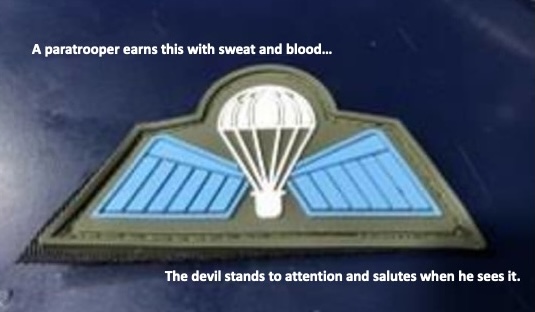
A new right hand was fitted to this brave young man at the Artificial Limb Centre in Pune. Although, he could not complete the para basic course and become a qualified paratrooper, Minoo Vania wished he had the authority to award the young man the coveted para wing for the fateful jump he made. After all it was for that little insignia that he had volunteered to join the Parachute Regiment. He lost a limb in seeking the distinction, but in the eyes of his fellow men he would forever walk tall.

Now in his nineties, Minoo recalls that moment vividly when his injured pupil lay in his arms after his extremely painful and traumatic experience. The boy’s words echo in his mind. The legendary PJI wonders, “If this is not stoic valour, what is?”

Epilogue
Court Martial or Shaurya Chakra?

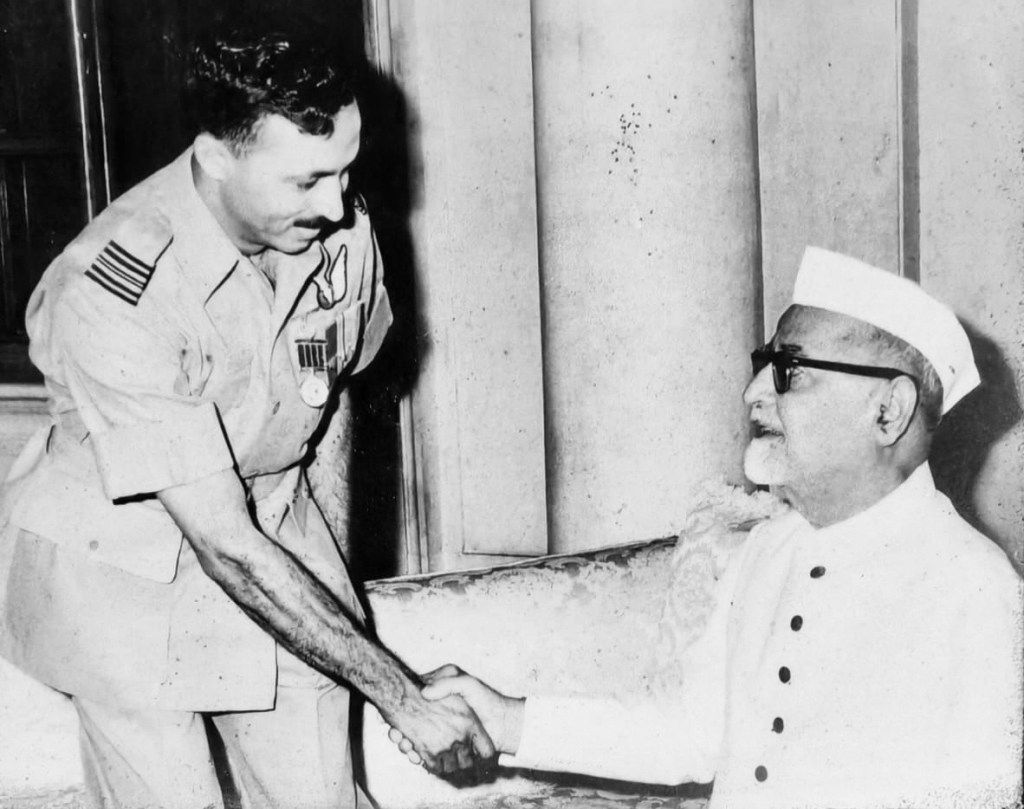
When Minoo Vania parachuted to help his pupil in distress, he was in the flight path of the Agra airfield. Technically speaking it was an operational hazard—NOT A DONE THING. And, there were people who saw it through that lens. “Minoo deserves to be tried by a court martial for flouting the laid down flight safety norms,” they opined. But then, there was a conscientious OC Flying in Wing Commander Pete Wilson who saw Minoo’s action differently—as a selfless act of daring. He viewed it as an officer risking his own life to provide succour to a jawan in dire need of assistance. Pete prevailed. Flight Lieutenant Minoo Vania was awarded the Shaurya Chakra for his selfless act of gallantry in peacetime. In the years ahead, Minoo Vania would train on D-1-8 parachute (jumping from AN-12 aircraft) in erstwhile USSR; carry out jump trials in Ladakh Region and the eastern sector, and undertake numerous equipment trials. His contribution to operations would be recognised by way of award of Vayu Sena Medal.

Postscript (by Air Commodore Minoo Vania SC, VM) Ashok suggested I add a postscript to this story you just read about the hang-up at Agra. To my eternal regret, I never learnt the name of the brave paratrooper. It was not for want of trying that his name eluded me, and I still have a hope. Maybe a fellow paratrooper on reading Ashok’s story may recall; maybe an officer of that era; or even a medical person where he would have been fitted with a prosthesis. It could be anybody who would lift the cloak of anonymity from this hero.

Other Parachuting Stories

Tipping the Fear of the Unknown… the very first jump

Jumping… definitely not to conclusion… what if the parachute fails to open.

Out of the Blue into the Tree!!… and, when one lands in trouble.

Mission First… will do everything for a jump.

Mission First

The exhilarating feeling is irresistible. A jumper would go as far as one can to satiate the desire to skydive. The Parachute Jump Instructors (PJIs) of the Paratroopers Training School (PTS), Agra are no exception. Drop a pin anywhere on the map of India and in a radius of fifty miles of the pin there will be a place where Akashganga, the Skydiving Team of the Indian Air Force (IAF) would have carried out a skydiving demonstration as a part of a major national event or a military tattoo. If not a demonstration, it would be a paradrop as a part of an airborne military training exercise.

Thanks to my tenures of duty as a PJI, I have been a part of many such displays. From the identification, reconnaissance and exploration of new Drop Zones in the freezing cold Leh-Ladakh region and trial jumps on those Drop Zones, to the exit over the Indian Ocean to land on a target in Thiruvananthapuram, each jump I undertook was different from the other and memorable in a unique way. When I look back, some stand out. An interesting one that often returns to the mind is the one performed as a part of the raising day celebrations of the President’s Bodyguards in November 1998.

High Altitude Jump Trials

I was then the Assistant Director of Operations (Para) at the Air Headquarters.

It was a Herculean task to get the requisite permissions and clearances for the demonstration at the Jaipur Polo Ground. With the who’s who of Indian leadership residing in Lutyens’ Delhi, security was a big concern. Jaipur Polo Ground was not far from the Prime Minister’s Residence. “It would be imprudent to allow such ‘frivolous’ activity in this area,” was an opinion. Then there was the issue of availability of airspace in the proximity of the busy Indira Gandhi International Airport where an aircraft takes off or lands almost every minute and dozens guzzle fuel as they await their turns on the ground or orbit in the nearby sectors. For many well-meaning people, disrupting the air traffic for a skydiving demonstration was an avoidable proposition. An easy way out for those in authority was to say: “NO.”

Notwithstanding what was happening on the files between the Air Headquarters, the Army Headquarters and the South Block in Delhi, the jumpers were agog, drooling. They were excitedly looking forward to the opportunity to jump at the prestigious event to be witnessed by the Supreme Commander of the Indian Armed Forces. Shri KR Narayanan was the then Honourable President of India.

How the permission to undertake the skydiving demonstration came about is the subject matter of another story. Suffice it to say that it did come—somehow. There were caveats, though. We were directed to operate from Air Force Station, Hindan. A team of security experts would sanitise our aircraft and inspect the parachutes for hazardous materials. We were told that they might frisk the jumpers too. Being personally searched was an irksome idea which we brushed aside in service interest.  Although the permission had been granted, we were also to await a last-minute clearance from Palam Air Traffic Control (ATC) before take-off. After getting airborne we were to follow a given corridor; report at check points and proceed only on further clearances.  The helicopter was permitted a maximum of 21 minutes over the Polo Ground to disgorge the jumpers and clear the area. Would the conscientious security apparatus be obliged to consider the aircraft ‘hostile’ if it strayed from the assigned route, or overstayed its allotted time over the Drop Zone (the Jaipur Polo Ground)? May be. May be not. To us, it mattered little as long as we could jump.

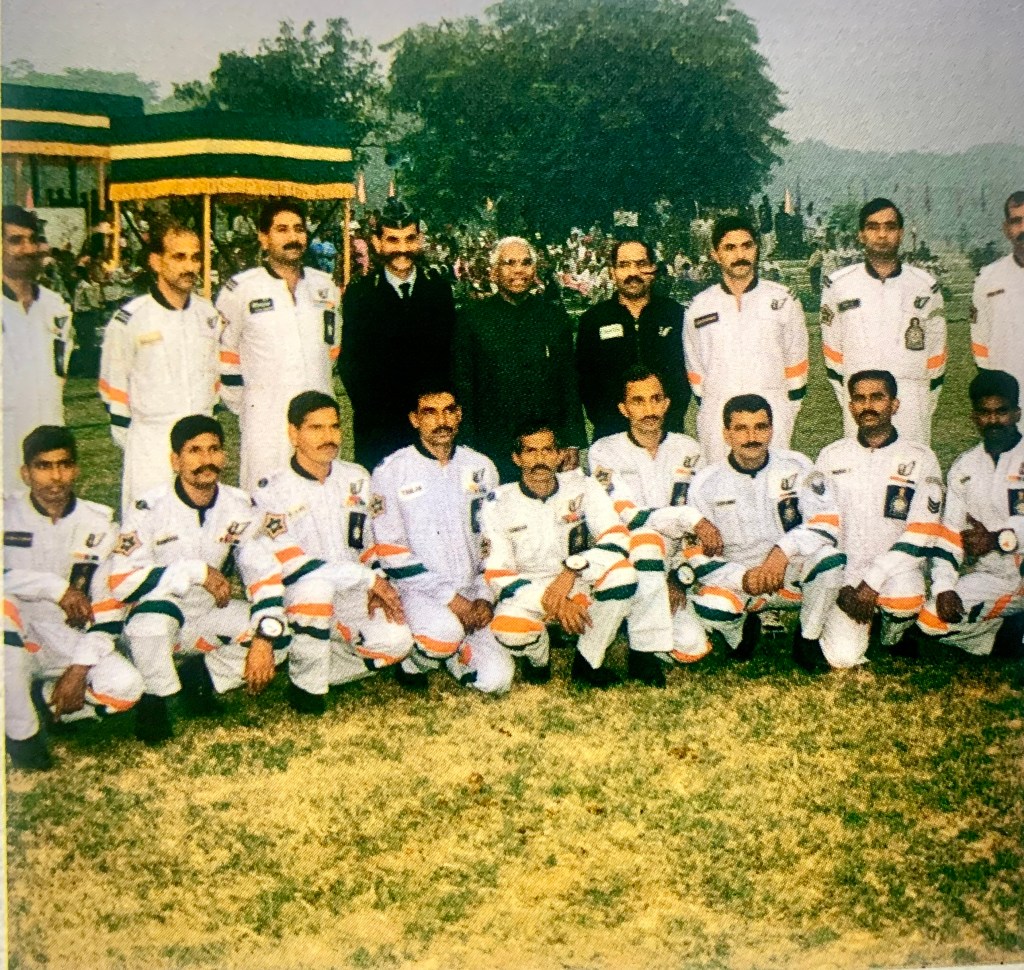
On the D-Day, the team led by Squadron Leader Sanjay Thapar, the then Chief Instructor PTS, arrived from Agra. Group Captain TK Rath, (the Director, Air Force Adventure Foundation), Squadron Leaders HN Bhagwat and RC Tripathi (both of the AF Adventure Foundation), and I joined them at Hindan. We inspected and lined up our parachutes and jump equipment and dispersed, since enough cushion time had been catered for, to account for unforeseen changes in programme. We all had our ways of passing the time available before take-off. Most sat quietly with fingers crossed hoping and praying for the drop to go through, because such VVIP programmes are prone to last minute hiccups. Group Captain Rath immersed himself in a book which he always carried in his overall pocket. He took a break in between to do a headstand. It was his way of attaining peace and calm. Thapar was engaged in communicating with Palam and the controller at the Polo Ground for the updates.

It was “OPS NORMAL!”

Minutes into the break the peace of sorts that prevailed on the tarmac was shattered by a commotion. The Security Team—in civilian clothing—after sanitising the aircraft had started overturning our lined-up parachutes to inspect them. They were alarmed to see sharp knives attached to the straps and had started taking them away.

Squadron Leader Tripathi saw them and literally pounced on them, “What are you doing?” he shouted.

“We are doing our duty… securing and sanitising everything. You can’t jump with these knives.” Their leader said with authority.

“But these knives are our lifeline… we need them in case we have to snap some parachute rigging lines in an emergency.”     

“We can’t help it… sharp objects around a VVIP are a taboo,” he drew a line.

Tripathi wasn’t the one to give in easily. He sparred on, “Well, now you have physically handled our parachutes without our knowledge. We don’t know if they have been rendered unfit for use. And, you are not allowing us to carry our survival knives, which is a must for us.” He let that sink in, and then came with the final punch, “Under the circumstances, it will not be possible for the team to jump. Please inform the guys at the other end that the demonstration jump is being called off for these very reasons.”

There was stunned silence before the leader spoke, “We understand your requirements. But you cannot cancel a programme meant for a VVIP and blame it on us. We are all men in uniform. We must find a way out.”

After a little ado, we were permitted to carry our jump knives.

The wait thereafter was long. Panic set in when the clock struck four. It was our scheduled time of take-off. There was no clearance yet. The Honourable President would arrive at 5:00 pm as per programme. In an extreme situation, just in case the Skydiving Demonstration couldn’t be undertaken for any reasons, the Military Band present at the Polo Ground would play martial tunes to entertain the audience. None was interested in that Plan-B; every stake-holder wanted the jump to go through.

In those moments of uncertainty, a deliberate decision was taken to get airborne and hold position over the dumbbell at Hindan airfield so that no time was wasted if and when a go-ahead message was received. So, still on tenterhooks, we strapped our parachutes and boarded the helicopter.

The clearance came 15 minutes too late; we’d now be cutting fine. Our helicopter was asked to hold position over the Yamuna bridge and wait for the final clearance. Time was running out. November smog had begun causing concern. But Thapar, who was born and brought up in Delhi was not deterred by the falling visibility; he knew the ground features by heart. He could manoeuvre blindfolded.

When the final clearance came, there was just enough time to make one pass over the Polo Ground. Under normal circumstances, the aircraft makes three passes over the Drop Zone—one, for the pilot and the Skydiving Team Leader to familiarise with the target on the ground and ascertain the line of run. The other two passes, are to drop jumpers in batches of six to eight each.

A confident Thapar took the decision to do away with the first two passes over the spectators. He briefed the jumpers in the aircraft that all of them—more than a dozen—would exit the aircraft in one go. He re-assigned the parachute opening heights to each jumper and stressed the need to stick to it else there would be many jumpers approaching the landing area together resulting in a melee; maybe collisions.

Good things don’t come easy!

At 5:00 pm, when the helicopter came overhead, the Drop Zone Safety Officer informed that the President had not arrived. “Please hold on!” he advised.

Three minutes later, the Air Traffic Controller from Palam Airport instructed our helicopter to clear the area instantly; international flights were getting inconvenienced. It was when the captain of the aircraft was contemplating abandoning the mission that Thapar leaned out of the aircraft and spotted the President’s motorcade. It would still take a couple of minutes to reach the spectator stands. When he turned back, he had taken the decision.

“Go!” he commanded the line of jumpers awaiting his instructions. Within seconds all the jumpers were out of the helicopter.

With the Supreme Commander

The pilots racing back to Hindan airfield saw the colourful parachute canopies adorning the sky over Lutyens’ Delhi. The Honourable President’s motorcade just moved into the Ground as the skydivers began landing one by one. It turned out to be a bit comical when the jumpers responded to the tune of the National Anthem and stood to attention on touchdown.

Cancellation of a para drop is one of the worst possibilities faced by a Parachute Jump Instructor.

Other Parachuting Stories

Tipping the Fear of the Unknown… the very first jump.

Jumping… definitely not to conclusion… what if the parachute fails to open.

Out of the Blue into the Tree!!… and, when one lands in trouble.

Stoic Valour… when a jumper trailed behind a flying aircraft.