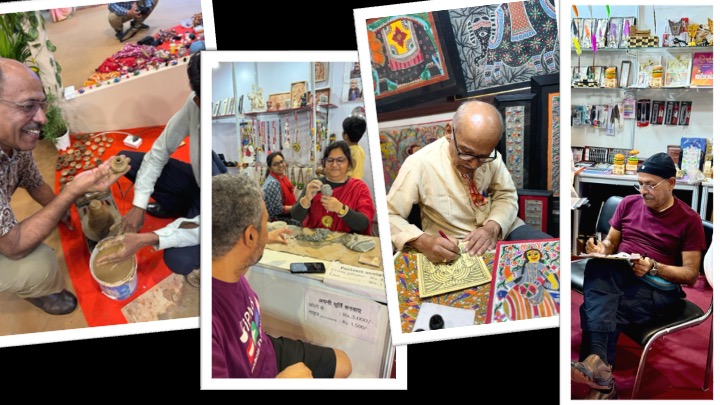
All have their own definition of it; and, it changes from time to time. For now, for me, it is a feeling of contentment and satisfaction one gets when one does something one has never done before. The other day, I experienced just that, when I spent quality time at the Trade Fair in Pragati Maidan. An artisan allowed me, and encouraged me to work on his potter’s wheel. With a little guidance and help, I could fulfil a desire I had nurtured since childhood. I could make a miniature vase; I felt, I was on top of the world.
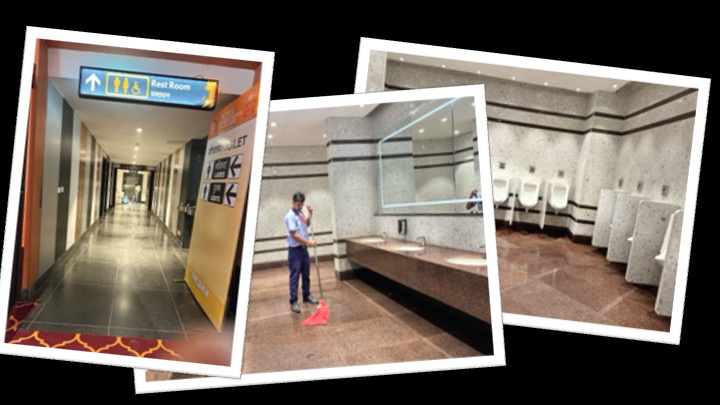
Spick and span…a different Pragati Maidan
In another stall, it was therapeutic to watch a lady work on the clay bust of a person sitting opposite her. I have seen umpteen artists making caricatures likewise, but never a person making a clay bust within minutes. Watching Mr Indrakant Jha engrossed in Madhubani art was a treat to the soul.
I had never experienced virtual reality before. So, flying a parachute canopy (in virtual reality) at the NTPC stall, seven years after I made my last parachute descent, was a top of the world experience.
Conscientious staff…
The child in me went berserk when I found a stall displaying writing instruments. I spent the good part of an hour trying my hand at calligraphy. If I had had my way, I’d have spent the entire day visiting the remaining stalls and exploring the other options.
In itself, the experience was exhilarating; it became more so because of the improvements I saw and experienced at the fair. To cite a few — the new underground parking is very well organised; comparable to any good mall in the NCR. Everything in and around the halls is spick-and-span. The public utilities are sparkling clean. The absence of litter, even around the eateries, is a pleasing sight. There are conscientious staff to maintain the surroundings. The security staff and those at the help-desks are courteous. The thoughtfully designed and placed signage makes things convenient.
Let’s be “good”
On the whole, our experience was in sharp contrast to what we have seen in the years gone by. People who are striving silently to make this possible deserve Kudos.
On our part, let us help them in their endeavour by just being ‘good’.
Post Script
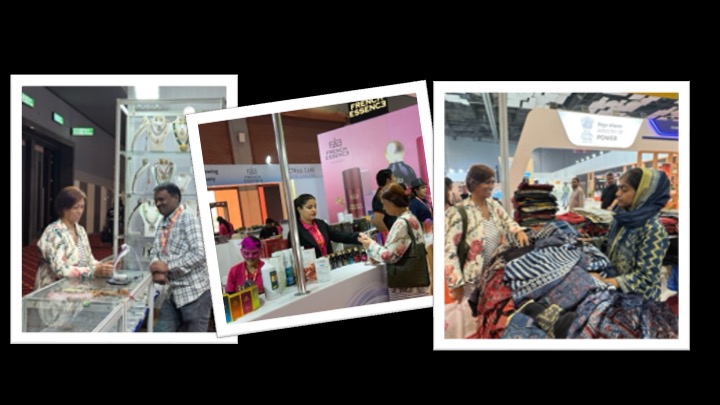
This description of our visit to the Trade Fair would be incomplete without the narration of our interaction at a stall displaying Gujrati garments. Chhayaji liked two dresses and decided to buy them. When she tried to bargain with one of the salespersons, the lady said with a lot of pride, “Like Modiji, we are Gujratis! We are upright people. We do not tell lies about price; we do not leave a scope for haggling.”
…fir bhi dil hai Hindustani
Amused, I asked her, “Why are you dragging Modiji, in this conversation?”
“Because, he is an upright leader; and he is a Gujrati,” she chirped with even greater pride.
“Why do you say you and Modiji are Gujratis? Aren’t we all Indians—you, I and Modiji? Think of it, it is only a matter of time, even Trump and Nigerians will stake a claim on Modiji. What will you do then?”
She laughed heartily at my quick-fire repartee; gave us a handsome rebate. We thanked both, the lady, and Modiji, profoundly before leaving the premises.
It will be interesting to know Modiji’s “MAN KI BAAT” someday on belongingness to a state, the nation, and the world.
Until the beginning of 1980s, the thing that drew an Indian traveller’s attention when the train approached a station was bare-bottomed men with a container of water squatting blissfully by the track, deliberately oblivious of the passing trains. Then, there came something that vied for attention and grabbed it nice and proper. It was a hoarding in big white letters in Hindi repeated on the dilapidated brown brick walls separating the tracks from the suburbs on the approach to all cities. It read:
प्रोफेसर अरोड़ा। रिश्ते ही रिश्ते। मिल तो लें। 28, रैगर पुरा, करोल बाग। ब्रांचेज इन अमरीका एण्ड कनाडा।
Literally: “Professor Arora. Loads of matrimonial contacts. Just meet (us). (Address) 28, Raigarpura, Karol Bagh. (We have our) Branches in America (the US) and Canada.”
Innumerable married Indians, and quite a few Americans and Canadians, owe their happily, or very happily married lives to that ad campaign which might be a case study for budding entrepreneurs. That 28, Raigarpura ad was more striking and easier to avail of the offered match-making services than the matrimonial columns of the leading national dailies. The system run by Prof Arora couldn’t have been computerised. Computers didn’t exist even in the imagination in the India of the 1980s. Yet Prof Arora gave a run for the money to all others offering match-making options. Had Modi been the Prime Minister at that time, Arora would have been a subject of discussion on “Man ki Baat.”
Whoever said, “Marriages are made in heaven,” must have lived on a different planet; may not have belonged here. Or, that may have been true in a different era. We rarely see it happen nowadays. The last well known swayamvar was that of Sita (or was it Draupadi?).
The breaking up of the marriage of the daughter of a leading astrologer of India days after she took seven pheras of the holy fire has cast doubt on that system. The role of astrologers, if not the art and science of match-making using astrology, has also lost its appeal.
A joke has been doing the rounds:
A five-floor super store provides choice of men for husbands; desirable qualities keep adding as one moves to the next higher floor. One can climb floors but cannot return to a lower floor to make a choice. A lady wanting to choose a husband found caring men with jobs on the first floor. Curiosity took her to the second floor where she found wealthy caring men with good looks. With a desire to find a better man, she went to the third floor where there were good looking rich romantic men. The woman was happy with the offer but was tempted to have a look on the fourth floor. On offer on the fourth floor were good looking romantic millionaire men who’d help in the kitchen and take care of kids too. Anticipating an even better choice, she took the lift to the top floor to find a prominently displayed message: “Sorry, the kind of man you are looking for does not exist.” [Disclaimer: This joke has been recalled and reproduced to the best of the author’s ability. The readers may change the gender of the main protagonist and re-read if it pleases them.]
Seeing the growing demand, websites facilitating match-making have proliferated. They collect what they call ‘BIO-DATA’ of the customers and their expectations. Then, for a fee they offer contacts of matches who generally meet the requirements. One doesn’t need to write complex algorithms to get the desired output of this nature. A school student adept at using Microsoft Excel can help choose a ‘suitable’ candidate. For that reason, such websites are available a dime a dozen. Satisfaction from their services doesn’t count. Whether matches made through them result in successful marriages or they end up in divorce is immaterial—none visits them a second time. To remove the element of uncertainty people have begun visiting ‘dating’ sites which, again, are a gamble.
All these efforts to find a near-perfect, if not an ideal match, suffer from an inherent drawback—an individual might provide incorrect data or conceal vital personal information during the meetings that follow initial interaction on email or during telephonic conversations. Little has been done to carry out a reliable background check on individuals by the match-making websites. If attempted, this could be construed as invasion of privacy. People with resources are known to employ private detectives for background checks. Artificial Intelligence (AI) has still not stepped into this arena in any big way. So, beyond just comparing ‘requirements,’ how does one ascertain compatibility?
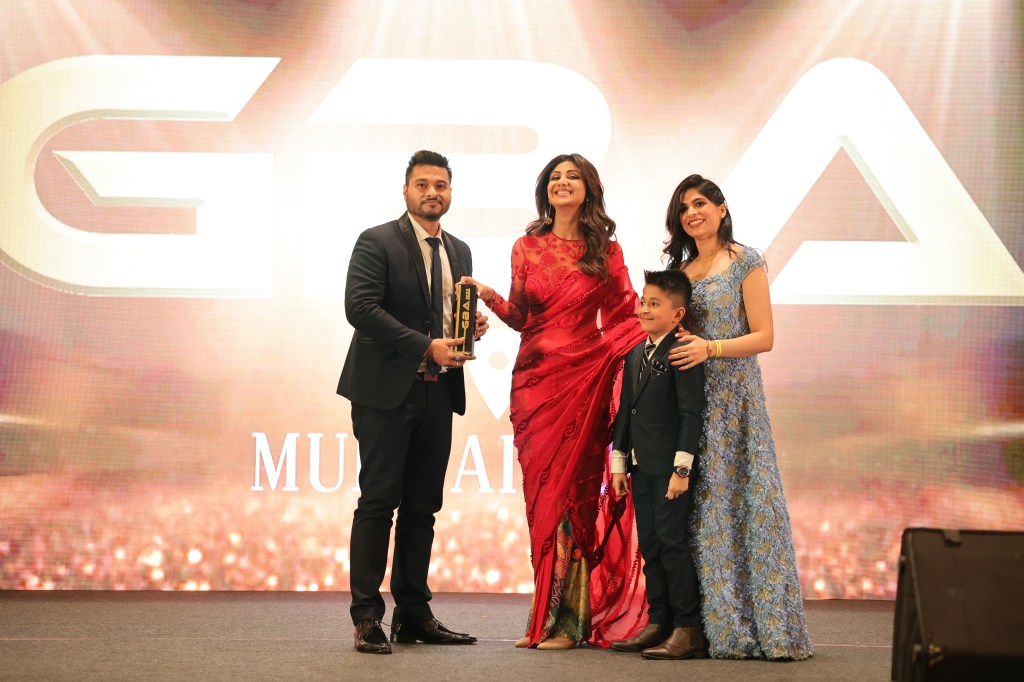
In December last year, Hold My Hand Matrimony, was adjudged as the Best Matrimonial Company by the Global Business Award (GBA). I was curious: How can one compare different websites providing almost exactly the same services? May be a website has a larger database with more fields to compare, match and report? My query led to a revelation; the company was doing something different. They were utilising services of skilled and experienced psychologists to ascertain the compatibility between individuals.
Best Matrimonial Company
The process starts with sharing the biodata and pictures for marriage. A compatibility form for marriage is provided to the candidates. On the basis of the criteria mentioned by the candidates, the matchmaking team shortlists the matches.
A personal relationship manager is always present on the first call on conference between the two individuals/ families. It is to make the individuals comfortable before they communicate with each other and familiarise themselves. Hold My Hand Matrimony boasts of having the data on some of the most eligible marriageable youth of the country and a large number of PIOs and NRIs.
Marriages are made here… on the earth
This aspect of involvement of psychologists to ascertain compatibility got me interested; amused, to be honest. So, with a view to find a suitable match for my nephew, I called Mr Navneet Sharma, the CEO of the company to know more about their modus operandi. I discovered that the company is run by the husband-wife team. Ms Puja Sharma (Navneet’s wife) is an equal partner in the Company and handles some of the gender specific issues. I was amazed by their vision. They are experimenting with two more never-before-thought-of dimensions to their match-making service. In their business interest, I cannot write about the fascinating aspects, which are still under trial. Suffice it to say that one of them is social and the other, quite scientific—both will take match-making several notches up to the next higher level.
It is beyond doubt that with so much effort going into match-making, more and more people will live happily for ever.
PS: A few readers have called me seeking the contact details of Hold My HandMatrimony. Here they are: WhatsApp: +919319706587 Email: info@holdmyhandmatrimony.com
Chinese incursion into the Galwan Valley earlier this year was but a-matter-of-routine. Nothing new, that’s something China had been doing for decades––entering Indian territory; sometimes withdrawing, but occasionally occupying pockets, and presenting them as ‘disputed areas’ at subsequent talks.
Salami slicing!
India’s response to that provocation surprised the world to no end. Among other options, a tough stance was the least expected, because until then people had judged India on the basis of its meek response to similar incidents in the past. The response dazed even the Indian public who had been in some kind of unspoken or grudgingly spoken awe of the dragon ever since the 1962 debacle.
India’s reaction was a Black Swan Event––unprecedented in its nature, spectacular in its impact. Now, military pundits and strategists are scratching their heads analysing, explaining and justifying the behaviour. The outcomes and the spinoffs of the transaction have been meaningful, and many. Importantly, it has raised the bar on the quality of India’s retaliation to Chinese military adventurism. That India will be even more assertive in such situations in the future is the new ‘expected’ norm. China will do well to take this change into account in its future calculations.
The talks at the diplomatic and the military levels to de-escalate tensions and to restore peace in the region have not made much headway. There is a definite dearth of points of convergence and trust has been conspicuously absent from the scene. A word about the complexity of the Sino-Indian border issue would be in order. Decades of diplomatic foot-dragging have complicated the already complex matter. Now, to resolve the issue appears to be as difficult as untangling a plateful of spaghetti or unscrambling an egg. Both, China and India have taken rigid stances and are unwilling to relent. It is anybody’s guess that the prevailing uneasy calm will end either in peace or will escalate into greater hostility. There’s however, an ominous tilt towards the possibility of the latter. Presently, both sides are trying hard to be in a situation wherein they can negotiate from a position of greater strength.
Meanwhile, General Bipin Rawat, the Chief of Defence Staff of India has declared that India is prepared for a military option, if the talks fail. In making such a provocative statement, the General might have only carried out the orders of the political leadership, because ‘good’ Indian generals do not normally air provocative views against a neighbour unless we are already at war. So, let the General roar and let the countrymen rest assured that Prime Minister Narendra Modi will give a clarion call through his ‘Man ki Baat‘ when the time is ripe. Period.
In a recently recorded video message, Mr Pravin Sawhney, Editor, Force Magazine dissects General Rawat’s words and iterates that unless backed by military power, warnings mean little; he’s so right on that count. He goes on to project India’s extreme vulnerabilities and concludes that it would take at least six months to prove the General’s claim of preparedness. After eulogising China for its varied capabilities––conventional warfare, cyber warfare, anti satellite (ASAT) capabilities, artificial intelligence capability, the capability to disrupt communication networks of India, its nexus with Pakistan et al.––he concludes that a war between China and India, if it were to take place, would be like the First Gulf War between the US and Iraq respectively, implying that India would be routed technologically even before the troops engage in land battle. At the end of a 20 plus-minute video in which he paints a dismal picture of India’s war preparedness and petrifies Indian viewers, he urges that the clip be circulated. For me, a replay of the video led to the distillation of the man’s suggestion, which to my mind conditioned by years of rigorous military life sounded somewhat like this:
“SURRENDER TO CHINA WITHOUT FIRING A BULLET!”
Echo of that implied suggestion so ‘F-O-R-C-E-fully’ made by Mr Pravin Sawhney rings menacingly in the mind until long after one turns off the video. Another look exposes the sense of insecurity of the presenter and the shallowness of his arguments. The naysayer and the pessimist in him, finds India’s faults and deficiencies well nigh infinite. If only he could realise, China is not the US; India, not Iraq. Unwarranted anxieties of the timid will only prove to be countervailing factors in India’s efforts to deal with that country. That said, there is good reason to listen carefully to the meaningful signals, if any, in the cacophony of deafening alarm bells that the paranoid Mr Sawhney rings.
Introspection!
Today, when India and China are at daggers drawn, the chunks of information on military capabilities of the two countries that are available in the open domain, rather ‘fed’ to the public, could be quite inaccurate. Under the circumstances, a SWOT analysis could go awry; it could be an exercise in futility. Therefore, more prudent and fruitful approach to deal with the darned dragon at this moment would be to focus on exploiting all available means and resources to bolster the existing military capacity and capabilities. Therein is the genesis of this five-part blog post––this part being the Preface. The posts that follow will discuss issues related to boosting military manpower, bolstering border infrastructure and military capability, refining military thinking on the use of nuclear weapons and the idea of mustering external influence to bear on the adversary and more.




 Road Much Travelled