

Will avail every opportunity to spend time in the Temple.
Will avail every opportunity to spend time in the Temple.



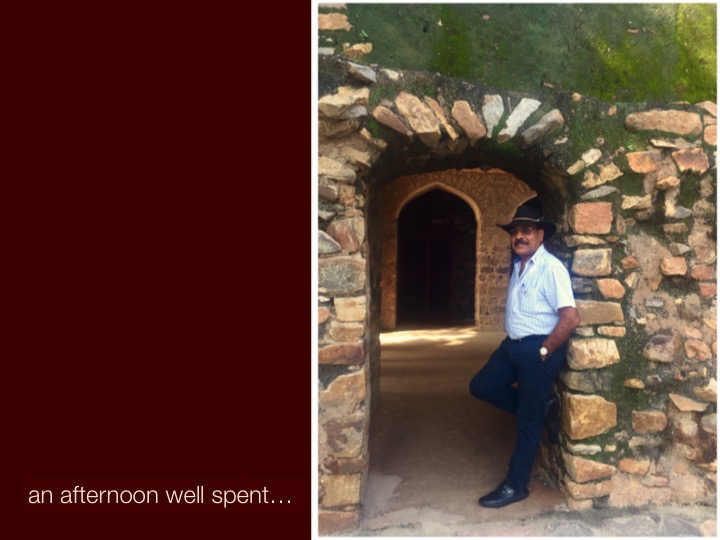
Operation Cactus: The Maldives, November 3, 1988.
The Indian Armed Forces had embarked on a seemingly impossible mission; a mission to rescue President Maumoon Abdul Gayoom who had been surrounded by armed men (cadres of People’s Liberation Organisation of Tamil Elam) led by a Maldivian businessm an, Abdullah Luthufee. I was a part of the team that landed at Hulule airport to respond to the SOS call of the Maldivian President.
The notice was short; and there was practically no intelligence. The odds were loaded heavily against us. Most strategists would have forecast a failure, nay a debacle, when we took off from Agra. And, although people have compared Operation Cactus with the Charge of the Light Brigade, albeit with a pleasant end, the Indian Armed Forces did not sleepwalk into the Maldives that November night. It was a fairly well planned and methodically executed Operation within the time and resources  available on that day. The risks were calculated and catered for. The spirits were high. A determined Brigadier FFC Bulsara wrote the following message for me hours before we landed at Hulule: “We’ll secure the airstrip and the President by 1000h tomorrow.”
In a very well coordinated operation involving the three Services and the diplomatic corps, the IAF airlanded the Paratroopers at Hulule who rescued the President. The Indian Navy chased the fleeing rebels and rescued the hostages on board the rogue ship. Among the hostages were a Maldivian minister and his Swiss wife. There was no casualty on our side.
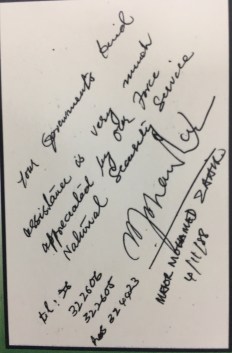 A Maldivian National Security Service (NSS) officer, Major Mohammed Zahir wrote a note on my scribble pad. The note speaks about the Maldivian sentiment at that time: “Your Governments kind assistance is very much appreciated by our Force. National Security Service.” He also presented me a cap badge and a formation sign of the NSS as souvenir.
That was 30 years ago. Time and tide has eroded the gratefulness.
China has taken over and occupied islands on lease in return for the infrastructure it has created for the Maldivians. Like Sri Lanka,  the country is heavily in debt. The population seems ignorant; the leadership has fallen into a trap from which it would be difficult to escape. Needless to say, Chinese gains have been at India’s cost. The pro-China sentiment is expressed in a hoarding which was put on the China-Maldives Friendship Bridge when it was under construction: “Waves are gifts from God. Bridge is a gigt from CHINA!”
 If the recent elections are to go by, democracy is still alive and kicking in the archipelago. Opposition candidate, Ibrahim Mohammed Salih has defeated the present (pro-China) incumbent, Abdullah Yameen. The former President, Mohammed Nasheed has recommended a review of the agreements with China. For India, this might turn out to be an omen of recovery of ties with the Maldives. It is an opportunity to put back the relations with the Maldives on firm footing.
It will be naïve, to say that replacement a pro-China president will lead to slipping of Beijing’s grip on the Maldives (as a newspaper headline suggests). Change of guard does not necessarily mean change of ideology or policies. At best India can start afresh, regaining the confidence of the Maldivians. India has many advantages (over the Chinese), including that of proximity to the Maldives. There is a lot that India can do to restore the strategic balance in the region.
Today is the day, now is the time!
 Author’s Note: “Operation Cactus: Anatomy of One of India’s Most Daring Military Operations” (Group Captain Ashok K Chordia, Knowledge World, New Delhi, 2018) is a seminal study of the operation launched by Prime Minister Rajiv Gandhi to rescue President MA Gayoom of the Maldives (November 1988). The book is based on recollections of the protagonists and official unit records and histories.
The turbulence in the wake of the omni-role fighter aircraft Rafale, which India has decided to buy, has become insignificant in comparison to the turbulence generated by the politics surrounding it. The purchase (mind you, not so much, the flying machine itself) has been making headlines every other day. The politics of it has given the opposition parties the nuclear tipped cruise missile to try and tether the government. 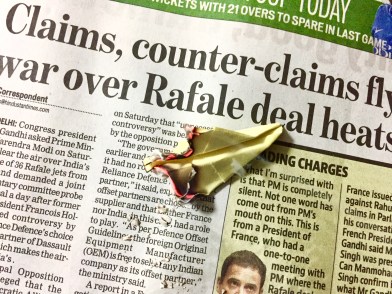 The Brahmastra has been launched. Now, frantic effort is ON to decide as to who or what should be the target. The effort is to ensure that the missile hits a target (anything that could be labelled as a target) before it runs out of propellant. And it must happen before the Lok Sabha elections scheduled next year.
The media is genuinely trying to keep the all-so-innocent junta informed. Effort to improve the TRP is a parallel enterprise. So, any news that informs (read sensationalises) is good. New issues need to replace the old ones.
In the clamour of people and parties accusing each other of motives and intentions, some good meaning media-persons consider it worthwhile to report on the performance characteristics of the aircraft, leaving aside the politics of it for a while. Who better to hear from than the Chief of the Air Staff (CAS), Air Chief Marshal BS Dhanoa? So they try to get the right answer from him.
Few would envy him for being in a position in which people with shallow theoretical knowledge seek comments on issues that are technical, sensitive and of strategic importance. And among the crowd are the smart people who attach meaning to each word the Chief says; and they comment on his body language and timing of the comment too. Now, because “the country wants to know,” (and because it would be inappropriate to keep the people guessing), the Chief confirms that it is a good aircraft that the country is buying to address the dire current defence need. He says so with the conviction of an air warrior who has flown thousands  of hours in fighter aircraft. He is the one who flew solo in a MiG-21 aircraft soon after taking over as the Chief displaying rare and exemplary military leadership!
When he speaks, he is sure of what he is talking about.
Yet on another occasion, they ask him about the aircraft. His answer is the same. A little later, the question is repeated in different ways. The Chief who means business of national defence only, repeats the answer.
Then comes the time to generate new and renewed interest in the Rafale Deal.
At a National Seminar on the IAF’s Force Structure (2035), a media-person recalls the Chief’s statements on the performance of Rafale aircraft and the timing thereof, and suggests if the comments are politically motivated. It was not the Chief who was asked the question but an officer (a retired one in that). The question was not responded to because it was not relevant to the subject and perhaps because it was the prerogative of the Chief to respond.
Any effort to draw the IAF into the political slugfest on Rafale will benefit people: some will be able to settle scores with the government; others might find a way to pass the blame, if any. But if the deal were to be shelved or the procurement were to be deferred, the worst sufferer will be India whose defence preparedness will get compromised.
 My Anna Bit: Whichever party comes to power, it will need the Air Force to defend the country’s skies and the frontiers. The Indian Air Force will continue to feel the pressure until the shortfall is made good. We’ll do well to leave the Chief and the Air Force to do their bit.
Come September the 28th, Hotel Taj Mansingh will be under the hammer (if the date is not changed)––some of the top names in the business of hospitality will vie to acquire the coveted premises. The Hotel has been witness to events of historical importance. I too have attended seminars and private parties in its elegantly decorated convention halls. But what I remember the Hotel is not for its grandeur but an incident, which twenty years on remains a mystery for me. It took place on the roundabout near the Hotel.
It was a Wednesday in Dec ember of 1998 (or 1999); I am not too sure of the year. Not that it is of much consequence. It was a Wednesday for sure, because I was in civvies. On other workdays we used to wear the uniform to Air Headquarters. I was driving along APJ Abdul Kalam Road (it used to be Aurangzeb Road then). On the roundabout near Hotel Taj Mansingh I narrowly missed a car parked dangerously in my path. I swerved and went around it. The cars following me had to take even more drastic evasive actions. I looked furtively at the driver of the parked car as I went past it. It was a lady.
Thinking that something was wrong and perhaps she needed assistance, I stopped a little ahead and approached her car. “Is there a problem? Can I help?” I asked.
“My car has stopped. It is not re-starting.”
“Let’s see what can be done. But before that let me push your car a little ahead. It is dangerously parked.”
She sat at the wheel as I pushed the car. Once the car was at a safe location––not in the path of the other moving vehicles––I asked her if there was sufficient fuel in the tank. She got out of the car as she confirmed, “There is enough petrol in the tank.”
She handed over the key to me and looked intently at the Defence Headquarters’ Identity Card hanging from my coat pocket and said, “I am an Air force Officer’s daughter. The need for me to introduce myself had become redundant––she had read my name.
I sat in the driver’s seat, inserted the key and cranked the engine. Lo and behold, the engine started as if nothing was wrong with it. I looked at her victoriously. She shrugged her shoulders as if to say, “I don’t know how it has started now. It wasn’t starting when I was trying.”
I got out of the car without switching off the engine and gestured her to occupy the seat. “Do not switch off; drive straight to a mechanic before it stops again.”
“Thank you,” she said as she got into the car.
As I was turning to go, I happened to see a “PRESS” sticker on her windscreen. “Are you from the media?” I asked her.
“Yes, I am Anita Baruah (name changed) from Bharat Ek Khoj (name changed).”
It was a popular news magazine––one of the most popular, indeed. But I didn’t know the young lady. Later when I shared the incident with a colleague, he told me that I had met a celebrity (he meant Ms Baruah) from the news media. She was an Associate Editor of the magazine. A few years later, she published a book on a military subject.
For the last twenty years, the instant starting of a supposedly broken down car has intrigued me. I have wondered whether the damsel was really in distress or the media-person was waiting opposite Taj Mansingh with a purpose; keeping an eve on someone or something for her magazine’s next big story.
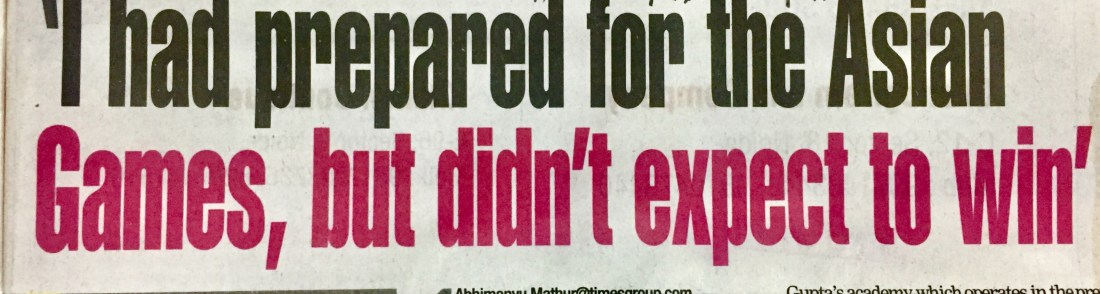
This post is inspired by a caption, which appeared in a newspaper supplement and drew my attention. It read: ‘I had prepared for the Asian Games, but didn’t expect to win.’ Why would a sportsperson enter a competition undetermined to win? The individual might have genuine personal reasons for being less hopeful. But I believe that the environment also kindles and fans this type of hopelessness.
I have heard coaches encouraging their trainees thus: “Haar kar mat aana,” meaning “Don’t lose and come.” And parents saying: “Win at least a medal.” Why are we so shy of even desiring to win? Perhaps with the following words of encouragement they would stand a better chance of returning victorious: “Guys you have toiled for this day. Elements of the universe are aligned in your favour. Now go for the Gold!”
The media, both print and electronic, have their way of reporting sporting events. Here is a standard line they use to report the entry of an individual (or a team) into the finals of an event:
“Satbir Singh has reached the finals of the Men’s Badminton. Now he is assured of a Silver Medal.”
Although this is truthful reporting, but it lacks the nudge that can possibly encourage a sportsperson to give that last bit in him/ her to win. If I were a media-person, I would tweak the same report to read thus:
“Satbir Singh has entered (mind you, not “reached”) the final round of the Men’s Badminton. He is now a step closer to the coveted Gold Medal” or “He’ll now fight for the Gold.”
Similar tweaking in the reporting of events in other walks of our daily lives can bring about a pleasant change in the way we start our days. That is a subject of another post, another day.
The other day I wrote about my experience with a couple whose vehicle had broken down on their way to the airport. It was incidental that I saw them stranded on the roadside and offered them a lift. And when the lady (an NRI settled in the US), expressed disbelief––“I never expected this to happen in India”––I responded spontaneously: “Young lady, it happens only in India.”
Kavita, my niece, now a US citizen, has responded to the post with:
“LOL! Though it happens outside India too, I can say for sure, having been on the receiving end of so many gracious gestures from so many strangers; country or continent no bar…”
I have revisited the incident in the light of Kavita’s remark. And, now I see an all new dimension of the incident.
The lady I wrote about was carrying a perception of India and the people here. For that reason, she did not expect such assistance in India.
My response was spontaneous, rather impulsive. Today when I look back, and analyse it dispassionately, I find two reasons for it. One, when she said: “I didn’t expect this to happen in India,” she inadvertently assaulted my pride as an Indian. And two, I haven’t been many places; I haven’t experienced much of the good behaviour of the people  abroad. To say––“It happens only in India”––is, I guess, incorrect.
I love my India so do others love their countries.
What would I tell the lady if I were to go back in time and meet her under the same circumstances?
I would perhaps tell her (of course with a more pleasant smile), “My lady, there is more to India than you have seen, read or heard about. Now go, feel the heartbeat of my country.”
Thank you Kavita for sharing that thought. I value your opinion 🙂
Early one summer morning, I was on my way to Gurgaon to participate in a golf tourney. It was an annual feature in which the logistics officers (serving and the veterans) of the Indian Air Force vie for honours. The modest prizes mean little; actually it is an occasion for the logistics officers to meet and catch up with friends. I had started a tad early from Noida to be able to spend some quality time with buddies before teeing off.
I saw a white Ambassador car parked by the roadside as I was driving past the Film City. Someone was working under the bonnet. Another person, back towards the car, was looking expectantly at the passing vehicles. It was daybreak and there were very few of them on the road. The man was fidgety, gesturing to stop the passing cars.
I stopped abeam his car and lowered my window. “What’s the matter?”
“Sir, my car has broken down. I have to catch a flight from the Indira Gandhi International Airport. The driver has not been able to place his finger on the fault yet. I’ll miss the flight if I wait till the car gets repaired…”
“Hop in,” I said cutting him short. “You are lucky. I am heading for a golf course in Gurgaon. The airport is on my way and I have some time in hand. With a small detour, I’ll be able to drop you.”
He was accompanied by a lady who stepped out of the car as we spoke. They sat in my car; the gentleman by my side and the lady on the rear seat. We exchanged niceties. Then the gentleman expressed their profound gratefulness. What he couldn’t express in words, he tried to convey with his body language.
They were in their late twenties; maybe early thirties. Just married. They were on their way to Leh for a honeymoon. The gentleman was a senior executive with a Government of India enterprise. The lady was an NRI settled in the US. She had come to India after decades.
As we drove along, we indulged in polite meaningless conversation, the type we make with strangers to while away the time––we talked about the weather, about the beauty of nature, about global warming, about congestion on the roads… The lady, who was a bit reserved in the beginning, started participating actively.
I was bu sy making calculations as I drove; I wanted to be in time for the golf tournament after dropping the couple at the airport. With the mind racing ahead of the car and trying to reach the golf course, I was participating passively in the discussion. But then, the lady said something, which drew all my attention. After thanking me for the lift she said, “I never expected this to happen in India.”
I turned my head for the first time, smiled at her and said: Young lady, it happens only in India.” There was silence.
The silence was broken by the man. He gave a long monologue, which was meant for his sweetheart. He highlighted every good thing that happens in India.
The lady was sheepish when I left the honeymooners at the airport.
 Road Much Travelled