
Article reproduced with permission from Wing Commander JK Kaushik (IAF Veteran).
The lead story in the newspapers and the TV channels over the last few days has been the US-Iran Summit at Lucerne in Switzerland. This took me back a couple of years when we had an encounter of a different kind in the very city that hosted the Summit recently.
Our son Aditya has lived in Zurich, Switzerland since 2020. The Covid pandemic restrictions disrupted travel and the plans for a family reunion. When travel restrictions were gradually removed, we decided to visit him. There’s a lovely view of Lake Zurich and the snow-covered peaks of the Alps from Aditya’s apartment. After soaking in the unadulterated beauty for a few days, we began exploring the rest of Switzerland. Aditya or Angelika (our daughter-in-law) accompanied us on these trips depending on their work schedules. When both were busy, Kalpana and I ventured out on our own.
One of the first excursions we undertook was to Lucerne—a short train ride from Zurich. On reaching Lucerne station we took a short bus ride to go Mount Pilatus. We absorbed the natural beauty of the Swiss alps on the gondola ride to the top of Mount Pilatus. The strong cold wind that greeted us at the top froze us to the bones. But, the view from the top was a treat to the soul. We enjoyed it for some time and, after a hot cup of coffee at the summit restaurant, prepared to return to Lucerne. This time we chose to take the special cogwheel railway down. Incidentally, the cogwheel railway from Mount Pilatus is the steepest such train in the world. The cogwheel railway ride down the slopes of Pilatus was a rare experience. Once we reached the base, we took a boat across Lake Lucerne to return to Lucerne.
The excursion to Mt Pilatus had taken much less time than we had anticipated. We had a few more hours at our disposal. The guidebooks suggested that we visit the Kapellbrücke (Chapel Bridge). This is an old wooden bridge, 170 m long, constructed in 1300 AD. There is a stone water tower at one end which, as the glossy handouts noted, had served as a lookout tower, a water storage tower and also as a prison. The bridge was partially burnt in 1993, but has since been painstakingly restored.
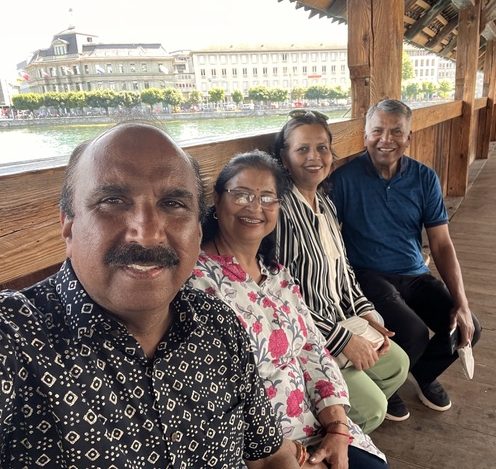
Google Maps guided us through the short walk from Lake Lucerne ferry terminal to the Chapel Bridge. We found that the area around was practically deserted as the Bridge is meant only for the pedestrians. After the ‘mandatory’ photo at the entrance, Kalpana and I started strolling slowly to the other end. We noticed a couple of benches on the bridge and decided to sit down for a few minutes. As we were approaching the benches I noticed another couple of almost our age walking ahead of us slowly and occupying the first bench. I remarked to Kalpana that they appeared to be Indian tourists like us. We went past them and settled on the next bench.
Kalpana started taking out the water bottle and some refreshments from her handbag. “They look very familiar,” she mused gesturing at the couple. I dismissed her remark as pure imagination. But, when she insisted that I take a look, I lifted my eyes from the screen of my mobile phone, which I had been scrolling as a matter of habit.
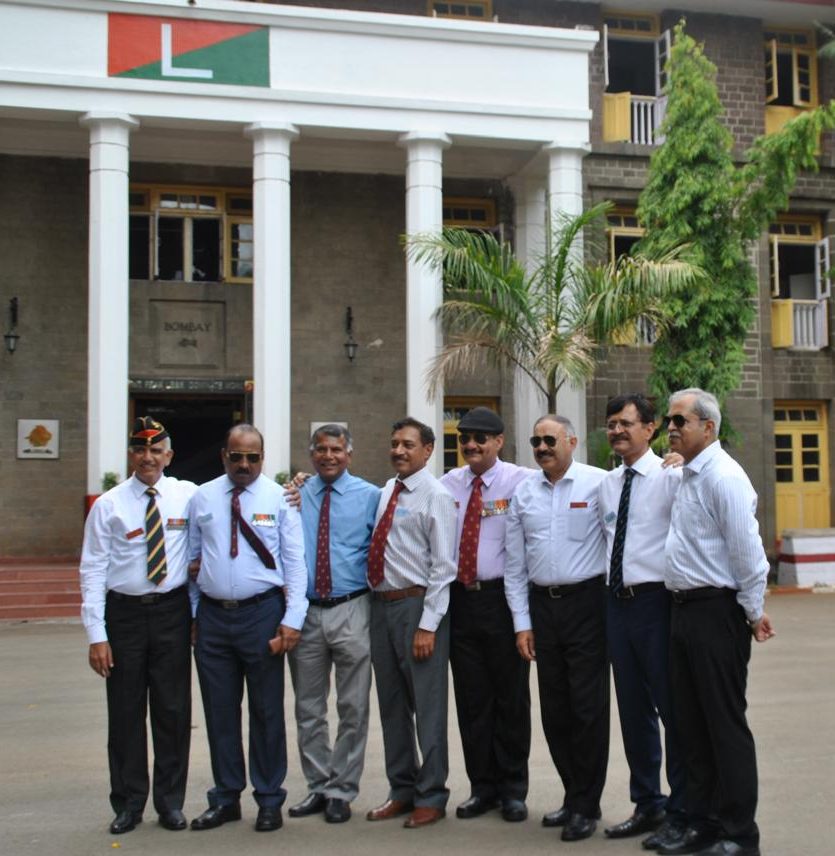
And, lo and behold, it was Diwakant, my NDA Course-mate and Squadron-mate and his wife. We had last met about 6 years ago at the course get-together at the IMA.
“Hi Diwa!” I got up and called out to him.
He looked up a bit surprised as to who could be calling him by his name so far away from India. In seconds we were in a bear hug—laughing at the rare coincidence of two course mates from same squadron being at a tourist spot in Switzerland at the same time. After much backslapping Diwa told us that they were on a short trip to France and Switzerland from Ireland where his son was working. Once the initial euphoria subsided we completed our walk along the Chapel Bridge and the Old town across the river.
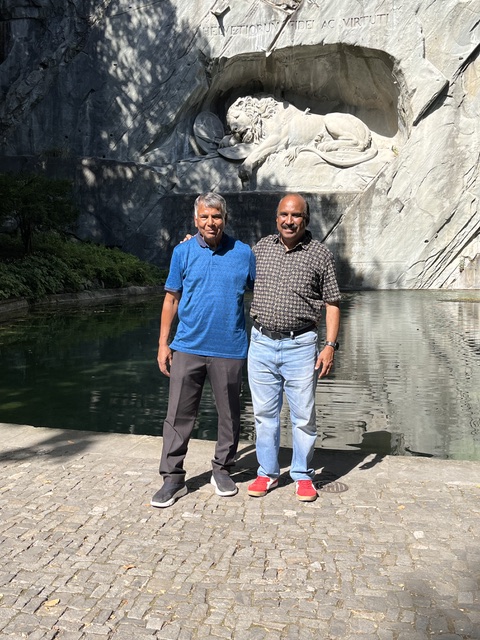
Lucerne has a Lion Monument. Since two Lions from Lima squadron had met by chance it was almost obligatory for us to visit the Lion Monument. After the visit to the Lion Monument and some souvenir shopping it was time for good byes. We had to head back to Zurich; Diwa was staying the night at Lucerne before taking the flight back to Ireland the next day. The world is wondering if the US-Iran Lucerne Summit will lead to some tangible outcomes. Let them keep meeting and fencing till cows come home. But the chance meeting of NDA Course-mates—and two LIONS in that—is a feeling to be cherished for a lifetime. This chance rendezvous was much more rewarding than any Lucerne Summit.


