Is there a way to put immediate stop to suffering in Gaza?
O Gaza!
The events of October 7 served as the immediate trigger, but the roots of the Gaza conflict extend far deeper. The underlying causes are complex and subject to debate, with little likelihood of consensus. For this reason, reducing the war to a binary of good versus evil oversimplifies the situation. Meanwhile, the human toll continues to rise, with thousands killed by bombardment and many more affected by hunger and displacement.
Recent decision by France, Australia, and the United Kingdom, to recognise Palestine, though politically significant, is unlikely to resolve the immediate challenges. Rather, it highlights the difficulty the international community has faced in addressing the conflict.
Israel’s Objectives
Israel’s stated aims can be broadly identified as:
• Destruction of Hamas,
• Release of the hostages,
• Ensuring Gaza no longer poses a threat to Israel, and
• Return of displaced residents of northern Israel.
The feasibility of achieving all four goals simultaneously remains uncertain.
Prospects of Eliminating Hamas
Military operations may succeed in neutralising most Hamas operatives within Gaza. However, complete elimination appears unlikely. Those who escape are likely to regroup elsewhere. Also, displaced Palestinians will carry their wounds and scars to other parts of the world. No border control can prevent the smuggling of hatred and anger. It would be naïve to imagine that some of them would not be behind a “9/11 (Version 2.0),” if and when such an attack happens anywhere in the world. One does not need Nostradamus to foresee this.
The Hostage Question
Israel does not follow a rigid hostage policy and has, in the past, agreed to prisoner swaps. During the Entebbe Raid (July 1976), the hijackers’ demand for the release of Palestinians in Israeli prisons was actively considered, even as preparations for Operation Thunderbolt (later renamed Operation Jonathan) went ahead. The mission was deliberate and well planned. Jonathan Netanyahu (Prime Minister Benjamin Netanyahu’s brother) sacrificed his life to rescue 104 Israeli hostages. One hostage, hospitalised in Uganda, later died under unclear circumstances.
In another instance, Kozo Okamoto of the Japanese Red Army—who, along with two comrades, killed 32 people and injured 72 at Lod Airport (now Ben Gurion Airport) on May 30, 1972—was captured alive. Israel, which has no death penalty, imprisoned him. Yet on May 20, 1985, nearly 13 years later, Okamoto was released as part of a prisoner swap. On that occasion, 4,600 Palestinian and Lebanese prisoners were freed in exchange for three Israeli soldiers.
Why then, despite immense pressure from the families of hostages and international opinion, has Israel been unwilling to proceed with more prisoner swaps? Here one tends to agree with Prime Minister Netanyahu and others: conceding to Hamas’s demands would amount to “rewarding” them for the October 7 attacks.
Other Goals
The other two aims—ensuring Gaza no longer poses a threat and facilitating the return of displaced residents of northern Israel—are relatively less difficult to address once the hostage issue is resolved.
At present, the deadlock lies with Hamas. They know well that releasing the remaining Israeli hostages (and the bodies of the dead) would spell their end. They would be hunted down and eliminated. That fate seems inevitable anyway.
If only one of these sufferings could offset the other…
A Possible Way Out?
What could break the impasse?
One possible—though imperfect—approach could involve offering safe passage for Hamas operatives out of Gaza in exchange for the release of hostages. Such an arrangement might drastically reduce civilian casualties, but it would raise questions about long-term security and the precedent it sets. Whether Israel, and Hamas, would accept such a suggestion remains uncertain.
In the fog of war, it is unclear whether both sides are already working toward a face-saving exit. Meanwhile, frustration and anger are mounting across a world that feels trapped in a seemingly hopeless situation. In the absence of a negotiated settlement, the conflict is likely to continue at great humanitarian cost.
A Warning for India
The dilemma is not unique to Israel. Sooner or later, India too may face a similar horrific choice: how should it deal with terrorists who, after striking a target, hide behind civilian population in India or, still worse, across the border in Pakistan?
Remembering dates and recalling chronology is not my cup of tea unless they are associated with memories. Suffice it to say that the exotic east was my home for two and a half years around the time 9/11 happened. Chhaya, my soulmate and Mudit, our son had stayed back in Delhi for the latter’s schooling when I moved on a posting to Tezpur as the Senior Logistics Officer (SLO). Those days mobile phones were rare and smart phones, non-existent. Video chat existed, but only in the drawing room discussions about the awe-inspiring future technologies. Public call booth was our means of connecting with our dear ones back home. The waiting at the booth used to be long when the call rates used to dip after 10 pm. Despite those little struggles, one realises in hindsight that without smart phone, existence was meaningful—one could indulge in activities which boosted the feel-good-factor, and to some extent, the quality of life.
In Tezpur, without family—people called that state of being, forced bachelorhood—I could devote all my time and attention to work. Thanks to the dedication of my predecessors, logistics support to the Station was streamlined; the ageing MiG-21 fleet was afloat, nay soaring. So, I also had the time to afford other activities. Once in a while, critical shortages of spares, or elephants rampaging our Ration Stand, used to inject excitement in our routine.
Nirvana!
The Gajraj Golf Club situated across the runway, offered me an opportunity on a platter to sharpen my golfing skills. My approach to the game was maniacal. I played like a man possessed, not missing a day unless there was a justifiable good reason. Unbelievable, but true—I played 45 holes on a particular holiday. That fact must not mislead one to conclude that I was playing well—piling birdies and pars. Far from it, long hours spent on the fairways—not to talk of the golfing lessons from the pro, Minky Barbora—did little to help me master my shots. At my best, I played to a fourteen handicap. So be it. I was happy playing. Period!
Air Commodore PK Barbora, popularly known as Babs Sir (later Air Marshal and Vice Chief of the Air Staff) was our Air Officer Commanding (AOC). He, and a dozen other officers shared similar passion for golf.
Nothing could stop the golfers, but…
The weather in Tezpur used to be hot, and mercilessly humid, for most part of the year. Rest of the time, it used rain heavily. A drizzle could never stop us from teeing off. What about rain? It was a mutually agreed rule to continue playing if it started raining after we had teed off. We permitted ourselves free lateral drops whenever a downpour created scores of shallow lakes in the fairways. We were unstoppable. For a few minutes though, we paused our game one day, only to give way to a herd of about 30 to 40 wild elephants who chose to cross our path.
Rounds of golf on the courses owned by the association of tea planters were jamborees. Amusingly, their fairways were maintained by the grazing cattle. The events provided unadulterated joy, taking us to the next higher level of being. Nirvana!
Indulging in a sporting activity alone, golf in particular, is no fun. Normally the AOC used to telephone one of us and confirm if we were playing on a given day. One day when others were occupied, he called me to check, if I was available. “So Ustaad, are we ON today? What time do we tee off? Is 2:45 fine?”
“Ustaad!” That’s how the AOC addressed everyone. That form of address had nothing to do with the formal term coined by Air Chief Marshal S Krishnaswamy to recognise and honour professionals.
It was a matter of chance that I too had a commitment that day. So, I responded apologetically, “Sir, I have a commitment today… I might get late. May I join you on the third or the fourth tee?”
“Ustaad, are you trying to impress me by staying late in the office.” Although the AOC said it in a lighter vein, his remark pricked me. Oblivious of my hurt feeling, he chuckled, “It’s fine. I’ll start alone. See if you can make it after finishing your task at hand.” Was I attaching too much meaning to the AOC’s words? Was I inviting offence when it was not meant? I wasn’t sure. But disturbed, I was.
The AOC was on the third tee when I joined him, “Good afternoon, Sir.” A grumpy me greeted him half-heartedly. His words, “Are you trying to impress me…,” were still screeching in my cranium; disturbing me. I felt he had been unfair in judging my commitment to work as an exercise to impress him. I knew in my heart, I would work anyway, regardless of him.
The AOC must have read my mind for he broached the subject, “Good afternoon Ustaad. What were you stuck with?”
“Sir, the weekly courier was to land today. I had a repairable aeroengine to be sent to Bangalore… it was urgent. Sometimes, when the aircraft are loaded to their capacity, the loadmasters decline our consignments. I went to the tarmac because I didn’t want that to happen today. Fortunately, they had the space and accepted our load.”
“What would you have done if they had had no space to accommodate your stuff?”
“It is a common occurrence, Sir. When there is no space, I speak with the crew of the aircraft and try to prevail upon them to offload some of their less important packages and accept my critical stores. I promise them to dispatch their offloaded packages by the next available aircraft. They appreciate the logistics needs of a fighter flying training station and generally concede to logic even if they are inconvenienced.”
I kept emptying my mind, “Besides, having spent seven years at PTS (Paratroopers Training School) Agra, I am able to connect well with most of the AN-32 and IL-76 crews, and sometimes I am even able to pressurise them to accept my consignments….” The AOC listened to my monologue without saying a word except for an occasional, “Hmm!” I wondered if I had been talking to a wall. We walked the distance together as I kept illuminating my late joining.
On the next green, the AOC was the epitome of peace and calm when he took stance for a long seven-foot putt for a par. The clinking of his TitleistPro V ball as it fell into the cup was music to the ears. Then it was my turn. About three feet from the cup, with two strokes in hand I was sitting pretty for a birdie. Chaos and disorder were still stewing in my mind when I struck the ball. I missed the putt twice. It was a bogey.
a bogey
“Oh no! Ustaad, how could you have missed that sitter,” Babs Sir exclaimed.
I shrugged my shoulders in disbelief. I too thought, at least a par was unmissable.
It was a disastrous day for me on the course. When we sat down for the usual cup of tea after the game, the AOC took out his pouch of tobacco and rolled a cigarette. He carried forward the conversation as he struck a match to light it, “You know Chordia, I am a happy AOC who has a conscientious SLO like you working for him. I appreciate your sincerity of purpose. Full marks….” He showered lavish praise on me for despatching the aeroengine. His demeanour suggested that he was headed elsewhere.
“But, think of it. Couldn’t any of your youngsters, or a Warrant Officer, or a Sergeant, have accomplished what you did… simply despatching an aeroengine?” He asked me as he took a last long drag on what remained of his little cigarette.
“Ustaad,” he continued, “Your men are an asset. Good grooming will enable them to shoulder greater responsibilities, and thereby relieve you to devote your time and energy to intellectual work. With thoughtful delegation one can manage things better. The opportunity to golf could be the spinoff of good management.”
I accepted the pearl of wisdom with humility. “Sir,” was all I said in my acceptance speech.
Postscript
There was much substance in what the AOC said that day. My fear that my men would not be able to accomplish things was holding me back from giving them responsibilities and making me feel indispensable. A little introspection and some fine tuning did wonders for me. Thereafter, I had a lot more time. I could not only play golf but pursue a lot of other hobbies and activities. I could immerse in books, draw caricatures, analyse handwriting, practise calligraphy strokes and even try my hand at wood carving. Tezpur turned out to be a greatly satisfying tenure, professionally and personally.
Spot the ‘gandak’
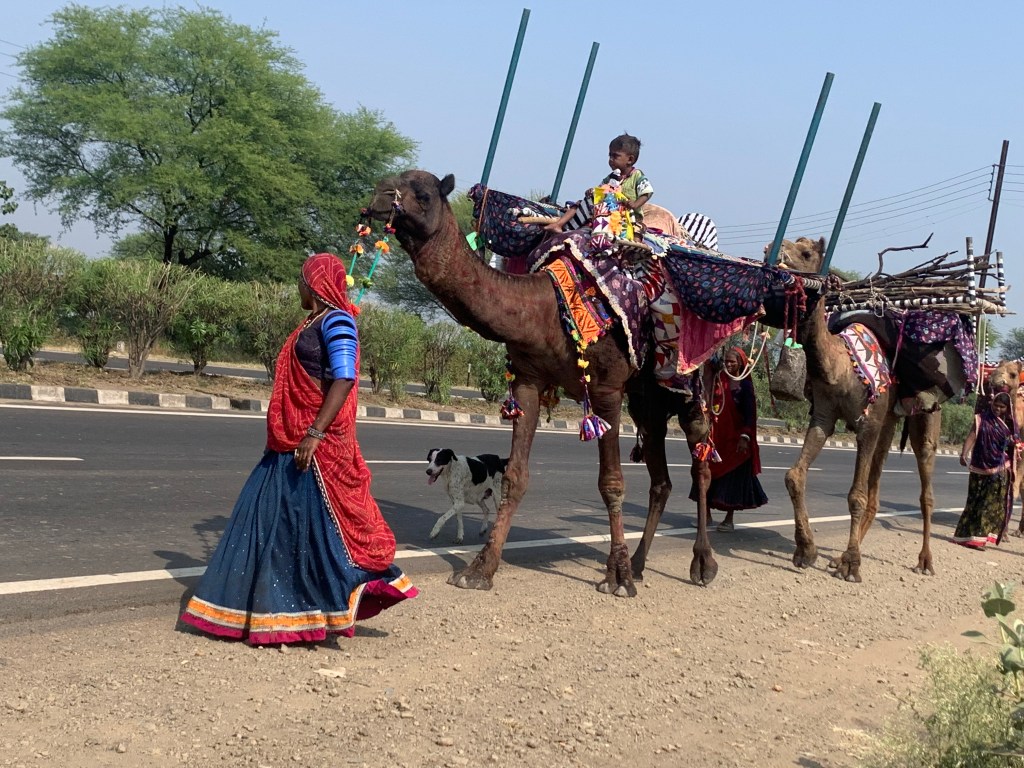
To conclude the sum and substance of this piece, a word about gandak will be in order.Gandak is a canine species, kind of a sheepdog found in Rajasthan. It can be seen walking in the shadows of the camels or under the carts drawn by them. Regardless of the weather—scorching heat or bitter cold—the long tongue of this little beast is always hanging; it is perpetually panting. My mother used to say, a gandak pants because it thinks that all the load is on its back and that it might tip over if it shrugs (read, “shirks”). Hidden inside us is a gandak which gives us a false feeling of indispensability. My life changed when I got rid of the gandak in me.
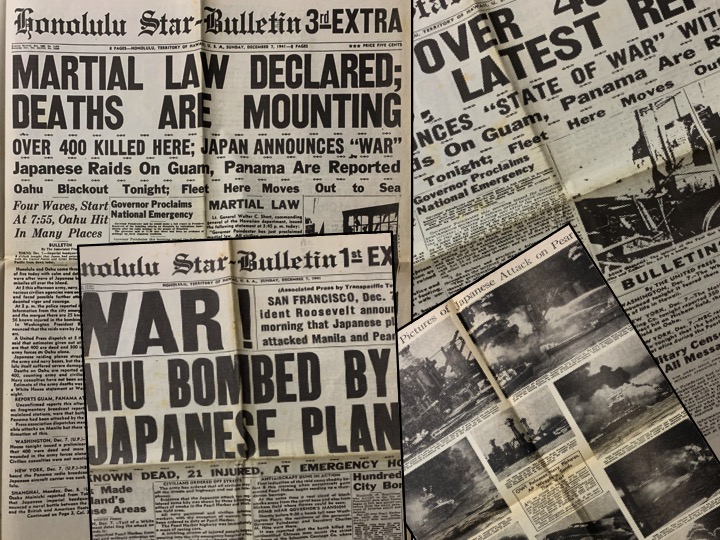
8:00 am. Sunday, December the 7th, 1941. Pearl Harbour happened––a surprise military strike by the Japanese devastated the US naval base in the Pacific. Major US losses included: four battleships sunk and another four damaged and three each cruisers and destroyers damaged. Worse was the destruction of 188 aircraft. Even greater setback was the loss of 2336 men (killed) and 1,143 wounded.
Although the US avenged Pearl Harbour by nuke bombing Nagasaki and Hiroshima, it left indelible scars on the American psyche.
After the end of WW II, the Americans turned almost the whole of Pearl Harbour into a War Museum. The USS Arizona Memorial with the list of the dead warriors; the tattered Stars and Stripes and copies of the next day’s newspapers and much more––keep jolting Americans. “Never again,” is the message writ large upon everything American in Hawaii.
Strafed wall: HQ US PACAF
On my first visit to Hawaii, Brigadier General Meryll drew my attention to bullet marks on the wall of a building of the Headquarters of the US Pacific Air Forces. “We’ve deliberately not repaired those craters left by the Japanese bombers––they remind us that we were caught napping once. Pearl Harbour will never repeat,” he said.
A solemn resolve.
Time erodes memories. America was caught napping again––9/11 happened. The US pounded Afghanistan and killed Osama Bin Laden. Those follow-up actions certainly did not avenge or offset the 3,000 innocent American lives lost in the ghastly attack on the twin towers of the World Trade Centre.
As if that was not enough, America lowered its guard yet again. Covid-19 pandemic is no less than another Pearl Harbour––close to 1,97,000 innocent American lives lost, and still counting. America blames this one on China. Yet, simmering internal strife and the forthcoming Presidential election has blunted weakened Uncle Sam’s ability resolve to punish its perpetrator.
Caught napping…
Countries have their Pearl Harbour moments––October 1962 was India’s, when China attacked and occupied Indian territory by surprise. In the nearly six decades gone by, China has occasionally reminded India of that one time when India had dozed off. Galwan Valley incident was a rude reminder of the dragon’s sliminess. In fact, it was a jolt that let India learn its lesson hard, and fast. The result was evident in the swiftness with which Indian Army grabbed tactical advantage in the Pangong Tso Area. PLA will now use every arrow in its quiver to neutralise the Indian advantage. In all probability, the present lull is a prelude to yet another adventure by the dragon.
For whatever reasons, in 1962, India did not employ its combat air power against the Chinese. Likewise, during Kargil, restriction was imposed on the Indian Air Force on crossing the LAC. In both those cases, India paid an avoidable cost for not exploiting the full potential of its combat air power.
In the present situation, when the Indian Army is sitting pretty on heights overlooking the Chinese positions, it would be advisable to give the Air Force a free hand to plan and execute its operations in support of the Indian Army.
The supreme sacrifice made by the Indian Jawans in Galwan Valley is too recent an occurrence to be forgotten; it is never to be forgotten. 1962, India’s Pearl Harbour, is too unpleasant to be allowed to repeat.
The 9/11 terror attacks led to killing of over 3000 Americans in New York. The US reacted; formed a coalition and vowed to avenge the strikes. In a response that was largely punitive for the mastermind and the abettors, who were still invisible, Uncle Sam went pounding and pulverising Afghanistan. As if that were not exemplary enough for the rest of the world, an enraged George W Bush went about setting his own standards for the world’s behaviour. He threatened the comity of nations: “Either you are with us or against us.”
Arrogance!
The outcome was much expected: In a moment of America’s extreme sorrow, the world responded with sympathy on the face and a subdued indifference in the heart. The feigned feelings made little difference to the US.
The US was the (mind the strikethrough) a Super Power then. The world looked at that country with awe, and respect, born of fear of its military and economic might rather than reverence for a true leader.
In its effect, the Covid-19 pandemic has been more devastating than the 9/11 attacks––the death toll in the US has exceeded 10,300. It is more than three times the lives lost in 9/11 and the figure continues to rise harrowingly. The catastrophic effect on the economy will be more evident as time passes. In denial, President Trump first called the pandemic a hoax and, in a matter of days changed tack to declare that it was horrific.
With a difference though, this pandemic is indeed America’s 9/11 (Version 2.0).
In 2001, without a second thought, the US began bombing the perpetrators of 9/11 allegedly hiding in Afghanistan. In this instance, although President Trump has blamed China for the spread of the pandemic, and has gone on to call Covid-19 as the Chinese Virus, he has displayed no desire or keenness to punish that country. As it appears, the US contemplates enough before punishing and chastising countries for errant behaviour. China is certainly not Vietnam, Korea, Panama, Guatemala or even Iraq.
There are stark reasons for this reluctance. The years gone by have exposed the rot setting in and have proved the powerlessness of the most powerful nation on the earth. Whether it is Paris Summit on Climate Change, or it is the Nuclear Deal with Iran, or it is trade war with China, or it is the affairs of the NATO, or it is China’s expansionist actions in the Sea in the South of China or it is intervention in a war-torn Syria, the US has gradually relinquished its leadership role. There are allegations that in the last few days, American firms have got a few consignments of medical equipment, meant for Europe, diverted to the US (of course, unscrupulously). Needless to say, these are acts unbecoming of a world leader. In hindsight, Hollywood’s projection of Uncle Sam as the saviour of the world looks comical.
In the same context, the high death toll in Europe (in Italy, Spain, France and the UK in particular) has laid bare the hollowness of the superiority of the West over the rest of the world. Last month, the Italian Prime Minister, Giuseppe Conte was heard saying, “If Europe does not rise to this unprecedented challenge, the whole European structure loses its raison d’être for the people.” The Serbian president Aleksandar Vucic was scathing: “European solidarity does not exist… that was a fairy tale. The only country that can help us in this hard situation is the People’s Republic of China. To the rest of them, thanks for nothing.”
The Covid-19 pandemic curve for China is flattening. Beijing has already begun extending medical support to countries all over the world. Its economy will soon get off the ventilator and show signs of improvement. But, if the news of dissent brewing in the Chinese population is to be believed, the peacefulness of further rise of the People’s Republic of China would be in doubt.
The leadership in India took timely and daring steps to fight the pandemic. Until now Prime Minister Narendra Modi has taken the population of 1.3 billion along by exploiting the ancient art of ‘saam, daam, dand, bhed’ (साम, दाम, दंड, भेद) literally meaning: “by hook or crook, or any rule in the book.” His leadership will be put to an even greater test when the storm has gone past and it is time to pick pieces and revive the economy.
It will be a while before conditions start improving in the US and other parts of the world. As it appears, Post Covid-19, US will not be automatically restored to its Super
Leadership in the Post Covid-19 World
Power position. Perhaps the world will look for a replacement for its desiccated and introverted leadership. Also, in a world that clamours for human rights and democracy, Russia and China will have to work overtime to prove their credentials to be accepted as the Number One. Perhaps it would be a leaderless world until a truly deserving country occupies that first-among-equals status. Perhaps the pace of life will slow down. Perhaps people will be more inclined to family values and spirituality….
Did someone say (…more loudly, this time), “It will be an Asian Century?”
All said (and hinted), it would be naïve to assume that the leadership of the post Covid-19 world would be up for grabs. It’ll have to be truly earned.





 Road Much Travelled