Calming a Crying Kid – I (Kush)

It was another of our family reunions. My parents, my siblings, our children, and their children––four generations of us were rejoicing under one roof when the agonising cries of a child put a pause to the celebration.

Kush, one of my grandnephews (about two years and a half) was crying; a more appropriate word would be: “Wailing.” We felt he was hurt and ran to his aid. Rachna, the child’s mother took charge; I joined her in her effort to calm down the little one. He wasn’t hurt. No physical harm had come to him. He was sitting rather coolly in a chair, wailing occasionally at will. Interesting conversation ensued between the mother and the child.

“Beta! What happened? Why are you crying?”

“Because Dhruv (another of my grandnephews) didn’t play with me yesterday.”

“But he is playing with you now. Why don’t you play?”

“Because he said that he would not play with me next Sunday.”

“He won’t play with you because he is leaving for Ujjain next weekend.”

“But why did he tease me in the school, two days ago?”

The Q & A session between the two seemed endless. Kush filled the time between each question and the following answer with a wail, each of which sounded louder, more orchestrated and more dramatic than the earlier one. The problem was that there was no problem. Was Kush seeking more attention than he was getting in the crowd?

I gave the issue a quick thought.

Rachna had been blessed with a second child, a son. At home, the infant was gnawing at her time and attention, which was once entirely Kush’s. It was natural for little Kush to feel neglected at home. Then, in the family gathering, there was none to spend much time with him. It was attention that Kush was seeking. I shared my thoughts with Rachna and advised her to make a conscious effort to spend quality time with him every day. That was a long-term solution; an immediate remedy was still eluding us.

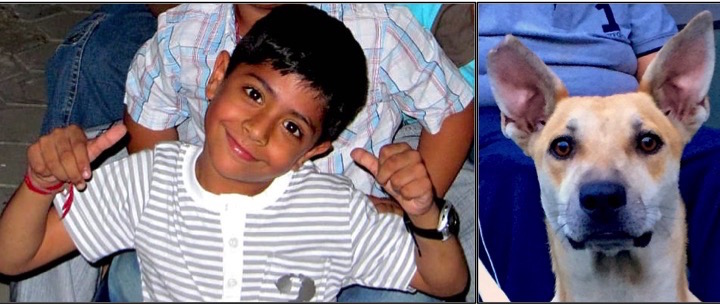
We were struggling to find a way out to quieten him when I stumbled upon an idea that worked. I urged Kush to stop crying instantly because unabated wailing was having adverse effect on his body; his features were getting convoluted. I told him, “One starts looking like a dog when one cries for long without a proper cause.” And, before his little mind could get the import of what I said, I clicked a photo on my iPhone. Then, picked the picture of a stray dog from my photo library and showed it to him.

Lo and behold! Kush became silent. The amazement in his eyes defied description.
Slide1

Epilogue: In due course Kush caught on the joke. A year later, when we met again, he made a funny face and asked me to click another picture. “How will the dog appear in the pic, if I make a face like this,” he asked with an impish smile.

A Garud Legacy

The unusually heavy rainfall in the southern Indian state of Kerala has led to the worst floods in a century. Almost all the river dams within the state were opened to let go of the excess water. More than 300 people have died and over 7 lakh people have been rendered homeless and are living in camps managed by the Indian Navy and a large number of charity organisations including the Gurdwaras.

Armed forces, the National Disaster Response Force, the Indian Railways and scores of other organisations have been toiling round the clock to provide succour to a people in distress. The helicopters of the Indian Air Force (IAF) and the Indian Navy (IN) have been dropping food packets for marooned people. They have been evacuating people to safe locations.

The print and electronic media, the social media included, are replete with news in pictures and videos on the mayhem caused by the floods. They also talk of the yeomen service being provided by all the agencies involved––uniformed men rescuing people in boats; helicopters dropping food supplies….

One such picture (and the video circulated by the India Today Group) that has caught my eye is that of Wing Commander Prashanth, a Garud of the IAF. He is seen rescuing a child in a daring winching operation by an IAF helicopter. “Well done Prashanth! Well done Garuds! The country is proud of you. Keep up the spirit! Keep up the good work!”

Garud child rescue prashanth Kerala

I see that picture and the video with a sense of déjà vu. In fact, that picture, and the video, have sent me on an errand a dozen years back in time.

Around 2005, Garud (IAF’s Special Force) was still in its infancy and I was the Commandant/ Chief Instructor for a brief period. The Garud Regimental Training Centre (GRTC) had just relocated from Air Force Station, Hindan to our new (permanent) location at Chandinagar, an abandoned airbase in the middle of nowhere. New infrastructure––classrooms, firing range, training apparatuses, messes and dormitories––was coming up. The existing facilities were in a dilapidated state.

We had to make do with the available resources till conditions improved.

Although it sounded oxymoronic, I had ordered Shramdaan (voluntary service) to clean up the thick undergrowth that had come up due to years of neglect. The entire station was at work through the afternoon. Men were scything the grass, lifting stones and clearing the paths. After about an hour of hard work in the sun, one of my officers spotted a dry well without a boundary wall. It was fairly deep, maybe 40 to 50 feet. Despite the broad daylight it was difficult to see the bottom.

It was imperative that we secured the well to avoid an accident. As we began piling stones and logs of wood to form a temporary barricade, a Garud trainee observed some movement at the bottom of the well––it was a dog that had fallen in and was showing signs of life.

Using nylon ropes meant for slithering, we lowered a basket containing bread and milk for the wretched animal to eat. Scared and hurt (due to the fall), the pariah dog declined the offerings. Left to itself, the fellow would die, so I suggested that we hauled him out. It meant that one of us would have to go down on a rope to the bottom of the well and physically bail him out.

There was an air of apprehension: One, the dog might bite its rescuer. Two, there could be insects and/ or snakes. And three, there could be lack of breathing air and, worse still, there could be a poisonous gas.

“Sir, after all it’s a dog,” someone murmured. “We can let him be there.”

I did not want an opportunity to test our skills and abilities to be baulked by doubts. “It is a dog today; it’ll be a human being tomorrow.” I stressed that it was a rare opportunity to rehearse a possibility. There was a need to rescue the poor animal. The questions and the doubts dissolved in the ensuing discussion.

In my assessment, there was no risk at all if one took the necessary precautions but I didn’t want to employ a reluctant messiah for the task. Besides, it was an opportunity to set an example. So without ado, using a nylon rope and an improvised harness, I got myself lowered into the well. Not fear, but an eerie sensation gripped the crowd as I proceeded. Once at the bottom, I grabbed and held the dog in a tight embrace and howled orders to pull me out. In less than two minutes, the dog was rescued. That incident marked a modest beginning.

The Garuds today are carrying forward the legacy.

Airlift During Natural Disasters: How Can More Lives be Saved?

Blame them on depletion of Ozone layer, global warming or some such phenomena––natural disasters have begun visiting us with the regularity of equinoxes and the solstices. The ongoing floods in India are an example of the fury unleashed by nature.

The armed forces in general––the Air Force in particular––are pressed into action to provide succour by airlifting men and material and evacuating the stranded population. The number of sorties flown despite inclement weather within the limited resources and the tonnage provide for impressive statistics. Selflessly rising to the occasion each time, the men in uniform save thousands of lives.

Thousands still die.

The question is: Ceteris paribus, can more lives be saved? Going by the Uttarakhand  experience (July 2013), the unequivocal answer would be, “YES.”

Centre for Air Power Studies, New Delhi, Issue Brief No. 19/ 2013 dated July 11, 2013 titled, “AIRLIFT DURING DISASTERS: THE UTTARAKHAND EXPERIENCE –– Can we Save More Lives?” explains, “How?”

Link: http://capsindia.org/files/documents/ISSUE-BRIEF_74_AIRLIFT-DURING-DIASTERS-THE-UTTRAKHAND-EXPERIENCE_11-July-2013.pdf

Kids, Cricket and Carrots

Clan Chordia had gotten together in our Bhopal home. As always, fun and frolic ensued. Being together was always an occasion to celebrate. We, the brothers––three of whom were young grandparents––reminisced about our childhood. Having met after a long time, the children exchanged notes as we waited for the table to be laid for lunch.

Oblivious of what the grandparents, parents and uncles were occupied with; Aashi and Dhruv were playing cricket in the little corridor between the dining area and the entrance. My mind governed by my years in military uniform did not approve of their playing inside the house. There had to be some decorum.

I held back the impulse to exercise my authority to stop them. Instead, I tried to feel the pulse before deciding a course of action.

“Hello kids! Playing cricket!?” I broached the subject half-heartedly.

Dhruv: “Yes Dada, why don’t you join us; we need a fielder?”

Me: “But you should be playing cricket on the playground; not here in the house.”

Aashi: “Temperatures are soaring outside. We have been permitted to play indoors. We are playing defensively and carefully so that we do not damage things around.”

Me: “OK, so you are trying to get into the league of Tendulkar, Sehwag, Dhoni, ….” I changed the tone of my conversation. It was their home and their actions bore the formal seal of approval of their parents.

Aashi stumped me by his reply: “Dada, I don’t want to emulate any of those legends. I want to be a successful cricketer and be known for my own style.” I envied him for his clarity of thought. I didn’t have it when I was his age. Chhaya, my wife vouches I still don’t have it. Disregardful of my poor skills with the bat and the ball, I joined in. After all, at 56, I was nearly ten times their age and thought I could match them in performance. They thought otherwise.

Constricted space mandated slow under-arm bowling. Those little champions who had mastered indoor cricket started hitting my slow straight balls all over until I discovered that spinning the ball while bowling under-arm was easy, and effective too. I exploited the possibility and bowled both “OUT!” several times in quick succession. They were awestruck; couldn’t fathom a reason for the steep fall in their performance with the bat.

Then, it just happened…

I asked them, “Do you eat carrots and green vegetables?”

“No, we don’t like them,” they were spontaneous.

“Oh! I guess that’s why your eyes are weak; you are unable to spot the ball in time. Also, since you don’t eat vegetables, you don’t get the necessary vitamins and minerals. I am not surprised your reactions are rather slow and you are getting beaten repeatedly.” It was an off the cuff statement with no intention whatsoever to sermonise the kids.

I carried on pulverising their pride in their batting prowess. Aashi continued to get bowled while Dhruv took a break. He went missing for a while––a long while, indeed. Next, I heard Ruby, his mother, chastising him, “ What are you doing with the knife? You’ll hurt yourself. I’ll do that for you.”

OMG! Dhruv was trying to clean up and cut a carrot to eat. He sought immediate improvement in his eyesight and reflexes. Both Dhruv and Aashi returned to bat after eating some carrots. This time on, I was under obligation to demonstrate the benefits of eating carrot and green leafy vegetables to the two grandchildren. I did not spin the ball anymore. With improved sight and reflexes, Aashi and Dhruv regained form. Rather they displayed superior performance.

While Aashi and Dhruv, realised the importance of healthy eating, I carried a different lesson:

“There are times when the fear of notional loss from not doing a thing far exceeds the joy of apparent gains accrued from doing it. This vulnerability is exploitable.”