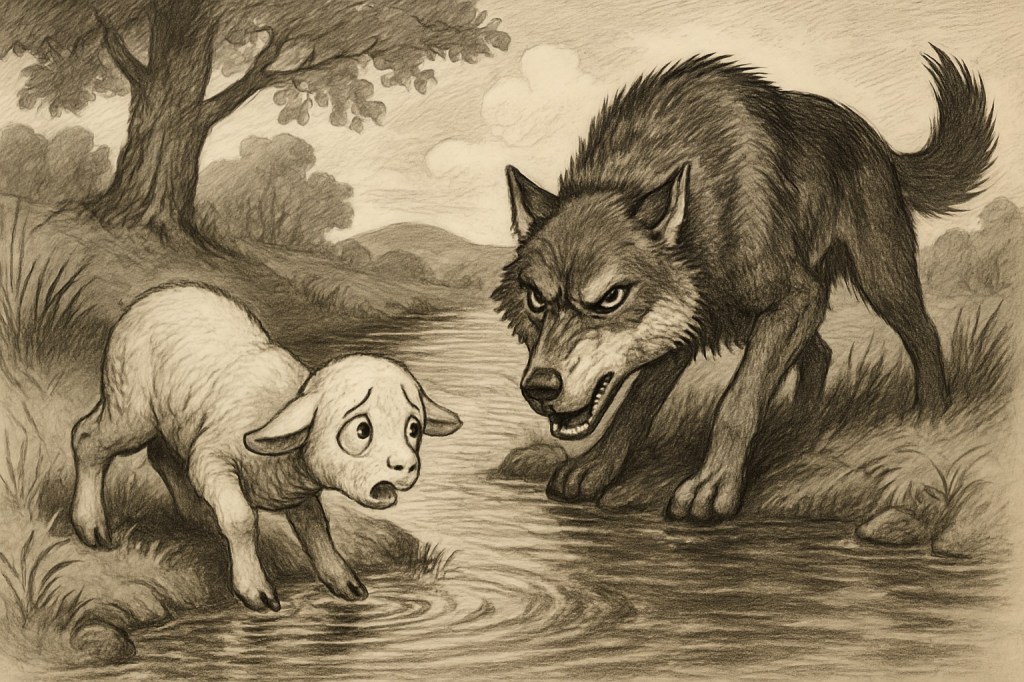
A wolf was drinking water on the bank of a river. A little away, downstream, was a lamb taking small sips.
“Why are you dirtying the water I am drinking,” growled the wolf.
“Sir, but I am downstream, how can I dirty the water reaching you?” The lamb tried to reason with the wolf.
“Okay! Okay!” said the wolf, his accent American, his logic Trumpian. “But why did you use abusive language with me last year?”
“But Sir, I wasn’t born last year,” pleaded the lamb wiping his sweat.
“Then, it must have been your mother,” said the angry wolf and pounced on the lamb.
That is the original version of the story.
“Why are you dirtying the water….”
The current version, has some more characters and interesting twists. The wolf is rankled more by two other animals in the jungle—the bear and the little dragon who have enough nuisance value for him. To his annoyance, the lamb is friendly with the bear. And, playing on the mind of the slimy wolf is the fear: “What if, let alone the lamb, the bear and the little dragon, other animals of the jungle stand up against him?
The animals of the jungle have a different concern.
Their worry is that the wolf has an Indian brain, a Chinese heart, a Vietnamese kidney, Latino lungs, Mexican blood, Jewish bones… but, it is controlled by its own xxxhole. How much more stink will it bestow upon the jungle before it suffers from the same?
“Of course, Kanishka! He’s all-powerful,” I said with authority.
“Even create a mountain He can’t lift?”
I was foxed by the question posed by my grandnephew.
“Think about it. Let me know if you ever meet such a God.”
That evening, I had my answer. “Trump,” I said. “He’s the God who can create mountains of problems… that not even he can fix… Capitol Riots, Trade Wars, Covid Denialism, failed nuclear deal with Iran, Ukraine and Gaza Wars—watch the peaks rise.”
On June 12, 2025, tragedy struck. Air India Flight AI 171, en route to London Gatwick, crashed seconds after take-off from Sardar Vallabhbhai Patel International Airport, Ahmedabad. The accident claimed the lives of 241 people on board—passengers and crew—and 19 individuals on the ground.
In the hours and days that followed, television screens lit up with expert analyses and heated debates. While some insights were valuable, much of it merely served to feed anxiety, both among seasoned travellers and the general public.
The Ripple Effect of a Crash
When such mishaps occur, they set off a domino effect across the aviation ecosystem. Authorities tighten checks and airlines enforce stricter adherence to procedures. In the days following the AI 171 crash, many flights were delayed, diverted, or even cancelled. Recent helicopter incidents only compounded the public’s growing unease.
These reactions are not just procedural—they are deeply psychological. Fear travels faster than airplanes.
Passenger Profiles
Following aviation accidents, travellers often fall into three categories:
The Stoics – the que sera sera kind. They acknowledge the incident, mourn the loss, and continue flying without visible hesitation.
The Escapists – those who vow never to board a flight again, unless absolutely necessary.
The Unsure – the ones caught in limbo, unsure whether to continue flying or retreat into fear.
A Peep into Passenger Psyches
Take for example July 4, 2025 Indigo Flight 6E 2258 from Delhi to Lucknow. It was delayed by over two hours due to a navigation system snag. As technicians worked to fix the issue, several passengers chose to disembark. Some left because their schedules were disrupted. Others simply couldn’t shake off their anxiety. Among them was a professor—perhaps someone who lectures on resilience. In contrast, an 85-year-old woman, bound for Ayodhya, stayed calm for a while—until she began chanting the Hanuman Chalisa, seeking comfort through faith.
Stories That Defy Logic
Aviation history is filled with eerie tales of missed flights and miraculous survivals.
In the early 1980s, a military Packet aircraft crashed during take-off in Agra, claiming the lives of 45 paratroopers, instructors, and crew. Squadron Leader (later AVM) D.K. Dhingra survived because he was held up in his office by a telephone call. Some others, too, missed the flight due to last-minute changes. Fate intervened.
Even in the case of AI 171, one man survived—Ramesh Viswash Kumar. He managed to walk away from the wreckage. Was it luck, chance, or destiny? It’s hard to say—but such stories shape the way we think about survival.
Air Warriors show the Way Aircraft incidents and accidents are a part of life in the Air Force; a professional hazard. Sitting in my office in Tezpur, I had once seen two pilots punch out (eject) of a flamed out MiG aircraft seconds after take-off. It is customary for all the pilots of a unit to take to air immediately (as soon as possible) after a serious accident (unless there are strong reasons to ground the entire fleet) to keep up the spirit. Likewise, a mass jump follows a parachute accident. There is no scope for fear to set in.
A Lesson in Acceptance
A classic parable might help those grappling with post-crash anxiety:
A slave once ran to his master in Cairo, trembling with fear. “Master,” he cried, “I saw Death today in the market. She stared at me and asked, ‘What are you doing here?’ I fear she has come for me. Please, I beg you, help me escape!”
The master gave him his finest horse and advised him to flee to Basra.
Later that evening, the master encountered Death and asked, “Why did you frighten my servant?”
Death replied calmly, “I was only surprised to see him in Cairo. You see, I have an appointment with him next week—in Basra.”
Sometimes, what we fear and try to avoid might be the very path we are destined to take. This isn’t to say we should be fatalistic—but it helps to recognize that some things lie beyond our control.
Trust, Caution, and Collective Responsibility
Aviation remains one of the safest modes of travel. Pilots are rigorously trained, technicians are meticulous, and air traffic controllers are highly competent professionals. Accidents, though tragic, are rare. They lead to introspection, investigation, and improvements in safety protocols.
As passengers, we can also contribute:
Avoid carrying unaccounted or suspicious baggage.
Follow crew instructions diligently.
Switch off mobile devices when requested.
Stay calm and respectful, even during delays or checks.
Let’s remember: behind every flight are thousands of hours of effort, layers of safety checks, and dedicated human beings who care about getting us safely to our destination.
Let’s fly safe. Fly wise. And above all—fly without fear.
In a household steeped in silence and legacy, a buried truth stirs…. Will it fracture the family’s foundation or let the light in?
He was woken up by the lights flooding the cabin, accompanied by the pilot’s announcement that they would be landing in Hyderabad in approximately forty-five minutes. The outside temperature would be 32 °C and the local time, 2.45 am. Rubbing his groggy eyes, Rohan sat up straight and pushed open the window blinds. Dim, obscure lights were visible on the ground, probably a tiny little Indian town. The lights were random and almost looked like stars in the sky on a slightly hazy night. The haze. That’s what it was. The lights were obscured by a layer of dusty haze covering the ground.
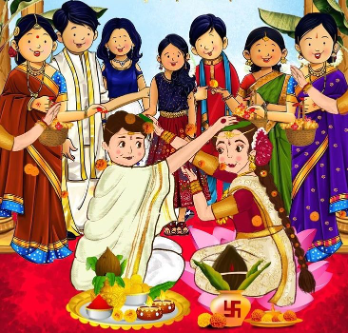
Sravanti, his cousin was getting married in a week and he had a lot resting on his shoulders. Relatives would remind him of his role in keeping the brother-in-law from running away to Kashi several times during the next week, sometimes joking and pinching his cheeks, and at other times, with a seriousness that bordered on delusion. This was an important ritual in Telugu weddings.
Sravanti, at 24 was six years younger than Rohan. All these years, no one bothered to pester Rohan into marriage. The whole family was desperate to see Sravanti married as soon as they could, because her prospects of finding a decent groom would fall with every passing year, or so they thought. In any case, Rohan was left off the hook all these years. And he knew that sooner or later questions would be asked. And this conversation wasn’t going to be easy.
By the time he woke up the next morning, the house was buzzing with activity. The smell of filter coffee wafted through the house. Rohan walked into the living room where pednanna, his father’s older brother was giving orders to the pandal guys about the colourful tent in the courtyard. His father was talking to the decorators about the flowers at the wedding venue. Rohan went and quietly stood next to his father, who saw him as soon as he was done talking to the decorator and gave him a nod of acknowledgement and a light hug. Rohan quickly went to greet his pednanna who looked at him and said, “Ah, good you are here, you can drive pedamma to the caterer, so that she can decide the menu.” That was always the way in this house. There was no grand welcome or warm greetings. It was down-to-business. It wasn’t that pednanna wasn’t happy to see Rohan. He just didn’t see the use of grand gestures.
Sravanti’s wedding
As he walked out towards the garage, he saw Sravanti, amma and pedamma, fervently discussing something about the sarees to be worn for the different rituals. A heap of silk sarees was lying on the bed and Sravanti had a yellow saree with a red border hung over her shoulder. She was looking into the mirror and caught a glimpse of Rohan’s image, immediately threw the saree aside and ran towards Rohan shouting “Annayya!” — big brother. Rohan was swept by a wave of emotion towards his little sister who he was always very fond of.
Rohan, Hari and Sravanti grew up in the same house. Although pednanna was older than Rohan and Hari’s father, Sravanti was the youngest. The series of wedding related activities kept everyone on their toes. Relatives were pouring into the house to see how things were going. The entire house was decorated with yellow marigold flowers. A gazebo of coconut branches was being put up at the main entrance of the house. There was an air of celebration and the sounds of laughter in the house. Pednanna and nanna were both giving out orders to the plethora of workers. Sravanti was surrounded by younger cousins who came to visit her and was lost in giggling and conversation.
With all this frenzy, Rohan, for once, felt good about being home. In the last few years, Rohan hadn’t really looked forward to coming home. He didn’t know when and how he started feeling more at home in Singapore than here. Maybe just the archaic ideas that pednana had about everything and his unwillingness to listen to reason; or the fact that Nanna never spoke anything against pednanna, or that neither amma or pedamma ever had any say in the matters of the house, made it easier for him to stay away. In the beginning, he tried to argue. But when his points were dismissed with remarks like, “Oh, look at the foreign-returned guy who’s forgotten his own culture,” his patience finally gave out.
As children, Rohan was always the boisterous one, while Hari remained quiet and withdrawn. Rohan sang, danced, and excelled in theatre. At every extended family gathering, his performances were a highlight. Hari, meanwhile, clung to the edge of his mother’s saree, silently observing from the sidelines. During their teenage years, Rohan was often surrounded by his lively group of friends, the centre of every hangout. Hari, in contrast, retreated into the world of video games and online avatars, preferring virtual realms to real-life interactions.
When Rohan landed his first job offer in Singapore, a mini-van was arranged to ferry the twenty-odd relatives and friends who wanted to see him off at the airport.
On arriving in Singapore, Rohan found himself all alone for the first time ever. But soon enough, he made new friends and looked at life from different perspectives. On a trip to Bali with some of his new friends, Rohan’s life completely changed. The second evening in Bali, he and his friends, had just come back from the day on the beach and decided to have dinner at the hotel restaurant. The tables were set along the pool and the fading light was shimmering on the tiny ripples of the pool. Rohan and his friends had just ordered their drinks and were lost in conversation when, out of the corner of his eye, he caught sight of Nikki. He wasn’t usually rendered speechless. But this time was different, he froze below his knees.
The next morning, Rohan decided to walk to the beach by himself while his friends were sleeping off their hangover. He had just stepped outside the hotel when he heard someone say, “Hello, you seem to be up early.” Rohan was mesmerised by the voice, and the dimple on the left cheek. Thoughts were rushing into Rohan’s mind. This was the stuff of movies.
Gathering himself, Rohan finally managed to string a few words together and said, “Do you live around here?”
“No, I live in Singapore and I am here on work. You see, I work in hospitality” Rohan began to relax and decided he could use the company. Rohan and Nikki walked through the market, looking at the local trinkets that were being sold. Nikki gave him tidbits of information about the village and the people. Conversation flowed, about families, homes, work, and childhood. They ate, strolled and without realising, they ended up on a beach. This wasn’t the popular touristy beach, but a fishing beach that only the local people went to.
Day had turned into dusk, and the beach had become more secluded. Sitting on the sand, Rohan realised that he wasn’t even trying anymore. The resistance he had felt in earlier such encounters wasn’t there anymore. Something was happening and he just couldn’t deny it anymore. He was enjoying the company, the setting, the sound of Nikki’s voice, the one-sided smile, the dimple in the cheek and he just couldn’t resist it anymore.
Eight hours had passed since he met Nikki on the street and they were still sitting together and talking. Rohan couldn’t even remember the conversation. The only thing he felt was a tiredness, the kind that one feels after a really satisfying day, when you just want to rest your head and sleep. He didn’t realise when he rested his head on Nikki’s shoulders and when he dozed off.
Back at the hotel, Rohan’s friends were packing up to leave the next day. Rohan and Nikki exchanged contact details and stayed in touch. Soon, they were frequently meeting, spending long evenings at Clarke Quay, dining at restaurants and spending nights with each other. It just felt natural, like it was meant to be. How would he explain this to his conservative South Indian Brahmin family?
With a jolt, Rohan came back to the present. The bride and the groom were tying the knot. People were throwing rice dipped in turmeric at the couple as blessings. Pednanna and peddamma were looking relieved and yet had tears streaming down their eyes.
Later that evening, after all the festivities were done and most of the relatives were gone, Pednanna called Rohan into the living room. Everyone was seated around the room and there was an air of speculation. Rohan knew what was coming. Pednanna said, “Subba Rao is my very close childhood friend. He has a daughter, Lavanya. We want you to meet her tomorrow.”
“Well, I am not surprised,” thought Rohan to himself. Then spoke aloud, “I don’t want to meet Lavanya, pednanna. With all due respect, I like someone else.”
“Is she Brahmin? Telugu?” yelled pednanna.
“No, and I don’t care about that at all,” retorted Rohan.
“Then I will never accept it. There is no place for uncultured foreigners in this house.” Pednanna was furious.
Pednanna was never one to mince words or hide his bigotry. In fact, he took pride in being that way. Rohan looked towards his mother and father. Nanna was looking down meekly instead of standing up for Rohan; it was typical of him. In all the years he was growing up, nanna never stood up either for himself, or for his family.
“Pednanna, how does all that matter? Isn’t it enough if we love each other?”
“Nonsense, this love, shove and all that doesn’t last. If you marry your foreigner, you will get divorced soon. They have no family values, those uncultured fellows.”
How narrow minded was his family! How did they decide that their culture was the best. Rohan didn’t want to argue anymore. He just stormed out of the house. He walked and walked till his legs were tired. Thoughts were rushing through his head. “As though marrying someone from your own caste was any guarantee for happiness. Was pedamma ever happy in her marriage? Pednanna and Pedamma never showed each other affection. So why am I expected to inherit these gendered roles that feel so hollow?”
He didn’t intend to conform to those roles. He couldn’t even if he wanted to. Exhausted with anguish, Rohan sat down on a bench by Tank Bund and before he knew it, tiredness took over his body and he fell asleep.
Hours later, Rohan was shaken awake by Nanna and Hari, their faces etched with worry. Disoriented, he blinked in the morning light, the weights of his thoughts from the previous night still pressing down on him. He hadn’t meant to fall asleep there, but his exhaustion, physical and emotional, had consumed him.
Nanna and Hari had spent the last few hours frantically searching for him, panic rising with every empty street and unanswered call. They heaved sighs of relief when they finally saw him, curled up, on a cold bench by the Tank Bund.
“Rohan, let’s go home. Stop being so stubborn.” Nanna said, shaking him awake, frantic with fear. Rohan refused to go home. He insisted that he was in love and he couldn’t spoil three lives by marrying someone he couldn’t love. If pednanna and the family couldn’t understand, what was the point of staying? Rohan felt a lump rising in his throat, his love, his identity and the impossible walls of tradition bearing down on him. He was ready to walk away from it all. Forever.
A sob tore through him, unrestrained. Nanna and Hari stood beside him, their own eyes brimming with emotion. “Please, Rohan,” Hari finally said, his voice, a whisper. “Come Let’s go home.” Nanna nodded, “We’ll figure this out.”
Rohan wanted to resist, to stay firm in his decision, but something in Nanna’s voice, something he had never felt before, made him pause. It wasn’t authority or resignation. It was something closer to understanding. Slowly he wiped his tears and stood up.
When they reached home, an uneasy silence was hanging over the house, thick and suffocating like the lingering scent of burnt incense after a long puja. Pedamma stood near the kitchen doorway, wringing the edge of her saree, her face tight with worry. Amma sat on the sofa, her eyes darting between Rohan and Pednanna, as if bracing for an inevitable storm.
Pednanna stood in the centre of the room, his arms crossed, his disapproval evident in his frown. Rohan could feel the weight of expectation pressing down on him, suffocating and unrelenting.
Then, for the first time in Rohan’s life, Nanna stepped forward. His voice was steady, but there was an unfamiliar urgency in it. “Annayya,” he said, looking pednanna directly in the eye, “Rohan is my son. If he says he loves this Nikki, my wife and I are going to support him. Even if Nikki is a foreigner, we will love her the way Rohan loves her.”
Oh dear, Rohan’s heart pounded as he glanced at his father, now he had to tell them that Nikki was actually Nicholas!
The InkQuest study report has the potential to destabilise Indian democracy.
The Dance of Democracy in India has evolved into a grand spectacle more theatrical than ever. One wonders whether it resembles a scintillating cabaret, a frenetic cancan or, the frenzied Rudra Tandav, an artful chaos bordering on self-destruction. The high decibel election campaigns have devolved into exposés of rivals’ failures and scams. Horse trading is now institutionalised, with steeds lodged (read, “locked”) in five-star resorts until some manage to jump the fence onto a greener side. Parties with starkly opposing ideologies forge fragile alliances to win against a common foe. Their seat-sharing negotiations overshadow any pretentions of a common minimum programme. Meanwhile, seizures of bags of cash and liquor crates have become routine election headlines. Notably, welfare and good governance sometimes manage to crawl into public discourse.
The voter, now a seasoned player, enjoys the perks, and feasts on freebies while casting his vote with discretion. Election rallies have become seasonal employment opportunities, with paid crowds giving the illusion of enthusiastic turnouts; noise pollution and traffic disruptions not being anybody’s concern. With each election, the mad race to serve the people is becoming fiercer, although who truly benefit—the elected representatives, or the ones electing them—remains debatable.
Getting up early; wearing lucky charms; offering prayers at several temples in a given sequence; and being accompanied by particular (women) constituents, to send a message; and many such tricks on their way to file nominations don’t seem to work for those seeking a berth in the state assembly or the parliament. Not anymore. It is amazing what will matter in the next dance performance of the Indian democracy?
The Stain of Democracy
News of a recent groundbreaking study with far reaching implications on future election results has been hastily suppressed. Unsurprisingly, the start-up, InkQuest, who conducted the study has vanished into thin air for the fear of being kidnapped by people with vested interests. It has been learnt from leaked reports that immediately after the recently held Delhi Assembly elections, samples of thousands of India (as different from INDI Alliance) Ink marks on the index fingers of the voters were collected using high definition and high-resolution cameras. The specimens were analysed by graphologists who had been quarantined so that their analysis was not influenced by the exit poll results or the paid media reports. After hours of extensive study of the ink stains, they concluded that it was possible to forecast the outcome of the poll by analysing the stains. In fact, they had given the names of the winners of that election, with six-sigma accuracy, well before the declaration of the result by the Election Commission.
Before the team went into hiding, they had spoken in confidence to a rare species of well-meaning media persons about their research. As has been learnt, the length of the stain; its width; the shape, the shade (due to dilution of the ink); whether the mark is broken; how much is the area covered by the ink on the nail in comparison to the area covered on the skin… everything conveys something. A close look reveals familiar shapes in the stains, for example: a boat, a crescent, a cock, a bull, a yacht, a leaf, a duck, a paramecium, a spider, a star and so many others. With careful analysis, it is possible to establish a relationship between the stain and the name of the candidate voted by an individual. Forecasting the outcome of an election based on the study of the stains of democracy is, but the tip of the iceberg. The spinoffs of this study are mind-boggling—they can hold the Indian democracy to ransom.
A corollary of the InkQuest study is particularly alarming: “If in an election, the India Ink stains were to be deliberately ‘designed’ on the fingernails of the voters to favour particular candidates, the outcome of the poll could be manoeuvred.” As a result, now those who have the power and means to manage, are trying to get men who’d apply the stain on voters’ fingers so as to ensure their win. Those who can’t, are preparing to put up a case to the Election Commission for an automatic finger staining machine (FSM) that’d ensure identical stains, preferably resembling the chakra of the Indian tricolour. Who knows… in the times to come, both, the EVMs, and the (FSM) will be held responsible for manipulated elections.
Whatever happens, one can rest assured, in the future there’ll be less of noise in the streets; less of dog-fights and less of freebies. Horse trading, liquor and largesse will be out of the question. One who’ll be able to manipulate the stain of democracy will be in the spotlight on the floor where darling democracy performs its dance.
Comments
Wing Commander Vijay Ambre (IAF Veteran): Ashok, I enjoyed reading your latest blog, as usual. I wonder, if it would be easier to employ “Thought Police”, a la George Orwell’s 1984, and influence the voter directly in the 2034 (or even 2029) General elections, rather than analyzing voter inkstains? Even easier ,would be to go go back to ballot paper votes, so that the boxes could be replaced with ones already stuffed with the ballots pre_stamped? Just thinking …..🤔😊
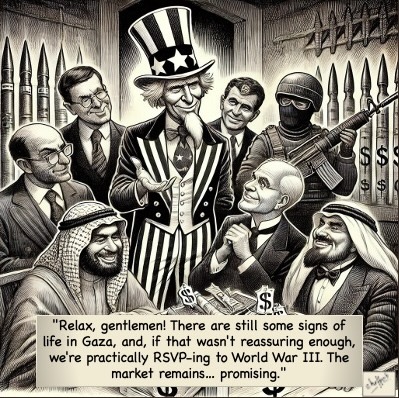
Gazans need food, water and medicines; not, contraceptives.
The dramatic drop in crime rates across the United States in the 1990s sparked intense debates about its underlying causes. Pundits credited economic growth, stricter gun control, a crackdown on drug trafficking, improved policing, and increased use of capital punishment. However, Steven Levitt and Stephen Dubner, authors of Freakonomics, proposed a controversial yet compelling theory: the legalization of abortion following the U.S. Supreme Court’s landmark Roe v. Wade ruling on January 22, 1973, played a pivotal role.
With abortion legally accessible, many pregnancies that might have resulted in unwanted children—often born into poverty and unstable environments—were terminated. Had these children been born, it was argued, many would have grown up in circumstances that increased their likelihood of engaging in criminal activity.
If this theory holds, a chilling corollary emerges: The United States is poised for an unprecedented surge in crime a decade and a half from now. As expected, experts will scramble for explanations, but this time, the reason will be glaringly obvious—the recent reversal of Roe v. Wade.
While rising crime in America may be a domestic concern, the consequences of its policies extend far beyond its borders. U.S. foreign policy often mirrors the contradictions in its domestic decisions, particularly in the Middle East. Nowhere is this clearer than in its approach to the Israeli-Palestinian conflict.
Successive U.S. administrations have adopted a selective stance on demographic control. During the Intifada of the early 1990s, Palestinian leader Yasser Arafat famously declared, “The womb of the Arab woman is my strongest weapon.” At the time, fertility rates in Gaza soared to an astounding 8.3 births per woman—nearly three times that of Israeli Jews. Alarmed by the demographic shift, the U.S. actively supported birth control programs in Palestine while simultaneously offering unwavering military and moral support to Israel.
Fast forward to today, and the consequences are staggering. Since October 7, 2023, nearly 44,000 Palestinians have died in Gaza, with deaths continuing even after a precarious ceasefire—first from bombings, now from hunger and the collapse of medical care.
Adding to the crisis, the U.S. has halted all foreign aid, including a modest yet symbolically significant $5 million designated for contraceptive supplies in Gaza. But if and when aid is restored, the priority should be clear: food and life-saving medicines, not birth control. As America’s policies continue to shape lives—both within and beyond its borders—the world watches. Whether on the streets of New York or the alleyways of Gaza, the consequences of U.S. decisions are neither isolated nor incidental. Perhaps it is time for the architects of these policies to reckon with the paradox they have created:
A nation that dictates life and death struggles to control its own fate.
Air Commodore ROJ Assey (IAF Veteran): Thanks, Ashok. Very thought provoking, indeed. I have never come across – or imagined the concept of ‘Roe vs Wade’ being a significant factor in crime control – fascinating. Some of us may be around to see it, too. Superb writing, as usual – and fascinating reading. Warm regards. ~ Rod
The first time I came across that word was when, as a schoolboy, I read RL Stevenson’s Treasure Island—Captain Bill humming: “Fifteen men on the dead man’s chest — Yo-ho-ho, and a bottle of rum!” I was too small then; didn’t heed the RUM part of that utterance. My first, real introduction with RUM, however ‘happened’ in a uniquely comical circumstance.
Mukesh Kumar, my senior and my cross-country team mate at St Stephen’s College, and I was on an endurance run on the ridge road when it started pouring. We pressed on regardless. In a while, a cab came to a halt by our side; the occupant signalled, rather insisted, that we took lift in his cab. So, there we were—a dripping Mukesh sitting beside the stranger in the rear seat, and I, shivering by the side of the driver. The man was swigging from an almost empty bottle of rum. He was happy; happy as one could be after downing more than a pint of the hard stuff. He proffered a fresh bottle for us to take sips in turns.
We declined but then, succumbed to his pestering for just one sip. I hated the unfamiliar taste and the burning sensation in my throat on taking that one sip. I wasn’t sure then, whether I would touch RUM ever again. And, although how I got introduced to the dark drink that rainy day has remained etched in my mind, my most memorable RUM session, a Quixotic one in that, took place about six years later.
At this point, a brief preface would be in order.
I left St Stephen’s to join the NDA; was eventually commissioned in the Air Force, in 1981. In the following year, I trained and became a Parachute Jump Instructor at the Paratroopers Training School (PTS), Agra. It was a turning point in my life—people started treating me as a differently-abled (they actually meant “exceptionally-abled”) individual everywhere, including, the bar. Yet, despite the nudges and needling like, “What sort of a paratrooper are you…, how come you don’t drink blah… blah,” I didn’t take to regular drinking. Two small helpings of anything—rum, gin, whiskey or, even wine (honestly, I couldn’t identify them by taste)—used to satiate me.
A veteran’s advice
“Look at me… five feet, f*** all inches. Don’t expect my capacity to be great,” has been my standard plea to those, and there are many of them, who insist on my having more drinks than I choose to consume. I try to follow a veteran’s advice in this matter.
I guess that description of my relationship with hard liquor puts my hospitality under a cloud. But I don’t think I’m all that bad a host in that regard. I sincerely try to offer my friends and guests drinks to their satisfaction. Invariably, Master Chef Chhaya covers up my inadequacies with her culinary skills at the dinner table.
Returning to the Quixotic Rum Session—it was a Saturday evening in June. I don’t remember the year. And, the social coward that I am, I’ll not mention the names of the colleagues involved because some might object to inclusion of their names in the mildly boisterous incident fringing on un-officerlike behaviour; others might take offence to their names being left out.
Chhaya, and I, had planned a get together at our residence—a cosy little bungalow in one corner of the Air Force Station. We called it, “Para-dise” (mind the hyphen and “Para” as in “parachute”). We were busy addressing our shared responsibilities when a Despatch Rider (DR), a messenger on a throbbing Enfield bike, arrived with the message that night para jump sorties had been planned. “Take off, 1900h (7:00 pm); you have been detailed as the Drop Zone Safety Officer (DZSO),” said the DR.
DZSO duty entailed reporting at the Malpura Drop Zone, 11 kms away from home, an hour before the first aircraft (paratroopers on board) took off. Simply put, it entailed coordinating and doing things to ensure that the paratroopers jumping from the aircraft (those days, it was C-119 Fairchild Packet) landed safely in the designated area. Five para drop sorties commencing at 1900h meant that I’d be home late; it could be later than 2300h.
Some other officers from among our invitees would be involved in the conduct of the night para drop—one of them would be there to supervise the emplaning of the jumpers; some others would like to grab the opportunity to log a night jump. Thus, on the threshold of being executed, our plan of the get together lay in ruins. We didn’t have residential telephones; and mobile phones didn’t exist, so I went around on my Vijay Super sharing my predicament with people on my guest list. We decided that, all the ladies, and those officers who were not engaged in the conduct of the para drop would still congregate at Para-dise. The rest of us would join after the completion of the scheduled jumps.
At the Malpura Drop Zone.
It was full moon; the sky was clear; the winds, calm. But the weather was hot and sultry. Having marked the DZ, we, the DZ Safety Team, sat there on a 10 m circular cemented platform in the centre of the 1.5X2.0 km Drop Zone and slapped mosquitoes as we chatted and waited for the aircraft. Cold water from an earthen pitcher provided occasional comfort. We talked of many things under the moon, but none cursed the administration for planning ad hoc para drop sorties and ruining the weekend. In the heart of our heart, we knew that on the timely completion of training jumps depended the parachute jump pay of the troops. Besides, a delay could cost some of them, their planned leave. Therefore, it was imperative that the availability of serviceable aircraft on good weather days be fully exploited. Mission first!
The aircraft came overhead as planned; dropped troops and returned to base. Repeated. By 2200h, 200 troops had jumped and landed safely. There was no injury, incident or accident. The troops would take time to bundle their parachutes and rendezvous at the control tower in one corner of the DZ.
We still had an hour or so before we could close shop.
Meanwhile, as expected, my buddies who had jumped that night, rolled their parachutes and joined me. I was expecting them to convey their condolences over the sad demise of our plan, the plan to party. Far from it—one of them gave me a big surprise by taking out a bottle of Sea Pirate, a popular rum in those days, from his haversack. He had carefully packed the bottle and jumped with it. Another, took out two packets of potato chips—the contents had got crushed during the jump. We were ready to start a celebration of sorts when spirits dipped momentarily. There was only one small dented and battered aluminium mug and we were six people (including two of my DZ Safety Team). Without glasses, how would we enjoy the RUM?
Where there’s a will; there’s a way!
Someone came up with a simple, stupid workable solution. We sat in a wide circle around the pitcher and passed around the bottle of Sea Pirate followed by the mug filled with water. Each one took a sip (large or small, at will) of the dark rum and a sip of water in turns. It was like folks sharing hukah on a village chaupal. It was bliss! It was Nirvana! To me RUM has never tasted as good as it did that moonlit night on the Malpura Drop Zone.
Soon we were at Para-dise—the party continued until past midnight.
A few days back, I came across a social media forward. It was the recipe of a drink using rum. It looked exotic. Sadly, even before I could try it, I lost it in the junk on my mobile phone or maybe, I deleted the link. Now, I cannot recall its name also. Yet, desperate to try it, I concocted my own version of it—from whatever I could recall—and tried it. It tasted good. Then I served it to a friend. He too relished it and asked me the drink’s name. In a spontaneous response, I called it: “Green ON! Go!” “Green ON! Go!” is the command on which a paratrooper jumps out of a perfectly well flying aircraft hundreds of feet above the ground. A top-of-the-world feeling follows the exit from the aircraft.
For those interested, here is the recipe.
…the ingredients
Ingredients
Dark Rum (30 ml) – This quantity may be tweaked to taste
Cinnamon (one stick) – Cinnamon has many health benefits. CLICK HERE to read about some of them.
Star anise (two pods) – It is a spice used in traditional Chinese medicine. It has powerful bioactive compounds that may help treat fungal, bacterial, and viral infections.
Black pepper (six pods) – Black pepper too has many health benefits. CLICK HERE to read about some of them.
Orange (one)
Honey (one teaspoon)
Getting Ready
Cut a slice of orange with its peel
Remove the peel of the remaining part of the orange and cut it into long fine shreds
Here we go!
Boil 250 ml water
Add cinnamon stick, star anise and black pepper. Continue boiling for five minutes
Arrange the shredded orange peel at the bottom of a glass tumbler
Pour the contents (boiling water with cinnamon stick, star anise and black pepper) into the tumbler.
Add honey; stir gently.
Slowly, add 30 ml dark rum. Don’t stir. Let the RUM linger long and merge with the concoction at its pace.
Gently place the slice of orange on the surface.
Raise a toast to paratroopers and say, “Green ON! Go!”
[Sometimes, I add a spoonful of orange pulp to suit my taste.]
An afterthought Forget the health benefits of the ingredients, I find the process of making “Green ON! Go!” therapeutic. Then, the drink itself… cinnamon and pepper give a distinct flavour. The slice of orange and star anise floating in the tumbler, is soothing to the eyes. The bitter sweet taste of orange and honey… and above all, the lingering RUM merging slowly with the surrounding water is a treat to the soul. On a winter evening, with subdued lights and soft music, a sip of it gives me a top-of-the-world feeling.
Some valued responses
Wg Cdr Vijay Ambre (Veteran): Dear Ashok, I enjoyed reading “Green On! Go!!” as much as I have all your other writings. It evokes memories of our lives in the transport stream of the Air Force; where “our ” times were never ours. Innumerable cancelations/absences that were always treated as a way of life by the family. As for the drink recipe, although, I enjoyed reading it ,I am not going to make GOG ,as I turned teetotal and gave up non-veg food aeons ago. Here’s wishing more power to your pen!👍👌👏
Air Commodore Ashok Kumar (Veteran): Ashok nicely written, as smooth as Patiala Sea Pirate. Chug it!
Air Commodore JV Paul: Sir, your para-normal skills are matched by your anecdotal skills!!!😁👌 Your exploits were already legendary by the time I entered the An 32 fleet in ’88 with the Yaks, and then reinforced and cemented by the time I entered the Skyhawks kingdom in 2007. Much more water had flowed beneath the bridge by the time my daughter entered the portals of Amity Noida to do her Architecture course. And she had the pleasure of Chhaya Ma’am’s benevolence as a hosteler there, especially after I disclosed my Skyhawk connection to Ma’am. The Skyhawk stint remains the high point of my career. Chhatri Mata ki Jai!
Virendra Singh Mann
Thoroughly enjoyed reading the post “Green On! Go!” Felt as though I was reading a novel. But I know this must be for real. Thank you so much for sharing. 🥃Cheers to a bottle of rum.
Viney Sharma
Hello Ashok, Very interesting read and I can fully relate to it.
In 1967 I got introduced to RUM (Hercules XXX @ Rs 10/ bottle from the CSD). 4 of us from college had gone on a trekking trip in Kashmir. We had taken a shikara to Char Chinar in the middle of Dal Lake (probably a full moon night). One of us with fauji connections produced the bottle from his backpack. It was quickly consumed with much back slapping and leg pulling. Don’t remember how we got back to our lodge but still remember the massive hangover next morning.
Squadron Leader RP Mittal (Veteran)
Nostalgic and smooth capture of the spirit of the moment in narration. 😊
Wing Commander Pradeep Dahiya (Veteran)
As always great read. Your writing has a wonderful capacity to stimulate imagining the scenes and characters . Thoroughly enjoyed.
Raghu Ramakrishnan Aiyar
Lively and highly, ” Spirited’, anecdote. Smooth, it flowed; Sublime, it lingered; Sensational, it spoke of the Para Jumps, even as the GreenON! Go… went on and on, wild and wanton👍👍👍👍