“I’ll hit you!” to “I’ll stitch a lounge suit for you.” in two hours

The planets had conspired to get me on the Ashram flyover that day at that time….

There was more than the usual traffic. Two cars had stopped (one behind the other) in the middle of the road. The drivers were arguing to establish culpability for a prang involving their cars. Having settled the scores, the athletic young driver of the lead car walked back to his vehicle. Unmindful of my car passing his through the narrow passage, he flung open the door. His wrist got caught between his door and the rear view mirror of my car as I was trying to manoeuvre through the passage. He shrieked as the mirror assembly of my car broke and hung by its wires––he was hurt badly.

It was the beginning of a two-hour ordeal.

“Are you blind? You can’t see even with specs on. I’ll hit you!” He raised a closed fist as I lowered the glass.

Here was a youth half my age, threatening to cause me physical harm. It felt as if he was challenging my years of training and grooming in the Air Force. A deluge of memories of my days as an instructor in the Paratroopers Training School and as the Chief Instructor at the Garud Regimental Training Centre flooded my cranium.

It was difficult to hold back the urge to counter rage with rage. His last words were still echoing menacingly in my ears: “I’ll hit you!” I looked piercingly into his eyes and said  calmly, “Please go ahead. Just try.”

I don’t know what did him in. “Get lost!” He said with his clenched teeth; turned and walked back to his car.

I drove off slowly not knowing that the ordeal was not over yet.

The youngster blocked my car at the end of the underpass near Moolchand Hospital. He raised his bleeding wrist and asked, “Who will get me first aid?”

“I will,” was my instant reply. He refused to go along with me to the Air Force Medicare Centre for treatment. So I followed him to a nursing home of his choice. At 8:30 am, the night duty staff were leaving; the day duty staff had not taken charge. They were not in a position to treat him. Half-heartedly, he let me take charge.

I made him park his vehicle and drove him to Moolchand Hospital in my car. He was given first aid and medicines. “Take these tablets after eating something and return for further treatment,” the doctor said handing over the prescription. His wrist had suffered a hairline fracture.

He had calmed down considerably when we reached the cafeteria. “Sir, I’ll have a coffee and half a pizza if you don’t mind having the other half.”

We chatted as we ate. He was Atul Batra (name changed), a fashion designer, educated in London and worked from there; had an office in Delhi too. His father was a retired Inspector General of Police. He was a kick boxer. After we agreed that it was an accident in the true sense of the term, we opened up and talked on more interesting subjects including fashion. Having served as the Assistant Quality Assurance Officer in the Ordnance Parachute Factory––where they manufactured parachutes and a wide range of garments for the Indian armed forces––I had a fair knowledge of garment manufacturing.

Just for fun, I asked him if he knew why the buttons on the garments for ladies and gents were stitched on the opposite sides. He did not have an answer. He guessed that it had something to do with the two lobes (left and right) of the brain, which functioned in diametrically opposite way for the two sexes.

“Did people have the knowledge of difference in the brains of the two sexes in the era when buttons were invented?” I winked as I asked.

“No, people of that era did not have this knowledge about brains.” He looked quizzically at me. “Do you know the answer to that question?”

I told him that when buttons were invented several centuries ago, only the kings and the membeIMG_6640rs of the royal family could afford them. The men folk used to dress up on their own––the buttons were placed on the right side for convenience. The queens and the other ladies of the royal family, on the other hand were assisted by maids. For the convenience of the maids, the buttons on the garments of the queens and the princesses were stitched on the opposite side. The practice has continued.

He was impressed by my knowledge. “I didn’t know that,” he said.

Both of us laughed when I told him that my source of information was Google.

Our interaction lasted two hours. His parting words when I left him by his car were: “Sir I’ll stitch a lounge suit for you.”

An instance of road rage need not always end in broken noses.

“Happy Birthday, Mahavir Swami!”

“When you make a greeting card for a person, you express your true love for that individual. It is one way to say that you care,” Chhaya used to tell our son, Mudit. Mom’s word being gospel, the little Michaelangelo used to let go of his imagination to create masterpieces of greeting cards. A skydiver, a flower, a hut, a car, a motorbike, a bird, or even an Uncle Chips sticker––literally anything that crossed his mind when he sat down to make a greeting card––found a place on his canvas (paper).

Some of the best wedding anniversary cards we have ever received in over three decades of our happily married life have been the ones specially designed by him––they are among our most prized possessions.

Mudit Greetings 1

In due course, it became a habit with him. If it was a birthday, it was his responsibility to make a birthday card.

One day he came to Chhaya and said, “Ma, tomorrow is a holiday. The school will be closed. They say it is Mahavir Jayanti. What is Mahavir Jayanti?”

“It is Mahavir Swami’s Birthday. He is our God,” explained Chhaya. Little did she know that her reply would trigger a chain of programmed actions; those that went into designing a birthday card.

Mudit was gone for a while. When he returned, he had in his hand a beautiful greeting card conveying birthday greetings to Lord Mahavir––perhaps the first ever birthday greeting card that the Lord had ever received.

Mudit Greetings 2 Mahavir Swami

Any reason is a good reason for creativity.

Being a Player

The seeds of this endeavour were sown in the December of 1996 when I arrived in Delhi on posting to Air Headquarters. For one like me, who had until then lived in small towns, the transfer was a cultural shock. I was not used to the fast paced life of Delhi. Heavy traffic, growing heavier by the day troubled me most. It was painful travelling every day by the Air Force bus from my home in Noida to the office in Vayu Bhawan and back. It was even worse if one were driving a car. Being stuck for long hours in traffic was a routine, almost. The stretch between Outer Ring Road and Akshardham was particularly bad. The traffic jams could be kilometres long and could take in excess of an hour, at times, to clear up.

Those jams sucked, turning helplessness into a permanent emotion.

The inauguration of the new bridge across the Yamuna, and the road connecting the Ring Road and Akshardham, came as a big respite. I did not enjoy the benefits of it for long. I was posted out to the tranquil town of Tezpur.

Everything had changed by the time I returned to Delhi on posting about eight years later. More than a dozen new flyovers had come up. Infrastructure to support the Commonwealth Games was also nearing completion. Ideally, these developments should have solved the problem of hold-ups in traffic and should have provided succour to the commuters. But the respite was short-lived because Delhi and the NCR had contributed vehicles to the roads at a very high rate.

The infrastructure development fell well short of the need. Traffic snarls returned with a vengeance. They were unpredictable in terms of time and location. The choice was between accepting the situation as it were (fate) or to do something about it. I chose not to be a sorry spectator; but to be a player and to contribute my tiny bit to address the problem.

I had observed that on many occasions the trigger for a jam used to be a broken down vehicle. The recovery van used to take some time to reach the spot and remove the vehicle. Ironically, the jam caused by the broken down vehicle used to hamper its recovery. For the jam to be eased it was imperative that the vehicle be taken away to a location where it would not obstruct the traffic; and it had to be done expeditiously.

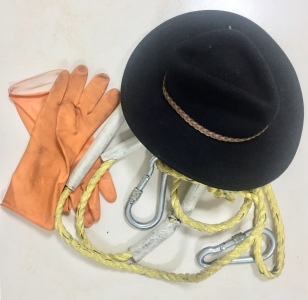
IMG_3800I started carrying a towrope with shackles in my car. And, whenever I came across a broken down vehicle causing traffic jam, I started towing it away to a location that would ease the traffic situation. Drivers of such vehicles are always surprised getting help from a stranger and at a time when they need it most (and expect it the least). For me the glow in their eyes is a big reward.

In the last ten years, I have towed more than a hundred vehicles to comfortable locations. In addition, I have helped others looking for assistance on the roadside. Each encounter has been a memorable experience.

Author’s Note: Some of those who were towed/ assisted by me, and some others with whom I have shared these experiences, have resolved to follow suit. Some have even started carrying contraptions (rope and shackles) to provide assistance likewise. The contagiousness of the endeavour has nudged me to write this post and the ones that follow in the Section: “O Delhi!”

Being ‘a spectator’ or ‘a player’ is a personal choice.

Banwarilal

Banwarilal was his name––a man my age (nearing 60) but who appeared to be years older. He seemed to have seen 75 summers. He was a gardener and had undergone accelerated aging working in the lush lawns of Lutyens’ Delhi. Squatting on his haunches and working long hours in the sun, had given him a permanent stoop and a dark tan.

We met first when I saw him trudging on the roadside, a walking stick in hand, and had offered him a lift in my car. He was taken aback. He sat on the edge of the seat for that’s how poor people are supposed to sit in the presence of the well-to-do. At least, that’s how Bollywood depicts them. Overwhelmed and full of gratitude in his eyes, he sat quietly looking at the road ahead and occasionally stealing a glance at me.

Baba, kaise ho?” I tried to make him feel easy.

“ I am fine, Sir.”

“Where are you coming from?”

“Delhi Sir. I work in a government nursery.”

A polite meaningless conversation ensued. When I dropped him a kilometre further, he showered blessings as expected.

I saw him again the next day and pulled up by the roadside. He got into the car with a smile. It being the second time, his demeanour was devoid of apprehension. We resumed our conversation. He was immune to governments and governance. His life revolved around his small family––a son, a daughter-in-law and some grandchildren.

It became a routine––the business of me offering him a lift. It was two to three times a week. It continued for over two months. With time he opened up and became talkative. He even offered to take care of my lawn. Then there was a long break. I started car-pooling to the office. As a result our timings did not match any longer.

I forgot Banwarilal.

Until another warm day over three months later…

I returned early and found him again. I stopped the car for him to get in. He wasn’t his chirpy self.

“All’s well Banwarilal?” I asked.

“Not really, Sir. I have not got my pay for three months. There has been some hold-up in the computerised system of payment since de-monetisation drive began.”

“Life must be awfully difficult…” I sympathised.

“Our reserves have touched rock-bottom; life has indeed become very difficult…” he went on. It was a monologue and I was a mute listener. Here was a man tortured by fate. He was silently suffering––not begging for a job or largesse.

A thought engulfed me: “Is there anything I can do for him?”

My chain of thoughts was disrupted when he asked me to stop.

As he opened the door to get out, I asked him if I could give him some money to overcome the crisis in his life.

To be honest, it was a half-hearted offer borne out of my feeling of helplessness to do something to mitigate Banwarilal’s misery. There were two diametrically opposite reasons for my hesitation. One: I was sceptical that Banwarilal might accept the offer and demand a huge amount of money that I would not like to dish out. On my part, I had decided to give him Rs 3000/- an amount that I had just received as remuneration for writing an article for the Defence and diplomacy Journal. Two: Banwarilal might get offended or feel demeaned.

Banwarilal declined the offer. He said that conditions were bad but not so bad so as to seek largesse. It was still possible for his family to stay afloat. I made a counter offer: “If you are determined not to take money, consider it to be a loan and return it to me whenever you are comfortable.

Banwarilal smiled again. With a broader grin this time, he said, “Sir, I am touched by your gesture. But I really do not need money; all I need is your prayers so that there is an end to my misery.

Being rich, poor or well-to-do is but a figment of imagination.

On Doodhoo and Bickies

Learning a language to express oneself, English language in particular, is an important first step in our lives in India. Parents do everything possible so that their little ones learn to speak soon. Really soon. It is an obsession––a natural response to the need to master a skill that would enable smooth sail later in life.

As young parents, Chhaya and I observed others teaching their little ones to speak. They would use words that did not exist in dictionaries. For example: doodhoo for doodh (Hindi for milk); ta-ta for hot; kitchtchy for a kiss and bicky for biscuit… the list is long. No sooner did children learn those invented words it was time to start unlearning them and learn the right words to convey the same thoughts. Parents would say, “Sunny, it is not doodhoo, it is doodh; not bicky but biscuit etc.

Toddlers would go through a cycle of learning words; unlearning them and then, learning the appropriate words. Both kids and the parents paid a cost in terms of time and effort involved in the little ones being able to communicate meaningfully.

In our son, Mudit’s case we leapfrogged this step of teaching/ learning by making a deliberate effort to use the right word in the first instance. Thus Mudit picked up fairly decent diction right in the beginning.

Building vocabulary was a parallel process. We helped Mudit learn new words. On his part, he made use of his limited vocabulary to his best advantage. Once when he wanted a hammer and did not know the word for it, he said. “Papa, please give me a nail-pusher.” I was reminded of a 1970 Dustin Hoffman starrer, Little Big Man in which one of the characters says: “I have pain between my ears,” to convey that he had a headache.

Years later, when I was doing a certificate course in French language, our professor posed a question that had a binary answer in a “yes” or a “no”. I do not remember the exact question but it was like: “Are you an Indian?”. The student, who stood up to answer, gave a nod. It was just a nod, a universally accepted expression for “Y-E-S.” On his response, which looked comical the class burst out laughing because everyone expected him to say (in French): “Yes Sir, I am an Indian.” When the laughter died down, on a serious note our professor said that the purpose of learning a language is to be able to convey ideas and to get a feedback or a confirmation or an answer. A nod was as good as an answer formed with half a dozen words. “Do not lose sight of the aim of learning anything,” he said.

As a child Mudit, also learnt that a picture was worth a thousand words. Once we left him home playing with a friend. On our return we found the front door of the house closed and latched. Stuck in the door-handle was a rather longish message that read: “Papa, Vaibhav and I are in Vaibhav’s house…” It was enough need-to-know information for me at that moment. Therefore, I would not have read the complete message, which read further, “Please meet us before you open the door…. There is a snake in the house.” What drew my attention to the rest of the message was the drawing of a snake made prominently in the lower half of the note. Thanks to Mudit’s warning (drawing), the snake was removed and the house was secured. None was harmed.

Fast-forward a dozen years and more. It is a treat seeing Vilasini, our grandniece––based in Geneva with a Tamil-speaking father and a Hindi-speaking mother––effortlessly switching between Hindi, English, Tamil and French. And Kartik, our grandnephew (in the tutelage of his grandmother and parents), conversing in intelligible Hindi/ English and reciting Shlokas in Sanskrit.

In a fast shrinking world, ability to convey ideas will be power of sorts.

Sweet home is the university where education on effective communication begins.

Calming a Crying Kid – II (Kartik)

It is always fun discussing parenting with Ravi, my nephew and Swati, his wife. They come up with innovative ways of addressing issues concerning Kartik, their son, my grandnephew.

The last time we met, I asked Ravi whether Kartik, otherwise a very well behaved toddler ever causes ruckus. And how do they calm him. Ravi said that Kartik doesn’t normally cry. He cries when he has a genuine reason to do so. Say, when he hurts himself. But then, he becomes quiet soon enough, on his own.

Ravi added, when Kartik cries because of a genuine problem, they try to pinpoint the problem and resolve it. On very rare occasions, Kartik cries purely to draw attention. He even says: “See Papa, I am crying.

Ravi says that they have discovered a way to deal with those situations; and it works.

In rarest of the rare cases when Kartik cries for no apparent reason, Ravi initiates the following conversation:

“Kartik, let’s play carom, now. Or, shall I read the story of the tortoise and the rabbit, now?” Or, would you like to drink a glass of milk, n-o-w?… … You can resume your crying later.”

Note: playing carom, being read a story, drinking milk,… are some of Kartik’s favourite pastimes.

Says Ravi, “Most often Kartik chooses to indulge in an activity of his choice and postpones his crying for an opportune moment later, which never returns.”

Agony deferred is agony lost!

Airlift During Natural Disasters: How Can More Lives be Saved?

Blame them on depletion of Ozone layer, global warming or some such phenomena––natural disasters have begun visiting us with the regularity of equinoxes and the solstices. The ongoing floods in India are an example of the fury unleashed by nature.

The armed forces in general––the Air Force in particular––are pressed into action to provide succour by airlifting men and material and evacuating the stranded population. The number of sorties flown despite inclement weather within the limited resources and the tonnage provide for impressive statistics. Selflessly rising to the occasion each time, the men in uniform save thousands of lives.

Thousands still die.

The question is: Ceteris paribus, can more lives be saved? Going by the Uttarakhand  experience (July 2013), the unequivocal answer would be, “YES.”

Centre for Air Power Studies, New Delhi, Issue Brief No. 19/ 2013 dated July 11, 2013 titled, “AIRLIFT DURING DISASTERS: THE UTTARAKHAND EXPERIENCE –– Can we Save More Lives?” explains, “How?”

Link: http://capsindia.org/files/documents/ISSUE-BRIEF_74_AIRLIFT-DURING-DIASTERS-THE-UTTRAKHAND-EXPERIENCE_11-July-2013.pdf