Damsel in Distress!?

Come September the 28th, Hotel Taj Mansingh will be under the hammer (if the date is not changed)––some of the top names in the business of hospitality will vie to acquire the coveted premises. The Hotel has been witness to events of historical importance. I too have attended seminars and private parties in its elegantly decorated convention halls. But what I remember the Hotel is not for its grandeur but an incident, which twenty years on remains a mystery for me. It took place on the roundabout near the Hotel.

It was a Wednesday in DecTaj Mansinghember of 1998 (or 1999); I am not too sure of the year. Not that it is of much consequence. It was a Wednesday for sure, because I was in civvies. On other workdays we used to wear the uniform to Air Headquarters. I was driving along APJ Abdul Kalam Road (it used to be Aurangzeb Road then). On the roundabout near Hotel Taj Mansingh I narrowly missed a car parked dangerously in my path. I swerved and went around it. The cars following me had to take even more drastic evasive actions. I looked furtively at the driver of the parked car as I went past it. It was a lady.

Thinking that something was wrong and perhaps she needed assistance, I stopped a little ahead and approached her car. “Is there a problem? Can I help?” I asked.

“My car has stopped. It is not re-starting.”

“Let’s see what can be done. But before that let me push your car a little ahead. It is dangerously parked.”

She sat at the wheel as I pushed the car. Once the car was at a safe location––not in the path of the other moving vehicles––I asked her if there was sufficient fuel in the tank. She got out of the car as she confirmed, “There is enough petrol in the tank.”

She handed over the key to me and looked intently at the Defence Headquarters’ Identity Card hanging from my coat pocket and said, “I am an Air force Officer’s daughter. The need for me to introduce myself had become redundant––she had read my name.

I sat in the driver’s seat, inserted the key and cranked the engine. Lo and behold, the engine started as if nothing was wrong with it. I looked at her victoriously. She shrugged her shoulders as if to say, “I don’t know how it has started now. It wasn’t starting when I was trying.”

I got out of the car without switching off the engine and gestured her to occupy the seat. “Do not switch off; drive straight to a mechanic before it stops again.”

“Thank you,” she said as she got into the car.

As I was turning to go, I happened to see a “PRESS” sticker on her windscreen. “Are you from the media?” I asked her.

“Yes, I am Anita Baruah (name changed) from Bharat Ek Khoj (name changed).”

It was a popular news magazine––one of the most popular, indeed. But I didn’t know the young lady. Later when I shared the incident with a colleague, he told me that I had met a celebrity (he meant Ms Baruah) from the news media. She was an Associate Editor of the magazine. A few years later, she published a book on a military subject.

For the last twenty years, the instant starting of a supposedly broken down car has intrigued me. I have wondered whether the damsel was really in distress or the media-person was waiting opposite Taj Mansingh with a purpose; keeping an eve on someone or something for her magazine’s next big story.


“Now a Silver Medal is Assured!”

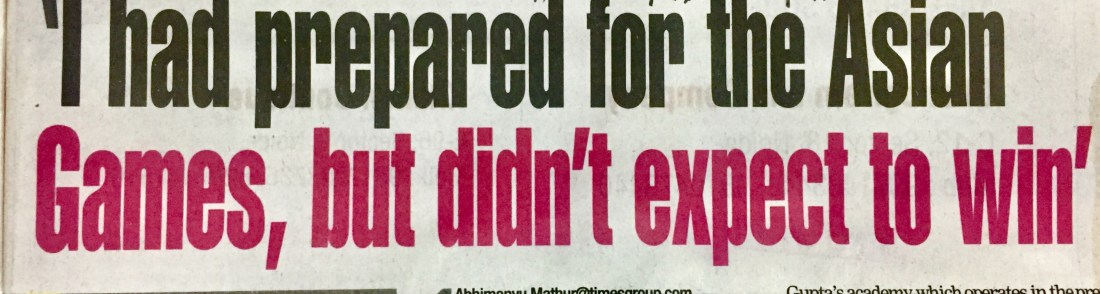
This post is inspired by a caption, which appeared in a newspaper supplement and drew my attention. It read: I had prepared for the Asian Games, but didn’t expect to win. Why would a sportsperson enter a competition undetermined to win? The individual might have genuine personal reasons for being less hopeful. But I believe that the environment also kindles and fans this type of hopelessness.

TOI I did not hope to win

I have heard coaches encouraging their trainees thus: “Haar kar mat aana,” meaning “Don’t lose and come.” And parents saying: “Win at least a medal.” Why are we so shy of even desiring to win? Perhaps with the following words of encouragement they would stand a better chance of returning victorious: “Guys you have toiled for this day. Elements of the universe are aligned in your favour. Now go for the Gold!”

The media, both print and electronic, have their way of reporting sporting events. Here is a standard line they use to report the entry of an individual (or a team) into the finals of an event:

“Satbir Singh has reached the finals of the Men’s Badminton. Now he is assured of a Silver Medal.”

Although this is truthful reporting, but it lacks the nudge that can possibly encourage a sportsperson to give that last bit in him/ her to win. If I were a media-person, I would tweak the same report to read thus:

“Satbir Singh has entered (mind you, not “reached”) the final round of the Men’s Badminton. He is now a step closer to the coveted Gold Medal” or “He’ll now fight for the Gold.”

Similar tweaking in the reporting of events in other walks of our daily lives can bring about a pleasant change in the way we start our days. That is a subject of another post, another day.

Tipping the Fear of the Unknown

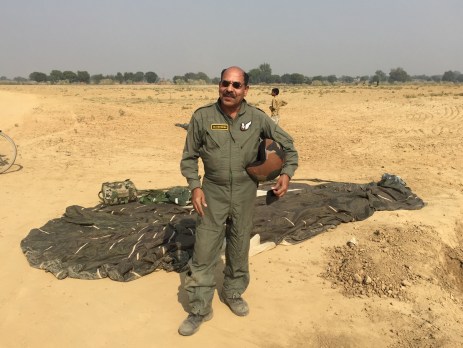
“Aren’t you scared abandoning a perfectly well flying aircraft mid-air? How did you feel when you made the first parachute jump? What motivated you to volunteer for such a perilous duty?” I have been asked those questions, and the like, umpteen times since I qualified as a Parachute Jump Instructor (PJI) at the prestigious Paratroopers’ Training School, Agra way back in the October of 1982.

I have trained hundreds of jumpers, including the NCC cadets. Individuals undertake parachute jumps for different reasons. Some want to prove a point––to themselves, to others, to the world. Some do it for adventure. Many in the army do it for the lure of the Maroon Beret and the paratrooper’s brevet––by far the most coveted insignia on a military uniform. The saying goes: “On the eighth day God created the paratroopers and the devil stood at attention.”

I knew little about PJI duties when I volunteered for selection for such a job. I was newly commissioned and posted as a logistics officer at an Equipment Depot in Devlali. Flight Lieutenant UR Rao, a PJI himself, was a role model for us youngsters. He said that it was a wonderful life as a PJI; we would get a glimpse of it during the selection process. “In any case, you’ll be able to see the Taj Mahal when you go to Agra,” he used to chuckle.

My training at Sainik School Rewa and the National Defence Academy, saw me through the tough selection. During the process, we were taken for an air experience in the Packet aircraft (an aircraft of WW II vintage). “The noise and the vibrations of this aircraft might be enough to force a person to bail out,” I wondered.

The toughening phase commenced on the following New Year’s Day (1982). Even in the biting cold and foggy winter of Agra, by 7 am, one could squeeze half a litre of sweat from our jerseys. There was no compromise. We were being trained to undertake assignments that would involve lives––on our actions would depend the safety of scores of paratroopers.

The training for the Para Basic Course lasted 12 days. Following an aptitude test we were ready for the first jump.

“Why the heavens did I opt for this?” That question hit me hard as the aft end door was opened over the drop zone and I was made to take position at the edge. It was scary standing in the open door of an aircraft flying at 225 kmph at a height of 1250 feet above the ground level. I wondered if I was better off as a logistics officer back in Devlali.

“Why? Why? Why?” The fear of the unknown was gnawing at my confidence. There were 30 seconds for the “G-R-E-E-N” signal to come on.

Turning back or looking back would amount to a weak resolve on my part––I had a decent opinion of myself. I couldn’t let myself down. Nonetheless, I managed a furtive glance into the aircraft. Standing behind me were four jawans, also ready to take their first plunge. They were quiet, absolutely quiet. Their faces were open books. Perhaps each was fighting a battle within. They were looking up to me to lead. I couldn’t have let them down.

I had found my trigger to go ahead.

Someone in the line hailed, “Chhatri Mata ki Jai!

“Green ON… G-O,” barked the despatcher.

Like a bullet I threw myself out of the aircraft. The parachute opened before I could count: “One thousand, two thousand, th-r-e-e…” The winds were gentle. On landing, the parachute collapsed like a pricked balloon. It was an experience of a lifetime. I smiled at my pre-jump apprehensions.

In the following years, as an instructor I always allayed the anxiety of my trainees by telling them that jumping from an aircraft was safer than crossing roads in Delhi.”

It takes right trigger to overcome the fear of the unknown.

IMG_5802

Hunger Pangs at Night

It was nearing midnight when Chhaya Chordia completed her round of the hostels. She was the Director (Hostels) and resided on the campus of Amity University, Noida. Random visits were her way of feeling the pulse of the hostels. They gave her insights into the problems of the students. Sometimes she would come across pranksters or stumble upon cases of indiscipline. Then there were cases, which belonged to the grey zone––one would wonder whether or not to treat them as flouting of norms. In over a dozen years in the business, she had developed a knack of resolving the issues of the young adults.

Today was a day when she would use that knack.

The wardens and the assistant wardens had submitted their ‘All Correct’ reports. There was silence in the corridors. Most students had gone to sleep; some were studying and some others were netsurfing. Occasionally, a student would step out to fill a bottle of drinking water. Peace prevailed.

Chhaya stepped out of the hostel to return to her residence when she saw someone walking towards the hostel. He had a carry-bag in his hand. She hailed him.

“Who are you?”

“Ma’am, I am Amit Sharma (name changed). I am…”

“You are II Year B Tech Biotech student,” Chhaya cut him short. “You are supposed to be in your room. What are you doing here on the road at this unearthly hour?

“Ma’am, I fell asleep in the evening and couldn’t eat my dinner in the cafeteria. So I ordered food from the dhaba across the road. I have just collected the stuff from gate number 4A.”

“Didn’t the guard on duty stop you?”

“He wasn’t there. He had gone to the loo when I collected the food packet.”

“You are a II Year student. You are fully aware that outside food is not allowed on the campus. Why then did you order food from the dhaba? Don’t you know that consuming food obtained from these roadside vendors can lead to food poisoning?”

“I’m sorry Ma’am. I was very hungry and every outlet in the food-court was closed. I promise, it will not repeat”

“There is no reason that I can allow you to consume this food. Please throw it into that garbage bin. And don’t repeat it.”

Amit complied grudgingly.

“Which is your room?”

“Room number 2 LGF in Hostel-6.”

“Now go back to your room and see me in my office at 11:00 am tomorrow.”

“Good night, Ma’am.”

Amit walked back towards the hostel gate as Chhaya headed for her residence. On her way she called the attendant on duty. “Malati, come to my residence right away.”

Back at her residence, Chhaya took out some food from the refrigerator and heated it. IMG_4039She baked some chapatis. Then laying out the food on a tray, she told the attendant, “Malati, take this to room number 2 LGF of Boys’ Hostel-6. Amit Sharma is the name of the student.

At 11:00 a.m. next morning…

Amit walked into the Hostel Office and touched Chhaya’s feet, “Last night I had returned to my room much annoyed with you. I’m so sorry. We have always seen you as a strict disciplinarian. Never knew about this trait of yours.” A tear rolled down his cheek as he added, “You are a godmother.”

Guru Nanakji & Golf

My drive from the third tee and the conversation following it changed my life forever.

That day I had landed at the golf course without a plan; I often do. Bansi, the Starter let me tee off with another golfer waiting to start.

He was a Sikh gentleman. He must have been in his early seventies; his grey hair and thick glasses suggested so. In his appearance, he resembled the legendary Khushwant Singh. He walked slowly and deliberately. He swung equally slowly with a perfect follow through. He must have been a very good golfer in his heydays. He was hitting short distances but his ball was following the path intended and directed by him. On the first hole he missed a five-foot putt and a par by a whisker. I barely managed to get a bogie.

On the second hole he got an easy par; I missed it narrowly.

The third fairway at the Race Course Golf Course is narrow in the beginning and widens in the later part. There are OBs on either side. One has to hit a long straight drive to be in a comfortable position for the rest of the par-five hole. He cleared the first hurdle comfortably.

It was my turn to tee off. I placed my ball on the tee; walked back a few paces to align myself and took stance. I thought of some of the 50 and more elements that go into making a perfect drive: the grip, the stance, the swing, the follow through, the transfer of weight, eye on the ball etc. I must have done really well at that because it was a long and straight drive, way ahead of the Sikh gentleman. There was instant accolade from him. “That’s a marvellous hit,” he said.

As we walked down the fairway to play our second shots, he appreciated my drive. The praise from the otherwise quiet man filled me with joy and pride. Outwardly I didn’t express much; I wanted to be modest; look modest.

“It just happened. I didn’t do anything. I just struck the ball, said “Wahe Guru” and prayed that it went long and straight.”

“Come on! You can’t get this good result with prayers alone,” he said. “You surely have worked hard for it.”

I tried to look even more modest. That’s when he narrated this story and I reproduce it:

“A Sikh youth was looking for a five-rupee coin that he had accidentally dropped in wet mud. He was praying to the gods to help him find his coin. There was a peculiar thing about his prayers­­––he was praying to all the gods other than the Sikh gods. When a curious bystander asked him, why he was remembering the other gods when his prayers could be (obviously) responded better by Guru Nanakji or other Sikh saints, he said, “Come on! Don’t expect me to ask Guru Nanakji to go into the mud for my five rupees. I’ll bother Him when I have a bigger problem or need. If I keep bothering him for petty things, He might not come to my rescue when I actually need Him.”

Returning to my good drive and prayers to Nanakji, he chuckled and said, “Don’t bother Guru Nanakji for small things in life. Save your prayers for the day when you are in dire need of His intervention.”

The message was loud and clear. That moment onwards, I have always done my bit; and done my bit well, and never nagged God for small favours.

Pray, I still do.

IMG_2662.jpg


One Anna

In the early sixties one anna used to be big money for a little kid in a small sleepy town likeAnna Ujjain. It was equal to six naye paise. It had the power to buy half a dozen candies, or to hire a bicycle for an hour, or to buy a bus ticket to travel half way across the city. An anna wrapped in appreciation could do much more.
Read on to truly appreciate the power of the copper-nickel coin.

I was barely five then. Dr Lalit Khanna had given me the coin in appreciation of a poem I had copied on my slate at the behest of my sister under whose tutelage I had learnt to form the letters of alphabet. I had gone around showing off my handwriting to every moving thing in my small world. I was fishing for compliments. Dr Khanna appreciated my handwriting amidst a group of three adults as he presented the coin to me.

When I grew up, I realised that there was nothing great about how I had written the poem that day. My handwriting wasn’t all that beautiful; I had just arranged the letters and words neatly in straight lines. Dr Khanna, the great motivator that he used to be, wanted to encourage me. The reward let my innocent mind believe that my handwriting was actually beautiful.

It marked a turning point in my life. That moment onwards, everything became a writing instrument and I used all the blank spaces on any piece of paper that I came across, to write. Writing became a passion. The word ‘calligraphy’ entered my vocabulary much later in life, after the art had become my hobby.

Thanks to Dr Khanna, I have a cherished hobby.

IMG_3986

Postscript to “It Happens Only in India!”

The other day I wrote about my experience with a couple whose vehicle had broken down on their way to the airport. It was incidental that I saw them stranded on the roadside and offered them a lift. And when the lady (an NRI settled in the US), expressed disbelief––“I never expected this to happen in India”––I responded spontaneously: “Young lady, it happens only in India.”

Kavita, my niece, now a US citizen, has responded to the post with:

“LOL! Though it happens outside India too, I can say for sure, having been on the receiving end of so many gracious gestures from so many strangers; country or continent no bar…”

I have revisited the incident in the light of Kavita’s remark. And, now I see an all new dimension of the incident.

The lady I wrote about was carrying a perception of India and the people here. For that reason, she did not expect such assistance in India.

My response was spontaneous, rather impulsive. Today when I look back, and analyse it dispassionately, I find two reasons for it. One, when she said: “I didn’t expect this to happen in India,” she inadvertently assaulted my pride as an Indian. And two, I haven’t been many places; I haven’t experienced much of the good behaviour of the people IMG_3770abroad. To say––“It happens only in India”––is, I guess, incorrect.

I love my India so do others love their countries.

What would I tell the lady if I were to go back in time and meet her under the same circumstances?

I would perhaps tell her (of course with a more pleasant smile), “My lady, there is more to India than you have seen, read or heard about. Now go, feel the heartbeat of my country.”

Thank you Kavita for sharing that thought. I value your opinion  🙂

It Happens Only in India!

Early one summer morning, I was on my way to Gurgaon to participate in a golf tourney. It was an annual feature in which the logistics officers (serving and the veterans) of the Indian Air Force vie for honours. The modest prizes mean little; actually it is an occasion for the logistics officers to meet and catch up with friends. I had started a tad early from Noida to be able to spend some quality time with buddies before teeing off.

I saw a white Ambassador car parked by the roadside as I was driving past the Film City. Someone was working under the bonnet. Another person, back towards the car, was looking expectantly at the passing vehicles. It was daybreak and there were very few of them on the road. The man was fidgety, gesturing to stop the passing cars.

I stopped abeam his car and lowered my window. “What’s the matter?”

“Sir, my car has broken down. I have to catch a flight from the Indira Gandhi International Airport. The driver has not been able to place his finger on the fault yet. I’ll miss the flight if I wait till the car gets repaired…”

“Hop in,” I said cutting him short. “You are lucky. I am heading for a golf course in Gurgaon. The airport is on my way and I have some time in hand. With a small detour, I’ll be able to drop you.”

He was accompanied by a lady who stepped out of the car as we spoke. They sat in my car; the gentleman by my side and the lady on the rear seat. We exchanged niceties. Then the gentleman expressed their profound gratefulness. What he couldn’t express in words, he tried to convey with his body language.

They were in their late twenties; maybe early thirties. Just married. They were on their way to Leh for a honeymoon. The gentleman was a senior executive with a Government of India enterprise. The lady was an NRI settled in the US. She had come to India after decades.

As we drove along, we indulged in polite meaningless conversation, the type we make with strangers to while away the time––we talked about the weather, about the beauty of nature, about global warming, about congestion on the roads… The lady, who was a bit reserved in the beginning, started participating actively.

I was buIMG_3770sy making calculations as I drove; I wanted to be in time for the golf tournament after dropping the couple at the airport. With the mind racing ahead of the car and trying to reach the golf course, I was participating passively in the discussion. But then, the lady said something, which drew all my attention. After thanking me for the lift she said, “I never expected this to happen in India.”

I turned my head for the first time, smiled at her and said: Young lady, it happens only in India.” There was silence.

The silence was broken by the man. He gave a long monologue, which was meant for his sweetheart. He highlighted every good thing that happens in India.

The lady was sheepish when I left the honeymooners at the airport.

The “Putting Ball”

It just happened one day half way through the game; on the tenth tee. I hit the ball 60 degrees off the intended line. I thought my stance, swing, follow through, …the works––which I had perfected by playing regularly over a year––were just fine. It didn’t end there; it repeated with every shot thereafter. The error of 60 degrees was a constant. What was disheartening was the inconsistency of the direction, left or right, which made corrective action impossible. I took six strokes to make it to the green (par 4). With shattered confidence, I carefully aligned my ‘putting ball’ and struck. A seven-foot putt just made it to the hole; dead centre. The sound of the ball falling into the cup was music to the ears.

The story repeated on the eleventh, the twelfth and the thirteenth holes––dismal performance along the fairway. But the putts were face-saving. The stance I took to prevent the ball going off the fairway was funny and yet it did not work because I was inconsistent with the direction, left or right. Then there was an assault on my self-esteem as a golfer.

“Sir, I think you need to take a break of a few days and go to the range,” advised my caddie. I took a sip of water and swallowed it as I did the pearl of wisdom given by the caddie. My golfing world was coming crumbling down..

As I trudged to the fourteenth tee, I banged the palm of my left hand with the right fist with the ball in my hand. It was a desperate physical and psychological action to retrieve what ever remained of my confidence. That’s when I found something strange; something weird. I could feel and hear the ball rattling. I shook the ball close to my ear and I could hear tIMG_3928.jpghe rattling more clearly.

“Eureka!” I was playing with an old golf ball. Its core had separated from its shell. And the shell was chipped too. Its dislocated centre of gravity and adversely affected aerodynamics were causing it to travel erratically through the air. Elementary Physics!

I played the remaining game with my ‘Putting Ball’. I regained my form as instantly as I had lost it. That was the day I threw the idea of a ‘Putting Ball’ from my mind. I started playing with the best ball in my bag. Thanks to friends and dear ones abroad, my stock of new balls never depletes. Very soon I earned a handicap card of 14. IMG_3934Although modest by all standards, it was enviable handicap in that environment.

Lately, my passion for writing has made my visits to the golf course less frequent. I do hit a few balls across a football ground with a pitching wedge to retain my muscle memory. But when I do return to the course (once in a blue moon, though) I feel comfortable betting with friends who use a ‘Putting Ball’.

 The probability of hitting the target is high when one uses the best arrow in one’s quiver.