It wasn’t the Second World War; no prisoners of war or Jews. It wasn’t the holocaust. It wasn’t Auschwitz either. But the cadet sergeant (man-)handling us must have been possessed by the spirit of Rudolf Eichmann for he seemed to be deriving sadistic pleasure from our pain. His actions, and his crooked smile more than confirmed his Nazi connection.
On a December afternoon in 1977, Cabin 128 in the central lobby of the top floor of J squadron of the NDA (National Defence Academy, Khadakwasla) was the scene of the action described herein. A bed, a cupboard, a side table, a study table and a chair were the rightful occupants of the room which measured barely 12 feet by 10. More than twenty of us were huddled and packed like sardines in the space unoccupied by the items of furniture. There was no place to stand, yet each one was struggling, to be able to carry out front rolls—it entailed a superior level of gymnastics. Eichmann—I have taken the liberty to award that epithet to the ruthless cadet sergeant—with a hockey stick in hand, was whacking the bums of the guys who were unable to roll. Our constraint of space was the least of his concerns.
We were a robust lot, fit to bear the physical pain. It was the sheer inability to respond to the inexecutable orders that was causing misery and anguish. Like a few others, Raizada had joined the ordeal in drill order — the soles of his drill boots were adorned with the specified thirteen metal studs, a toe-plate and a horse shoe. A kick with that boot could knock a person unconscious. He got his quota of smacks when he paused to avoid injury to someone ahead of him. “Keep rolling, you wretch,” yelled the devil as he swung his stick.
“Oops…,” groaned Raizada and uttered, “bloody psycho…,” under his breath. Two years later, Raizada would be a strict CSM (Cadet Sergeant Major) pushing the Squadron to win the Drill Competition. The duo of Dilip Prasad and him would achieve that feat without cruelty — just by striking the right chords with the magic of words.
Hopelessness pervaded the chamber despite natural light entering through the glass window. In a short while, we had consumed all the oxygen; the air was now heavy with the mixed stench of sweat and our breaths laden with the odours of the food that had been served in the dining hall that day. The scent of egg curry, chholey and biryani was occasionally overtaken by the distinct smell of bidi. The lungs of our smoker friends were chugging overtime to keep up with the rest.
In difficult times mind meanders for meaning of life.
“Father, forgive him, for he knows not what he is doing.” That was a God-fearing Jose praying for the target of our collective curses. “This shall also pass,” philosophised another soul. “Is this what they meant when they said Life is jazz in J Squadron,” someone cursed the day he was assigned J Squadron.
Those exclamations were, but superficial manifestations of what was brewing inside of us. Each one was wading in his own little pool of emotions. I too took a moment to reflect on our plight. First — the ‘why’ of it…. Earlier in the day, the cadet sergeant had ordered us to prepare an hour-long entertainment programme for a function to be held the next evening to bid farewell to the passing out course. When he issued directions, he did not speak to any individual in particular, “Guys, I want you to come up with a skit and a mono act or a qawwali or some such thing… healthy entertainment… squadron officers will also be there, so maintain the decorum… do not hit below the belt…” He went on and on for a good part of an hour. He also sought some volunteers to report to him to prepare and decorate the stage for the event and to take on other sundry duties.
Traditionally, it was the privilege of the First Term cadets to put up the entertainment programme, set the stage and arrange the sofas and chairs, and usher the guests — do all the dirty jobs. We were Second Term cadets, but thanks to the inauguration of the Ghorpudi Wing of the NDA in Pune, the next course had not yet joined us in Khadakwasla. In their absence we were being entrusted with those not-so-welcome duties. We had accepted our destiny grudgingly.
It was the end of the term; the holiday mood had set in. A half of us were not listening to what we thought was the usual crap from Eichmann. The other half had delegated the listening to the first half. “It is 1200h now,” he looked at his wrist watch and concluded, “Fall in again after three hours in the Central Lobby of the top floor with some exciting ideas…. Any questions…? Any doubts?” He didn’t wait for any response. “Now vanish,” he barked and saw us disappear in different directions. As the junior(-most) cadets we were expected to be always on our toes, and running; not to be seen, not to be heard.
Three hours later, there was no suggestion of an entertainment programme and none had volunteered for the sundry duties. To our utter surprise, the cadet sergeant was unruffled, “No problem. I think your sense of responsibility, and discipline, needs some fine tuning. Get into this cabin… all of you.” And then, the carnage began. The spectacle moved into the corridor, and continued under the hot and cold showers in the bathroom. Those who couldn’t roll anymore were sent to the seventh heaven — to hang from a grill until the mesh began cutting through their palms. The ordeal finally stopped; I don’t know why. Either Eichmann was sick and tired of beating us, or it seems, someone threw up or hurt himself. All that drama was avoidable. If only, Eichmann had allocated the duties and responsibilities clearly. Or, maybe if some of us had taken initiative to put up an entertainment programme. It wasn’t a big deal. Ravi Chauhan and I did come up with a skit later, which everyone enjoyed and lauded. That said, the cadet sergeant’s method was medieval, if not primitive.
A dispassionate analysis of the antecedents continued in the mind’s laboratory. I felt that during that ordeal, and all others that had preceded it in our greenhorn months, when the entire lot used to be subjected to unofficial rigorous activity (I have concocted this expression for want of an apt term), someone or the other used to be exempted or missing. Even on that day, of the 27 on roll, 23 were present — four were exempted. The absence was for valid reasons, always. One could be the understudy of a cadet appointment (the Battalion Cadet Captain, the Squadron Cadet Captain, or the Cadet Sergeant Major etc) preparing reports, or taking orders, or doing official errands for them. One could be a sportsperson playing for the Squadron or the Academy. It could be as simple as someone updating the notice board. All those were unwelcome jobs. Interestingly, none envied the guys when they performed those unbidden duties, but their absence from the torture chamber was viewed with mixed feelings. Some looked at them with disdain. “They lack camaraderie… sissies.” was a hushed opinion. A number of us were unconcerned.
There was a third category who thought differently, and I belonged to that species. In our perception, the ill feelings we nursed for our (exempted) course mates, were unjustified. It certainly wasn’t their fault that they were chosen for roles, which others deplored, and jobs which earned them immunity from unpopular plenaries. They were well within their rights to redeem the points they had accumulated by dint of some rare or special qualification. Secretly, I envied them because, in the first round of introspection I discovered that I didn’t possess a skill or an ability whose points I could redeem.
A more deliberate time travel to my past revealed that my neat handwriting had earned me rich dividends all through my school days. And then, in the first term in NDA, I wrote a project for a cadet appointment wherein I exploited my calligraphy skill. In return, I too had redeemed decent benefits. More important was the protection I got against some keen and ever ready seniors who had taken the onus of instilling military culture in us — the First Term cadets. Since it happened in J Squadron, I now call it ‘The Jazz Redemption.’
Our own Eichmann was not a bad individual, only his methods were crude
Returning to our own Eichmann. After all, he was not a bad individual; only his methods were crude. Because of him I discovered myself and found a dictum which ensured a smooth sail through my years in the uniform. Re-attired in 2016, I continue to redeem my points. Here is a version of my postulate (to be refined someday)
“It pays to volunteer for a less appealing duty than being thrust with a job one detests, an assignment which breaches one’s peace. Redemption of points gained in the process is a well-earned reward.”
A researcher placed a frog on a table and snapped, “Froggie jump!”
The frog jumped and landed two feet away.
The man, in quest of knowledge, scribbled an observation on his notepad and put the frog back at the starting point and chopped one of its hind legs. “Froggie jump!” he yelled again retaining the pitch and the loudness of the previous occasion.
The frog jumped. This time, it landed just about a foot away.
With great anticipation, the academic chopped the other hind leg of the helpless being and repeated the exercise. The profusely bleeding frog didn’t move an inch. The scholar repeated, “Froggie jump,” several times, varying the pitch and loudness of his command.
Then, with the air of an Archimedes discovering the principle of buoyancy, he noted: “A frog becomes deaf when its hind legs are severed.”
In a study on the impact of major historical events on the environment, published over a dozen years ago, it was theorised that some occurances could have impacted the climate due to the return of forests after depopulation; one of the events studied was the Mongol invasion of the 13th and 14th Century. It was revealed that 40 million deaths during the Mongol conquests caused large areas of cultivated land to grow thick once again with trees, which absorbed carbon dioxide from the atmosphere. Ecologists believe it may be one of the first ever cases of successful man-made global cooling. Thus, Genghis Khan was the greenest invader in history.
The ecologists who arrived at the green conclusion didn’t have the tools or, more probably, they didn’t have the inclination to comment on the kind of 40 million people killed by the Green Genghis. Among those put to sword, there could have been artists, painters, thinkers and social scientists who might have put the earth back on a greener track? May be. May not be.
It is only a matter of time, some social scientist, somewhere, will draw similar conclusions about the (good) environmental impact of the recent wars. More than 90 million (including civilians) have died in the wars since WW I (including only the major wars with casualties in excess of 25,000). Blame it on the fog of war—this estimate of ~90 million+ could be grossly incorrect. This figure does not include the Covid deaths.
Most wars have their genesis in the failure of dialogue and diplomacy. And when two sides do go to war, they fight to win it, and impose their will on the vanquished. Incidentally, the numbers that die on one side are not compensated by the number killed on the other side—they add up. In military academies and war colleges all over the world, they teach the art and the Principles of War. The knowledge gleaned from the writings of Kautilya, Sun Tzu, Clausewitz and their ilk, is passed on from a generation to another. The future leaders study campaigns, and try to figure out whether or not the military wisdom of the yore was put to use. The effort is to establish, to what extent the victor and the vanquished adhered to the proven warfighting tactics/ strategy.
The Ukraine War and, now the War in Gaza (some call it the War on Gaza, and with good reason, which depends where they stand and how their glasses are tinted), has necessitated the need to refine and redefine warfighting for the ones executing the will of the political leadership. A few might agree (most others will agree absolutely) to cram the sum and substance of all military knowledge in just four words: “LIVE AND LET DIE!”
“Live and let die!” that is what exactly the Ukrainians, the Russians, the Israelis and the members of Hamas are trying to achieve even as the cheerleaders, the US, the UK, the NATO and Iran etc are eagerly awaiting the opportunity to enter the fray.
An uncertain ICJ
Meanwhile, in the International Court of Justice (ICJ), the ‘genocide’ issue led to an animated debate. South African advocates painted a vivid picture of Israeli atrocities in Gaza. The Israeli rebuttal was passionate and strong. Rhetoric at the Hague boiled down to the definition of ‘genocide’ and ‘the intention to kill.’ At one point, the chair had to advise the Israeli representative to go slow to enable the translators and interpreters to keep pace. Speed notwithstanding, it is axiomatic that some meaning is always lost in translation. How then, can one expect people to understand each other, let alone be sympathetic? There is no way yet, to translate the ‘vibes.’ It is no wonder then, that the interim order of a toothless ICJ sounds so hesitant. The UN body has directed Israel to prevent genocide (mind the subtle difference between ‘preventing’ and ‘stopping’) in Gaza. As it stands, the ICJ is certainly not blaming Israel for the said crime. It has not ordered an immediate ceasefire.
The Gaza War has the potential to engulf many more actors and stakeholders in its raging flames. It is an unparalleled crisis. It is said that the worst corners of hell are reserved for those who maintain neutrality in times of crisis.
Time is NOW to speak up and work towards preventing further bloodshed.
Many wrongs have been committed since the birth of Israel in 1948. All those wrongs do not add up to make a right. They also do not justify either the Hamas raid on Israel on October 7, 2023 or the Israeli action following that attack. One of the possible ways out of the present crisis is the release of the Israeli hostages followed immediately by a ceasefire. If Israel decides to continue to pursue its aim of eliminating Hamas even after release of its hostages, it might succeed in its mission (although that is an extremely doubtful proposition) but in the process, it will sow the seeds for still worse to happen.
The writing on the wall is legible and clear. May sense prevail.
Tathastu!
Comments
Colonel Jamshed Hussain (Veteran) — Reasons are invented to justify most violent actions, including wars. Winners prevail, hence history is recorded as viewed by a victor. Seeds sown by imperial powers of yesteryears, will continue to fester conflicts…So Gazas and Ukraines will continue.. Ashok👍
Air Commodore Roj Assey (Veteran) — Very well written, Ashok. I have a video clip of the Israeli ambassador speaking at the UN, a couple of weeks ago. He made two major points …. If Hamas returns all the hostages, Israel will stop its offensive the next day. Nothing is more important to Israel than its own survival – irrespective of what the world does, or thinks. On the first point, this statement was made by an official rep of Israel and is a guarantee made in front of a world audience. On the second point, ever since Israel declared its independence on 14 May 1948, after the dramatic Resolution taken in the UN on 29 Nov 1947, Israel has had to fight for its survival. A Russian Mig or an Israeli Mirage takes only a few minutes to cross the entire country of Israel. There has been an enormous amount of heated, prejudiced, passionate and emotional talk and writing about the crisis. How much of it is true, depends, as you very aptly quoted, on how the glasses are tinted. I would suggest that 99 per cent – at least – of what is written, is a mix of fact and outright fiction. But I cannot fault Israel’s desire to survive.
Oh those customs and traditions of the armed forces!
Norman Dixon’s book—ON THE PSYCHOLOGY OF MILITARY INCOMPETENCE—is a shocking and provocative treatise on the behaviour of the men in uniform. Although his nearly 450-page study—to explain how a minority of individuals come to inflict upon their fellow men depths of misery and pain virtually unknown in other walks of life—is thought-provoking, his work fringes on mocking military personnel. The fact that he talks mostly about the Royal Army is not a saving grace for the armed forces of India, Pakistan, Bangladesh, Sri Lanka and so many other Commonwealth Countries who are steeped in customs and traditions of the Raj. Thus, what he talks about the British Army, by implication, applies to the Indian Armed Forces too.
Norman Dixon’s Treatise
In the foreword to the book, Shelford Bidwell points out that the wars were not fought solely with victory as the object—victory being defined, presumably, as a net gain of benefits over costs—but for ‘glory’. To achieve ‘glory’, the war had to be conducted according to certain rules, using only certain honourable weapons and between soldiers, dressed in bizarre and often unsuitable costumes. The bayonet, the sabre and the lance were more noble than the firearm (one British cavalry regiment on being issued with carbines for the first time in the mid-nineteenth century ceremonially put the first consignment into a barrow and tipped it on the stable dung pile). The book is well punctuated with such examples. Dixon’s scholarly work is invaluable; it is well-supported by footnotes and bibliography which runs into several pages.
Needless to say, such scholarly work triggers ‘creation’ of anecdotes, which get accepted as facts in due course of time. One, whose truthfulness can’t be verified, goes like this:
At a firing demonstration of an artillery gun, two members of the fire-power display team took positions on either side of the gun. All through the exercise, they stood motionless, each with a closed fist held a little high; at the shoulder level. It was as if they were holding something. None, including the JCO, knew about the role of those two men in the firing of the gun. Research revealed that long ago, when wheeled guns used to be towed by mules and horses, two men were deputed to hold the reins of the animals when the guns boomed to prevent them going berserk. With time, the horse-drawn carts were replaced by motorised platforms. People didn’t care to reassign tasks to those two men who were no longer required.
Here is another one on the unquestioned Casabianca-like devotion and adherence to trivial orders:
A military formation in Central India had a Jawan deputed 24/7 in all weather conditions to stand guard by a bench in the Unit’s Park. None in the unit knew the purpose. During the re-union of the Unit, a retired JCO, in his late eighties solved the mystery when he asked, “Oh my God! Why do you still man that post. It was created on a temporary basis, sixty years ago, when I was a Lance Naik to prevent anyone sitting on the freshly painted bench.”
Taking cue and liberties from suchlike anecdotes, the film makers and ad agencies have created their own versions of military men. A retired Colonel or a Major being a role model; or a disciplinarian struggling to settle down in the family and society; or a comical character (butt of people’s jokes) was the theme of many a Hindi film of the last quarter of the last century. A recent ad features a burly army officer (or a band master? Mind the rank badges and the ribbons and the medals), with a gun in hand, chasing his Man Friday who is running around a table with a bowl of chholey prepared with ‘Everest Chholey Masala’.
A General Officer or a band-master?
Media does reflect reality to some extent. In real life, things are not too different.
The other day, a freak telephonic request from a clerical staff of one of the service Headquarters made me scratch my head hard. As if that torture on my smooth hairless scalp was not enough—that transaction with the gentleman dented whatever good opinion I had of my looks. “Sir, kindly email another of your passport size photographs,” he had requested.
Just to give the readers the background, I had already sent him a photograph which was required to be printed alongside an article which I had submitted for publication in a magazine.
“What’s wrong with the one I sent earlier?” I asked him. I knew it was a sharp image and nothing could have been wrong with it. “Is there a problem in downloading it,” I queried.
“Sir, it is not passport size,” he said hesitantly. On second thoughts, I felt he was not hesitant; he actually sounded sheepish.
“But it is a digital image. You can re-size, and even crop it,” I said with the air of a person who takes pride in his computer literacy. And, why not? Long ago, I had undergone programming courses in COBOL and Visual Basic in the prestigious (then) Military College of Telecommunications Engineering (MCTE), MHOW and Air HQ Computer Centre respectively. And, I am adept at using many computer applications. That—after getting me trained in programming—the Indian Air Force never utilised my programming skills is an altogether different matter. Although, secretly and silently, I have lugged the regret of not having been able to serve alongside the top brains of the Air Force, I have always taken time to educate the less knowledgeable who came my way. I have motivated (sometimes lovingly ‘kicked’ unwilling horses) and personally taught my men how to use computers effectively.
I thought here was an opportunity to light a candle for a soul groping in the dark.
A word about the photograph which I had mailed earlier. It was the one, which Chhaya, my dear wife had clicked during the Corona Virus pandemic. I had just recovered from a long bout of Covid. In the photograph I was sporting a thick salt and pepper beard and had worn a navy-blue round-neck tee-shirt; a black felt hat and dark round-rimmed sunglasses. It had received many responses, which I thought, were compliments. “Wow! You look like a cowboy,” was one observation. “Looks of a seasoned writer…,” commented another friend. “…that countenance goes well with your forays into film-making and association with the theatre.” Those flattering remarks gave my naïve self a reason to feel elated. I began using that picture wherever I could, including, as my DP on the social media; felt great.
Disapproved public persona of an Air Veteran
Returning to this person who wanted me to resend a ‘passport size’ photo.
After he had repeated his demand several times, I was able to elicit the real reason for his insistence. His ‘boss’ had disapproved my ‘iconic’ photo which, I thought, represented the ‘re-attired’ public persona of an Air Veteran of my kind.
There was no point arguing with the conduit, and I did not have the will and the stamina to engage in a discussion with the concerned officer. More importantly, I don’t belong to that category of writers whose articles are in demand and can dictate terms. It is so difficult to get an article published. Withdrawing my article on this ground was out of the question. So, with feigned alacrity, I agreed to comply with the demand. Within minutes, I sent him another of my passport size photographs in which I was well shaven and dressed like ‘an officer and a gentleman’—in a black suit. No hat; no goggles!
Image of an officer and a gentleman
At the click of the ‘SEND’ button, I became acceptable. And, as a corollary, my article got the nod of approval.
The next thing I did was to dig out several of my ‘passport size photographs’ and consign them to a folder on my computer desktop. Now I have a collection—A REAL PICTURE for every requirement… tor scholarly articles; for talks to executives; for lectures to college students; to media persons; for theatre and film fraternity. I know, I am going to need them, at least until more people read Dixon.
To a seasoned skydiver, the vision of a packed parachute on the back… the open door of an aircraft flying a couple of thousand feet above the ground… and a blast of air hitting the face is like a saucer of cream on the mental horizon of a cat.
The exhilarating feeling is irresistible. A jumper would go as far as one can to satiate the desire to skydive. The Parachute Jump Instructors (PJIs) of the Paratroopers Training School (PTS), Agra are no exception. Drop a pin anywhere on the map of India and in a radius of fifty miles of the pin there will be a place where Akashganga, the Skydiving Team of the Indian Air Force (IAF) would have carried out a skydiving demonstration as a part of a major national event or a military tattoo. If not a demonstration, it would be a paradrop as a part of an airborne military training exercise.
Thanks to my tenures of duty as a PJI, I have been a part of many such displays. From the identification, reconnaissance and exploration of new Drop Zones in the freezing cold Leh-Ladakh region and trial jumps on those Drop Zones, to the exit over the Indian Ocean to land on a target in Thiruvananthapuram, each jump I undertook was different from the other and memorable in a unique way. When I look back, some stand out. An interesting one that often returns to the mind is the one performed as a part of the raising day celebrations of the President’s Bodyguards in November 1998.
High Altitude Jump Trials
I was then the Assistant Director of Operations (Para) at the Air Headquarters.
It was a Herculean task to get the requisite permissions and clearances for the demonstration at the Jaipur Polo Ground. With the who’s who of Indian leadership residing in Lutyens’ Delhi, security was a big concern. Jaipur Polo Ground was not far from the Prime Minister’s Residence. “It would be imprudent to allow such ‘frivolous’ activity in this area,” was an opinion. Then there was the issue of availability of airspace in the proximity of the busy Indira Gandhi International Airport where an aircraft takes off or lands almost every minute and dozens guzzle fuel as they await their turns on the ground or orbit in the nearby sectors. For many well-meaning people, disrupting the air traffic for a skydiving demonstration was an avoidable proposition. An easy way out for those in authority was to say: “NO.”
Notwithstanding what was happening on the files between the Air Headquarters, the Army Headquarters and the South Block in Delhi, the jumpers were agog, drooling. They were excitedly looking forward to the opportunity to jump at the prestigious event to be witnessed by the Supreme Commander of the Indian Armed Forces. Shri KR Narayanan was the then Honourable President of India.
How the permission to undertake the skydiving demonstration came about is the subject matter of another story. Suffice it to say that it did come—somehow. There were caveats, though. We were directed to operate from Air Force Station, Hindan. A team of security experts would sanitise our aircraft and inspect the parachutes for hazardous materials. We were told that they might frisk the jumpers too. Being personally searched was an irksome idea which we brushed aside in service interest. Although the permission had been granted, we were also to await a last-minute clearance from Palam Air Traffic Control (ATC) before take-off. After getting airborne we were to follow a given corridor; report at check points and proceed only on further clearances. The helicopter was permitted a maximum of 21 minutes over the Polo Ground to disgorge the jumpers and clear the area. Would the conscientious security apparatus be obliged to consider the aircraft ‘hostile’ if it strayed from the assigned route, or overstayed its allotted time over the Drop Zone (the Jaipur Polo Ground)? May be. May be not. To us, it mattered little as long as we could jump.
On the D-Day, the team led by Squadron Leader Sanjay Thapar, the then Chief Instructor PTS, arrived from Agra. Group Captain TK Rath, (the Director, Air Force Adventure Foundation), Squadron Leaders HN Bhagwat and RC Tripathi (both of the AF Adventure Foundation), and I joined them at Hindan. We inspected and lined up our parachutes and jump equipment and dispersed, since enough cushion time had been catered for, to account for unforeseen changes in programme. We all had our ways of passing the time available before take-off. Most sat quietly with fingers crossed hoping and praying for the drop to go through, because such VVIP programmes are prone to last minute hiccups. Group Captain Rath immersed himself in a book which he always carried in his overall pocket. He took a break in between to do a headstand. It was his way of attaining peace and calm. Thapar was engaged in communicating with Palam and the controller at the Polo Ground for the updates.
It was “OPS NORMAL!”
Minutes into the break the peace of sorts that prevailed on the tarmac was shattered by a commotion. The Security Team—in civilian clothing—after sanitising the aircraft had started overturning our lined-up parachutes to inspect them. They were alarmed to see sharp knives attached to the straps and had started taking them away.
Squadron Leader Tripathi saw them and literally pounced on them, “What are you doing?” he shouted.
“We are doing our duty… securing and sanitising everything. You can’t jump with these knives.” Their leader said with authority.
“But these knives are our lifeline… we need them in case we have to snap some parachute rigging lines in an emergency.”
“We can’t help it… sharp objects around a VVIP are a taboo,” he drew a line.
Tripathi wasn’t the one to give in easily. He sparred on, “Well, now you have physically handled our parachutes without our knowledge. We don’t know if they have been rendered unfit for use. And, you are not allowing us to carry our survival knives, which is a must for us.” He let that sink in, and then came with the final punch, “Under the circumstances, it will not be possible for the team to jump. Please inform the guys at the other end that the demonstration jump is being called off for these very reasons.”
There was stunned silence before the leader spoke, “We understand your requirements. But you cannot cancel a programme meant for a VVIP and blame it on us. We are all men in uniform. We must find a way out.”
After a little ado, we were permitted to carry our jump knives.
The wait thereafter was long. Panic set in when the clock struck four. It was our scheduled time of take-off. There was no clearance yet. The Honourable President would arrive at 5:00 pm as per programme. In an extreme situation, just in case the Skydiving Demonstration couldn’t be undertaken for any reasons, the Military Band present at the Polo Ground would play martial tunes to entertain the audience. None was interested in that Plan-B; every stake-holder wanted the jump to go through.
In those moments of uncertainty, a deliberate decision was taken to get airborne and hold position over the dumbbell at Hindan airfield so that no time was wasted if and when a go-ahead message was received. So, still on tenterhooks, we strapped our parachutes and boarded the helicopter.
The clearance came 15 minutes too late; we’d now be cutting fine. Our helicopter was asked to hold position over the Yamuna bridge and wait for the final clearance. Time was running out. November smog had begun causing concern. But Thapar, who was born and brought up in Delhi was not deterred by the falling visibility; he knew the ground features by heart. He could manoeuvre blindfolded.
When the final clearance came, there was just enough time to make one pass over the Polo Ground. Under normal circumstances, the aircraft makes three passes over the Drop Zone—one, for the pilot and the Skydiving Team Leader to familiarise with the target on the ground and ascertain the line of run. The other two passes, are to drop jumpers in batches of six to eight each.
A confident Thapar took the decision to do away with the first two passes over the spectators. He briefed the jumpers in the aircraft that all of them—more than a dozen—would exit the aircraft in one go. He re-assigned the parachute opening heights to each jumper and stressed the need to stick to it else there would be many jumpers approaching the landing area together resulting in a melee; maybe collisions.
Good things don’t come easy!
At 5:00 pm, when the helicopter came overhead, the Drop Zone Safety Officer informed that the President had not arrived. “Please hold on!” he advised.
Three minutes later, the Air Traffic Controller from Palam Airport instructed our helicopter to clear the area instantly; international flights were getting inconvenienced. It was when the captain of the aircraft was contemplating abandoning the mission that Thapar leaned out of the aircraft and spotted the President’s motorcade. It would still take a couple of minutes to reach the spectator stands. When he turned back, he had taken the decision.
“Go!” he commanded the line of jumpers awaiting his instructions. Within seconds all the jumpers were out of the helicopter.
With the Supreme Commander
The pilots racing back to Hindan airfield saw the colourful parachute canopies adorning the sky over Lutyens’ Delhi. The Honourable President’s motorcade just moved into the Ground as the skydivers began landing one by one. It turned out to be a bit comical when the jumpers responded to the tune of the National Anthem and stood to attention on touchdown.
Cancellation of a para drop is one of the worst possibilities faced by a Parachute Jump Instructor.
It is said: “War is the failure of diplomacy.” And, since there is no medal for the runners up in war, each war must be won—there are no two ways about it. Put starkly, for a warrior, the essence of war is: To live and let (the enemy) die. Among other factors, it is the ability of a warrior to generate extreme violence that proves his/her worth. A study has shown that humans have evolved to be six times deadlier to their own species than the average mammal.[i] Although the study does not distinguish between males and females, the perception is that females are less capable—physically and otherwise—of generating violence than the males. So then, based on such perception, one wonders: Do females qualify to be warriors?
In a world striving for gender equality, most often the answer is neither a firm ‘YES’ nor a clear ‘NO. The response to suchlike questions comes with a pause and is loaded with doubts, counter-questions, conditions and ‘what-ifs.’
Congenital Bias
In 1878, archaeologists uncovered the remains of a warrior in a 10th-century burial tomb in Birka, Sweden. By the side of the warrior’s skeleton were, among other things, weapons (a sword, spear, shield) and a board, which was perhaps used to map out military strategies. For nearly 140 years, archaeologists maintained that those remains were of a male warrior until, in 2017, a study proved that they belonged to a female warrior.[ii]
The 2017-study was questioned vehemently: Whether the correct set of bones had been analysed or, the presence of a male warrior sharing the grave had been overlooked, or the grave belonged to a transgender man? Follow-up research reaffirmed the original findings stating that there was sufficient evidence that the warrior (female) held a high-status in the military. The array of weapons indicated the probability of the deceased being an experienced mounted archer. Interestingly, there were no domestic utensils and tools which people generally associate with women.
The warrior’s (initial) incorrect identification as male could have been because of archaeologists’ ‘in general’ assignment of sex based on a grave’s contents rather than scientific analysis. Also, at the time of the grave’s discovery, male biological sex was related to a man’s gendered identity and being a warrior was taken for granted to be an exclusively masculine activity. Therefore, it is understandable that for long years there was denial of the remains being those of a female warrior. Clearly, gender bias was at play.
Time hasn’t helped erode that perception of what is masculine and what is not. If at all, it has upheld it. The bias has continued to linger on and permeate the atmosphere to different levels in all walks of life.
Women Warriors of the Second World War
A phenomenal 3,50,000 women volunteers enlisted for the US military during the Second World War and extended exemplary service, yet their entry and subsequent terms in the armed forces were riddled with difficulties. Some senior admirals in the Navy would have preferred “dogs or ducks or monkeys” to females if it were possible for those animals to perform the same chores. There were drill instructors who resented women “more than a battalion of Japanese troops.”[iii] A rumour encouraged by a slanderous campaign against women claimed that many of them sold sex for cash.[iv] At a time when the US needed every citizen, blatant discrimination severely limited the notion of any kind of full mobilisation.
Despite the initial hesitation and resistance, a thousand women flew military aircraft of all kinds. They were allowed to operate only as Civil Service personnel “attached” to the Air Force. That discrimination did not stop them from excelling professionally. By dint of her ability, one of the women pilots, Ann B Carl, became an experimental test pilot and the first woman to fly a jet aircraft. Yet American women’s contribution to fighting the War went unrecognised—Women Airforce Service Pilots (WASP), an organisation which was created to boost the war effort, was disbanded in December 1945. Women could become full-fledged members of the Air Force only in 1977.[v]
Around the same time, in the Soviet Union, women bomber pilots, popularly known as, “Night Witches” were active in the air war against Germany. Unlike Soviet men, they were not formally conscripted into the armed forces. But when the chips were down in 1941, there were mass campaigns to induct them into the military. More than 8,000 women fought in the charnel house of Stalingrad. In late 1941, Stalin signed an order to establish three all-women Air Force units. Over the next four years they flew in excess of 30,000 combat sorties and dropped 23,000 tons of ammunition.
In those days, the items of military equipment were designed (only) for men. As such Soviet women faced difficulties in performance of their duties. They had to wear hand-me-down uniforms from the male pilots. Notwithstanding the constraints, they efficiently and bravely flew 1920s-vintage Polikarpov PO-2 two-seater biplanes. Their aircraft had only the rudimentary instruments; there was no radio; navigation was done with a stopwatch and a map. Those planes did not carry guns and parachutes. Women flew only at night, and were mainly involved in harassment bombing of German military concentrations, rear area bases and supply depots. They were not assigned targets of strategic importance, but their bombing raids had considerable psychological effect.
Among the Soviet women pilots who flew missions during the War, Nadezhda Popova, was an ace pilot who logged 852 raids against the enemies. Her aircraft was shot down or forced to land several times, but she always managed to return unharmed. Once she flew 18 sorties in a single night. She was awarded three Orders of the Patriotic War for bravery. She became a flying instructor and was promoted to the rank of lieutenant colonel.[vi]
The women who fought alongside the men in the Second World War proved their worth as combatants but were not accorded—let alone an equal status as men—the respect which is due to warriors.
Indian Women Warriors—The Early Years
Think of women warriors of India, and the names that easily come to the mind are those of Rani Kittur Chennamma and Maharani Laxmibai and several other women rulers who fought the Britishers. A more recent name is that of Captain Laxmi Sahgal of the Rani of Jhansi Regiment of the Indian National Army (INA), raised by Netaji Subhash Chandra Bose in July 1943.
The first batch of about 170 cadets of the all-female regiment was trained in Singapore. They were given military training which included drills, route marches, and weapon training with rifles and bayonets. They were capable of hurling hand grenades. A chosen few were trained in jungle warfare. They were given ranks of non-commissioned officer or sepoy based on their education. Five hundred cadets completed their training on March 30, 1944. Two hundred cadets who were trained as nurses, formed the Chand Bibi Nursing Corps. Plans were afoot to form a vanguard unit of nearly a hundred troops to enter the Gangetic plains of Bengal after the expected fall of Imphal. Following the failure of the siege of Imphal and the INA’s hasty retreat, the Rani troops coordinated the relief and care of the injured INA troops who returned from the frontline. After the fall of Rangoon, the troops originally from Burma were allowed to disband, while the remainder of the regiment retreated along with the Japanese forces. They suffered enemy attacks during the retreat. The Regiment later disbanded. Although trained to fight, the troops of the Rani Jhansi Regiment could not be deployed effectively in combat.
Military Nursing Service (MNS), established in 1888 under British rule, was another (mainly) women’s organisation devoted to military service during the two World Wars. Nearly 350 nurses either died or were taken prisoners of war, or declared missing when SS Kuala was sunk by the Japanese Bombers in 1942. Post-independence, nurses were granted regular commission. They were administered the oath of allegiance, wore the same uniform, had the same privileges, entitlements, and retirement benefits, and were in every respect on a par with the regular army, and were to be treated as such.
They have served in the war and conflict zones in Sudan, Congo, Somalia, Sierra Leone, Afghanistan, and Sri Lanka. In India, they have been posted in Jammu & Kashmir and served on active duty in Kargil near the Line of Control. They have been posted in insurgency prone areas of the North-East. They have been accompanying the wounded in ambulances through the conflict zones. In effect they are combatants.[vii]
For reasons, which social scientists might be able to discern, over the years, the personnel of the MNS have been relegated in status and are treated with a degree of disdain. Despite their occasional deployment in field conditions, their weapons and arms training was discontinued. In 2000, their uniforms were also changed to differentiate them from the regular army.[viii]
A dispassionate study of the antecedents of Indian women warriors of the past might reveal that—as it happened in other parts of the world—their warriorhood was mandated by the circumstances prevailing at those given points in time. Of course, they were volunteers but they were certainly not the first choice of the recruiters. In most cases, they were enrolled mainly because enough numbers of able-bodied willing men to wield weapons could not be mustered to tide over an existential crisis. It needs to be understood clearly and emphasised that, in the past, women joined the profession of arms because they were needed; and not because the then existing environment wanted to open the doors for them to a domain deemed fit exclusively for their male counterparts. Gender equality was not on the agenda.
Breeze of Change
In the years following India’s independence, the subject of women warriors lost its relevance (almost). There was no crisis necessitating recruitment and training of women warriors. The usual human resource requirement of the armed forces was met through recruitment of men. All the stakeholders seemed content with the situation.
In the 1990s, when an increasing number of women began stepping out of the homes to seek job opportunities, some looked at the profession of arms and wondered: “Why not?” Their foray into the (still considered) exclusive male bastion, was taken lightly and brushed aside by most other stakeholders. The thought of women donning military uniform, aiming rifles, and firing shots or flying military aircraft, was considered outright quixotic. After much deliberation, in 1992, the parliament granted Short Service Commission to the women in selected branches.
Fast forward to today. Women are now entitled to permanent commission in the three services. They are being employed as pilots in the Navy and the Air Force. On experimental basis, the Air Force has begun training women as fighter pilots.
A Backward and a Sideways Glance
In the years since their induction, women have carved a niche for themselves in the Indian armed forces. At this juncture, it would be worthwhile to throw a fleeting glance at the road travelled this far to appreciate some distinct thought processes at play. This exercise will help chart a definite future not only for the women but also for the armed forces and the country.
To begin with, the argument to include women in the Indian armed forces was often propped up with historical events—the Rani Laxmibai and the INA examples. “Because, they were women and they could fight, so can the women of today.” The other justification used to be: “Because it has worked in so many countries the world over—the US, the UK, Russia, Israel, China and even Pakistan, it must work in India too.” The implied suggestion has often been to ‘COPY/PASTE’ what are perceived as the best practices abroad.
The commonly extended arguments against women’s employment in the military (including combat roles) could be grouped under three broad categories. One: Women’s physical limitation every month during the menstruation cycle. Two: Their prolonged physical absence mandated during pregnancy and post-partum period. Three: The fear, what if they are taken PsOW by the enemy? This concern about women warriors is posed with dramatic effect. It is presumed that minimum of a Nirbhaya Treatment awaits every woman POW.
Repeatedly, the decision makers have wrapped these arguments in different words to present their cases. Answering questions in Kanpur in 2014, the then Chief of Air Staff, Air Chief Marshal (ACM) Arup Raha, had said that the capabilities of women “air warriors” in the Air Force were never in doubt but “biological and natural constraints” precluded them from flying fighters. “As far as flying fighter planes is concerned, it’s a very challenging job. Women are by nature not physically suited for flying fighters for long hours, especially when they are pregnant or have other health problems,” said ACM Raha, as per news reports.[ix]
Women Combatants — an evaporating “NO”
At a Passing Out Parade at the National Defence Academy, in 2017, the then Defence Minister, Mr Manohar Parrikar echoed the IAF Chief’s opinion by categorically ruling out combat role for the women in the Indian armed forces.[x]
In contrast, in 2013, the US lifted its ban on women in combat roles seeing their contribution in support services over a prolonged period during wars in Iraq and Afghanistan.[xi] Although the reason extended for lifting the ban was ‘to bring about gender equality’, the purpose (as it was during the Second World War), could well have been ‘to bolster the strength of the military in another crisis situation’. Therefore, following blindly in the footsteps of the US would be unwise.
There is another reason for exercising caution while applying the COPY/PASTE formula to the experience of the US (read, “other countries”). Women warriors in the US face far too many cases of sexual harassment. Surveys by the Pentagon have revealed that as many as 26, 000 service members were victims of sexual assault in the year 2012.[xii]
No need to ape the US Military
Level Playing Field: A Must for Mission Success
Much has been done to accommodate women as warriors; more needs to be done to create an environment which gives them a fair, and equal, opportunity as men to achieve results.
As is the case, almost all the military equipment in use today, was designed and developed keeping an ‘average male’ body in mind. To be able to use such equipment, women must work their ways around difficulties. A flying helmet tested on an average male dummy might fit the head of a female pilot snugly but the added risk her neck is exposed to during a likely ejection, cannot be quantified. The ejection seat itself caters to the forces which a male body can withstand. The flying boots, the gloves… the list is long. The ergonomics of the cockpit and the physical force required to operate the different switches and levers—all cater to an ‘average’ man; women need to put in an ‘extra bit’ to be able to use them or operate them.
A more specific example will illustrate the point. The Tactile Situation Awareness System (TSAS) is a vest designed for air force pilots and fitted with 32 sensors that vibrate if the pilot needs to correct his position in the cockpit and avoid disorientation. The TSAS enables the pilot to always know his/her orientation with respect to the ground. A review of the system casually mentions that vibration is detected best on hairy, bony skin and is most difficult to detect on soft fleshy areas of the body.[xiii] Given that women have breasts and don’t tend to have particularly hairy chest, they might not accrue as much benefit as men while using the vest.
It must be realised that failing to consider female bodies while developing equipment doesn’t just result in equipment that doesn’t work for women, it can cause them injury and, in some cases force mission abortions.
Time to refine ‘the Question’
It has been more than two decades since process began to induct women in the armed forces. In these years, women officers have displayed professionalism of high order in execution of their duties as military personnel. The doubts that used to be raised at the time of their entry into the armed forces have lost much of their relevance.
It is time to see through the optics of a woman President or a woman Defence Minister, or a woman journalist donning a flying overall and taking to the sky in a fighter aircraft. It is time we stopped being euphoric about these symbolic gestures. Today, these can hardly be construed as: ‘breaking-through-the-glass-ceiling.’ It is also time to stop eulogising a woman pilot for landing on a high-altitude airstrip, or carrying out daring rescue missions. All these, and more, are the ‘new normal’ for Indian women warriors, and must be seen in that light. That would be a genuine first step towards gender equality.
Optics and beyond…
While at it, it is important to appreciate the difference between sex and gender. ‘Sex’ relates to the biological characteristics that determine whether an individual is male or female. ‘Gender’ relates to the social meanings that are imposed upon those biological facts. One is man-made, but both are real. And both will influence the outcomes of future military missions.
With focus of war fighting shifting from contact to more technologically advanced battles, proliferated with sophisticated platforms and non-contact standoff operations, adequate avenues exist for employment of women as warriors. Therefore, there is a need to refine the old question: “Do females qualify to be warriors?” Today the unequivocal answer to that question is: “YES!” And, it is axiomatic; it doesn’t have to be proved, or explained anymore. In fact, it is time to refine that question thus: “What can make women better warriors?” The answer(s) will have far reaching consequences for the armed forces. Women have the ability (and the capability) to be warriors; all that needs to change is the attitudes so that another half of our country’s population can contribute their bit more meaningfully.
[This article was published in the INAUGURAL ISSUE of “BLUE YONDER” JOURNAL OF THE CENTRE FOR AIR POWER STUDIES (CAPS) JANUARY-JUNE 2023]
[i] Gómez, José María, Verdú, M, González-Megías, A et al, The phylogenetic roots of human lethal violence available at https://doi.org/10.1038/nature19758 accessed on September 21, 2022.
[ii] Meilan Solly, Smithsonian Magazine, February 21, 2019, “Researchers Reaffirm Remains in Viking Warrior Tomb Belonged to a Woman,” available at https://www.smithsonianmag.com/smart-news/researchers-reaffi rm-famed-ancient-viking-warrior-was-biologically-female-180971541/ accessed on September 20, 2022.
[iii] Jeanne Holm, Women in the Military: An Unfinished Revolution (New York: Ballantine Books, 1992) p. 24-37 and Leisa Meyer, Creating GI Janes (New York: Columbia University Press, 1996) p. 77]
[iv] Robert A Slayton, Master of the Air: William Tunner and the Success of Military Airlift (Tuscaloosa: The University of Alabama Press, 2010) p. 26 & 28.
[v] Ann B Carl, A Wasp Among Eagles: A Woman Military Test Pilot in WW II (Washington DC: Smithsonian Books, 1999) Kindle Edition Loc 61-67/ 2689.
[xii] “When an army endangers its women,” The Times of India, Sunday, June 16, 2013, p. 14.
[xiii] Caroline Criado Perez, Invisible Women: Exposing Data Bias in a world designed for men (London: Penguin Random House UK, 2019) p. 122.
POSTSCRIPT
There are as many opinions on the subject as people thinking about it. An opinion I came across is that there are good, bad and average professionals among both, men and women warriors; they must be judged and treated by the same yardsticks. Also, the physical standards (which appear to have been lowered considerably for women warriors) must be reviewed.
Another opinion expressed by a reader is that women are mollycoddled. Also, too much is done for symbolism. Some striking examples are — all women squad on Republic Day Parade; they being detailed to carry the trays laden with medals during investiture ceremonies and they being deputed as liaison officers for visiting dignitaries. It would serve a better purpose, if women warriors are assigned roles which are not purely for symbolism.
The interesting question then would be: Who’ll perform those ‘apparently-less-military‘ (read less “manly”) duties? Men? There are no standard answers.
“If your main parachute fails and the reserve also does not open… …then you are jumping to C-O-N-C-L-U-S-I-O-N.”
A skydiving demonstration in September 1988 was a humbling experience for me as a member of Akashganga, the Skydiving Team of the Indian Air Force. It was a matter of rare honour to have been tasked to jump and land into the Nehru Stadium, New Delhi during the Pre-Olympic Trial Games to cheer up our sportspersons headed for the Seoul Games later that month. On bailing out of a MI-17 helicopter, the Stadium—with its maroon race track, brightly coloured PVC seats, fluttering flags, ribbons, and buntings—looked like a bouquet of bloomed flowers. It was packed to capacity with euphoric spectators. We, the jumpers could hear their cheering a thousand feet above the ground as we manoeuvred our parachutes to land in their midst. The gaiety of the occasion was an integral part of Akashganga demonstrations—a given. But what followed that day was something unprecedented for me.
I was bundling up my parachute after landing on a predesignated part of the track when a young mother—with a child she was barely able to lift, and an older boy in tow—managed to slip past the security cordon, and staggered towards me. “Sir, please… my son wants to touch you,” she urged and, before I could realise what was happening, put the little one down and stretched his hand to enable him to touch me, and feel my parachute.
Soar like an eagle; land like a feather…
“You said you wanted to touch the uncle who jumped from the helicopter… here he is…,” she said to the child as she pulled the elder boy who was a bit hesitant, and made him follow suit. “See uncle is like us… he is not different,” she added excitedly as she encouraged the two youngsters to feel my overall clad arms and shoulders. Then pointing at the younger boy, she said to me, “My little one thought you people are gods descending from heaven… he wanted to touch you and have a close look at your parachute. It’s indeed a big day for my kids. This event will remain etched in their minds forever.”
I was overwhelmed.
All this happened in less than a minute. The mother didn’t argue with the security personnel who had followed her to shepherd the family away. Having accomplished their mission, the three prepared to leave. And, even as the lady took the boys away, the older one managed to say with all the confidence he had mustered in the minute gone by: “Uncle, what if, your parachute had not opened?” Although I told the curious child that I was carrying a reserve parachute to provide for that contingency, his question kept ringing in my mind for a few days before it was consigned to the less accessed recesses of my brain.
Whipping open a reserve parachute in case of a total failure of the main parachute, is a standard drill all jumpers practice before emplaning an aircraft for a jump. I had gone through that mock exercise before each of the hundreds of jumps I had carried out. In the process I had begun believing that opening a reserve parachute if, and when need arose, would be a reflex action. It’s a different matter though, that the thought of my parachute really failing never crossed my mind.
Not too far in the future, I would recall my interaction with the boy, and his innocent question, with a sense of déjà vu.
It happened about a month and a half later when I had almost forgotten the Nehru Stadium incident. It was yet another Akashganga demonstration; this time on, at Air Force Station Ambala. An AN-32 aircraft with our team on board, was cruising at 225 kmph, 6,000 feet above the ground. The team leader gave thumbs up––the universal sign conveying readiness––when the aircraft was over the spectator-stand. He opened the barrier at the aft end of the aircraft and roared, “Go!” On that command, the team members jumped out of the aircraft one after the other in quick succession. I, being the lightest, was detailed to exit the aircraft last. Within seconds, we reached our terminal velocities and were falling at 120-200 feet per second. We had been assigned different (staggered) parachute opening heights to avoid a melee at the time of landing on the target––a circle of 15 metres diameter facing the enthusiastic crowd.
The Strato Cloud parachute I was jumping with, had an aerofoil-shaped canopy. Once deployed, it behaved like a glider. Rather than descending vertically, it glided with a good glide ratio of 1:3. Simply put, it moved forward three feet for every foot of descent. It could reach airspeeds of 40-50 kmph. Its manoeuvrability and high sensitivity to controls enabled experienced jumpers to execute pinpoint landings. They used to say: “With deft handling of the control lines, one can land on a target as small as a lady’s kerchief.” Miscalculation, on the other hand, could lead to serious injuries.
The spectators looked skywards and counted the jumpers who popped out of the aircraft like tiny pebbles. They held their breath waiting for the parachutes to open. The jumpers falling below me deployed their parachutes at their assigned heights. I too threw away my pilot chute—a small parachute which initiates the opening sequence of the main parachute. In a second and a half, my parachute was filled with air. And then began an ordeal, the memory of which, even today, sends a chill down my spine.
Akashganga days…
The suspension lines on one side of my parachute were jumbled up and the canopy was badly deformed. The partially deployed parachute began turning to the right. My efforts to untangle the suspension lines were in vain. In a few seconds, the turns became vicious; I was hurled like a stone at the end of a sling and spiralling down at a tremendous speed. I pulled down the lines to stop the turns. Thanks to the gruelling training sessions under Sergeant R Singh, I had developed strong arms to deal with such situations. My effort met with partial success. The turns slowed down to a stop (almost) but now the parachute headed for an incipient stall––a condition in which there could be a sudden loss of height (40 to 50 feet). Holding on to the lines would certainly result in a stall. I was still at 4,500 feet above the ground; a stall at that height would cause me no harm. But a stall close to the ground would be disastrous. I recalled with horror, an accident involving Warrant Officer Augustine who had been sentenced to the confines of a wheel chair for life due to a heavy landing.
There was a surge of adrenaline and yet my mind went on several quick errands. I was reminded of Mudit, my son, eliciting a promise from me while bidding me bye that morning to make a paper bird for him that could flap its wings. Let alone giving him lessons in origami, I wondered if I would live to see him again. Then I recalled Squadron Leader (later Air Vice Marshal) Ajgaonkar’s ordeal a year or so ago. In a similar emergency, he had promptly deployed his reserve parachute and landed safely. “Never Say Die” was the gospel he had passed on to us. “Am I in the same situation?” I began comparing. “His was a high-speed emergency––total failure of the main parachute. I was faced with a slow speed emergency; I had, at least, a partially functioning parachute over my head. What if I jettisoned the malfunctioning main parachute and the reserve parachute did not open?”
That must-be-avoided-at-all-costs conversation with my own self had a numbing effect.
Mudit… origami… Augustine in wheelchair… Ajgaonkar…. Had time coagulated? No, it was an illusion. Time, and height above the ground, the two most precious commodities for me were fast running out. The impartiality of the earth’s gravity was evident in the rate at which the unwinding needle of my altimeter was sweeping the face of the instrument.
“Should I risk a stall with a deformed main canopy, or jettison it and depend on the reserve parachute for a safe landing?” The dilemma was damning. I was a mere 2,500 feet above the ground and approaching it at a breakneck speed. I was left with a few precious seconds in which, to decide, and cram deliberate action on which, would depend my survival, and the safety of my limbs. I pulled down my goggles, which had got fogged due to excessive sweating.
Suddenly everything became tranquil, and clear. Reason booted out all the silly thoughts from my head. There was no basis for assuming the possibility of failure of the reserve parachute. It had been packed by the most proficient hands and overseen by the most careful eyes; those of the skilled and conscientious Safety Equipment Workers of the Paratroopers’ Training School.
And then…
I took the most vital decision––the decision to jettison the main parachute and go for the reserve parachute. A tug at the cutaway handle got me rid of the malfunctioning main canopy. With the Newton’s Law of Gravitation at work, I went hurtling down approaching Mother Earth at a very high speed, and accelerating. Then, without further delay, I pulled the ripcord handle of the reserve parachute. Sight of a fully deployed white canopy was a great relief.
When the parachute opened, I was 2,000 feet above the ground level—just about sufficient height to manage an accurate landing. Joy rioted in my heart; the wind with prankish flurry caused the stabiliser of the parachute to flap rhythmically. Its flutter was music to my ears. Since I had lost sufficient height, I executed a tight circuit and homed on to the landing area. I felt victorious and exhausted when I touched down softly on the target.
As I removed my helmet and unfastened the parachute harness, I realised that the usual enthusiasm, and the frolicking associated with an Akashganga display, was conspicuously missing. In its place was a lingering melancholy. The main canopy that I had jettisoned a while ago had fallen a mile away from the spectators. They had taken it to be a case of a total failure of the parachute and had feared a fatal accident. Concern for the safety of the unknown skydiver had cast a shadow of gloom. They heaved a sigh of relief when they came to know the fact.
In the flight back from Ambala, I went through the day’s events. I also recalled my interaction with the little boy in Nehru Stadium: “Uncle, what if, your parachute had not opened?” Even in solitude, that thought registered a smile on my face. Then, mind, as is its wont, began wandering further. It flew way ahead of the aircraft, to my family in Agra. “How would I disclose the incident to my wife without causing anxiety?” I began contemplating.
At home, Chhaya was awaiting me at lunch with a plate of Russian Salad and her usual welcome hug. Having been a parachute jumper herself, she took the incident in a stride. I devoured the sumptuous lunch and was off for another Skydiving Demonstration in Agra that very afternoon.
That much to answer my little fan’s question about parachute failure. Parachuting today, is indeed as safe as safe can be—it is safer than crossing roads in Delhi. But then, there’s another curious question people sometimes pose: “What if the reserve parachute also fails?” Wing Commander AK Singh, a colleague veteran parachute Jump Instructor has an answer: “If your main parachute fails and the reserve parachute also does not open, then you are jumping to C-O-N-C-L-U-S-I-O-N.”
Can the outcome of a recent study on a type of bacteria in the saliva of a person with suicidal ideation help prevent suicides?
A study at the University of Florida has found that the bacteria in the saliva of college students who reported recent suicidal tendencies differed significantly from those found in the saliva of students who had not experienced recent suicidal ideation. Such students showed lower levels of Alloprevotella rava, a bacteria associated with positive brain health, in their samples. For the purpose of the study, recent suicidal ideation was considered as thoughts of suicide arising within the two weeks before the saliva sample was taken. The study was undertaken controlling the other known factors like diet and sleep etc which affect mental health. It was found that students with recent suicidal thoughts had higher levels of bacteria associated with periodontal disease and other inflammatory health conditions rather than of Alloprevotella rava. The study analysed saliva samples collected from nearly 500 undergraduate students. Those who reported recent suicidal ideation were referred to on-campus mental health services. In India too, a large number of youth commit suicide; study suggests that two lakh students died by suicide since 1995. In 2021 alone, 13,000 students took their lives.
Suicide by youth is a serious issue all over the world
It is a known fact that mental health is a serious issue on college campuses. A 2020 study by the US based Centre for Disease Control (CDC) found that up to a quarter of people between ages 18 to 24 had seriously thought about suicide within the previous month. The story is not much different in other parts of the world, including India. Although, various treatments and lifestyle changes help, there is a need to explore how some microbiomes affect mental health and could be harnessed to improve it. While at it, at is extremely important to ascertain whether the lower levels of the said bacteria result in suicidal tendencies or the lower levels are the result of suicidal ideation.
In future, a close observation of these bacteria might help predict tendencies and might lead to pro- or prebiotic treatments for those at risk.
As the scientists go ahead with their research, there’s an urgent need to widen the scope of this study to include people from other walks of life. The first category of professionals that comes to mind is the armed forces personnel. An article published in the New York Times in June 2012 included startling figures on spike in suicides among the active-duty US military personnel. As per Pentagon, the suicide rate (in 2012), eclipsed the number of troops dying in battle and on pace to set a record annual high since the start of the wars in Iraq and Afghanistan more than a decade earlier. The suicide rate was nearly one per day in 2012. The sharp increase in suicides led Pentagon to establish a Defence Suicide Prevention Office. The commanders were reminded that those seeking counselling should not be stigmatised. Defence Secretary, Leon E Panetta emphasised that suicide prevention was a leadership responsibility. But veterans’ groups felt that the Pentagon had not done enough to moderate the tremendous stress under which combat troops were living, including coping with multiple deployments. Suicides among active-duty military personnel were “the tip of the iceberg.” A survey conducted among the 1,60,000 members of the Iraq and Afghanistan Veterans of America Group found that 37 percent knew someone who had committed suicide.
Stress-busters alone are not enough
It is a similar story in case of the Indian Armed Forces. In a written reply to a question in the Rajya Sabha, in March 2021, the then Minister of State for Defence, Mr Shripad Naik had said that the Indian Armed Forces (Army, Air Force and Navy) had lost 787 personnel to suicides in the preceding seven years. In quite a few cases, the mentally stressed students and military personnel have gone on a shooting spree, killing innocent people, before committing suicide. The ever rising numbers of suicides point at the need to do more qualitatively to mitigate nay eliminate the circumstances nudging men to take that drastic step. Mechanical stress management efforts do not suffice. A study like the one conducted at the University of Florida with a wider scope (to look into the high rate of suicides in the Armed Forces) will go a long way in addressing the issue.
The Air Raid on Government House, Dacca (Indo-Pak War 1971) triggered a chain of events that eventually led to the historical surrender of a 93,000 strong Pakistan Army on December 16, 1971.
Many events led to the historic surrender of a 93,000 strong Pakistan Army on December 16, 1971; some stand out. One of them is the bombing of the Government House in Dacca which, according to many historians, was the proverbial last straw which broke the camel’s back. It is interesting how it came about.
In about a week since its breakout on December 3, the Indo-Pak War in the eastern sector had reached a turning point. The Indian Air Force was in command of the skies and was striking Pakistani military targets with impunity. The Indian Navy had achieved a blockade in the Bay of Bengal so that no assistance could reach the battered and bruised Pakistani forces from the sea. The biggest and the most successful paradrop since the Second World War (Tangail, December 11, 1971) had shattered the morale of the Pakistani forces. The Indian Paratroopers who had landed at Tangail had linked up with the troops from the north and had closed in on Dacca. Dacca with 26,400 Pakistani troops was surrounded by 3,000 Indian troops. The numerical asymmetry favoured Pakistan. Hereafter, it would be a bloody street fight between desperate Pakistani troops fighting for survival and the Indian troops and the cadres of Mukti Bahini flushing them out in an effort to wrest control of the city.
The rudderless and helpless Pakistani leadership holed up in Dacca knew that a fortified Dacca would be costly and time-consuming for the Indian troops to capture; holding on to it would give them the possible time needed to clamour for international support, and maybe, get it. Several ceasefire resolutions had already been tabled in the UN. The US, siding with Pakistan had tried to pressurise India in to a ceasefire by moving its aircraft carrier USS Enterprise and other warships into the Bay of Bengal. The Soviet Union had vetoed all the resolutions that did not link a ceasefire with the recognition of the will of the people of East Pakistan. But under diplomatic compulsions, Moscow had conveyed to Delhi that there would be no more vetoes. Under those circumstances, any prolonging of the War would be detrimental to the interest of the freedom fighters seeking independence from Pakistan and for the Indian armed forces who had brought the War so close to a favourable conclusion. Victory and the achievement of the goal was so close, yet so far. Something had to be done before a third party could intervene and ‘thrust’ a ceasefire.
To work out a concrete plan to delay the fall of Dacca until international support could be mustered, Governor Dr AM Malik had called a very high-level meeting in the Government House around mid-day on December 14. The who’s who of the administrative machinery, the military leadership, a few foreign diplomats, the representative of the International Committee of the Red Cross and the UN representative, John Kelly would be present. The main aim was to find a way to bring about a face-saving ceasefire rather than a shameful surrender by the Pakistani Army.
There were several transmissions by the Pakistanis on the radio air waves sharing the details of the meeting called by the Governor. It is a matter of chance that those communications were picked up by a vigilant Wireless Experimental Unit of the Indian Air Force. A flight lieutenant officiating as the Commanding Officer, heard and re-heard those messages because they indicated a congregation of the top Pakistani leadership at a place at a given time. He wasted no time in bringing it to the notice of his ‘higher ups.’
Thereafter things happened really fast. The Signal Intelligence Directorate, Army Command and the Eastern Air Command shared the leak with Delhi. Those in Delhi, realised the strategic importance of the leaked message. To thwart the Pakistani design to manoeuvre a ceasefire or to tether the Indian troops on the periphery of Dacca until ‘help’ arrived, it was imperative to somehow prevent decision making by the Governor. It was of strategic importance to disrupt that planned meeting. The stymieing of the meeting would also send the administration and defence of Dacca into total disarray. With the time of the meeting fast approaching, the window of opportunity to throw a spanner in the works was rather small.
Acting fast, Air Headquarters ordered the Eastern Air Command in the morning of December 14, to strike the Circuit House where the meeting was to take place. The First Supersonics, the MiG-21 fighters of 28 Squadron, Air Force based at Guwahati, were tasked with the responsibility. Wing Commander BK Bishnoi, the Commanding Officer, who had just returned from a close-support mission from Mainamati Cantonment in the morning received the instructions through Group Captain MSD Wollen (Station Commander, Air Force Station, Guwahati).
The time was 10:55 am when Bishnoi was directed to strike the Circuit House in Dacca at 11:20 am. It was a tall order in as much as, the flying time from Guwahati to Dacca was 21 minutes. And, to add to the woes of the pilots, none in the Squadron knew where in Dacca was the Circuit House located. The building was not clearly indicated in the quarter-inch and the one-inch maps available in the Squadron. Under those circumstances, striking the target without causing collateral damage would be difficult.
To help out Bishnoi with the location of the intended target, Wollen produced a tourist map which gave the location of the Circuit House. Even on that map of the city of Dacca, pinpointing a particular crossing and the Circuit House on that crossing in a crowded locality was difficult. How to strike the target in that crammed locality and yet avoid harming the civilian population in the vicinity, must have been uppermost in the mind of a conscientious Bishnoi when he took the tourist map from Wollen and accepted the daunting task. Since time was running out, he decided to fly over Dacca with the tourist map and look for the Circuit House. He could afford that luxury because there was practically no resistance from the Pakistani Air Force.
Four MiG-21 aircraft loaded with 32 High Explosive Rockets each were readied for the mission. It was when Bishnoi was strapping up in the cockpit that one of his officers came running to him and gave him a slip of paper which said that the target was Government House and not Circuit House. A major faux pas was averted.
Once the formation was airborne and was on its way to execute the mission, Bishnoi scanned the tourist map and identified the Government House on it. The other three members of the strike team––Flight Lieutenants Vinod Bhatia, Raghavachari and Malhi––were still oblivious of the last-minute change of the target from Circuit House to Government House. Bishnoi had not announced the change on the R/T, to maintain secrecy to the extent possible.
Barely a minute before the formation was over Dacca, Bishnoi shared the ‘revised’ target information with his team. He described it for them and gave them the approximate location and asked them to look out for it. Bhatia who spotted the Government House first, identified it as a magnificent old styled palatial building with a high dome, in the middle of a lush green compound, eleven o’clock to them, about 500 yards away. A few vehicles were parked on its premises.
Bishnoi orbited once to confirm the identity of the target and then ordered the attack, himself taking the building from the wider side. He aimed at the room below the dome. The others targeted other parts of the building. In two passes, the team fired 128 rockets at the Government House. Two MiG aircraft of No. 5 Squadron Air Force followed Bishnoi’s formation. They made four passes each, firing rockets at their target. The IAF aircraft remained unscathed by the half-hearted firing by the Pakistani anti-aircraft guns
Smoke and dust rose from the seat of Pakistani power in East Pakistan.
Like Wing Commander Bishnoi, Wing Commander SK Kaul, the Commanding Officer of 37 Squadron, Air Force located at Hashimara, too didn’t get much time to prepare. At about 10:30 am on the same day he also received instructions to target the Government House in Dacca. When he raised questions about the location of the building, a young officer of his Squadron came up with a Burmah Shell tourist map of the city of Dacca. It amazed the Commanding Officer to no end. But, according to Kaul, the map was more detailed than the quarter-inch and the one-inch maps used by the pilots. At least, it served the intended purpose at that crucial moment.
Before, the Governor and the people in the Government House could absorb the shock of the rocket attack by the MiG fighters, they were attacked by two Hunter aircraft flown by Wing Commander SK Kaul and Flying Officer Harish Masand, respectively. They made several passes over the target and emptied their guns. On their way back they saw the spectator gallery that was on the rooftop of the Dacca Intercontinental Hotel. Standing atop the hotel building, the foreigners and the media-persons were watching the spectacle at the Government House.
Those in the Government House didn’t have a respite; they didn’t have time to raise their heads. The raid by the duo of Kaul and Masand was followed by a raid by Squadron Leader Bose and Flight Lieutenant Menon. Again, there was a feeble response from the Air Defence elements on the ground. The Indian MiG and Hunter formations had inflicted severe damage on the seat of power in East Pakistan; the air attacks had shattered the pride and morale of the leadership.
Down below, the massive roof of the main hall of the Government House was ripped. There was pandemonium in the building as people ran for cover. The Governor rushed to the air-raid shelter. Between the raids, he quickly scribbled his resignation to General Yahya Khan, the President of Pakistan. He was seen taking off his shoes, washing his hands and feet and kneeling down for prayers in an air raid shelter. Allah alone could save him and the Pakistanis from the wrath of the Indian Armed Forces.
After tendering his resignation, Dr Malik, his Cabinet and the West Pakistani Civil Servants based in the city, made a beeline to the Dacca Intercontinental Hotel, which had been converted into a Neutral Zone by the International Red Cross. As per diplomatic norms Serving Pakistani officials couldn’t have taken refuge in the Hotel. So, the top brass dissociated themselves in writing from the Government of Pakistan to become eligible to get admission in the Neutral Zone.
The same evening, in a desperate bid, Lieutenant General Niazi rushed to Mr Herbert Daniel Spivack, the US Consul-General in Dacca with a request to negotiate a ceasefire with India on Pakistan’s behalf. The American diplomat declined the request outright, instead he offered to ‘send a message’. The air attacks on the Government House in Dacca broke the back of Pakistani command and control in the eastern sector. In the following two days, it took a little more of arm-twisting of Lieutenant General AAK Niazi by Lieutenant General JFR Jacob to make him agree to an unconditional surrender by the Pakistani Army.
An audacious Flight Lieutenant hangs below a vintage C-119 Fairchild Packet aircraft in-flight to rectify a snag in the nose-wheel; prevents a major air crash and saves the lives of a crew of seven IAF air warriors.
Late that November evening in 1982, the Air Officer Commanding (AOC), Air Force Station Kheria (Agra) was the most concerned commander of the Indian Air Force. A ‘May Day‘ call from a C-119 Fairchild Packet aircraft of No 12 Squadron, Air Force, on a routine training flight had sent Air Commodore KK Badhwar rushing to the Air Traffic Control (ATC) tower. “There’s an emergency… Packet aircraft… problem with the nose landing gear… orbiting overhead… will approach for landing in about an hour,” he had been informed briefly by the air traffic controller on duty who was in a great hurry to drop the line––his attention, and all his energies were focussed elsewhere.
The ATC tower was abuzz; preparing to deal with the worst––the crash crew had been alerted; the crash tenders and the ambulances were ready, awaiting further orders. The routine take-off and landing of aircraft had been stopped altogether; all other aircraft had been advised to clear the airspace and the runway; everyone concerned, had been notified. Once in the control tower, the AOC conversed with Squadron Leader CK Jolly, the Captain of the aircraft, and gauged the gravity of the situation.
Minutes ago, when this Packet aircraft, call sign IK-461, was approaching Agra airfield for its sixth landing, the Captain had observed that on lowering the landing gear, the nose landing gear warning light had remained red. Steps to lower the nose wheel as per the Standard Operating Procedure (SOP) had been in vain––either the warning light indication in the cockpit was faulty, or the landing gear was actually malfunctioning. In the latter case, it was a serious emergency; the nosewheel landing gear could collapse on touchdown leading to a difficult-to-manage crisis situation. A few more checks confirmed the worst fears––it was a positive warning; the nose landing gear was actually dysfunctional.
C-119 Fairchild Packet was one-of-its-kind flying machine, if it could be called one. In appearance, it was quite un-aircraft-like; people marvelled at its ability to mock the laws of gravity and the Principles of Flight. Its designers called it a Flying Boxcar; others, less kind in their treatment of the aircraft, awarded it the epithet: ‘Flying Coffin’. It wouldn’t be much of an exaggeration if one were to declare that this aircraft of the Korean War vintage, of the early 1950s, used to get airborne and stay afloat more because of the willpower of the magnificent men who flew it––and those who enabled its flight; the technicians––than because of its powerful engines and large wingspan. Having served the USAF, and then the IAF, so very well for long years, the ageing machine demanded superior care and maintenance to remain airworthy. The memory of a crash on the take-off run, although not due to a technical snag, wherein a contingent of 42 paratroopers, five Parachute Jump Instructors and the aircrew had perished in a fireball, in the not-too-distant past, must have weighed heavily on the mind of the AOC as he listened to the conversation between the Controller and the Captain. Yet in that extremely charged atmosphere, he was quiet, composed and un-interfering. Air Commodore Badhwar, a decorated Canberra Bomber pilot and a hero of the 1971 Indo-Pak War (a Vir Chakra awardee), knew the air warriors under his command well. They were dutiful conscientious men who didn’t need hand-holding or nudging. Leadership!
Flying Boxcar
Up there, in the aircraft…
There was practically no choice. The Captain had consulted the other crew members and the professionals who had gathered in the ATC tower, and had taken an informed decision to land. That decision would mean––a very high probability of the nose landing gear piercing through the aircraft structure on making contact with the runway surface; its propellers hitting the concrete; the engines and the airframe suffering damage and causing a major fire. The possibility of the aircraft cartwheeling due to one of the wings hitting the ground and ending up in a mangled mass of metal couldn’t be ruled out either. Threat to the lives of the seven air warriors onboard, was a given. Without speaking a word, the crash crew rehearsed in their minds, the crash drill––the very idea of pulling men out of the burning wreckage of an aircraft was nerve-wracking. The only thing the pilots could do was to land with nearly empty fuel tanks to minimise the ferocity of the blaze. Decision to land anyway, had been taken. And, it was a unanimous decision… almost.
Mind it! A-L-M-O-S-T!
Among the crew was a young Flight Engineer whose mind was flying out of the Boxcar (pun intended). Flight Lieutenant Sumer Chand Gaur, “SC” to his friends, was an engineer instructor on type; knew the aircraft systems like the backside of his hand. He thought differently and was somehow unconvinced about the decision to land the aircraft in that condition. He didn’t accept what others saw as a fait accompli.
Flight Lieutenant Gaur reasoned with the Captain that the nose undercarriage was not lowering and locking due to an internal obstruction. He opined that it was possible, in-flight, to remove the jack from its attachments in the nose undercarriage bay and let the landing gear free to come down fully. A Qualified Flying Instructor himself, Squadron Leader Jolly understood the technicality very well, but wavered on the decision to attempt rectification. The solution was fraught with great risk and as a Captain, he was just not ready to expose his Flight Engineer to that danger.
A healthy debate ensued even as time, and fuel––the most precious commodities in that crisis––kept running out. Any one attempting to rectify the snag could accidentally fall off the aircraft to instant death. The Captain’s dilemma was: whether he should put Gaur’s life to risk in the hope that all seven lives might be saved or, not allow Gaur to attempt rectification and endanger all seven lives on touchdown.
The Captain remained caught up between the devil and the deep sea for a short while but then, gave in to the enthusiasm of his Flight Engineer. He allowed him to discuss the plan with the experts sitting in the ATC tower and to get another opinion. The AOC and the others listened attentively to Gaur on the radio set and grasped the technical viability of the solution suggested by him. But most of them thought he was volunteering for an extremely audacious action––almost impossible to execute––to solve the problem. It entailed hanging outside (below) the flying aircraft and working on the landing gear. Barnstorming!? A mistake while attempting it could send him hurtling 5,000 feet down, to mother earth.
All eyes were on the AOC.
Air Commodore Badhwar knew Flight Lieutenant Gaur as an energetic and enthusiastic young officer; a thoroughbred professional and a go-getter in that. He took little time to decide and was unflinching when he gave a nod to his gutsy plan of action. That indeed marked the beginning of a forty-seven-minute ordeal which, to those involved in it, would appear to be an eternity.
Moments into the exercise, the protagonists realised that the problem was far more complex than they had visualised. To begin with, the gap created by removing the panels from the floor of the aircraft was too small for a well-built Gaur to pass through. Also, the poorly lit space in the wheel bay was very crammed; there was hardly any elbow room. It was a struggle for him to squeeze into the rathole. Non-availability of proper tools on board made things more difficult––Jugaad turned out to be the watch word. Without wasting any time, Gaur got down to execute the Mission Impossible. One of his trainee Flight Engineers held his feet as he got himself lowered, head first, into the nosewheel bay.
November in Agra is rather cold. Incidentally, it was November the 25th––a day after SC’s 36th birthday. A ruthless December was less than a week away. At 7:45 pm, outside the aircraft it was dark and freezing.
In the wheel bay…
Cold air, at a hundred miles per hour, pierced SC’s face; and numbed his nose and cheeks. Within seconds, his eyes and nose started watering. With both his hands occupied––one, in tethering him to a strong point and the other, to hold the tools he was working with––there was no way to grip the heavy two-cell Geep torch. He held it firmly in his mouth to point the light where he wanted. That made his jaw ache, and breathing, difficult. Six to eight minutes was a very long time to work in that air blast. So, Gaur surveyed the landing gear and quickly withdrew into the cargo compartment for a breather. He had to thaw his frozen nose and clean his face which was, thanks to the wind chill, smeared with fresh saliva and mucous.
The very best in people comes to the fore when they are in life and death situations. It is as true about the grit and resilience of men in distress, as about their sense of humour. At a time when, they were unsure of seeing another sunrise, Squadron Leader Narwal, the Navigator did not miss any opportunity to crack jokes to lighten the mood even as Flight Lieutenant Gaur prepared to enter the nose wheel bay a second time. He stood precariously in the nose-wheel bay working on the landing gear. The blast of cold air was relentless in its effort to dislodge the young engineer. His fingers frozen again, SC resurfaced into the cargo compartment––only to regain his breath, warm and revive his fingers and wipe his face. The process repeated––in about forty minutes, Gaur had been into the nosewheel bay five times. All this while the cockpit crew, and the AOC in the ATC tower listened, with bated breath, to the running commentary that was being broadcast by the Flight Signaller, Junior Warrant Officer Subbu who was keenly observing and relaying every piece of action.
With great effort, Gaur was able to unlock the nut holding the landing gear actuator––the bolt however, remained stuck. It was imperative to dislodge it to set the landing gear free. His attempts to remove it were fruitless. He needed a hammer to complete the task. Meanwhile, breathing was becoming a strain; he felt exhausted. One of the crew brought a cylinder of breathing oxygen with a mask to comfort him. Rejuvenated by a tonic of jokes and several lungfuls of oxygen, he got down to pushing the bolt out of its casing. For want of a hammer, he struggled with a large spanner.
Viva! At last, the adamant bolt slipped out. Then, without wasting another second, Gaur removed the actuator freeing the landing gear to move into fully down position. There was instant jubilation in the cockpit––the nosewheel undercarriage warning light had turned ‘Green.’ In the last action, SC inserted the Ground Lock Pin into the undercarriage to prevent its accidental retraction; he tied it with a lashing chain and jack to make it absolutely safe.
Although smiling, gutsy Gaur was numb and utterly sapped when he emerged from the nosewheel bay for the sixth, and the last, time. Down below, in the control tower, there was a feeble sense of celebration. Eeriness had pervaded the air. People had their fingers crossed as they waited for the aircraft to land. Cautiously, Squadron Leader Jolly made a perfect landing and switched off the engine power instantly. With minimum use of brakes, he carefully brought the aircraft to a halt at the end of the long runway.
The AOC arrived instantly at the head of a convoy of vehicles––crash tenders, fire tenders, ambulances and cranes. With arms wide open and a smile that conveyed everything, he welcomed the crew. After a warm hug, he offered his overcoat to SC who was still shivering. He learnt about the incident from Gaur and Jolly, as he drove them to the Flight Commander’s Office where cups of much sought hot coffee awaited them. After completing the documentation, the crew of IK-461, headed to the Squadron Commander’s residence to celebrate a happy end to their ordeal. The celebration continued into the wee hours of the morning.
For a display of professionalism of the highest order and selfless devotion to duty under extremely perilous circumstances, Flight Lieutenant Sumer Chand Gaur was awarded the coveted Shaurya Chakra (exceptional peacetime gallantry) by Giani Zail Singh, the then President of India. Still later, in recognition of his distinguished services, he was awarded the Vishishth Seva Medal.
A well earned ‘Shaurya Chakra’
Now a veteran, Group Captain SC Gaur SC, VSM, resides in Ghaziabad. When the ever-so youthful and daring officer is not playing golf, he spends time motivating youth. The legacy must live; the baton must be passed on.



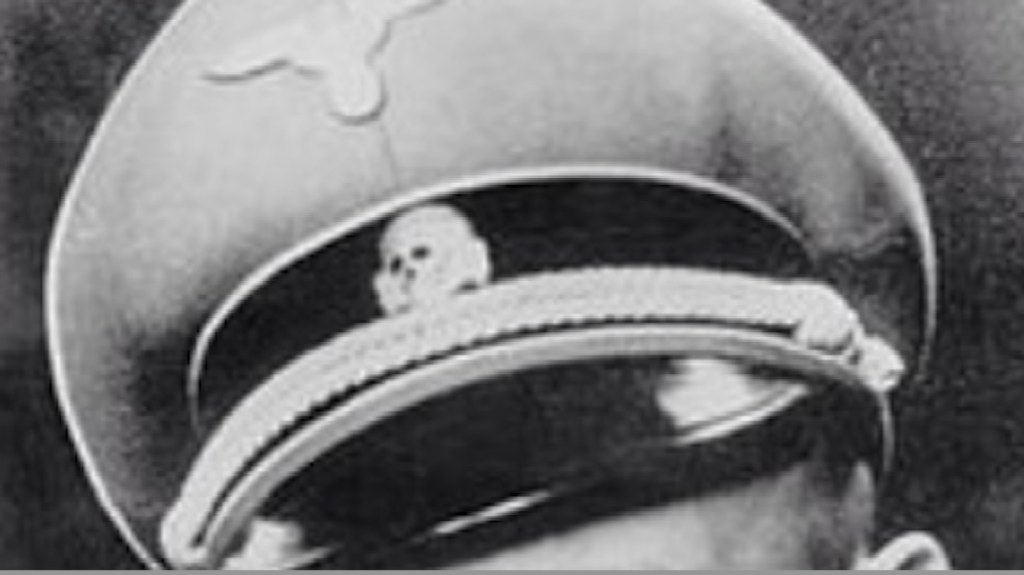


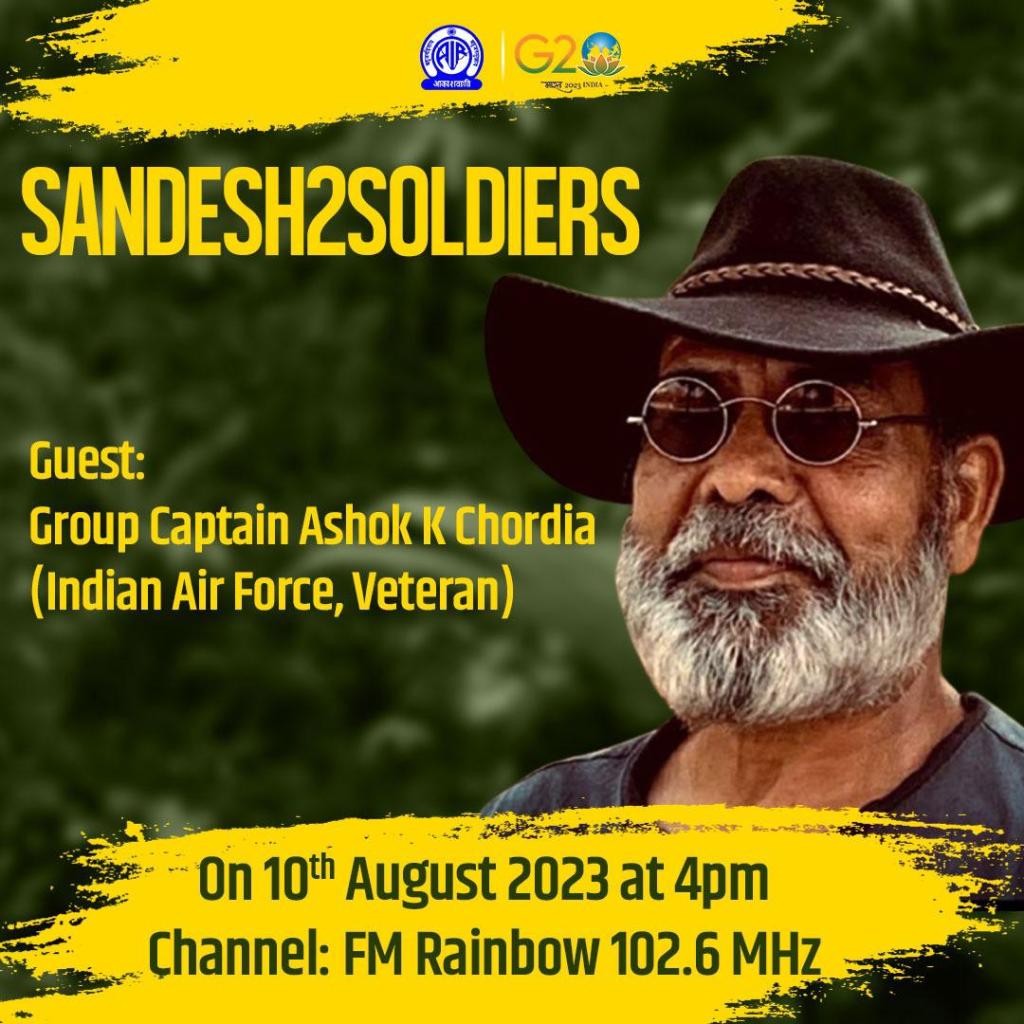


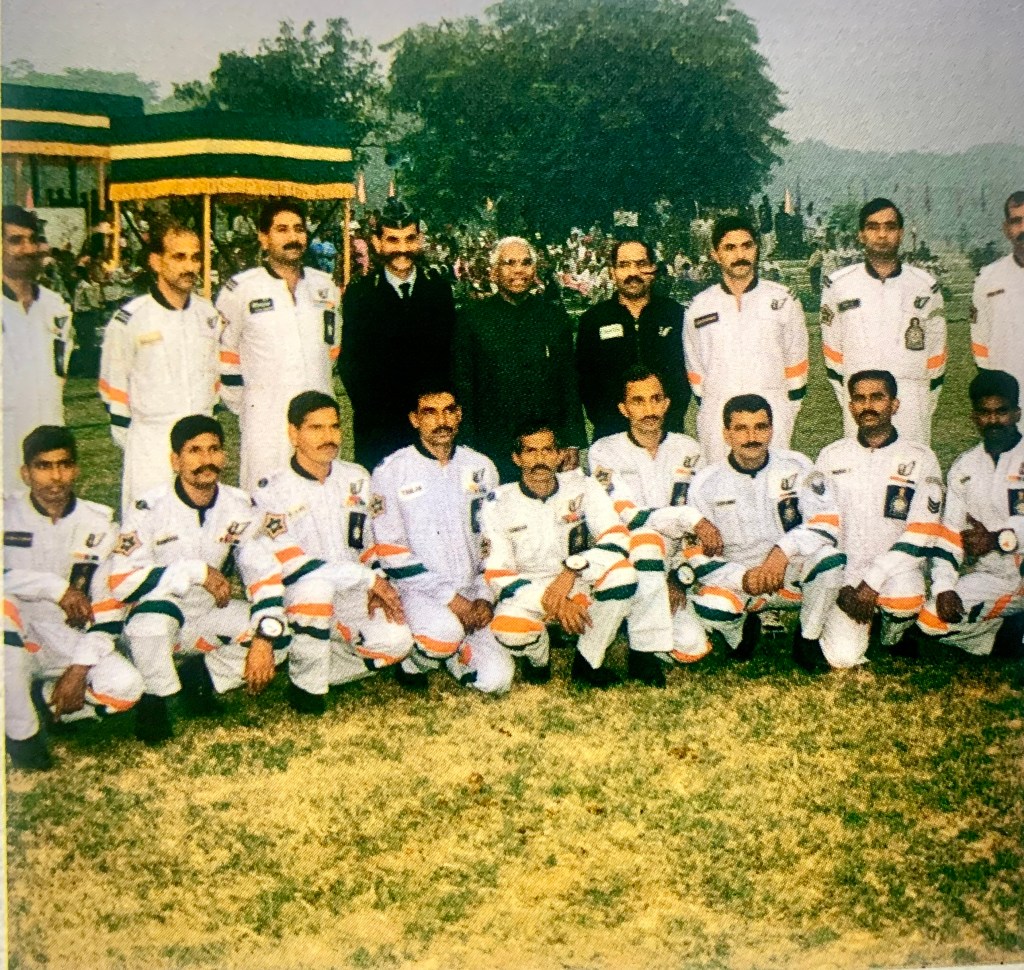


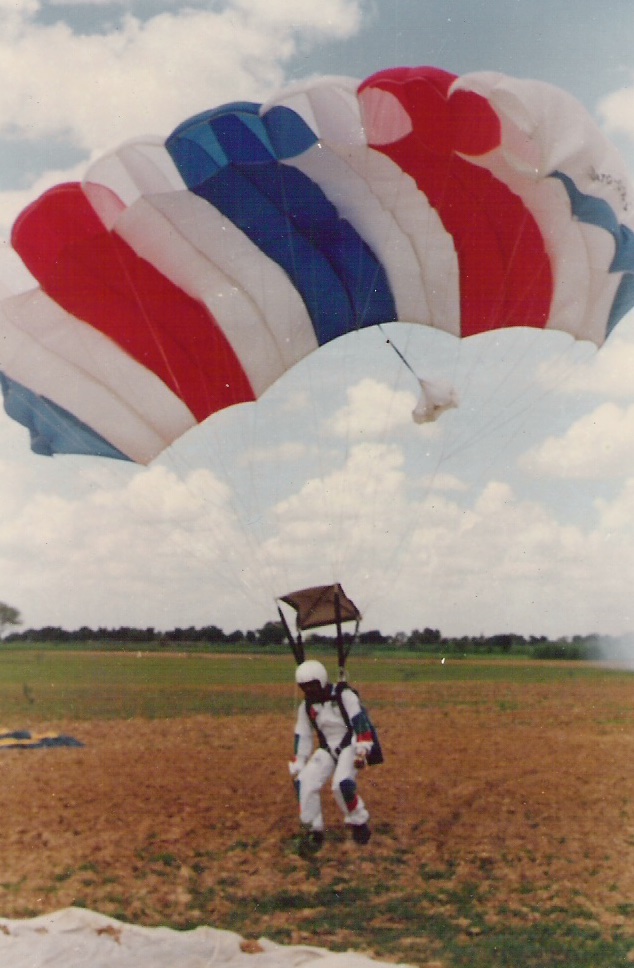
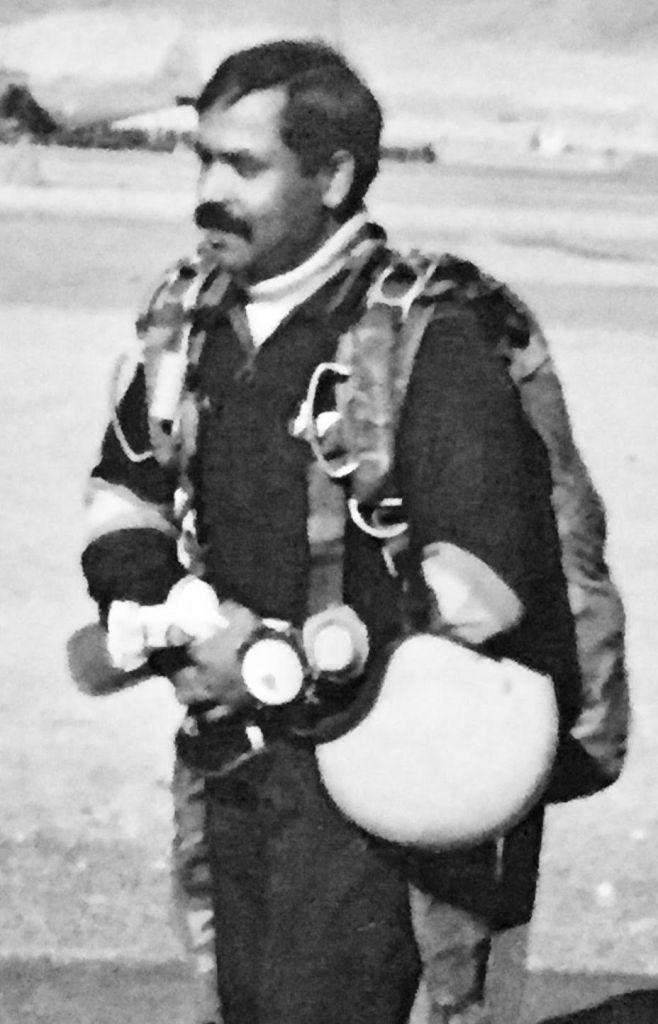
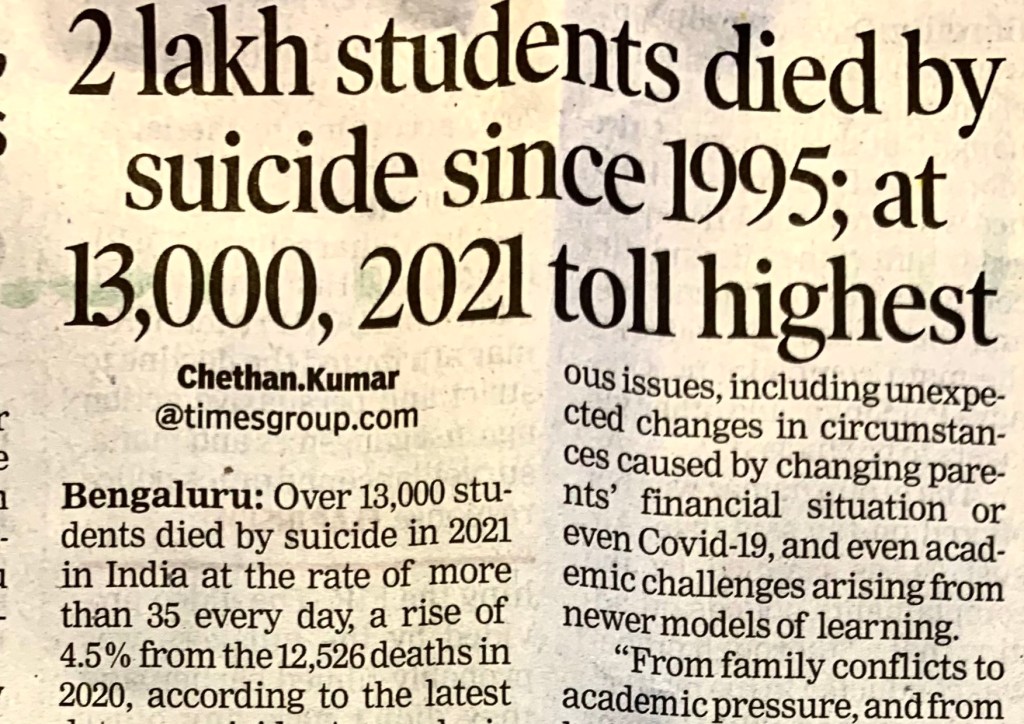


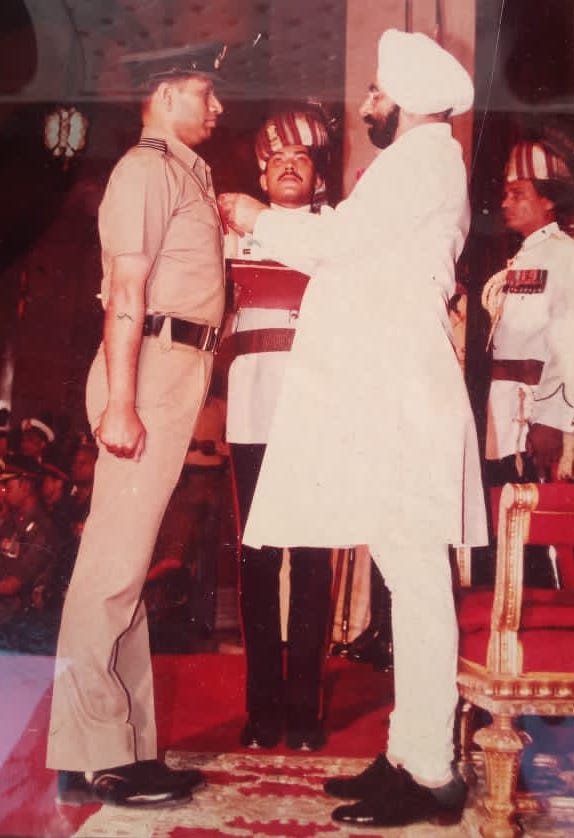
 Road Much Travelled