“True education,” Mr RGL Srivastava, our English teacher, used to reflect, “is what stays with one after one has forgotten everything one learnt.” Young naughty minds then, we spent much time splitting hairs over the literal meaning of the pearl of wisdom. “If one forgets everything,” we used to argue, “nothing remains. So, there is no such thing as true education.”
Much of what my teachers, which includes my parents, sister and brothers, taught me, has stayed with me and shaped the way I think and work. The lessons were not limited to classrooms and textbooks. They were about curiosity, discipline, and integrity, and more importantly, about the spirit in which knowledge should be pursued. Those values, slowly absorbed, became part of who I am.
Today, when I stand before students as an adjunct faculty member and honorary Professor of Practice, I often find myself trying—however modestly—to emulate my own teachers. I try to make learning engaging. A class may begin with an anecdote, a little-known fact from the history of science, or a challenge that students cannot resist attempting. Sometimes there is a small surprise reward for solving a quiz—a pen, perhaps, or a book.
It brings excitement to the classroom. The students participate, question, and occasionally throw back a challenge. By the time the formal lecture begins, the atmosphere is already alive with curiosity. It is fun for them and me alike. I find each teaching experience rewarding in some way.
On this journey I continue to learn from seniors whose profession is teaching. One such person is Dr Devendra Singh, the erudite Head of the Mechanical Engineering Department at AK Garg Engineering College in Ghaziabad, whose passion for teaching is unmistakable.
One afternoon last month, we were exchanging notes over a cup of tea in his office when a student walked in. She was a resident student, a hosteller.
“Jai Hind, Sir,” she said politely. “I’ve come to request approval for a night out-pass. My mother is visiting Ghaziabad to see my local guardian who is unwell. I’ll stay with them over the weekend.”
It sounded like a routine request. I expected the form to be signed without much discussion. Instead, Prof Singh asked her to call her mother. “I just wish to speak with her,” he said.
To me, it appeared to be a rather cautious approach. I wondered, if it was really necessary to treat a young adult that way. I got my answer soon; in the very next minute.
The telephonic conversation between the mother and Prof Singh revealed that the student’s LG wasn’t unwell. Also, her mother was not scheduled to visit Ghaziabad any time soon. The student had simply wanted to spend the weekend with friends—something disapproved by the parents. The request was declined without drama, and the student withdrew quietly.
Later Dr Singh remarked that the student’s body language had made him suspicious. “Giving students freedom while ensuring they don’t stray into trouble is difficult these days,” he mused. “It was much easier when we were students,” he chuckled as he recalled an incident from his own days as a student in the late 1980s at the Motilal Nehru Regional Engineering College in Allahabad.
On a frivolous issue, a few students had instigated a strike and encircled the main building with the intention of causing nuisance. They were pressing unreasonable demands and seemed to be on the verge of going on a rampage. Slogans of “Zindabad… Murdabad…,” had filled the air.
At that moment, the proctor, Prof SM Goel stepped out of the main building and walked up daringly to the agitated crowd. Standing on the steps above them, he raised his hand to quieten the noise. Just as the students seemed ready to listen, one self-styled leader shouted dramatically, “If our demands are not met, we will immolate ourselves!”
Professor Goel, a habitual smoker, happened to be holding a lit cigarette. Without losing his composure he said loudly, “I have come to settle your problem. But if someone still wishes to immolate himself, here is a can of petrol—pour it over yourself… and here is the light.” He flashed the lit cigarette in his hand.
The effect was instantaneous. The crowd dispersed, and the fiery leaders vanished.
Prof Singh cited the incident in the lighter vein. Yet behind the humour lay an important lesson about authority, wisdom, and the ability of a teacher to influence young minds in a moment of confrontation.
Our conversation then drifted to how education has changed over the decades. There was a time, he recalled, when engineering colleges in places like Roorkee and Muzaffarnagar produced some of the finest engineers in Asia. Placements were so abundant that in one instance the placement rate exceeded one hundred per cent—some students received offers from several companies.
Campus life had its own informal discipline. Seniors did not merely dominate juniors; they mentored them. They taught them how to conduct themselves, even basic table manners. Walking into the dining hall improperly dressed invited silent disapproval.
“Now,” he said with a smile, “I find myself on the other side of the fence—teaching. I enjoy it far more than my years in the corporate world.” Listening to him, I was reminded again of my schoolteacher’s words about true education. Theoretical knowledge may fade, facts may blur, and textbooks may gather dust. But the values, habits, and examples set by impressionable teachers continue to dispel darkness and illuminate our lives.
Note: Here are two of the quizzes my students and I had fun solving.
Now, this not that time of the day when I am usually engrossed in intellectual discussions with friends after downing a few Paul Johns, or Old Monks, or some wine — or a “Green ON! Go!” for that matter. That I saw God is not a figment of my imagination after a few drinks. It really happened.
Before I proceed, a word about God, godliness, and my stand on that subject.
I am neither an atheist nor a believer. But, sometimes I do flaunt Rudraksh beads; I feel they go well with my baldness and round-rimmed glasses. Occasionally, I also apply chandan (sandalwood paste) on my forehead; it is so soothing. The beads and the chandanka tika—together, they give me a rather cool, saintly look. That is my belief. But my dear wife urges me to discard them. “This kind of symbolism is meaningless; be a good human being and people will see God in you,” she says admonishingly, so I give up the pretence.
With or without saintliness and godliness, life goes on.
Yet, sometimes in this God’s Own Country, I wonder if HE/SHE (THEY) really exist. What do THEY look like? Multiple heads and arms? Riding a tiger, a mouse, an elephant, or a swan? I got my answer when I visited Ranthambore recently.
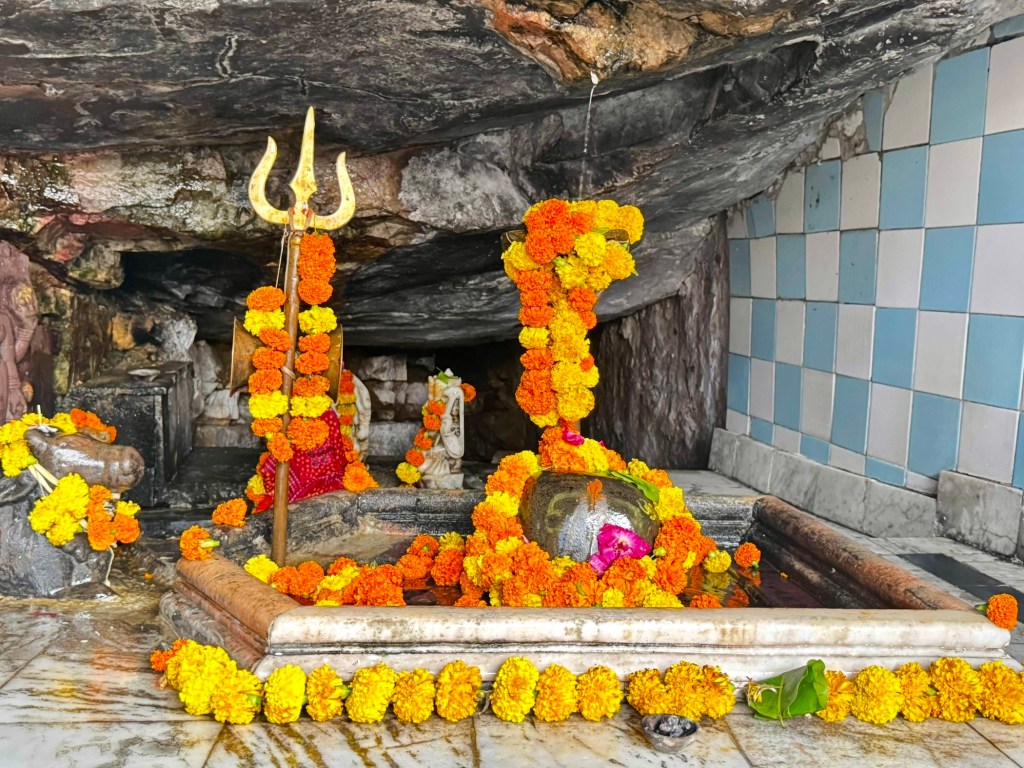
It was a family holiday—nearly twenty of us. The night before, at Juna Mahal (the resort), we had great time — star-gazing, folk songs and music and local cuisine. We were all set to embark on a tiger safari the next afternoon. Since the morning was free, some of us decided to visit the Amareshwar Mahadev Temple nearby. Each one on board had an agenda to be met at the temple. I guess most were going there to seek “special” blessings. As for me, I was eager to discover the physics behind the perpetual trickle of water falling on the Shivling in that small temple carved inside a rock—a cave of sorts; Lord Shiva’s blessings would be a bonus.
It was mandatory to leave the cars at a gate about two kilometres from the temple. A jeep meant to ferry visitors, took us to the foot of the hill on which the temple was situated. Thereafter, it was about a kilometre and a half of gentle climb through rocky terrain. We were warned to remain in a group, as tigers had been spotted in the area in the past.
Amareshwar Mahadev
I belong to Ujjain, known for its temples—Mahakaleshwar, in particular. When I realised that, like the Mahakaleshwar Temple, the Amareshwar Mahadev Temple is dedicated to Lord Shiva, I began looking for similarities, which were aplenty—such as, the Shivling and a small water tank for people to take a dip. But there was a striking difference that caught my eye. The 1.5 km walkway to the temple was clean beyond imagination. This was in sharp contrast to the litter one sees around Mahakaleshwar and other temples. I attributed the exceptional cleanliness to the relatively (much) lower footfall at that site, and concluded the dialogue within.
The temple surroundings were clean too. And ah, the serenity! It was a cherished world far from the humdrum of where each one of us had come from—Noida, in my case. One had to prostrate oneself to get a close darshan of the Shivling. The constantly trickling thin stream of water from the rocks above the Shivling evoked reverence and amazement. It had been dripping for many years. We spent a blissful half hour at the temple before heading back. The return trek was uneventful yet fun.
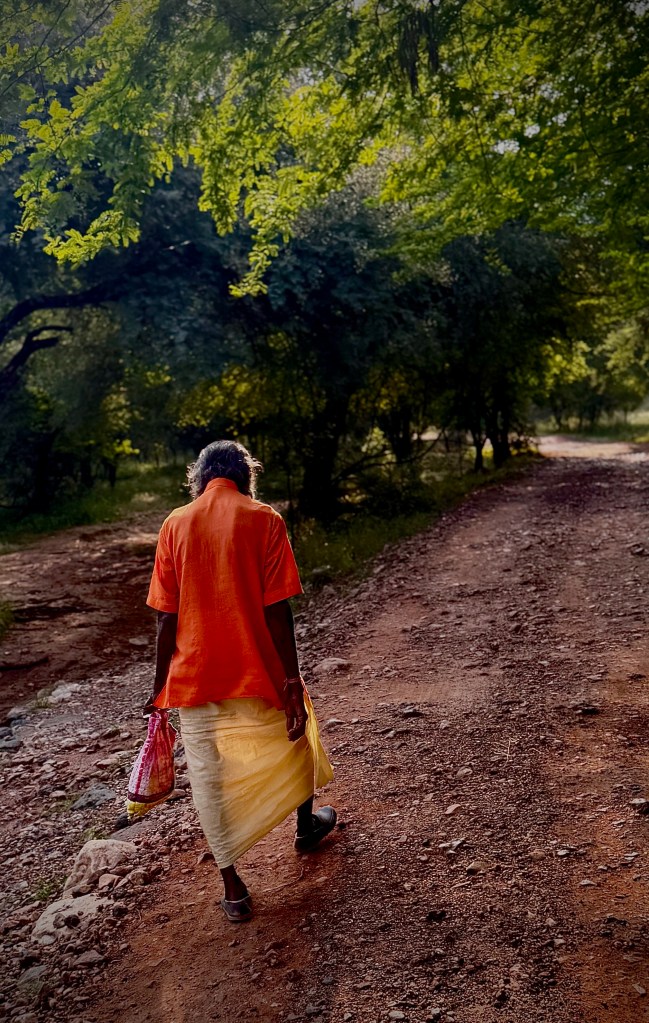
While driving back in the rickety jeep, we crossed a man dressed in a saffron half-kurta and a white dhoti. With long hair, a beard, and a cloth bag dangling from his hand, he looked like a typical sadhu. I thought he was one of the caretakers on his way to the temple.
Ganesh, the living god…
“This old man is walking alone to the temple. Isn’t he afraid of the tigers?” I asked the driver of our jeep out of sheer curiosity.
I listened in disbelief to what the driver told us about the man. “That man in saffron is Ganesh. He is the son of one Ramchandra Verma and lives in a nearby village. He has been walking to the temple and back every day for the last forty years. On his way up and down, he collects litter thrown around by devotees. We owe the cleanliness of this place to this one man. He does it selflessly, and with devotion; doesn’t charge a paisa. He lives on whatever he earns by tilling his small piece of land.”
When I turned back, I saw the man in the distance, a halo around him—the kind we see in pictures of gods and saints. I had no doubt; I had caught a glimpse of a living GOD.
Postscript
No regret that we didn’t spot a tiger that day.
Last week, when I got an opportunity to visit Ranthambore again, I grabbed it with both hands. While another tiger safari was the loudly proclaimed agenda, somewhere at the back of my mind was a strong desire to cross paths with the same god. Sadly, this time I missed both—the tiger and the god.
If, and when, I revisit Ranthambore, it will be with the primary motive of meeting Ganesh — all else, will be secondary.
“Chanakya” as the real Chanakya could possibly have been!
Sterling…
My revered theatre friend, Shri Ashok Banthia, rekindled my love for the stage when he invited me to work with him on the play Maha Param Veer two years ago. The production was staged in Udaipur, Jaipur, and Bhopal, and is expected to travel to other state capitals as well.
Recently, thanks to Ashokji, I had my first glimpse into the beautiful world of the National School of Drama (NSD). I was awestruck, to say the least. As is often my habit of wishing I could go back in time to pursue unfulfilled dreams, I found myself longing to study drama at NSD. That renewed desire arose from the stellar performances I witnessed yesterday.
Gripping…
The play was Chanakya.
All of us Indians have grown up hearing stories of Chanakya and Chandragupta Maurya. Honestly, those stories seldom inspire awe anymore. However, this Chanakya—researched and scripted over four years—felt fresh and intellectually invigorating. Having been staged more than 1,700 times, it’s no surprise that the actors have come to live and breathe their roles. Watching them, I couldn’t help but wonder if the real Chanakya, Amatya Rakshas, and Chandragupta Maurya could have expressed themselves half as powerfully. No exaggeration intended!
Been there.
The team led by Manoj Joshi (as Chanakya) and Ashok Banthia (as Amatya Rakshas) delivered a sterling performance. The dialogues were powerful and passionate, complemented by excellent costumes, lighting, sound, and music—every element of the production was par excellence. Time seemed to fly, and before I knew it, the play was over.
Beyond its artistic brilliance, the play reintroduces Indian history in a way that leaves a lasting impact. Those who watch it—especially those involved in running the country—will carry pearls of wisdom passed on by the real Chanakya through Manoj and Ashok’s portrayals.
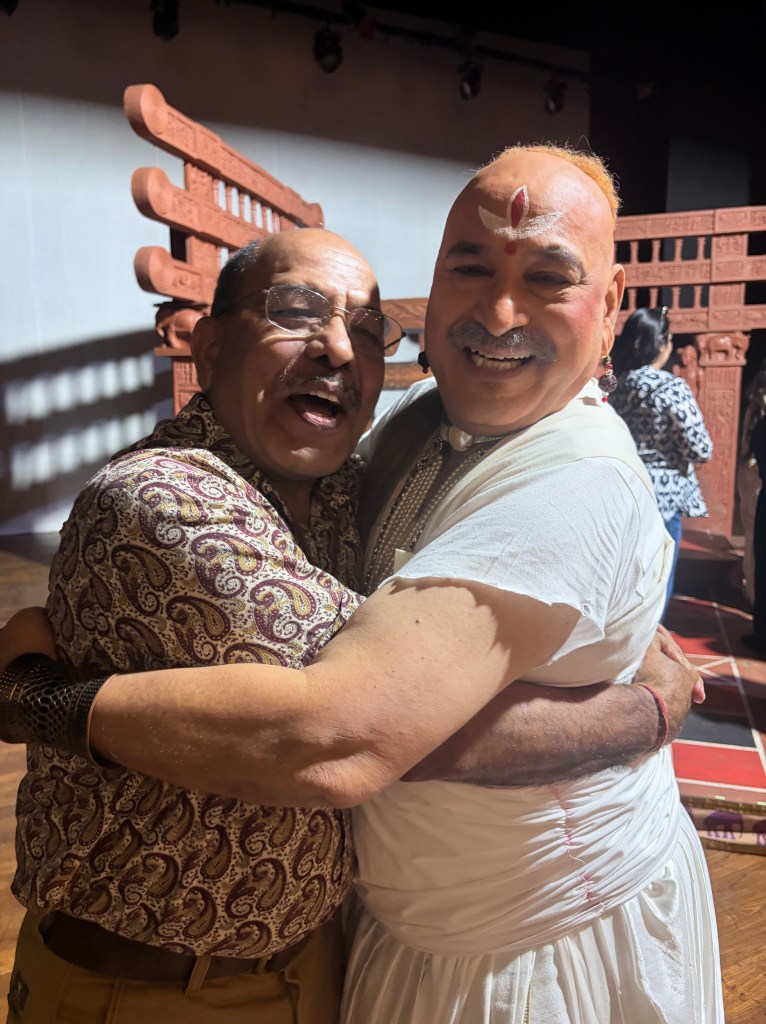
…with my theatre mentor
We often judge a film or play by whether it’s worth our time. My conclusion? Watching Chanakya was worth more than a dozen of the best films or OTT series combined.
When I received a warm, friendly hug from Shri Ashok Banthia after the performance, I couldn’t hold back my hidden desire. I requested him, “Sir, please accept me as your pupil. If nothing else, I’ll cherish the role of a tree or a lamp-post beside which you stand and mesmerize audiences.”
Kudos to Manoj, Ashok, and the entire Chanakya team!
On June 12, 2025, tragedy struck. Air India Flight AI 171, en route to London Gatwick, crashed seconds after take-off from Sardar Vallabhbhai Patel International Airport, Ahmedabad. The accident claimed the lives of 241 people on board—passengers and crew—and 19 individuals on the ground.
In the hours and days that followed, television screens lit up with expert analyses and heated debates. While some insights were valuable, much of it merely served to feed anxiety, both among seasoned travellers and the general public.
The Ripple Effect of a Crash
When such mishaps occur, they set off a domino effect across the aviation ecosystem. Authorities tighten checks and airlines enforce stricter adherence to procedures. In the days following the AI 171 crash, many flights were delayed, diverted, or even cancelled. Recent helicopter incidents only compounded the public’s growing unease.
These reactions are not just procedural—they are deeply psychological. Fear travels faster than airplanes.
Passenger Profiles
Following aviation accidents, travellers often fall into three categories:
The Stoics – the que sera sera kind. They acknowledge the incident, mourn the loss, and continue flying without visible hesitation.
The Escapists – those who vow never to board a flight again, unless absolutely necessary.
The Unsure – the ones caught in limbo, unsure whether to continue flying or retreat into fear.
A Peep into Passenger Psyches
Take for example July 4, 2025 Indigo Flight 6E 2258 from Delhi to Lucknow. It was delayed by over two hours due to a navigation system snag. As technicians worked to fix the issue, several passengers chose to disembark. Some left because their schedules were disrupted. Others simply couldn’t shake off their anxiety. Among them was a professor—perhaps someone who lectures on resilience. In contrast, an 85-year-old woman, bound for Ayodhya, stayed calm for a while—until she began chanting the Hanuman Chalisa, seeking comfort through faith.
Stories That Defy Logic
Aviation history is filled with eerie tales of missed flights and miraculous survivals.
In the early 1980s, a military Packet aircraft crashed during take-off in Agra, claiming the lives of 45 paratroopers, instructors, and crew. Squadron Leader (later AVM) D.K. Dhingra survived because he was held up in his office by a telephone call. Some others, too, missed the flight due to last-minute changes. Fate intervened.
Even in the case of AI 171, one man survived—Ramesh Viswash Kumar. He managed to walk away from the wreckage. Was it luck, chance, or destiny? It’s hard to say—but such stories shape the way we think about survival.
Air Warriors show the Way Aircraft incidents and accidents are a part of life in the Air Force; a professional hazard. Sitting in my office in Tezpur, I had once seen two pilots punch out (eject) of a flamed out MiG aircraft seconds after take-off. It is customary for all the pilots of a unit to take to air immediately (as soon as possible) after a serious accident (unless there are strong reasons to ground the entire fleet) to keep up the spirit. Likewise, a mass jump follows a parachute accident. There is no scope for fear to set in.
A Lesson in Acceptance
A classic parable might help those grappling with post-crash anxiety:
A slave once ran to his master in Cairo, trembling with fear. “Master,” he cried, “I saw Death today in the market. She stared at me and asked, ‘What are you doing here?’ I fear she has come for me. Please, I beg you, help me escape!”
The master gave him his finest horse and advised him to flee to Basra.
Later that evening, the master encountered Death and asked, “Why did you frighten my servant?”
Death replied calmly, “I was only surprised to see him in Cairo. You see, I have an appointment with him next week—in Basra.”
Sometimes, what we fear and try to avoid might be the very path we are destined to take. This isn’t to say we should be fatalistic—but it helps to recognize that some things lie beyond our control.
Trust, Caution, and Collective Responsibility
Aviation remains one of the safest modes of travel. Pilots are rigorously trained, technicians are meticulous, and air traffic controllers are highly competent professionals. Accidents, though tragic, are rare. They lead to introspection, investigation, and improvements in safety protocols.
As passengers, we can also contribute:
Avoid carrying unaccounted or suspicious baggage.
Follow crew instructions diligently.
Switch off mobile devices when requested.
Stay calm and respectful, even during delays or checks.
Let’s remember: behind every flight are thousands of hours of effort, layers of safety checks, and dedicated human beings who care about getting us safely to our destination.
Let’s fly safe. Fly wise. And above all—fly without fear.
The first time I came across that word was when, as a schoolboy, I read RL Stevenson’s Treasure Island—Captain Bill humming: “Fifteen men on the dead man’s chest — Yo-ho-ho, and a bottle of rum!” I was too small then; didn’t heed the RUM part of that utterance. My first, real introduction with RUM, however ‘happened’ in a uniquely comical circumstance.
Mukesh Kumar, my senior and my cross-country team mate at St Stephen’s College, and I was on an endurance run on the ridge road when it started pouring. We pressed on regardless. In a while, a cab came to a halt by our side; the occupant signalled, rather insisted, that we took lift in his cab. So, there we were—a dripping Mukesh sitting beside the stranger in the rear seat, and I, shivering by the side of the driver. The man was swigging from an almost empty bottle of rum. He was happy; happy as one could be after downing more than a pint of the hard stuff. He proffered a fresh bottle for us to take sips in turns.
We declined but then, succumbed to his pestering for just one sip. I hated the unfamiliar taste and the burning sensation in my throat on taking that one sip. I wasn’t sure then, whether I would touch RUM ever again. And, although how I got introduced to the dark drink that rainy day has remained etched in my mind, my most memorable RUM session, a Quixotic one in that, took place about six years later.
At this point, a brief preface would be in order.
I left St Stephen’s to join the NDA; was eventually commissioned in the Air Force, in 1981. In the following year, I trained and became a Parachute Jump Instructor at the Paratroopers Training School (PTS), Agra. It was a turning point in my life—people started treating me as a differently-abled (they actually meant “exceptionally-abled”) individual everywhere, including, the bar. Yet, despite the nudges and needling like, “What sort of a paratrooper are you…, how come you don’t drink blah… blah,” I didn’t take to regular drinking. Two small helpings of anything—rum, gin, whiskey or, even wine (honestly, I couldn’t identify them by taste)—used to satiate me.
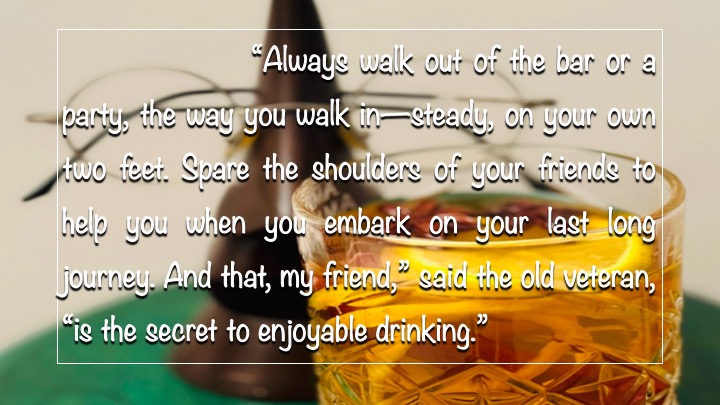
A veteran’s advice
“Look at me… five feet, f*** all inches. Don’t expect my capacity to be great,” has been my standard plea to those, and there are many of them, who insist on my having more drinks than I choose to consume. I try to follow a veteran’s advice in this matter.
I guess that description of my relationship with hard liquor puts my hospitality under a cloud. But I don’t think I’m all that bad a host in that regard. I sincerely try to offer my friends and guests drinks to their satisfaction. Invariably, Master Chef Chhaya covers up my inadequacies with her culinary skills at the dinner table.
Returning to the Quixotic Rum Session—it was a Saturday evening in June. I don’t remember the year. And, the social coward that I am, I’ll not mention the names of the colleagues involved because some might object to inclusion of their names in the mildly boisterous incident fringing on un-officerlike behaviour; others might take offence to their names being left out.
Chhaya, and I, had planned a get together at our residence—a cosy little bungalow in one corner of the Air Force Station. We called it, “Para-dise” (mind the hyphen and “Para” as in “parachute”). We were busy addressing our shared responsibilities when a Despatch Rider (DR), a messenger on a throbbing Enfield bike, arrived with the message that night para jump sorties had been planned. “Take off, 1900h (7:00 pm); you have been detailed as the Drop Zone Safety Officer (DZSO),” said the DR.
DZSO duty entailed reporting at the Malpura Drop Zone, 11 kms away from home, an hour before the first aircraft (paratroopers on board) took off. Simply put, it entailed coordinating and doing things to ensure that the paratroopers jumping from the aircraft (those days, it was C-119 Fairchild Packet) landed safely in the designated area. Five para drop sorties commencing at 1900h meant that I’d be home late; it could be later than 2300h.
Some other officers from among our invitees would be involved in the conduct of the night para drop—one of them would be there to supervise the emplaning of the jumpers; some others would like to grab the opportunity to log a night jump. Thus, on the threshold of being executed, our plan of the get together lay in ruins. We didn’t have residential telephones; and mobile phones didn’t exist, so I went around on my Vijay Super sharing my predicament with people on my guest list. We decided that, all the ladies, and those officers who were not engaged in the conduct of the para drop would still congregate at Para-dise. The rest of us would join after the completion of the scheduled jumps.
At the Malpura Drop Zone.
It was full moon; the sky was clear; the winds, calm. But the weather was hot and sultry. Having marked the DZ, we, the DZ Safety Team, sat there on a 10 m circular cemented platform in the centre of the 1.5X2.0 km Drop Zone and slapped mosquitoes as we chatted and waited for the aircraft. Cold water from an earthen pitcher provided occasional comfort. We talked of many things under the moon, but none cursed the administration for planning ad hoc para drop sorties and ruining the weekend. In the heart of our heart, we knew that on the timely completion of training jumps depended the parachute jump pay of the troops. Besides, a delay could cost some of them, their planned leave. Therefore, it was imperative that the availability of serviceable aircraft on good weather days be fully exploited. Mission first!
The aircraft came overhead as planned; dropped troops and returned to base. Repeated. By 2200h, 200 troops had jumped and landed safely. There was no injury, incident or accident. The troops would take time to bundle their parachutes and rendezvous at the control tower in one corner of the DZ.
We still had an hour or so before we could close shop.
Meanwhile, as expected, my buddies who had jumped that night, rolled their parachutes and joined me. I was expecting them to convey their condolences over the sad demise of our plan, the plan to party. Far from it—one of them gave me a big surprise by taking out a bottle of Sea Pirate, a popular rum in those days, from his haversack. He had carefully packed the bottle and jumped with it. Another, took out two packets of potato chips—the contents had got crushed during the jump. We were ready to start a celebration of sorts when spirits dipped momentarily. There was only one small dented and battered aluminium mug and we were six people (including two of my DZ Safety Team). Without glasses, how would we enjoy the RUM?
Where there’s a will; there’s a way!
Someone came up with a simple, stupid workable solution. We sat in a wide circle around the pitcher and passed around the bottle of Sea Pirate followed by the mug filled with water. Each one took a sip (large or small, at will) of the dark rum and a sip of water in turns. It was like folks sharing hukah on a village chaupal. It was bliss! It was Nirvana! To me RUM has never tasted as good as it did that moonlit night on the Malpura Drop Zone.
Soon we were at Para-dise—the party continued until past midnight.
A few days back, I came across a social media forward. It was the recipe of a drink using rum. It looked exotic. Sadly, even before I could try it, I lost it in the junk on my mobile phone or maybe, I deleted the link. Now, I cannot recall its name also. Yet, desperate to try it, I concocted my own version of it—from whatever I could recall—and tried it. It tasted good. Then I served it to a friend. He too relished it and asked me the drink’s name. In a spontaneous response, I called it: “Green ON! Go!” “Green ON! Go!” is the command on which a paratrooper jumps out of a perfectly well flying aircraft hundreds of feet above the ground. A top-of-the-world feeling follows the exit from the aircraft.
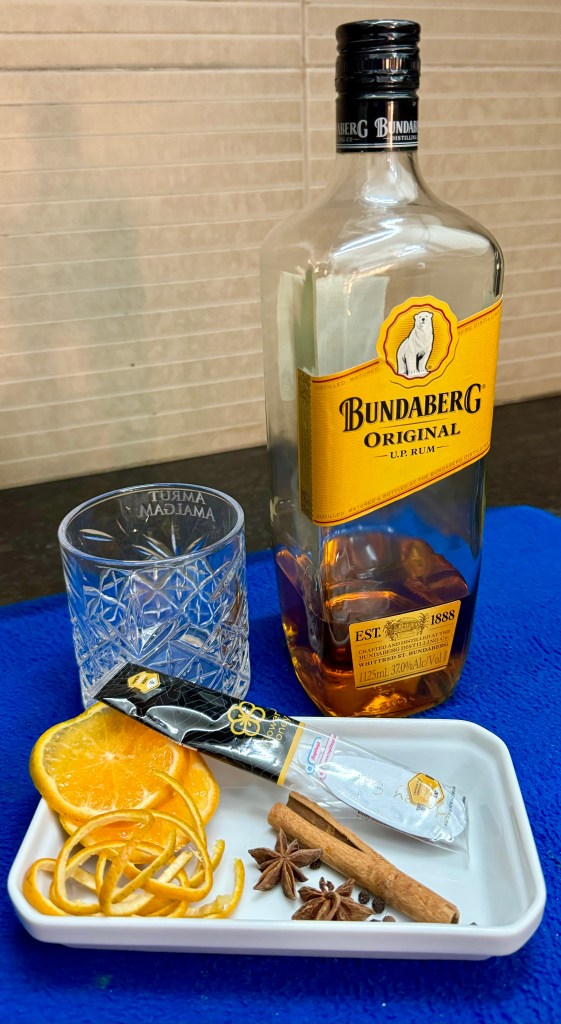
For those interested, here is the recipe.
…the ingredients
Ingredients
Dark Rum (30 ml) – This quantity may be tweaked to taste
Cinnamon (one stick) – Cinnamon has many health benefits. CLICK HERE to read about some of them.
Star anise (two pods) – It is a spice used in traditional Chinese medicine. It has powerful bioactive compounds that may help treat fungal, bacterial, and viral infections.
Black pepper (six pods) – Black pepper too has many health benefits. CLICK HERE to read about some of them.
Orange (one)
Honey (one teaspoon)
Getting Ready
Cut a slice of orange with its peel
Remove the peel of the remaining part of the orange and cut it into long fine shreds
Here we go!
Boil 250 ml water
Add cinnamon stick, star anise and black pepper. Continue boiling for five minutes
Arrange the shredded orange peel at the bottom of a glass tumbler
Pour the contents (boiling water with cinnamon stick, star anise and black pepper) into the tumbler.
Add honey; stir gently.
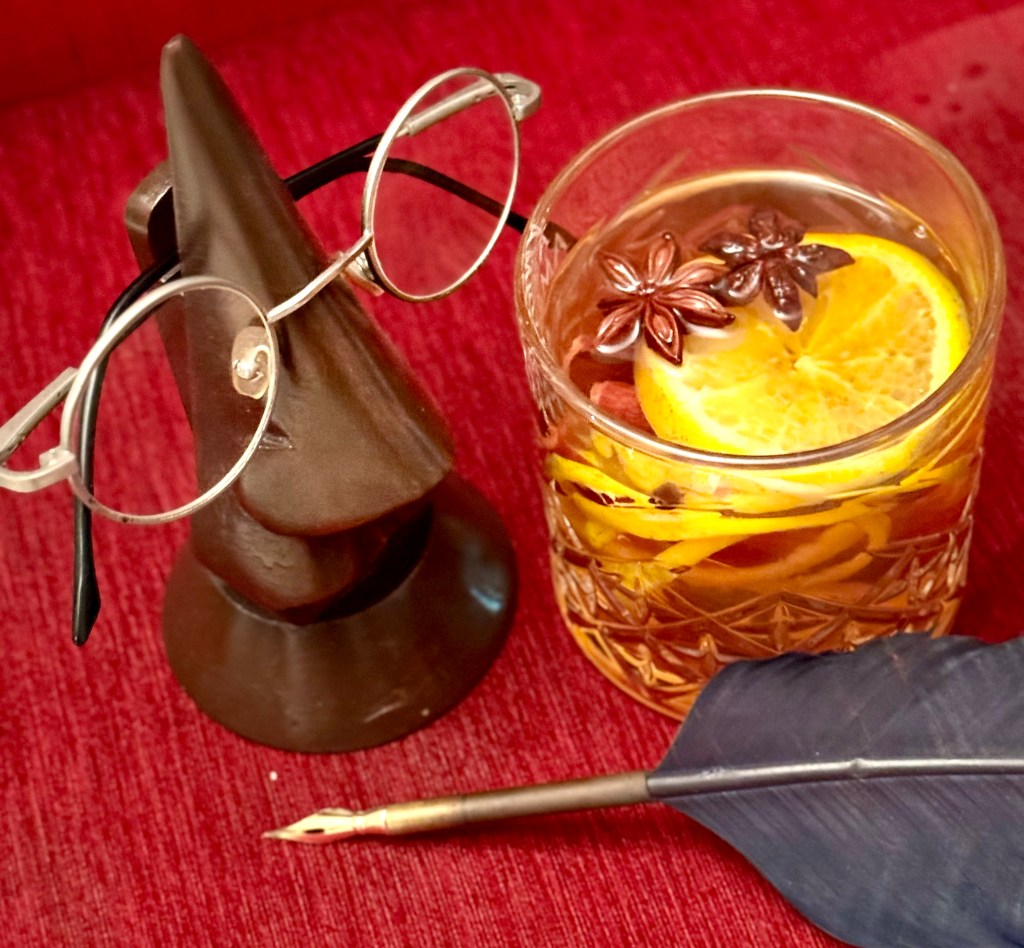
Slowly, add 30 ml dark rum. Don’t stir. Let the RUM linger long and merge with the concoction at its pace.
Gently place the slice of orange on the surface.
Raise a toast to paratroopers and say, “Green ON! Go!”
[Sometimes, I add a spoonful of orange pulp to suit my taste.]
An afterthought Forget the health benefits of the ingredients, I find the process of making “Green ON! Go!” therapeutic. Then, the drink itself… cinnamon and pepper give a distinct flavour. The slice of orange and star anise floating in the tumbler, is soothing to the eyes. The bitter sweet taste of orange and honey… and above all, the lingering RUM merging slowly with the surrounding water is a treat to the soul. On a winter evening, with subdued lights and soft music, a sip of it gives me a top-of-the-world feeling.
Some valued responses
Wg Cdr Vijay Ambre (Veteran): Dear Ashok, I enjoyed reading “Green On! Go!!” as much as I have all your other writings. It evokes memories of our lives in the transport stream of the Air Force; where “our ” times were never ours. Innumerable cancelations/absences that were always treated as a way of life by the family. As for the drink recipe, although, I enjoyed reading it ,I am not going to make GOG ,as I turned teetotal and gave up non-veg food aeons ago. Here’s wishing more power to your pen!👍👌👏
Air Commodore Ashok Kumar (Veteran): Ashok nicely written, as smooth as Patiala Sea Pirate. Chug it!
Air Commodore JV Paul: Sir, your para-normal skills are matched by your anecdotal skills!!!😁👌 Your exploits were already legendary by the time I entered the An 32 fleet in ’88 with the Yaks, and then reinforced and cemented by the time I entered the Skyhawks kingdom in 2007. Much more water had flowed beneath the bridge by the time my daughter entered the portals of Amity Noida to do her Architecture course. And she had the pleasure of Chhaya Ma’am’s benevolence as a hosteler there, especially after I disclosed my Skyhawk connection to Ma’am. The Skyhawk stint remains the high point of my career. Chhatri Mata ki Jai!
Virendra Singh Mann
Thoroughly enjoyed reading the post “Green On! Go!” Felt as though I was reading a novel. But I know this must be for real. Thank you so much for sharing. 🥃Cheers to a bottle of rum.
Viney Sharma
Hello Ashok, Very interesting read and I can fully relate to it.
In 1967 I got introduced to RUM (Hercules XXX @ Rs 10/ bottle from the CSD). 4 of us from college had gone on a trekking trip in Kashmir. We had taken a shikara to Char Chinar in the middle of Dal Lake (probably a full moon night). One of us with fauji connections produced the bottle from his backpack. It was quickly consumed with much back slapping and leg pulling. Don’t remember how we got back to our lodge but still remember the massive hangover next morning.
Squadron Leader RP Mittal (Veteran)
Nostalgic and smooth capture of the spirit of the moment in narration. 😊
Wing Commander Pradeep Dahiya (Veteran)
As always great read. Your writing has a wonderful capacity to stimulate imagining the scenes and characters . Thoroughly enjoyed.
Raghu Ramakrishnan Aiyar
Lively and highly, ” Spirited’, anecdote. Smooth, it flowed; Sublime, it lingered; Sensational, it spoke of the Para Jumps, even as the GreenON! Go… went on and on, wild and wanton👍👍👍👍
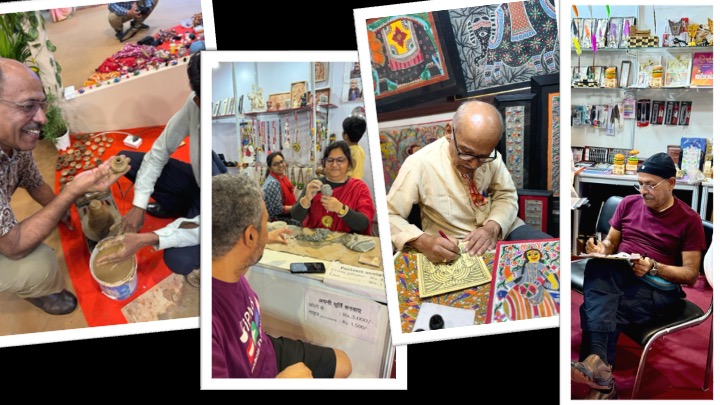
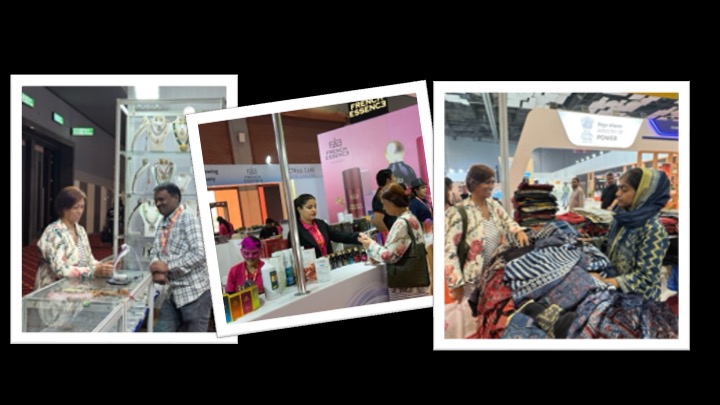
All have their own definition of it; and, it changes from time to time. For now, for me, it is a feeling of contentment and satisfaction one gets when one does something one has never done before. The other day, I experienced just that, when I spent quality time at the Trade Fair in Pragati Maidan. An artisan allowed me, and encouraged me to work on his potter’s wheel. With a little guidance and help, I could fulfil a desire I had nurtured since childhood. I could make a miniature vase; I felt, I was on top of the world.
Spick and span…a different Pragati Maidan
In another stall, it was therapeutic to watch a lady work on the clay bust of a person sitting opposite her. I have seen umpteen artists making caricatures likewise, but never a person making a clay bust within minutes. Watching Mr Indrakant Jha engrossed in Madhubani art was a treat to the soul.
I had never experienced virtual reality before. So, flying a parachute canopy (in virtual reality) at the NTPC stall, seven years after I made my last parachute descent, was a top of the world experience.
Conscientious staff…
The child in me went berserk when I found a stall displaying writing instruments. I spent the good part of an hour trying my hand at calligraphy. If I had had my way, I’d have spent the entire day visiting the remaining stalls and exploring the other options.
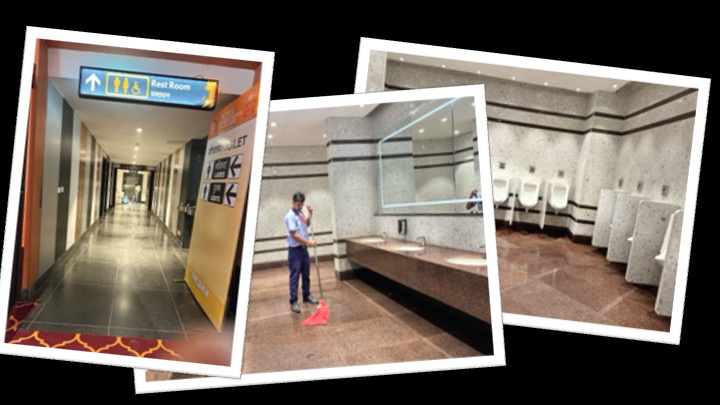
In itself, the experience was exhilarating; it became more so because of the improvements I saw and experienced at the fair. To cite a few — the new underground parking is very well organised; comparable to any good mall in the NCR. Everything in and around the halls is spick-and-span. The public utilities are sparkling clean. The absence of litter, even around the eateries, is a pleasing sight. There are conscientious staff to maintain the surroundings. The security staff and those at the help-desks are courteous. The thoughtfully designed and placed signage makes things convenient.
Let’s be “good”
On the whole, our experience was in sharp contrast to what we have seen in the years gone by. People who are striving silently to make this possible deserve Kudos.
On our part, let us help them in their endeavour by just being ‘good’.
Post Script
This description of our visit to the Trade Fair would be incomplete without the narration of our interaction at a stall displaying Gujrati garments. Chhayaji liked two dresses and decided to buy them. When she tried to bargain with one of the salespersons, the lady said with a lot of pride, “Like Modiji, we are Gujratis! We are upright people. We do not tell lies about price; we do not leave a scope for haggling.”
…fir bhi dil hai Hindustani
Amused, I asked her, “Why are you dragging Modiji, in this conversation?”
“Because, he is an upright leader; and he is a Gujrati,” she chirped with even greater pride.
“Why do you say you and Modiji are Gujratis? Aren’t we all Indians—you, I and Modiji? Think of it, it is only a matter of time, even Trump and Nigerians will stake a claim on Modiji. What will you do then?”
She laughed heartily at my quick-fire repartee; gave us a handsome rebate. We thanked both, the lady, and Modiji, profoundly before leaving the premises.
It will be interesting to know Modiji’s “MAN KI BAAT” someday on belongingness to a state, the nation, and the world.
An interesting bit of information is displayed on a standee kept next to The Very First Volvo in the World of Volvo, in Gothenburg. It points out that the premier of ÖV4, in the 1920s, fell flat because a rear axle gear had been installed incorrectly and the car could only drive in reverse in its first test drive. Embarrassment caused by the event to the company notwithstanding, Volvo identified the fault and immediately fixed it. Then onwards, the Volvo cars and trucks have had the reverse gears; but Volvo, the automobile giant, has only moved forward. It has gracefully covered the long distance to world leadership in automobile sector.
World of Volvo
Before talking further about Volvo culture, here is a less known fact about the reverse gear—it is the most powerful gear in all automobiles. Once, while on a 3,700-mile road trip from Paris to Ankara, Dominique Lapierre, and his classmate, Dominique Frémy, was faced with a steep climb near Athens, which brought their 6-HP antique Amilcar to its knees. To deal with the challenge, they turned around the car and drove uphill in reverse gear. The effect was miraculous: their valiant car climbed the slope like a Tour de France bicycle.
There is much to learn from Volvo’s culture of acknowledging shortcomings, working on them to improve, and above all, talking candidly about the failure. The power of the reverse gear also has a message.
Managing personal life; running a corporation or a government—each is akin to driving a vehicle. If a not-so-correct decision is taken and implemented, it would only be appropriate to acknowledge it gracefully, in time, like Volvo, and to get into the powerful reverse gear to prevent appreciable damage.
Like the reverse gear, the brakes and the rear-view mirrors also contribute to good driving. The purpose of brakes—more important than the ability to slow down and stop at will—is to allow driving at high speeds. Awareness of functional brakes, or ‘brake consciousness’ as it may be called, sets one free to speed up.
Amusingly, the purpose of the rear-view mirrors installed in the cars of the yesteryears was to enable the drivers to keep an eye on the cops who might be chasing them. Today, they have a more meaningful purpose—to ensure road safety.
Cruising ahead in life; or leading an organisation, it pays to look into the rear view mirror and observe the road travelled. Slowing down to take stock, or getting into reverse gear to make amends are empowering options.
Willingness to adopt the goodness of Volvo Culture is the need of the hour.
The Mesopotamian had changed my outlook towards people and life. In the month following my exchange with him, I met people with a mind emptied of all old stories.
Just another cabbie
The first person I met thereafter was (also) a cab driver of Arab descent; he was as pleased with life as the Mesopotamian. Then, I came across an educated Somali taxi driver who played soothing Somali songs on the car stereo and hummed along. He even explained the song themes to me. Next was a Swede of Nordic ancestry, who remained silent, mostly; smiled, only when he responded to my queries about Sweden. Then there was a Palestinian, a part of whose name was synonymous with holy war. Hanging from the rear-view mirror of his cab were Palestinian colours. On a green cloth cover draping the head-rest of the driver’s seat was printed matter in Arabic which Google translated for me as: “The Green Giant.” Maybe it had something to do with consciousness about the environment. In passing, he expressed sorrow for what was happening in Gaza and sympathised with his brethren he had left behind to fend for themselves.
For good reason, I had started believing in the metamorphosis I had undergone. I even goaded myself to a greatness which is the result of looking at, and treating all people as equal beings. But, poof! It took just another interaction to lay bare how superficial and reversible the change was.
That day, we—my son, Mudit; daughter-in-law, Anjali; granddaughter, Maya and I—were returning late from an outing. Sleep deprivation was making the little one restless. So, we chose to take a cab home instead of a tram. We booked one and waited for it.
On arrival, the cabbie conveyed curtly that it was mandatory to use a baby seat for the toddler. He added that he had one, and he’d would charge us SEK 100 in addition to the fare which was SEK 160. Although I felt he was charging an unfairly high amount for the baby’s seat, we agreed to pay and quickly settled into the cab. I, as usual occupied the front seat, and the rest, filled the rear seats.
“Hum kitni der mein ghar pahunchenge (In how much time will we reach home)?” I asked Mudit with a concern for the baby. My use of Hindi was a matter of natural habit.
“Kareeb aadha ghanta lagega (It’ll take about a half of an hour),” the prompt response came not from Mudit, or Anjali but, surprisingly, from the driver.
I was overwhelmed and surprised to hear the cabbie speak in chaste Hindi. “Aap Hindi bolte hain (You speak Hindi)!” I exclaimed joyously. His accent suggested that he hailed from Jallandhar, Ludhiana or Amritsar, or somewhere there. “He could well be a Satinder, or a Kulwinder or Maninder…,” I imagined.
“I am from Pakistan, and I know Hindi.” said the man boastfully.
Silence!
More silence!
Even more silence!
For me, his matter-of-fact statement broke a barrage of discomforting memories. The menacing waves pushed me many years back, to the year 1965 when India and Pakistan were at war. I was too small then—memory of my childhood days in Ujjain had faded. Yet sitting by the side of the Pak driver, I recalled hazily that one of the sons of an elderly couple staying nearby, was a commissioned officer in the Indian Army. We were all proud of the fact that someone we knew personally was fighting the enemy at the border. Then, one day, came a bit of news which cast a pall of gloom over the entire neighbourhood — he had been taken a prisoner of war (PoW). I never saw him again, but we were told that he was a skeleton of himself when he returned home after the cessation of hostilities.
The 1965 Indo-Pak War gave a different meaning to Pakistan and Pakistani for me—now they were my Enemy Number One.
My train of thoughts chugging along its track was interrupted by the cabbie (let me assign him a name, “Saleem”). “I was born and brought up in Sialkot….”
I remembered Sialkot as the graveyard of Pakistani armour (Indo-Pak War 1965) and one of the targets of our air raids in the war games I had participated in at the College of Air Warfare and the Army War College.
“I love to travel,” Saleem continued with his story. He was blissfully unaware of what was stewing in my head, “I have been to many countries in Europe and to Australia. I have spent many years in Athens and Gothenburg. I used to be a chef but I gave up cooking because, in Gothenburg a cook has to do everything himself, he is even required to clean utensils. There is no help at hand. I don’t like to do those chores. So, I have started driving a cab.” He said, although he was able to make ends meet, life was difficult in Europe.
“What about your family?”
“My wife, siblings and children are in Sialkot. I send them enough money once in a while. They don’t need me. I don’t need them. I am happy glob-trotting. I have spent about five years in Sweden. I might be able to settle here for good. What about you?”
I was expecting that question, but I had not thought of an answer.
“I am a veteran air warrior… Indian Air Force.” I said, and looked at his face to observe his reaction. Given the strained relations between our two countries, I expected diminished warmth from his side.
Both, his answer, and his demeanour surprised me. “Sir, so nice to know that you are from the Indian armed forces. I have a lot of respect for the military. My father was also a fauji.”
That sent me on another trip.
Saleem didn’t look very old. He must have been in his early forties. If his father too was a soldier, we—his father and I—must have donned the military uniforms of our countries around the same time. And, in some situations, we’d have been happy to see each other damned. Or, was his father older? Was he one of the 93,000 who surrendered to the Indian Army in December ’71?”
For a little while I kept wondering about his father’s participation in wars against India. Infiltration in Kashmir…, Mumbai blasts…, Kargil…. Ayub Khan, Yahya Khan, Bhutto, Zia-ul-Haq, Musharraf, Kasab…. Stories! Stories! When my meandering mind took a short break, I realised that the man in the driver’s seat taking me home was not an enemy soldier or a terrorist wielding a weapon. Yet, I was finding it difficult to treat him like anything, but a foe. I started looking for a reason for my thought process.
A fidgety voice inside me said, “But, they had been trying to bleed us through a thousand cuts since 1947.”
A different, calmer, voice argued, “But Saleem, the cabbie is not the same as they. He has caused India no harm. And, having stayed out of Pakistan for so many years, he has had no opportunity to fuel and fan the fires of hatred burning on either side of the fence. Why should he be seen through the same lens as they?”
Notwithstanding the wave after wave of unsettling thoughts inundating me, I was listening to whatever Saleem was saying.
“I have been to Jammu many years ago… when peace prevailed. People there, were so cordial and caring….”
“Peacenik! What is he trying to tell me? Having left Pakistan years ago, he was a Mr Nobody to speak on these issues.” I chugged along—still bellowing clouds of dark black smoke in my head.
“The people on both sides want peace, but….”
At that point, I became more interested and waited for him to complete.
“The people on both sides are fed up; want peace. But the politicians don’t want the relations to improve.” Saleem made a sweeping statement. My experience suggests that a discussion on these lines leads nowhere. So, I didn’t nudge him any further; kept listening to his other stories.
At our destination, Saleem waived off the SEK 100 which he had quoted for the baby seat. It was a big concession considering that he was working hard to make ends meet. More importantly, when we insisted to pay for the baby seat, he declined with a guileless smile. “It’s fine. We are one people. I needn’t charge you for this small facility.”
After some ado, Saleem prevailed and drove off leaving me with a debt of a hundred SEK which, I wonder, I’ll ever be able to repay. More importantly, he left me ruminating with his: “We are one people.”
Comments
Air Commodore Anil Kumar Benipuri (IAF Veteran):This is called Hunny Tirap🥴🥴👌
Gp Capt Siba Sankar Mishra (IAF Veteran): 👌👌👌 Sir nicely written. I somehow love ur style of writing. The spontaneity, the flow of words, the subplots, the story itself. Ur writings have the intensity to grab a reader away from his other train of thoughts instantly. Thanx for sharing and keep sending ….
Aseem Jindal:This true story is not only thrilling but also serves as a profound lesson for our minds. The way you have recounted the entire event is both captivating and thought-provoking. Yet, after all, we too are but human…🙏
The man arranged my bags in the boot of his taxi and opened the door with a smile for me to occupy the rear seat. That was his routine, and he followed it mechanically, I guess, with everyone. He was visibly surprised when I politely declined his suggestion and sought his okay to sit by his side. Sitting in the front seat satiates the desire of the child in me to look out and see places through the windscreen. Besides, chatting with a local gives me a peep into the life and culture of a people I know less about. This was my fourth landing in Gothenburg. On all the earlier occasions I had been received and escorted from the airport by one of my family. This time, I was alone.
I found it strange that the cab driver wasn’t familiar with the address I wanted him to take me to. As a matter of habit, which my children consider silly, I compared the state of affairs with India where taxi drivers know the locations by heart. They download the local maps into their heads and are capable of driving a guest through the narrow lanes literally blindfolded. At peak hours, they know better than Google does, the best route for fast mobility. With a little struggle, he energised the Google Map on his tablet. “You want to go here?” He placed his rugged finger on the screen to confirm the location.
Even as I nodded an affirmation, my knowledge of body language and accent indicated that in all probability he was an immigrant; not a Swede by birth. It didn’t really matter to me. Or, did it?
“From the front seat I will be able to truly appreciate the beauty of your city,” I initiated a meaningless conversation as I strapped up by his side.
“You tourist? First visiting to Gothenburg?” His pronunciation, economy and choice of words, and flawed English led me to doubt if he was of European descent either. Just for academic interest I wanted to establish his roots. And, I wished to do it without asking him. Back home, in India I take pride in identifying the domicile (state or the region) of a person with 60 to 70 precent accuracy, after conversing with the individual for a few minutes. Now I was anxious to test my ability in Sweden.
“An Arab?” I thought as I began narrowing down my search. “This is my fourth trip to Gothenburg… I am visiting my children,” I opened up.
“They is working here,” he asked.
“They are researchers,” I replied as I fished for more clues about him.
“You from India…? Hindoostan?” He stumped me with that question. He turned out to be a master of the art I was trying to learn. And then, when I smiled, he took off, “I am Afran Ahmed (name changed). I am from Iraq.” With that declaration, he took away my chance to complete my discovery and feel elated. “I like Indian films… Amitabh Bachchan… Shahrukh Khan….” A glow swept his face.
For me, Iraq refreshed the memory of the Iran-Iraq War; Saddam Hussein, the Shah of Iran, Ayatollah Khomeini; the Israeli raid on the Osirak nuclear facility; the Gulf War; George W Bush and the Weapons of Mass Destruction; the hanging of Saddam Hussein and other recent happenings in and around Iraq. In the decades gone by, I had either watched the news of those events on the television, or read about them extensively to sharpen my knowledge to pass promotion examinations while in the Air Force. The last names that came to mind were Tikrit and Mosul—the regions made infamous by the ISIS. I admit that the recent history of Iraq churning in my mind was somehow eroding my interest in him.
“So, how long have you been driving in Sweden?”
“Few years… before that I do work for VOLVO… about 20 years,” he said proudly.
I have a high opinion of the automobile giant, VOLVO. Visiting ‘The World of VOLVO,’ the recently commissioned VOLVO Museum, in Gothenburg was in my itinerary. A man who had worked for VOLVO for two decades must have had something in him. It was his mettle I was not privy to. I held him in high esteem for a brief while until Iran-Iraq War, Gulf War, Saddam Hussain… returned to my mind.
“What were you doing before coming to Sweden?”
“Many years I play for Iraq football team. Once I play friendly match in Bombay,” his eyes lit up like little LEDs and searched the horizon excitedly for the Indian city. I love the game; and I adore football players. My interest in him, which was sliding down, braked momentarily. My reverence for him rose until the thoughts of Mosul, Tikrit and ISIS crawled in again.
He continued enthusiastically. My occasional “Unh” and “Oh, I see” kept recharging him. He was grateful to the Swedish government for having accepted him. By the time I was ready to disembark, I had come to know a lot more about him and his family. His daughter was studying medicine and with the grace of Allah, his son would be an engineer someday. In the time I spent with him, he had presented me with a waft of his life. He was a contended man — a rare species in today’s world.
He did not tell me why he had left Iraq. Was he persecuted? May be. May be not. I thought it impolite to probe. He was sad about his once prosperous country being ravaged by wars and internal disturbances.
Anjali, my daughter-in-law, and Maya, my granddaughter was approaching the parking area when our cab rolled in. Suddenly, I was in a hurry to be with them. A problem with the payment using my International Debit Card caused a last-minute hiccup. Afran handed me the swipe machine to swipe the card myself. I tried, and succeeded. Afran enquired if I wanted a receipt. I always decline a printed receipt, but in this instance, I wanted to retain it as a souvenir, so I requested him to print one. Afran obliged me with a copy and drove off cheerfully. In a minute after his cab turned the first corner, I deposited the Iraqi into a far corner of my memory—to be retrieved if, and when required.
I relished the delicious food prepared by Anjali and tried to decipher Maya’s gibberish at the dinner table. It was still broad daylight at about 10 pm when we closed our plates. Days are long in Sweden at this time of the year (July). It was time to reset my biological clock and get used to the long daylight hours.
My flight from Delhi to Gothenburg, with a two-hour layover in Helsinki, had been very tiring. I had been up for nearly fifteen hours; had not slept except for a few winks here and there. I was expecting to experience a jet lag and was preparing to crash when panic struck. While unpacking my bags I realised that my wallet was missing. I remembered taking out my debit card from it to pay the cab fare. Then, in a hurry, I had kept back the card in the front pocket of my shirt. What about the wallet? Where could I have kept it, if not back in my waist pouch or my hip pocket? Maybe I had dropped it in the cab or on the way from the parking area to my son’s flat. It contained some cash, my debit cards and identity cards. If not recovered, I’d have to block them. My worry was that, having never done it before, I wasn’t familiar with the procedure to de-activate cards. The need to recall the consumer numbers, user ids, and passwords was making me feel sick — reproducing those details accurately would entail a lot of scratching of my bald head.
I was sad that the loss of my wallet was going to dent, in some ways, my endeavour to feel the pulse of the people and places I was going to visit during my excursion, which had hardly begun.
…feeling the pulse of a people and place
As a first step, Anjali and I walked back to the spot where I had left the cab. We scanned the path for the wallet. But there was no trace of it. Possibly I had left it on the seat in the cab or dropped it on the floor of the vehicle. God alone, or that driver must have known where my wallet was. I was harbouring no illusions about finding it because I did not have the cabbie’s contact details. I couldn’t picture him going out of his way to trace me to return the wallet. At best, he might deposit it in some lost and found depository, I thought.
“Why would someone go out of his way to connect with a stranger?”
“Afran… Iraq, Gulf War, Saddam Hussein, Tikrit, ISIS….,” I was sinking slowly into the quicksand of negativity when Anjali came up with a suggestion, “Dad, give me the receipt. It’ll surely have the details of the driver and the cab company.”
To our good luck, it bore the name of the cab company.
Anjali called the company’s helpline. Given the transaction id and the name of the driver, the mobile number of the individual and the trip details could be traced. For some reasons, Afran did not, or could not, respond to the cab agency’s phone calls raising my anxiety by a few notches. Within me, I was cursing the habit of people turning off their phones after work hours.
“Gulf War, weapons of mass destruction, Saddam Hussein, ISIS, Tikrit, ….”
The car rental company’s representative shared Afran’s number with us. After a while, when he could be contacted, Afran confirmed that my wallet was left in his cab; it was safe with him. I had dropped it on the floor of the car. He said that it could be collected from him from a central place in Gothenburg the next day.
Anjali collected my wallet from Afran the next afternoon and conveyed grateful thanks to him. The contents were intact. The time since I arrived in Gothenburg had flown so fast that I had not had an opportunity to go through the messages on my mobile phone and my emails. Relieved of the immediate tension, I sifted through my unread messages. There was one from an unfamiliar Sweden number. It read, “Hi, this is Afran Ahmed.” It was delivered to me at 10:37 pm (local time) the previous evening, around the time we were trying to connect with Afran. He had perhaps got my number from my visiting card kept in my wallet and was trying to contact me to let me know that I had left behind my wallet. If I had read that message and had spoken with Afran instantly, I wouldn’t have cluttered my mind so much.
A different Iraq
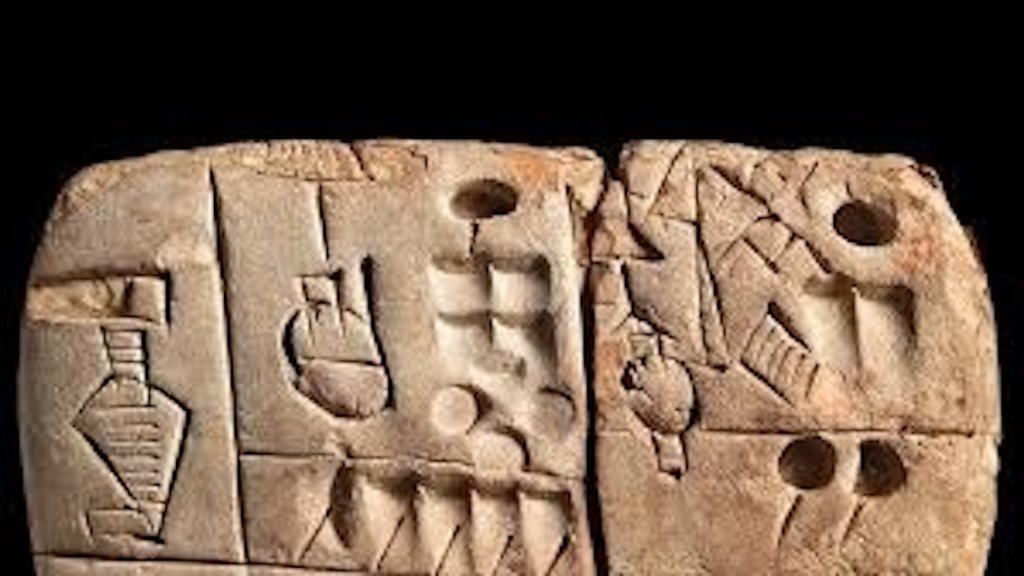
At peace. I revisited Iraq. This time, I could effortlessly wade past the ISIS, the Gulf War and a country in ruins — to a once-prosperous civilisation between the Tigris and the Euphrates. I recalled the fascinating history of Mesopotamia and its rich and varied heritage. One of the oldest civilisations in the world; the birth place of cuneiform writing and recorded history… and much more.
The Mesopotamian I met that day left me a lesson — to savour the true vibrant colours of this beautiful world, one must see it without tinted glasses.
In a month into the excursion, I would meet a Pakistani — the one and only person of that nationality, I have ever interacted with. He’d leave another indelible memory, and a small debt, which, I doubt, I’d ever have an opportunity to repay. That story… another day, another time.
Comments
Air Commodore Anil Kumar Benipuri (Veteran) : This is also called the Stockholm Syndrome. 🤣🤣









 Road Much Travelled