
Where have all the American children gone?

Where have all the American children gone?
Uncle Sam uncertain as seldom never before…
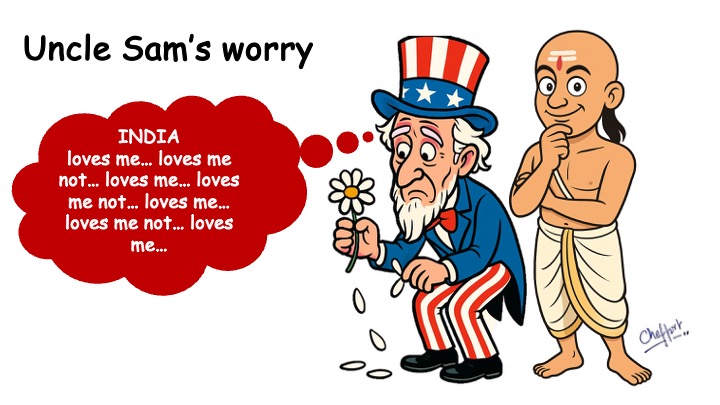
Will the wolf pay this time…?
A wolf was drinking water on the bank of a river. A little away, downstream, was a lamb taking small sips.
“Why are you dirtying the water I am drinking,” growled the wolf.
“Sir, but I am downstream, how can I dirty the water reaching you?” The lamb tried to reason with the wolf.
“Okay! Okay!” said the wolf, his accent American, his logic Trumpian. “But why did you use abusive language with me last year?”
“But Sir, I wasn’t born last year,” pleaded the lamb wiping his sweat.
“Then, it must have been your mother,” said the angry wolf and pounced on the lamb.
That is the original version of the story.
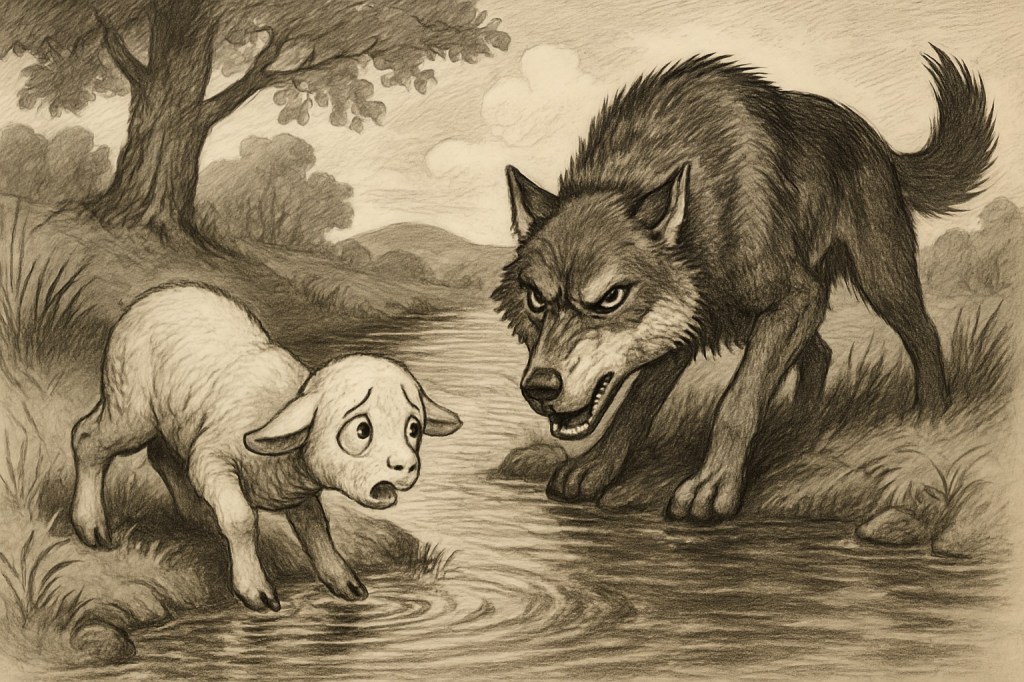
The current version, has some more characters and interesting twists. The wolf is rankled more by two other animals in the jungle—the bear and the little dragon who have enough nuisance value for him. To his annoyance, the lamb is friendly with the bear. And, playing on the mind of the slimy wolf is the fear: “What if, let alone the lamb, the bear and the little dragon, other animals of the jungle stand up against him?
The animals of the jungle have a different concern.
Their worry is that the wolf has an Indian brain, a Chinese heart, a Vietnamese kidney, Latino lungs, Mexican blood, Jewish bones… but, it is controlled by its own xxxhole. How much more stink will it bestow upon the jungle before it suffers from the same?
“Dadu, can God do anything?”
“Of course, Kanishka! He’s all-powerful,” I said with authority.
“Even create a mountain He can’t lift?”
I was foxed by the question posed by my grandnephew.
“Think about it. Let me know if you ever meet such a God.”
That evening, I had my answer. “Trump,” I said. “He’s the God who can create mountains of problems… that not even he can fix… Capitol Riots, Trade Wars, Covid Denialism, failed nuclear deal with Iran, Ukraine and Gaza Wars—watch the peaks rise.”

The InkQuest study report has the potential to destabilise Indian democracy.
The Dance of Democracy in India has evolved into a grand spectacle more theatrical than ever. One wonders whether it resembles a scintillating cabaret, a frenetic cancan or, the frenzied Rudra Tandav, an artful chaos bordering on self-destruction. The high decibel election campaigns have devolved into exposés of rivals’ failures and scams. Horse trading is now institutionalised, with steeds lodged (read, “locked”) in five-star resorts until some manage to jump the fence onto a greener side. Parties with starkly opposing ideologies forge fragile alliances to win against a common foe. Their seat-sharing negotiations overshadow any pretentions of a common minimum programme. Meanwhile, seizures of bags of cash and liquor crates have become routine election headlines. Notably, welfare and good governance sometimes manage to crawl into public discourse.
The voter, now a seasoned player, enjoys the perks, and feasts on freebies while casting his vote with discretion. Election rallies have become seasonal employment opportunities, with paid crowds giving the illusion of enthusiastic turnouts; noise pollution and traffic disruptions not being anybody’s concern. With each election, the mad race to serve the people is becoming fiercer, although who truly benefit—the elected representatives, or the ones electing them—remains debatable.
Getting up early; wearing lucky charms; offering prayers at several temples in a given sequence; and being accompanied by particular (women) constituents, to send a message; and many such tricks on their way to file nominations don’t seem to work for those seeking a berth in the state assembly or the parliament. Not anymore. It is amazing what will matter in the next dance performance of the Indian democracy?

News of a recent groundbreaking study with far reaching implications on future election results has been hastily suppressed. Unsurprisingly, the start-up, InkQuest, who conducted the study has vanished into thin air for the fear of being kidnapped by people with vested interests. It has been learnt from leaked reports that immediately after the recently held Delhi Assembly elections, samples of thousands of India (as different from INDI Alliance) Ink marks on the index fingers of the voters were collected using high definition and high-resolution cameras. The specimens were analysed by graphologists who had been quarantined so that their analysis was not influenced by the exit poll results or the paid media reports. After hours of extensive study of the ink stains, they concluded that it was possible to forecast the outcome of the poll by analysing the stains. In fact, they had given the names of the winners of that election, with six-sigma accuracy, well before the declaration of the result by the Election Commission.
Before the team went into hiding, they had spoken in confidence to a rare species of well-meaning media persons about their research. As has been learnt, the length of the stain; its width; the shape, the shade (due to dilution of the ink); whether the mark is broken; how much is the area covered by the ink on the nail in comparison to the area covered on the skin… everything conveys something. A close look reveals familiar shapes in the stains, for example: a boat, a crescent, a cock, a bull, a yacht, a leaf, a duck, a paramecium, a spider, a star and so many others. With careful analysis, it is possible to establish a relationship between the stain and the name of the candidate voted by an individual. Forecasting the outcome of an election based on the study of the stains of democracy is, but the tip of the iceberg. The spinoffs of this study are mind-boggling—they can hold the Indian democracy to ransom.
A corollary of the InkQuest study is particularly alarming: “If in an election, the India Ink stains were to be deliberately ‘designed’ on the fingernails of the voters to favour particular candidates, the outcome of the poll could be manoeuvred.” As a result, now those who have the power and means to manage, are trying to get men who’d apply the stain on voters’ fingers so as to ensure their win. Those who can’t, are preparing to put up a case to the Election Commission for an automatic finger staining machine (FSM) that’d ensure identical stains, preferably resembling the chakra of the Indian tricolour. Who knows… in the times to come, both, the EVMs, and the (FSM) will be held responsible for manipulated elections.
Whatever happens, one can rest assured, in the future there’ll be less of noise in the streets; less of dog-fights and less of freebies. Horse trading, liquor and largesse will be out of the question. One who’ll be able to manipulate the stain of democracy will be in the spotlight on the floor where darling democracy performs its dance.
Comments
Wing Commander Vijay Ambre (IAF Veteran): Ashok, I enjoyed reading your latest blog, as usual.
I wonder, if it would be easier to employ “Thought Police”, a la George Orwell’s 1984, and influence the voter directly in the 2034 (or even 2029) General elections, rather than analyzing voter inkstains?
Even easier ,would be to go go back to ballot paper votes, so that the boxes could be replaced with ones already stuffed with the ballots pre_stamped?
Just thinking …..🤔😊
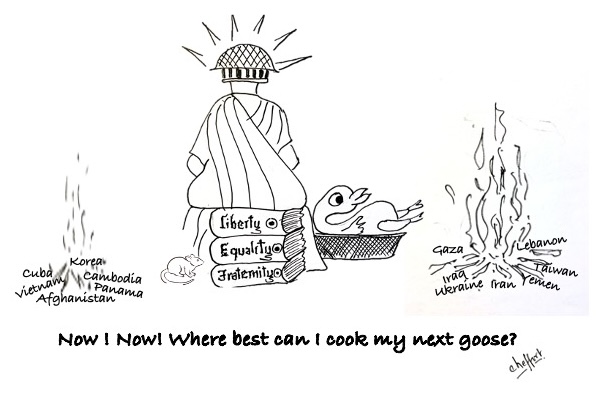
Inundated with choices, where will Uncle Sam cook his next goose?
Comments
Air Marshal KK Nohwar (IAF Veteran) — A finger in every pyre (sic). It might end up cooking its own goose if it doesn’t take corrective action now. Sitting on the fence in Ukraine and Gaza won’t help its image much.
Great effort, Ashok.
Stay at it, you have the potential!!!
👏👏👏👍😊
Air Commodore Roj Assey (IAF Veteran) — Super effort …. and I think the answer is clear. From all indications, Uncle Sam will cook his goose rather royally in the next presidential elections ! Heads, he loses. Tails, he loses !! 😂😅🤣
Air Marshal Naresh Verma (IAF Veteran) — A brilliant cartoon indeed. You are quite multifaceted. Let us have more such creative outputs from you.
Best wishes.
Praful Nanavaty — Gazab is the word 👌👌
Air Commodore BS Yadav (IAF Veteran) — OMG.. that’s hard hitting… A cartoon conveys more than a 1000 words… Brilliant… You are an all rounder 🫡
Colonel Jamshed Husain (Veteran) — Cartoons have a subtle bite, which is a way ahead of words. Americans are great masters of literally cooking their own goose so often..Your this attempt👍. Stay blessed Ashok..
Dinesh Lakhanpal (Film Writer, Producer, Director) — It indeed is a multi-edged sword. Just a single drawing, called, cartoon, suffice for the entire newspaper. Not an easy form to follow. Hits straight. Now don’t stop and get spoiled further. 👍👍
Dr Kirti Jain (UK) — That is spot on – brilliant specially if it is your first attempt.
“Is INDIA prepared for the dire consequences?”
This morning my little grandnephew asked me, “Dadu, why do we say, ‘the US, the UK, the UAE?’ Why don’t we say, ‘the India’?”
“It is rather simple, my child,” I said, “When the name of a country suggests that it is a group of states or a confederation or a federation, we use ‘the‘ before their names like, the United States, the United Kingdom, the United Arab Emirates….”
“I see,” Kartik nodded.
“Not only that…,” I added to enlighten him further, “…the names of some countries which are archipelagos or groups of islands, are also preceded by ‘the‘ for example the Maldives and the Seychelles.”
“I will not use ‘the’ with Maldives. I don’t like that country. The Indian troops risked their lives for their President and we have been rushing to help them in their times of need, yet they speak with disrespect for our Prime Minister. They are bad people!”
“Language has nothing to do with relations between countries,” I chuckled. “Grammar is not governed by feelings, Maldives will continue to be called, the Maldives. Your dislike for that country doesn’t change anything. Relations between countries are temporary; only interests are permanent. Yesterday the Maldives were with us; today they are with China. Who knows, tomorrow they might end up being without any one on their side when China discards them like a spent tissue.”
A pout on the little lips, lateral movement of the eyeballs, and a shrug of his little shoulders was Kartik’s way of conveying his displeasure about this particular rule of the English grammar. He continued paying attention regardless.
“Not only that, we use ‘the’ before names of groups/ organisations that suggest coming together of several entities. For example, the United Nations, the World Health Organisation and…,” I paused to think of names of more organisations.
“In that case it would be grammatically correct to use ‘the’ with India too,” the little one spoke with sparkling eyes. “I.N.D.I.A. stands for ‘Indian National Developmental Inclusive Alliance’ and meets the criteria of being a coalition of several entities?”
That question put me in a tailspin. I remained silent for a long minute until Kartik tugged me, “Isn’t it Dadu?
I scraped the inside of my cranium for the special wisdom required to answer such questions. Then I spoke hesitantly. “Well, theoretically you’d be right if you use ‘the’ before I.N.D.I.A. But as it stands, there is nothing like I.N.D.I.A. It is just a group of ambitious people trying to remain relevant in Indian politics by any means. Rather than setting an agenda for the country, their only aim is to remove the ruling dispensation, and their primary concern is ‘seat sharing.’ Men apart, every man there is a candidate for the post of prime minister. As of now I.N.D.I.A. exists only as a concept.”
The quizzical look on Kartik’s face suggested that he didn’t understand a word of what I had said. But does either India or I.N.D.I.A. visualise the consequences of having a weak, rudderless and meaningless opposition?
Comments
Wing Commander Sanjay Sharma (IAF Veteran) — If my Grandson were to grill me like you were fried, I shall take apolitical asylum in Djibouti.😱😱🤯🤯
Wing Commander Vijay Ambre (IAF Veteran)—You need a strong and united opposition for a vibrant parliamentary democracy. The present conglomeration in the opposition is not likely to provide that after the general elections, especially if the present government returns to power.
The Modi government is doing a very good job on all fronts and deserves another term for internal and external policy continuity.
Colonel Jamshed Hussain (Indian Army Veteran)—Very interesting…use of grammer to drive home a point..for a meaningful democracy, a strong opposition is as important…. The small one for weekend, is razor sharp in its thought..Ashok, my compliments.👍 Stay blessed🙏
Air Marshal PV Athawale (IAF Veteran—Beautifully put across Ashok, through Kartik, something which “the politicians” scream aloud every evening on the TV, and no one understands!
UNBELIEVABLE… ‘पोहा’ a delicacy from the Malwa Region of MP is stoking up social discrimination.
For ages, restaurants in the Malwa region of Madhya Pradesh have been serving a delicacy they call Poha. It tastes awesome and a plateful is within the means of the commonest of the common man. It is made using flattened rice and is traditionally savoured at breakfast with jalebi and tea. Some prefer to eat Poha with a glass of milk. The Indian Constitution is silent on the freedom of eating it as a part of any other meal than breakfast. The peace-loving docile people of Malwa have never protested against those deviating from the norm.
Memories!
Etched indelibly in my mind are little flat plates of Poha garnished with fresh coriander and Senv—a local bhujiya which cannot be substituted by the likes of Haldiram and Bikanerwala. Standing by a thela (a typical roofed push-cart used by the Poha vendors) or outside a shack, people used to eat from enamelled plates with flimsy aluminium spoons. Bent at different angles at their necks, those spoons used to be cutlery marvels. Despite the crookedness, they enabled people to shovel measured quantities of Poha into their mouths without spilling. Using those deformed tools to serve their intended purpose of enabling eating was an art akin to using chopsticks. People of all castes, creed, colour, sex or status used the same plates and the same spoons; there was no discrimination. Socialism!
Over a plate of Poha and a cup of kadak chai (strong tea) folks used to discuss everything. Everything meaning, everything under the sun. They talked about the quality of leadership provided by Indira Gandhi as against that of Nehru or Shastri. They shared their concerns emanating from the Cold War and India’s leadership of the Non-Aligned Movement. They had opinions on whether or not Nawab Pataudi could lead India. Those unbiased views were based purely on the Tiger’s performance on the field, although some people doubted his capability because of an eye-defect. Some even felt that his marriage to Sharmila Tagore had affected his game. For better or worse—they were unsure. They even talked about what could be India’s strategy in the next war with China, if it took place ever. All this… over a plate of Poha and a cup of tea. And of course, in a very amiable atmosphere. They did agree to disagree on a few issues but never raised their voices or carried grudges. Poha united them.
Much of that has changed.
Not long ago, people began questioning the cleanliness of the crockery and cutlery used for serving Poha. They objected to eating from plates rinsed repeatedly with water kept in a discarded Asian Paint bucket. They were right in lamenting, “It is unhygienic.” But most of the Poha vendors did not afford the luxury of running water to clean the used plates.
At a time when Poha Culture, an activity that united the Malwi people and could have earned UNESCO’s recognition, was on the verge of extinction, the Poha Vendor’s Association of Malwa (PVAM) came up with an innovative solution which appealed to all and sundry. They recommended use of bits of old newspapers in place of the usual crockery. They also came up with an improvised paper spoon—origami at its best. Those who still preferred the enamelled (now ceramic) plates and the usual spoons (now made of steel and devoid of kinkiness), could be extended the service. All stakeholders were happy; it was a WIN-WIN situation. “Not really,” was the response of one of my acquaintances. “This change is damaging the social fabric of Malwa,” he was emotional. His voice choked; he couldn’t elaborate.
Curiosity led me to indulge in pseudo-investigative journalism. And, this is what I experienced when I visited Mahaakal Hotel on the outskirts of the holy city of Ujjain in the guise of a highway traveller last week.
Chhotu, the waiter (barely in his teens) didn’t know that I was there to probe a matter of national importance—an issue that could draw the attention of New York Times and sully, India’s image. He came holding five tumblers in a way that his fingers were dipped in the water contained in them, and literally banged them in front of me on the creaky table. He was unmindful of the water he spilled in the process. He bared his yellow teeth when I asked him to clean the table and promptly wiped the tabletop with a smelly rag which left parallel streaks of more water in front of me. Contents of the glasses were tad misty—Poha particles which had been clinging on to Chhotu’s fingers had parted ways and were now descending majestically towards the bottoms of the glasses. It was a beautiful sight; my thirst was quenched without taking a sip.
Exploitation of children concerns me. It pains me to see little ones working in hotels, homes and workshops rather than going to school. On numerous occasions, I have tried my bit to alleviate their misery but to no avail. More often than not, I have found that a child pulled out of the clutches of a restaurant owner ends up sleeping hungry with a school bag for a pillow. Free education—mere ability to read, write and do elementary arithmetic—and mid-day meal, is a good concept but does not find favour with those at the receiving end of it. Working in the hotels enables those children to earn not only meals but also cash to carry home. Occasionally, modest tips add up to a decent amount. Besides, the life’s lessons they learn while serving people are invaluable. That on-the-job training, I think, is one of the purer and more practical forms of education—more useful than crude literacy. I have come across a rare breed of employers, who treat children extremely benevolently. Some provide for all the needs of the urchins including their part time schooling. We also hear of the cruel masters as projected in Bollywood films. Honestly, I am unsure of my stand on the subject. In rare moments of solitude when I have a conversation with myself, my inability to do something gnaws at my heart. I try to overcome my guilt by tipping children who work to earn their livelihood.
Chhotu enquired if I preferred Poha being served to me on a plate, or on a piece of newspaper. “Both will cost the same,” he chimed.
“Get it on a newspaper,” I told him as I placed a rupee fifty note on his little palm. He thought that I was making advance payment for my plate of Poha but was pleasantly surprised when I told him that it was his tip. He looked around and pocketed it.
Mahaakal Hotel was strategically located on a fairly busy road crossing. Next to the hotel was an empty plot of land. More than half a dozen cars were parked haphazardly in that open space. There was a rare green Merc A Class, a passion yellow Audi A4, a black Skoda Ocatvia, an old grey Honda City and a couple of i10 and Maruti Alto class of vehicles. These were the Poha lovers who had travelled long distances from the heart of Indore and Ujjain to relish a plate of the popular Mahaakal Poha. They were honking to draw the attention of the waiters who were fluttering about like butterflies from one car to the other taking orders and effecting deliveries. The occupants of the yellow Audi were clad in white Khadi. When two of them stepped out to stretch their legs, their body language suggested that they were in the business of running the state government. I recalled seeing one of them on the cover page of Nai Duniya that morning. The waiters were certainly not indifferent to the customers sitting at the tables but surely, they were paying greater attention to the needs of patrons sitting in the cars.
Just then, I heard a customer at the adjoining table, whining. He was complaining that his order had been delayed and that the carwallahs were getting preferential treatment. Smelling trouble, the obese owner of the Hotel left his chair at the cash counter and tried to pacify the disgruntled man. “Please calm down, Sir” he said. “Your order will be here in a jiffy.” Then he added with deliberate stress for everyone around to hear, “Sir, for us all customers are equal.”
He then shouted on top of his voice, “Golu, chhallewali gaadi me poha dekar teen number table ko attend kar.” [Golu, attend to the customer at table number 3 after serving the guests in the car with rings (meaning Audi).]
After a little while, I overheard one of the Audi occupants addressing Golu jocularly, “Keep serving us tea like this… we’ll make sure that one day you become the Prime Minister.” This monologue was followed by a chorused chuckle.
Chhotu returned to me after all guests had been served. By then I had finished eating the Poha he had served me. “Can I get you anything else,” he enquired. He continued when I declined. “Sir, you must try a plate of our special Poha and Samosa. Both are really good.”
“What’s so good about them,” I enquired.
“In addition to the usual Senv and coriander, we garnish Special Poha Plate with chopped onion, boondi and fresh pomegranate. The helping is larger and it costs just five rupees more. The Samosa is fried in Saffola oil… very light Sir.”
Since I had already eaten Poha, I ordered a Samosa.
Chhotu got me a Samosa on a piece of paper. Since there weren’t many guests at that time, he stood a little distance from my table and made a deliberate effort to engage me in a conversation. “How’s it, Sir?”
“Hmm, it’s good,” I said rather indifferently.
“Sir, those guests who come in shining cars always order Special Mahaakal Poha and get some Samosas packed for home… I know they are VIPs and serve them on the glossy pages of English magazines or The Times of India newspaper. Others, I serve on the pages of Nai Dunia and Dainik Jagran.”
Chhotu’s salesmanship made me laugh. “But, your boss said, you people do not discriminate. All guests are equal for you?” I took a dig.
He gazed at me in a way which seemed to say, “Come on, Sir you must be joking.” Then he said aloud with all seriousness, “Sir, in theory it is alright to say that all customers are equal. But in real life, some customers are more equal than others… and, they have to be given their due.”

Out of curiosity, I looked at the piece of paper on which Chhotu had served me the Samosa. It was that part of the city edition of some local newspaper which had the daily crossword, Sudoku and Hitori. I wasn’t sure on which rung of the social ladder he had placed me.
I am still waiting to conclude my maiden project in journalism.
In June 2022, Delhiites narrowly escaped something deadlier than the Covid pandemic! The danger still lurks…
Not too long ago, in June 2022, a lady was hit on the head by a bottle in an uncultured club in South Delhi. She had to be treated in a hospital. Apparently, an FIR was also lodged but was withdrawn later. A show-cause notice was served to the owner of the bar cum café for running well past the permissible time. This was followed by suspension, and subsequent cancellation, of the licence.
How procedurally methodical!
The court took a serious view of the case and dismissed the plea of the owner to reopen the facility, but then, hoped that the police commissioner would take a sympathetic view since the last two years had been catastrophic on account of Covid-19. The restaurant and service industry in particular, had been severely hit by the pandemic. The court added sympathetically that the restaurant had been providing employment to a number of people since 2017.
How socially conscious and considerate too!
The club did reopen after it was established that ‘nobody hit the lady.’ Some recalled the film No-One-Killed-Jessica-Lal with a sense of déjà vu. Now, all that has little to do with what happened behind the closed doors of the club before it was so conscientiously reopened in the public interest.
Unbeknown to the outside world, a meeting took place behind the sealed ‘bar and café’ doors. Numbering more than a hundred, the members of the group occupied every nook and corner of the premises. And, although all of them, without any exception were slurring (“Zzzuzzu-ing,” to be more accurate), they definitely were not suffering from speech sound disorder. They weren’t drunk either. They were very much in their senses and knew their agenda well.
The oldest and most revered member of the group began, “My friendzz,… Aedez, Anophelez, Culex,… before we prozeed, I want to requezt you to ztand in zilence, wherever you are, for two minutez, to mourn the untimely death of 47 of our brethren.” The gathered members stood motionless––one could hear only the zzzuzzuing caused by their breathing. Tears rolled and the cheeks of some of the members, mostly female, glistened in the intermittent glow of the blue and red LED light emanating from the RO water filter installed behind the bar counter of that dark and gloomy complex.
After two minutes, which lasted barely ten seconds, the revered member continued, “They died young… in fact, if you azk me, they didn’t die… (emphasis) they were killed… yez, ladiez and gentlemen… they were K-I-L-L-E-D…. And we will avenge their deathz,” he paused and looked around for attention as the zzzuizzing rose in decibel. “They were trampled to death when they lay unconsciouz on the floor of thiz very bar. Our expertz have dizcovered that… I’m zad to zay… they were inebriated. They were intoxicated becauze they had conzumed the blood of the drunken lot in thiz bar. Their blood had unuzually high levelz of alcohol.”
“Death to Delhiitezz!!” one member sitting on the shade of a fancy light expressed his rage.
Another one, perched precariously on the brim of a wine glass screamed, “Aedez! Anophelez! Culex… mozquitoez of the world, unite… zzz.” Shivering with anger, he lost balance and slipped and fell into the empty glass and hurt his head.
“Ladiez and gentlemen, maintain zilenze! Zloganeering will take uz nowhere. Let the revered leader zpeak,” a volunteer who looked like a muscular bouncer gestured to the crowd to settle down. “And… ladiez and gentlemen, let me make it clear… we are not mozquitoez… we are M-O-Z-Q-U-I-T-E-E-R-Z… and let’z behave like MOZQUITEERZ,” he stressed before letting the revered member resume.
The response of the audience was exactly as the revered member had expected it to be. He proceeded with his melodrama with a heightened sense of satisfaction, “Thankz to the new excize rulez in zome Ztatez… more and more people are now dying of drunken driving, brawlz in the barz and road rage… there is no account of zpike in the deathz due to increazed domeztic violenze. Thoze rizing numberz, my muzquiteer friendz are alarming. Our worry iz that in due courze of time, thoze numberz will exzeed the numberz dying because of Covid, malaria, filaria and chikungunya… we’ll loze the leftover trazez of rezpect.” The voice of the revered member crackled with grief. “It is a viziouz zircle,” he became philosophical, “Free electrizity, free water, free buz-ride… haz left the aam aadmi with enough money to zpend on himzelf. A mazzive cut in liquor prizez haz brought it within the eazy reach of everyone. Of courze, it iz a beautiful trend… fatherz, motherz, zonz, daughterz,… familiez and friendz drinking together from the zame bottle of cheaply and readily available Glenlivett and zpeaking in just learnt farratedaar Englizh… I don’t mind those people blowing up the government largezze… but my conzern is the long term ill effectz it’ll have on our young mozquiteerz, and our breedz.”
There was silence in the bar; even the zzzuzzuing had stopped. Faced with existential crisis, the mosquitoes had gone into introspection.
Sound of footsteps and human voices broke the chain of their thoughts. Concern and fear writ large on their faces, their heads turned towards the bar door. With bated breaths they heard the keys clink and the door knob rotate. “Thank God, they have finally accepted our plea. Victor, I have organised a Hawan at nine tomorrow. Please get the bar cleaned and sanitised before sunrise tomorrow. And… oops… these mosquitoes! Spray some odourless repellent,” said the bar owner as he killed a mosquito who had mistakenly landed on his chubby cheek. Then, there was commotion. The last thing heard as the mosquitoes ran for cover was the voice of their revered leader: “Dizperze! Dizperze! Each one to himzelf…. We’ll meet again zoon… until then take care of yourzelf and avoid conzuming the blood of drunken Delhiitez. Don’t worry, there haz been a brawl in another bar… more will follow… we’ll have a wide choize of venuez to get together… the addrezz of our next meet will be communicated to you. Remember we have to avenge the killingz of our fellow mozquiteerz. Zai Zind!”
A self respecting dog who prides in himself and his name, chalks out a plan to punish the person who rechristens him and takes away his identity.
Whoever said, “What’s in a name…,” was absolutely clueless about the psychology, and the art and science of naming. I bet there’s everything in a name. Everything! Else, why would Indians perform elaborate religious rituals while giving names to their new-borns. Ask me! And, I’ll tell you what’s in a name; none knows it better than I do.
In some weird state of mind, Mahabir Prasad Shukl, a Final-Year Mass Com student from Darbhanga, called me, “Sampain.” Mind you, he is very particular about not writing an ‘a’ at the end of his family name, Shukl. He explains, “It is to ensure that my name is pronounced properly. Exactly as it is written and read in Hindi.” Now, just watch––one so particular about his own name wouldn’t care a fig about mine. His colleagues, including his girlfriend Partibha, who knew that communication was the handicap of this Mass Com student, understood that when he said Sampain, he actually meant: “Champagne.”

So, that name, Champagne has stuck with me. Actually, this guy must have been high on the cheapest of the cheap country liquors, else what similarity did that Gen-Nexter find in me, an unkempt street dog and that bubbly French wine of the same name. Ever since he gave me that oh-so-European name, people have been expecting a much sophisticated behaviour of me.
Earlier the students used to call me Jhumru, a name given by a Management (General) under-grad of Jhumritillaiya domicile. Back then, with a name that brimmed with affection, they cared for me. They tossed leftover rotis, puris, halwa, eggs, biscuits, and what have you, towards me without expecting anything in return. Some students who were governed by their hearts bought food specially for me. Oh my, it was such carefree existence; I cherished that life. Trust me, it was the envy of every dog in the area, as also of some freshers on the University Campus. Now, in my avatar as Champagne, they expect me to behave and perform acts like that guy who lives on the farmhouse yonder, and who travels in shining cars sitting in the lap of a glamorous girl who comes to the campus, more to show off her parents’ stinking richness, than to study. Not that I can’t do what he does, but I am averse to bartering my freedom for bread crumbs. It is certainly not a case of sour grapes. Just that I have some self-respect and I live for it. Period.
Agreed, I am a dog, and I lead a dog’s life. But then, that’s my destiny. And, if I may say, “That’s my choice, too.” Let’s be very clear. None has the right to mess with my name, and my life. That guy who re-christened me, actually ruined both.
The more I have thought about this name business, and the treatment meted out to me because of it, the more miserable I have felt. So, one day, after much deliberation, I took a big decision. I even consulted Laila and Shera, the other guys who share the territory with me, and they too thought, enough was enough, I needed to pay back this Shukl guy.
What best can a dog do to punish a guy? Bite!
So, I was determined to take my revenge upon Shukl. A near perfect plan was afoot. I had chosen a date, a time, a place and the manner in which I was going to dig my sharp canines through his Levis Jeans into his right calf. It was going to be a day before the Convocation, in the evening, in the sports ground where he would be taking a walk with Partibha. I had heard him tell his beloved that that’s when they would plan their party to celebrate their degrees. Laila and Shera would help me corner him.
That dude, he thought he was too hip; he’d remember my bite for life.
On the D-Day, everything had worked as per plan and with clockwork precision. A cheerful Shukl with a smiling Partibha stepped out of the Radhakrishnan Hall exactly at 5:00 pm. He had a document folder in one hand; the other hand rested on Partibha’s shoulder as if she were his property. She was looking into his eyes coyly. Or, maybe she was pretending to be coy. There’s a basis for that doubt; I had seen her behave even more coyly in the presence of three other guys (of course, with one at a time). That doesn’t really matter; now she was with him. She had a bottle of Fanta in her right hand. From the moisture collected on its outer surface I could make out that it was chilled. In the other hand she was carrying a box of Dominos Pizza. Under normal circumstances, a piece of it would be thrown at me once they are through with their snacking. They walked lazily towards the sports ground; to its farthest corner, to their favourite bench from where they’d have a good view of the ground.
Laila and Shera had taken positions and had nodded readiness.
“Hum soch raha hoon ki, kal party me tumko propose kar doonga (I think, I’ll propose to you tomorrow in the party),” suggested Shukl, with a big smile.
Partibha became even more coy, nodded, “Theek hai, Ham Anita, Nusrat, Neena aur Gopal ko party mein inbhite kiye hain. Cake bhi arder kar diye hain. Saath mein samosa le ayenge (Okay, I have invited Anita, Nusrat, Neena and Gopal for the party. I have ordered a cake too. In addition I’ll get samosas.”
Listening to Partibha, I started wavering. “Should I harm this guy just a day before he plans to propose to his sweetheart?” I asked myself. But then my dog-sense told me that Shukl deserved the punishment I had decided to inflict on him. I pushed those thoughts out of my mind, nodded at my colleagues, and moved closer to the two love birds.
I went over my plan again. It was time. I could hear the gears change, and the cogs move in my head. I had bared my teeth and was about to strike when Shukl said something which made me give up my plan for good, and change my opinion about the guy. “Hum Sunil, Arjun, Arif aur Akriti ko bulaye hain. Thode aur snacks le ayenge. Aur soch rahe the ki Sampain ke bina party adhoora rahega. So saath mein Sampain bhi le ayenge (I have called Sunil, Arjun, Arif and Akriti. I’ll get some more snacks. And, I was thinking that the party would be incomplete without Champagne. So I’ll get Champagne along.”
 Road Much Travelled