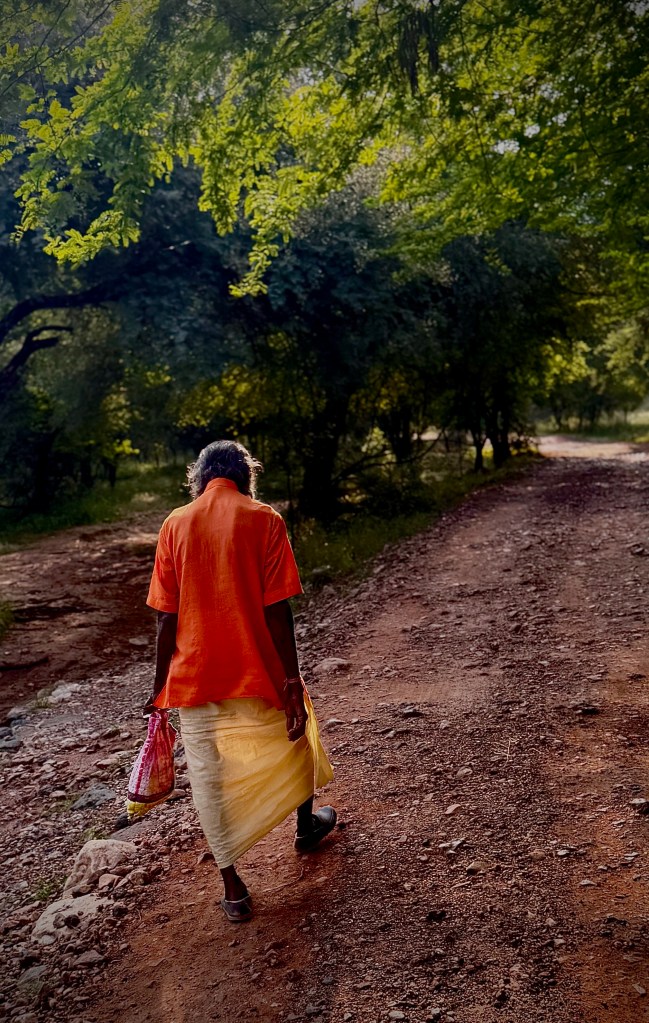
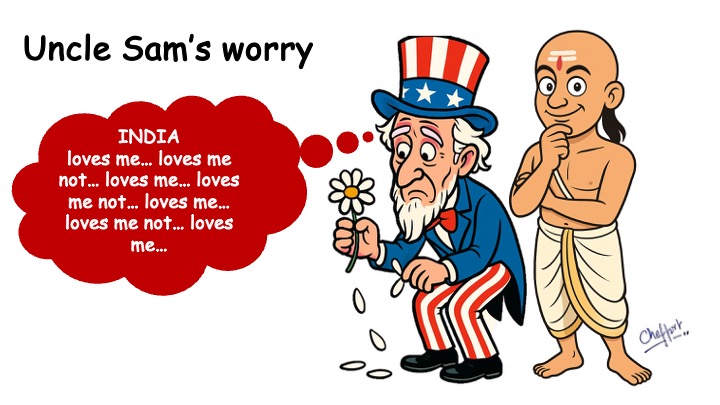
“Chanakya”

Sterling…

My revered theatre friend, Shri Ashok Banthia, rekindled my love for the stage when he invited me to work with him on the play Maha Param Veer two years ago. The production was staged in Udaipur, Jaipur, and Bhopal, and is expected to travel to other state capitals as well.

Recently, thanks to Ashokji, I had my first glimpse into the beautiful world of the National School of Drama (NSD). I was awestruck, to say the least. As is often my habit of wishing I could go back in time to pursue unfulfilled dreams, I found myself longing to study drama at NSD. That renewed desire arose from the stellar performances I witnessed yesterday.

Gripping…

The play was Chanakya.

All of us Indians have grown up hearing stories of Chanakya and Chandragupta Maurya. Honestly, those stories seldom inspire awe anymore. However, this Chanakya—researched and scripted over four years—felt fresh and intellectually invigorating. Having been staged more than 1,700 times, it’s no surprise that the actors have come to live and breathe their roles. Watching them, I couldn’t help but wonder if the real Chanakya, Amatya Rakshas, and Chandragupta Maurya could have expressed themselves half as powerfully. No exaggeration intended!

Been there.

The team led by Manoj Joshi (as Chanakya) and Ashok Banthia (as Amatya Rakshas) delivered a sterling performance. The dialogues were powerful and passionate, complemented by excellent costumes, lighting, sound, and music—every element of the production was par excellence. Time seemed to fly, and before I knew it, the play was over.

Beyond its artistic brilliance, the play reintroduces Indian history in a way that leaves a lasting impact. Those who watch it—especially those involved in running the country—will carry pearls of wisdom passed on by the real Chanakya through Manoj and Ashok’s portrayals.

…with my theatre mentor

We often judge a film or play by whether it’s worth our time. My conclusion? Watching Chanakya was worth more than a dozen of the best films or OTT series combined.

When I received a warm, friendly hug from Shri Ashok Banthia after the performance, I couldn’t hold back my hidden desire. I requested him, “Sir, please accept me as your pupil. If nothing else, I’ll cherish the role of a tree or a lamp-post beside which you stand and mesmerize audiences.”

Kudos to Manoj, Ashok, and the entire Chanakya team!

Delhi’s Dirty Air: Why Quick-fixes don’t work?

Delhi has done much and is contemplating more to rid its air of menacing particulate matter. Atomisers, sprinklers, mechanical road sweepers, smog towers and now, cloud seeding, is being resorted to clean the air. Regardless of the cost, the effectiveness of these methods has been, at the best, marginal.

Psychological Relief
Sprinkler: transferring the problem in time and space?

Except smog towers and mechanical road sweepers, all the other methods (including, the much talked about cloud seeding) of removing particulate matter from the air are either temporary, or have the tendency to transfer the problem from one locality to another. The water (sprayed or sprinkled) supresses the particulate matter temporarily. The dust particles when brought down at one place by water, first stick to the road surface and then cling to the wheels of the passing vehicles, and are carried to other parts of the city. When the water evaporates and the wheels become dry, the particles are released back into the air. Thus, the dust from Mayur Vihar gets transported to Lajpat Nagar; that from Lajpat Nagar, to Sarojini Nagar, and so on and so forth.

Old particles remain in circulation and new get added from different sources. The relief, if at all, is temporary and psychological.

Smog Towers: Limited Success

Talking of smog towers. Studies suggest that they make a marginal difference. The smog tower at Connaught Place was installed at an approximate cost of $2.5 million (nearly ₹ 21 Crores). Where the tower stands, its efficiency is 50%; at 50 metres, it is 30%; and at 500 metres it is just 10%. If the filters are improperly sealed; they allow dusty air to by-pass them. As per some estimates, Delhi would need 2.5 million such smog towers to clean its air. The likely cost will be close to $20 billion, about 2.5 times the Delhi State budget for 2021. Numbers speak!

It is noteworthy that Beijing and Shanghai have abandoned large-scale smog towers because of limited success.

Cloud Seeding: glamorous, iffy results

Suppressing dust particles by causing artificial rain (through cloud seeding), likewise, will have temporary effect—the dust particles will remain tethered to the earth’s surface only as long as it is wet. If by some chance, the rain is heavy, poor drainage will cause traffic snarls. In effect, we’ll rob Peter to pay Paul—if not the lungs, the roads will get clogged. Delhiites will pay for both.

Is there a way out?

Of course, there is one! It follows the principle: capture particulate matter and prevent it from getting back into circulation. It is as simple as it sounds.

This can be achieved as follows:

  • Polluted air (laden with particulate matter) is directed on to moist screens, or is passed through specially designed ducts whose walls are moist.
  • The wet surfaces/ ducts ‘trap’ particulate matter and let go of cleaner air—devoid of particulate matter.
  • These wet surfaces and ducts are continuously cleaned by running water, or still better, water jets. The running water takes away the particulate matter with it and deposits it into a sump. Thus, the wet surface always remains clean and ready to ‘trap’ more particles.
  • From the sump, the particulate matter is removed continuously by decantation/ filtration and the water is reused.
  • The particulate matter thus removed is disposed of in a way that it doesn’t get into circulation again.

Using this principle, simple inexpensive static and mobile contraptions can be made to very effectively ‘capture’ particulate matter and consign them to their graves.

Yours truly, confident of the effectiveness of this method, had written to the authorities who matter. There must have been some communication gap, because the response was on these lines: “If you have a problem, please connect with the concerned department. Thank you for visiting the website.”

When I presented this idea to budding engineers (college students whom I lecture sometimes), they responded favourably and expressed their desire to take up projects on these lines. But very soon, they backed off for they had graver concerns—examinations and placement interviews.

Thus, what I thought was a cost-effective practical solution to Delhi’s woes got stored into some less frequently visited corner of my mind.

Then this childhood friend, while playing golf, rekindled the subject discussion, “It is a desperate situation now. The AQI has risen to alarming levels. It is still rising. The concern is high. Yours seems to be a workable solution. Why don’t you write to Delhi Govt?”

Going by my past experience, I was disinclined to go through the grind again. But then, the thought came to share the idea in a blogpost which passes more eyes.

So here it is.

I share this post in a hope that someone, somewhere, turns this simple idea into a real solution for Delhi’s lungs. Among the beneficiaries will be my better half and some of my dear friends who are occasionally forced to use inhalers and nebulisers for respite.

  • Air Commodore Meenu Vania, SC, VM: Any idea is better than no idea 🙏 In your case what you propose seems a workable solution and deserves a trial. I also have a point of view 👍I propose we tackle the known sources of air pollution ie construction activities, vehicular traffic , stubble and garbage burning , road sweeping ( actually its absence ! )and any other pollution generating activities. My point is the major sources of air pollution are not unknown. For ages its poor policy , knee jerk reactions , and an unwillingness to take some strong action that may result in political harakiri that has resulted in this pathetic state of affairs 🙏 Don’t tell me we are not aware that winter, Diwali and crop burning are a deadly cocktail. Surely if we can think of Gaganyan we can think of a solution to this problem of air pollution too 🙏
  • My response: ‘Nipping it in the bud’ is THE solution. That is a gospel. Just can’t be denied.Pollution due to Deepawali & crop burning also can be brought to zero if there is a will. Education is lacking. Despite best efforts, some pollution due to construction work and vehicle use is a given. What I am suggesting (without saying it in so many words) is to fight the pollution which can’t be stopped at source despite all efforts. 🙏
  • Colonel Alankar Bhardwaj: Was installed in Chandigarh. Failed and is now shut down. https://chatgpt.com/s/t_69058d278e7881919dfab9934b5b37ab

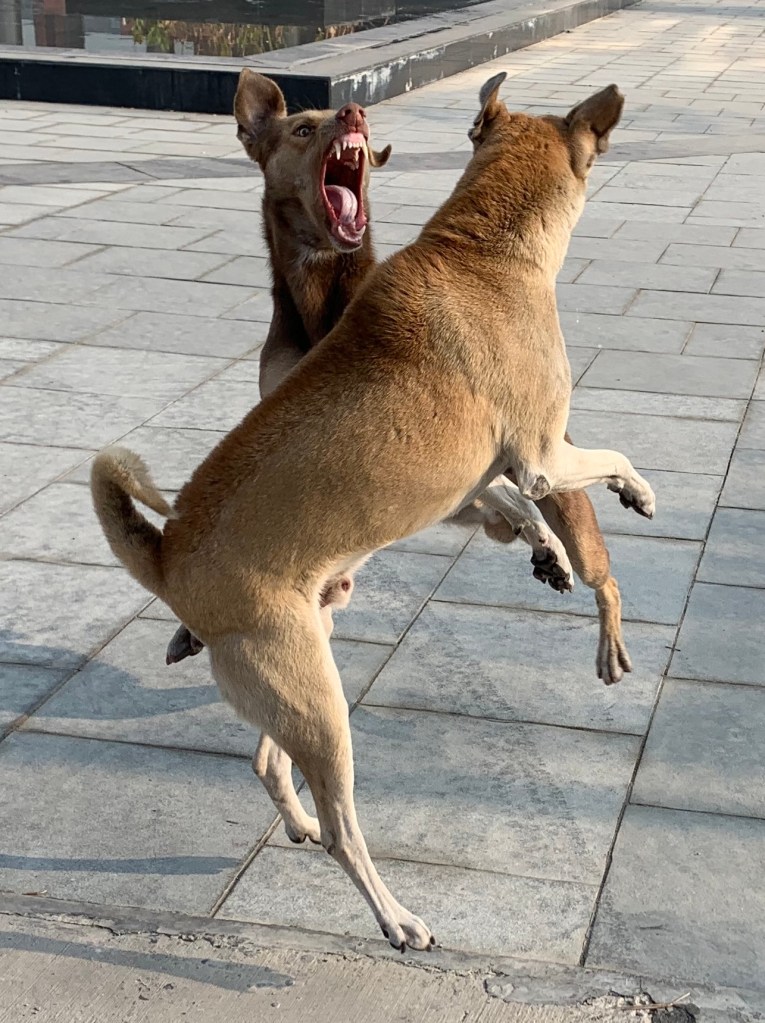
Delhi’s Dogs of War

…and Champagne* wonders, “Why do these Delhi dogs fight for territory despite relief granted by
the Honourable Supreme Court? Doesn’t the whole of Delhi belong to us?”

The Art of Creating a Narrative

In creating a narrative, timing is very important. Most important!

The other day, as a part of the Centenary Celebrations of the RSS, Dr Mohan Bhagwat answered many questions posed to him about the RSS. They were curiosity packed questions, which come to the mind of one taking only a fleeting glance at the activities of the 100-year-old organisation. Incidentally, one thinks of the Swayam Sevaks mostly when they are in the news. Normally, their social work does not draw any attention; it is taken for granted. They become a subject of discussion when they are infrequently dragged into the headlines for unpopular reasons.

Dr Bhagwat tried to clear that perception too.

People have a favourable/ unfavourable opinion about the RSS and as always, some people belong to the ‘unsure’ category. Unsure because of some of its ideologies—its Hindutva ideology and strong stand on conversion, being one of them. The Sangh Parivar has long been accused of influencing politics and, now, of infiltrating other walks of Indian life—bureaucracy, judiciary and lately, even military. In his responses, Dr Bhagwat tried to dispel many such myths. Whether he succeeded, only time will tell.

I assumed that the RSS Boss would be able to influence some fence sitters and might inspire some on the ‘other’ side of the fence, to give an unbiased second thought to the RSS. That was my view until this morning when I listened to a BBC Global News Podcast. It is not so now.

My reason for wavering is a report by BBC South Asia Correspondent, Samira Hussain who spoke of deportation of 40 Rohingiya Refugees by India. The language, tone and tenor have been cleverly used to create a narrative. The transcript of the Podcast is reproduced here:

As per the news caster, the incident took place in May this year. It’s broadcast coinciding with the Centenary Celebrations of RSS, is “BBC-MANAGED.” Now, what has a BBC news report on deportation of Rohingya refugees got to do with the Centenary Celebrations of the RSS?

Well, lately a perception has been created that the ruling BJP and the RSS are two sides of the same coin. So, if a narrative is advanced about India and the Indian Navy—asking refugees to drop their pants for identification and ‘throwing’ poor refugees into the sea—it is likely to project the RSS as instigating or inspiring such actions. This narrative, whether it is to malign the Indian Government, the Indian Navy or, through them, the RSS does not augur well for India as a sovereign nation.    

Some Points to Ponder

As stated earlier, India is not a signatory to the Refugee Convention (1951) and the 1967 Protocol. As such India is not bound by them to accept refugees. Still, India accepted Bangladeshi refugees in 1971. India is paying a price for not sending them back after liberation of Bangladesh. Roughly 2,000 Rohingya refugees are reported to be in India. It is India’s right to deport foreigners who enter India without permission.

Now picture this: The 40 deported refugees were made to disembark at a point beyond which the boat couldn’t have gone. This is being literally projected as “dumping refugees in the sea.” It is a pure action against uninvited visitors to India; BBC is attaching meaning to that action and creating a narrative. Also, projecting Indian navy sailors as villains harassing the refugees (by asking them to drop their pants to determine their religion) is a deliberate effort of the broadcaster to create a narrative.

One must understand, correspondents will go to any length to earn their bread, and some extra butter. With one stone, Ms Samira is striking the Indian government and obliquely trying to stymie, the effort of the RSS to project a different image. Had it not been for the timing, one wouldn’t have seen through the motive.  

No wonder, Israel bans the entry of BBC correspondents into Gaza.

Gaza: The Hostage Issue

O Gaza!

The events of October 7 served as the immediate trigger, but the roots of the Gaza conflict extend far deeper. The underlying causes are complex and subject to debate, with little likelihood of consensus. For this reason, reducing the war to a binary of good versus evil oversimplifies the situation. Meanwhile, the human toll continues to rise, with thousands killed by bombardment and many more affected by hunger and displacement.

Recent decision by France, Australia, and the United Kingdom, to recognise Palestine, though politically significant, is unlikely to resolve the immediate challenges. Rather, it highlights the difficulty the international community has faced in addressing the conflict.

Israel’s Objectives

Israel’s stated aims can be broadly identified as:

•           Destruction of Hamas,

•           Release of the hostages,

•           Ensuring Gaza no longer poses a threat to Israel, and

•           Return of displaced residents of northern Israel.

The feasibility of achieving all four goals simultaneously remains uncertain.

Prospects of Eliminating Hamas

Military operations may succeed in neutralising most Hamas operatives within Gaza. However, complete elimination appears unlikely. Those who escape are likely to regroup elsewhere. Also, displaced Palestinians will carry their wounds and scars to other parts of the world. No border control can prevent the smuggling of hatred and anger. It would be naïve to imagine that some of them would not be behind a “9/11 (Version 2.0),” if and when such an attack happens anywhere in the world. One does not need Nostradamus to foresee this.

The Hostage Question

Israel does not follow a rigid hostage policy and has, in the past, agreed to prisoner swaps. During the Entebbe Raid (July 1976), the hijackers’ demand for the release of Palestinians in Israeli prisons was actively considered, even as preparations for Operation Thunderbolt (later renamed Operation Jonathan) went ahead. The mission was deliberate and well planned. Jonathan Netanyahu (Prime Minister Benjamin Netanyahu’s brother) sacrificed his life to rescue 104 Israeli hostages. One hostage, hospitalised in Uganda, later died under unclear circumstances.

In another instance, Kozo Okamoto of the Japanese Red Army—who, along with two comrades, killed 32 people and injured 72 at Lod Airport (now Ben Gurion Airport) on May 30, 1972—was captured alive. Israel, which has no death penalty, imprisoned him. Yet on May 20, 1985, nearly 13 years later, Okamoto was released as part of a prisoner swap. On that occasion, 4,600 Palestinian and Lebanese prisoners were freed in exchange for three Israeli soldiers.

Why then, despite immense pressure from the families of hostages and international opinion, has Israel been unwilling to proceed with more prisoner swaps? Here one tends to agree with Prime Minister Netanyahu and others: conceding to Hamas’s demands would amount to “rewarding” them for the October 7 attacks.

Other Goals

The other two aims—ensuring Gaza no longer poses a threat and facilitating the return of displaced residents of northern Israel—are relatively less difficult to address once the hostage issue is resolved.

At present, the deadlock lies with Hamas. They know well that releasing the remaining Israeli hostages (and the bodies of the dead) would spell their end. They would be hunted down and eliminated. That fate seems inevitable anyway.

If only one of these sufferings could offset the other…

A Possible Way Out?

What could break the impasse?

One possible—though imperfect—approach could involve offering safe passage for Hamas operatives out of Gaza in exchange for the release of hostages. Such an arrangement might drastically reduce civilian casualties, but it would raise questions about long-term security and the precedent it sets. Whether Israel, and Hamas, would accept such a suggestion remains uncertain.

In the fog of war, it is unclear whether both sides are already working toward a face-saving exit. Meanwhile, frustration and anger are mounting across a world that feels trapped in a seemingly hopeless situation. In the absence of a negotiated settlement, the conflict is likely to continue at great humanitarian cost.

A Warning for India

The dilemma is not unique to Israel. Sooner or later, India too may face a similar horrific choice: how should it deal with terrorists who, after striking a target, hide behind civilian population in India or, still worse, across the border in Pakistan?