Little Big Man

These epithets — Taangewallah, Mechanic, Masaalchi, Tailormaster, Electrician and Masterji — had one thing in common; they were invented for a single soul, Babloo. They aptly described the diverse roles the ever-so-ordinary looking short-statured man played in the lives of the citizenry of the sleepy locality of Freegunj in the holy city of Ujjain. Thus, Babloo was Babloo Taangewallah when he took people to the Mahakaleshwar Temple in his tottering tonga drawn by a skeleton of a horse he called Toofan, the tornado. The tonga didn’t belong to him; he got to use it on lease whenever it was available. He spent a good part of the pittance he earned by plying the tonga on the pitiable Toofan. He was Babloo Mechanic when he cleaned, and micro-adjusted the gaps of the spark plugs of their Lambretta and Vespa scooters and checked and topped up the radiator water, engine oil and brake fluid levels of their prized Fiat and Ambassador cars on Sunday mornings. Likewise, he was Babloo Masaalchi when he dominated their kitchens on festive occasions and on children’s birthdays. He could stitch buttons, darn clothes, repair electric irons, kerosene and gas stoves and leaking taps, not to talk of solving arithmetic problems for children. Babloo was a Jack of many trades.
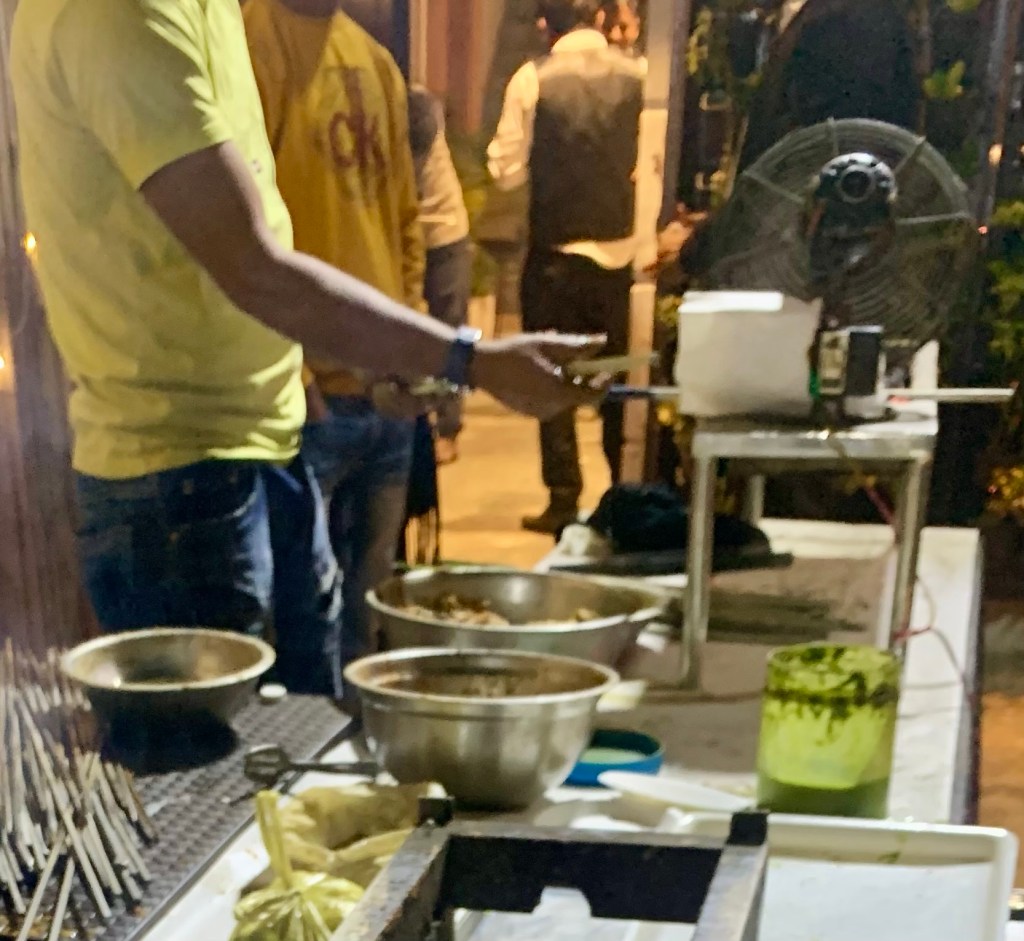
Babloo Masaalchi

It is also true that people’s minutiae were his missions. He was everyone’s man Friday. People paid Babloo miserly for his services but were generous with their hand-me-downs. Babloo was genuinely grateful when children passed on broken toys and stubs of pencils to him. Less mindful of the renumeration, he took pride in whatever he did and cherished the affection that came as a bonus with those specific-to-service nicknames.

Something in Babloo likened the children and the young adults to Keshto Mukherjee, the character who had become a synonym of the drunk in Hindi cinema. They called him Babloo Afeemchi, meaning drug addict, because sometimes he gave the impression of one high on afeem (opium). Now, that was not because he was a worshipper of Lord Shiva and consumed bhang — a popular local herb which gave a temporary high — once every year on the occasion of Holi. He owed that Afeemchi image to his body language spurred by cumulative fatigue which, in turn was the result of running errands and doing things for people day in and day out. Sheer tiredness caused his spirits to droop and his eyelids to drop, and he seemed to lose partial control of his limbs. That epithet, Afeemchi, pricked him but he bore the pain with a smile. After all they were children.

Father, forgive them, for they don’t know what they are doing.”

~ Luke 23:34

Then there were those who took Babloo to be their personal servant, and treated him more like a slave. But, very few people knew, or cared, about Babloo’s own small world—a wife, Shyama and a son, Munna who had just begun going to Bal Vinay Mandir, the Government Pre-School that had the canopy of a hundred-year-old banyan tree for a roof. The discarded stationery items which Babloo received from people were Munna’s prized possessions.

Once a month, Babloo left Munna in the care of his sister in Desai Nagar, and took Shyama to the matinee show in Ashok Talkies; they both loved to watch films starring Rajesh Khanna and Mumtaz. They always went early to the cinema hall and bought tickets for the second class; and rushed in to occupy the aisle seats because Babloo didn’t like anyone sitting right next to Shyama. A plate of samosas during the interval was a given. No rain, hail or storm could stop Babloo from being there to walk Munna to the school each morning. He’d also make it a point to tell the little one a bedtime story before devoting his full attention to Shyama.  

Among the very few who understood Babloo was Dr Jai Veer Singh, the Vice Chancellor of Vikram University. The man of letters was better known by his pen name ‘Snehi.’ They called him, ‘Snehiji’ out of respect which he had earned as much through compassionate social work as through his scholarly achievements. Greeting him with joined hands or, more appropriately, touching his feet, was a reflex action of people when they met him. It was on his insistence that people allowed Babloo four days’ leave every month end—none questioned it. It was believed that it was to visit his old parents in Maksi, a small town not far from Ujjain. A conscientious Babloo always re-joined duty punctually. As a matter of an unwritten rule, he was never late.

Last monthend when he returned from leave, his face was bruised; there was a deep laceration on his upper lip and a dark blue patch under his right eye — the tell-tale signs of a brawl.

It was 6 am; Snehiji was drinking his tea sitting in a cane chair on the veranda of P-21 Kothi Road, the sprawling bungalow earmarked for the Vice Chancellor. He had already turned the pages of two of the three dailies kept on the glass top of the round coffee table in front of him. He preferred to read Nai Duniya last. It was the City Edition of the Hindi newspaper, and contained the local news. He read every word of it. That habit gave him an edge in his discussions with his bureaucrat friends over drinks in Madhav Club every evening.

Babloo tiptoed past him. But the old man caught sight of him when he lifted his head momentarily to take a sip of the well brewed Green Label tea.

“Why, what happened Babloo? How did you get those wounds?”

“I fell down, Sir” Babloo mumbled and continued with a sense of urgency.

“I hope you are fine?” Snehiji genuine concern was laced with doubt. “How can a fall result in those injuries to the face?” he wondered. He resumed where he had left — the City Highlights page. Something caught his attention. He re-read it several times with utter disbelief.

Moments after Babloo returned with the old man’s brogues and penny loafers, and the paraphernalia to polish them, the old man hailed him. “Come here!” His voice was unusually harsh, “What’s this?” He slammed the half-folded newspaper on the table and pointed at a news item for Babloo to read. The headline read:

“Domestic help arrested for theft.”

Babloo read the news:

“Freegunj. January 29. Ramdeen alias Babloo, a domestic help working in several houses in Freegunj was found stealing grocery items at Maganiram Muralidhar Grocery Store. The man was beaten up by the salespersons before the local police took charge of him. The man pleaded that he was innocent. He said he was only carrying the grocery for one Mr Shiv Dayal who had forgotten to make the payment. Mr Shiv Dayal couldn’t be contacted to clarify. One of the customers said that, “Babloo Chor (Babloo the thief) had a history; he’d been seen in the Madhav Nagar Police lock up on several occasions.” Our correspondent has reported that there has been a spurt in cases of thefts in East Ujjain. People have been warned to be watchful.”

“So, you have another trait and a name… Babloo Chor,” Snehiji looked at Babloo, “How could you do that?  You have betrayed my trust.”

Babloo stood still like a statue; he stared down at the flooring and kept clasping and unclasping his hands behind his back. The toe of his bare right foot tried in vain to inveigle into a hole in the old carpet. He didn’t wince once but bit his lower lip several times when a tear rolled down his cheek and wet a bruise. The pain caused by the salty tear smearing his wounds was far less than that caused by the feeling of loss of face.    

“Go away… I don’t want to see you,” Snehiji couldn’t believe that he had, for once, failed in his judgement of a person.

***

Babloo Chor, and the spurt in thefts in Freegunj, dominated conversation at Madhav Club that evening.

“We have relieved Babloo of all duties. I have told my wife, not to let him into our house ever again,” said Dr Sanjay Mangeshkar.

“It is so difficult to find reliable domestic help these days,” rued Mahesh Verma of Verma Constructions.

“Poverty is a sin. I don’t think we must expect loyalty and integrity from people who toil on empty stomachs. We have been paying so little to Babloo. I am not so surprised by his actions. Anyone would do that.” The owner-editor of Dainik Awantika differed.

“But a theft is a theft is a theft is a theft. I don’t think it must be condoned,” opined Mr Qarim Qasimbhoy who owned a chain of stationery shops in Indore and Ujjain. “He is lucky. In Saudi, they would have chopped his hands.”

On the whole the house was divided, nay confused, on the subject of treatment meted out to the ‘Babloos’ of the society. It was one of those rare occasions when Snehiji didn’t air an opinion. Babloo’s demeanour when he left his bungalow that morning had left many questions in the poet scholar’s mind. He had registered the turmoil brewing within Babloo as was evident in his silence. “I couldn’t have been so grossly wrong in understanding the individual in Babloo,” he ruminated as he travelled homeward in his chauffeur-driven Ambassador.

His train of thoughts was interrupted by his driver, Satish: “Sir, Babloo Mechanic has done a wonderful job. The engine isn’t knocking anymore. Todarmal Auto Garage people could not place their finger on the problem in a fortnight,” he said.

Babloo didn’t turn up for work the next morning. The first thing Snehiji did after reaching his office was to call the SHO of Madhav Nagar Police Station.

“Please tell me something about Babloo who was caught for shoplifting at Magani Ram Murlidhar Grocery Store the day before yesterday,” he requested the Police Officer.

“You mean, Babloo Mechanic, alias Babloo Taangwallah,… alias Babloo Masaalchi, Sir?” he chuckled.

“Yes, Babloo Mechanic. He works for me and several others in Freegunj,” Snehiji was serious, business-like.

“Sir, he is a vagabond. But he has an absolutely clean record… not a single black mark.”

“Then, why did you put him in the lock up?”

“Sir. actually, we didn’t intern him… it’s a long story… Babloo was caught for a suspected petty theft more than a year ago. It was proved beyond any doubt that he had not committed that theft. But before his release from our lock up three days later, he had repaired some of our corridor lights and an alarm bell and a leaking tap. Besides, he did a lot of other repair work for individuals; including repairing an electric iron for me. All our people were happy with him. We made it a point to show ‘official’ prison work against his name which earned him a decent amount as a skilled labourer. He was happy and took a cake for his son for his birthday when we released him.”

Snehiji listened intently.

“With mutual understanding, it became a routine. Every monthend, we have been rounding him up for four days on flimsy grounds. During his stay with us, we get our work done from him and make sure that he is compensated handsomely. He even teaches the other inmates. He feels indebted because he gets food and is able to earn enough to buy eatables and toys for his son… it is a symbiotic relationship. The other day, things went out of hand. He was beaten up before we could reach the grocery store and intervene.”

Minutes later, Snehiji’s office car was on its way to fetch Babloo.

“Why didn’t you tell me about your deal with the cops?” said Dr Snehi pretending to be annoyed.

“I thought you’d be offended. Who’d give work to someone who had been in police custody? And, I was in dire need of money to buy things for Munna.”

“But now… look at what you have done… people are calling you Babloo Chor. They have decided to not to give you any work. And, how will you face your son for whom you have been slogging? Don’t worry,” added Dr Snehi soothingly as he held his forearm reassuringly, “I’ll set matters right.”

Babloo stood in wonderment. There was a long pause before Snehiji resumed.

“I have a deal for you. Dataram, my driver is quitting the job. He is off to Bhopal to join his brother. I need another driver. I want you to take his place on permanent basis. I’ll get Munna admitted to a better school and pay for his schooling—his tuition fees, his books and his school uniform. You can move into our servant’s quarter by this weekend.”

Epilogue

A day, not too far in the future, Babloo stopped the car in front of Magani Ram Murlidhar General Store. Snehiji had asked him to get the car refuelled and to buy a packet of Green Label Tea on his way back. Munna was sitting by his side. Dr Shehi had permitted Babloo to take Munna around in the car once in a while. The salesperson, oblivious of who was sitting in the car, came out running, saluted mechanically and enquired, “What can I get for you, Sir?” He was shocked to see Babloo in place of Snehiji in the car. It was too late to bring down the hand raised in salute to the man he had beaten the other day. Munna looked from the salesperson to Babloo, to salesperson to Babloo again. He was mighty thrilled about the new status earned by his father.

Acknowledgement

My special thanks to Air Vice Marshal Sudhanshu Rath for sowing the seed of this story in my mind.

Poha, Samosa and Socialism

UNBELIEVABLE… ‘पोहा’ a delicacy from the Malwa Region of MP is stoking up social discrimination.

For ages, restaurants in the Malwa region of Madhya Pradesh have been serving a delicacy they call Poha. It tastes awesome and a plateful is within the means of the commonest of the common man. It is made using flattened rice and is traditionally savoured at breakfast with jalebi and tea. Some prefer to eat Poha with a glass of milk. The Indian Constitution is silent on the freedom of eating it as a part of any other meal than breakfast. The peace-loving docile people of Malwa have never protested against those deviating from the norm.

Memories!

Etched indelibly in my mind are little flat plates of Poha garnished with fresh coriander and Senv—a local bhujiya which cannot be substituted by the likes of Haldiram and Bikanerwala. Standing by a thela (a typical roofed push-cart used by the Poha vendors) or outside a shack, people used to eat from enamelled plates with flimsy aluminium spoons. Bent at different angles at their necks, those spoons used to be cutlery marvels. Despite the crookedness, they enabled people to shovel measured quantities of Poha into their mouths without spilling. Using those deformed tools to serve their intended purpose of enabling eating was an art akin to using chopsticks. People of all castes, creed, colour, sex or status used the same plates and the same spoons; there was no discrimination. Socialism!

Over a plate of Poha and a cup of kadak chai (strong tea) folks used to discuss everything. Everything meaning, everything under the sun. They talked about the quality of leadership provided by Indira Gandhi as against that of Nehru or Shastri. They shared their concerns emanating from the Cold War and India’s leadership of the Non-Aligned Movement. They had opinions on whether or not Nawab Pataudi could lead India. Those unbiased views were based purely on the Tiger’s performance on the field, although some people doubted his capability because of an eye-defect. Some even felt that his marriage to Sharmila Tagore had affected his game. For better or worse—they were unsure. They even talked about what could be India’s strategy in the next war with China, if it took place ever. All this… over a plate of Poha and a cup of tea. And of course, in a very amiable atmosphere. They did agree to disagree on a few issues but never raised their voices or carried grudges. Poha united them.

Much of that has changed.

Not long ago, people began questioning the cleanliness of the crockery and cutlery used for serving Poha. They objected to eating from plates rinsed repeatedly with water kept in a discarded Asian Paint bucket. They were right in lamenting, “It is unhygienic.” But most of the Poha vendors did not afford the luxury of running water to clean the used plates.

At a time when Poha Culture, an activity that united the Malwi people and could have earned UNESCO’s recognition, was on the verge of extinction, the Poha Vendor’s Association of Malwa (PVAM) came up with an innovative solution which appealed to all and sundry. They recommended use of bits of old newspapers in place of the usual crockery. They also came up with an improvised paper spoon—origami at its best. Those who still preferred the enamelled (now ceramic) plates and the usual spoons (now made of steel and devoid of kinkiness), could be extended the service. All stakeholders were happy; it was a WIN-WIN situation. “Not really,” was the response of one of my acquaintances. “This change is damaging the social fabric of Malwa,” he was emotional. His voice choked; he couldn’t elaborate.

Curiosity led me to indulge in pseudo-investigative journalism. And, this is what I experienced when I visited Mahaakal Hotel on the outskirts of the holy city of Ujjain in the guise of a highway traveller last week.

Chhotu, the waiter (barely in his teens) didn’t know that I was there to probe a matter of national importance—an issue that could draw the attention of New York Times and sully, India’s image. He came holding five tumblers in a way that his fingers were dipped in the water contained in them, and literally banged them in front of me on the creaky table. He was unmindful of the water he spilled in the process. He bared his yellow teeth when I asked him to clean the table and promptly wiped the tabletop with a smelly rag which left parallel streaks of more water in front of me. Contents of the glasses were tad misty—Poha particles which had been clinging on to Chhotu’s fingers had parted ways and were now descending majestically towards the bottoms of the glasses. It was a beautiful sight; my thirst was quenched without taking a sip.

Exploitation of children concerns me. It pains me to see little ones working in hotels, homes and workshops rather than going to school. On numerous occasions, I have tried my bit to alleviate their misery but to no avail. More often than not, I have found that a child pulled out of the clutches of a restaurant owner ends up sleeping hungry with a school bag for a pillow. Free education—mere ability to read, write and do elementary arithmetic—and mid-day meal, is a good concept but does not find favour with those at the receiving end of it. Working in the hotels enables those children to earn not only meals but also cash to carry home. Occasionally, modest tips add up to a decent amount. Besides, the life’s lessons they learn while serving people are invaluable. That on-the-job training, I think, is one of the purer and more practical forms of education—more useful than crude literacy. I have come across a rare breed of employers, who treat children extremely benevolently. Some provide for all the needs of the urchins including their part time schooling. We also hear of the cruel masters as projected in Bollywood films. Honestly, I am unsure of my stand on the subject. In rare moments of solitude when I have a conversation with myself, my inability to do something gnaws at my heart. I try to overcome my guilt by tipping children who work to earn their livelihood.

Chhotu enquired if I preferred Poha being served to me on a plate, or on a piece of newspaper. “Both will cost the same,” he chimed.

“Get it on a newspaper,” I told him as I placed a rupee fifty note on his little palm. He thought that I was making advance payment for my plate of Poha but was pleasantly surprised when I told him that it was his tip. He looked around and pocketed it.

Mahaakal Hotel was strategically located on a fairly busy road crossing. Next to the hotel was an empty plot of land. More than half a dozen cars were parked haphazardly in that open space. There was a rare green Merc A Class, a passion yellow Audi A4, a black Skoda Ocatvia, an old grey Honda City and a couple of i10 and Maruti Alto class of vehicles. These were the Poha lovers who had travelled long distances from the heart of Indore and Ujjain to relish a plate of the popular Mahaakal Poha. They were honking to draw the attention of the waiters who were fluttering about like butterflies from one car to the other taking orders and effecting deliveries. The occupants of the yellow Audi were clad in white Khadi. When two of them stepped out to stretch their legs, their body language suggested that they were in the business of running the state government. I recalled seeing one of them on the cover page of Nai Duniya that morning. The waiters were certainly not indifferent to the customers sitting at the tables but surely, they were paying greater attention to the needs of patrons sitting in the cars.

Just then, I heard a customer at the adjoining table, whining. He was complaining that his order had been delayed and that the carwallahs were getting preferential treatment. Smelling trouble, the obese owner of the Hotel left his chair at the cash counter and tried to pacify the disgruntled man. “Please calm down, Sir” he said. “Your order will be here in a jiffy.” Then he added with deliberate stress for everyone around to hear, “Sir, for us all customers are equal.”

He then shouted on top of his voice, “Golu, chhallewali gaadi me poha dekar teen number table ko attend kar.” [Golu, attend to the customer at table number 3 after serving the guests in the car with rings (meaning Audi).]

After a little while, I overheard one of the Audi occupants addressing Golu jocularly, “Keep serving us tea like this… we’ll make sure that one day you become the Prime Minister.” This monologue was followed by a chorused chuckle.

Chhotu returned to me after all guests had been served. By then I had finished eating the Poha he had served me. “Can I get you anything else,” he enquired. He continued when I declined. “Sir, you must try a plate of our special Poha and Samosa. Both are really good.”

“What’s so good about them,” I enquired.

“In addition to the usual Senv and coriander, we garnish Special Poha Plate with chopped onion, boondi and fresh pomegranate. The helping is larger and it costs just five rupees more. The Samosa is fried in Saffola oil… very light Sir.”

Since I had already eaten Poha, I ordered a Samosa.

Chhotu got me a Samosa on a piece of paper. Since there weren’t many guests at that time, he stood a little distance from my table and made a deliberate effort to engage me in a conversation. “How’s it, Sir?”

“Hmm, it’s good,” I said rather indifferently.

“Sir, those guests who come in shining cars always order Special Mahaakal Poha and get some Samosas packed for home… I know they are VIPs and serve them on the glossy pages of English magazines or The Times of India newspaper. Others, I serve on the pages of Nai Dunia and Dainik Jagran.”

Chhotu’s salesmanship made me laugh. “But, your boss said, you people do not discriminate. All guests are equal for you?” I took a dig.

He gazed at me in a way which seemed to say, “Come on, Sir you must be joking.” Then he said aloud with all seriousness, “Sir, in theory it is alright to say that all customers are equal. But in real life, some customers are more equal than others… and, they have to be given their due.”

Poha, Samosa and Socialism

Out of curiosity, I looked at the piece of paper on which Chhotu had served me the Samosa. It was that part of the city edition of some local newspaper which had the daily crossword, Sudoku and Hitori. I wasn’t sure on which rung of the social ladder he had placed me.

I am still waiting to conclude my maiden project in journalism.

Women of Substance

सैर कर दुनिया की ग़ाफ़िल, ज़िन्दगानी फिर कहाँ? ज़िन्दगानी ग़र रही, तो नौजवानी फिर कहाँ?

This couplet in Urdu––please do not mind the spellings––nudges one to travel around the world while one is (still) alive, for life would mean less (nothing) in old age.

Although I do not go out of my way visiting places, I try to live up to the spirit expressed by the poet and try to make the best of the opportunities that come my way. And, I love to travel by rail rather than by air. Time spent travelling in the train is fun. Sometimes it is more memorable (and enjoyable) than arrival at the destination. The same is true about life too––the struggle and toil that one goes through in life, is as enjoyable, if not more than the achievement of the goal. A journey is a period of time, it is dynamic. The achievement of goal is, but a stationary point. Talking of train journeys––two of my best friends are the people I met during one such memorable journey more than a quarter of a century ago. Arun! Prashant! Are you listening?

I always carry a book when I travel. But lately, the opportunities to flip pages have become rare. There are enough books to read in the faces of people around you. Thanks to the media (social media, included) people are so opinionated and so articulate these days that it is difficult to concentrate and read a line because of the cacophony that surrounds you. When an issue is debated, it becomes difficult to stay neutral. People nudge and tip you to one side of the fence even if you don’t have the knowledge, let alone an opinion, on a subject.

In those regards, my last train journey from Nizamuddin to Ujjain to visit my nonagenarian mother was no less memorable; I carried back a life’s lesson from it. My co-passengers were three men and four women––a balanced crowd, devoid of gender bias. The ages of the men are not all that important; the women were ‘going to be’ senior citizens in a year or two. This revelation came when the conductor made a round and it was revealed that they had availed the concession, which is due to senior citizens (women aged 58 years or more).

The men sat silently; the women were chirpy––talking and cracking jokes. They were less mindful of the people around. Nonetheless in polite meaningless conversation, it emerged that they were a part of a larger ‘women only’ group (nearly a dozen or more travelling by the same train) visiting Ujjain and the nearby places of tourist interest. Their visit to the holy city had nothing to do with their religious beliefs. They were just going sightseeing.

More about them…

That rare species of genuinely happy humans had got together and embarked on this excursion; they had been visiting places similarly for several years now. They had been abroad in the yesteryears. They said that they were through with their commitments in the sense most Indians look at life. Their children were married and well settled in life with respectable jobs. The husbands? Well, they too were happy doing what they were doing.

They appeared to be working ladies in Government jobs travelling on Leave Travel Concession (LTC). A little more familiarity led to a revelation. They were all working for MTNL/ BSNL. They were travelling at their own expense, not on LTC. They had not received their pay cheques for some months and to add to their woes, there was a move to lower their retirement age. There were some glitches with the Voluntary Retirement Scheme (VRS) too.

Surprisingly, there was no trace of grief that one would normally associate with people in such a state––no pay for months and uncertain future. Their only ray of hope was––the union leaders being true to themselves and finding an amicable solution. If the union leaders fell for any personal allurement by the management/ government, all of them would face doom.

“Why were they, the MTNL/ BSNL, a one time Nav Ratna Company, in such dire straits?” queried a curious listener.

“Sir, for years we (MTNL/BSNL) have been getting a raw deal, a stepmotherly treatment. Successive governments have tried to clip our wings. We were not allowed  to partcipate (actually ‘forbidden’) when 4G spectrum was auctioned. Now even though we give unlimited data, other private companies are preferred because although they offer very little data, they provide much higher speeds (4G). We have enviable assets, which are rotting. If the government has decided to favour the private players over us, so be it. They can go ahead and sell our assets and give us our pay.” With passion they continued to talk in turns. “Now that we do not have 4G we’ll not be eligible to go in for 5G although our R&D people are already working with some world leaders on 7G technology.”

One of the ladies showed a video clip on her mobile in which someone was trying passionately to elucidate how MTNL/BSNL were unscrupulously marginalised.

Their arguments were Greek and Latin to us. And honestly, we didn’t care. We were satisfied with our Jio and Airtel connectivity. Without going into the depth of what those ladies were saying, we tended to believe that MTNL/BSNL were paying for their poor performance. Period!

Did they care what we thought about MTNL/ BSNL or about them? Or, what was in store for them? Not the least.

Women of Substance

Those exuberant women were joined by many others of their ilk when they disembarked at Ujjain Junction. None would have believed that they were going through a crisis of their lifetime with no end in sight. “We want to live life today and now,” said one of them. “Tomorrow when we retire, we’ll go and settle down in different parts of the country and might not get an opportunity to be together ever again.”

Never seen women of such substance, such grit. God was perhaps reading my lips when I picked up my bags to proceed homeward: “Oh God! Give them their due, and more.” I had prayed.

A week later, lost in the din of the UN Climate Summit and Howdy Modi, there are two news items.

One, a threat from a foreign vendor: “Won’t invest more if denied 5G permission, says Huawei.” Is it going to be another nail in the coffin of BSNL/MTNL?

Two, a relief to the deserving: “BSNL pays August salaries to staff: CMD.”

Of Two ‘Swastika’

For centuries, cultures across the world have used the Swastika as a sacred icon. Literally, the word Swastika is formed of two Sanskrit words ‘सु’ (meaning ‘well’ or ‘good’) and ‘अस्ति’ (meaning ‘to be’). Most Indian scriptures depict it as a symbol of well-being. For a religious-minded in India, it symbolises two Gods. One is the Goddess of wealth and prosperity––Maa Laxmi. And the other is the God of all wisdom––Lord Ganesha. Hindus, Jains, Buddhists and a large number of Eurasians regard and revere the symbol––auspicious ceremonies commence with the worship of the symbol.

For some, Swastika comprises four elements––earth, air, water and fire. It adorns the walls of places of worship. People treat it as a symbol of positive energy and good luck. From divinity and spirituality to auspiciousness and good fortune and from religiousness to mysticism, Swastika evokes many feelings (to say nothing of Hitler’s Swastika which sets afire an entirely different emotion).

A Swastika can be drawn in two ways. One: with the outer elements drawn in a clockwise direction. And two: with them being drawn in the counter clockwise direction. Drawn any which way, a Swastika is a lot more than the simple geometric figure it appears to be. Visit the famous Chintaman Ganesh Temple in Ujjain to feel the power and the magic of the two Swastika.

Chintaman Ganesh Temple, Ujjain

The Chintaman Ganesh Temple is located on the outskirts of the holy city of Ujjain known for its glorious past. King Vikramaditya ruled here and Kalidasa wrote the epic Shakuntalam and Meghdutam in the serene atmosphere on the bank of the Shipra River.

According to the scriptures, Lord Rama stopped here for a while during his fourteen years in exile. Finding things amiss, he established the temple to get the blessings of Lord Ganesha. Laxman, on his part shot an arrow into the ground to create a well to provide water for a thirsty Sita to drink. The well called Laxman Baori is located next to the temple.

Laxman Baori

And now about the magic of the two Swastika

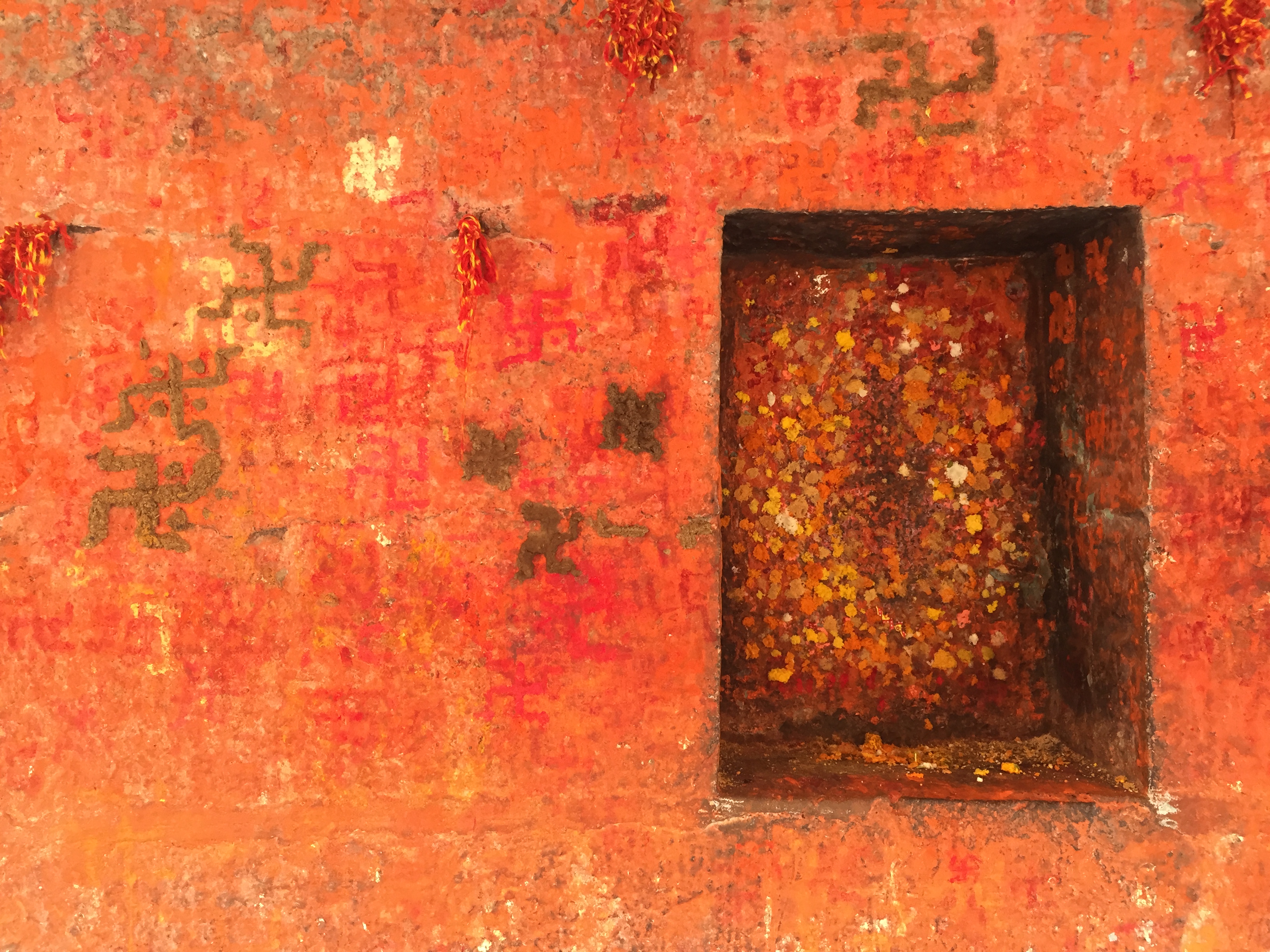
People from far and wide visit the temple with the hope of getting their wishes fulfilled. The faithful believe that if one draws a Swastika (anticlockwise) and makes a wish after praying to Lord Ganesha in the temple, the wish comes true. And then––when the wish is fulfilled––one is expected to re-visit the temple and draw another Swastika (clockwise, this time on). Looking at the hundreds of Swastika drawn on the temple’s walls––both anticlockwise and clockwise––one can gauge the popularity of the Temple.

Swastika and the Sacred Thread

Lately, people have started complementing the Swastika with a sacred thread for the same effect. One ties a thread while making a wish and removes it (or any other thread) when the wish is fulfilled. Thousands of sacred threads tell a tale of belief.

Wishes, unfulfilled and the fulfilled

Some of those whose wishes are fulfilled have a curious way of conveying their gratitude to the God. They weigh themselves in clothes, blankets, sweets or milk or food grain and donate the same to the poor. The poor and the transgender thrive on the generosity and the largesse of the blessed ones. At all times, the temple is thronged by two categories of people––those with wishes to be fulfilled and those, whose wishes have been fulfilled. The first category includes the newly married couples.

Gratitude by weight
To be happily married forever

The next time when there’s an exam to be cracked; a heart to be won; a family feud to be resolved; a lottery to be won; or, peace to be restored in a tumultuous life––think of the two Swastika and the Chintaman Ganesha Temple of Ujjain (sixty kilometres from Indore Airport in Madhya Pradesh).

That, of course, after you’ve done your bit.

Wishes! Wishes! Wishes!