
An excursion ordained by celestial command…
The man I was trying to evade so resolutely, caught up with me at last. He overtook me with a last long stride; turned about with the agility of a gymnast and stood in my way. His hands sheathed in tattered gloves stopped me from moving further. Although I was rankled and trying desperately to steer clear of a brawl in a foreign land, I was sure of my entitlement to self-defence anywhere, anytime. A calmer me was armed with confidence, and coiled, and ready to stun the stranger and execute my escape and evasion, if need arose.
I was panting; so was he. At an ambient temperature of three degrees Celsius our breaths were sending out little grey clouds of vapour towards each other. Did he smell of cannabis? Or, I was imagining things? My naïve olfactory system cannot distinguish smells but I had good reason to believe what I was thinking—he was into drugs; wanted to peddle his stuff.
It was a noisy exchange in a public place. Yet the people around us were unbothered. “Why would they care,” I thought. We were in the heart of Copenhagen, on Pusher Street in Freetown Christiania, the Green Light Area, a haven for hippies and drug peddlers… far from the civilized world. Concern for strangers was an alien sentiment on that shady patch of the planet.
“Will you please listen to me, Sir?” he urged. Very clumsily, he wiggled his hand out of his greasy gauntlet and held mine with forced friendliness, and shook it. “Calm down my friend from India. I mean no harm.”
Friend, or a foe? I was still in doubt. He wore a mud-caked black beret—Che Guevara style, less the star. A deep scar ran across his right cheek. During the just concluded handshake, I had noticed with a sense of creepiness, that the index finger of his right hand was missing. He astonished me with an unexpected act—he joined his hands in reverence and bowed, “Namaste! me Obert Ngoma… they call me Obe…, Black Obe.”
***
The seed of this encounter, which later turned out to be perplexing and grisly, was sown in an Airbnb apartment we had rented earlier that week for a holiday in Copenhagen. I had arrived in the Danish capital from Gothenburg with my son, Mudit; daughter in law, Anjali and granddaughter Maya. My nephew, Nihit along with his wife, Swetha, had travelled from Delft (the Netherlands) to be with us.

The hired accommodation had cherished amenities; a well-provisioned kitchen and a cellar stocked with exclusive wines. There were three tall racks of books. The subjects ranged from travel to literary classics; from sports to baking cakes to origami; from humour to science fiction. There were books on Palestine, Iran and the middle east. Two copies of Cervantes’ Don Quixote, one in English and the other in Danish spoke of the owner’s unfeigned interest in literature.
We spent three days seeing places, clicking pictures, trying local cuisines and buying souvenirs. The fourth day was devoted to Nyhavn. A walk down the cobblestone street—the canal with anchored yachts and historical wooden ships on one side, and colourful 17th century townhouses and restaurants lining the other—was a tourist delight. In the evening, a thoughtfully ordered dinner awaited us in the apartment. The young couples, and the baby crashed early.
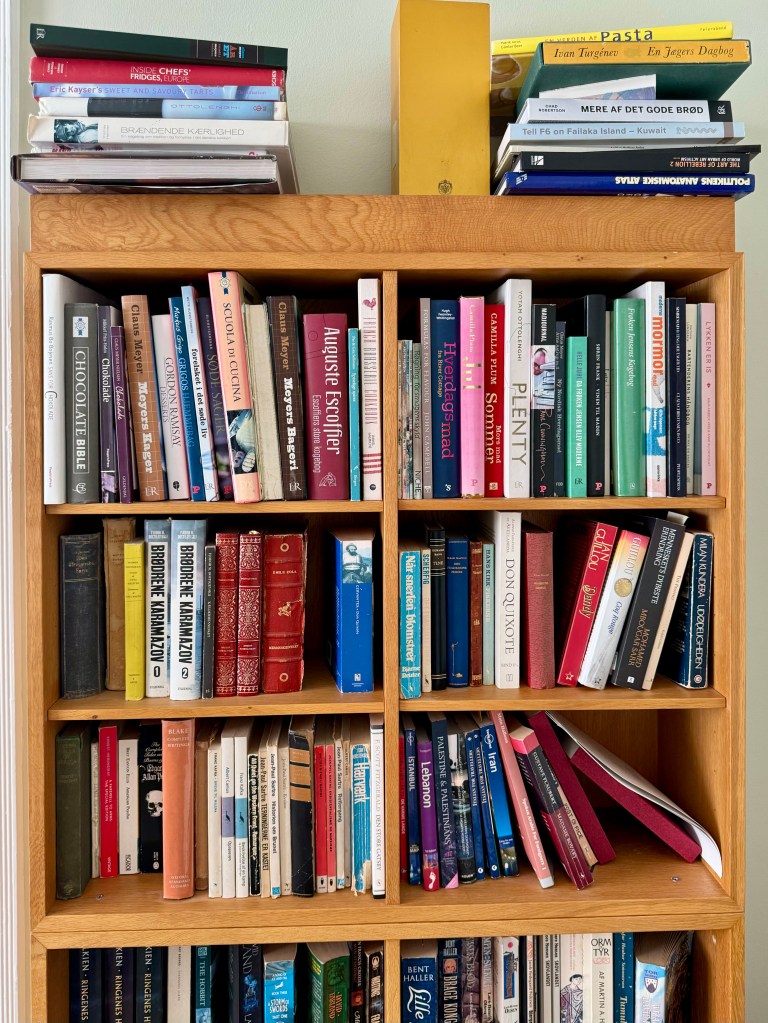
The library of rare books and my habit of reading before retiring, colluded to dodge my sleep. I pulled out The Complete Tales and Poems of Edgar Allan Poe from its shelf and began reading it. It took less than half of an hour for me to appreciate why Poe is considered a master of macabre literature. Suspense and intrigue presented with hallucination in his stories made me sweat.
Past midnight, I returned Poe to its reserved berth on the shelf. His gruesome characters and ghosts were strolling in my mind when I pulled the quilt over me. For reasons unbeknown to me, the night felt ominous. A restless sleep followed an hour of tossing and turning in the bed.
Like a funny bone in people, there is a curious bone too and, I think, I have it in me. On the last day, I wanted to spend the few remaining hours in Copenhagen exploring whatever else we could. “Our train to Gothenburg is at 1:00 pm. Nihit and Swetha’s flight to Amsterdam is at 3:00 pm. We still have about five hours in hand. Is there another place we can visit in Copenhagen?” I posed the question to nobody in particular.
“I wonder if Christiania might interest you,” queried Nihit.
“What’s it known for?” I asked.
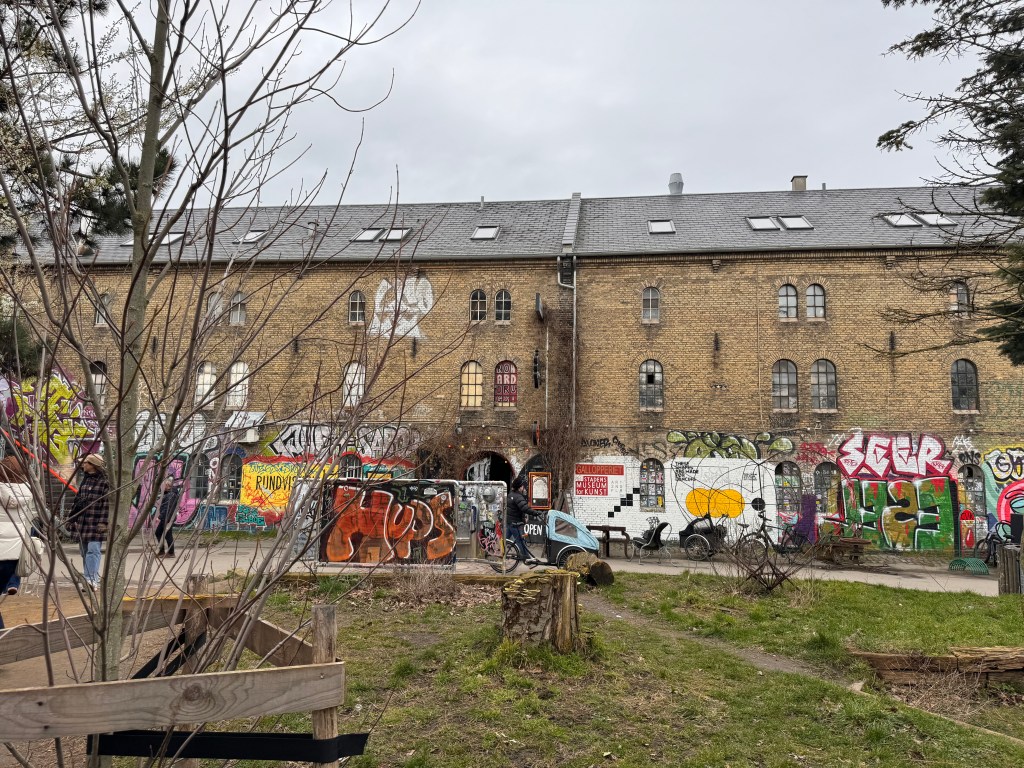
“It is an insulated anarchist territory within Copenhagen. It was founded by squatters seeking freedom. They occupied abandoned Danish military barracks of the WW II era, and declared Christiania an independent country. It is notorious for open sale of narcotics. There are occasional gang wars, and fights between the drug-peddlers and the people who strive to put a stop to drug peddling. It’ll be a good experience visiting that place; I suggest you take this trip while we wind up here. You might find something interesting to write about.”
A little later, my ordeal began in Christiania
***
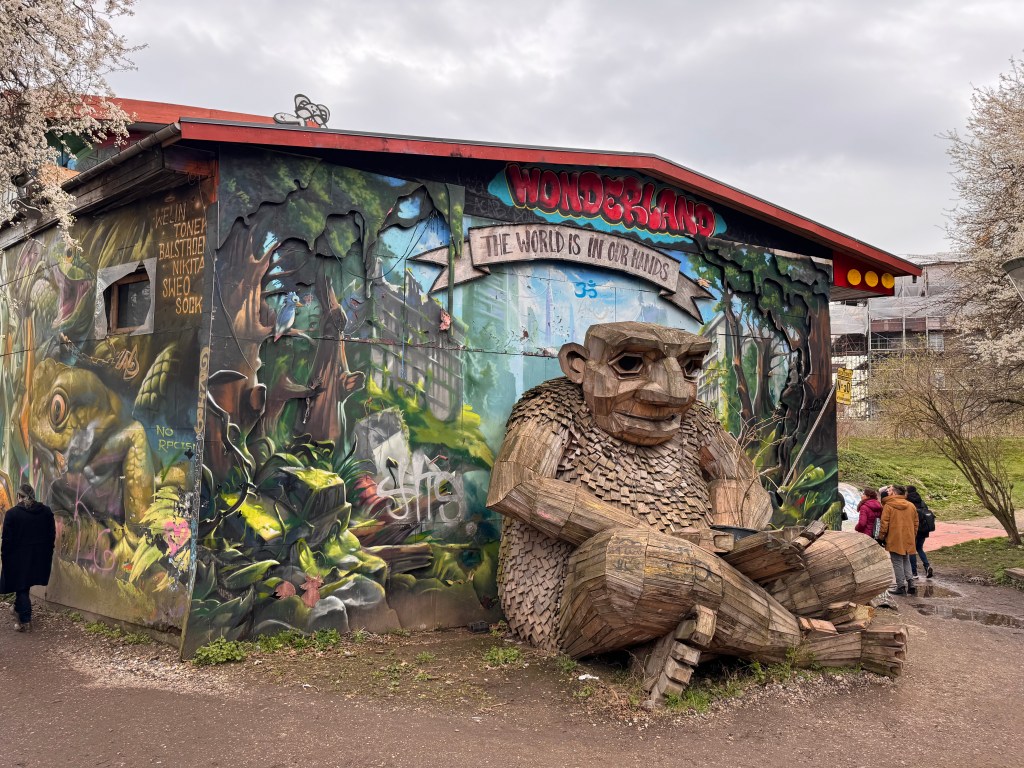
Obe calmed me down with meaningful arguments and won me over. He succeeded in proving his harmlessness, and prevailed upon me to visit his shack nearby. His little dwelling was neat and tidy. The walls were painted with slogans, and religious symbols like the swastika, the om, the holy cross, the crescent and many others, which I didn’t recognise. Earlier, on my arrival in Christiania, I had noticed with surprise, the Hindu symbol of om painted on the wall behind a giant wooden statue of a weird crouched man—the so-called free man—sitting in what appeared to be the padmasana (the lotus pose in Yoga) at the entrance to the hamlet. The caption read: “The World is in our Hands!” I had also seen the obsession of the dwellers of this weird world with the lotus flower resembling the party symbol of the BJP of India. Stickers, depicting the flower were on sale everywhere. I felt more at ease when I saw Obe flaunting a string of rudraksh beads.
“Howsoever queer this man might appear; he doesn’t seem to have bad intentions.” I was very consciously lowering my guard.
“A coffee for you, Sir?” Obe asked me, and taking my yes for granted, flipped the switch of his electric kettle. Meanwhile, my roving eyes spotted a tattered pocket book version of the Geeta and a bible on a shelf. In a corner, the amber flame of a candle nested in a shining pewter stand, vied with the blue grey smoke of the incense sticks, to reach for the roof. I had a hunch that the things around me were conveying messages, which I was not comprehending.
Without preamble, Obe began talking about his vision of a drug-free peaceful world. He elaborated what his colleagues, and he was doing to realise their common dream. “A place like Christiania has a shelf life before the vested interests destroy it. The pioneers wanted this place to be a Utopia and strived for it, but those who came later, have plundered it. The glamourous appeal of our kind of world remains long after the reality decays. Anarchy is enticing, but finally, we need a stable society. Me think, Yoga and spirituality can get us back on track.” He said as he offered me a chipped porcelain cup filled to the brim with steaming coffee. He paused for breath but didn’t allow me to speak.
“It’s a noble idea. I support it whole-heartedly like I support all other causes. The LGBTQ and women’s rights, child labour, global warming, nuclear non-proliferation, Rohinghiyas, Eskimos, elephant poaching and what have you… but I am not the kind of activist who’d join candle marches, and further aggravate global warming. In fact, I am not an activist at all. I am fine with silent support to all causes. But, by the way, Mr Obert Ngoma, what do you expect me to do for your specific-to-Christiania cause?” I said to myself and then, to appear interested in his life’s mission, I spoke aloud, “I wish governments took this issue more seriously.”
What my host said next, surprised me.
“LGBTQ and women’s rights, child labour, global warming, nuclear non-proliferation, Rohinghiyas, Eskimos, elephant poaching and what have we…. one doesn’t have to join candle marches; they only aggravate global warming. There’s no need for one to be an activist at all….” He repeated my thoughts verbatim, almost. Was he a thought diviner? Black Obe gave me a premonitory shiver.
“Me been watching you, since you stepped into Christiania about an hour ago. Me trail all visitors of interest. Me study them, and seek help for our cause from those who, me think, can make a difference,” he continued.
“I am leaving this afternoon. I wonder, how I can be of any help to you?” I asked.
“Me colleague, Nevin Abrahams resides in Gothenburg. He used to be on cannabis until we met; he struggled, and gave it up… for good,” Obe’s eyes lit up like little lanterns, “Never took a milligramme of it until bad people pushed him into the hell again.”
I listened to him intently.
“We could bail him out again but, by then, his health had deteriorated. He’s mostly bed-ridden now. Me been visiting him every week, and have been taking him out, sometimes. It makes him feel good.”
“What was Black Obe expecting of me?” I was getting curious.
“Lately, me been too occupied to visit Nevin… been requestin’ visitors like you to do me small favours. Since you goin to Gothenburg, Me wanna request you to….”
He was quick to put off a sliver of simmering suspicion and hesitation my hurriedly acquired knowledge of Christinia had bred in me. “Don’t you worry, Sir. me not askin’ you to deliver nothin’ to him, lest you think me tryin’ to use you to peddle bad stuff. Me, Black Obe, ain’t doin’ that. Me just wanna’ me friend feel cared. He’ll be delighted if you meet him. It’ll be great seeing someone from India—someone from the land that gave us Yoga; the land that epitomises peace and harmony; the land of Mahavira and Buddha.”
He upgraded his request when he saw me yielding, “Nevin has been missin’ outings with me. He’ll be on top of the world, if you could take him out tonight. He doesn’t stay very far from where you are puttin’ up on Barytongatan; just a little more than a mile away; close to St Matthew’s Chapel.”
“How did he know, I was putting up on Barytongatan?” Obert’s knowledge of me astonished me to no end. He didn’t allow me to interrupt him, and ask him about how he had come to know what he knew about me.
“The easiest way to reach Nevin is to ask anyone at the Chapel or around there, and they’ll be pleased to guide you to where Nevin Abrahams—the man who fought drug mafia like none other—resides. You don’t need no address to find me buddy.”
Obe didn’t have a mobile phone. “I can do without one,” he said when I asked him for his contact details. Very reluctantly, he clicked a selfie of the two of us on my mobile phone when I suggested that I carry his pic for Nevin’s sake.
The story of my meeting with Obe elicited a positive and chorused response from Mudit, Anjali, Nihit and Swetha: “You can bring untold joy to Nevin. Time permitting, you must say, ‘Hello’ to him… nothing like it, if you can take him out.”
***
Gothenburg. 5:00 pm.
It was still broad daylight; sunset would be at 8:00 pm. The outside temperature was hovering around 4°C. Snowfall had been forecast after 7:00 pm. A week hence, I would be setting course for Delhi, so Mudit and Anjali had called over their Indian friends— Keshto and Bipasha, a couple who hail from Kolkata—to meet me. When we reached home, Mudit and Anjali got down to preparing dinner for the guests. Since I had little to contribute in the kitchen, I proposed to take a walk to meet Nevin. The aim was to tick an item on my To Do list.
“That’s a good idea,” said Mudit, “More than two hours to go before Keshto and Bipasha arrive. You can put this time to good use by meeting that guy and conveying Obe’s wishes to him. He’ll be pleased.”
“St Matthew’s Chapel is not far. I should be back in a little more than an hour—well in time to welcome your friends,” I said as I stepped out of the apartment.
***
My mind wandered as I walked to my destination. For reasons which I couldn’t place my finger on, my interaction with Black Obe kept intriguing me. My consciousness began drifting like a feather in gentle breeze. In a while on the road, I was overcome with a feeling that I wasn’t taking that short trip to meet Nevin; the trip was taking me. Meeting him was an unenthusiastic commitment which I had accepted gingerly. But, the urge to comply with it, now felt like a celestial command.
***

St Matthew’s Chapel was deserted. The doors were closed. I pressed my face on to a window pane to see if there was anyone inside. The inner sanctum gave me the impression of an abandoned masonic lodge. My breath fogged the cold glass and blurred my vision. I wiped the smooth surface with my sleeve to get a clearer view when I felt some movement behind the main door. I stepped back and waited. The door handle moved down and the old wooden door creaked open just enough for me to get a whiff of the inside air laden with the mixed odours of damp linen, aged paper, mold and old leather. Beams of light entering the Chapel through the panelled windows illuminated cobwebs and floating dust particles. Everything inside was draped in sepia. Disuse hallmarked St Matthew’s Chapel.
A tall man slipped out when the door opened wider. He wore a dark robe with a hood that covered most of his face. Pale white Franciscan Cincture with its three knots—signifying poverty, chastity and obedience—secured his waist. His skin was white; white as white could be; and hair, blonde. Strange as it may sound, his very light brown eyes without eyebrows appeared to be wrinkled; they kept popping out and retiring into their sockets at will. His sparse, equally white eyelashes were merging with his skin. He reminded me of Silas, the Opus Dei character of The Da Vinci Code. It was very difficult to judge his age except by the crow’s feet at the outer ends of his eyes—they became more prominent when he squinted to see me.
The white man scanned me from top to bottom and then let his eyes linger on my face. I felt intimidated. When he opened his mouth to speak, I discovered that he had prominent canines. The large gaps between his teeth were dark scarlet.
“Yes?” he hissed.
“I am Ashok Chordia. Mr Obert Ngoma has guided me to this place. I wish to meet one Mr Nevin Abrahams. I wonder if you could guide me to where he stays.”
“Who… Obert Ngoma?”
“He’s the dark guy… from Freetown Christiania…,” I scrolled the picture library of my iPhone to show him my picture with Obe. I was shocked to find that in the selfie which Obe had clicked, Obe was missing: only I was there in the frame. How did he go missing from that picture? I had seen the picture when he had clicked it; he was very much there.
“Do you mean Black Obe, by any chance… missing index finger; scarred face?”
I nodded approvingly.
“Oh, Obe… Black Obe… my boy! ‘He’ has sent you?” There was a strange emphasis on ‘he’. I get it now… Nevin Abrahams… yes, yes, of course. I was, indeed, expecting you.” His demeanour changed for the better, but not good enough to make me feel easy. “…good guys, both of them, Black Obe and Nevin. They belong to a different league; live in a world of their own. Obe keeps sending requests for odd little favours. Have you joined these guys?” I felt he wasn’t actually seeking an answer to his question; I remained non-committal.

“Come, let’s go! We’ll take this short path. I am Aldersen… Hens Aldersen. You can call me Hens. I am the custodian here.” He led the way; I walked half a pace behind him. The short path he chose was through the Western Cemetery. The gently undulating ground on either side was lush and tidy. Neatly aligned grave-stones filled me with sobriety and awe. I felt the world could take a lesson in respect-for-the-dead from the Europeans.
***
“Have you met Nevin lately? How’s he doing?” I asked to dissipate the growing discomfort I was experiencing.
“Met Nevin lately!” the cloaked man exclaimed. “What do you mean… have I met Nevin lately? He is dead… died long ago. Didn’t Black Obe tell you?”
“Dead? Died long ago! Then, where are you taking me?” I was going nuts.
“I am taking you to the grave where he lies interred.”

Before I could recover from the shock I had just experienced, we were at Nevin’s grave. The epitaph read: “TAKE ME OUT TO NIGHT.”
“In his last days, he used to wait very impatiently for Obe. Black Obe used to visit him every weekend without fail; used to take him out. Nevin died when he got the news that Obe was killed in the crossfire between two gangs. Poor Nevin… he couldn’t take the shock,” Hens stunned me yet again.
“You mean… Black Obe is also dead? Did I meet a dead man in Christiania?” Hoping, that was not the case, I waited in trepidation for what Hens might say next.
“Both, Nevin and Black Obe are dead.” The custodian’s voice reverberated even in the open. “They died unnatural and untimely deaths. Since they were passionate about their mission, and the mission remained incomplete, their spirits keep returning. Sometimes, Obe finds people to visit Nevin, here, in the Western Cemetery. I facilitate the visits.” Hens stood solemnly facing Nevin’s tombstone. He touched his forehead, heart and the shoulders—signifying the Father, the Son and the Holy Spirit—to invoke God’s blessing and protection.
Even in that intriguing moment, I knew that people would never believe what I had experienced, so I quickly clicked a picture of Nevin’s tombstone. Then, with no further word, I pirouetted and took my first step away from Hens. I heard him say, “Hejdå,” to my back. I didn’t respond to the Swede’s goodbye; I was in a hurry to be somewhere else. I wanted to be back home; back with my people. To make things difficult for me, several snowflakes fell on my face and signalled the snowfall that had been forecast by the weather man. So that I was not stuck on the way, I took a tram back home.

It was snowing at Nymilsgatan, where I disembarked the tram. Everything around was covered in a white sheet. Another chapel on the way looked haunted. Cautiously, I trudged the slippery path in front of me.
***
Keshto and Bipasha had just arrived when I reached home. I took several deep breaths to calm my unwieldy emotions before I narrated my evening’s experience to everyone at the dinner table. None believed me until there was another twist. Keshto looked at the picture of Nevin’s tombstone on my mobile’s screen and declared, “Black Obe and Nevin are dead men; so is Hens Aldersen. He died nearly 200 years ago.” He pointed at a tombstone in the background of Nevin’s. It belonged to Hens Aldersen. Keshto’s curiosity, and the following investigation, led to another startling revelation—St Matthew’s Chapel has remained closed ever since its custodian, one Mr Hens Aldersen died under mysterious circumstances in 1829.
***
 Road Much Travelled