
“RUM.”
The first time I came across that word was when, as a schoolboy, I read RL Stevenson’s Treasure Island—Captain Bill humming: “Fifteen men on the dead man’s chest — Yo-ho-ho, and a bottle of rum!” I was too small then; didn’t heed the RUM part of that utterance. My first, real introduction with RUM, however ‘happened’ in a uniquely comical circumstance.
Mukesh Kumar, my senior and my cross-country team mate at St Stephen’s College, and I was on an endurance run on the ridge road when it started pouring. We pressed on regardless. In a while, a cab came to a halt by our side; the occupant signalled, rather insisted, that we took lift in his cab. So, there we were—a dripping Mukesh sitting beside the stranger in the rear seat, and I, shivering by the side of the driver. The man was swigging from an almost empty bottle of rum. He was happy; happy as one could be after downing more than a pint of the hard stuff. He proffered a fresh bottle for us to take sips in turns.
We declined but then, succumbed to his pestering for just one sip. I hated the unfamiliar taste and the burning sensation in my throat on taking that one sip. I wasn’t sure then, whether I would touch RUM ever again. And, although how I got introduced to the dark drink that rainy day has remained etched in my mind, my most memorable RUM session, a Quixotic one in that, took place about six years later.
At this point, a brief preface would be in order.
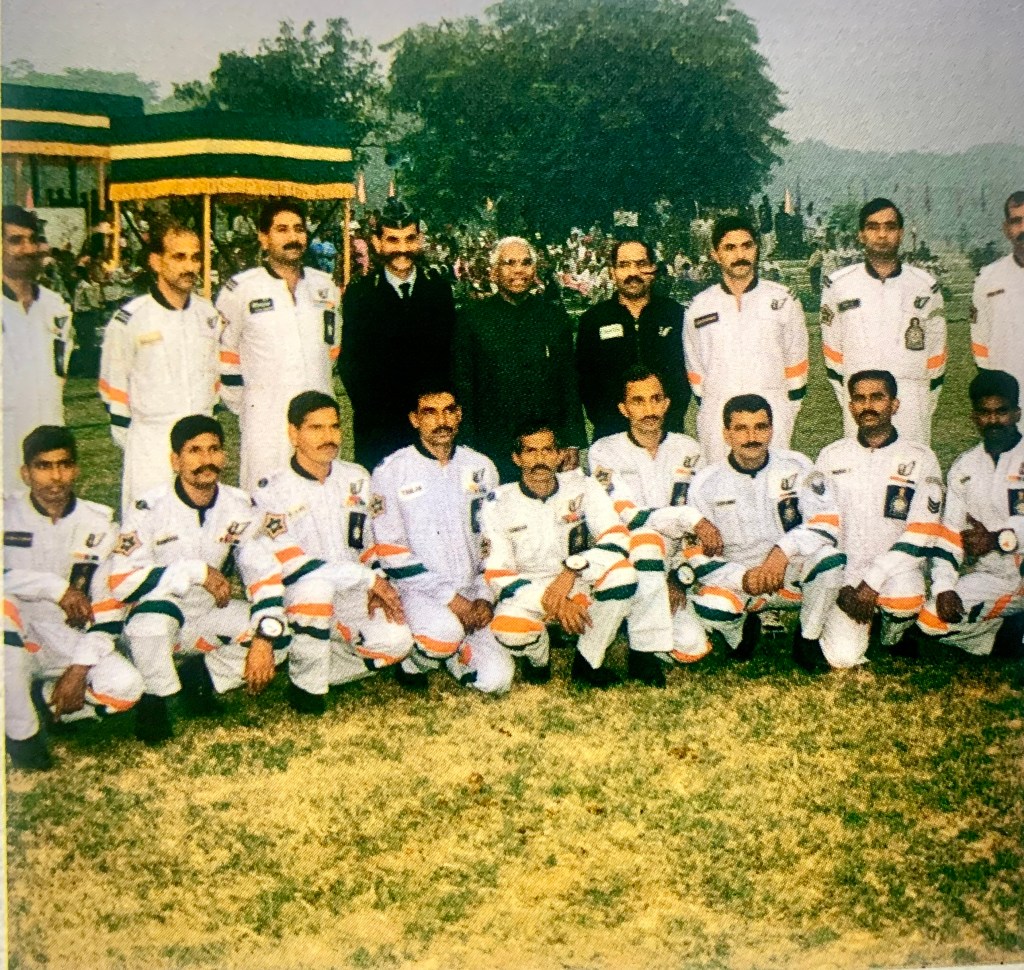
I left St Stephen’s to join the NDA; was eventually commissioned in the Air Force, in 1981. In the following year, I trained and became a Parachute Jump Instructor at the Paratroopers Training School (PTS), Agra. It was a turning point in my life—people started treating me as a differently-abled (they actually meant “exceptionally-abled”) individual everywhere, including, the bar. Yet, despite the nudges and needling like, “What sort of a paratrooper are you…, how come you don’t drink blah… blah,” I didn’t take to regular drinking. Two small helpings of anything—rum, gin, whiskey or, even wine (honestly, I couldn’t identify them by taste)—used to satiate me.
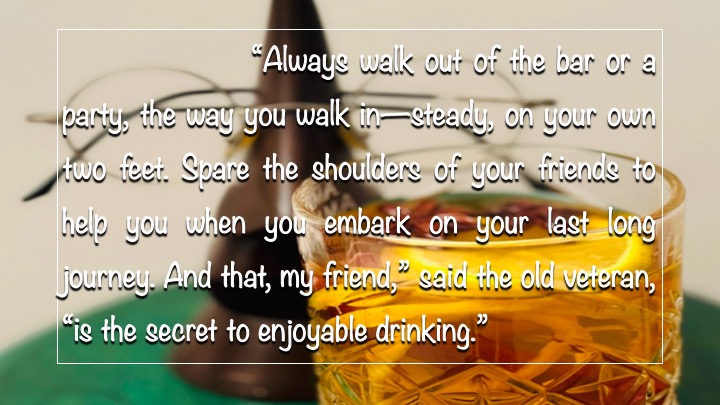
“Look at me… five feet, f*** all inches. Don’t expect my capacity to be great,” has been my standard plea to those, and there are many of them, who insist on my having more drinks than I choose to consume. I try to follow a veteran’s advice in this matter.
I guess that description of my relationship with hard liquor puts my hospitality under a cloud. But I don’t think I’m all that bad a host in that regard. I sincerely try to offer my friends and guests drinks to their satisfaction. Invariably, Master Chef Chhaya covers up my inadequacies with her culinary skills at the dinner table.
Returning to the Quixotic Rum Session—it was a Saturday evening in June. I don’t remember the year. And, the social coward that I am, I’ll not mention the names of the colleagues involved because some might object to inclusion of their names in the mildly boisterous incident fringing on un-officerlike behaviour; others might take offence to their names being left out.
Chhaya, and I, had planned a get together at our residence—a cosy little bungalow in one corner of the Air Force Station. We called it, “Para-dise” (mind the hyphen and “Para” as in “parachute”). We were busy addressing our shared responsibilities when a Despatch Rider (DR), a messenger on a throbbing Enfield bike, arrived with the message that night para jump sorties had been planned. “Take off, 1900h (7:00 pm); you have been detailed as the Drop Zone Safety Officer (DZSO),” said the DR.
DZSO duty entailed reporting at the Malpura Drop Zone, 11 kms away from home, an hour before the first aircraft (paratroopers on board) took off. Simply put, it entailed coordinating and doing things to ensure that the paratroopers jumping from the aircraft (those days, it was C-119 Fairchild Packet) landed safely in the designated area. Five para drop sorties commencing at 1900h meant that I’d be home late; it could be later than 2300h.
Some other officers from among our invitees would be involved in the conduct of the night para drop—one of them would be there to supervise the emplaning of the jumpers; some others would like to grab the opportunity to log a night jump. Thus, on the threshold of being executed, our plan of the get together lay in ruins. We didn’t have residential telephones; and mobile phones didn’t exist, so I went around on my Vijay Super sharing my predicament with people on my guest list. We decided that, all the ladies, and those officers who were not engaged in the conduct of the para drop would still congregate at Para-dise. The rest of us would join after the completion of the scheduled jumps.
At the Malpura Drop Zone.
It was full moon; the sky was clear; the winds, calm. But the weather was hot and sultry. Having marked the DZ, we, the DZ Safety Team, sat there on a 10 m circular cemented platform in the centre of the 1.5X2.0 km Drop Zone and slapped mosquitoes as we chatted and waited for the aircraft. Cold water from an earthen pitcher provided occasional comfort. We talked of many things under the moon, but none cursed the administration for planning ad hoc para drop sorties and ruining the weekend. In the heart of our heart, we knew that on the timely completion of training jumps depended the parachute jump pay of the troops. Besides, a delay could cost some of them, their planned leave. Therefore, it was imperative that the availability of serviceable aircraft on good weather days be fully exploited. Mission first!
The aircraft came overhead as planned; dropped troops and returned to base. Repeated. By 2200h, 200 troops had jumped and landed safely. There was no injury, incident or accident. The troops would take time to bundle their parachutes and rendezvous at the control tower in one corner of the DZ.
We still had an hour or so before we could close shop.
Meanwhile, as expected, my buddies who had jumped that night, rolled their parachutes and joined me. I was expecting them to convey their condolences over the sad demise of our plan, the plan to party. Far from it—one of them gave me a big surprise by taking out a bottle of Sea Pirate, a popular rum in those days, from his haversack. He had carefully packed the bottle and jumped with it. Another, took out two packets of potato chips—the contents had got crushed during the jump. We were ready to start a celebration of sorts when spirits dipped momentarily. There was only one small dented and battered aluminium mug and we were six people (including two of my DZ Safety Team). Without glasses, how would we enjoy the RUM?
Where there’s a will; there’s a way!
Someone came up with a simple, stupid workable solution. We sat in a wide circle around the pitcher and passed around the bottle of Sea Pirate followed by the mug filled with water. Each one took a sip (large or small, at will) of the dark rum and a sip of water in turns. It was like folks sharing hukah on a village chaupal. It was bliss! It was Nirvana! To me RUM has never tasted as good as it did that moonlit night on the Malpura Drop Zone.
Soon we were at Para-dise—the party continued until past midnight.
A few days back, I came across a social media forward. It was the recipe of a drink using rum. It looked exotic. Sadly, even before I could try it, I lost it in the junk on my mobile phone or maybe, I deleted the link. Now, I cannot recall its name also. Yet, desperate to try it, I concocted my own version of it—from whatever I could recall—and tried it. It tasted good. Then I served it to a friend. He too relished it and asked me the drink’s name. In a spontaneous response, I called it: “Green ON! Go!” “Green ON! Go!” is the command on which a paratrooper jumps out of a perfectly well flying aircraft hundreds of feet above the ground. A top-of-the-world feeling follows the exit from the aircraft.
For those interested, here is the recipe.
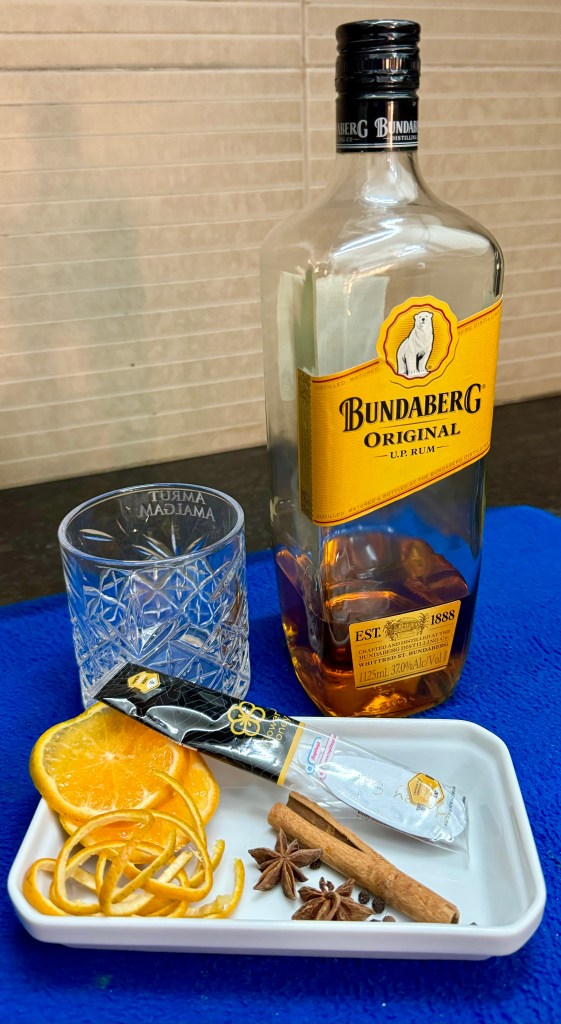
Ingredients
- Dark Rum (30 ml) – This quantity may be tweaked to taste
- Cinnamon (one stick) – Cinnamon has many health benefits. CLICK HERE to read about some of them.
- Star anise (two pods) – It is a spice used in traditional Chinese medicine. It has powerful bioactive compounds that may help treat fungal, bacterial, and viral infections.
- Black pepper (six pods) – Black pepper too has many health benefits. CLICK HERE to read about some of them.
- Orange (one)
- Honey (one teaspoon)
Getting Ready
- Cut a slice of orange with its peel
- Remove the peel of the remaining part of the orange and cut it into long fine shreds
Here we go!
- Boil 250 ml water
- Add cinnamon stick, star anise and black pepper. Continue boiling for five minutes
- Arrange the shredded orange peel at the bottom of a glass tumbler
- Pour the contents (boiling water with cinnamon stick, star anise and black pepper) into the tumbler.
- Add honey; stir gently.
- Slowly, add 30 ml dark rum. Don’t stir. Let the RUM linger long and merge with the concoction at its pace.
- Gently place the slice of orange on the surface.
Raise a toast to paratroopers and say, “Green ON! Go!”
[Sometimes, I add a spoonful of orange pulp to suit my taste.]
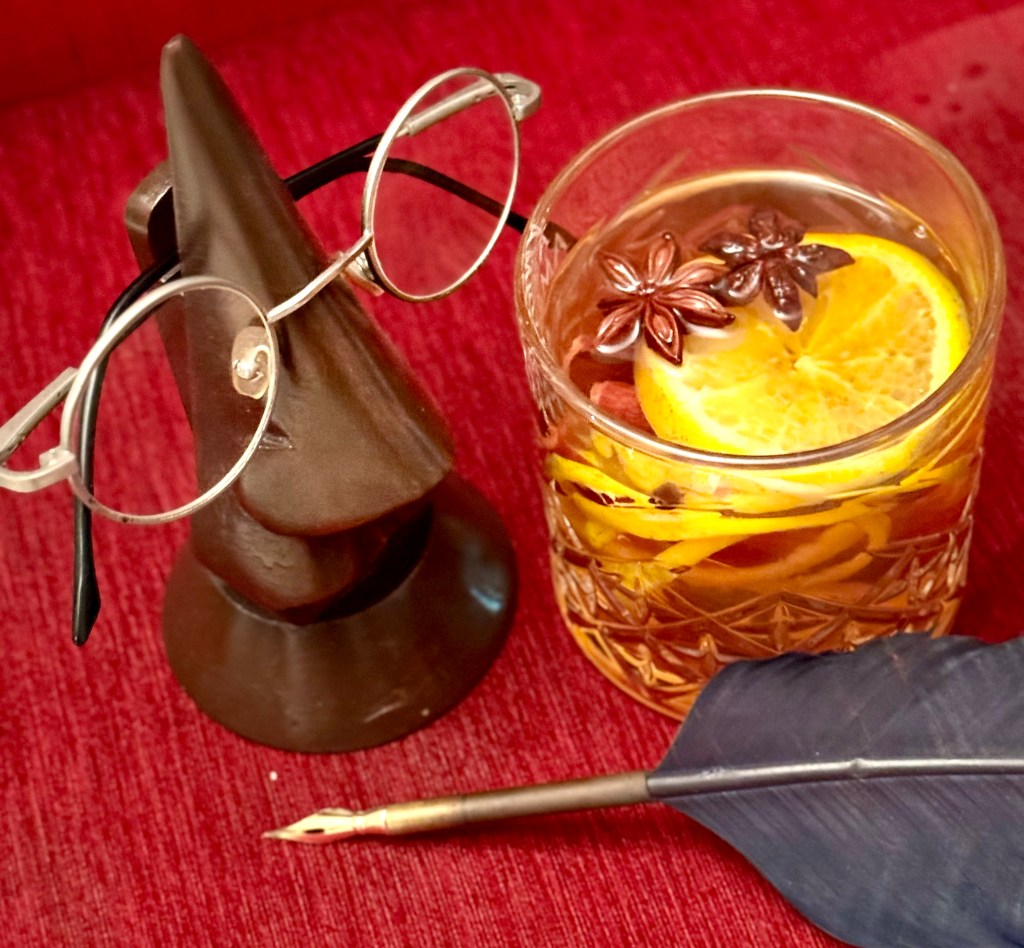
An afterthought Forget the health benefits of the ingredients, I find the process of making “Green ON! Go!” therapeutic. Then, the drink itself… cinnamon and pepper give a distinct flavour. The slice of orange and star anise floating in the tumbler, is soothing to the eyes. The bitter sweet taste of orange and honey… and above all, the lingering RUM merging slowly with the surrounding water is a treat to the soul. On a winter evening, with subdued lights and soft music, a sip of it gives me a top-of-the-world feeling.
Some valued responses
Wg Cdr Vijay Ambre (Veteran): Dear Ashok, I enjoyed reading “Green On! Go!!” as much as I have all your other writings. It evokes memories of our lives in the transport stream of the Air Force; where “our ” times were never ours. Innumerable cancelations/absences that were always treated as a way of life by the family. As for the drink recipe, although, I enjoyed reading it ,I am not going to make GOG ,as I turned teetotal and gave up non-veg food aeons ago. Here’s wishing more power to your pen!👍👌👏
Air Commodore Ashok Kumar (Veteran): Ashok nicely written, as smooth as Patiala Sea Pirate. Chug it!
Air Commodore JV Paul: Sir, your para-normal skills are matched by your anecdotal skills!!!😁👌 Your exploits were already legendary by the time I entered the An 32 fleet in ’88 with the Yaks, and then reinforced and cemented by the time I entered the Skyhawks kingdom in 2007.
Much more water had flowed beneath the bridge by the time my daughter entered the portals of Amity Noida to do her Architecture course. And she had the pleasure of Chhaya Ma’am’s benevolence as a hosteler there, especially after I disclosed my Skyhawk connection to Ma’am. The Skyhawk stint remains the high point of my career. Chhatri Mata ki Jai!
Virendra Singh Mann
Thoroughly enjoyed reading the post “Green On! Go!” Felt as though I was reading a novel. But I know this must be for real. Thank you so much for sharing. 🥃Cheers to a bottle of rum.
Viney Sharma
Hello Ashok, Very interesting read and I can fully relate to it.
In 1967 I got introduced to RUM (Hercules XXX @ Rs 10/ bottle from the CSD). 4 of us from college had gone on a trekking trip in Kashmir. We had taken a shikara to Char Chinar in the middle of Dal Lake (probably a full moon night). One of us with fauji connections produced the bottle from his backpack. It was quickly consumed with much back slapping and leg pulling. Don’t remember how we got back to our lodge but still remember the massive hangover next morning.
Squadron Leader RP Mittal (Veteran)
Nostalgic and smooth capture of the spirit of the moment in narration. 😊
Wing Commander Pradeep Dahiya (Veteran)
As always great read. Your writing has a wonderful capacity to stimulate imagining the scenes and characters . Thoroughly enjoyed.
Raghu Ramakrishnan Aiyar
Lively and highly, ” Spirited’, anecdote. Smooth, it flowed; Sublime, it lingered; Sensational, it spoke of the Para Jumps, even as the GreenON! Go… went on and on, wild and wanton👍👍👍👍

 Road Much Travelled