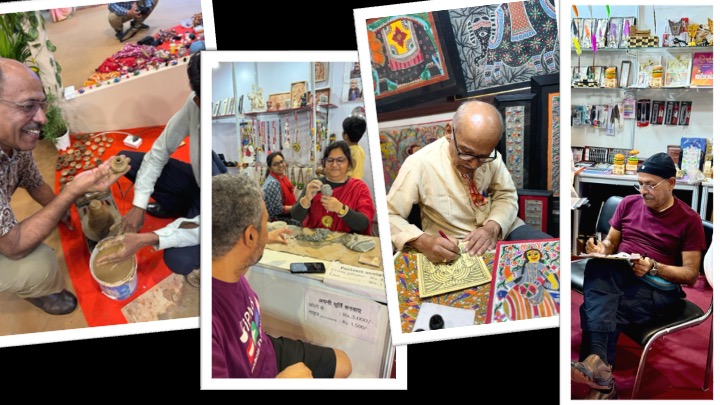
All have their own definition of it; and, it changes from time to time. For now, for me, it is a feeling of contentment and satisfaction one gets when one does something one has never done before. The other day, I experienced just that, when I spent quality time at the Trade Fair in Pragati Maidan. An artisan allowed me, and encouraged me to work on his potter’s wheel. With a little guidance and help, I could fulfil a desire I had nurtured since childhood. I could make a miniature vase; I felt, I was on top of the world.
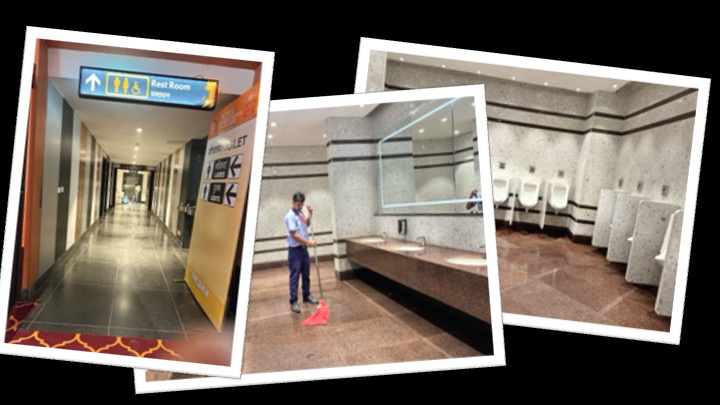
Spick and span…a different Pragati Maidan
In another stall, it was therapeutic to watch a lady work on the clay bust of a person sitting opposite her. I have seen umpteen artists making caricatures likewise, but never a person making a clay bust within minutes. Watching Mr Indrakant Jha engrossed in Madhubani art was a treat to the soul.
I had never experienced virtual reality before. So, flying a parachute canopy (in virtual reality) at the NTPC stall, seven years after I made my last parachute descent, was a top of the world experience.
Conscientious staff…
The child in me went berserk when I found a stall displaying writing instruments. I spent the good part of an hour trying my hand at calligraphy. If I had had my way, I’d have spent the entire day visiting the remaining stalls and exploring the other options.
In itself, the experience was exhilarating; it became more so because of the improvements I saw and experienced at the fair. To cite a few — the new underground parking is very well organised; comparable to any good mall in the NCR. Everything in and around the halls is spick-and-span. The public utilities are sparkling clean. The absence of litter, even around the eateries, is a pleasing sight. There are conscientious staff to maintain the surroundings. The security staff and those at the help-desks are courteous. The thoughtfully designed and placed signage makes things convenient.
Let’s be “good”
On the whole, our experience was in sharp contrast to what we have seen in the years gone by. People who are striving silently to make this possible deserve Kudos.
On our part, let us help them in their endeavour by just being ‘good’.
Post Script
This description of our visit to the Trade Fair would be incomplete without the narration of our interaction at a stall displaying Gujrati garments. Chhayaji liked two dresses and decided to buy them. When she tried to bargain with one of the salespersons, the lady said with a lot of pride, “Like Modiji, we are Gujratis! We are upright people. We do not tell lies about price; we do not leave a scope for haggling.”
…fir bhi dil hai Hindustani
Amused, I asked her, “Why are you dragging Modiji, in this conversation?”
“Because, he is an upright leader; and he is a Gujrati,” she chirped with even greater pride.
“Why do you say you and Modiji are Gujratis? Aren’t we all Indians—you, I and Modiji? Think of it, it is only a matter of time, even Trump and Nigerians will stake a claim on Modiji. What will you do then?”
She laughed heartily at my quick-fire repartee; gave us a handsome rebate. We thanked both, the lady, and Modiji, profoundly before leaving the premises.
It will be interesting to know Modiji’s “MAN KI BAAT” someday on belongingness to a state, the nation, and the world.
To a seasoned skydiver, the vision of a packed parachute on the back… the open door of an aircraft flying a couple of thousand feet above the ground… and a blast of air hitting the face is like a saucer of cream on the mental horizon of a cat.
The exhilarating feeling is irresistible. A jumper would go as far as one can to satiate the desire to skydive. The Parachute Jump Instructors (PJIs) of the Paratroopers Training School (PTS), Agra are no exception. Drop a pin anywhere on the map of India and in a radius of fifty miles of the pin there will be a place where Akashganga, the Skydiving Team of the Indian Air Force (IAF) would have carried out a skydiving demonstration as a part of a major national event or a military tattoo. If not a demonstration, it would be a paradrop as a part of an airborne military training exercise.
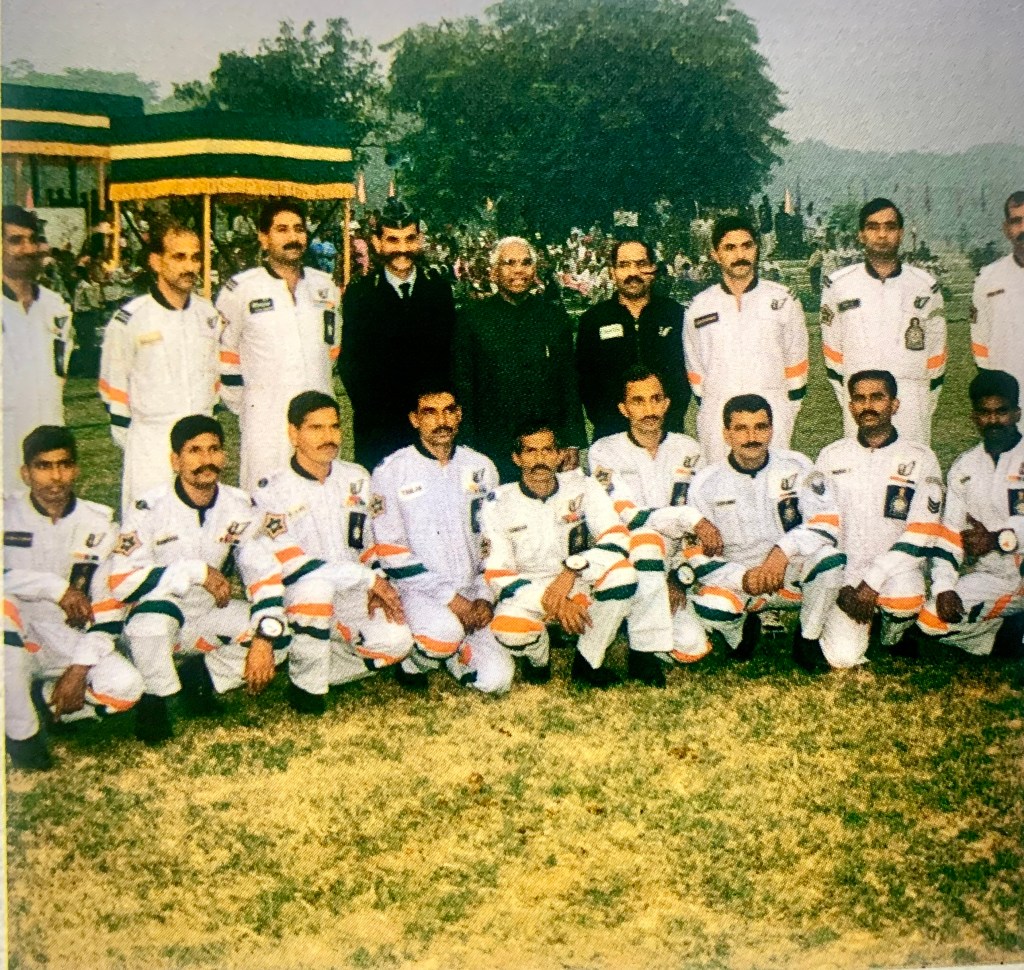
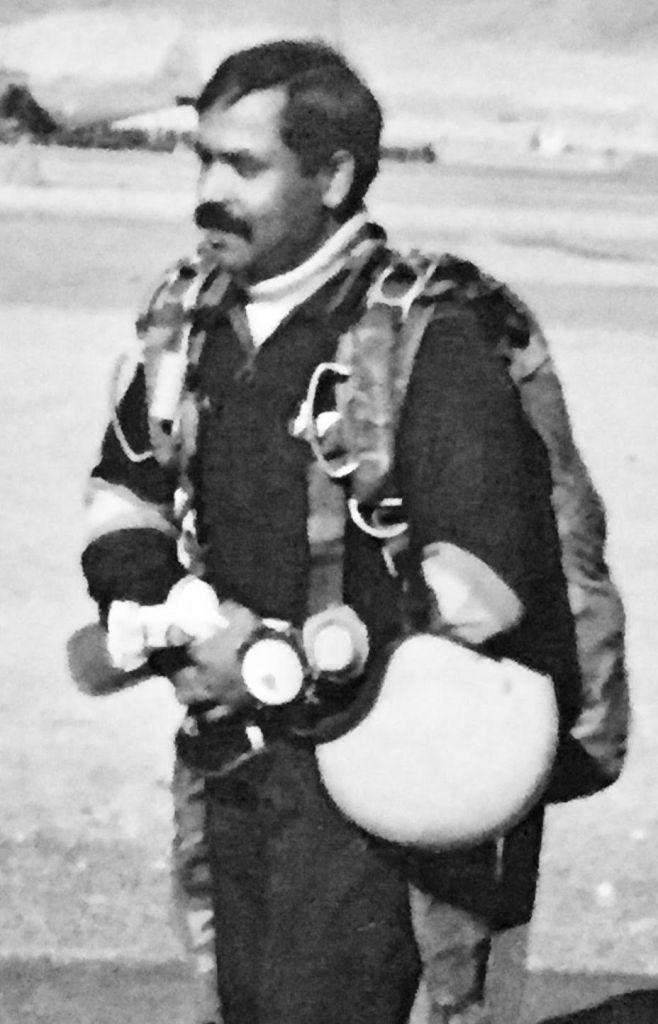
Thanks to my tenures of duty as a PJI, I have been a part of many such displays. From the identification, reconnaissance and exploration of new Drop Zones in the freezing cold Leh-Ladakh region and trial jumps on those Drop Zones, to the exit over the Indian Ocean to land on a target in Thiruvananthapuram, each jump I undertook was different from the other and memorable in a unique way. When I look back, some stand out. An interesting one that often returns to the mind is the one performed as a part of the raising day celebrations of the President’s Bodyguards in November 1998.
High Altitude Jump Trials
I was then the Assistant Director of Operations (Para) at the Air Headquarters.
It was a Herculean task to get the requisite permissions and clearances for the demonstration at the Jaipur Polo Ground. With the who’s who of Indian leadership residing in Lutyens’ Delhi, security was a big concern. Jaipur Polo Ground was not far from the Prime Minister’s Residence. “It would be imprudent to allow such ‘frivolous’ activity in this area,” was an opinion. Then there was the issue of availability of airspace in the proximity of the busy Indira Gandhi International Airport where an aircraft takes off or lands almost every minute and dozens guzzle fuel as they await their turns on the ground or orbit in the nearby sectors. For many well-meaning people, disrupting the air traffic for a skydiving demonstration was an avoidable proposition. An easy way out for those in authority was to say: “NO.”
Notwithstanding what was happening on the files between the Air Headquarters, the Army Headquarters and the South Block in Delhi, the jumpers were agog, drooling. They were excitedly looking forward to the opportunity to jump at the prestigious event to be witnessed by the Supreme Commander of the Indian Armed Forces. Shri KR Narayanan was the then Honourable President of India.
How the permission to undertake the skydiving demonstration came about is the subject matter of another story. Suffice it to say that it did come—somehow. There were caveats, though. We were directed to operate from Air Force Station, Hindan. A team of security experts would sanitise our aircraft and inspect the parachutes for hazardous materials. We were told that they might frisk the jumpers too. Being personally searched was an irksome idea which we brushed aside in service interest. Although the permission had been granted, we were also to await a last-minute clearance from Palam Air Traffic Control (ATC) before take-off. After getting airborne we were to follow a given corridor; report at check points and proceed only on further clearances. The helicopter was permitted a maximum of 21 minutes over the Polo Ground to disgorge the jumpers and clear the area. Would the conscientious security apparatus be obliged to consider the aircraft ‘hostile’ if it strayed from the assigned route, or overstayed its allotted time over the Drop Zone (the Jaipur Polo Ground)? May be. May be not. To us, it mattered little as long as we could jump.
On the D-Day, the team led by Squadron Leader Sanjay Thapar, the then Chief Instructor PTS, arrived from Agra. Group Captain TK Rath, (the Director, Air Force Adventure Foundation), Squadron Leaders HN Bhagwat and RC Tripathi (both of the AF Adventure Foundation), and I joined them at Hindan. We inspected and lined up our parachutes and jump equipment and dispersed, since enough cushion time had been catered for, to account for unforeseen changes in programme. We all had our ways of passing the time available before take-off. Most sat quietly with fingers crossed hoping and praying for the drop to go through, because such VVIP programmes are prone to last minute hiccups. Group Captain Rath immersed himself in a book which he always carried in his overall pocket. He took a break in between to do a headstand. It was his way of attaining peace and calm. Thapar was engaged in communicating with Palam and the controller at the Polo Ground for the updates.
It was “OPS NORMAL!”
Minutes into the break the peace of sorts that prevailed on the tarmac was shattered by a commotion. The Security Team—in civilian clothing—after sanitising the aircraft had started overturning our lined-up parachutes to inspect them. They were alarmed to see sharp knives attached to the straps and had started taking them away.
Squadron Leader Tripathi saw them and literally pounced on them, “What are you doing?” he shouted.
“We are doing our duty… securing and sanitising everything. You can’t jump with these knives.” Their leader said with authority.
“But these knives are our lifeline… we need them in case we have to snap some parachute rigging lines in an emergency.”
“We can’t help it… sharp objects around a VVIP are a taboo,” he drew a line.
Tripathi wasn’t the one to give in easily. He sparred on, “Well, now you have physically handled our parachutes without our knowledge. We don’t know if they have been rendered unfit for use. And, you are not allowing us to carry our survival knives, which is a must for us.” He let that sink in, and then came with the final punch, “Under the circumstances, it will not be possible for the team to jump. Please inform the guys at the other end that the demonstration jump is being called off for these very reasons.”
There was stunned silence before the leader spoke, “We understand your requirements. But you cannot cancel a programme meant for a VVIP and blame it on us. We are all men in uniform. We must find a way out.”
After a little ado, we were permitted to carry our jump knives.
The wait thereafter was long. Panic set in when the clock struck four. It was our scheduled time of take-off. There was no clearance yet. The Honourable President would arrive at 5:00 pm as per programme. In an extreme situation, just in case the Skydiving Demonstration couldn’t be undertaken for any reasons, the Military Band present at the Polo Ground would play martial tunes to entertain the audience. None was interested in that Plan-B; every stake-holder wanted the jump to go through.
In those moments of uncertainty, a deliberate decision was taken to get airborne and hold position over the dumbbell at Hindan airfield so that no time was wasted if and when a go-ahead message was received. So, still on tenterhooks, we strapped our parachutes and boarded the helicopter.
The clearance came 15 minutes too late; we’d now be cutting fine. Our helicopter was asked to hold position over the Yamuna bridge and wait for the final clearance. Time was running out. November smog had begun causing concern. But Thapar, who was born and brought up in Delhi was not deterred by the falling visibility; he knew the ground features by heart. He could manoeuvre blindfolded.
When the final clearance came, there was just enough time to make one pass over the Polo Ground. Under normal circumstances, the aircraft makes three passes over the Drop Zone—one, for the pilot and the Skydiving Team Leader to familiarise with the target on the ground and ascertain the line of run. The other two passes, are to drop jumpers in batches of six to eight each.
A confident Thapar took the decision to do away with the first two passes over the spectators. He briefed the jumpers in the aircraft that all of them—more than a dozen—would exit the aircraft in one go. He re-assigned the parachute opening heights to each jumper and stressed the need to stick to it else there would be many jumpers approaching the landing area together resulting in a melee; maybe collisions.
Good things don’t come easy!
At 5:00 pm, when the helicopter came overhead, the Drop Zone Safety Officer informed that the President had not arrived. “Please hold on!” he advised.
Three minutes later, the Air Traffic Controller from Palam Airport instructed our helicopter to clear the area instantly; international flights were getting inconvenienced. It was when the captain of the aircraft was contemplating abandoning the mission that Thapar leaned out of the aircraft and spotted the President’s motorcade. It would still take a couple of minutes to reach the spectator stands. When he turned back, he had taken the decision.
“Go!” he commanded the line of jumpers awaiting his instructions. Within seconds all the jumpers were out of the helicopter.
With the Supreme Commander
The pilots racing back to Hindan airfield saw the colourful parachute canopies adorning the sky over Lutyens’ Delhi. The Honourable President’s motorcade just moved into the Ground as the skydivers began landing one by one. It turned out to be a bit comical when the jumpers responded to the tune of the National Anthem and stood to attention on touchdown.
Cancellation of a para drop is one of the worst possibilities faced by a Parachute Jump Instructor.
“If your main parachute fails and the reserve also does not open… …then you are jumping to C-O-N-C-L-U-S-I-O-N.”
A skydiving demonstration in September 1988 was a humbling experience for me as a member of Akashganga, the Skydiving Team of the Indian Air Force. It was a matter of rare honour to have been tasked to jump and land into the Nehru Stadium, New Delhi during the Pre-Olympic Trial Games to cheer up our sportspersons headed for the Seoul Games later that month. On bailing out of a MI-17 helicopter, the Stadium—with its maroon race track, brightly coloured PVC seats, fluttering flags, ribbons, and buntings—looked like a bouquet of bloomed flowers. It was packed to capacity with euphoric spectators. We, the jumpers could hear their cheering a thousand feet above the ground as we manoeuvred our parachutes to land in their midst. The gaiety of the occasion was an integral part of Akashganga demonstrations—a given. But what followed that day was something unprecedented for me.
I was bundling up my parachute after landing on a predesignated part of the track when a young mother—with a child she was barely able to lift, and an older boy in tow—managed to slip past the security cordon, and staggered towards me. “Sir, please… my son wants to touch you,” she urged and, before I could realise what was happening, put the little one down and stretched his hand to enable him to touch me, and feel my parachute.
Soar like an eagle; land like a feather…
“You said you wanted to touch the uncle who jumped from the helicopter… here he is…,” she said to the child as she pulled the elder boy who was a bit hesitant, and made him follow suit. “See uncle is like us… he is not different,” she added excitedly as she encouraged the two youngsters to feel my overall clad arms and shoulders. Then pointing at the younger boy, she said to me, “My little one thought you people are gods descending from heaven… he wanted to touch you and have a close look at your parachute. It’s indeed a big day for my kids. This event will remain etched in their minds forever.”
I was overwhelmed.
All this happened in less than a minute. The mother didn’t argue with the security personnel who had followed her to shepherd the family away. Having accomplished their mission, the three prepared to leave. And, even as the lady took the boys away, the older one managed to say with all the confidence he had mustered in the minute gone by: “Uncle, what if, your parachute had not opened?” Although I told the curious child that I was carrying a reserve parachute to provide for that contingency, his question kept ringing in my mind for a few days before it was consigned to the less accessed recesses of my brain.
Whipping open a reserve parachute in case of a total failure of the main parachute, is a standard drill all jumpers practice before emplaning an aircraft for a jump. I had gone through that mock exercise before each of the hundreds of jumps I had carried out. In the process I had begun believing that opening a reserve parachute if, and when need arose, would be a reflex action. It’s a different matter though, that the thought of my parachute really failing never crossed my mind.
Not too far in the future, I would recall my interaction with the boy, and his innocent question, with a sense of déjà vu.
It happened about a month and a half later when I had almost forgotten the Nehru Stadium incident. It was yet another Akashganga demonstration; this time on, at Air Force Station Ambala. An AN-32 aircraft with our team on board, was cruising at 225 kmph, 6,000 feet above the ground. The team leader gave thumbs up––the universal sign conveying readiness––when the aircraft was over the spectator-stand. He opened the barrier at the aft end of the aircraft and roared, “Go!” On that command, the team members jumped out of the aircraft one after the other in quick succession. I, being the lightest, was detailed to exit the aircraft last. Within seconds, we reached our terminal velocities and were falling at 120-200 feet per second. We had been assigned different (staggered) parachute opening heights to avoid a melee at the time of landing on the target––a circle of 15 metres diameter facing the enthusiastic crowd.
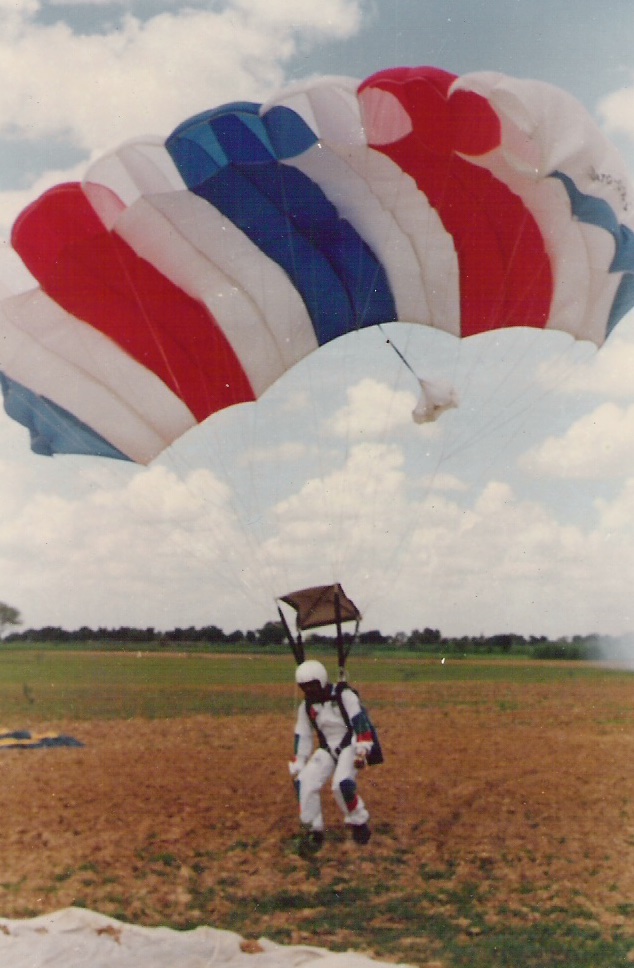
The Strato Cloud parachute I was jumping with, had an aerofoil-shaped canopy. Once deployed, it behaved like a glider. Rather than descending vertically, it glided with a good glide ratio of 1:3. Simply put, it moved forward three feet for every foot of descent. It could reach airspeeds of 40-50 kmph. Its manoeuvrability and high sensitivity to controls enabled experienced jumpers to execute pinpoint landings. They used to say: “With deft handling of the control lines, one can land on a target as small as a lady’s kerchief.” Miscalculation, on the other hand, could lead to serious injuries.
The spectators looked skywards and counted the jumpers who popped out of the aircraft like tiny pebbles. They held their breath waiting for the parachutes to open. The jumpers falling below me deployed their parachutes at their assigned heights. I too threw away my pilot chute—a small parachute which initiates the opening sequence of the main parachute. In a second and a half, my parachute was filled with air. And then began an ordeal, the memory of which, even today, sends a chill down my spine.
Akashganga days…
The suspension lines on one side of my parachute were jumbled up and the canopy was badly deformed. The partially deployed parachute began turning to the right. My efforts to untangle the suspension lines were in vain. In a few seconds, the turns became vicious; I was hurled like a stone at the end of a sling and spiralling down at a tremendous speed. I pulled down the lines to stop the turns. Thanks to the gruelling training sessions under Sergeant R Singh, I had developed strong arms to deal with such situations. My effort met with partial success. The turns slowed down to a stop (almost) but now the parachute headed for an incipient stall––a condition in which there could be a sudden loss of height (40 to 50 feet). Holding on to the lines would certainly result in a stall. I was still at 4,500 feet above the ground; a stall at that height would cause me no harm. But a stall close to the ground would be disastrous. I recalled with horror, an accident involving Warrant Officer Augustine who had been sentenced to the confines of a wheel chair for life due to a heavy landing.
There was a surge of adrenaline and yet my mind went on several quick errands. I was reminded of Mudit, my son, eliciting a promise from me while bidding me bye that morning to make a paper bird for him that could flap its wings. Let alone giving him lessons in origami, I wondered if I would live to see him again. Then I recalled Squadron Leader (later Air Vice Marshal) Ajgaonkar’s ordeal a year or so ago. In a similar emergency, he had promptly deployed his reserve parachute and landed safely. “Never Say Die” was the gospel he had passed on to us. “Am I in the same situation?” I began comparing. “His was a high-speed emergency––total failure of the main parachute. I was faced with a slow speed emergency; I had, at least, a partially functioning parachute over my head. What if I jettisoned the malfunctioning main parachute and the reserve parachute did not open?”
That must-be-avoided-at-all-costs conversation with my own self had a numbing effect.
Mudit… origami… Augustine in wheelchair… Ajgaonkar…. Had time coagulated? No, it was an illusion. Time, and height above the ground, the two most precious commodities for me were fast running out. The impartiality of the earth’s gravity was evident in the rate at which the unwinding needle of my altimeter was sweeping the face of the instrument.
“Should I risk a stall with a deformed main canopy, or jettison it and depend on the reserve parachute for a safe landing?” The dilemma was damning. I was a mere 2,500 feet above the ground and approaching it at a breakneck speed. I was left with a few precious seconds in which, to decide, and cram deliberate action on which, would depend my survival, and the safety of my limbs. I pulled down my goggles, which had got fogged due to excessive sweating.
Suddenly everything became tranquil, and clear. Reason booted out all the silly thoughts from my head. There was no basis for assuming the possibility of failure of the reserve parachute. It had been packed by the most proficient hands and overseen by the most careful eyes; those of the skilled and conscientious Safety Equipment Workers of the Paratroopers’ Training School.
And then…
I took the most vital decision––the decision to jettison the main parachute and go for the reserve parachute. A tug at the cutaway handle got me rid of the malfunctioning main canopy. With the Newton’s Law of Gravitation at work, I went hurtling down approaching Mother Earth at a very high speed, and accelerating. Then, without further delay, I pulled the ripcord handle of the reserve parachute. Sight of a fully deployed white canopy was a great relief.
When the parachute opened, I was 2,000 feet above the ground level—just about sufficient height to manage an accurate landing. Joy rioted in my heart; the wind with prankish flurry caused the stabiliser of the parachute to flap rhythmically. Its flutter was music to my ears. Since I had lost sufficient height, I executed a tight circuit and homed on to the landing area. I felt victorious and exhausted when I touched down softly on the target.
As I removed my helmet and unfastened the parachute harness, I realised that the usual enthusiasm, and the frolicking associated with an Akashganga display, was conspicuously missing. In its place was a lingering melancholy. The main canopy that I had jettisoned a while ago had fallen a mile away from the spectators. They had taken it to be a case of a total failure of the parachute and had feared a fatal accident. Concern for the safety of the unknown skydiver had cast a shadow of gloom. They heaved a sigh of relief when they came to know the fact.
In the flight back from Ambala, I went through the day’s events. I also recalled my interaction with the little boy in Nehru Stadium: “Uncle, what if, your parachute had not opened?” Even in solitude, that thought registered a smile on my face. Then, mind, as is its wont, began wandering further. It flew way ahead of the aircraft, to my family in Agra. “How would I disclose the incident to my wife without causing anxiety?” I began contemplating.
At home, Chhaya was awaiting me at lunch with a plate of Russian Salad and her usual welcome hug. Having been a parachute jumper herself, she took the incident in a stride. I devoured the sumptuous lunch and was off for another Skydiving Demonstration in Agra that very afternoon.
That much to answer my little fan’s question about parachute failure. Parachuting today, is indeed as safe as safe can be—it is safer than crossing roads in Delhi. But then, there’s another curious question people sometimes pose: “What if the reserve parachute also fails?” Wing Commander AK Singh, a colleague veteran parachute Jump Instructor has an answer: “If your main parachute fails and the reserve parachute also does not open, then you are jumping to C-O-N-C-L-U-S-I-O-N.”





 Road Much Travelled