Blame it on Steinbeck and Chekhov

Of the many blunders I have committed, two stand out because, together, they almost cost me my sanity.

The first was taking Anton Chekhov’s words seriously. When asked how he got ideas for his short stories, he is believed to have said, “Put your cigarette on this ash-tray and I’ll write a story about it.” I was naïve enough to believe that everything had a story; all one needed was the mind’s eye to find it, read it and reproduce it.

It sounded so simple that, unmindful of the quality of output, I began writing on everything that crossed my imagination. From military life to mosquitoes; from a railway platform in Uttar Pradesh to a cemetery in Sweden; from Champagne to golf and from Trump to China, my pen spared none.

Churning out posts

One writes to be read. So, I kept thrusting my posts on friends who, I thought, didn’t mind being inundated by the ink I spilled. As if that was not enough for a peacefully re-attired life, I made the second big blunder of reading John Steinbeck’s Travels with Charley in Search of America and believing that I could travel and write in India as freely and easily as he did in America.

With raw inspiration from Steinbeck and Chekhov, and nothing else for a backup, this Don Quixote — you might call me one — decided to conquer the literary world. I was oblivious that my chosen mission would demand the daredevilry of an absolute fool. I resolved to travel to the most crowded parts of Delhi — Chandni Chowk and Sadar Bazaar — in search of the authentic pulse of the old city and write about it.

That spelt my doom.

In search of the authentic pulse…

To begin with, the going was good, or at least I thought so. The writer in me was buoyant with the many stories that stewed in my small head, the scalp of which had not seen a crop in years. As I carried on, I clicked hundreds of pictures, for I believe that each picture is worth a thousand words.

Then disaster struck.

It was a Sunday in June. Most of the main shops in Sadar Bazaar were closed, but the pavements and ledges outside had been taken over by street vendors selling everything from imitation jewellery to bridal dresses, toys to suitcases, polythene bags to gift-wrapping paper — it was an endless list. Rickshaws, hand-pulled carts, motorcycles and honking cars, all vied with pedestrians for whatever road space remained. Skeletons of men carrying loads twice their size reminded me of the skeletal robots performing miraculous feats at a Robotics Exhibition in China.

The sheer intensity of human activity in that environment reinforces one’s faith in the 84,000-odd Indian gods.

I shuddered at the sight of electric cables criss-crossing the pathways—a potential fire hazard, I thought. Peepal plants sprouted from cracks in the walls of a dilapidated building. A massive banner displaying the face of a prominent political leader, surrounded by a dozen party workers and proclaiming “Happy Eid-ul-Fitr”, seemed to be the only thing preventing the adjoining wall from crumbling. Older posters still wished people “Happy Holi” and “Happy Diwali”. Several others conveyed birthday greetings to beloved leaders.

There was momentary panic when the vendors suddenly began winding up their wares and closing their shops.

“Committee is coming! Committee is coming!” A boy on the run had energised the street.

The chaos settled as the team of Municipal Committee members—supposedly there to stop the vendors from encroaching on the roads—turned into another by-lane. It was business as usual thereafter.     

The sheer intensity of human activity in that environment reinforced my faith in the 84,000-odd Indian gods.

I ventured further and entered a narrow lane to get a ‘different’ feel. Even at 3 p.m. on that sunny afternoon, it was pretty dark. Hawkers had spread their wares on either side of the narrow passage, making walking past them something like manoeuvring through a minefield. I kept moving, but soon the combination of the asphyxiating smell of an open drain, rotting fruit on the floor, cow dung infested with flies and a lavatory somewhere in the distance began to nauseate me. Further up, the passage was choked with people.

I turned back; I thought I had had enough for the day. In minutes, I would discover how misplaced my assessment was. I hadn’t had enough; there was more to follow.

After clicking the last picture in that lane, I slipped my iPhone into the side pocket of my cargo troussers. I maintain that cargos are ideal for travelling in crowded places, with their box pockets secured by flaps.

Just then, I felt a push on my right flank. I turned around. A boy, in a hurry — he must have been a teenager—was trying to find his way. I gave him a look that said, “Behave yourself.”

Before he could extend the apology, I thought he was trying to convey with his eyes, I was pushed from the left. Another youngster; late teens, perhaps. Then came another push, this time from a third direction. And then, two more.

Those pushes threw me off balance. In the split second that I took to regain my footing; my instinct told me that something was amiss. I felt my pockets — cargo pockets, six of them, secure pockets with flaps — not once, twice, thrice, but many times.

The horse had bolted.

Those five devils! They had taken away my iPhone. In a flash, I realised what else had gone with it. Data apart, my notes and pictures, around which I was weaving stories, were gone—one of my loved worlds had shattered like an Austrian wine glass struck by a Vande Bharat. They had stripped me of my secret pride.

It was an emergency akin to a parachute failure I had experienced years ago. I had seconds to act if I was to get my phone back. Running behind those boys in the dark alley would have been a wild-goose chase. Besides, my ageing knees would have given up the chase sooner rather than later. So, I did the next best thing. I hobbled to the nearest police assistance booth on the main road, introduced myself to the officer on duty and told him that my phone had been snatched.

He sent a police constable with me to ascertain the exact spot where it had happened. To my good fortune, the location was partly covered by a CCTV camera.

Back at the police booth, the cops sifted through the last few minutes of the CCTV footage. Lo and behold, there I was, surrounded by the little devils, signalling to one another and exchanging meaningful glances. Although the actual snatching was not caught on camera, the cops assured me that if those boys had taken my mobile phone, they would get it back.

“We’ll take it out of their belly if they swallow it,” one of them assured me. He identified one of the boys as an old offender.

A constable sent to the boy’s house returned with the information that he had not returned home.

“Please don’t visit our home. Cops visiting us brings disrepute to the family. Arrest the boy if he has committed any crime,” an elderly lady of the house had urged the constable.

“Sir, these people take undue advantage of the laws governing treatment of juvenile delinquency,” the police sergeant apprised me of the difficulty they face dealing with teenaged miscreants.

In the meantime, the smart alecks who had taken my mobile had powered it off. It couldn’t be reached when my number was dialled several times from different mobiles.

“Please rest assured your phone will be recovered.”

Those were the parting words of the police officer when I left Sadar Bazaar that day.

As a first step, on reaching home I blocked my SIM and used my Apple account to declare my phone ‘lost’. This would prevent misuse of my device by anyone. Apple’s Find My option gave the last known location of the device as Sadar Bazaar, where it was snatched.

Thereafter turning on my MacBook and trying to determine the current location of the lost mobile became a mania with me. I tried it several times through the following night, hoping that someone would switch it on and I’d be able to lock its location.    

Thanks to the Telecom Department, along with strict regulations to prevent fraud, there is also the convenience of getting another SIM across the counter. The procedures are simple; and the representatives of the service providers, helpful. I got mine in a jiffy the very next day, when there were still no signs of recovery of my phone.

It was surprisingly difficult to use an old phone that I had discarded years ago. Installation of essential apps, including banking apps, entailed long-drawn processes involving passwords, debit-card details and OTPs. How I went about installing the apps—and the loss of all my messages during the reinstallation of WhatsApp—exposed my technological illiteracy and how poorly organised I was. Many of the lost messages were actionable; they were my commitments which, sadly, I would never even recall, let alone fulfil.

Hassled by the goings-on at my end, I had no time to read, act on, or respond to messages on social media. So, over the following two days, I publicised that I was going on a digital detox and would rejoin in due course. I did this partly because ‘digital detox’ sounded ‘hap’ and partly under the influence of Johann Hari, of Stolen Focus fame. It was my opportunity to stay away from avoidable noise for a while.

It didn’t surprise me a bit when none asked why I was going silent.

It was my conclusion that people are too burdened to bother about another’s life. A genuine soul calling or messaging to enquire about someone’s welfare could be seen as an intrusion or as someone trying to seek a favour.

A break from social media, which ultimately lasted for about a month for different reasons, was a boon. It let me indulge in some of my loved activities and hobbies. A return to calligraphy, sculpturing, caricaturing, serious reading, writing and even walking and cycling was godsent.

Nothing encouraging happened on the second day. The confidence in the police camp dwindled.

“Sir, if your phone is sold while we are trying to trace it, I am afraid it will become impossible to find,” the officer warned.

I discovered that stolen Apple phones are generally not resold for use; they are cannibalised — dismantled, with their parts passed on to repair shops. The outer cases, screens, microphones, speakers and camera lenses fetch decent returns.

I crossed my fingers.

On the third day, Apple’s Find My feature spotted my phone in a residential area near Sangam Vihar. A prominent landmark, Boozer’s Bar, was a block away.

I informed the cops and then, assuming I was smart, drove 30 kilometres to the general area with my dear wife and a team of two tough men — just in case.

When I think of it today, it was a funny sight. The four of us moved stealthily, laptop open, through the locality. It reminded me of an Indian film in which the protagonists, dressed as street singers, with a harmonium dangling from the hero’s neck, go around singing to find a kidnapped child.

Our search that day ended in a fiasco when the batteries of our devices drained and we realised that the location we were chasing was two days old. Once in the vicinity, Google Maps went bonkers. After a three-hour adventure, we, the self-styled sleuths, returned home empty-handed.

The probability of finding the phone receded with each passing day. It dipped to almost zero, and my heart sank when on a following day, Find My spotted the phone at a location in Gaffar Market, notorious for sale of stolen gadgets.

On impulse, I thought, I would pose as a buyer of an old iPhone 15 Pro and look for my phone. In my heart of hearts, I was prepared to buy my own phone. My primary aim was not saving money, but recovering my valuable data.

I gave up that ‘brilliant’ idea when I realised that the Gaffar Market location was also two days old. With the villains switching the phone on and off as they pleased, and scooting all the time, it would be impossible to catch up with them in the normal course.      

Initially, I did not lodge an FIR because if the stolen device were recovered after filing one, I would have to get it through the court—a long bureaucratic hassle. On the third day, I lodged an eFIR reluctantly to stake my claim on the mobile if it were to be found at a later date.

I lumped every torture as a necessary evil and kept going. After four days, I even stopped nagging the cops but continued staring at Find My on my computer screen.

All along, sanity kept eroding. Yoga didn’t help regain peace of mind, but staying away from social media and pursuing hobbies did.

More than a week later, I spotted the device at a location in Sadar. When I called the cops, I was told that they had recovered the phone. I identified it by its ‘night blue’ colour. To avoid the circuitous procedure of getting it back through the court, I withdrew the eFIR. I thanked the cops profoundly and didn’t pester them to tell me how they had recovered it.

When it was handed over to me, I switched it on and tried to ‘open’ it using Wi-Fi. In my excitement, I skipped some steps and lost all the unsaved data on the device.

Recovery of the phone turned out to be a Gift of the Magi for me.

Aware of the futility of pursuing a case against the juvenile delinquents, I didn’t pursue the matter. I was too exhausted to do so. Besides, in some corner of my heart, I had developed a kind of admiration for their skill and teamwork.

I had sympathy for them, for we as a society, had failed to channelise their energies.

It certainly was not a case of Stockholm Syndrome.

In the following three weeks, I lost my remaining sanity trying to re-activate the eSIM in my phone. The police had done their job; the Telecom Department had unblocked the IMEI, but in the records of the service provider it was still BLOCKED.

Out-of-the-way assistance of a buddy, Major General Lav Chand, and an Airtel associate helped remove the glitch and finally ended my ordeal.

It all started with me wanting to look for stories and write them. Instead, I ended up being one.

I blame Steinbeck and Chekhov for it.
A Sinner, or a Saint?

On rare days, the area around Nizamuddin Railway Station, on the Sarai Kale Khan side, is in chaos. On normal days, it is in utter chaos. To my luck it was a normal day on that June morning when I had alighted from the Bhopal Rajdhani at 6:00 am. I skilfully wove my way through fly-infested little heaps of litter, and patches of dirty water caused by leaky pipes, and manoeuvred around people sleeping on the platform to exit the station. Getting atop the foot-over bridge and walking through a tidal wave of humanity had been an exercise in itself. Outside the station I was greeted by the mixed smell of overcooked spicy food emanating from the dingy hotels on the roadside. Competing with the signature odours of omelette and aloo parantha was the stench from the overflowing drains. A wretched dog, and two crows were feasting on the leftover food offered by a kind-hearted passenger.

Having lost my iPhone a few days ago, I was undergoing a forced digital detox. The apps on the phone I was using for the time being, were functioning at less-than-optimal efficiency. For that reason, my four attempts to engage a cab had failed. In the meantime, I had declined several auto rickshaw drivers to take me to NOIDA. Not that I was averse to travelling by a three-wheeler. It is just that I had three suitcases and an air-bag, which I presumed wouldn’t fit into an auto.

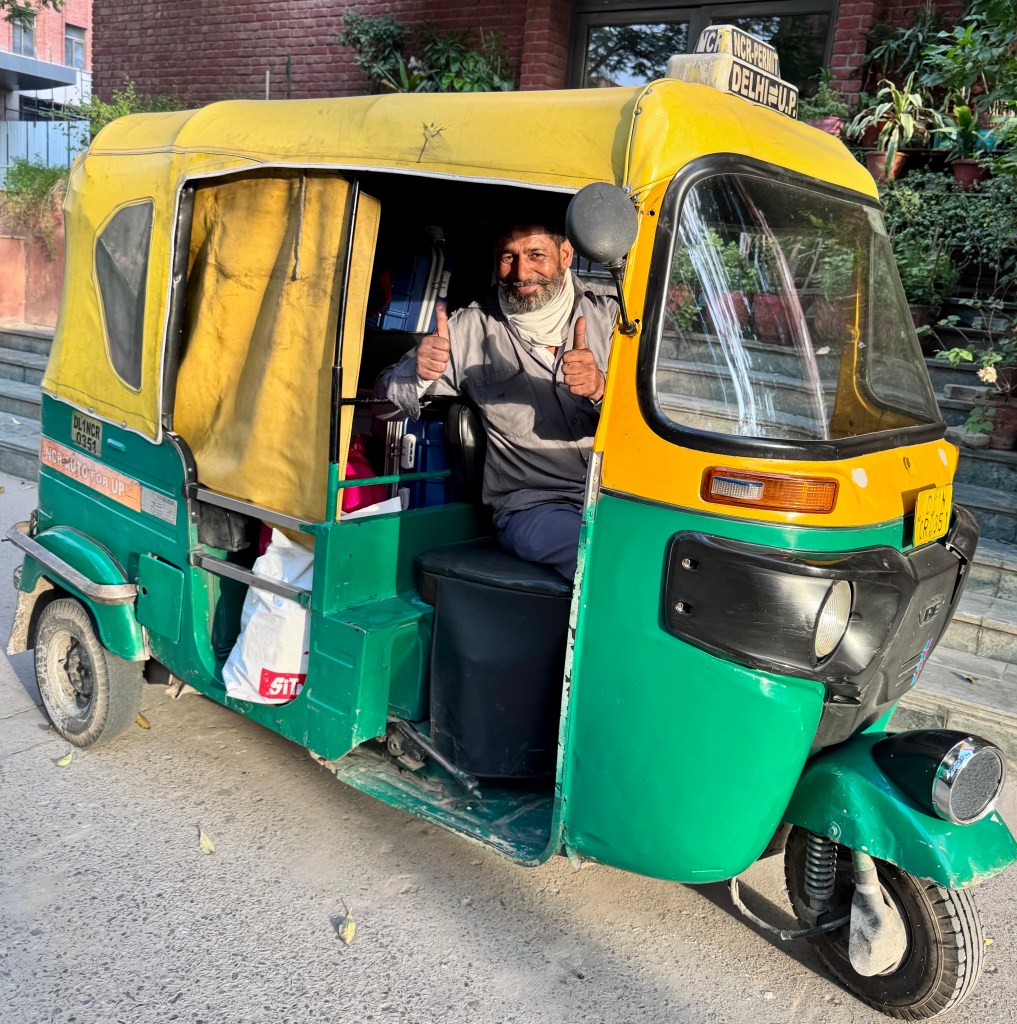
Mahender Singh, an auto driver—the events of the following half hour or so, had obliged me to ask him his name when we parted in NOIDA—read my mind and nudged me to re-evaluate my options. “Sir, don’t worry, I’ll be able to adjust everything into my auto,” he offered.

“Should I continue to stand in the crowded place and keep trying to get a cab; or, I must hop into his auto and get some semblance of relief?” Embedded in that dilemma was my strong urge to be anywhere else, soon. Then, the stench and the noise nudged me to accept his offer. The man could well have been a smart warehouse in-charge, or a logistician, I thought when he stowed my bags meticulously in the little space behind the passenger’s seat.

…king of the road

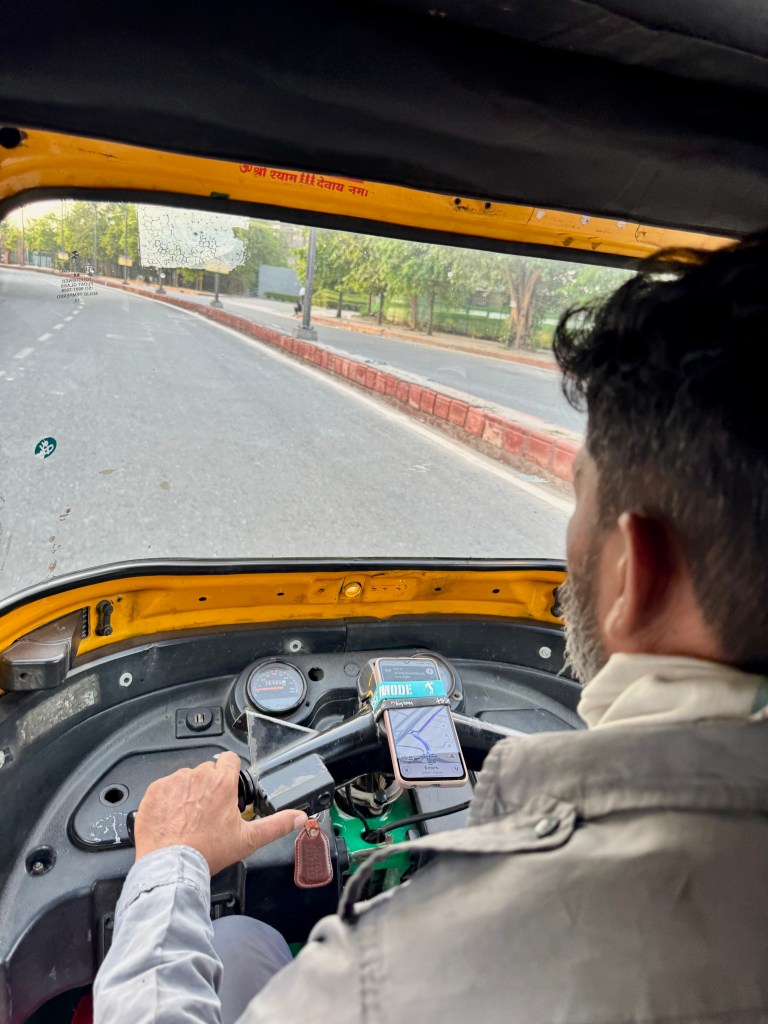
“Sir, sit tight and keep pushing the back of the seat so that your bags stay in place,” he directed me as he cranked the engine to life. Soon, we were zipping down the crowded road. In a small stretch of about half a kilometre, where pedestrians and vehicles of all kinds were fighting for every inch of space, Mahender’s driving speed was causing me anxiety. The horn of his vehicle was perpetually ‘ON’. He was shoving the nose of his auto into the small gaps wherever he could find them, and was pushing forward. He was behaving like a man possessed. At one point, he entered the wrong lane. My heart missed a beat every time he dodged the traffic coming from the opposite direction. He was occasionally lifting his eyes off the road and staring at the Google Maps on the damaged screen of his mobile phone, which he had tied (literally crucified) on the handle of his auto where the speedometer ought to have been. To him, speed did not matter. In any case, he was driving at max possible throttle setting all the time.

By the time we reached the Outer Ring Road, I had refined the long draft of my sermon to him on adherence to traffic norms. The density of the traffic had reduced, and the average speed of vehicles on the road had gone up considerably. So, I decided to defer the delivery of a piece of my mind to him until we reached NOIDA.

Yet, there was no respite for me. All along the way, he kept changing lanes without giving any indication and overtook vehicles from any ‘convenient’ side. I held firmly on to the metal pipe in front of me and avoided getting thrown out of the auto. On a few occasions, I dared to assist him by stretching my hand out to convey his intention (turning left or right) to the drivers he was sharing the road with. He was looking at me from the corners of his eyes and didn’t mind what I was doing.

“If we, the educated lot, do not correct these erring drivers, who will? On reaching my destination, I’ll pull him up…. But, who am I to correct him? Who all will I correct? There are so many reckless people on the road… the drunken, the rich and the mighty who mow down unsuspecting pedestrians… the under-age privileged ones who kill and are let off by the court after writing an essay on traffic rules….”

Sinner, or Saint

My thoughts were travelling ahead of the noisy auto when, all of a sudden, came a moment of reckoning. An ambulance approached a roundabout which Mahender was negotiating at a high speed. I was certain that he would carry on driving, not giving a pass to the ambulance approaching us from the left. So, I stretched my left hand, indicating to the ambulance driver that Mahender was in no mood to slow down.

To my utter surprise, Mahender slowed down, almost to a halt, and asked me to pull back my hand. “Sir, let the ambulance go,” he said with an air of urgency. Then, he felt the surprise in my reaction and said, “Sir, an ambulance must always be given the right of way. Don’t know how serious the patient inside it might be.” This thought coming from Mahender who had been flouting almost every possible traffic rule since we left Nizamuddin Railway Station, surprised me no end.

I ejected the draft of the moral lecture meant for Mahender, out of my cluttered mind when the auto stopped at my residence. He didn’t deserve a sermon from me. He didn’t let me carry my bags—lifting them himself up a flight of ten steps to the landing in front of my flat. And, before I could realise, he was gone, leaving a breath of fresh air on that summer morning.

Comments

Air Commodore Sanjay Sharma (IAF Veteran)

I was 17 and a half. BSc Prev. Onboard Utkal Express from my small town Kosi Kalan to Raja ki Mandi. ( From home to Sapru Hostel, Agra College). Month of December. A group of four ruffians in their twenties boarded the train without a ticket (an accepted norm on that route) from Mathura. Asked the other passengers to ” Khisko, thoda sa” to make room for them to sit. Started playing cards. I was cursing them silently in my slight frame for being so unruly. There was a beggar in a tattered shirt and an excuse for a pajama. He came dragging himself and started begging. Hardly anybody gave him a paisa until he came close to this gang and suddenly, the most ” Goonda looking” one amongst them took his pullover off and made this beggar wear it.
People broke into applause. I felt small in my own eyes for judging the book by its cover.

The One

[A thought-provoking story by Swetha Banda]

He was woken up by the lights flooding the cabin, accompanied by the pilot’s announcement that they would be landing in Hyderabad in approximately forty-five minutes. The outside temperature would be 32 °C and the local time, 2.45 am. Rubbing his groggy eyes, Rohan sat up straight and pushed open the window blinds. Dim, obscure lights were visible on the ground, probably a tiny little Indian town. The lights were random and almost looked like stars in the sky on a slightly hazy night. The haze. That’s what it was. The lights were obscured by a layer of dusty haze covering the ground. 

Sravanti, his cousin was getting married in a week and he had a lot resting on his shoulders. Relatives would remind him of his role in keeping the brother-in-law from running away to Kashi several times during the next week, sometimes joking and pinching his cheeks, and at other times, with a seriousness that bordered on delusion. This was an important ritual in Telugu weddings.

Sravanti, at 24 was six years younger than Rohan. All these years, no one bothered to pester Rohan into marriage. The whole family was desperate to see Sravanti married as soon as they could, because her prospects of finding a decent groom would fall with every passing year, or so they thought. In any case, Rohan was left off the hook all these years. And he knew that sooner or later questions would be asked. And this conversation wasn’t going to be easy. 

By the time he woke up the next morning, the house was buzzing with activity. The smell of filter coffee wafted through the house. Rohan walked into the living room where pednanna, his father’s older brother was giving orders to the pandal guys about the colourful tent in the courtyard. His father was talking to the decorators about the flowers at the wedding venue. Rohan went and quietly stood next to his father, who saw him as soon as he was done talking to the decorator and gave him a nod of acknowledgement and a light hug. Rohan quickly went to greet his pednanna who looked at him and said, “Ah, good you are here, you can drive pedamma to the caterer, so that she can decide the menu.” That was always the way in this house. There was no grand welcome or warm greetings. It was down-to-business. It wasn’t that pednanna wasn’t happy to see Rohan. He just didn’t see the use of grand gestures. 

Sravanti’s wedding

As he walked out towards the garage, he saw Sravanti, amma and pedamma, fervently discussing something about the sarees to be worn for the different rituals. A heap of silk sarees was lying on the bed and Sravanti had a yellow saree with a red border hung over her shoulder. She was looking into the mirror and caught a glimpse of Rohan’s image, immediately threw the saree aside and ran towards Rohan shouting “Annayya!” — big brother. Rohan was swept by a wave of emotion towards his little sister who he was always very fond of. 

Rohan, Hari and Sravanti grew up in the same house. Although pednanna was older than Rohan and Hari’s father, Sravanti was the youngest. The series of wedding related activities kept everyone on their toes. Relatives were pouring into the house to see how things were going. The entire house was decorated with yellow marigold flowers. A gazebo of coconut branches was being put up at the main entrance of the house. There was an air of celebration and the sounds of laughter in the house. Pednanna and nanna were both giving out orders to the plethora of workers. Sravanti was surrounded by younger cousins who came to visit her and was lost in giggling and conversation.

With all this frenzy, Rohan, for once, felt good about being home. In the last few years, Rohan hadn’t really looked forward to coming home. He didn’t know when and how he started feeling more at home in Singapore than here. Maybe just the archaic ideas that pednana had about everything and his unwillingness to listen to reason; or the fact that Nanna never spoke anything against pednanna, or that neither amma or pedamma ever had any say in the matters of the house, made it easier for him to stay away. In the beginning, he tried to argue. But when his points were dismissed with remarks like, “Oh, look at the foreign-returned guy who’s forgotten his own culture,” his patience finally gave out.

As children, Rohan was always the boisterous one, while Hari remained quiet and withdrawn. Rohan sang, danced, and excelled in theatre. At every extended family gathering, his performances were a highlight. Hari, meanwhile, clung to the edge of his mother’s saree, silently observing from the sidelines. During their teenage years, Rohan was often surrounded by his lively group of friends, the centre of every hangout. Hari, in contrast, retreated into the world of video games and online avatars, preferring virtual realms to real-life interactions.

When Rohan landed his first job offer in Singapore, a mini-van was arranged to ferry the twenty-odd relatives and friends who wanted to see him off at the airport.

On arriving in Singapore, Rohan found himself all alone for the first time ever. But soon enough, he made new friends and looked at life from different perspectives. On a trip to Bali with some of his new friends, Rohan’s life completely changed. The second evening in Bali, he and his friends, had just come back from the day on the beach and decided to have dinner at the hotel restaurant. The tables were set along the pool and the fading light was shimmering on the tiny ripples of the pool. Rohan and his friends had just ordered their drinks and were lost in conversation when, out of the corner of his eye, he caught sight of Nikki.  He wasn’t usually rendered speechless. But this time was different, he froze below his knees. 

The next morning, Rohan decided to walk to the beach by himself while his friends were sleeping off their hangover. He had just stepped outside the hotel when he heard someone say, “Hello, you seem to be up early.” Rohan was mesmerised by the voice, and the dimple on the left cheek. Thoughts were rushing into Rohan’s mind. This was the stuff of movies. 

Gathering himself, Rohan finally managed to string a few words together and said, “Do you live around here?”

“No, I live in Singapore and I am here on work. You see, I work in hospitality” Rohan began to relax and decided he could use the company. Rohan and Nikki walked through the market, looking at the local trinkets that were being sold. Nikki gave him tidbits of information about the village and the people. Conversation flowed, about families, homes, work, and childhood. They ate, strolled and without realising, they ended up on a beach. This wasn’t the popular touristy beach, but a fishing beach that only the local people went to.

Day had turned into dusk, and the beach had become more secluded. Sitting on the sand, Rohan realised that he wasn’t even trying anymore. The resistance he had felt in earlier such encounters wasn’t there anymore. Something was happening and he just couldn’t deny it anymore. He was enjoying the company, the setting, the sound of Nikki’s voice, the one-sided smile, the dimple in the cheek and he just couldn’t resist it anymore. 

Eight hours had passed since he met Nikki on the street and they were still sitting together and talking. Rohan couldn’t even remember the conversation. The only thing he felt was a tiredness, the kind that one feels after a really satisfying day, when you just want to rest your head and sleep. He didn’t realise when he rested his head on Nikki’s shoulders and when he dozed off. 

Back at the hotel, Rohan’s friends were packing up to leave the next day. Rohan and Nikki exchanged contact details and stayed in touch. Soon, they were frequently meeting, spending long evenings at Clarke Quay, dining at restaurants and spending nights with each other. It just felt natural, like it was meant to be. How would he explain this to his conservative South Indian Brahmin family?

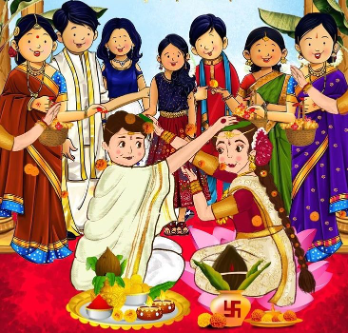
With a jolt, Rohan came back to the present. The bride and the groom were tying the knot. People were throwing rice dipped in turmeric at the couple as blessings. Pednanna and peddamma were looking relieved and yet had tears streaming down their eyes. 

Later that evening, after all the festivities were done and most of the relatives were gone, Pednanna called Rohan into the living room. Everyone was seated around the room and there was an air of speculation. Rohan knew what was coming. Pednanna said, “Subba Rao is my very close childhood friend. He has a daughter, Lavanya. We want you to meet her tomorrow.”

“Well, I am not surprised,” thought Rohan to himself. Then spoke aloud, “I don’t want to meet Lavanya, pednanna. With all due respect, I like someone else.”

“Is she Brahmin? Telugu?” yelled pednanna. 

“No, and I don’t care about that at all,” retorted Rohan. 

“Then I will never accept it. There is no place for uncultured foreigners in this house.” Pednanna was furious.

Pednanna was never one to mince words or hide his bigotry. In fact, he took pride in being that way. Rohan looked towards his mother and father. Nanna was looking down meekly instead of standing up for Rohan; it was typical of him. In all the years he was growing up, nanna never stood up either for himself, or for his family.

“Pednanna, how does all that matter? Isn’t it enough if we love each other?” 

“Nonsense, this love, shove and all that doesn’t last. If you marry your foreigner, you will get divorced soon. They have no family values, those uncultured fellows.” 

How narrow minded was his family! How did they decide that their culture was the best. Rohan didn’t want to argue anymore. He just stormed out of the house. He walked and walked till his legs were tired. Thoughts were rushing through his head. “As though marrying someone from your own caste was any guarantee for happiness. Was pedamma ever happy in her marriage? Pednanna and Pedamma never showed each other affection. So why am I expected to inherit these gendered roles that feel so hollow?”

He didn’t intend to conform to those roles. He couldn’t even if he wanted to. Exhausted with anguish, Rohan sat down on a bench by Tank Bund and before he knew it, tiredness took over his body and he fell asleep. 

Hours later, Rohan was shaken awake by Nanna and Hari, their faces etched with worry. Disoriented, he blinked in the morning light, the weights of his thoughts from the previous night still pressing down on him. He hadn’t meant to fall asleep there, but his exhaustion, physical and emotional, had consumed him. 

Nanna and Hari had spent the last few hours frantically searching for him, panic rising with every empty street and unanswered call. They heaved sighs of relief when they finally saw him, curled up, on a cold bench by the Tank Bund.

“Rohan, let’s go home. Stop being so stubborn.” Nanna said, shaking him awake, frantic with fear. Rohan refused to go home. He insisted that he was in love and he couldn’t spoil three lives by marrying someone he couldn’t love. If pednanna and the family couldn’t understand, what was the point of staying? Rohan felt a lump rising in his throat, his love, his identity and the impossible walls of tradition bearing down on him. He was ready to walk away from it all. Forever.

A sob tore through him, unrestrained. Nanna and Hari stood beside him, their own eyes brimming with emotion. “Please, Rohan,” Hari finally said, his voice, a whisper. “Come Let’s go home.” Nanna nodded, “We’ll figure this out.”

Rohan wanted to resist, to stay firm in his decision, but something in Nanna’s voice, something he had never felt before, made him pause. It wasn’t authority or resignation. It was something closer to understanding. Slowly he wiped his tears and stood up. 

When they reached home, an uneasy silence was hanging over the house, thick and suffocating like the lingering scent of burnt incense after a long puja. Pedamma stood near the kitchen doorway, wringing the edge of her saree, her face tight with worry. Amma sat on the sofa, her eyes darting between Rohan and Pednanna, as if bracing for an inevitable storm.

Pednanna stood in the centre of the room, his arms crossed, his disapproval evident in his frown. Rohan could feel the weight of expectation pressing down on him, suffocating and unrelenting.

Then, for the first time in Rohan’s life, Nanna stepped forward. His voice was steady, but there was an unfamiliar urgency in it. “Annayya,” he said, looking pednanna directly in the eye, “Rohan is my son. If he says he loves this Nikki, my wife and I are going to support him. Even if Nikki is a foreigner, we will love her the way Rohan loves her.”

Oh dear, Rohan’s heart pounded as he glanced at his father, now he had to tell them that Nikki was actually Nicholas!

Swetha Banda