
Oh those customs and traditions of the armed forces!
Norman Dixon’s book—ON THE PSYCHOLOGY OF MILITARY INCOMPETENCE—is a shocking and provocative treatise on the behaviour of the men in uniform. Although his nearly 450-page study—to explain how a minority of individuals come to inflict upon their fellow men depths of misery and pain virtually unknown in other walks of life—is thought-provoking, his work fringes on mocking military personnel. The fact that he talks mostly about the Royal Army is not a saving grace for the armed forces of India, Pakistan, Bangladesh, Sri Lanka and so many other Commonwealth Countries who are steeped in customs and traditions of the Raj. Thus, what he talks about the British Army, by implication, applies to the Indian Armed Forces too.

In the foreword to the book, Shelford Bidwell points out that the wars were not fought solely with victory as the object—victory being defined, presumably, as a net gain of benefits over costs—but for ‘glory’. To achieve ‘glory’, the war had to be conducted according to certain rules, using only certain honourable weapons and between soldiers, dressed in bizarre and often unsuitable costumes. The bayonet, the sabre and the lance were more noble than the firearm (one British cavalry regiment on being issued with carbines for the first time in the mid-nineteenth century ceremonially put the first consignment into a barrow and tipped it on the stable dung pile). The book is well punctuated with such examples. Dixon’s scholarly work is invaluable; it is well-supported by footnotes and bibliography which runs into several pages.
Needless to say, such scholarly work triggers ‘creation’ of anecdotes, which get accepted as facts in due course of time. One, whose truthfulness can’t be verified, goes like this:
At a firing demonstration of an artillery gun, two members of the fire-power display team took positions on either side of the gun. All through the exercise, they stood motionless, each with a closed fist held a little high; at the shoulder level. It was as if they were holding something. None, including the JCO, knew about the role of those two men in the firing of the gun. Research revealed that long ago, when wheeled guns used to be towed by mules and horses, two men were deputed to hold the reins of the animals when the guns boomed to prevent them going berserk. With time, the horse-drawn carts were replaced by motorised platforms. People didn’t care to reassign tasks to those two men who were no longer required.
Here is another one on the unquestioned Casabianca-like devotion and adherence to trivial orders:
A military formation in Central India had a Jawan deputed 24/7 in all weather conditions to stand guard by a bench in the Unit’s Park. None in the unit knew the purpose. During the re-union of the Unit, a retired JCO, in his late eighties solved the mystery when he asked, “Oh my God! Why do you still man that post. It was created on a temporary basis, sixty years ago, when I was a Lance Naik to prevent anyone sitting on the freshly painted bench.”
Taking cue and liberties from suchlike anecdotes, the film makers and ad agencies have created their own versions of military men. A retired Colonel or a Major being a role model; or a disciplinarian struggling to settle down in the family and society; or a comical character (butt of people’s jokes) was the theme of many a Hindi film of the last quarter of the last century. A recent ad features a burly army officer (or a band master? Mind the rank badges and the ribbons and the medals), with a gun in hand, chasing his Man Friday who is running around a table with a bowl of chholey prepared with ‘Everest Chholey Masala’.

Media does reflect reality to some extent. In real life, things are not too different.
The other day, a freak telephonic request from a clerical staff of one of the service Headquarters made me scratch my head hard. As if that torture on my smooth hairless scalp was not enough—that transaction with the gentleman dented whatever good opinion I had of my looks. “Sir, kindly email another of your passport size photographs,” he had requested.
Just to give the readers the background, I had already sent him a photograph which was required to be printed alongside an article which I had submitted for publication in a magazine.
“What’s wrong with the one I sent earlier?” I asked him. I knew it was a sharp image and nothing could have been wrong with it. “Is there a problem in downloading it,” I queried.
“Sir, it is not passport size,” he said hesitantly. On second thoughts, I felt he was not hesitant; he actually sounded sheepish.
“But it is a digital image. You can re-size, and even crop it,” I said with the air of a person who takes pride in his computer literacy. And, why not? Long ago, I had undergone programming courses in COBOL and Visual Basic in the prestigious (then) Military College of Telecommunications Engineering (MCTE), MHOW and Air HQ Computer Centre respectively. And, I am adept at using many computer applications. That—after getting me trained in programming—the Indian Air Force never utilised my programming skills is an altogether different matter. Although, secretly and silently, I have lugged the regret of not having been able to serve alongside the top brains of the Air Force, I have always taken time to educate the less knowledgeable who came my way. I have motivated (sometimes lovingly ‘kicked’ unwilling horses) and personally taught my men how to use computers effectively.
I thought here was an opportunity to light a candle for a soul groping in the dark.
A word about the photograph which I had mailed earlier. It was the one, which Chhaya, my dear wife had clicked during the Corona Virus pandemic. I had just recovered from a long bout of Covid. In the photograph I was sporting a thick salt and pepper beard and had worn a navy-blue round-neck tee-shirt; a black felt hat and dark round-rimmed sunglasses. It had received many responses, which I thought, were compliments. “Wow! You look like a cowboy,” was one observation. “Looks of a seasoned writer…,” commented another friend. “…that countenance goes well with your forays into film-making and association with the theatre.” Those flattering remarks gave my naïve self a reason to feel elated. I began using that picture wherever I could, including, as my DP on the social media; felt great.
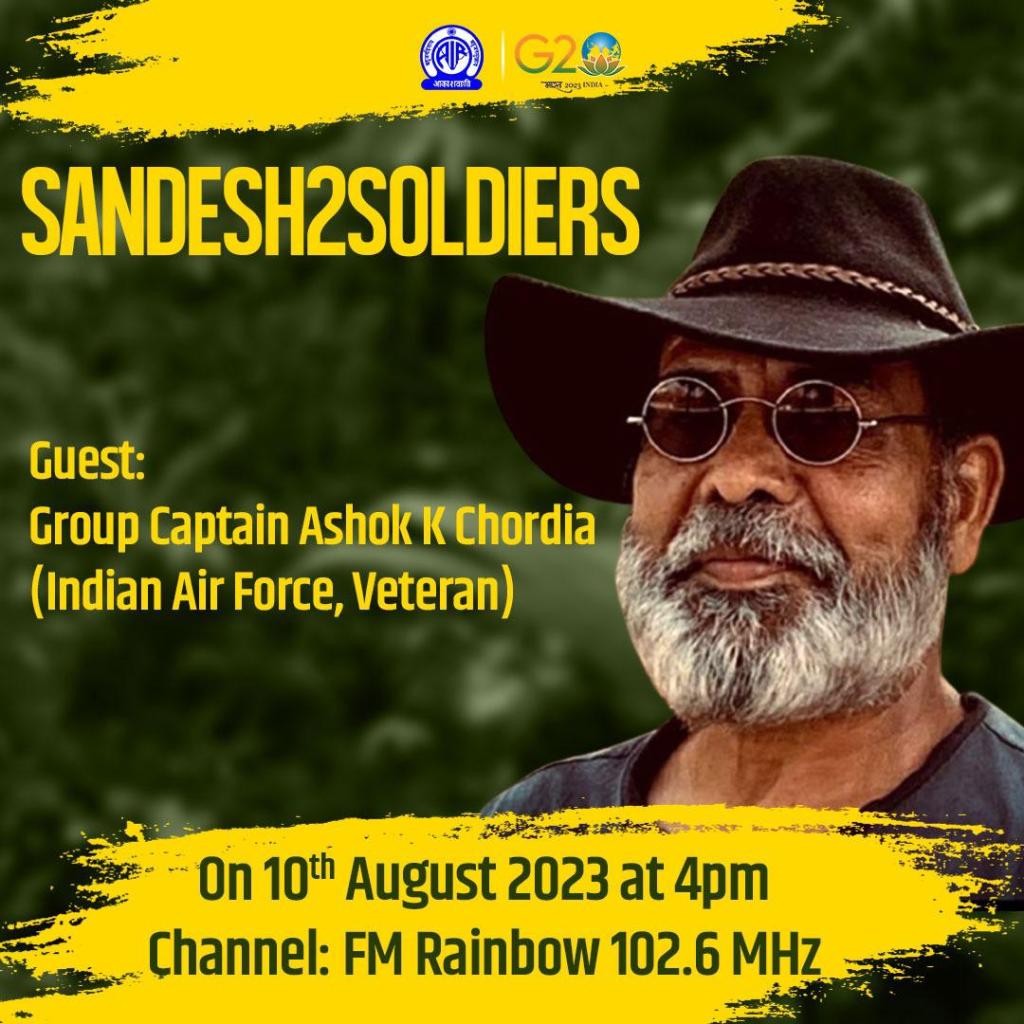
Returning to this person who wanted me to resend a ‘passport size’ photo.
After he had repeated his demand several times, I was able to elicit the real reason for his insistence. His ‘boss’ had disapproved my ‘iconic’ photo which, I thought, represented the ‘re-attired’ public persona of an Air Veteran of my kind.
There was no point arguing with the conduit, and I did not have the will and the stamina to engage in a discussion with the concerned officer. More importantly, I don’t belong to that category of writers whose articles are in demand and can dictate terms. It is so difficult to get an article published. Withdrawing my article on this ground was out of the question. So, with feigned alacrity, I agreed to comply with the demand. Within minutes, I sent him another of my passport size photographs in which I was well shaven and dressed like ‘an officer and a gentleman’—in a black suit. No hat; no goggles!

At the click of the ‘SEND’ button, I became acceptable. And, as a corollary, my article got the nod of approval.
The next thing I did was to dig out several of my ‘passport size photographs’ and consign them to a folder on my computer desktop. Now I have a collection—A REAL PICTURE for every requirement… tor scholarly articles; for talks to executives; for lectures to college students; to media persons; for theatre and film fraternity. I know, I am going to need them, at least until more people read Dixon.
 Road Much Travelled