Question of a Sabbatical

The date and the year are of less consequence; it was a hot April afternoon. I saw the three of them walking on the footpath in Subroto Park and offered them a lift. They got into the car hesitantly.

“Thank you Sir. I am Ravindra Sharma, he is my brother Navin and he is my son, Ajay (names changed),” one of them broke the ice as they settled in the car.

“I am Group Captain Ashok Chordia,” I introduced myself and asked, “Where do you want to go?”

“We have to board a train from Nizamuddin railway Station. It will be kind of you, if you could leave us at the nearest bus stop on your way,” he urged.

“The Station is on my way. I’ll leave you there.”

“So nice of you, sir.”

Then there was prolonged silence. The three sat quietly, perhaps not knowing what to talk about. I have experienced this type of a mix of reticent and introverted behaviour on the part of simple people in the presence of strangers. In the presence of service officers, the behaviour seems to be more pronounced.

It was going to be a fairly long (15 kms) drive along the Inner Ring Road and was going to take in excess of 30 minutes. Silence with four people sitting in the car would be menacing.

“You don’t seem to belong to Delhi?” I initiated a polite meaningless conversation.

“Sir, we belong to Kota. We were here for a counselling session for Ajay.”

“How was it? What does your son intend doing?”

“Just so. I am disappointed with his board exams result,” said the father with concern.

“What’s the matter?”

Books“Sir, he has scored 94 per cent marks. He just doesn’t read. If he studies properly, he can get more marks. He wants to do engineering. Why don’t you advise him, please?”

My jaw dropped. “Here is a father dissatisfied with his son scoring enviable marks, and he wants me to guide him? What advice do I render to a kid who in my assessment is brilliant,” I wondered.

I did not want to disappoint the father so I continued talking. In a while I realised that the boy was very intelligent and could understand concepts rather fast. Therefore he used to take less time as compared to others to complete his assignments. Repetition used to bore him and that’s where his ideas conflicted with his father.

With much thought I came out with a piece of advice to him, “If you read more books of each subject you will have a deeper understanding of the concepts. Solving question papers and numerical problems from different books will give you a strong base. Lastly, if you still have time, devote it to improving your communication skills––an effort that will stand you in good stead, what ever you do later in life.” All three were listening to me intently.

“Sir, I’ll do as you have suggested,” assured Ajay.

“That’s good. You are capable of better performance and must try to exploit your ability to grasp things fast to broaden your knowledge base and communication skills.”

The father was happy with the interaction. At the railway station, I took him aside and advised him to give a freer hand to the boy to manage his studies. I told him that meddling with his approach to academics might be counter-productive.

The chapter was over, I thought.

Not really!

A month later, I received a call from Ravindra, “Sir, you have cast a magic spell on my son. He is a transformed person now. I want to thank you for making a difference.”

“I am happy to hear that. I hope he continues to work that way. Convey my good wishes to him.” We exchanged some niceties before disconnecting.

It was not over yet.

A few months later, I received another call from Ravindra, which put me in a very difficult situation. “Sir, I am in dire need of your advice. Ajay wants to take a sabbatical and prepare for IIT entrance examination. If he doesn’t get through, a year will be wasted. What shall we do?”

In a few seconds which seemed to last an eternity, I gave a thought to Ravindra’s request for advice. I realised that he had called me with great hope. I found it difficult to turn down his request. But then, what advice could I give him?

I collected my thoughts and organised them in the few seconds in which we exchanged less important information. Then I started, “Ravindra, our lifespan is 75 to 80 years if we lead a decent life. One year in a lifespan of 75-80 years is a small fraction; it is insignificant. If you allow, Ajay to have his way, he will put in his heart and soul in the preparation and, in all probability, he’ll get through. It will be great if that happens. If he doesn’t get through, the hard work that he puts in through the year will not go a waste. The knowledge that he will gain, will stand him in good stead in whichever college he joins subsequently. Besides, if he doesn’t make it to the IIT, he will come to know of his limitations. One last thing… if you let him take a sabbatical wholeheartedly and support him in his endeavour, without bothering about the end result, he will love and respect you more than he does now. I feel he deserves your willing support.” Ravindra thanked me profoundly for sharing my thoughts.

For the next few months, I waited eagerly to hear from him. There was silence.

Much later, when I had forgotten everything, Ravindra called me again. It was a courtesy call. “How do you do, Sir!? All’s well here. Ajay is doing very well. He’ll be an engineer soon. He joins me in conveying regards to you for all the valuable advice you gave us.”

“That’s heartening. What about the sabbatical? Did he take it? Did he get through to IIT?” I was curious to know.

“Sir, I gave him a free hand; told him to go ahead and take a sabbatical and prepare for IIT. But then he decided against it. He got admission in a college of his choice and a course of his liking. I’ll keep you posted of his progress.”

Ravindra has been calling me occasionally to share his little joys.
Grandma or Tom Sawyer!?

One of my all time favourite books is Mark Twain’s Adventures of Tom Sawyer. In particular, I remember the part published as a separate story titled Whitewashing the Fence. Briefly, Tom is assigned the job of whitewashing the fence by aunt Polly––something that he does not really like. He starts whitewashing the fence, but ultimately makes the other kids of his neighbourhood do the job for him. He sells the idea that whitewashing is a work of art and not many can do it well. His friends fall for the challenge and come to do it in turns. They even pay him in kind to be able to get a chance at it. He not only gets the job done (he is able to get three coats of whitewash on the fence) by his friends but also makes some gains in the form of the core of an apple, a kite, a dead rat and a string to swing it with, twelve marbles, part of a Jew’s-harp, a piece of blue bottle-glass to look through… the list is very long. Says Mark Twain, “If he (Tom Sawyer) hadn’t run out of whitewash he would have bankrupted every boy in the village.”

Mark Twain summarises Tom’s exploitation of the kids thus:

“He (Tom) had discovered a great law of human action, without knowing it—namely, that in order to make a man or a boy covet a thing, it is only necessary to make the thing difficult to attain.”

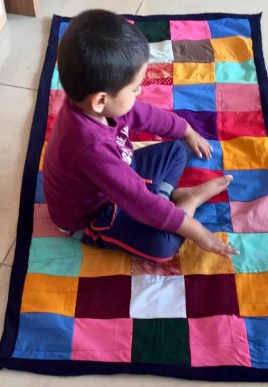
Throwing small challenges, which a kid cannot but accept, is an art. Grandma Rita Jain, a Professor of Botany, seems to have mastered the art well. She has stitched a colourful mat with leftover pieces of cloth that she had. She makes her grandson, Kartik sit on the mat and proposes (that’s her way of challenging the little one), “Kartik, I wonder if you can point at the red squares.”

3aaa0de2-c2b9-436b-ae18-5a72c4d58887Kartik feels victorious when he is able, not only to point, but also count the squares of a particular colour. Sitting in Padmasan, the Lotus Posture on the same mat and performing some other actions form a package deal of challenges, which he enjoys accepting.

One trick cannot keep a kid engaged for long. Kartik seeks variety. The other day, the grandma sat by him and started whipping curds with the traditional Indian whipper (Mathani). It was a stratagem. As the grandma had expected, the little one was attracted to it and wanted to do it all by himself. “Dadiji, I want to do it,” he expressed his desire.

e60e8f23-aed3-4f1d-9828-a4196a484cde“Beta, it is difficult. Do you think you can really do it?” She made the exercise of whipping the curd sound like a highly technical job.

“I’ll do it slowly. I’ll not spill anything. Let me try at least. Please, Dadiji.” Kartik urged.

“Okay! Go ahead! Let me see how well you do it,” the grandma ratcheted up the challenge.

Kartik did it; and did it well. There was nothing great about it. But that little challenge was a step forward in improving eye-hand coordination. The sense of pride that he had at the end of the exercise, gave him confidence for yet another challenge.

In these games that Kartik and the grandma play, both are winners.  


“Now a Silver Medal is Assured!”

This post is inspired by a caption, which appeared in a newspaper supplement and drew my attention. It read: I had prepared for the Asian Games, but didn’t expect to win. Why would a sportsperson enter a competition undetermined to win? The individual might have genuine personal reasons for being less hopeful. But I believe that the environment also kindles and fans this type of hopelessness.

TOI I did not hope to win

I have heard coaches encouraging their trainees thus: “Haar kar mat aana,” meaning “Don’t lose and come.” And parents saying: “Win at least a medal.” Why are we so shy of even desiring to win? Perhaps with the following words of encouragement they would stand a better chance of returning victorious: “Guys you have toiled for this day. Elements of the universe are aligned in your favour. Now go for the Gold!”

The media, both print and electronic, have their way of reporting sporting events. Here is a standard line they use to report the entry of an individual (or a team) into the finals of an event:

“Satbir Singh has reached the finals of the Men’s Badminton. Now he is assured of a Silver Medal.”

Although this is truthful reporting, but it lacks the nudge that can possibly encourage a sportsperson to give that last bit in him/ her to win. If I were a media-person, I would tweak the same report to read thus:

“Satbir Singh has entered (mind you, not “reached”) the final round of the Men’s Badminton. He is now a step closer to the coveted Gold Medal” or “He’ll now fight for the Gold.”

Similar tweaking in the reporting of events in other walks of our daily lives can bring about a pleasant change in the way we start our days. That is a subject of another post, another day.

Hunger Pangs at Night

It was nearing midnight when Chhaya Chordia completed her round of the hostels. She was the Director (Hostels) and resided on the campus of Amity University, Noida. Random visits were her way of feeling the pulse of the hostels. They gave her insights into the problems of the students. Sometimes she would come across pranksters or stumble upon cases of indiscipline. Then there were cases, which belonged to the grey zone––one would wonder whether or not to treat them as flouting of norms. In over a dozen years in the business, she had developed a knack of resolving the issues of the young adults.

Today was a day when she would use that knack.

The wardens and the assistant wardens had submitted their ‘All Correct’ reports. There was silence in the corridors. Most students had gone to sleep; some were studying and some others were netsurfing. Occasionally, a student would step out to fill a bottle of drinking water. Peace prevailed.

Chhaya stepped out of the hostel to return to her residence when she saw someone walking towards the hostel. He had a carry-bag in his hand. She hailed him.

“Who are you?”

“Ma’am, I am Amit Sharma (name changed). I am…”

“You are II Year B Tech Biotech student,” Chhaya cut him short. “You are supposed to be in your room. What are you doing here on the road at this unearthly hour?

“Ma’am, I fell asleep in the evening and couldn’t eat my dinner in the cafeteria. So I ordered food from the dhaba across the road. I have just collected the stuff from gate number 4A.”

“Didn’t the guard on duty stop you?”

“He wasn’t there. He had gone to the loo when I collected the food packet.”

“You are a II Year student. You are fully aware that outside food is not allowed on the campus. Why then did you order food from the dhaba? Don’t you know that consuming food obtained from these roadside vendors can lead to food poisoning?”

“I’m sorry Ma’am. I was very hungry and every outlet in the food-court was closed. I promise, it will not repeat”

“There is no reason that I can allow you to consume this food. Please throw it into that garbage bin. And don’t repeat it.”

Amit complied grudgingly.

“Which is your room?”

“Room number 2 LGF in Hostel-6.”

“Now go back to your room and see me in my office at 11:00 am tomorrow.”

“Good night, Ma’am.”

Amit walked back towards the hostel gate as Chhaya headed for her residence. On her way she called the attendant on duty. “Malati, come to my residence right away.”

Back at her residence, Chhaya took out some food from the refrigerator and heated it. IMG_4039She baked some chapatis. Then laying out the food on a tray, she told the attendant, “Malati, take this to room number 2 LGF of Boys’ Hostel-6. Amit Sharma is the name of the student.

At 11:00 a.m. next morning…

Amit walked into the Hostel Office and touched Chhaya’s feet, “Last night I had returned to my room much annoyed with you. I’m so sorry. We have always seen you as a strict disciplinarian. Never knew about this trait of yours.” A tear rolled down his cheek as he added, “You are a godmother.”

Guru Nanakji & Golf

My drive from the third tee and the conversation following it changed my life forever.

That day I had landed at the golf course without a plan; I often do. Bansi, the Starter let me tee off with another golfer waiting to start.

He was a Sikh gentleman. He must have been in his early seventies; his grey hair and thick glasses suggested so. In his appearance, he resembled the legendary Khushwant Singh. He walked slowly and deliberately. He swung equally slowly with a perfect follow through. He must have been a very good golfer in his heydays. He was hitting short distances but his ball was following the path intended and directed by him. On the first hole he missed a five-foot putt and a par by a whisker. I barely managed to get a bogie.

On the second hole he got an easy par; I missed it narrowly.

The third fairway at the Race Course Golf Course is narrow in the beginning and widens in the later part. There are OBs on either side. One has to hit a long straight drive to be in a comfortable position for the rest of the par-five hole. He cleared the first hurdle comfortably.

It was my turn to tee off. I placed my ball on the tee; walked back a few paces to align myself and took stance. I thought of some of the 50 and more elements that go into making a perfect drive: the grip, the stance, the swing, the follow through, the transfer of weight, eye on the ball etc. I must have done really well at that because it was a long and straight drive, way ahead of the Sikh gentleman. There was instant accolade from him. “That’s a marvellous hit,” he said.

As we walked down the fairway to play our second shots, he appreciated my drive. The praise from the otherwise quiet man filled me with joy and pride. Outwardly I didn’t express much; I wanted to be modest; look modest.

“It just happened. I didn’t do anything. I just struck the ball, said “Wahe Guru” and prayed that it went long and straight.”

“Come on! You can’t get this good result with prayers alone,” he said. “You surely have worked hard for it.”

I tried to look even more modest. That’s when he narrated this story and I reproduce it:

“A Sikh youth was looking for a five-rupee coin that he had accidentally dropped in wet mud. He was praying to the gods to help him find his coin. There was a peculiar thing about his prayers­­––he was praying to all the gods other than the Sikh gods. When a curious bystander asked him, why he was remembering the other gods when his prayers could be (obviously) responded better by Guru Nanakji or other Sikh saints, he said, “Come on! Don’t expect me to ask Guru Nanakji to go into the mud for my five rupees. I’ll bother Him when I have a bigger problem or need. If I keep bothering him for petty things, He might not come to my rescue when I actually need Him.”

Returning to my good drive and prayers to Nanakji, he chuckled and said, “Don’t bother Guru Nanakji for small things in life. Save your prayers for the day when you are in dire need of His intervention.”

The message was loud and clear. That moment onwards, I have always done my bit; and done my bit well, and never nagged God for small favours.

Pray, I still do.

IMG_2662.jpg


Postscript to “It Happens Only in India!”

The other day I wrote about my experience with a couple whose vehicle had broken down on their way to the airport. It was incidental that I saw them stranded on the roadside and offered them a lift. And when the lady (an NRI settled in the US), expressed disbelief––“I never expected this to happen in India”––I responded spontaneously: “Young lady, it happens only in India.”

Kavita, my niece, now a US citizen, has responded to the post with:

“LOL! Though it happens outside India too, I can say for sure, having been on the receiving end of so many gracious gestures from so many strangers; country or continent no bar…”

I have revisited the incident in the light of Kavita’s remark. And, now I see an all new dimension of the incident.

The lady I wrote about was carrying a perception of India and the people here. For that reason, she did not expect such assistance in India.

My response was spontaneous, rather impulsive. Today when I look back, and analyse it dispassionately, I find two reasons for it. One, when she said: “I didn’t expect this to happen in India,” she inadvertently assaulted my pride as an Indian. And two, I haven’t been many places; I haven’t experienced much of the good behaviour of the people IMG_3770abroad. To say––“It happens only in India”––is, I guess, incorrect.

I love my India so do others love their countries.

What would I tell the lady if I were to go back in time and meet her under the same circumstances?

I would perhaps tell her (of course with a more pleasant smile), “My lady, there is more to India than you have seen, read or heard about. Now go, feel the heartbeat of my country.”

Thank you Kavita for sharing that thought. I value your opinion  🙂

On Doodhoo and Bickies

Learning a language to express oneself, English language in particular, is an important first step in our lives in India. Parents do everything possible so that their little ones learn to speak soon. Really soon. It is an obsession––a natural response to the need to master a skill that would enable smooth sail later in life.

As young parents, Chhaya and I observed others teaching their little ones to speak. They would use words that did not exist in dictionaries. For example: doodhoo for doodh (Hindi for milk); ta-ta for hot; kitchtchy for a kiss and bicky for biscuit… the list is long. No sooner did children learn those invented words it was time to start unlearning them and learn the right words to convey the same thoughts. Parents would say, “Sunny, it is not doodhoo, it is doodh; not bicky but biscuit etc.

Toddlers would go through a cycle of learning words; unlearning them and then, learning the appropriate words. Both kids and the parents paid a cost in terms of time and effort involved in the little ones being able to communicate meaningfully.

In our son, Mudit’s case we leapfrogged this step of teaching/ learning by making a deliberate effort to use the right word in the first instance. Thus Mudit picked up fairly decent diction right in the beginning.

Building vocabulary was a parallel process. We helped Mudit learn new words. On his part, he made use of his limited vocabulary to his best advantage. Once when he wanted a hammer and did not know the word for it, he said. “Papa, please give me a nail-pusher.” I was reminded of a 1970 Dustin Hoffman starrer, Little Big Man in which one of the characters says: “I have pain between my ears,” to convey that he had a headache.

Years later, when I was doing a certificate course in French language, our professor posed a question that had a binary answer in a “yes” or a “no”. I do not remember the exact question but it was like: “Are you an Indian?”. The student, who stood up to answer, gave a nod. It was just a nod, a universally accepted expression for “Y-E-S.” On his response, which looked comical the class burst out laughing because everyone expected him to say (in French): “Yes Sir, I am an Indian.” When the laughter died down, on a serious note our professor said that the purpose of learning a language is to be able to convey ideas and to get a feedback or a confirmation or an answer. A nod was as good as an answer formed with half a dozen words. “Do not lose sight of the aim of learning anything,” he said.

As a child Mudit, also learnt that a picture was worth a thousand words. Once we left him home playing with a friend. On our return we found the front door of the house closed and latched. Stuck in the door-handle was a rather longish message that read: “Papa, Vaibhav and I are in Vaibhav’s house…” It was enough need-to-know information for me at that moment. Therefore, I would not have read the complete message, which read further, “Please meet us before you open the door…. There is a snake in the house.” What drew my attention to the rest of the message was the drawing of a snake made prominently in the lower half of the note. Thanks to Mudit’s warning (drawing), the snake was removed and the house was secured. None was harmed.

Fast-forward a dozen years and more. It is a treat seeing Vilasini, our grandniece––based in Geneva with a Tamil-speaking father and a Hindi-speaking mother––effortlessly switching between Hindi, English, Tamil and French. And Kartik, our grandnephew (in the tutelage of his grandmother and parents), conversing in intelligible Hindi/ English and reciting Shlokas in Sanskrit.

In a fast shrinking world, ability to convey ideas will be power of sorts.

Sweet home is the university where education on effective communication begins.