
Is golfing merely scything with expensive equipment?
“Chordia, why don’t you start playing golf?” I remember the day, nearly 35 years ago, when our Air Officer Commanding (AOC) at No 24 Equipment Depot, Manauri posed that question to me. In fact, it wasn’t really a question. I felt it was an oblique recommendation to play the game. At least, the old man’s intonation suggested that. Those days I used to enjoy sweating on the football field. About golf, I had a low opinion; I felt it was like scything with expensive equipment. I had just worn the Squadron Leader rank—inside me was a fidgety Flight Lieutenant who spoke first and thought later. Therefore, I am not surprised that I responded promptly with a polite smirk. Yes, a smirk can be polite, pleasant.
“Sir,” I blurted out, “I think golf is meant for the elderly and the moneyed; and may be… for senior officers. I do not belong to any of those categories of beings.”
With that utterance, I had dropped a brick, if not a bomb. I realised it as soon as the words left my mouth. So, I quickly replaced my polite smirk with a smile. And then, the actor in me worked overtime to look like an innocent youngster trying to be jocular.
The AOC didn’t show an iota of dissatisfaction on his favourite game being seen in a not-so-good light. He rather surprised me with a chuckle, “Beta (son), Playing, or not playing golf, and when to start playing, is a choice. You may choose not to play; but it’s definitely time you refined your ideas. Young people are taking to golf and it is not so expensive—you can buy a half set for pittance. That the game is meant for senior officers, is a myth.”
In the following week, he sent me to HQ Central Air Command to study their course and replicate their ‘Mini Golf Course’—a big putting green with nine holes and interesting obstacles. He patted me for creating ‘a marvel’ for Manauri as he called it. Crazy putting green—it was like playing marbles with putters. I wasn’t impressed; did not make a beginning. The AOC gave up on me when I refused to see the grass on the other side of the fence, let alone appreciating its greenness.
Around the same time, in another part of the world, a teenager, Eldrick Tont Woods (15)—nearly half my age—had made waves by winning the US Junior Amateur Golf Champion title. Soon, the world would know him as Tiger Woods. Clearly, old age wasn’t a criterion; people of all ages were golfing.
A year later, I was in Kanpur on posting. My work schedule gave me time to spare after office hours, and the golf course was next door. This time on, it was an Ordnance Corps officer, a Major, who nudged me, “Why don’t you give the game a try? The course is so close to your residence.” He dragged me to the greens.
The Kanpur Golf Course is scenic. The fairways run parallel to the Ganges. The river is so close that sometimes wayward balls land up in the majestically flowing waters. The saying goes: “You have to offer a few balls as guru-dakshina to Gangaji (teacher’s fee to the Ganges) to learn golf.” There are natural undulations, and trees with large canopies, which pose varying degrees of enjoyable challenges. The water hazards, the bunkers and the sand traps are positioned at vantage points to get the best out of a player; they get the better of some. Gentle breeze laden with fragrance of freshly blooming flowers and the chirping birds transport one to a different world. The gazebo next to the club-house provides a commanding view of the Course as one sips a cup of freshly brewed coffee. It is heavenly; it is enticing!
I couldn’t resist the temptation and gave the game a try. In those days (early 1990s), the Kanpur fairways had a lot of pebbles; preferred lie was allowed all along the course. That made it less humiliating and easier for a beginner like me to pick up the game. I was soon addicted. That little change of mind—to give the game a try—led to a big regret of my life: “Why didn’t I start playing golf earlier?” The AOC’s chuckle and his advice to refine my thoughts about the game echoed in my mind. To this day, those thoughts keep returning. I have realised the importance of trying things rather than rejecting them at face value or on the basis of perceptions.
As if to make up for the lost time, I began playing golf like a man possessed—never missing an opportunity to swing. Since Kanpur, I must have walked a few thousand kilometres with a golf club in my hand. And, I must have spent days (cumulative time) searching my golf balls in the wilderness. In Tezpur, where I was a forced bachelor—Chhaya and Mudit had stayed back in Delhi for Mudit’s schooling—I played golf every day, for two and a half years, except when I was outstation. I recall a sunny Sunday when I played 45 holes through the day. Even the rains couldn’t stop some of us. We would continue playing if it started raining after we had teed-off and would take lateral drops if there were puddles in the fairways. Playing on some of the courses maintained by the grazing cattle, in the tea gardens of the exotic east was unadulterated fun. One day, half way through the game, we were visited by a group of elephants, 30 or 40 of them. Majestic!
Playing with course-mates and friends has always been fun. Most golfers will agree that good company matters; some will argue that company matters the most. On numerous occasions, when I have reached the course without a booking, I have had the opportunity to play with interesting strangers. I have written about one, a Khushwant Singh-like old Sikh gentleman who shared a pearl of wisdom on ‘when to approach Guru Nanakji to influence one’s game of golf (and life)’.
Somehow my caddies have never been impressed by my game: “Sir, keep your head down!” “Sir, you aren’t following through.” “Sir, you are not keeping your eyes on the ball.” “Sir, you are applying too much force.” And the most hard hitting, “Sir, why don’t you take a break and spend some time on the driving range with a pro?” One of my caddies could lob a ball using the branch of a tree better than I could with a lob wedge. I can compile a 200-page booklet on all the solicited and unsolicited advice extended to me by my caddies and fellow golfers. For me, playing golf has always been a humbling experience. Reading self-help books and watching experts on YouTube has not helped. It is celebration when I score below 100. I am on the winning side only when I piggyback a good player.
I bought my first (and the only) half-set for an easily affordable Rs 3500/- and gifted it to a greenhorn when I was presented a full new set by a dear friend. My second new set was also a gift, from my nephew. I have been lucky in that regard. My long innings on the greens have (mis)led some onlookers and beginners to seek guidance from me. Inspite of my not-so-good-credentials, I have always encouraged them: “Golf is the best exercise, next only to yoga. It requires a lot of concentration; and, your concentration improves if you play golf. It teaches you to put aside setbacks and get going in life… mind-muscle coordination… it is application of laws of physics in three dimensions…,” I have sermonised. To some, I have loaned old balls and my 7-iron. But I have seldom taught anyone anything beyond interlocking grip, basic rules and etiquettes.
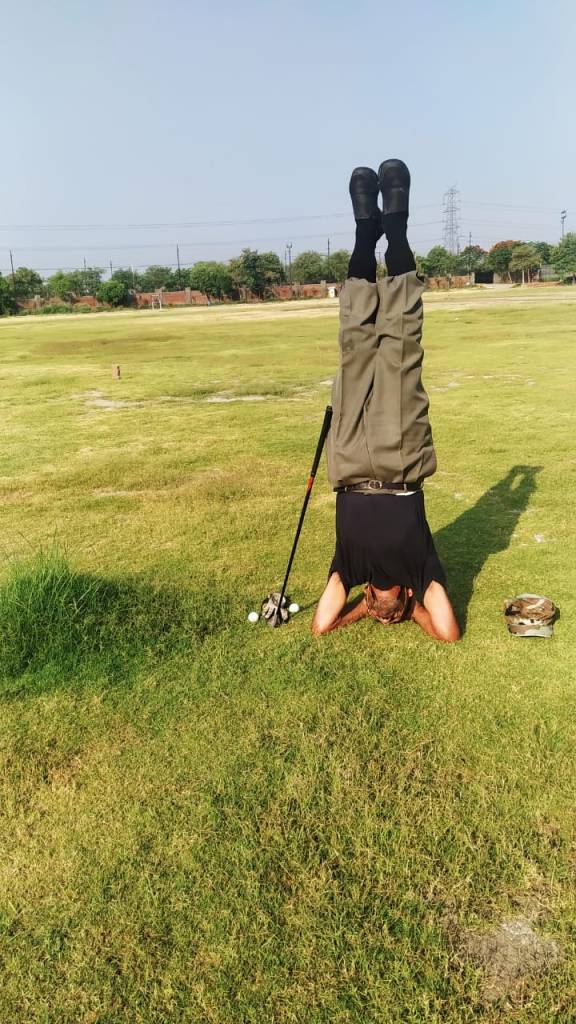
When Covid struck and people were confined to their homes, playing golf was out of the question. It wasn’t so for me. I was confined to the sprawling 60-acre Amity University Campus. Hardly anyone entered the University gate those days. I took the opportunity to play golf. I used to take my short irons and a dozen golf balls to the University’s sports ground. For hours on end, I used to hit golf balls from one end of the ground to the other. The best things people associate with golf—good company, good fairways, good greens, a cafeteria etc etc—were missing. But in due course of time, I began enjoying. It was Nirvana!

What was it about golf that I was enjoying so much? Alone? On a football ground?
After much thought, I concluded that the second-best thing about playing golf is the feeling one gets when one hits the ball from the sweet spot of the club-head and watches it take the cherished flight; land and roll to the intended point. It is a top-of-the-world feeling when a few of the fifty odd elements that go into making a perfect stroke, align favourably to give the desired result. The audio, the soft impact and the visual effect—all lead to ecstasy. Much else matters less. Having a friend around who genuinely rejoices when you execute that near perfect shot only enhances that feeling of levitation.
I have shared this thought with many a golfer. Most have echoed the joy of striking the ball from the sweet spot, but, in the same breath they have questioned, “If that joyous feeling is the second-best thing about playing golf, then what is the best thing about the game?” Elementary! The best thing about playing golf is strictly personal. It resides in each golfer’s mind—it is that single reason which beckons them to the greens at dawn, over and over again, when rest of the world slumbers. A dear friend who strives to see every sunrise in the golf course says he is drawn to the game because: “It is the maximum fun one can have with pants on.”
 Last Monday, playing nine holes after six months, I had three pars; two of them were missed birdies. Rest of the game was decent, mostly bogies, and an odd double bogie. For me, that’s a great performance. It can give me wings to soar for the next six months. But that is not what made my day. My day was made at the Noida Golf Course when I went there later in the afternoon to witness a Golf Tournament organised for the caddies.
 The golf bit––the gross scores, the net scores, the longest drive, the closest to the pin… and the prizes––was like any I had seen in so many places. What touched me was a team of people talking passionately to them about L-I-F-E. Trying to talk them into looking at their lives and think about improving it. I did not know the people who spoke, but I remember the passion with which they were trying to influence their minds. They spoke to their families too––their wives and children who had come well dressed for the occasion. They had cast a spell on the lot. At the end of it, they seemed determined to rise and shine in life.
 Road Much Travelled