“Chanakya” as the real Chanakya could possibly have been!
Sterling…
My revered theatre friend, Shri Ashok Banthia, rekindled my love for the stage when he invited me to work with him on the play Maha Param Veer two years ago. The production was staged in Udaipur, Jaipur, and Bhopal, and is expected to travel to other state capitals as well.
Recently, thanks to Ashokji, I had my first glimpse into the beautiful world of the National School of Drama (NSD). I was awestruck, to say the least. As is often my habit of wishing I could go back in time to pursue unfulfilled dreams, I found myself longing to study drama at NSD. That renewed desire arose from the stellar performances I witnessed yesterday.
Gripping…
The play was Chanakya.
All of us Indians have grown up hearing stories of Chanakya and Chandragupta Maurya. Honestly, those stories seldom inspire awe anymore. However, this Chanakya—researched and scripted over four years—felt fresh and intellectually invigorating. Having been staged more than 1,700 times, it’s no surprise that the actors have come to live and breathe their roles. Watching them, I couldn’t help but wonder if the real Chanakya, Amatya Rakshas, and Chandragupta Maurya could have expressed themselves half as powerfully. No exaggeration intended!
Been there.
The team led by Manoj Joshi (as Chanakya) and Ashok Banthia (as Amatya Rakshas) delivered a sterling performance. The dialogues were powerful and passionate, complemented by excellent costumes, lighting, sound, and music—every element of the production was par excellence. Time seemed to fly, and before I knew it, the play was over.
Beyond its artistic brilliance, the play reintroduces Indian history in a way that leaves a lasting impact. Those who watch it—especially those involved in running the country—will carry pearls of wisdom passed on by the real Chanakya through Manoj and Ashok’s portrayals.
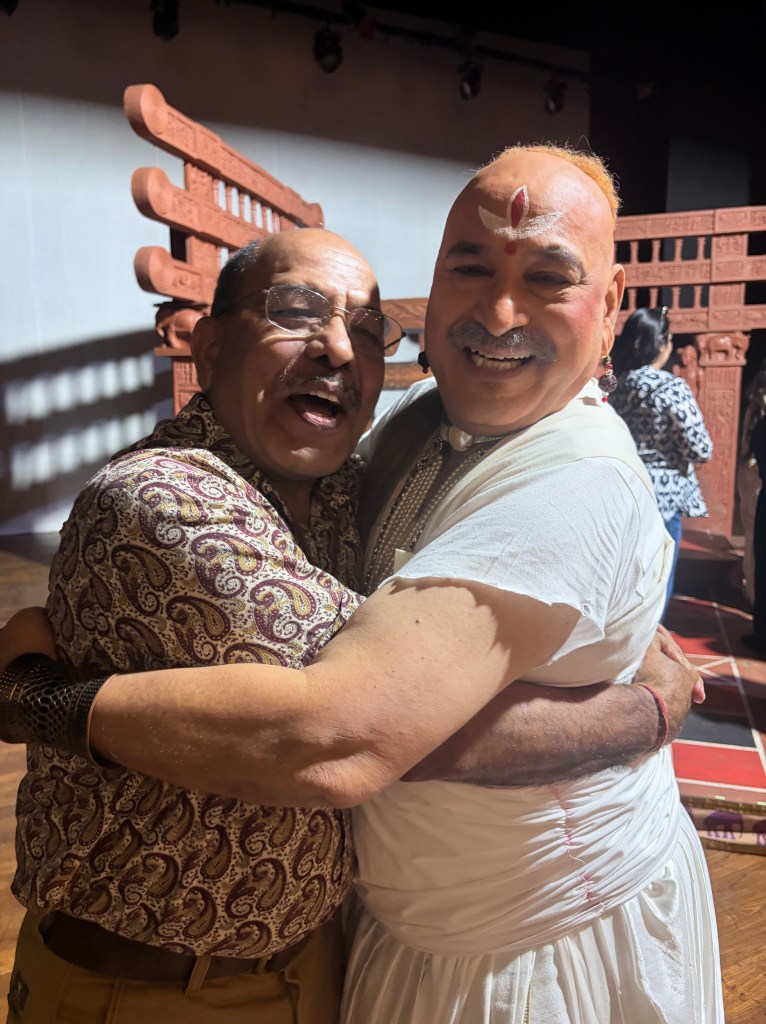
…with my theatre mentor
We often judge a film or play by whether it’s worth our time. My conclusion? Watching Chanakya was worth more than a dozen of the best films or OTT series combined.
When I received a warm, friendly hug from Shri Ashok Banthia after the performance, I couldn’t hold back my hidden desire. I requested him, “Sir, please accept me as your pupil. If nothing else, I’ll cherish the role of a tree or a lamp-post beside which you stand and mesmerize audiences.”
Kudos to Manoj, Ashok, and the entire Chanakya team!
In a household steeped in silence and legacy, a buried truth stirs…. Will it fracture the family’s foundation or let the light in?
He was woken up by the lights flooding the cabin, accompanied by the pilot’s announcement that they would be landing in Hyderabad in approximately forty-five minutes. The outside temperature would be 32 °C and the local time, 2.45 am. Rubbing his groggy eyes, Rohan sat up straight and pushed open the window blinds. Dim, obscure lights were visible on the ground, probably a tiny little Indian town. The lights were random and almost looked like stars in the sky on a slightly hazy night. The haze. That’s what it was. The lights were obscured by a layer of dusty haze covering the ground.
Sravanti, his cousin was getting married in a week and he had a lot resting on his shoulders. Relatives would remind him of his role in keeping the brother-in-law from running away to Kashi several times during the next week, sometimes joking and pinching his cheeks, and at other times, with a seriousness that bordered on delusion. This was an important ritual in Telugu weddings.
Sravanti, at 24 was six years younger than Rohan. All these years, no one bothered to pester Rohan into marriage. The whole family was desperate to see Sravanti married as soon as they could, because her prospects of finding a decent groom would fall with every passing year, or so they thought. In any case, Rohan was left off the hook all these years. And he knew that sooner or later questions would be asked. And this conversation wasn’t going to be easy.
By the time he woke up the next morning, the house was buzzing with activity. The smell of filter coffee wafted through the house. Rohan walked into the living room where pednanna, his father’s older brother was giving orders to the pandal guys about the colourful tent in the courtyard. His father was talking to the decorators about the flowers at the wedding venue. Rohan went and quietly stood next to his father, who saw him as soon as he was done talking to the decorator and gave him a nod of acknowledgement and a light hug. Rohan quickly went to greet his pednanna who looked at him and said, “Ah, good you are here, you can drive pedamma to the caterer, so that she can decide the menu.” That was always the way in this house. There was no grand welcome or warm greetings. It was down-to-business. It wasn’t that pednanna wasn’t happy to see Rohan. He just didn’t see the use of grand gestures.
Sravanti’s wedding
As he walked out towards the garage, he saw Sravanti, amma and pedamma, fervently discussing something about the sarees to be worn for the different rituals. A heap of silk sarees was lying on the bed and Sravanti had a yellow saree with a red border hung over her shoulder. She was looking into the mirror and caught a glimpse of Rohan’s image, immediately threw the saree aside and ran towards Rohan shouting “Annayya!” — big brother. Rohan was swept by a wave of emotion towards his little sister who he was always very fond of.
Rohan, Hari and Sravanti grew up in the same house. Although pednanna was older than Rohan and Hari’s father, Sravanti was the youngest. The series of wedding related activities kept everyone on their toes. Relatives were pouring into the house to see how things were going. The entire house was decorated with yellow marigold flowers. A gazebo of coconut branches was being put up at the main entrance of the house. There was an air of celebration and the sounds of laughter in the house. Pednanna and nanna were both giving out orders to the plethora of workers. Sravanti was surrounded by younger cousins who came to visit her and was lost in giggling and conversation.
With all this frenzy, Rohan, for once, felt good about being home. In the last few years, Rohan hadn’t really looked forward to coming home. He didn’t know when and how he started feeling more at home in Singapore than here. Maybe just the archaic ideas that pednana had about everything and his unwillingness to listen to reason; or the fact that Nanna never spoke anything against pednanna, or that neither amma or pedamma ever had any say in the matters of the house, made it easier for him to stay away. In the beginning, he tried to argue. But when his points were dismissed with remarks like, “Oh, look at the foreign-returned guy who’s forgotten his own culture,” his patience finally gave out.
As children, Rohan was always the boisterous one, while Hari remained quiet and withdrawn. Rohan sang, danced, and excelled in theatre. At every extended family gathering, his performances were a highlight. Hari, meanwhile, clung to the edge of his mother’s saree, silently observing from the sidelines. During their teenage years, Rohan was often surrounded by his lively group of friends, the centre of every hangout. Hari, in contrast, retreated into the world of video games and online avatars, preferring virtual realms to real-life interactions.
When Rohan landed his first job offer in Singapore, a mini-van was arranged to ferry the twenty-odd relatives and friends who wanted to see him off at the airport.
On arriving in Singapore, Rohan found himself all alone for the first time ever. But soon enough, he made new friends and looked at life from different perspectives. On a trip to Bali with some of his new friends, Rohan’s life completely changed. The second evening in Bali, he and his friends, had just come back from the day on the beach and decided to have dinner at the hotel restaurant. The tables were set along the pool and the fading light was shimmering on the tiny ripples of the pool. Rohan and his friends had just ordered their drinks and were lost in conversation when, out of the corner of his eye, he caught sight of Nikki. He wasn’t usually rendered speechless. But this time was different, he froze below his knees.
The next morning, Rohan decided to walk to the beach by himself while his friends were sleeping off their hangover. He had just stepped outside the hotel when he heard someone say, “Hello, you seem to be up early.” Rohan was mesmerised by the voice, and the dimple on the left cheek. Thoughts were rushing into Rohan’s mind. This was the stuff of movies.
Gathering himself, Rohan finally managed to string a few words together and said, “Do you live around here?”
“No, I live in Singapore and I am here on work. You see, I work in hospitality” Rohan began to relax and decided he could use the company. Rohan and Nikki walked through the market, looking at the local trinkets that were being sold. Nikki gave him tidbits of information about the village and the people. Conversation flowed, about families, homes, work, and childhood. They ate, strolled and without realising, they ended up on a beach. This wasn’t the popular touristy beach, but a fishing beach that only the local people went to.
Day had turned into dusk, and the beach had become more secluded. Sitting on the sand, Rohan realised that he wasn’t even trying anymore. The resistance he had felt in earlier such encounters wasn’t there anymore. Something was happening and he just couldn’t deny it anymore. He was enjoying the company, the setting, the sound of Nikki’s voice, the one-sided smile, the dimple in the cheek and he just couldn’t resist it anymore.
Eight hours had passed since he met Nikki on the street and they were still sitting together and talking. Rohan couldn’t even remember the conversation. The only thing he felt was a tiredness, the kind that one feels after a really satisfying day, when you just want to rest your head and sleep. He didn’t realise when he rested his head on Nikki’s shoulders and when he dozed off.
Back at the hotel, Rohan’s friends were packing up to leave the next day. Rohan and Nikki exchanged contact details and stayed in touch. Soon, they were frequently meeting, spending long evenings at Clarke Quay, dining at restaurants and spending nights with each other. It just felt natural, like it was meant to be. How would he explain this to his conservative South Indian Brahmin family?
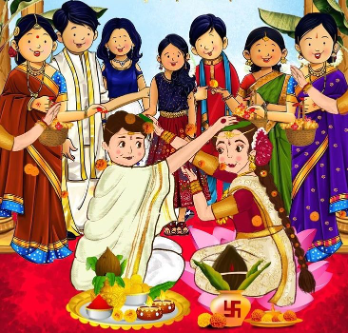
With a jolt, Rohan came back to the present. The bride and the groom were tying the knot. People were throwing rice dipped in turmeric at the couple as blessings. Pednanna and peddamma were looking relieved and yet had tears streaming down their eyes.
Later that evening, after all the festivities were done and most of the relatives were gone, Pednanna called Rohan into the living room. Everyone was seated around the room and there was an air of speculation. Rohan knew what was coming. Pednanna said, “Subba Rao is my very close childhood friend. He has a daughter, Lavanya. We want you to meet her tomorrow.”
“Well, I am not surprised,” thought Rohan to himself. Then spoke aloud, “I don’t want to meet Lavanya, pednanna. With all due respect, I like someone else.”
“Is she Brahmin? Telugu?” yelled pednanna.
“No, and I don’t care about that at all,” retorted Rohan.
“Then I will never accept it. There is no place for uncultured foreigners in this house.” Pednanna was furious.
Pednanna was never one to mince words or hide his bigotry. In fact, he took pride in being that way. Rohan looked towards his mother and father. Nanna was looking down meekly instead of standing up for Rohan; it was typical of him. In all the years he was growing up, nanna never stood up either for himself, or for his family.
“Pednanna, how does all that matter? Isn’t it enough if we love each other?”
“Nonsense, this love, shove and all that doesn’t last. If you marry your foreigner, you will get divorced soon. They have no family values, those uncultured fellows.”
How narrow minded was his family! How did they decide that their culture was the best. Rohan didn’t want to argue anymore. He just stormed out of the house. He walked and walked till his legs were tired. Thoughts were rushing through his head. “As though marrying someone from your own caste was any guarantee for happiness. Was pedamma ever happy in her marriage? Pednanna and Pedamma never showed each other affection. So why am I expected to inherit these gendered roles that feel so hollow?”
He didn’t intend to conform to those roles. He couldn’t even if he wanted to. Exhausted with anguish, Rohan sat down on a bench by Tank Bund and before he knew it, tiredness took over his body and he fell asleep.
Hours later, Rohan was shaken awake by Nanna and Hari, their faces etched with worry. Disoriented, he blinked in the morning light, the weights of his thoughts from the previous night still pressing down on him. He hadn’t meant to fall asleep there, but his exhaustion, physical and emotional, had consumed him.
Nanna and Hari had spent the last few hours frantically searching for him, panic rising with every empty street and unanswered call. They heaved sighs of relief when they finally saw him, curled up, on a cold bench by the Tank Bund.
“Rohan, let’s go home. Stop being so stubborn.” Nanna said, shaking him awake, frantic with fear. Rohan refused to go home. He insisted that he was in love and he couldn’t spoil three lives by marrying someone he couldn’t love. If pednanna and the family couldn’t understand, what was the point of staying? Rohan felt a lump rising in his throat, his love, his identity and the impossible walls of tradition bearing down on him. He was ready to walk away from it all. Forever.
A sob tore through him, unrestrained. Nanna and Hari stood beside him, their own eyes brimming with emotion. “Please, Rohan,” Hari finally said, his voice, a whisper. “Come Let’s go home.” Nanna nodded, “We’ll figure this out.”
Rohan wanted to resist, to stay firm in his decision, but something in Nanna’s voice, something he had never felt before, made him pause. It wasn’t authority or resignation. It was something closer to understanding. Slowly he wiped his tears and stood up.
When they reached home, an uneasy silence was hanging over the house, thick and suffocating like the lingering scent of burnt incense after a long puja. Pedamma stood near the kitchen doorway, wringing the edge of her saree, her face tight with worry. Amma sat on the sofa, her eyes darting between Rohan and Pednanna, as if bracing for an inevitable storm.
Pednanna stood in the centre of the room, his arms crossed, his disapproval evident in his frown. Rohan could feel the weight of expectation pressing down on him, suffocating and unrelenting.
Then, for the first time in Rohan’s life, Nanna stepped forward. His voice was steady, but there was an unfamiliar urgency in it. “Annayya,” he said, looking pednanna directly in the eye, “Rohan is my son. If he says he loves this Nikki, my wife and I are going to support him. Even if Nikki is a foreigner, we will love her the way Rohan loves her.”
Oh dear, Rohan’s heart pounded as he glanced at his father, now he had to tell them that Nikki was actually Nicholas!


 Road Much Travelled