Mission First

The exhilarating feeling is irresistible. A jumper would go as far as one can to satiate the desire to skydive. The Parachute Jump Instructors (PJIs) of the Paratroopers Training School (PTS), Agra are no exception. Drop a pin anywhere on the map of India and in a radius of fifty miles of the pin there will be a place where Akashganga, the Skydiving Team of the Indian Air Force (IAF) would have carried out a skydiving demonstration as a part of a major national event or a military tattoo. If not a demonstration, it would be a paradrop as a part of an airborne military training exercise.

Thanks to my tenures of duty as a PJI, I have been a part of many such displays. From the identification, reconnaissance and exploration of new Drop Zones in the freezing cold Leh-Ladakh region and trial jumps on those Drop Zones, to the exit over the Indian Ocean to land on a target in Thiruvananthapuram, each jump I undertook was different from the other and memorable in a unique way. When I look back, some stand out. An interesting one that often returns to the mind is the one performed as a part of the raising day celebrations of the President’s Bodyguards in November 1998.

High Altitude Jump Trials

I was then the Assistant Director of Operations (Para) at the Air Headquarters.

It was a Herculean task to get the requisite permissions and clearances for the demonstration at the Jaipur Polo Ground. With the who’s who of Indian leadership residing in Lutyens’ Delhi, security was a big concern. Jaipur Polo Ground was not far from the Prime Minister’s Residence. “It would be imprudent to allow such ‘frivolous’ activity in this area,” was an opinion. Then there was the issue of availability of airspace in the proximity of the busy Indira Gandhi International Airport where an aircraft takes off or lands almost every minute and dozens guzzle fuel as they await their turns on the ground or orbit in the nearby sectors. For many well-meaning people, disrupting the air traffic for a skydiving demonstration was an avoidable proposition. An easy way out for those in authority was to say: “NO.”

Notwithstanding what was happening on the files between the Air Headquarters, the Army Headquarters and the South Block in Delhi, the jumpers were agog, drooling. They were excitedly looking forward to the opportunity to jump at the prestigious event to be witnessed by the Supreme Commander of the Indian Armed Forces. Shri KR Narayanan was the then Honourable President of India.

How the permission to undertake the skydiving demonstration came about is the subject matter of another story. Suffice it to say that it did come—somehow. There were caveats, though. We were directed to operate from Air Force Station, Hindan. A team of security experts would sanitise our aircraft and inspect the parachutes for hazardous materials. We were told that they might frisk the jumpers too. Being personally searched was an irksome idea which we brushed aside in service interest.  Although the permission had been granted, we were also to await a last-minute clearance from Palam Air Traffic Control (ATC) before take-off. After getting airborne we were to follow a given corridor; report at check points and proceed only on further clearances.  The helicopter was permitted a maximum of 21 minutes over the Polo Ground to disgorge the jumpers and clear the area. Would the conscientious security apparatus be obliged to consider the aircraft ‘hostile’ if it strayed from the assigned route, or overstayed its allotted time over the Drop Zone (the Jaipur Polo Ground)? May be. May be not. To us, it mattered little as long as we could jump.

On the D-Day, the team led by Squadron Leader Sanjay Thapar, the then Chief Instructor PTS, arrived from Agra. Group Captain TK Rath, (the Director, Air Force Adventure Foundation), Squadron Leaders HN Bhagwat and RC Tripathi (both of the AF Adventure Foundation), and I joined them at Hindan. We inspected and lined up our parachutes and jump equipment and dispersed, since enough cushion time had been catered for, to account for unforeseen changes in programme. We all had our ways of passing the time available before take-off. Most sat quietly with fingers crossed hoping and praying for the drop to go through, because such VVIP programmes are prone to last minute hiccups. Group Captain Rath immersed himself in a book which he always carried in his overall pocket. He took a break in between to do a headstand. It was his way of attaining peace and calm. Thapar was engaged in communicating with Palam and the controller at the Polo Ground for the updates.

It was “OPS NORMAL!”

Minutes into the break the peace of sorts that prevailed on the tarmac was shattered by a commotion. The Security Team—in civilian clothing—after sanitising the aircraft had started overturning our lined-up parachutes to inspect them. They were alarmed to see sharp knives attached to the straps and had started taking them away.

Squadron Leader Tripathi saw them and literally pounced on them, “What are you doing?” he shouted.

“We are doing our duty… securing and sanitising everything. You can’t jump with these knives.” Their leader said with authority.

“But these knives are our lifeline… we need them in case we have to snap some parachute rigging lines in an emergency.”     

“We can’t help it… sharp objects around a VVIP are a taboo,” he drew a line.

Tripathi wasn’t the one to give in easily. He sparred on, “Well, now you have physically handled our parachutes without our knowledge. We don’t know if they have been rendered unfit for use. And, you are not allowing us to carry our survival knives, which is a must for us.” He let that sink in, and then came with the final punch, “Under the circumstances, it will not be possible for the team to jump. Please inform the guys at the other end that the demonstration jump is being called off for these very reasons.”

There was stunned silence before the leader spoke, “We understand your requirements. But you cannot cancel a programme meant for a VVIP and blame it on us. We are all men in uniform. We must find a way out.”

After a little ado, we were permitted to carry our jump knives.

The wait thereafter was long. Panic set in when the clock struck four. It was our scheduled time of take-off. There was no clearance yet. The Honourable President would arrive at 5:00 pm as per programme. In an extreme situation, just in case the Skydiving Demonstration couldn’t be undertaken for any reasons, the Military Band present at the Polo Ground would play martial tunes to entertain the audience. None was interested in that Plan-B; every stake-holder wanted the jump to go through.

In those moments of uncertainty, a deliberate decision was taken to get airborne and hold position over the dumbbell at Hindan airfield so that no time was wasted if and when a go-ahead message was received. So, still on tenterhooks, we strapped our parachutes and boarded the helicopter.

The clearance came 15 minutes too late; we’d now be cutting fine. Our helicopter was asked to hold position over the Yamuna bridge and wait for the final clearance. Time was running out. November smog had begun causing concern. But Thapar, who was born and brought up in Delhi was not deterred by the falling visibility; he knew the ground features by heart. He could manoeuvre blindfolded.

When the final clearance came, there was just enough time to make one pass over the Polo Ground. Under normal circumstances, the aircraft makes three passes over the Drop Zone—one, for the pilot and the Skydiving Team Leader to familiarise with the target on the ground and ascertain the line of run. The other two passes, are to drop jumpers in batches of six to eight each.

A confident Thapar took the decision to do away with the first two passes over the spectators. He briefed the jumpers in the aircraft that all of them—more than a dozen—would exit the aircraft in one go. He re-assigned the parachute opening heights to each jumper and stressed the need to stick to it else there would be many jumpers approaching the landing area together resulting in a melee; maybe collisions.

Good things don’t come easy!

At 5:00 pm, when the helicopter came overhead, the Drop Zone Safety Officer informed that the President had not arrived. “Please hold on!” he advised.

Three minutes later, the Air Traffic Controller from Palam Airport instructed our helicopter to clear the area instantly; international flights were getting inconvenienced. It was when the captain of the aircraft was contemplating abandoning the mission that Thapar leaned out of the aircraft and spotted the President’s motorcade. It would still take a couple of minutes to reach the spectator stands. When he turned back, he had taken the decision.

“Go!” he commanded the line of jumpers awaiting his instructions. Within seconds all the jumpers were out of the helicopter.
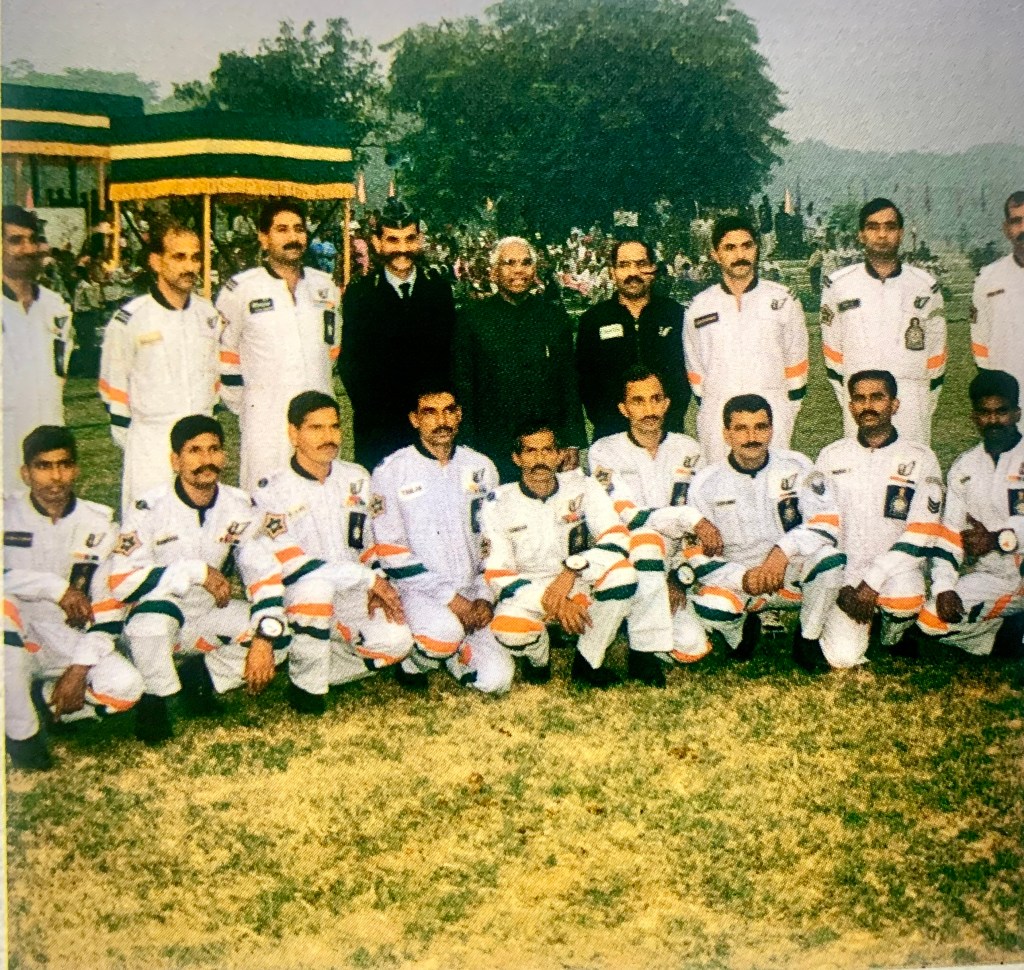
With the Supreme Commander

The pilots racing back to Hindan airfield saw the colourful parachute canopies adorning the sky over Lutyens’ Delhi. The Honourable President’s motorcade just moved into the Ground as the skydivers began landing one by one. It turned out to be a bit comical when the jumpers responded to the tune of the National Anthem and stood to attention on touchdown.

Cancellation of a para drop is one of the worst possibilities faced by a Parachute Jump Instructor.

The Last Straw: The Air Raid on Government House, Dacca  (Indo-Pak War 1971)

The Air Raid on Government House, Dacca  (Indo-Pak War 1971) triggered a chain of events that eventually led to the historical surrender of a 93,000 strong Pakistan Army on December 16, 1971.

Many events led to the historic surrender of a 93,000 strong Pakistan Army on December 16, 1971; some stand out. One of them is the bombing of the Government House in Dacca which, according to many historians, was the proverbial last straw which broke the camel’s back. It is interesting how it came about.

In about a week since its breakout on December 3, the Indo-Pak War in the eastern sector had reached a turning point. The Indian Air Force was in command of the skies and was striking Pakistani military targets with impunity. The Indian Navy had achieved a blockade in the Bay of Bengal so that no assistance could reach the battered and bruised Pakistani forces from the sea. The biggest and the most successful paradrop since the Second World War (Tangail, December 11, 1971) had shattered the morale of the Pakistani forces. The Indian Paratroopers who had landed at Tangail had linked up with the troops from the north and had closed in on Dacca. Dacca with 26,400 Pakistani troops was surrounded by 3,000 Indian troops. The numerical asymmetry favoured Pakistan. Hereafter, it would be a bloody street fight between desperate Pakistani troops fighting for survival and the Indian troops and the cadres of Mukti Bahini flushing them out in an effort to wrest control of the city.

The rudderless and helpless Pakistani leadership holed up in Dacca knew that a fortified Dacca would be costly and time-consuming for the Indian troops to capture; holding on to it would give them the possible time needed to clamour for international support, and maybe, get it. Several ceasefire resolutions had already been tabled in the UN. The US, siding with Pakistan had tried to pressurise India in to a ceasefire by moving its aircraft carrier USS Enterprise and other warships into the Bay of Bengal. The Soviet Union had vetoed all the resolutions that did not link a ceasefire with the recognition of the will of the people of East Pakistan. But under diplomatic compulsions, Moscow had conveyed to Delhi that there would be no more vetoes. Under those circumstances, any prolonging of the War would be detrimental to the interest of the freedom fighters seeking independence from Pakistan and for the Indian armed forces who had brought the War so close to a favourable conclusion. Victory and the achievement of the goal was so close, yet so far. Something had to be done before a third party could intervene and ‘thrust’ a ceasefire.

To work out a concrete plan to delay the fall of Dacca until international support could be mustered, Governor Dr AM Malik had called a very high-level meeting in the Government House around mid-day on December 14. The who’s who of the administrative machinery, the military leadership, a few foreign diplomats, the representative of the International Committee of the Red Cross and the UN representative, John Kelly would be present. The main aim was to find a way to bring about a face-saving ceasefire rather than a shameful surrender by the Pakistani Army.

There were several transmissions by the Pakistanis on the radio air waves sharing the details of the meeting called by the Governor. It is a matter of chance that those communications were picked up by a vigilant Wireless Experimental Unit of the Indian Air Force. A flight lieutenant officiating as the Commanding Officer, heard and re-heard those messages because they indicated a congregation of the top Pakistani leadership at a place at a given time. He wasted no time in bringing it to the notice of his ‘higher ups.’

Thereafter things happened really fast. The Signal Intelligence Directorate, Army Command and the Eastern Air Command shared the leak with Delhi. Those in Delhi, realised the strategic importance of the leaked message. To thwart the Pakistani design to manoeuvre a ceasefire or to tether the Indian troops on the periphery of Dacca until ‘help’ arrived, it was imperative to somehow prevent decision making by the Governor. It was of strategic importance to disrupt that planned meeting. The stymieing of the meeting would also send the administration and defence of Dacca into total disarray. With the time of the meeting fast approaching, the window of opportunity to throw a spanner in the works was rather small. 

Acting fast, Air Headquarters ordered the Eastern Air Command in the morning of December 14, to strike the Circuit House where the meeting was to take place. The First Supersonics, the MiG-21 fighters of 28 Squadron, Air Force based at Guwahati, were tasked with the responsibility. Wing Commander BK Bishnoi, the Commanding Officer, who had just returned from a close-support mission from Mainamati Cantonment in the morning received the instructions through Group Captain MSD Wollen (Station Commander, Air Force Station, Guwahati).

The time was 10:55 am when Bishnoi was directed to strike the Circuit House in Dacca at 11:20 am. It was a tall order in as much as, the flying time from Guwahati to Dacca was 21 minutes. And, to add to the woes of the pilots, none in the Squadron knew where in Dacca was the Circuit House located. The building was not clearly indicated in the quarter-inch and the one-inch maps available in the Squadron. Under those circumstances, striking the target without causing collateral damage would be difficult.

To help out Bishnoi with the location of the intended target, Wollen produced a tourist map which gave the location of the Circuit House. Even on that map of the city of Dacca, pinpointing a particular crossing and the Circuit House on that crossing in a crowded locality was difficult. How to strike the target in that crammed locality and yet avoid harming the civilian population in the vicinity, must have been uppermost in the mind of a conscientious Bishnoi when he took the tourist map from Wollen and accepted the daunting task. Since time was running out, he decided to fly over Dacca with the tourist map and look for the Circuit House. He could afford that luxury because there was practically no resistance from the Pakistani Air Force.

Four MiG-21 aircraft loaded with 32 High Explosive Rockets each were readied for the mission. It was when Bishnoi was strapping up in the cockpit that one of his officers came running to him and gave him a slip of paper which said that the target was Government House and not Circuit House. A major faux pas was averted.

Once the formation was airborne and was on its way to execute the mission, Bishnoi scanned the tourist map and identified the Government House on it. The other three members of the strike team––Flight Lieutenants Vinod Bhatia, Raghavachari and Malhi––were still oblivious of the last-minute change of the target from Circuit House to Government House. Bishnoi had not announced the change on the R/T, to maintain secrecy to the extent possible.

Barely a minute before the formation was over Dacca, Bishnoi shared the ‘revised’ target information with his team. He described it for them and gave them the approximate location and asked them to look out for it. Bhatia who spotted the Government House first, identified it as a magnificent old styled palatial building with a high dome, in the middle of a lush green compound, eleven o’clock to them, about 500 yards away. A few vehicles were parked on its premises.

Bishnoi orbited once to confirm the identity of the target and then ordered the attack, himself taking the building from the wider side. He aimed at the room below the dome. The others targeted other parts of the building. In two passes, the team fired 128 rockets at the Government House. Two MiG aircraft of No. 5 Squadron Air Force followed Bishnoi’s formation. They made four passes each, firing rockets at their target. The IAF aircraft remained unscathed by the half-hearted firing by the Pakistani anti-aircraft guns

Smoke and dust rose from the seat of Pakistani power in East Pakistan.  

Like Wing Commander Bishnoi, Wing Commander SK Kaul, the Commanding Officer of 37 Squadron, Air Force located at Hashimara, too didn’t get much time to prepare. At about 10:30 am on the same day he also received instructions to target the Government House in Dacca. When he raised questions about the location of the building, a young officer of his Squadron came up with a Burmah Shell tourist map of the city of Dacca. It amazed the Commanding Officer to no end. But, according to Kaul, the map was more detailed than the quarter-inch and the one-inch maps used by the pilots. At least, it served the intended purpose at that crucial moment.

Before, the Governor and the people in the Government House could absorb the shock of the rocket attack by the MiG fighters, they were attacked by two Hunter aircraft flown by Wing Commander SK Kaul and Flying Officer Harish Masand, respectively. They made several passes over the target and emptied their guns. On their way back they saw the spectator gallery that was on the rooftop of the Dacca Intercontinental Hotel. Standing atop the hotel building, the foreigners and the media-persons were watching the spectacle at the Government House.

Those in the Government House didn’t have a respite; they didn’t have time to raise their heads. The raid by the duo of Kaul and Masand was followed by a raid by Squadron Leader Bose and Flight Lieutenant Menon. Again, there was a feeble response from the Air Defence elements on the ground. The Indian MiG and Hunter formations had inflicted severe damage on the seat of power in East Pakistan; the air attacks had shattered the pride and morale of the leadership.     

Down below, the massive roof of the main hall of the Government House was ripped. There was pandemonium in the building as people ran for cover. The Governor rushed to the air-raid shelter. Between the raids, he quickly scribbled his resignation to General Yahya Khan, the President of Pakistan. He was seen taking off his shoes, washing his hands and feet and kneeling down for prayers in an air raid shelter. Allah alone could save him and the Pakistanis from the wrath of the Indian Armed Forces.  

After tendering his resignation, Dr Malik, his Cabinet and the West Pakistani Civil Servants based in the city, made a beeline to the Dacca Intercontinental Hotel, which had been converted into a Neutral Zone by the International Red Cross. As per diplomatic norms Serving Pakistani officials couldn’t have taken refuge in the Hotel. So, the top brass dissociated themselves in writing from the Government of Pakistan to become eligible to get admission in the Neutral Zone.

The same evening, in a desperate bid, Lieutenant General Niazi rushed to Mr Herbert Daniel Spivack, the US Consul-General in Dacca with a request to negotiate a ceasefire with India on Pakistan’s behalf. The American diplomat declined the request outright, instead he offered to ‘send a message’.      The air attacks on the Government House in Dacca broke the back of Pakistani command and control in the eastern sector. In the following two days, it took a little more of arm-twisting of Lieutenant General AAK Niazi by Lieutenant General JFR Jacob to make him agree to an unconditional surrender by the Pakistani Army.