“Now a Silver Medal is Assured!”

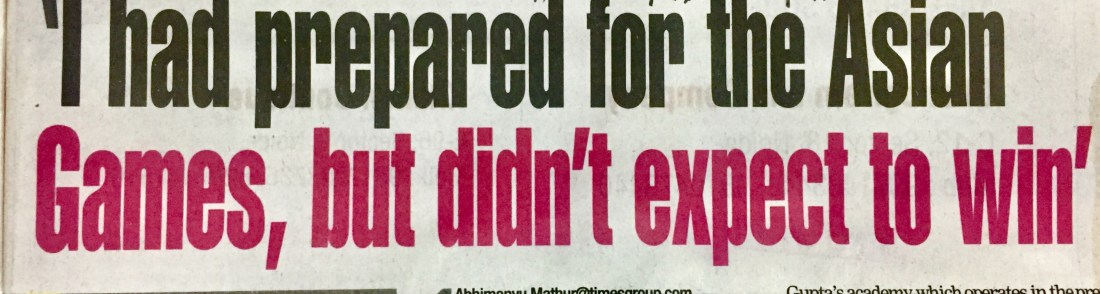
This post is inspired by a caption, which appeared in a newspaper supplement and drew my attention. It read: I had prepared for the Asian Games, but didn’t expect to win. Why would a sportsperson enter a competition undetermined to win? The individual might have genuine personal reasons for being less hopeful. But I believe that the environment also kindles and fans this type of hopelessness.

TOI I did not hope to win

I have heard coaches encouraging their trainees thus: “Haar kar mat aana,” meaning “Don’t lose and come.” And parents saying: “Win at least a medal.” Why are we so shy of even desiring to win? Perhaps with the following words of encouragement they would stand a better chance of returning victorious: “Guys you have toiled for this day. Elements of the universe are aligned in your favour. Now go for the Gold!”

The media, both print and electronic, have their way of reporting sporting events. Here is a standard line they use to report the entry of an individual (or a team) into the finals of an event:

“Satbir Singh has reached the finals of the Men’s Badminton. Now he is assured of a Silver Medal.”

Although this is truthful reporting, but it lacks the nudge that can possibly encourage a sportsperson to give that last bit in him/ her to win. If I were a media-person, I would tweak the same report to read thus:

“Satbir Singh has entered (mind you, not “reached”) the final round of the Men’s Badminton. He is now a step closer to the coveted Gold Medal” or “He’ll now fight for the Gold.”

Similar tweaking in the reporting of events in other walks of our daily lives can bring about a pleasant change in the way we start our days. That is a subject of another post, another day.

Tipping the Fear of the Unknown

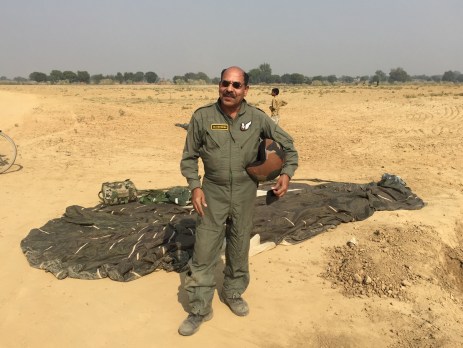
“Aren’t you scared abandoning a perfectly well flying aircraft mid-air? How did you feel when you made the first parachute jump? What motivated you to volunteer for such a perilous duty?” I have been asked those questions, and the like, umpteen times since I qualified as a Parachute Jump Instructor (PJI) at the prestigious Paratroopers’ Training School, Agra way back in the October of 1982.

I have trained hundreds of jumpers, including the NCC cadets. Individuals undertake parachute jumps for different reasons. Some want to prove a point––to themselves, to others, to the world. Some do it for adventure. Many in the army do it for the lure of the Maroon Beret and the paratrooper’s brevet––by far the most coveted insignia on a military uniform. The saying goes: “On the eighth day God created the paratroopers and the devil stood at attention.”

I knew little about PJI duties when I volunteered for selection for such a job. I was newly commissioned and posted as a logistics officer at an Equipment Depot in Devlali. Flight Lieutenant UR Rao, a PJI himself, was a role model for us youngsters. He said that it was a wonderful life as a PJI; we would get a glimpse of it during the selection process. “In any case, you’ll be able to see the Taj Mahal when you go to Agra,” he used to chuckle.

My training at Sainik School Rewa and the National Defence Academy, saw me through the tough selection. During the process, we were taken for an air experience in the Packet aircraft (an aircraft of WW II vintage). “The noise and the vibrations of this aircraft might be enough to force a person to bail out,” I wondered.

The toughening phase commenced on the following New Year’s Day (1982). Even in the biting cold and foggy winter of Agra, by 7 am, one could squeeze half a litre of sweat from our jerseys. There was no compromise. We were being trained to undertake assignments that would involve lives––on our actions would depend the safety of scores of paratroopers.

The training for the Para Basic Course lasted 12 days. Following an aptitude test we were ready for the first jump.

“Why the heavens did I opt for this?” That question hit me hard as the aft end door was opened over the drop zone and I was made to take position at the edge. It was scary standing in the open door of an aircraft flying at 225 kmph at a height of 1250 feet above the ground level. I wondered if I was better off as a logistics officer back in Devlali.

“Why? Why? Why?” The fear of the unknown was gnawing at my confidence. There were 30 seconds for the “G-R-E-E-N” signal to come on.

Turning back or looking back would amount to a weak resolve on my part––I had a decent opinion of myself. I couldn’t let myself down. Nonetheless, I managed a furtive glance into the aircraft. Standing behind me were four jawans, also ready to take their first plunge. They were quiet, absolutely quiet. Their faces were open books. Perhaps each was fighting a battle within. They were looking up to me to lead. I couldn’t have let them down.

I had found my trigger to go ahead.

Someone in the line hailed, “Chhatri Mata ki Jai!

“Green ON… G-O,” barked the despatcher.

Like a bullet I threw myself out of the aircraft. The parachute opened before I could count: “One thousand, two thousand, th-r-e-e…” The winds were gentle. On landing, the parachute collapsed like a pricked balloon. It was an experience of a lifetime. I smiled at my pre-jump apprehensions.

In the following years, as an instructor I always allayed the anxiety of my trainees by telling them that jumping from an aircraft was safer than crossing roads in Delhi.”

It takes right trigger to overcome the fear of the unknown.

IMG_5802

Hunger Pangs at Night

It was nearing midnight when Chhaya Chordia completed her round of the hostels. She was the Director (Hostels) and resided on the campus of Amity University, Noida. Random visits were her way of feeling the pulse of the hostels. They gave her insights into the problems of the students. Sometimes she would come across pranksters or stumble upon cases of indiscipline. Then there were cases, which belonged to the grey zone––one would wonder whether or not to treat them as flouting of norms. In over a dozen years in the business, she had developed a knack of resolving the issues of the young adults.

Today was a day when she would use that knack.

The wardens and the assistant wardens had submitted their ‘All Correct’ reports. There was silence in the corridors. Most students had gone to sleep; some were studying and some others were netsurfing. Occasionally, a student would step out to fill a bottle of drinking water. Peace prevailed.

Chhaya stepped out of the hostel to return to her residence when she saw someone walking towards the hostel. He had a carry-bag in his hand. She hailed him.

“Who are you?”

“Ma’am, I am Amit Sharma (name changed). I am…”

“You are II Year B Tech Biotech student,” Chhaya cut him short. “You are supposed to be in your room. What are you doing here on the road at this unearthly hour?

“Ma’am, I fell asleep in the evening and couldn’t eat my dinner in the cafeteria. So I ordered food from the dhaba across the road. I have just collected the stuff from gate number 4A.”

“Didn’t the guard on duty stop you?”

“He wasn’t there. He had gone to the loo when I collected the food packet.”

“You are a II Year student. You are fully aware that outside food is not allowed on the campus. Why then did you order food from the dhaba? Don’t you know that consuming food obtained from these roadside vendors can lead to food poisoning?”

“I’m sorry Ma’am. I was very hungry and every outlet in the food-court was closed. I promise, it will not repeat”

“There is no reason that I can allow you to consume this food. Please throw it into that garbage bin. And don’t repeat it.”

Amit complied grudgingly.

“Which is your room?”

“Room number 2 LGF in Hostel-6.”

“Now go back to your room and see me in my office at 11:00 am tomorrow.”

“Good night, Ma’am.”

Amit walked back towards the hostel gate as Chhaya headed for her residence. On her way she called the attendant on duty. “Malati, come to my residence right away.”

Back at her residence, Chhaya took out some food from the refrigerator and heated it. IMG_4039She baked some chapatis. Then laying out the food on a tray, she told the attendant, “Malati, take this to room number 2 LGF of Boys’ Hostel-6. Amit Sharma is the name of the student.

At 11:00 a.m. next morning…

Amit walked into the Hostel Office and touched Chhaya’s feet, “Last night I had returned to my room much annoyed with you. I’m so sorry. We have always seen you as a strict disciplinarian. Never knew about this trait of yours.” A tear rolled down his cheek as he added, “You are a godmother.”

The Little Coin-Collector

I just phoned a friend. I fall back on Banjo for solutions to many problems. Today it was to know the right word for ‘one who collects old coins’. His prompt answer was ‘numismatist’. Now, that word is a little difficult for me to spell and more so to pronounce. And, I guess not many people are familiar with it, at least in India. So for this post I’ll stick to a simpler expression: ‘coin-collector.

IMG_4035I had just been introduced to this new hobby. I had started with a few coins, which my grandfather had given me. I had not seen them in common use. Some were shapeless and not as shiny as the coins I was used to seeing. I washed them with soap and water but there was no improvement in the looks. I tried other cleaning materials to no avail.

“How do I shine my coins?” Now, this was a worry wearying me out. I was five then.

Where there is a will there is a way. In a different context, unrelated to my problem, I heard someone say, “Petrol is a good cleaner. I use it to clean my cycle chain.”

“Coins! Petrol! Cleaner! Eureka!” I had stumbled upon a solution to the nagging problem that had taken away my sleep. “I will clean my coins to a sparkle and surprise everyone,” I was determined.

“I would need a very small quantity of petrol to clean my coins. Where do I get it from?” The solution to the subsidiary problem came instantly. We had a moped.

“I’ll draw some petrol from our moped. How do I do that?”

Where there is a will there is a way. I took a piece of sponge fastened it to a metal wire and lowered it into the petrol tank, dipped it in petrol and pulled the wire. It wasn’t easy.

The piece of sponge got detached and fell into the tank. My efforts to take it out failed. The problem was that the inside of the tank was dark and I could not see the piece of sponge. “How do I see it to be able to fish it out?”

Where there is a will there is a way. I’ll light a match and illuminate the inside of the tank; locate the piece of sponge and fish it out. Simple!”

I ran inside our house and fetched a matchbox. I took out a matchstick and struck to ignite. I failed to light it. It was destined that way. Before I could strike the match a second time, I saw my eldest brother approaching.

A word about my eldest brother: Born on December the 25th he has been a guardian angel to us, the younger siblings––warding off our troubles.

I staggered when I saw him approaching. Not that I was afraid of him; I loved and adored him. Just that I did not want to seek his help in this endeavour. I wanted to go it alone and surprise everyone.

I shelved the project for sometime.

In due course, I had other pressing issues to deal with––my homework, a game of football with my friends in the neighbourhood…. Coins, sponge and petrol were forgotten. A big tragedy was averted.

Not really! When it strikes again the second time, my guardian angel would not be around to steer the path for me. I leave that story for another day.

Anything can ignite a child’s mind.


Guru Nanakji & Golf

My drive from the third tee and the conversation following it changed my life forever.

That day I had landed at the golf course without a plan; I often do. Bansi, the Starter let me tee off with another golfer waiting to start.

He was a Sikh gentleman. He must have been in his early seventies; his grey hair and thick glasses suggested so. In his appearance, he resembled the legendary Khushwant Singh. He walked slowly and deliberately. He swung equally slowly with a perfect follow through. He must have been a very good golfer in his heydays. He was hitting short distances but his ball was following the path intended and directed by him. On the first hole he missed a five-foot putt and a par by a whisker. I barely managed to get a bogie.

On the second hole he got an easy par; I missed it narrowly.

The third fairway at the Race Course Golf Course is narrow in the beginning and widens in the later part. There are OBs on either side. One has to hit a long straight drive to be in a comfortable position for the rest of the par-five hole. He cleared the first hurdle comfortably.

It was my turn to tee off. I placed my ball on the tee; walked back a few paces to align myself and took stance. I thought of some of the 50 and more elements that go into making a perfect drive: the grip, the stance, the swing, the follow through, the transfer of weight, eye on the ball etc. I must have done really well at that because it was a long and straight drive, way ahead of the Sikh gentleman. There was instant accolade from him. “That’s a marvellous hit,” he said.

As we walked down the fairway to play our second shots, he appreciated my drive. The praise from the otherwise quiet man filled me with joy and pride. Outwardly I didn’t express much; I wanted to be modest; look modest.

“It just happened. I didn’t do anything. I just struck the ball, said “Wahe Guru” and prayed that it went long and straight.”

“Come on! You can’t get this good result with prayers alone,” he said. “You surely have worked hard for it.”

I tried to look even more modest. That’s when he narrated this story and I reproduce it:

“A Sikh youth was looking for a five-rupee coin that he had accidentally dropped in wet mud. He was praying to the gods to help him find his coin. There was a peculiar thing about his prayers­­––he was praying to all the gods other than the Sikh gods. When a curious bystander asked him, why he was remembering the other gods when his prayers could be (obviously) responded better by Guru Nanakji or other Sikh saints, he said, “Come on! Don’t expect me to ask Guru Nanakji to go into the mud for my five rupees. I’ll bother Him when I have a bigger problem or need. If I keep bothering him for petty things, He might not come to my rescue when I actually need Him.”

Returning to my good drive and prayers to Nanakji, he chuckled and said, “Don’t bother Guru Nanakji for small things in life. Save your prayers for the day when you are in dire need of His intervention.”

The message was loud and clear. That moment onwards, I have always done my bit; and done my bit well, and never nagged God for small favours.

Pray, I still do.

IMG_2662.jpg


“Can you make me look like Shah Rukh Khan?”

It was a terribly warm day in mid-May; the outside temperature was in excess of 40C. I had wound up early from the office and was driving back to Noida. I wanted to get home fast. A traffic jam on the Ashram flyover had caused a holdup. I entered the Delhi-Noida-Delhi Expressway and heaved a sigh of relief. “I can speed up now.” I thought. Just then, I saw a man on foot, about a hundred metres ahead, dragging a motorbike.

I stopped by his side, lowered the glass and asked him if I could be of any assistance. He was sweating at each pore. Wiping his forehead, he said, “ Sir, my bike is not starting. I don’t think you can do anything.”

“Don’t tell me you will drag your bike four kms across the DND Flyway in this scorching heat.”

“I don’t have a choice.”

By then I had come out of the car. “Why don’t you lock your bike and come along with me to Noida and get a mechanic.”

“Sir it will be a big exercise, if the mechanic is unable to detect the fault. Besides, he’ll fleece me for coming here. Please do not bother. I’ll manage. Thanks anyway.”

He was in a pitiable condition. I wanted to help him somehow. I had my towrope in the car. And I had had sufficient experience of towing cars––until then I had towed more than sixty cars on Delhi roads. “Would I be able to tow a bike behind my car?” I debated in my mind. “I just have to tow the bike the way I have been towing cars. It is this guy who has to balance the bike.”

“I have a towrope. What if I tow your bike?” I asked him. “Will you be able to manage? It’s a long distance.”

“I can give it a try.” He was hesitant.

“Are you sure? It will be a tad risky.”

He mustered courage and said, “I’ll do it.”

I tied the towrope to his bike and connected it to my car. I then briefed him on the hand signals that I would use along the way. And finally, I briefed him about the likely emergencies, and the actions in those situations. I wished him good luck and settled in my car.

Thumbs up! And we rolled slowly. I gained confidence as we moved. I had an eye on him in the rear view mirror. I gave him another thumbs up; this time, to indicate that I was going to accelerate. He smiled and gave me thumbs up to go ahead. I was tense all along the way, worrying about his safety.

When we reached the tollbooth at the other end of the DND Flyway, I disengaged the bike to get past the barrier and asked him to re-join me on the other side. When we met on the other side, he looked at the IAF stickers on my windscreen and enquired, “Sir, are you from the Air Force.”

“Yes, I am a Wing Commander,” I nodded.

With gratitude in his eyes, he said a few sentences in praise of the armed forces. I cut him short politely and asked him to reposition his bike for towing further, he said that it was OK and that he would manage further. When I said I had no issues towing him up to a mechanic, he said that he had to go close by. “Sir, Thank you so much. Please don’t bother anymore. I have to go to the Film City. It is just here.”

“Do you work there?”

“Yes Sir, I am a makeup artist,” he said with a sense of pride.

IMG_3925I was impressed. I posed to look smart, and winked, “Can you make me look like Shah Rukh Khan?” That question was just for fun; I didn’t want an answer.

He smiled and said, “Sir, you must be joking. Shah Rukh Khan is just an actor. You are a real hero. Does he do what you are doing? If at all, the likes of Shah Rukh Khan must crave to be you; act your role.” He gave a pause and winked back at me and said, “In any case it would be easier for me to make you look like Anupam Kher rather than Shah Rukh Khan.”

We parted on that light note.

Epilogue

Years later…

My book on Operation Cactus had been published (I had participated in that Operation in November 1988). Discovery channel had telecast a documentary on Operation Cactus (they had given me the credit as ‘Episode Consultant’). Bollywood producers had expressed a desire to make a feature film on Operation Cactus.

I was sitting with two producers, a director and a scriptwriter and was discussing the film in Mumbai. I recalled with a sense of déjà vu what the makeup artist had said that day. I thought, “If all goes well, a Bollywood star would be acting my role in the film.”

 

Banwarilal

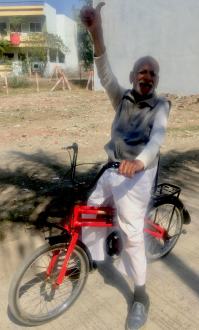
Banwarilal was his name––a man my age (nearing 60) but who appeared to be years older. He seemed to have seen 75 summers. He was a gardener and had undergone accelerated aging working in the lush lawns of Lutyens’ Delhi. Squatting on his haunches and working long hours in the sun, had given him a permanent stoop and a dark tan.

We met first when I saw him trudging on the roadside, a walking stick in hand, and had offered him a lift in my car. He was taken aback. He sat on the edge of the seat for that’s how poor people are supposed to sit in the presence of the well-to-do. At least, that’s how Bollywood depicts them. Overwhelmed and full of gratitude in his eyes, he sat quietly looking at the road ahead and occasionally stealing a glance at me.

Baba, kaise ho?” I tried to make him feel easy.

“ I am fine, Sir.”

“Where are you coming from?”

“Delhi Sir. I work in a government nursery.”

A polite meaningless conversation ensued. When I dropped him a kilometre further, he showered blessings as expected.

I saw him again the next day and pulled up by the roadside. He got into the car with a smile. It being the second time, his demeanour was devoid of apprehension. We resumed our conversation. He was immune to governments and governance. His life revolved around his small family––a son, a daughter-in-law and some grandchildren.

It became a routine––the business of me offering him a lift. It was two to three times a week. It continued for over two months. With time he opened up and became talkative. He even offered to take care of my lawn. Then there was a long break. I started car-pooling to the office. As a result our timings did not match any longer.

I forgot Banwarilal.

Until another warm day over three months later…

I returned early and found him again. I stopped the car for him to get in. He wasn’t his chirpy self.

“All’s well Banwarilal?” I asked.

“Not really, Sir. I have not got my pay for three months. There has been some hold-up in the computerised system of payment since de-monetisation drive began.”

“Life must be awfully difficult…” I sympathised.

“Our reserves have touched rock-bottom; life has indeed become very difficult…” he went on. It was a monologue and I was a mute listener. Here was a man tortured by fate. He was silently suffering––not begging for a job or largesse.

A thought engulfed me: “Is there anything I can do for him?”

My chain of thoughts was disrupted when he asked me to stop.

As he opened the door to get out, I asked him if I could give him some money to overcome the crisis in his life.

To be honest, it was a half-hearted offer borne out of my feeling of helplessness to do something to mitigate Banwarilal’s misery. There were two diametrically opposite reasons for my hesitation. One: I was sceptical that Banwarilal might accept the offer and demand a huge amount of money that I would not like to dish out. On my part, I had decided to give him Rs 3000/- an amount that I had just received as remuneration for writing an article for the Defence and diplomacy Journal. Two: Banwarilal might get offended or feel demeaned.

Banwarilal declined the offer. He said that conditions were bad but not so bad so as to seek largesse. It was still possible for his family to stay afloat. I made a counter offer: “If you are determined not to take money, consider it to be a loan and return it to me whenever you are comfortable.

Banwarilal smiled again. With a broader grin this time, he said, “Sir, I am touched by your gesture. But I really do not need money; all I need is your prayers so that there is an end to my misery.

Being rich, poor or well-to-do is but a figment of imagination.