The Second-Best Thing About Playing Golf

“Chordia, why don’t you start playing golf?” I remember the day, nearly 35 years ago, when our Air Officer Commanding (AOC) at No 24 Equipment Depot, Manauri posed that question to me. In fact, it wasn’t really a question. I felt it was an oblique recommendation to play the game. At least, the old man’s intonation suggested that. Those days I used to enjoy sweating on the football field. About golf, I had a low opinion; I felt it was like scything with expensive equipment. I had just worn the Squadron Leader rank—inside me was a fidgety Flight Lieutenant who spoke first and thought later. Therefore, I am not surprised that I responded promptly with a polite smirk. Yes, a smirk can be polite, pleasant.

“Sir,” I blurted out, “I think golf is meant for the elderly and the moneyed; and may be… for senior officers. I do not belong to any of those categories of beings.”

With that utterance, I had dropped a brick, if not a bomb. I realised it as soon as the words left my mouth. So, I quickly replaced my polite smirk with a smile. And then, the actor in me worked overtime to look like an innocent youngster trying to be jocular.

The AOC didn’t show an iota of dissatisfaction on his favourite game being seen in a not-so-good light. He rather surprised me with a chuckle, “Beta (son), Playing, or not playing golf, and when to start playing, is a choice. You may choose not to play; but it’s definitely time you refined your ideas. Young people are taking to golf and it is not so expensive—you can buy a half set for pittance. That the game is meant for senior officers, is a myth.”

In the following week, he sent me to HQ Central Air Command to study their course and replicate their ‘Mini Golf Course’—a big putting green with nine holes and interesting obstacles. He patted me for creating ‘a marvel’ for Manauri as he called it. Crazy putting green—it was like playing marbles with putters. I wasn’t impressed; did not make a beginning. The AOC gave up on me when I refused to see the grass on the other side of the fence, let alone appreciating its greenness.

Around the same time, in another part of the world, a teenager, Eldrick Tont Woods (15)—nearly half my age—had made waves by winning the US Junior Amateur Golf Champion title. Soon, the world would know him as Tiger Woods. Clearly, old age wasn’t a criterion; people of all ages were golfing.

A year later, I was in Kanpur on posting. My work schedule gave me time to spare after office hours, and the golf course was next door. This time on, it was an Ordnance Corps officer, a Major, who nudged me, “Why don’t you give the game a try? The course is so close to your residence.” He dragged me to the greens.

The Kanpur Golf Course is scenic. The fairways run parallel to the Ganges. The river is so close that sometimes wayward balls land up in the majestically flowing waters. The saying goes: “You have to offer a few balls as guru-dakshina to Gangaji (teacher’s fee to the Ganges) to learn golf.” There are natural undulations, and trees with large canopies, which pose varying degrees of enjoyable challenges. The water hazards, the bunkers and the sand traps are positioned at vantage points to get the best out of a player; they get the better of some. Gentle breeze laden with fragrance of freshly blooming flowers and the chirping birds transport one to a different world. The gazebo next to the club-house provides a commanding view of the Course as one sips a cup of freshly brewed coffee. It is heavenly; it is enticing!

I couldn’t resist the temptation and gave the game a try. In those days (early 1990s), the Kanpur fairways had a lot of pebbles; preferred lie was allowed all along the course. That made it less humiliating and easier for a beginner like me to pick up the game. I was soon addicted. That little change of mind—to give the game a try—led to a big regret of my life: “Why didn’t I start playing golf earlier?” The AOC’s chuckle and his advice to refine my thoughts about the game echoed in my mind. To this day, those thoughts keep returning. I have realised the importance of trying things rather than rejecting them at face value or on the basis of perceptions.

As if to make up for the lost time, I began playing golf like a man possessed—never missing an opportunity to swing. Since Kanpur, I must have walked a few thousand kilometres with a golf club in my hand. And, I must have spent days (cumulative time) searching my golf balls in the wilderness. In Tezpur, where I was a forced bachelor—Chhaya and Mudit had stayed back in Delhi for Mudit’s schooling—I played golf every day, for two and a half years, except when I was outstation. I recall a sunny Sunday when I played 45 holes through the day. Even the rains couldn’t stop some of us. We would continue playing if it started raining after we had teed-off and would take lateral drops if there were puddles in the fairways. Playing on some of the courses maintained by the grazing cattle, in the tea gardens of the exotic east was unadulterated fun. One day, half way through the game, we were visited by a group of elephants, 30 or 40 of them. Majestic!

Playing with course-mates and friends has always been fun. Most golfers will agree that good company matters; some will argue that company matters the most. On numerous occasions, when I have reached the course without a booking, I have had the opportunity to play with interesting strangers. I have written about one, a Khushwant Singh-like old Sikh gentleman who shared a pearl of wisdom on ‘when to approach Guru Nanakji to influence one’s game of golf (and life)’.

Best… next, only to Yoga

Somehow my caddies have never been impressed by my game: “Sir, keep your head down!” “Sir, you aren’t following through.” “Sir, you are not keeping your eyes on the ball.” “Sir, you are applying too much force.” And the most hard hitting, “Sir, why don’t you take a break and spend some time on the driving range with a pro?” One of my caddies could lob a ball using the branch of a tree better than I could with a lob wedge. I can compile a 200-page booklet on all the solicited and unsolicited advice extended to me by my caddies and fellow golfers. For me, playing golf has always been a humbling experience. Reading self-help books and watching experts on YouTube has not helped. It is celebration when I score below 100. I am on the winning side only when I piggyback a good player.

I bought my first (and the only) half-set for an easily affordable Rs 3500/- and gifted it to a greenhorn when I was presented a full new set by a dear friend. My second new set was also a gift, from my nephew. I have been lucky in that regard. My long innings on the greens have (mis)led some onlookers and beginners to seek guidance from me. Inspite of my not-so-good-credentials, I have always encouraged them: “Golf is the best exercise, next only to yoga. It requires a lot of concentration; and, your concentration improves if you play golf. It teaches you to put aside setbacks and get going in life… mind-muscle coordination… it is application of laws of physics in three dimensions…,” I have sermonised. To some, I have loaned old balls and my 7-iron. But I have seldom taught anyone anything beyond interlocking grip, basic rules and etiquettes.

When Covid struck and people were confined to their homes, playing golf was out of the question. It wasn’t so for me. I was confined to the sprawling 60-acre Amity University Campus. Hardly anyone entered the University gate those days. I took the opportunity to play golf. I used to take my short irons and a dozen golf balls to the University’s sports ground. For hours on end, I used to hit golf balls from one end of the ground to the other. The best things people associate with golf—good company, good fairways, good greens, a cafeteria etc etc—were missing. But in due course of time, I began enjoying. It was Nirvana!

Nirvana!

What was it about golf that I was enjoying so much? Alone? On a football ground?

After much thought, I concluded that the second-best thing about playing golf is the feeling one gets when one hits the ball from the sweet spot of the club-head and watches it take the cherished flight; land and roll to the intended point. It is a top-of-the-world feeling when a few of the fifty odd elements that go into making a perfect stroke, align favourably to give the desired result. The audio, the soft impact and the visual effect—all lead to ecstasy. Much else matters less. Having a friend around who genuinely rejoices when you execute that near perfect shot only enhances that feeling of levitation.

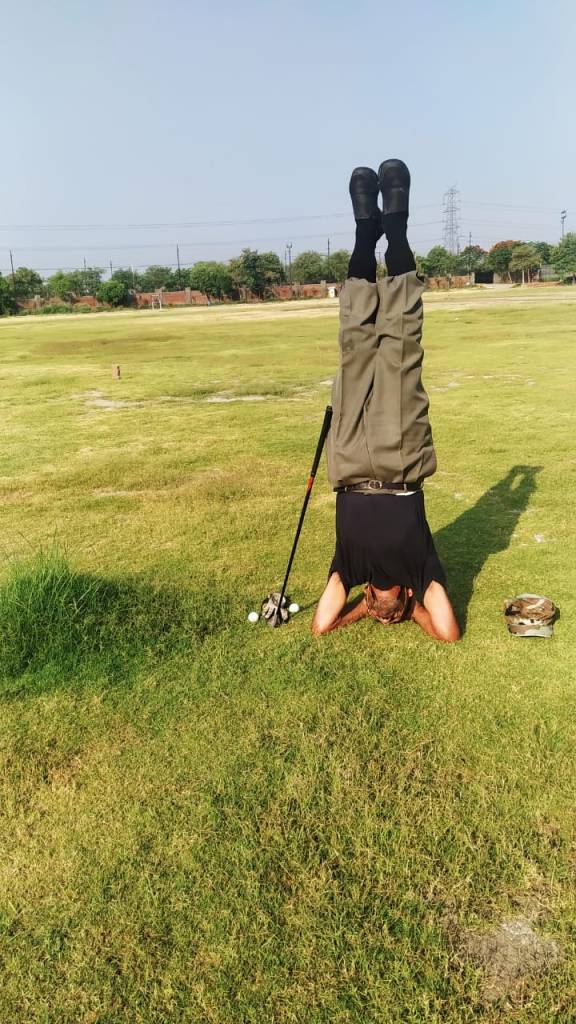
I have shared this thought with many a golfer. Most have echoed the joy of striking the ball from the sweet spot, but, in the same breath they have questioned, “If that joyous feeling is the second-best thing about playing golf, then what is the best thing about the game?” Elementary! The best thing about playing golf is strictly personal. It resides in each golfer’s mind—it is that single reason which beckons them to the greens at dawn, over and over again, when rest of the world slumbers. A dear friend who strives to see every sunrise in the golf course says he is drawn to the game because: “It is the maximum fun one can have with pants on.”

Little Big Man

These epithets — Taangewallah, Mechanic, Masaalchi, Tailormaster, Electrician and Masterji — had one thing in common; they were invented for a single soul, Babloo. They aptly described the diverse roles the ever-so-ordinary looking short-statured man played in the lives of the citizenry of the sleepy locality of Freegunj in the holy city of Ujjain. Thus, Babloo was Babloo Taangewallah when he took people to the Mahakaleshwar Temple in his tottering tonga drawn by a skeleton of a horse he called Toofan, the tornado. The tonga didn’t belong to him; he got to use it on lease whenever it was available. He spent a good part of the pittance he earned by plying the tonga on the pitiable Toofan. He was Babloo Mechanic when he cleaned, and micro-adjusted the gaps of the spark plugs of their Lambretta and Vespa scooters and checked and topped up the radiator water, engine oil and brake fluid levels of their prized Fiat and Ambassador cars on Sunday mornings. Likewise, he was Babloo Masaalchi when he dominated their kitchens on festive occasions and on children’s birthdays. He could stitch buttons, darn clothes, repair electric irons, kerosene and gas stoves and leaking taps, not to talk of solving arithmetic problems for children. Babloo was a Jack of many trades.

Babloo Masaalchi

It is also true that people’s minutiae were his missions. He was everyone’s man Friday. People paid Babloo miserly for his services but were generous with their hand-me-downs. Babloo was genuinely grateful when children passed on broken toys and stubs of pencils to him. Less mindful of the renumeration, he took pride in whatever he did and cherished the affection that came as a bonus with those specific-to-service nicknames.

Something in Babloo likened the children and the young adults to Keshto Mukherjee, the character who had become a synonym of the drunk in Hindi cinema. They called him Babloo Afeemchi, meaning drug addict, because sometimes he gave the impression of one high on afeem (opium). Now, that was not because he was a worshipper of Lord Shiva and consumed bhang — a popular local herb which gave a temporary high — once every year on the occasion of Holi. He owed that Afeemchi image to his body language spurred by cumulative fatigue which, in turn was the result of running errands and doing things for people day in and day out. Sheer tiredness caused his spirits to droop and his eyelids to drop, and he seemed to lose partial control of his limbs. That epithet, Afeemchi, pricked him but he bore the pain with a smile. After all they were children.

Father, forgive them, for they don’t know what they are doing.”

~ Luke 23:34

Then there were those who took Babloo to be their personal servant, and treated him more like a slave. But, very few people knew, or cared, about Babloo’s own small world—a wife, Shyama and a son, Munna who had just begun going to Bal Vinay Mandir, the Government Pre-School that had the canopy of a hundred-year-old banyan tree for a roof. The discarded stationery items which Babloo received from people were Munna’s prized possessions.

Once a month, Babloo left Munna in the care of his sister in Desai Nagar, and took Shyama to the matinee show in Ashok Talkies; they both loved to watch films starring Rajesh Khanna and Mumtaz. They always went early to the cinema hall and bought tickets for the second class; and rushed in to occupy the aisle seats because Babloo didn’t like anyone sitting right next to Shyama. A plate of samosas during the interval was a given. No rain, hail or storm could stop Babloo from being there to walk Munna to the school each morning. He’d also make it a point to tell the little one a bedtime story before devoting his full attention to Shyama.  

Among the very few who understood Babloo was Dr Jai Veer Singh, the Vice Chancellor of Vikram University. The man of letters was better known by his pen name ‘Snehi.’ They called him, ‘Snehiji’ out of respect which he had earned as much through compassionate social work as through his scholarly achievements. Greeting him with joined hands or, more appropriately, touching his feet, was a reflex action of people when they met him. It was on his insistence that people allowed Babloo four days’ leave every month end—none questioned it. It was believed that it was to visit his old parents in Maksi, a small town not far from Ujjain. A conscientious Babloo always re-joined duty punctually. As a matter of an unwritten rule, he was never late.

Last monthend when he returned from leave, his face was bruised; there was a deep laceration on his upper lip and a dark blue patch under his right eye — the tell-tale signs of a brawl.

It was 6 am; Snehiji was drinking his tea sitting in a cane chair on the veranda of P-21 Kothi Road, the sprawling bungalow earmarked for the Vice Chancellor. He had already turned the pages of two of the three dailies kept on the glass top of the round coffee table in front of him. He preferred to read Nai Duniya last. It was the City Edition of the Hindi newspaper, and contained the local news. He read every word of it. That habit gave him an edge in his discussions with his bureaucrat friends over drinks in Madhav Club every evening.

Babloo tiptoed past him. But the old man caught sight of him when he lifted his head momentarily to take a sip of the well brewed Green Label tea.

“Why, what happened Babloo? How did you get those wounds?”

“I fell down, Sir” Babloo mumbled and continued with a sense of urgency.

“I hope you are fine?” Snehiji genuine concern was laced with doubt. “How can a fall result in those injuries to the face?” he wondered. He resumed where he had left — the City Highlights page. Something caught his attention. He re-read it several times with utter disbelief.

Moments after Babloo returned with the old man’s brogues and penny loafers, and the paraphernalia to polish them, the old man hailed him. “Come here!” His voice was unusually harsh, “What’s this?” He slammed the half-folded newspaper on the table and pointed at a news item for Babloo to read. The headline read:

“Domestic help arrested for theft.”

Babloo read the news:

“Freegunj. January 29. Ramdeen alias Babloo, a domestic help working in several houses in Freegunj was found stealing grocery items at Maganiram Muralidhar Grocery Store. The man was beaten up by the salespersons before the local police took charge of him. The man pleaded that he was innocent. He said he was only carrying the grocery for one Mr Shiv Dayal who had forgotten to make the payment. Mr Shiv Dayal couldn’t be contacted to clarify. One of the customers said that, “Babloo Chor (Babloo the thief) had a history; he’d been seen in the Madhav Nagar Police lock up on several occasions.” Our correspondent has reported that there has been a spurt in cases of thefts in East Ujjain. People have been warned to be watchful.”

“So, you have another trait and a name… Babloo Chor,” Snehiji looked at Babloo, “How could you do that?  You have betrayed my trust.”

Babloo stood still like a statue; he stared down at the flooring and kept clasping and unclasping his hands behind his back. The toe of his bare right foot tried in vain to inveigle into a hole in the old carpet. He didn’t wince once but bit his lower lip several times when a tear rolled down his cheek and wet a bruise. The pain caused by the salty tear smearing his wounds was far less than that caused by the feeling of loss of face.    

“Go away… I don’t want to see you,” Snehiji couldn’t believe that he had, for once, failed in his judgement of a person.

***

Babloo Chor, and the spurt in thefts in Freegunj, dominated conversation at Madhav Club that evening.

“We have relieved Babloo of all duties. I have told my wife, not to let him into our house ever again,” said Dr Sanjay Mangeshkar.

“It is so difficult to find reliable domestic help these days,” rued Mahesh Verma of Verma Constructions.

“Poverty is a sin. I don’t think we must expect loyalty and integrity from people who toil on empty stomachs. We have been paying so little to Babloo. I am not so surprised by his actions. Anyone would do that.” The owner-editor of Dainik Awantika differed.

“But a theft is a theft is a theft is a theft. I don’t think it must be condoned,” opined Mr Qarim Qasimbhoy who owned a chain of stationery shops in Indore and Ujjain. “He is lucky. In Saudi, they would have chopped his hands.”

On the whole the house was divided, nay confused, on the subject of treatment meted out to the ‘Babloos’ of the society. It was one of those rare occasions when Snehiji didn’t air an opinion. Babloo’s demeanour when he left his bungalow that morning had left many questions in the poet scholar’s mind. He had registered the turmoil brewing within Babloo as was evident in his silence. “I couldn’t have been so grossly wrong in understanding the individual in Babloo,” he ruminated as he travelled homeward in his chauffeur-driven Ambassador.

His train of thoughts was interrupted by his driver, Satish: “Sir, Babloo Mechanic has done a wonderful job. The engine isn’t knocking anymore. Todarmal Auto Garage people could not place their finger on the problem in a fortnight,” he said.

Babloo didn’t turn up for work the next morning. The first thing Snehiji did after reaching his office was to call the SHO of Madhav Nagar Police Station.

“Please tell me something about Babloo who was caught for shoplifting at Magani Ram Murlidhar Grocery Store the day before yesterday,” he requested the Police Officer.

“You mean, Babloo Mechanic, alias Babloo Taangwallah,… alias Babloo Masaalchi, Sir?” he chuckled.

“Yes, Babloo Mechanic. He works for me and several others in Freegunj,” Snehiji was serious, business-like.

“Sir, he is a vagabond. But he has an absolutely clean record… not a single black mark.”

“Then, why did you put him in the lock up?”

“Sir. actually, we didn’t intern him… it’s a long story… Babloo was caught for a suspected petty theft more than a year ago. It was proved beyond any doubt that he had not committed that theft. But before his release from our lock up three days later, he had repaired some of our corridor lights and an alarm bell and a leaking tap. Besides, he did a lot of other repair work for individuals; including repairing an electric iron for me. All our people were happy with him. We made it a point to show ‘official’ prison work against his name which earned him a decent amount as a skilled labourer. He was happy and took a cake for his son for his birthday when we released him.”

Snehiji listened intently.

“With mutual understanding, it became a routine. Every monthend, we have been rounding him up for four days on flimsy grounds. During his stay with us, we get our work done from him and make sure that he is compensated handsomely. He even teaches the other inmates. He feels indebted because he gets food and is able to earn enough to buy eatables and toys for his son… it is a symbiotic relationship. The other day, things went out of hand. He was beaten up before we could reach the grocery store and intervene.”

Minutes later, Snehiji’s office car was on its way to fetch Babloo.

“Why didn’t you tell me about your deal with the cops?” said Dr Snehi pretending to be annoyed.

“I thought you’d be offended. Who’d give work to someone who had been in police custody? And, I was in dire need of money to buy things for Munna.”

“But now… look at what you have done… people are calling you Babloo Chor. They have decided to not to give you any work. And, how will you face your son for whom you have been slogging? Don’t worry,” added Dr Snehi soothingly as he held his forearm reassuringly, “I’ll set matters right.”

Babloo stood in wonderment. There was a long pause before Snehiji resumed.

“I have a deal for you. Dataram, my driver is quitting the job. He is off to Bhopal to join his brother. I need another driver. I want you to take his place on permanent basis. I’ll get Munna admitted to a better school and pay for his schooling—his tuition fees, his books and his school uniform. You can move into our servant’s quarter by this weekend.”

Epilogue

A day, not too far in the future, Babloo stopped the car in front of Magani Ram Murlidhar General Store. Snehiji had asked him to get the car refuelled and to buy a packet of Green Label Tea on his way back. Munna was sitting by his side. Dr Shehi had permitted Babloo to take Munna around in the car once in a while. The salesperson, oblivious of who was sitting in the car, came out running, saluted mechanically and enquired, “What can I get for you, Sir?” He was shocked to see Babloo in place of Snehiji in the car. It was too late to bring down the hand raised in salute to the man he had beaten the other day. Munna looked from the salesperson to Babloo, to salesperson to Babloo again. He was mighty thrilled about the new status earned by his father.

Acknowledgement

My special thanks to Air Vice Marshal Sudhanshu Rath for sowing the seed of this story in my mind.

Where on Earth are the Marriages made?

New dimensions are being added to match-making…

Until the beginning of 1980s, the thing that drew an Indian traveller’s attention when the train approached a station was bare-bottomed men with a container of water squatting blissfully by the track, deliberately oblivious of the passing trains. Then, there came something that vied for attention and grabbed it nice and proper. It was a hoarding in big white letters in Hindi repeated on the dilapidated brown brick walls separating the tracks from the suburbs on the approach to all cities. It read:

प्रोफेसर अरोड़ा। रिश्ते ही रिश्ते। मिल तो लें। 28, रैगर पुरा, करोल बाग। ब्रांचेज इन अमरीका एण्ड कनाडा।

Literally: “Professor Arora. Loads of matrimonial contacts. Just meet (us). (Address) 28, Raigarpura, Karol Bagh. (We have our) Branches in America (the US) and Canada.”

Innumerable married Indians, and quite a few Americans and Canadians, owe their happily, or very happily married lives to that ad campaign which might be a case study for budding entrepreneurs. That 28, Raigarpura ad was more striking and easier to avail of the offered match-making services than the matrimonial columns of the leading national dailies. The system run by Prof Arora couldn’t have been computerised. Computers didn’t exist even in the imagination in the India of the 1980s. Yet Prof Arora gave a run for the money to all others offering match-making options. Had Modi been the Prime Minister at that time, Arora would have been a subject of discussion on “Man ki Baat.”

Whoever said, “Marriages are made in heaven,” must have lived on a different planet; may not have belonged here. Or, that may have been true in a different era. We rarely see it happen nowadays. The last well known swayamvar was that of Sita (or was it Draupadi?).

The breaking up of the marriage of the daughter of a leading astrologer of India days after she took seven pheras of the holy fire has cast doubt on that system. The role of astrologers, if not the art and science of match-making using astrology, has also lost its appeal.

A joke has been doing the rounds:

A five-floor super store provides choice of men for husbands; desirable qualities keep adding as one moves to the next higher floor. One can climb floors but cannot return to a lower floor to make a choice. A lady wanting to choose a husband found caring men with jobs on the first floor. Curiosity took her to the second floor where she found wealthy caring men with good looks. With a desire to find a better man, she went to the third floor where there were good looking rich romantic men. The woman was happy with the offer but was tempted to have a look on the fourth floor. On offer on the fourth floor were good looking romantic millionaire men who’d help in the kitchen and take care of kids too. Anticipating an even better choice, she took the lift to the top floor to find a prominently displayed message: “Sorry, the kind of man you are looking for does not exist.” [Disclaimer: This joke has been recalled and reproduced to the best of the author’s ability. The readers may change the gender of the main protagonist and re-read if it pleases them.]

Seeing the growing demand, websites facilitating match-making have proliferated. They collect what they call ‘BIO-DATA’ of the customers and their expectations. Then, for a fee they offer contacts of matches who generally meet the requirements. One doesn’t need to write complex algorithms to get the desired output of this nature. A school student adept at using Microsoft Excel can help choose a ‘suitable’ candidate. For that reason, such websites are available a dime a dozen. Satisfaction from their services doesn’t count. Whether matches made through them result in successful marriages or they end up in divorce is immaterial—none visits them a second time. To remove the element of uncertainty people have begun visiting ‘dating’ sites which, again, are a gamble.

All these efforts to find a near-perfect, if not an ideal match, suffer from an inherent drawback—an individual might provide incorrect data or conceal vital personal information during the meetings that follow initial interaction on email or during telephonic conversations. Little has been done to carry out a reliable background check on individuals by the match-making websites. If attempted, this could be construed as invasion of privacy. People with resources are known to employ private detectives for background checks. Artificial Intelligence (AI) has still not stepped into this arena in any big way. So, beyond just comparing ‘requirements,’ how does one ascertain compatibility?

In December last year, Hold My Hand Matrimony, was adjudged as the Best Matrimonial Company by the Global Business Award (GBA). I was curious: How can one compare different websites providing almost exactly the same services? May be a website has a larger database with more fields to compare, match and report? My query led to a revelation; the company was doing something different. They were utilising services of skilled and experienced psychologists to ascertain the compatibility between individuals.

Best Matrimonial Company

The process starts with sharing the biodata and pictures for marriage. A compatibility form for marriage is provided to the candidates. On the basis of the criteria mentioned by the candidates, the matchmaking team shortlists the matches.

A personal relationship manager is always present on the first call on conference between the two individuals/ families. It is to make the individuals comfortable before they communicate with each other and familiarise themselves. Hold My Hand Matrimony boasts of having the data on some of the most eligible marriageable youth of the country and a large number of PIOs and NRIs.

Marriages are made here… on the earth

This aspect of involvement of psychologists to ascertain compatibility got me interested; amused, to be honest. So, with a view to find a suitable match for my nephew, I called Mr Navneet Sharma, the CEO of the company to know more about their modus operandi. I discovered that the company is run by the husband-wife team. Ms Puja Sharma (Navneet’s wife) is an equal partner in the Company and handles some of the gender specific issues. I was amazed by their vision. They are experimenting with two more never-before-thought-of dimensions to their match-making service. In their business interest, I cannot write about the fascinating aspects, which are still under trial. Suffice it to say that one of them is social and the other, quite scientific—both will take match-making several notches up to the next higher level.  

It is beyond doubt that with so much effort going into match-making, more and more people will live happily for ever.

PS: A few readers have called me seeking the contact details of Hold My Hand Matrimony. Here they are: WhatsApp: +919319706587 Email: info@holdmyhandmatrimony.com

Jumping… definitely not to conclusion

“If your main parachute fails and the reserve also does not open… …then you are jumping to C-O-N-C-L-U-S-I-O-N.

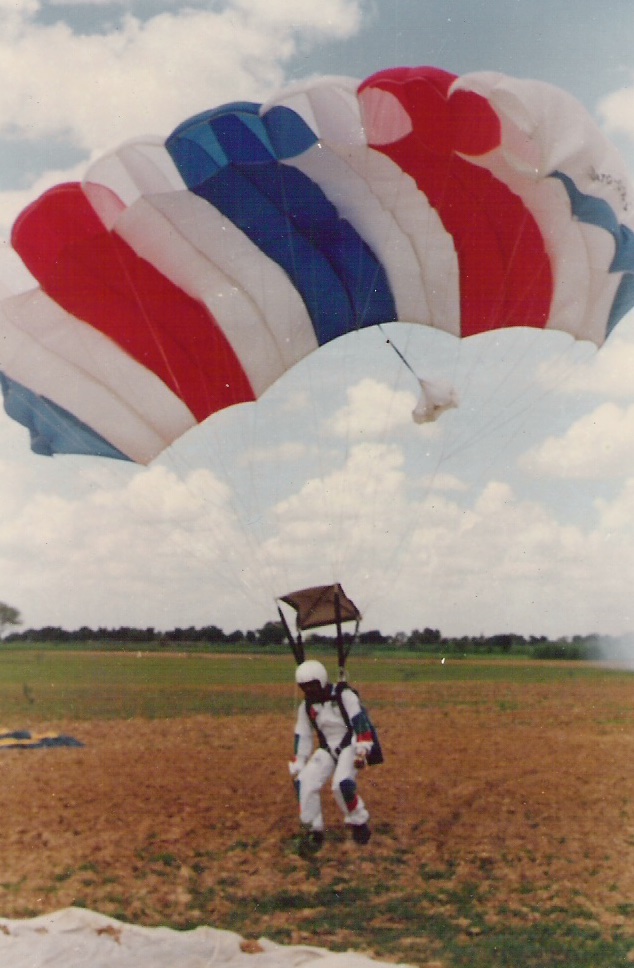
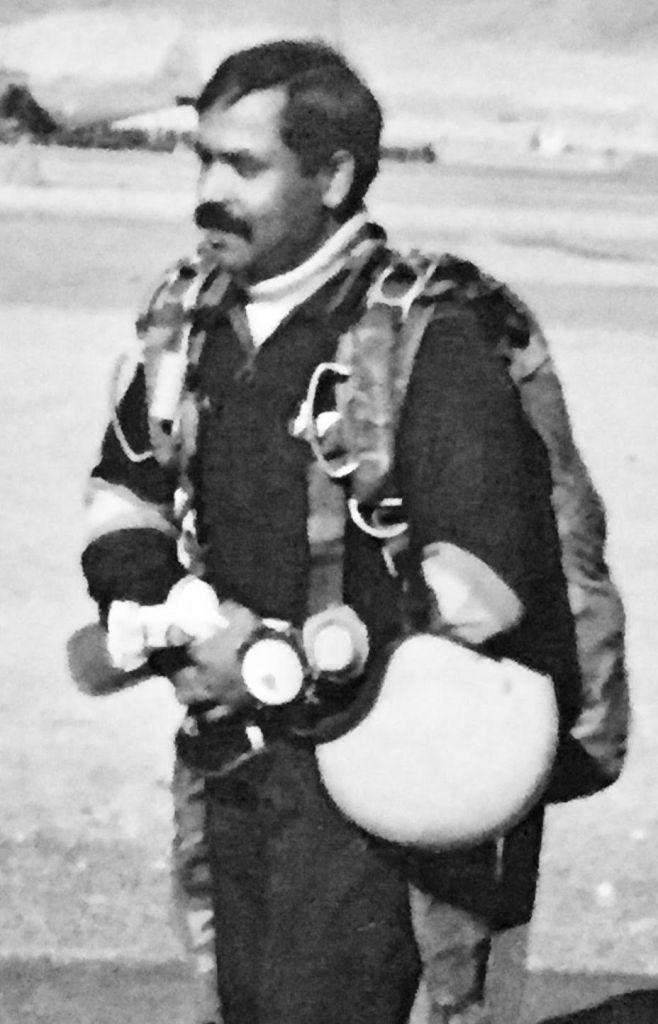
A skydiving demonstration in September 1988 was a humbling experience for me as a member of Akashganga, the Skydiving Team of the Indian Air Force. It was a matter of rare honour to have been tasked to jump and land into the Nehru Stadium, New Delhi during the Pre-Olympic Trial Games to cheer up our sportspersons headed for the Seoul Games later that month. On bailing out of a MI-17 helicopter, the Stadium—with its maroon race track, brightly coloured PVC seats, fluttering flags, ribbons, and buntings—looked like a bouquet of bloomed flowers. It was packed to capacity with euphoric spectators. We, the jumpers could hear their cheering a thousand feet above the ground as we manoeuvred our parachutes to land in their midst. The gaiety of the occasion was an integral part of Akashganga demonstrations—a given. But what followed that day was something unprecedented for me.

I was bundling up my parachute after landing on a predesignated part of the track when a young mother—with a child she was barely able to lift, and an older boy in tow—managed to slip past the security cordon, and staggered towards me. “Sir, please… my son wants to touch you,” she urged and, before I could realise what was happening, put the little one down and stretched his hand to enable him to touch me, and feel my parachute.

Soar like an eagle; land like a feather…

“You said you wanted to touch the uncle who jumped from the helicopter… here he is…,” she said to the child as she pulled the elder boy who was a bit hesitant, and made him follow suit. “See uncle is like us… he is not different,” she added excitedly as she encouraged the two youngsters to feel my overall clad arms and shoulders. Then pointing at the younger boy, she said to me, “My little one thought you people are gods descending from heaven… he wanted to touch you and have a close look at your parachute. It’s indeed a big day for my kids. This event will remain etched in their minds forever.”

I was overwhelmed.

All this happened in less than a minute. The mother didn’t argue with the security personnel who had followed her to shepherd the family away. Having accomplished their mission, the three prepared to leave. And, even as the lady took the boys away, the older one managed to say with all the confidence he had mustered in the minute gone by: “Uncle, what if, your parachute had not opened?” Although I told the curious child that I was carrying a reserve parachute to provide for that contingency, his question kept ringing in my mind for a few days before it was consigned to the less accessed recesses of my brain.

Whipping open a reserve parachute in case of a total failure of the main parachute, is a standard drill all jumpers practice before emplaning an aircraft for a jump. I had gone through that mock exercise before each of the hundreds of jumps I had carried out. In the process I had begun believing that opening a reserve parachute if, and when need arose, would be a reflex action. It’s a different matter though, that the thought of my parachute really failing never crossed my mind.

Not too far in the future, I would recall my interaction with the boy, and his innocent question, with a sense of déjà vu.

It happened about a month and a half later when I had almost forgotten the Nehru Stadium incident. It was yet another Akashganga demonstration; this time on, at Air Force Station Ambala. An AN-32 aircraft with our team on board, was cruising at 225 kmph, 6,000 feet above the ground. The team leader gave thumbs up––the universal sign conveying readiness––when the aircraft was over the spectator-stand. He opened the barrier at the aft end of the aircraft and roared, “Go!” On that command, the team members jumped out of the aircraft one after the other in quick succession. I, being the lightest, was detailed to exit the aircraft last. Within seconds, we reached our terminal velocities and were falling at 120-200 feet per second. We had been assigned different (staggered) parachute opening heights to avoid a melee at the time of landing on the target––a circle of 15 metres diameter facing the enthusiastic crowd.

The Strato Cloud parachute I was jumping with, had an aerofoil-shaped canopy. Once deployed, it behaved like a glider. Rather than descending vertically, it glided with a good glide ratio of 1:3. Simply put, it moved forward three feet for every foot of descent. It could reach airspeeds of 40-50 kmph. Its manoeuvrability and high sensitivity to controls enabled experienced jumpers to execute pinpoint landings. They used to say: “With deft handling of the control lines, one can land on a target as small as a lady’s kerchief.” Miscalculation, on the other hand, could lead to serious injuries.

The spectators looked skywards and counted the jumpers who popped out of the aircraft like tiny pebbles. They held their breath waiting for the parachutes to open. The jumpers falling below me deployed their parachutes at their assigned heights. I too threw away my pilot chute—a small parachute which initiates the opening sequence of the main parachute. In a second and a half, my parachute was filled with air. And then began an ordeal, the memory of which, even today, sends a chill down my spine.

Akashganga days…

The suspension lines on one side of my parachute were jumbled up and the canopy was badly deformed. The partially deployed parachute began turning to the right. My efforts to untangle the suspension lines were in vain. In a few seconds, the turns became vicious; I was hurled like a stone at the end of a sling and spiralling down at a tremendous speed. I pulled down the lines to stop the turns. Thanks to the gruelling training sessions under Sergeant R Singh, I had developed strong arms to deal with such situations. My effort met with partial success. The turns slowed down to a stop (almost) but now the parachute headed for an incipient stall––a condition in which there could be a sudden loss of height (40 to 50 feet). Holding on to the lines would certainly result in a stall. I was still at 4,500 feet above the ground; a stall at that height would cause me no harm. But a stall close to the ground would be disastrous. I recalled with horror, an accident involving Warrant Officer Augustine who had been sentenced to the confines of a wheel chair for life due to a heavy landing.

There was a surge of adrenaline and yet my mind went on several quick errands. I was reminded of Mudit, my son, eliciting a promise from me while bidding me bye that morning to make a paper bird for him that could flap its wings. Let alone giving him lessons in origami, I wondered if I would live to see him again. Then I recalled Squadron Leader (later Air Vice Marshal) Ajgaonkar’s ordeal a year or so ago. In a similar emergency, he had promptly deployed his reserve parachute and landed safely. “Never Say Die” was the gospel he had passed on to us. “Am I in the same situation?” I began comparing. “His was a high-speed emergency––total failure of the main parachute. I was faced with a slow speed emergency; I had, at least, a partially functioning parachute over my head. What if I jettisoned the malfunctioning main parachute and the reserve parachute did not open?”

That must-be-avoided-at-all-costs conversation with my own self had a numbing effect.

Mudit… origami… Augustine in wheelchair… Ajgaonkar…. Had time coagulated? No, it was an illusion. Time, and height above the ground, the two most precious commodities for me were fast running out. The impartiality of the earth’s gravity was evident in the rate at which the unwinding needle of my altimeter was sweeping the face of the instrument.

“Should I risk a stall with a deformed main canopy, or jettison it and depend on the reserve parachute for a safe landing?” The dilemma was damning. I was a mere 2,500 feet above the ground and approaching it at a breakneck speed. I was left with a few precious seconds in which, to decide, and cram deliberate action on which, would depend my survival, and the safety of my limbs. I pulled down my goggles, which had got fogged due to excessive sweating.

Suddenly everything became tranquil, and clear. Reason booted out all the silly thoughts from my head. There was no basis for assuming the possibility of failure of the reserve parachute. It had been packed by the most proficient hands and overseen by the most careful eyes; those of the skilled and conscientious Safety Equipment Workers of the Paratroopers’ Training School.

And then…

I took the most vital decision––the decision to jettison the main parachute and go for the reserve parachute. A tug at the cutaway handle got me rid of the malfunctioning main canopy. With the Newton’s Law of Gravitation at work, I went hurtling down approaching Mother Earth at a very high speed, and accelerating. Then, without further delay, I pulled the ripcord handle of the reserve parachute. Sight of a fully deployed white canopy was a great relief. 

When the parachute opened, I was 2,000 feet above the ground level—just about sufficient height to manage an accurate landing. Joy rioted in my heart; the wind with prankish flurry caused the stabiliser of the parachute to flap rhythmically. Its flutter was music to my ears. Since I had lost sufficient height, I executed a tight circuit and homed on to the landing area. I felt victorious and exhausted when I touched down softly on the target.

As I removed my helmet and unfastened the parachute harness, I realised that the usual enthusiasm, and the frolicking associated with an Akashganga display, was conspicuously missing. In its place was a lingering melancholy. The main canopy that I had jettisoned a while ago had fallen a mile away from the spectators. They had taken it to be a case of a total failure of the parachute and had feared a fatal accident. Concern for the safety of the unknown skydiver had cast a shadow of gloom. They heaved a sigh of relief when they came to know the fact.

In the flight back from Ambala, I went through the day’s events. I also recalled my interaction with the little boy in Nehru Stadium: “Uncle, what if, your parachute had not opened?” Even in solitude, that thought registered a smile on my face. Then, mind, as is its wont, began wandering further. It flew way ahead of the aircraft, to my family in Agra. “How would I disclose the incident to my wife without causing anxiety?” I began contemplating.

At home, Chhaya was awaiting me at lunch with a plate of Russian Salad and her usual welcome hug. Having been a parachute jumper herself, she took the incident in a stride. I devoured the sumptuous lunch and was off for another Skydiving Demonstration in Agra that very afternoon.

That much to answer my little fan’s question about parachute failure. Parachuting today, is indeed as safe as safe can be—it is safer than crossing roads in Delhi. But then, there’s another curious question people sometimes pose: “What if the reserve parachute also fails?” Wing Commander AK Singh, a colleague veteran parachute Jump Instructor has an answer: “If your main parachute fails and the reserve parachute also does not open, then you are jumping to C-O-N-C-L-U-S-I-O-N.

Unravelling Suicidal Ideation

Can the outcome of a recent study on a type of bacteria in the saliva of a person with suicidal ideation help prevent suicides?

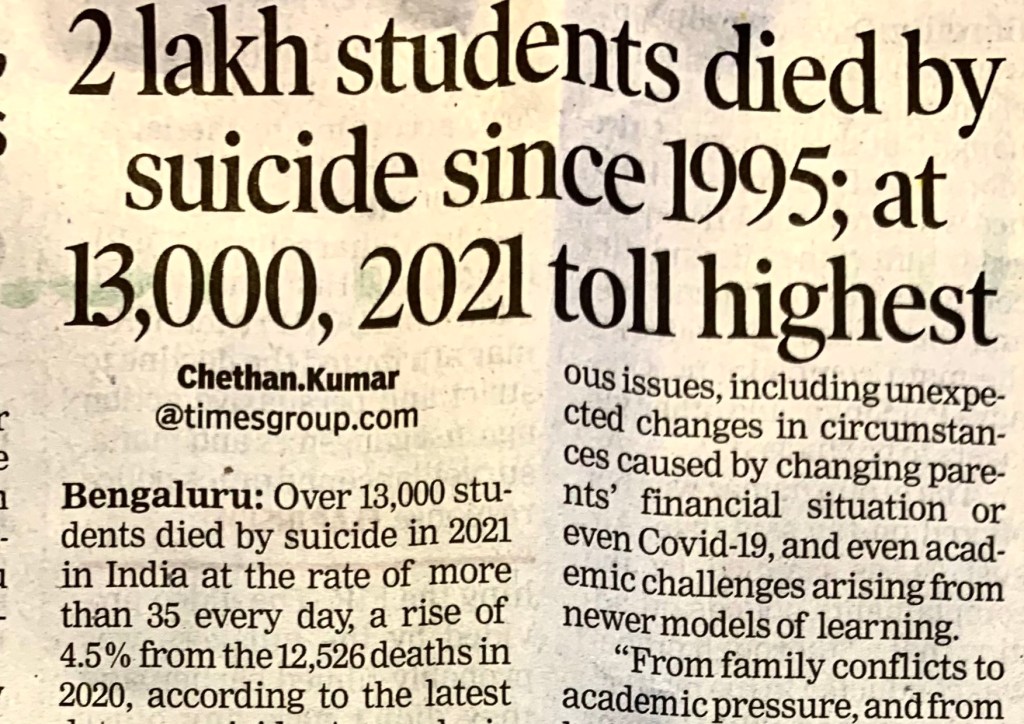
A study at the University of Florida has found that the bacteria in the saliva of college students who reported recent suicidal tendencies differed significantly from those found in the saliva of students who had not experienced recent suicidal ideation. Such students showed lower levels of Alloprevotella rava, a bacteria associated with positive brain health, in their samples. For the purpose of the study, recent suicidal ideation was considered as thoughts of suicide arising within the two weeks before the saliva sample was taken. The study was undertaken controlling the other known factors like diet and sleep etc which affect mental health. It was found that students with recent suicidal thoughts had higher levels of bacteria associated with periodontal disease and other inflammatory health conditions rather than of Alloprevotella rava. The study analysed saliva samples collected from nearly 500 undergraduate students. Those who reported recent suicidal ideation were referred to on-campus mental health services. In India too, a large number of youth commit suicide; study suggests that two lakh students died by suicide since 1995. In 2021 alone, 13,000 students took their lives.

Suicide by youth is a serious issue all over the world

It is a known fact that mental health is a serious issue on college campuses. A 2020 study by the US based Centre for Disease Control (CDC) found that up to a quarter of people between ages 18 to 24 had seriously thought about suicide within the previous month. The story is not much different in other parts of the world, including India. Although, various treatments and lifestyle changes help, there is a need to explore how some microbiomes affect mental health and could be harnessed to improve it. While at it, at is extremely important to ascertain whether the lower levels of the said bacteria result in suicidal tendencies or the lower levels are the result of suicidal ideation.

In future, a close observation of these bacteria might help predict tendencies and might lead to pro- or prebiotic treatments for those at risk.

As the scientists go ahead with their research, there’s an urgent need to widen the scope of this study to include people from other walks of life. The first category of professionals that comes to mind is the armed forces personnel. An article published in the New York Times in June 2012 included startling figures on spike in suicides among the active-duty US military personnel. As per Pentagon, the suicide rate (in 2012), eclipsed the number of troops dying in battle and on pace to set a record annual high since the start of the wars in Iraq and Afghanistan more than a decade earlier. The suicide rate was nearly one per day in 2012. The sharp increase in suicides led Pentagon to establish a Defence Suicide Prevention Office. The commanders were reminded that those seeking counselling should not be stigmatised. Defence Secretary, Leon E Panetta emphasised that suicide prevention was a leadership responsibility. But veterans’ groups felt that the Pentagon had not done enough to moderate the tremendous stress under which combat troops were living, including coping with multiple deployments. Suicides among active-duty military personnel were “the tip of the iceberg.” A survey conducted among the 1,60,000 members of the Iraq and Afghanistan Veterans of America Group found that 37 percent knew someone who had committed suicide.

Stress-busters alone are not enough

It is a similar story in case of the Indian Armed Forces. In a written reply to a question in the Rajya Sabha, in March 2021, the then Minister of State for Defence, Mr Shripad Naik had said that the Indian Armed Forces (Army, Air Force and Navy) had lost 787 personnel to suicides in the preceding seven years. In quite a few cases, the mentally stressed students and military personnel have gone on a shooting spree, killing innocent people, before committing suicide. The ever rising numbers of suicides point at the need to do more qualitatively to mitigate nay eliminate the circumstances nudging men to take that drastic step. Mechanical stress management efforts do not suffice. A study like the one conducted at the University of Florida with a wider scope (to look into the high rate of suicides in the Armed Forces) will go a long way in addressing the issue.

Mid-Air Mission Impossible: The Legend of Gutsy Gaur

An audacious Flight Lieutenant hangs below a vintage C-119 Fairchild Packet aircraft in-flight to rectify a snag in the nose-wheel; prevents a major air crash and saves the lives of a crew of seven IAF air warriors.

Late that November evening in 1982, the Air Officer Commanding (AOC), Air Force Station Kheria (Agra) was the most concerned commander of the Indian Air Force. A ‘May Day‘ call from a C-119 Fairchild Packet aircraft of No 12 Squadron, Air Force, on a routine training flight had sent Air Commodore KK Badhwar rushing to the Air Traffic Control (ATC) tower. “There’s an emergency… Packet aircraft… problem with the nose landing gear… orbiting overhead… will approach for landing in about an hour,” he had been informed briefly by the air traffic controller on duty who was in a great hurry to drop the line––his attention, and all his energies were focussed elsewhere.

The ATC tower was abuzz; preparing to deal with the worst––the crash crew had been alerted; the crash tenders and the ambulances were ready, awaiting further orders. The routine take-off and landing of aircraft had been stopped altogether; all other aircraft had been advised to clear the airspace and the runway; everyone concerned, had been notified. Once in the control tower, the AOC conversed with Squadron Leader CK Jolly, the Captain of the aircraft, and gauged the gravity of the situation.

Minutes ago, when this Packet aircraft, call sign IK-461, was approaching Agra airfield for its sixth landing, the Captain had observed that on lowering the landing gear, the nose landing gear warning light had remained red. Steps to lower the nose wheel as per the Standard Operating Procedure (SOP) had been in vain––either the warning light indication in the cockpit was faulty, or the landing gear was actually malfunctioning. In the latter case, it was a serious emergency; the nosewheel landing gear could collapse on touchdown leading to a difficult-to-manage crisis situation. A few more checks confirmed the worst fears––it was a positive warning; the nose landing gear was actually dysfunctional.

C-119 Fairchild Packet was one-of-its-kind flying machine, if it could be called one. In appearance, it was quite un-aircraft-like; people marvelled at its ability to mock the laws of gravity and the Principles of Flight. Its designers called it a Flying Boxcar; others, less kind in their treatment of the aircraft, awarded it the epithet: ‘Flying Coffin’. It wouldn’t be much of an exaggeration if one were to declare that this aircraft of the Korean War vintage, of the early 1950s, used to get airborne and stay afloat more because of the willpower of the magnificent men who flew it––and those who enabled its flight; the technicians––than because of its powerful engines and large wingspan. Having served the USAF, and then the IAF, so very well for long years, the ageing machine demanded superior care and maintenance to remain airworthy. The memory of a crash on the take-off run, although not due to a technical snag, wherein a contingent of 42 paratroopers, five Parachute Jump Instructors and the aircrew had perished in a fireball, in the not-too-distant past, must have weighed heavily on the mind of the AOC as he listened to the conversation between the Controller and the Captain. Yet in that extremely charged atmosphere, he was quiet, composed and un-interfering. Air Commodore Badhwar, a decorated Canberra Bomber pilot and a hero of the 1971 Indo-Pak War (a Vir Chakra awardee), knew the air warriors under his command well. They were dutiful conscientious men who didn’t need hand-holding or nudging. Leadership!

Flying Boxcar

Up there, in the aircraft…

There was practically no choice. The Captain had consulted the other crew members and the professionals who had gathered in the ATC tower, and had taken an informed decision to land. That decision would mean––a very high probability of the nose landing gear piercing through the aircraft structure on making contact with the runway surface; its propellers hitting the concrete; the engines and the airframe suffering damage and causing a major fire. The possibility of the aircraft cartwheeling due to one of the wings hitting the ground and ending up in a mangled mass of metal couldn’t be ruled out either. Threat to the lives of the seven air warriors onboard, was a given. Without speaking a word, the crash crew rehearsed in their minds, the crash drill––the very idea of pulling men out of the burning wreckage of an aircraft was nerve-wracking. The only thing the pilots could do was to land with nearly empty fuel tanks to minimise the ferocity of the blaze. Decision to land anyway, had been taken. And, it was a unanimous decision… almost.

Mind it! A-L-M-O-S-T!

Among the crew was a young Flight Engineer whose mind was flying out of the Boxcar (pun intended). Flight Lieutenant Sumer Chand Gaur, “SC” to his friends, was an engineer instructor on type; knew the aircraft systems like the backside of his hand. He thought differently and was somehow unconvinced about the decision to land the aircraft in that condition. He didn’t accept what others saw as a fait accompli.

Flight Lieutenant Gaur reasoned with the Captain that the nose undercarriage was not lowering and locking due to an internal obstruction. He opined that it was possible, in-flight, to remove the jack from its attachments in the nose undercarriage bay and let the landing gear free to come down fully. A Qualified Flying Instructor himself, Squadron Leader Jolly understood the technicality very well, but wavered on the decision to attempt rectification. The solution was fraught with great risk and as a Captain, he was just not ready to expose his Flight Engineer to that danger.

A healthy debate ensued even as time, and fuel––the most precious commodities in that crisis––kept running out. Any one attempting to rectify the snag could accidentally fall off the aircraft to instant death. The Captain’s dilemma was: whether he should put Gaur’s life to risk in the hope that all seven lives might be saved or, not allow Gaur to attempt rectification and endanger all seven lives on touchdown.

The Captain remained caught up between the devil and the deep sea for a short while but then, gave in to the enthusiasm of his Flight Engineer. He allowed him to discuss the plan with the experts sitting in the ATC tower and to get another opinion. The AOC and the others listened attentively to Gaur on the radio set and grasped the technical viability of the solution suggested by him. But most of them thought he was volunteering for an extremely audacious action––almost impossible to execute––to solve the problem. It entailed hanging outside (below) the flying aircraft and working on the landing gear. Barnstorming!? A mistake while attempting it could send him hurtling 5,000 feet down, to mother earth.

All eyes were on the AOC.

Air Commodore Badhwar knew Flight Lieutenant Gaur as an energetic and enthusiastic young officer; a thoroughbred professional and a go-getter in that. He took little time to decide and was unflinching when he gave a nod to his gutsy plan of action. That indeed marked the beginning of a forty-seven-minute ordeal which, to those involved in it, would appear to be an eternity.

Moments into the exercise, the protagonists realised that the problem was far more complex than they had visualised. To begin with, the gap created by removing the panels from the floor of the aircraft was too small for a well-built Gaur to pass through. Also, the poorly lit space in the wheel bay was very crammed; there was hardly any elbow room. It was a struggle for him to squeeze into the rathole. Non-availability of proper tools on board made things more difficult––Jugaad turned out to be the watch word. Without wasting any time, Gaur got down to execute the Mission Impossible. One of his trainee Flight Engineers held his feet as he got himself lowered, head first, into the nosewheel bay.

November in Agra is rather cold. Incidentally, it was November the 25th––a day after SC’s 36th birthday. A ruthless December was less than a week away. At 7:45 pm, outside the aircraft it was dark and freezing.

In the wheel bay…

Cold air, at a hundred miles per hour, pierced SC’s face; and numbed his nose and cheeks. Within seconds, his eyes and nose started watering. With both his hands occupied––one, in tethering him to a strong point and the other, to hold the tools he was working with––there was no way to grip the heavy two-cell Geep torch. He held it firmly in his mouth to point the light where he wanted. That made his jaw ache, and breathing, difficult. Six to eight minutes was a very long time to work in that air blast. So, Gaur surveyed the landing gear and quickly withdrew into the cargo compartment for a breather. He had to thaw his frozen nose and clean his face which was, thanks to the wind chill, smeared with fresh saliva and mucous.

The very best in people comes to the fore when they are in life and death situations. It is as true about the grit and resilience of men in distress, as about their sense of humour. At a time when, they were unsure of seeing another sunrise, Squadron Leader Narwal, the Navigator did not miss any opportunity to crack jokes to lighten the mood even as Flight Lieutenant Gaur prepared to enter the nose wheel bay a second time. He stood precariously in the nose-wheel bay working on the landing gear. The blast of cold air was relentless in its effort to dislodge the young engineer. His fingers frozen again, SC resurfaced into the cargo compartment––only to regain his breath, warm and revive his fingers and wipe his face. The process repeated––in about forty minutes, Gaur had been into the nosewheel bay five times. All this while the cockpit crew, and the AOC in the ATC tower listened, with bated breath, to the running commentary that was being broadcast by the Flight Signaller, Junior Warrant Officer Subbu who was keenly observing and relaying every piece of action.

With great effort, Gaur was able to unlock the nut holding the landing gear actuator––the bolt however, remained stuck. It was imperative to dislodge it to set the landing gear free. His attempts to remove it were fruitless. He needed a hammer to complete the task. Meanwhile, breathing was becoming a strain; he felt exhausted. One of the crew brought a cylinder of breathing oxygen with a mask to comfort him. Rejuvenated by a tonic of jokes and several lungfuls of oxygen, he got down to pushing the bolt out of its casing. For want of a hammer, he struggled with a large spanner.

Viva! At last, the adamant bolt slipped out. Then, without wasting another second, Gaur removed the actuator freeing the landing gear to move into fully down position. There was instant jubilation in the cockpit––the nosewheel undercarriage warning light had turned ‘Green.’ In the last action, SC inserted the Ground Lock Pin into the undercarriage to prevent its accidental retraction; he tied it with a lashing chain and jack to make it absolutely safe.

Although smiling, gutsy Gaur was numb and utterly sapped when he emerged from the nosewheel bay for the sixth, and the last, time. Down below, in the control tower, there was a feeble sense of celebration. Eeriness had pervaded the air. People had their fingers crossed as they waited for the aircraft to land. Cautiously, Squadron Leader Jolly made a perfect landing and switched off the engine power instantly. With minimum use of brakes, he carefully brought the aircraft to a halt at the end of the long runway.

The AOC arrived instantly at the head of a convoy of vehicles––crash tenders, fire tenders, ambulances and cranes. With arms wide open and a smile that conveyed everything, he welcomed the crew. After a warm hug, he offered his overcoat to SC who was still shivering. He learnt about the incident from Gaur and Jolly, as he drove them to the Flight Commander’s Office where cups of much sought hot coffee awaited them. After completing the documentation, the crew of IK-461, headed to the Squadron Commander’s residence to celebrate a happy end to their ordeal. The celebration continued into the wee hours of the morning.

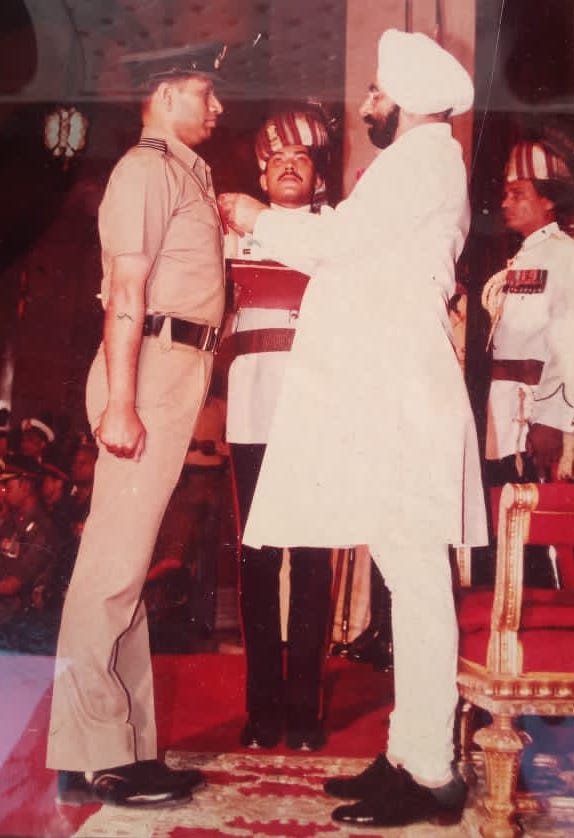
For a display of professionalism of the highest order and selfless devotion to duty under extremely perilous circumstances, Flight Lieutenant Sumer Chand Gaur was awarded the coveted Shaurya Chakra (exceptional peacetime gallantry) by Giani Zail Singh, the then President of India. Still later, in recognition of his distinguished services, he was awarded the Vishishth Seva Medal.

A well earned ‘Shaurya Chakra’

Now a veteran, Group Captain SC Gaur SC, VSM, resides in Ghaziabad. When the ever-so youthful and daring officer is not playing golf, he spends time motivating youth. The legacy must live; the baton must be passed on.

The Best Thing that has Happened to me Since the Lockdown Began

Creative Writing Course with the British Council is the best thing that has happened to me since the outbreak of Covid-19 pandemic. In fact, it is one of the most satisfying courses of instructions I have ever attended.

I have been writing for some time––I have published a book and have been posting articles and short stories on my blog, Road Much Travelled (www.akchordia.com) for nearly two years. This course was an eye-opener; I realised how little I knew about writing. It was indeed, a humbling experience. Having done the course, I feel much powerful. Now, I have the tools to pursue my passion with much greater satisfaction. The joy of writing will be different, hereafter.

Better late than never…

The curriculum had been structured keeping our needs in mind. And, in the time available, it was covered exceedingly well. The method of instructions was exceptional––Ms Ananya Banerjee devoted time and attention to each participant. She had answers to all our questions, and as a teacher, she was always extremely encouraging and inspiring. The exercises and assignments kept the interest alive all through. She took pains to check and give detailed and valuable suggestions to improve our writing skills.

Thanks to Ms Banerjee’s guidance, the ‘improved’ version of my short story assignment was liked by a film maker––may soon be a short film. I guess I have already begun reaping the benefits of investing time in this course.

There is, but one regret––if only I had undergone this Course some years ago, I would have had the pleasure of writing for a longer period in life. Better late than never! At sixty, I still have some time to go.

Thank you, Ms Banerjee! Thank you, British Council!

3 Incredibly Simple Ways of Calming Cranky Kids

Sometimes, children are cranky; they cry. At times, they do so for justifiable reasons, on other occasions, there’s no apparent reason for their behaviour. Parents feel obligated to do anything to calm them. They have their own ways of dealing with situations. Succumbing to difficult demands or paying ransom each time is not a good way of dealing with them. Here are three tried, tested and proven ways of handling situations, particularly when there is no just cause for wailing. Needless to say, these approaches must be tried as a last resort; only after one has tried to pinpoint and resolve a genuine problem, if any.

The Kush Approach

This approach entails skilful use of the mobile phone camera to zap an unsuspecting kid. It works with an assured one hundred per cent rate of success when used for the first time. With innovativeness parents can re-use the technique multiple times until the child gets to know the trick.

As a first step, a cranky child is apprised of a serious side effect of crying. He is told that crying ‘without a valid reason’ deforms the face. While the child tries to get the import of what is being said, pictures of some animals––say, an ape, a dog, a cat, a donkey or a cow etc––are downloaded on a mobile phone. This downloading of pictures can be done much in advance. Then, using the same mobile phone, a close-up photograph of the crying child is clicked. He is told that he looks like an ape (or a dog etc.) when he cries. He is urged to stop crying because, the parent could say: “I do not want you to turn into an animal. I’ll be very sad if you turn into an ape and… and what will your cousins, friends and teachers say? Oh my God, … please stop crying.”

Then, with theatrics, he is shown the downloaded picture of an animal. Seeing himself turned into an ape or a dog etc, stuns a child into disbelief.

Named after my grandnephew, Kush, I discovered this approach when one day, during a family get together, he caused a pandemonium for bizarre reasons.

Puneet’s Approach

This is another very effective way of dealing with a child crying for no apparent reason. It has an assured success rate of close to a hundred per cent in the first instance. Its effectiveness erodes considerably with every use.

This technique involves crying and wailing much louder than the child. When a parent, or better still, someone known to the child, cries more loudly than the child, the child invariably pauses in wonderment. That pause is often sufficient to break his chain of thought and to stop his wailing. Children who stop crying under such a spell, normally do not resume crying again.

Named after my jeweller friend Puneet Bagga, I discovered this approach when I saw him calming a child in his showroom.

The Kartik Approach

This technique involves approving a child’s reason for crying, taking him into confidence and then suggesting the idea of postponing his crying to a later point in time.

As a first step the parent agrees with the child that his reason for crying is justified. The child appreciates someone empathising with him. Then he is given a suggestion that he could as well indulge in an activity which he likes e.g., playing carrom, eating an apple or drinking milk chocolate (these are not the activities he is wailing for) and could rather postpone his crying to a later point in time. In this exercise, first, the child gets a bit confused and then, in most cases agrees to pursue an activity deferring his crying to an opportune moment later, which never comes.

This technique works on the elementary principle of: “Deferred agony is lost agony!” The success rate could be as high as 80% depending on the oratory skills of the parent.

Named after my grandnephew, Kartik, I discovered this approach when one day, I saw his father Ravi, using this technique effortlessly to calm him down.

For vivid examples click the links below: –

The Kush Approach

Puneet’s Approach

The Kartik Approach

For the Eyes of Modi & Shah

Not because ‘Brevity is the soul of wit’, but because time is running out, I’ll be brief.

It is true that Corona virus cannot kill a person unless it spots one. You have got the first step right––ordering a lockout. The Junta Curfew was a smart way of getting people on board and administering the bitter pill to the willing (?) population subsequently. The success of the effort will depend on adherence to the lockdown in letter and spirit.

There are two chinks in that armour.

It will take a handful of desperate people to undo the collective effort of the entire country. There are more than a handful of them waiting helplessly huddled (with frugal supply of food from well meaning people) in pockets in different parts of the country. These are the homeless or the migrants stuck away from their homes. In the absence of train/ bus service some of them are daring to walk miles back to their homes. They need food and shelter and space in which they can afford social distancing.

The video in my previous post (Reason Why Prime Minister Modi’s Initiative Deserves Whole-Hearted & Unconditional Support by Every Indian) shows how a single infected idiot can accelerate the spread of infection. The well-meaning Pradhan Mantri Gareeb Kalyan Yojna addresses the issue in a very big way; yet not in its entirety. Paper money will not satiate the hunger for food. Besides, people will have to move around to get their entitlement of rice/ wheat and pulses. Requirement of proof of identity to avail the benefits is likely to stymie the effort. This will be an inappropriate time to stress the requirement of a national identity card (and related issues) for the benefits to reach the deserving.

During this lockdown period, it is an urgent and dire need to bring under control the number of infected cases within the capacity of the medical teams to handle else, 21 days (now 18 days––the duration of Mahabharata) later a few infected people travelling criss-cross will spread the pandemic afresh.

The other very important issue pertains to foreseeable excessive load on medical and affiliated services. Addressing the personal and psychological needs of the personnel involved is as important as the need of adequate numbers of testing equipment, ventilators, medicines and protective clothing.

Morale boosting messages by celebrities will prepare the masses mentally; the effect of their words will only wane with time. Monetary and material support rather than lip service and sermonising is the need of the hour. There’s something to learn from Federer who has pledged USD 1 million to fight the pandemic. The government alone might not be able to handle the enormous burden of the cost.

Today is the day, now is the time.

Religious institutions across the country could be urged to rise to the occasion (all the Gurdwaras of the country and some temples and mosques are already doing their bit) and cater directly to the current needs of the society. A single speech to the Jewish community in the US in 1948 had enabled Ms Golda Mier to muster millions of dollars the Israelis needed to support their fight for survival. Likewise, Prime Minister Modi’s oratory skills are needed today more than ever before to achieve this end. If what we hear is correct, the coffers of our religious institutions can bail out the economies of several small republics. Today is the time to put them to their best use to provide succour to our own people.

The poor people suffering because of the lockdown have no claim on the coffers of the wealthy. In response to Prime Minister Modi’s clarion call, some business houses are already fulfilling their Corporate Social Responsibility.

But that is a trickle.

While Prime Minister Modi is concentrating on the larger issues, Home Minister Amit Shah can address a different class of people and ‘make offers which they cannot refuse.’ The allusion to Don Corleone (in Mario Puzo’s The Godfather) is intended. At this moment, the country needs all of Mr Amit Shah’s abilities to convince people.

Support from the religious institutions and the business houses at a later date will be meaningless.

To sum up, an army marches on its belly. Every Indian in the war against Corona pandemic is a soldier whose belly must remain filled to enable him to stand and fight. The leader must use every weapon in the armoury to win, and to win without bloodshed (least casualties).