
Every dust particle removed ‘permanently‘ from the air, is a dust particle less in Delhi’s lungs.
Delhi has done much and is contemplating more to rid its air of menacing particulate matter. Atomisers, sprinklers, mechanical road sweepers, smog towers and now, cloud seeding, is being resorted to clean the air. Regardless of the cost, the effectiveness of these methods has been, at the best, marginal.


Except smog towers and mechanical road sweepers, all the other methods (including, the much talked about cloud seeding) of removing particulate matter from the air are either temporary, or have the tendency to transfer the problem from one locality to another. The water (sprayed or sprinkled) supresses the particulate matter temporarily. The dust particles when brought down at one place by water, first stick to the road surface and then cling to the wheels of the passing vehicles, and are carried to other parts of the city. When the water evaporates and the wheels become dry, the particles are released back into the air. Thus, the dust from Mayur Vihar gets transported to Lajpat Nagar; that from Lajpat Nagar, to Sarojini Nagar, and so on and so forth.
Old particles remain in circulation and new get added from different sources. The relief, if at all, is temporary and psychological.

Talking of smog towers. Studies suggest that they make a marginal difference. The smog tower at Connaught Place was installed at an approximate cost of $2.5 million (nearly ₹ 21 Crores). Where the tower stands, its efficiency is 50%; at 50 metres, it is 30%; and at 500 metres it is just 10%. If the filters are improperly sealed; they allow dusty air to by-pass them. As per some estimates, Delhi would need 2.5 million such smog towers to clean its air. The likely cost will be close to $20 billion, about 2.5 times the Delhi State budget for 2021. Numbers speak!
It is noteworthy that Beijing and Shanghai have abandoned large-scale smog towers because of limited success.
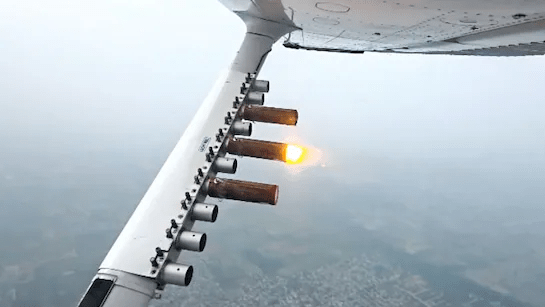
Suppressing dust particles by causing artificial rain (through cloud seeding), likewise, will have temporary effect—the dust particles will remain tethered to the earth’s surface only as long as it is wet. If by some chance, the rain is heavy, poor drainage will cause traffic snarls. In effect, we’ll rob Peter to pay Paul—if not the lungs, the roads will get clogged. Delhiites will pay for both.
Is there a way out?
Of course, there is one! It follows the principle: capture particulate matter and prevent it from getting back into circulation. It is as simple as it sounds.
This can be achieved as follows:
- Polluted air (laden with particulate matter) is directed on to moist screens, or is passed through specially designed ducts whose walls are moist.
- The wet surfaces/ ducts ‘trap’ particulate matter and let go of cleaner air—devoid of particulate matter.
- These wet surfaces and ducts are continuously cleaned by running water, or still better, water jets. The running water takes away the particulate matter with it and deposits it into a sump. Thus, the wet surface always remains clean and ready to ‘trap’ more particles.
- From the sump, the particulate matter is removed continuously by decantation/ filtration and the water is reused.
- The particulate matter thus removed is disposed of in a way that it doesn’t get into circulation again.
Using this principle, simple inexpensive static and mobile contraptions can be made to very effectively ‘capture’ particulate matter and consign them to their graves.
Yours truly, confident of the effectiveness of this method, had written to the authorities who matter. There must have been some communication gap, because the response was on these lines: “If you have a problem, please connect with the concerned department. Thank you for visiting the website.”
When I presented this idea to budding engineers (college students whom I lecture sometimes), they responded favourably and expressed their desire to take up projects on these lines. But very soon, they backed off for they had graver concerns—examinations and placement interviews.
Thus, what I thought was a cost-effective practical solution to Delhi’s woes got stored into some less frequently visited corner of my mind.
Then this childhood friend, while playing golf, rekindled the subject discussion, “It is a desperate situation now. The AQI has risen to alarming levels. It is still rising. The concern is high. Yours seems to be a workable solution. Why don’t you write to Delhi Govt?”
Going by my past experience, I was disinclined to go through the grind again. But then, the thought came to share the idea in a blogpost which passes more eyes.
So here it is.
I share this post in a hope that someone, somewhere, turns this simple idea into a real solution for Delhi’s lungs. Among the beneficiaries will be my better half and some of my dear friends who are occasionally forced to use inhalers and nebulisers for respite.
Author’s Notes: This method of removing particulate matter from the air, ‘for good‘, can be implemented in numerous and innovative ways. Before posting this article, I shared my thoughts on the subject with my BITSIAN brother, Sumit Chordia, and lo and behold, he came up with umpteen suggestions not only to trap the rogue particles flying in the air but also to check pollution at source. Likewise, I invite my readers to share what comes to mind. Eventually some idea, will work.
Comments & Feedback
- Air Commodore Meenu Vania, SC, VM: Any idea is better than no idea 🙏 In your case what you propose seems a workable solution and deserves a trial. I also have a point of view 👍I propose we tackle the known sources of air pollution ie construction activities, vehicular traffic , stubble and garbage burning , road sweeping ( actually its absence ! )and any other pollution generating activities. My point is the major sources of air pollution are not unknown. For ages its poor policy , knee jerk reactions , and an unwillingness to take some strong action that may result in political harakiri that has resulted in this pathetic state of affairs 🙏 Don’t tell me we are not aware that winter, Diwali and crop burning are a deadly cocktail. Surely if we can think of Gaganyan we can think of a solution to this problem of air pollution too 🙏
- My response: ‘Nipping it in the bud’ is THE solution. That is a gospel. Just can’t be denied.Pollution due to Deepawali & crop burning also can be brought to zero if there is a will. Education is lacking. Despite best efforts, some pollution due to construction work and vehicle use is a given. What I am suggesting (without saying it in so many words) is to fight the pollution which can’t be stopped at source despite all efforts. 🙏
- Colonel Alankar Bhardwaj: Was installed in Chandigarh. Failed and is now shut down. https://chatgpt.com/s/t_69058d278e7881919dfab9934b5b37ab

 Road Much Travelled