Passport Size Photograph

Norman Dixon’s book—ON THE PSYCHOLOGY OF MILITARY INCOMPETENCE—is a shocking and provocative treatise on the behaviour of the men in uniform. Although his nearly 450-page study—to explain how a minority of individuals come to inflict upon their fellow men depths of misery and pain virtually unknown in other walks of life—is thought-provoking, his work fringes on mocking military personnel. The fact that he talks mostly about the Royal Army is not a saving grace for the armed forces of India, Pakistan, Bangladesh, Sri Lanka and so many other Commonwealth Countries who are steeped in customs and traditions of the Raj. Thus, what he talks about the British Army, by implication, applies to the Indian Armed Forces too.

Norman Dixon’s Treatise

In the foreword to the book, Shelford Bidwell points out that the wars were not fought solely with victory as the object—victory being defined, presumably, as a net gain of benefits over costs—but for ‘glory’. To achieve ‘glory’, the war had to be conducted according to certain rules, using only certain honourable weapons and between soldiers, dressed in bizarre and often unsuitable costumes. The bayonet, the sabre and the lance were more noble than the firearm (one British cavalry regiment on being issued with carbines for the first time in the mid-nineteenth century ceremonially put the first consignment into a barrow and tipped it on the stable dung pile). The book is well punctuated with such examples. Dixon’s scholarly work is invaluable; it is well-supported by footnotes and bibliography which runs into several pages.

Needless to say, such scholarly work triggers ‘creation’ of anecdotes, which get accepted as facts in due course of time. One, whose truthfulness can’t be verified, goes like this:

At a firing demonstration of an artillery gun, two members of the fire-power display team took positions on either side of the gun. All through the exercise, they stood motionless, each with a closed fist held a little high; at the shoulder level. It was as if they were holding something. None, including the JCO, knew about the role of those two men in the firing of the gun. Research revealed that long ago, when wheeled guns used to be towed by mules and horses, two men were deputed to hold the reins of the animals when the guns boomed to prevent them going berserk. With time, the horse-drawn carts were replaced by motorised platforms. People didn’t care to reassign tasks to those two men who were no longer required.

Here is another one on the unquestioned Casabianca-like devotion and adherence to trivial orders:

A military formation in Central India had a Jawan deputed 24/7 in all weather conditions to stand guard by a bench in the Unit’s Park. None in the unit knew the purpose. During the re-union of the Unit, a retired JCO, in his late eighties solved the mystery when he asked, “Oh my God! Why do you still man that post. It was created on a temporary basis, sixty years ago, when I was a Lance Naik to prevent anyone sitting on the freshly painted bench.”

Taking cue and liberties from suchlike anecdotes, the film makers and ad agencies have created their own versions of military men. A retired Colonel or a Major being a role model; or a disciplinarian struggling to settle down in the family and society; or a comical character (butt of people’s jokes) was the theme of many a Hindi film of the last quarter of the last century. A recent ad features a burly army officer (or a band master? Mind the rank badges and the ribbons and the medals), with a gun in hand, chasing his Man Friday who is running around a table with a bowl of chholey prepared with ‘Everest Chholey Masala’.

A General Officer or a band-master?

Media does reflect reality to some extent. In real life, things are not too different.       

The other day, a freak telephonic request from a clerical staff of one of the service Headquarters made me scratch my head hard. As if that torture on my smooth hairless scalp was not enough—that transaction with the gentleman dented whatever good opinion I had of my looks. “Sir, kindly email another of your passport size photographs,” he had requested.

Just to give the readers the background, I had already sent him a photograph which was required to be printed alongside an article which I had submitted for publication in a magazine.

“What’s wrong with the one I sent earlier?” I asked him. I knew it was a sharp image and nothing could have been wrong with it. “Is there a problem in downloading it,” I queried.

“Sir, it is not passport size,” he said hesitantly. On second thoughts, I felt he was not hesitant; he actually sounded sheepish.

“But it is a digital image. You can re-size, and even crop it,” I said with the air of a person who takes pride in his computer literacy. And, why not? Long ago, I had undergone programming courses in COBOL and Visual Basic in the prestigious (then) Military College of Telecommunications Engineering (MCTE), MHOW and Air HQ Computer Centre respectively. And, I am adept at using many computer applications. That—after getting me trained in programming—the Indian Air Force never utilised my programming skills is an altogether different matter. Although, secretly and silently, I have lugged the regret of not having been able to serve alongside the top brains of the Air Force, I have always taken time to educate the less knowledgeable who came my way. I have motivated (sometimes lovingly ‘kicked’ unwilling horses) and personally taught my men how to use computers effectively.

I thought here was an opportunity to light a candle for a soul groping in the dark.

A word about the photograph which I had mailed earlier. It was the one, which Chhaya, my dear wife had clicked during the Corona Virus pandemic. I had just recovered from a long bout of Covid. In the photograph I was sporting a thick salt and pepper beard and had worn a navy-blue round-neck tee-shirt; a black felt hat and dark round-rimmed sunglasses. It had received many responses, which I thought, were compliments. “Wow! You look like a cowboy,” was one observation. “Looks of a seasoned writer…,” commented another friend. “…that countenance goes well with your forays into film-making and association with the theatre.” Those flattering remarks gave my naïve self a reason to feel elated. I began using that picture wherever I could, including, as my DP on the social media; felt great.
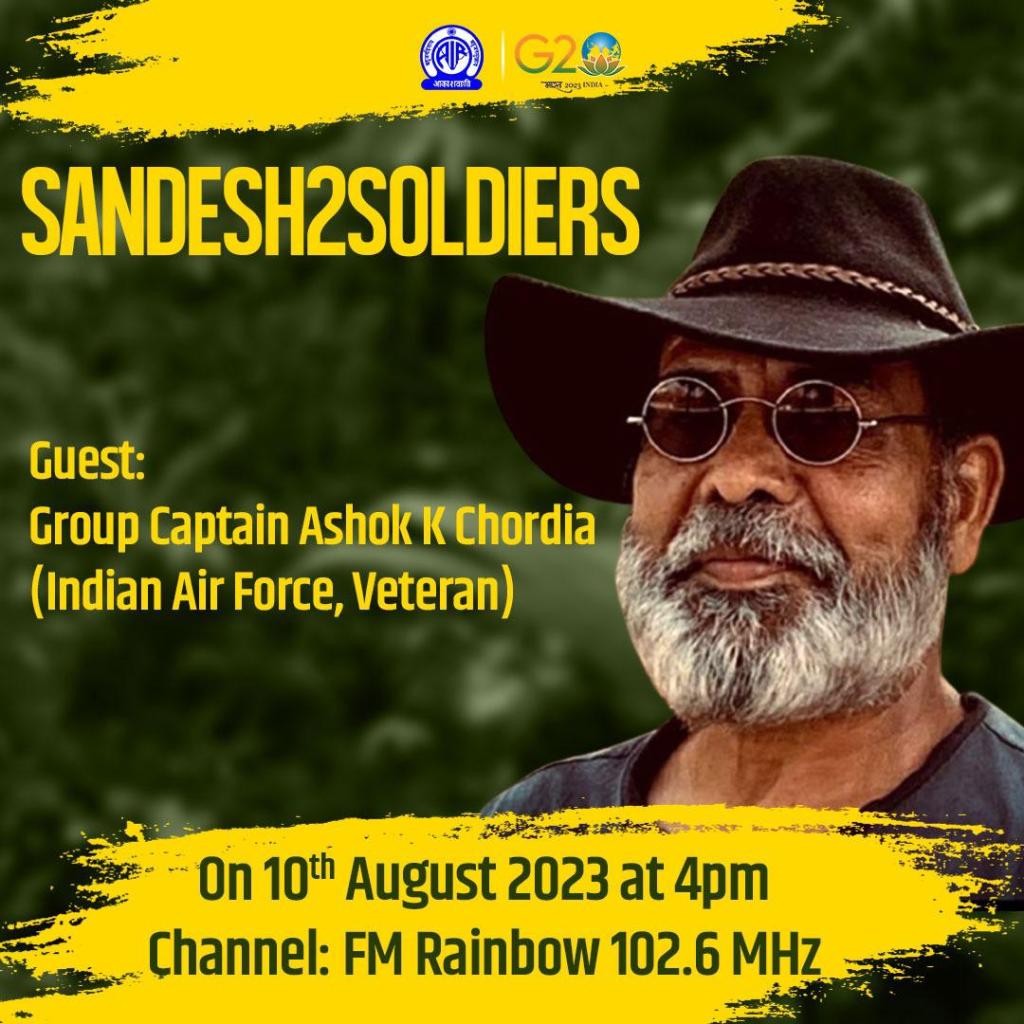
Disapproved public persona of an Air Veteran

Returning to this person who wanted me to resend a ‘passport size’ photo.

After he had repeated his demand several times, I was able to elicit the real reason for his insistence. His ‘boss’ had disapproved my ‘iconic’ photo which, I thought, represented the ‘re-attired’ public persona of an Air Veteran of my kind.

There was no point arguing with the conduit, and I did not have the will and the stamina to engage in a discussion with the concerned officer. More importantly, I don’t belong to that category of writers whose articles are in demand and can dictate terms. It is so difficult to get an article published. Withdrawing my article on this ground was out of the question. So, with feigned alacrity, I agreed to comply with the demand. Within minutes, I sent him another of my passport size photographs in which I was well shaven and dressed like ‘an officer and a gentleman’—in a black suit. No hat; no goggles!

Image of an officer and a gentleman

At the click of the ‘SEND’ button, I became acceptable. And, as a corollary, my article got the nod of approval.

The next thing I did was to dig out several of my ‘passport size photographs’ and consign them to a folder on my computer desktop. Now I have a collection—A REAL PICTURE for every requirement… tor scholarly articles; for talks to executives; for lectures to college students; to media persons; for theatre and film fraternity. I know, I am going to need them, at least until more people read Dixon.
Little Big Man

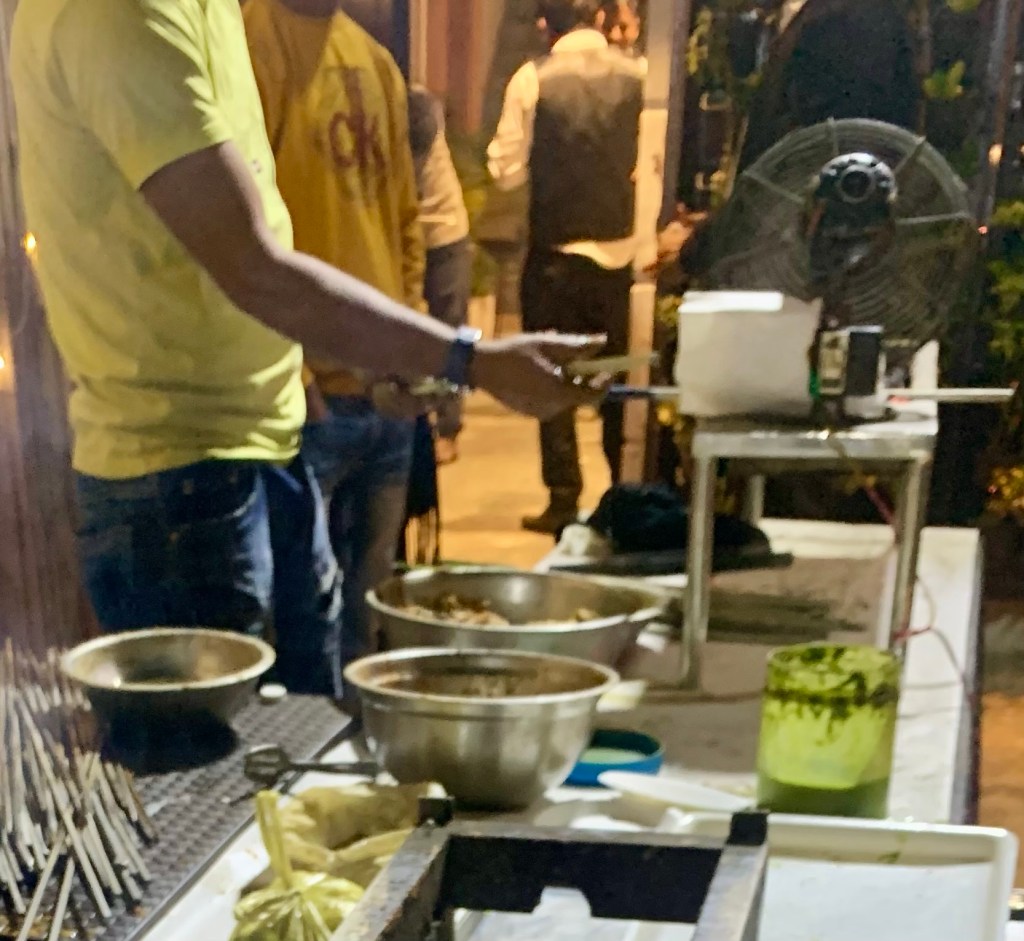
These epithets — Taangewallah, Mechanic, Masaalchi, Tailormaster, Electrician and Masterji — had one thing in common; they were invented for a single soul, Babloo. They aptly described the diverse roles the ever-so-ordinary looking short-statured man played in the lives of the citizenry of the sleepy locality of Freegunj in the holy city of Ujjain. Thus, Babloo was Babloo Taangewallah when he took people to the Mahakaleshwar Temple in his tottering tonga drawn by a skeleton of a horse he called Toofan, the tornado. The tonga didn’t belong to him; he got to use it on lease whenever it was available. He spent a good part of the pittance he earned by plying the tonga on the pitiable Toofan. He was Babloo Mechanic when he cleaned, and micro-adjusted the gaps of the spark plugs of their Lambretta and Vespa scooters and checked and topped up the radiator water, engine oil and brake fluid levels of their prized Fiat and Ambassador cars on Sunday mornings. Likewise, he was Babloo Masaalchi when he dominated their kitchens on festive occasions and on children’s birthdays. He could stitch buttons, darn clothes, repair electric irons, kerosene and gas stoves and leaking taps, not to talk of solving arithmetic problems for children. Babloo was a Jack of many trades.

Babloo Masaalchi

It is also true that people’s minutiae were his missions. He was everyone’s man Friday. People paid Babloo miserly for his services but were generous with their hand-me-downs. Babloo was genuinely grateful when children passed on broken toys and stubs of pencils to him. Less mindful of the renumeration, he took pride in whatever he did and cherished the affection that came as a bonus with those specific-to-service nicknames.

Something in Babloo likened the children and the young adults to Keshto Mukherjee, the character who had become a synonym of the drunk in Hindi cinema. They called him Babloo Afeemchi, meaning drug addict, because sometimes he gave the impression of one high on afeem (opium). Now, that was not because he was a worshipper of Lord Shiva and consumed bhang — a popular local herb which gave a temporary high — once every year on the occasion of Holi. He owed that Afeemchi image to his body language spurred by cumulative fatigue which, in turn was the result of running errands and doing things for people day in and day out. Sheer tiredness caused his spirits to droop and his eyelids to drop, and he seemed to lose partial control of his limbs. That epithet, Afeemchi, pricked him but he bore the pain with a smile. After all they were children.

Father, forgive them, for they don’t know what they are doing.”

~ Luke 23:34

Then there were those who took Babloo to be their personal servant, and treated him more like a slave. But, very few people knew, or cared, about Babloo’s own small world—a wife, Shyama and a son, Munna who had just begun going to Bal Vinay Mandir, the Government Pre-School that had the canopy of a hundred-year-old banyan tree for a roof. The discarded stationery items which Babloo received from people were Munna’s prized possessions.

Once a month, Babloo left Munna in the care of his sister in Desai Nagar, and took Shyama to the matinee show in Ashok Talkies; they both loved to watch films starring Rajesh Khanna and Mumtaz. They always went early to the cinema hall and bought tickets for the second class; and rushed in to occupy the aisle seats because Babloo didn’t like anyone sitting right next to Shyama. A plate of samosas during the interval was a given. No rain, hail or storm could stop Babloo from being there to walk Munna to the school each morning. He’d also make it a point to tell the little one a bedtime story before devoting his full attention to Shyama.  

Among the very few who understood Babloo was Dr Jai Veer Singh, the Vice Chancellor of Vikram University. The man of letters was better known by his pen name ‘Snehi.’ They called him, ‘Snehiji’ out of respect which he had earned as much through compassionate social work as through his scholarly achievements. Greeting him with joined hands or, more appropriately, touching his feet, was a reflex action of people when they met him. It was on his insistence that people allowed Babloo four days’ leave every month end—none questioned it. It was believed that it was to visit his old parents in Maksi, a small town not far from Ujjain. A conscientious Babloo always re-joined duty punctually. As a matter of an unwritten rule, he was never late.

Last monthend when he returned from leave, his face was bruised; there was a deep laceration on his upper lip and a dark blue patch under his right eye — the tell-tale signs of a brawl.

It was 6 am; Snehiji was drinking his tea sitting in a cane chair on the veranda of P-21 Kothi Road, the sprawling bungalow earmarked for the Vice Chancellor. He had already turned the pages of two of the three dailies kept on the glass top of the round coffee table in front of him. He preferred to read Nai Duniya last. It was the City Edition of the Hindi newspaper, and contained the local news. He read every word of it. That habit gave him an edge in his discussions with his bureaucrat friends over drinks in Madhav Club every evening.

Babloo tiptoed past him. But the old man caught sight of him when he lifted his head momentarily to take a sip of the well brewed Green Label tea.

“Why, what happened Babloo? How did you get those wounds?”

“I fell down, Sir” Babloo mumbled and continued with a sense of urgency.

“I hope you are fine?” Snehiji genuine concern was laced with doubt. “How can a fall result in those injuries to the face?” he wondered. He resumed where he had left — the City Highlights page. Something caught his attention. He re-read it several times with utter disbelief.

Moments after Babloo returned with the old man’s brogues and penny loafers, and the paraphernalia to polish them, the old man hailed him. “Come here!” His voice was unusually harsh, “What’s this?” He slammed the half-folded newspaper on the table and pointed at a news item for Babloo to read. The headline read:

“Domestic help arrested for theft.”

Babloo read the news:

“Freegunj. January 29. Ramdeen alias Babloo, a domestic help working in several houses in Freegunj was found stealing grocery items at Maganiram Muralidhar Grocery Store. The man was beaten up by the salespersons before the local police took charge of him. The man pleaded that he was innocent. He said he was only carrying the grocery for one Mr Shiv Dayal who had forgotten to make the payment. Mr Shiv Dayal couldn’t be contacted to clarify. One of the customers said that, “Babloo Chor (Babloo the thief) had a history; he’d been seen in the Madhav Nagar Police lock up on several occasions.” Our correspondent has reported that there has been a spurt in cases of thefts in East Ujjain. People have been warned to be watchful.”

“So, you have another trait and a name… Babloo Chor,” Snehiji looked at Babloo, “How could you do that?  You have betrayed my trust.”

Babloo stood still like a statue; he stared down at the flooring and kept clasping and unclasping his hands behind his back. The toe of his bare right foot tried in vain to inveigle into a hole in the old carpet. He didn’t wince once but bit his lower lip several times when a tear rolled down his cheek and wet a bruise. The pain caused by the salty tear smearing his wounds was far less than that caused by the feeling of loss of face.    

“Go away… I don’t want to see you,” Snehiji couldn’t believe that he had, for once, failed in his judgement of a person.

***

Babloo Chor, and the spurt in thefts in Freegunj, dominated conversation at Madhav Club that evening.

“We have relieved Babloo of all duties. I have told my wife, not to let him into our house ever again,” said Dr Sanjay Mangeshkar.

“It is so difficult to find reliable domestic help these days,” rued Mahesh Verma of Verma Constructions.

“Poverty is a sin. I don’t think we must expect loyalty and integrity from people who toil on empty stomachs. We have been paying so little to Babloo. I am not so surprised by his actions. Anyone would do that.” The owner-editor of Dainik Awantika differed.

“But a theft is a theft is a theft is a theft. I don’t think it must be condoned,” opined Mr Qarim Qasimbhoy who owned a chain of stationery shops in Indore and Ujjain. “He is lucky. In Saudi, they would have chopped his hands.”

On the whole the house was divided, nay confused, on the subject of treatment meted out to the ‘Babloos’ of the society. It was one of those rare occasions when Snehiji didn’t air an opinion. Babloo’s demeanour when he left his bungalow that morning had left many questions in the poet scholar’s mind. He had registered the turmoil brewing within Babloo as was evident in his silence. “I couldn’t have been so grossly wrong in understanding the individual in Babloo,” he ruminated as he travelled homeward in his chauffeur-driven Ambassador.

His train of thoughts was interrupted by his driver, Satish: “Sir, Babloo Mechanic has done a wonderful job. The engine isn’t knocking anymore. Todarmal Auto Garage people could not place their finger on the problem in a fortnight,” he said.

Babloo didn’t turn up for work the next morning. The first thing Snehiji did after reaching his office was to call the SHO of Madhav Nagar Police Station.

“Please tell me something about Babloo who was caught for shoplifting at Magani Ram Murlidhar Grocery Store the day before yesterday,” he requested the Police Officer.

“You mean, Babloo Mechanic, alias Babloo Taangwallah,… alias Babloo Masaalchi, Sir?” he chuckled.

“Yes, Babloo Mechanic. He works for me and several others in Freegunj,” Snehiji was serious, business-like.

“Sir, he is a vagabond. But he has an absolutely clean record… not a single black mark.”

“Then, why did you put him in the lock up?”

“Sir. actually, we didn’t intern him… it’s a long story… Babloo was caught for a suspected petty theft more than a year ago. It was proved beyond any doubt that he had not committed that theft. But before his release from our lock up three days later, he had repaired some of our corridor lights and an alarm bell and a leaking tap. Besides, he did a lot of other repair work for individuals; including repairing an electric iron for me. All our people were happy with him. We made it a point to show ‘official’ prison work against his name which earned him a decent amount as a skilled labourer. He was happy and took a cake for his son for his birthday when we released him.”

Snehiji listened intently.

“With mutual understanding, it became a routine. Every monthend, we have been rounding him up for four days on flimsy grounds. During his stay with us, we get our work done from him and make sure that he is compensated handsomely. He even teaches the other inmates. He feels indebted because he gets food and is able to earn enough to buy eatables and toys for his son… it is a symbiotic relationship. The other day, things went out of hand. He was beaten up before we could reach the grocery store and intervene.”

Minutes later, Snehiji’s office car was on its way to fetch Babloo.

“Why didn’t you tell me about your deal with the cops?” said Dr Snehi pretending to be annoyed.

“I thought you’d be offended. Who’d give work to someone who had been in police custody? And, I was in dire need of money to buy things for Munna.”

“But now… look at what you have done… people are calling you Babloo Chor. They have decided to not to give you any work. And, how will you face your son for whom you have been slogging? Don’t worry,” added Dr Snehi soothingly as he held his forearm reassuringly, “I’ll set matters right.”

Babloo stood in wonderment. There was a long pause before Snehiji resumed.

“I have a deal for you. Dataram, my driver is quitting the job. He is off to Bhopal to join his brother. I need another driver. I want you to take his place on permanent basis. I’ll get Munna admitted to a better school and pay for his schooling—his tuition fees, his books and his school uniform. You can move into our servant’s quarter by this weekend.”

Epilogue

A day, not too far in the future, Babloo stopped the car in front of Magani Ram Murlidhar General Store. Snehiji had asked him to get the car refuelled and to buy a packet of Green Label Tea on his way back. Munna was sitting by his side. Dr Shehi had permitted Babloo to take Munna around in the car once in a while. The salesperson, oblivious of who was sitting in the car, came out running, saluted mechanically and enquired, “What can I get for you, Sir?” He was shocked to see Babloo in place of Snehiji in the car. It was too late to bring down the hand raised in salute to the man he had beaten the other day. Munna looked from the salesperson to Babloo, to salesperson to Babloo again. He was mighty thrilled about the new status earned by his father.

Acknowledgement

My special thanks to Air Vice Marshal Sudhanshu Rath for sowing the seed of this story in my mind.

Mission First

The exhilarating feeling is irresistible. A jumper would go as far as one can to satiate the desire to skydive. The Parachute Jump Instructors (PJIs) of the Paratroopers Training School (PTS), Agra are no exception. Drop a pin anywhere on the map of India and in a radius of fifty miles of the pin there will be a place where Akashganga, the Skydiving Team of the Indian Air Force (IAF) would have carried out a skydiving demonstration as a part of a major national event or a military tattoo. If not a demonstration, it would be a paradrop as a part of an airborne military training exercise.

Thanks to my tenures of duty as a PJI, I have been a part of many such displays. From the identification, reconnaissance and exploration of new Drop Zones in the freezing cold Leh-Ladakh region and trial jumps on those Drop Zones, to the exit over the Indian Ocean to land on a target in Thiruvananthapuram, each jump I undertook was different from the other and memorable in a unique way. When I look back, some stand out. An interesting one that often returns to the mind is the one performed as a part of the raising day celebrations of the President’s Bodyguards in November 1998.

High Altitude Jump Trials

I was then the Assistant Director of Operations (Para) at the Air Headquarters.

It was a Herculean task to get the requisite permissions and clearances for the demonstration at the Jaipur Polo Ground. With the who’s who of Indian leadership residing in Lutyens’ Delhi, security was a big concern. Jaipur Polo Ground was not far from the Prime Minister’s Residence. “It would be imprudent to allow such ‘frivolous’ activity in this area,” was an opinion. Then there was the issue of availability of airspace in the proximity of the busy Indira Gandhi International Airport where an aircraft takes off or lands almost every minute and dozens guzzle fuel as they await their turns on the ground or orbit in the nearby sectors. For many well-meaning people, disrupting the air traffic for a skydiving demonstration was an avoidable proposition. An easy way out for those in authority was to say: “NO.”

Notwithstanding what was happening on the files between the Air Headquarters, the Army Headquarters and the South Block in Delhi, the jumpers were agog, drooling. They were excitedly looking forward to the opportunity to jump at the prestigious event to be witnessed by the Supreme Commander of the Indian Armed Forces. Shri KR Narayanan was the then Honourable President of India.

How the permission to undertake the skydiving demonstration came about is the subject matter of another story. Suffice it to say that it did come—somehow. There were caveats, though. We were directed to operate from Air Force Station, Hindan. A team of security experts would sanitise our aircraft and inspect the parachutes for hazardous materials. We were told that they might frisk the jumpers too. Being personally searched was an irksome idea which we brushed aside in service interest.  Although the permission had been granted, we were also to await a last-minute clearance from Palam Air Traffic Control (ATC) before take-off. After getting airborne we were to follow a given corridor; report at check points and proceed only on further clearances.  The helicopter was permitted a maximum of 21 minutes over the Polo Ground to disgorge the jumpers and clear the area. Would the conscientious security apparatus be obliged to consider the aircraft ‘hostile’ if it strayed from the assigned route, or overstayed its allotted time over the Drop Zone (the Jaipur Polo Ground)? May be. May be not. To us, it mattered little as long as we could jump.

On the D-Day, the team led by Squadron Leader Sanjay Thapar, the then Chief Instructor PTS, arrived from Agra. Group Captain TK Rath, (the Director, Air Force Adventure Foundation), Squadron Leaders HN Bhagwat and RC Tripathi (both of the AF Adventure Foundation), and I joined them at Hindan. We inspected and lined up our parachutes and jump equipment and dispersed, since enough cushion time had been catered for, to account for unforeseen changes in programme. We all had our ways of passing the time available before take-off. Most sat quietly with fingers crossed hoping and praying for the drop to go through, because such VVIP programmes are prone to last minute hiccups. Group Captain Rath immersed himself in a book which he always carried in his overall pocket. He took a break in between to do a headstand. It was his way of attaining peace and calm. Thapar was engaged in communicating with Palam and the controller at the Polo Ground for the updates.

It was “OPS NORMAL!”

Minutes into the break the peace of sorts that prevailed on the tarmac was shattered by a commotion. The Security Team—in civilian clothing—after sanitising the aircraft had started overturning our lined-up parachutes to inspect them. They were alarmed to see sharp knives attached to the straps and had started taking them away.

Squadron Leader Tripathi saw them and literally pounced on them, “What are you doing?” he shouted.

“We are doing our duty… securing and sanitising everything. You can’t jump with these knives.” Their leader said with authority.

“But these knives are our lifeline… we need them in case we have to snap some parachute rigging lines in an emergency.”     

“We can’t help it… sharp objects around a VVIP are a taboo,” he drew a line.

Tripathi wasn’t the one to give in easily. He sparred on, “Well, now you have physically handled our parachutes without our knowledge. We don’t know if they have been rendered unfit for use. And, you are not allowing us to carry our survival knives, which is a must for us.” He let that sink in, and then came with the final punch, “Under the circumstances, it will not be possible for the team to jump. Please inform the guys at the other end that the demonstration jump is being called off for these very reasons.”

There was stunned silence before the leader spoke, “We understand your requirements. But you cannot cancel a programme meant for a VVIP and blame it on us. We are all men in uniform. We must find a way out.”

After a little ado, we were permitted to carry our jump knives.

The wait thereafter was long. Panic set in when the clock struck four. It was our scheduled time of take-off. There was no clearance yet. The Honourable President would arrive at 5:00 pm as per programme. In an extreme situation, just in case the Skydiving Demonstration couldn’t be undertaken for any reasons, the Military Band present at the Polo Ground would play martial tunes to entertain the audience. None was interested in that Plan-B; every stake-holder wanted the jump to go through.

In those moments of uncertainty, a deliberate decision was taken to get airborne and hold position over the dumbbell at Hindan airfield so that no time was wasted if and when a go-ahead message was received. So, still on tenterhooks, we strapped our parachutes and boarded the helicopter.

The clearance came 15 minutes too late; we’d now be cutting fine. Our helicopter was asked to hold position over the Yamuna bridge and wait for the final clearance. Time was running out. November smog had begun causing concern. But Thapar, who was born and brought up in Delhi was not deterred by the falling visibility; he knew the ground features by heart. He could manoeuvre blindfolded.

When the final clearance came, there was just enough time to make one pass over the Polo Ground. Under normal circumstances, the aircraft makes three passes over the Drop Zone—one, for the pilot and the Skydiving Team Leader to familiarise with the target on the ground and ascertain the line of run. The other two passes, are to drop jumpers in batches of six to eight each.

A confident Thapar took the decision to do away with the first two passes over the spectators. He briefed the jumpers in the aircraft that all of them—more than a dozen—would exit the aircraft in one go. He re-assigned the parachute opening heights to each jumper and stressed the need to stick to it else there would be many jumpers approaching the landing area together resulting in a melee; maybe collisions.

Good things don’t come easy!

At 5:00 pm, when the helicopter came overhead, the Drop Zone Safety Officer informed that the President had not arrived. “Please hold on!” he advised.

Three minutes later, the Air Traffic Controller from Palam Airport instructed our helicopter to clear the area instantly; international flights were getting inconvenienced. It was when the captain of the aircraft was contemplating abandoning the mission that Thapar leaned out of the aircraft and spotted the President’s motorcade. It would still take a couple of minutes to reach the spectator stands. When he turned back, he had taken the decision.

“Go!” he commanded the line of jumpers awaiting his instructions. Within seconds all the jumpers were out of the helicopter.

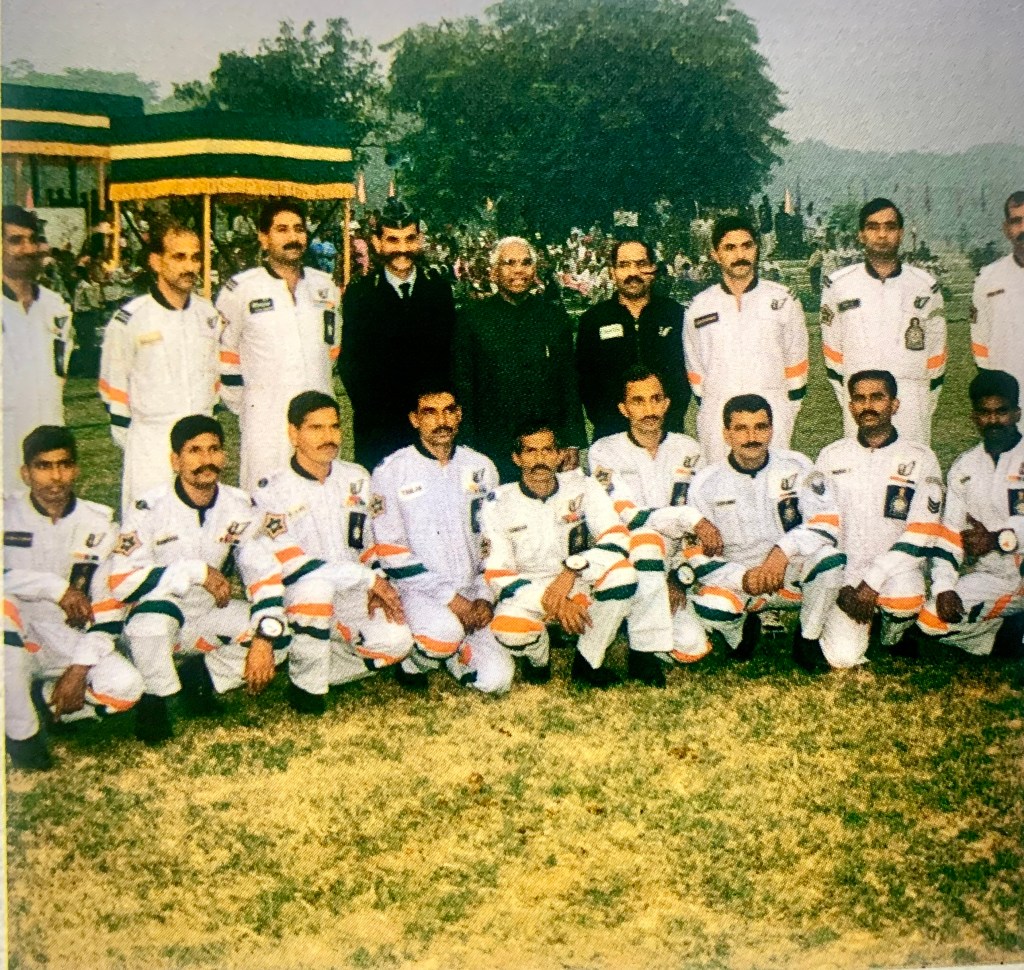
With the Supreme Commander

The pilots racing back to Hindan airfield saw the colourful parachute canopies adorning the sky over Lutyens’ Delhi. The Honourable President’s motorcade just moved into the Ground as the skydivers began landing one by one. It turned out to be a bit comical when the jumpers responded to the tune of the National Anthem and stood to attention on touchdown.

Cancellation of a para drop is one of the worst possibilities faced by a Parachute Jump Instructor.